
WEEK 5 n What is Urban Political Economy
WEEK 5: n. What is Urban Political Economy Approach? It emerges as a critique to both mainstream economics and the urban social ecology approach that we learned about last week…
n The basic premise of urban political economy approach is that the growth and development and the decline and the fall of cities do not occur simply by chance. Social, economic and political factors play a key role and the city must be understood within the context of social structural and processes of change that benefit some at the expense of others > Conflict perspective
n The model is based on a Marxian orientation. Karl Marx, while never developing a theory of urbanism, applied his perspective to the city by observing that it was the site for workplace struggles of class conflict and capital accumulation.
n The model emphasizes the importance of uneven development in urban processes: In metropolitan regions, the variation in the affluence of particular places is called uneven development. People with money seek to invest in places and enterprises that will bring them the highest rates of return. But this profit making is usually expected to occur in a short time period and with the largest return possible. >>> Consequently, investors look at the opportunities carefully and will always try to switch to places where money will achieve its greatest return.
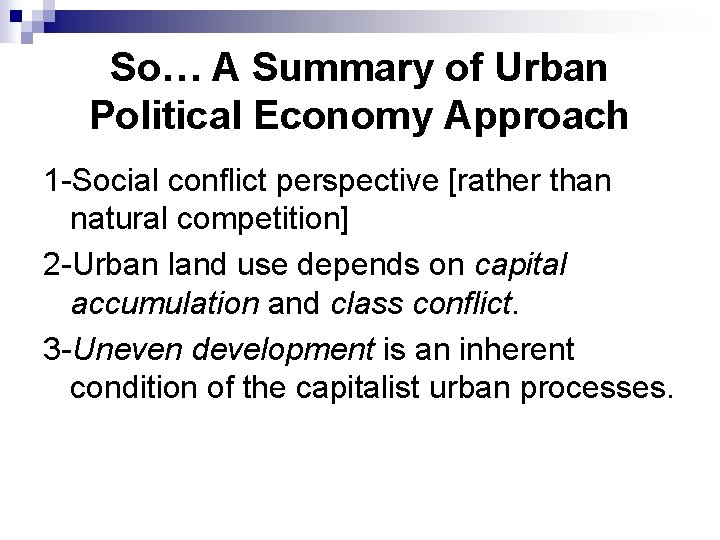
So… A Summary of Urban Political Economy Approach 1 -Social conflict perspective [rather than natural competition] 2 -Urban land use depends on capital accumulation and class conflict. 3 -Uneven development is an inherent condition of the capitalist urban processes.

David Harvey The Urban Process under Capitalism 1) 2) City = a built environment that encompasses a series of capital accumulation at different scales Conflicting economic and social interests between capitalist and working classes are part of urban life

David Harvey The Urban Process under Capitalism 3) The capitalist class requires government to intervene and help the profit making process within the cities. 4) Urban processes depend on the logic of Circuits of capital
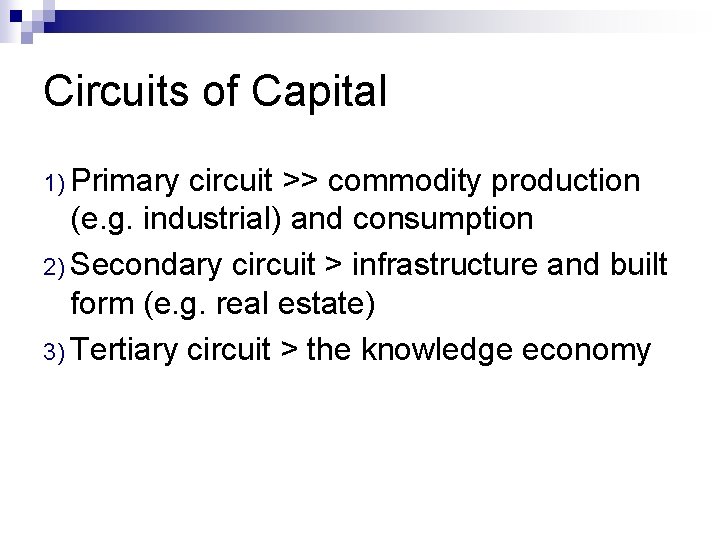
Circuits of Capital 1) Primary circuit >> commodity production (e. g. industrial) and consumption 2) Secondary circuit > infrastructure and built form (e. g. real estate) 3) Tertiary circuit > the knowledge economy
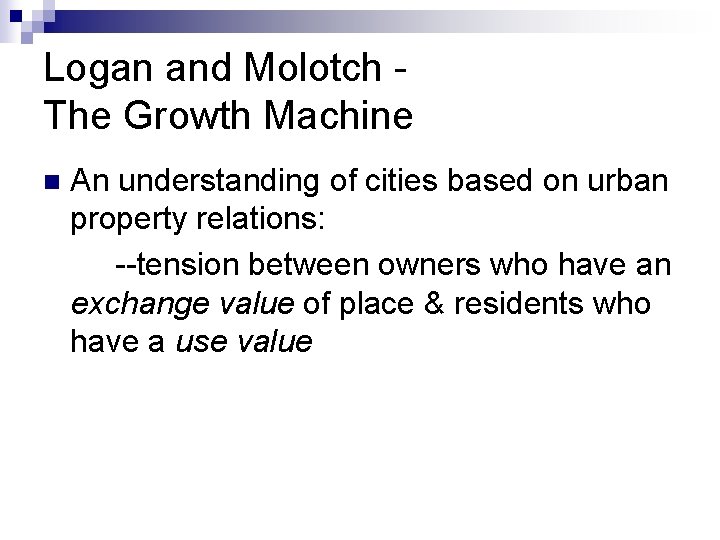
Logan and Molotch The Growth Machine n An understanding of cities based on urban property relations: --tension between owners who have an exchange value of place & residents who have a use value
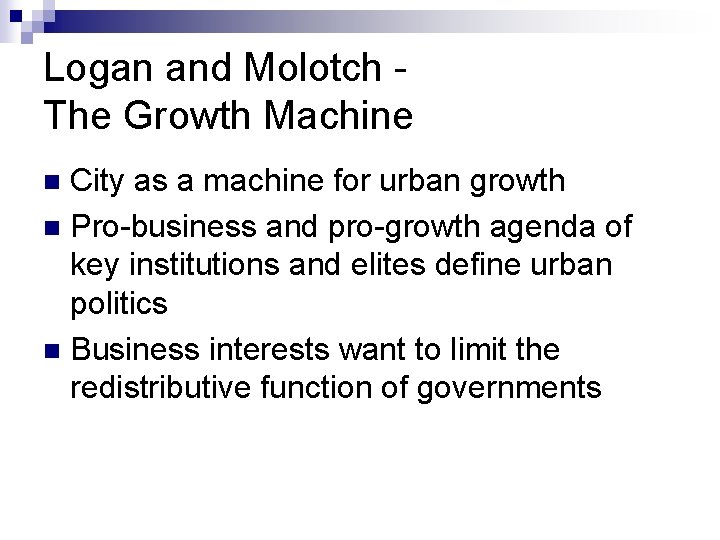
Logan and Molotch The Growth Machine City as a machine for urban growth n Pro-business and pro-growth agenda of key institutions and elites define urban politics n Business interests want to limit the redistributive function of governments n
Discussion Questions – Week 5 What causes uneven development to occur within a metropolitan region? What are the effects of uneven development on urban growth? What are some of the examples of uneven development that you can see within New York City or the other metropolitan regions where you currently live? Discuss these questions in two paragraphs using Harvey’s and Logan &Molotch’s articles.
- Slides: 11