
Week 4 Year 3 Character description This week







- Slides: 19
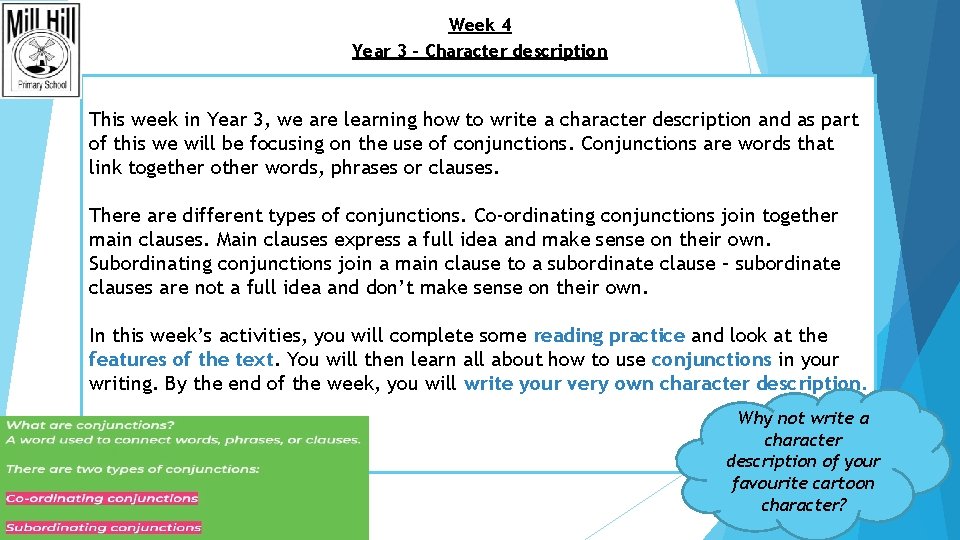
Week 4 Year 3 – Character description This week in Year 3, we are learning how to write a character description and as part of this we will be focusing on the use of conjunctions. Conjunctions are words that link together other words, phrases or clauses. There are different types of conjunctions. Co-ordinating conjunctions join together main clauses. Main clauses express a full idea and make sense on their own. Subordinating conjunctions join a main clause to a subordinate clause – subordinate clauses are not a full idea and don’t make sense on their own. In this week’s activities, you will complete some reading practice and look at the features of the text. You will then learn all about how to use conjunctions in your writing. By the end of the week, you will write your very own character description. Why not write a character description of your favourite cartoon character?
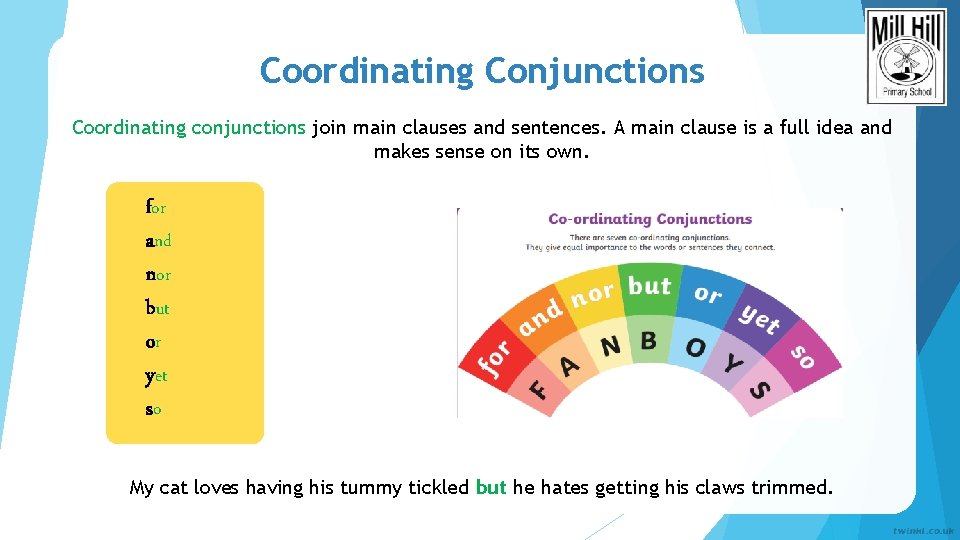
Coordinating Conjunctions Coordinating conjunctions join main clauses and sentences. A main clause is a full idea and makes sense on its own. for and nor but or yet so My cat loves having his tummy tickled but he hates getting his claws trimmed.
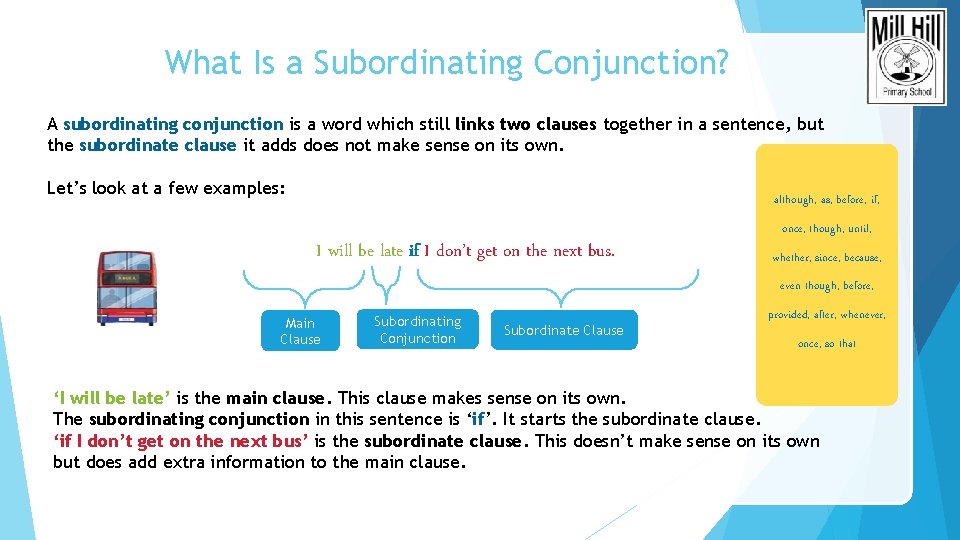
What Is a Subordinating Conjunction? A subordinating conjunction is a word which still links two clauses together in a sentence, but the subordinate clause it adds does not make sense on its own. Let’s look at a few examples: although, as, before, if, I will be late if I don’t get on the next bus. once, though, until, whether, since, because, even though, before, Main Clause Subordinating Conjunction Subordinate Clause provided, after, whenever, once, so that ‘I will be late’ is the main clause. This clause makes sense on its own. The subordinating conjunction in this sentence is ‘if’. It starts the subordinate clause. ‘if I don’t get on the next bus’ is the subordinate clause. This doesn’t make sense on its own but does add extra information to the main clause.
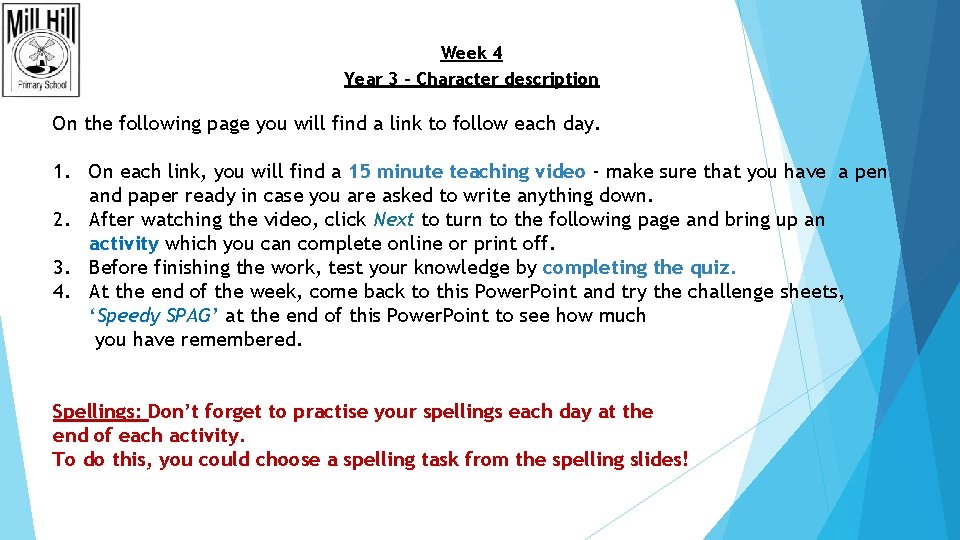
Week 4 Year 3 – Character description On the following page you will find a link to follow each day. 1. On each link, you will find a 15 minute teaching video - make sure that you have a pen and paper ready in case you are asked to write anything down. 2. After watching the video, click Next to turn to the following page and bring up an activity which you can complete online or print off. 3. Before finishing the work, test your knowledge by completing the quiz. 4. At the end of the week, come back to this Power. Point and try the challenge sheets, ‘Speedy SPAG’ at the end of this Power. Point to see how much you have remembered. Spellings: Don’t forget to practise your spellings each day at the end of each activity. To do this, you could choose a spelling task from the spelling slides!
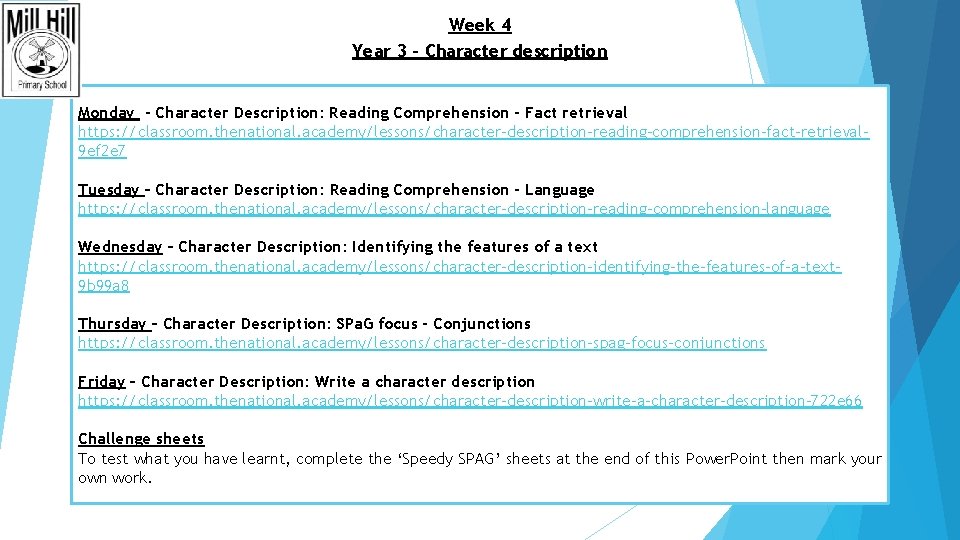
Week 4 Year 3 – Character description Monday - Character Description: Reading Comprehension - Fact retrieval https: //classroom. thenational. academy/lessons/character-description-reading-comprehension-fact-retrieval 9 ef 2 e 7 Tuesday – Character Description: Reading Comprehension - Language https: //classroom. thenational. academy/lessons/character-description-reading-comprehension-language Wednesday – Character Description: Identifying the features of a text https: //classroom. thenational. academy/lessons/character-description-identifying-the-features-of-a-text 9 b 99 a 8 Thursday – Character Description: SPa. G focus - Conjunctions https: //classroom. thenational. academy/lessons/character-description-spag-focus-conjunctions Friday – Character Description: Write a character description https: //classroom. thenational. academy/lessons/character-description-write-a-character-description-722 e 66 Challenge sheets To test what you have learnt, complete the ‘Speedy SPAG’ sheets at the end of this Power. Point then mark your own work.
Spellings Why not try one of the spelling tasks on the next page to help you learn your spellings?
Spelling activities Definitions Use a paper or online dictionary to find out the meaning of each of your spelling words – can you write your own definition in your own words to explain what it means ? Sentences Write a sentence for each of your spellings. Challenge: Can you include this week’s SPAG focus in one of your sentences?
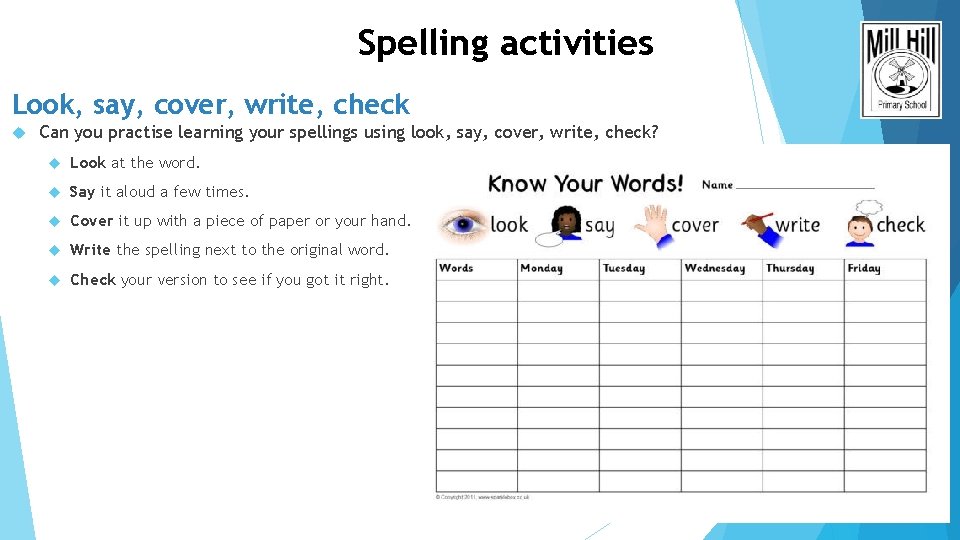
Spelling activities Look, say, cover, write, check Can you practise learning your spellings using look, say, cover, write, check? Look at the word. Say it aloud a few times. Cover it up with a piece of paper or your hand. Write the spelling next to the original word. Check your version to see if you got it right.
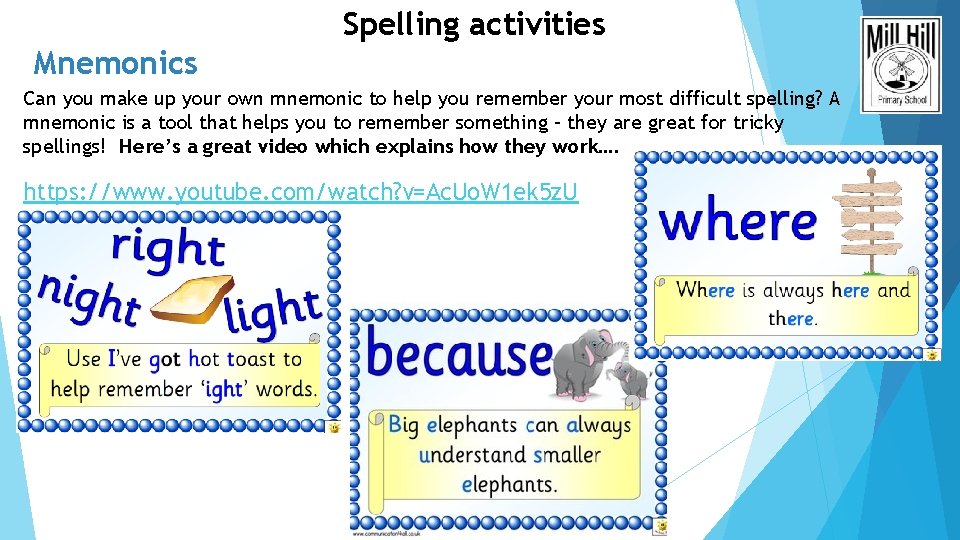
Spelling activities Mnemonics Can you make up your own mnemonic to help you remember your most difficult spelling? A mnemonic is a tool that helps you to remember something – they are great for tricky spellings! Here’s a great video which explains how they work…. https: //www. youtube. com/watch? v=Ac. Uo. W 1 ek 5 z. U
Spelling Pyramid Spelling activities Use this template (or create your own on paper) and order your spellings from easiest to hardest. Write the easiest spelling at the top and the hardest at the bottom, you will need to write each word several times to fill the entire line.
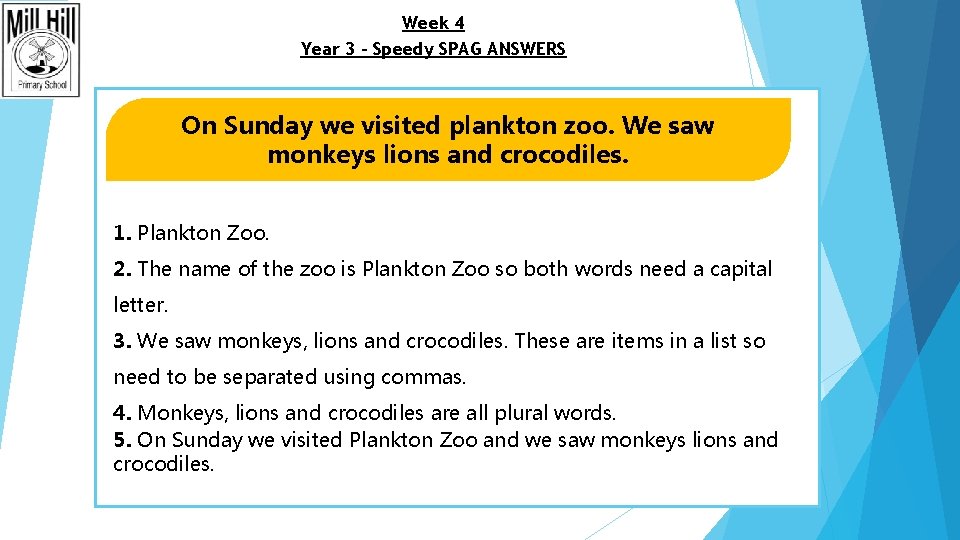
Week 4 Year 3 – Speedy SPAG On Sunday we visited plankton zoo. We saw monkeys lions and crocodiles. 1. Add the missing capital letters. 2. Explain why it needs a capital letter. 3. Add a missing comma. 4. Identify the plural words. 5. Join the two sentences together with a conjunction. A plural word is used when we have more than one of something.
Week 4 Year 3 – Speedy SPAG Click onto the next page for the answers!
Week 4 Year 3 – Speedy SPAG ANSWERS On Sunday we visited plankton zoo. We saw monkeys lions and crocodiles. 1. Plankton Zoo. 2. The name of the zoo is Plankton Zoo so both words need a capital letter. 3. We saw monkeys, lions and crocodiles. These are items in a list so need to be separated using commas. 4. Monkeys, lions and crocodiles are all plural words. 5. On Sunday we visited Plankton Zoo and we saw monkeys lions and crocodiles.
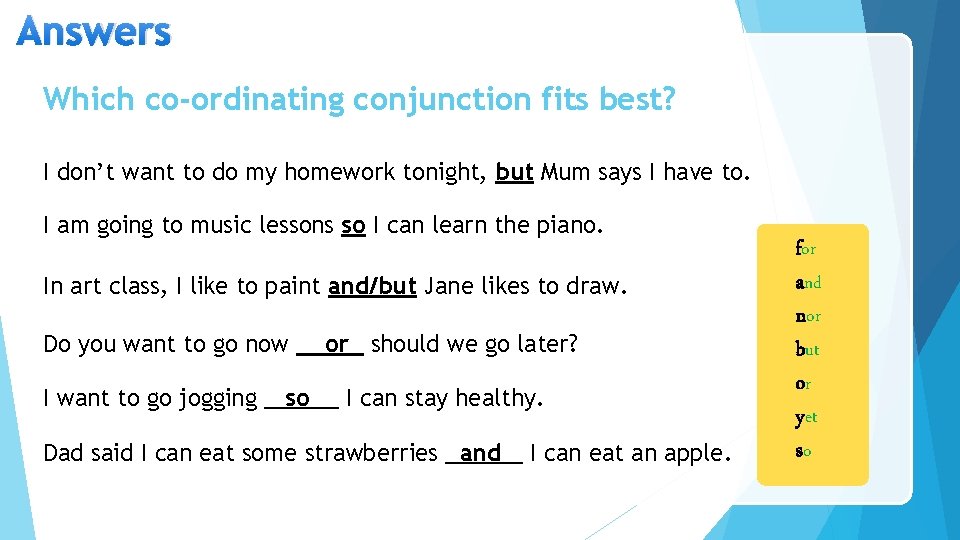
Which co-ordinating conjunction fits best? I don’t want to do my homework tonight, I am going to music lessons In art class, I like to paint Do you want to go now I want to go jogging Mum says I have to. I can learn the piano. Jane likes to draw. should we go later? I can stay healthy. Dad said I can eat some strawberries I can eat an apple. for and nor but or yet so
Answers Which co-ordinating conjunction fits best? I don’t want to do my homework tonight, but Mum says I have to. I am going to music lessons so I can learn the piano. In art class, I like to paint and/but Jane likes to draw. Do you want to go now I want to go jogging so or should we go later? I can stay healthy. Dad said I can eat some strawberries and I can eat an apple. for and nor but or yet so
Which subordinating conjunction makes sense? Read the main and subordinate clauses below and decide which subordinating conjunction would make the most sense. Beth was a little bit scared Hazim cheered loudly his favourite player scored a goal. I didn’t go to school If Since As the ride was spinning quickly. it was closed for the summer holidays. When Although While Until Because After Before
Answers Which subordinating conjunction makes sense? Did you manage to choose a subordinating conjunction which makes sense in the sentence? Beth was a little bit scared as the ride was spinning quickly. In this sentence, the conjunctions ‘because’, ‘when’ and ‘while’ also make sense. Hazim cheered loudly when his favourite player scored a goal. In this sentence, the conjunctions ‘because’, ‘as’, ‘while’ and ‘after’ also make sense. I didn’t go to school while it was closed for the summer holidays. In this sentence, the conjunctions ‘because’, ‘since’, ‘as’ and ‘when’ also make sense.
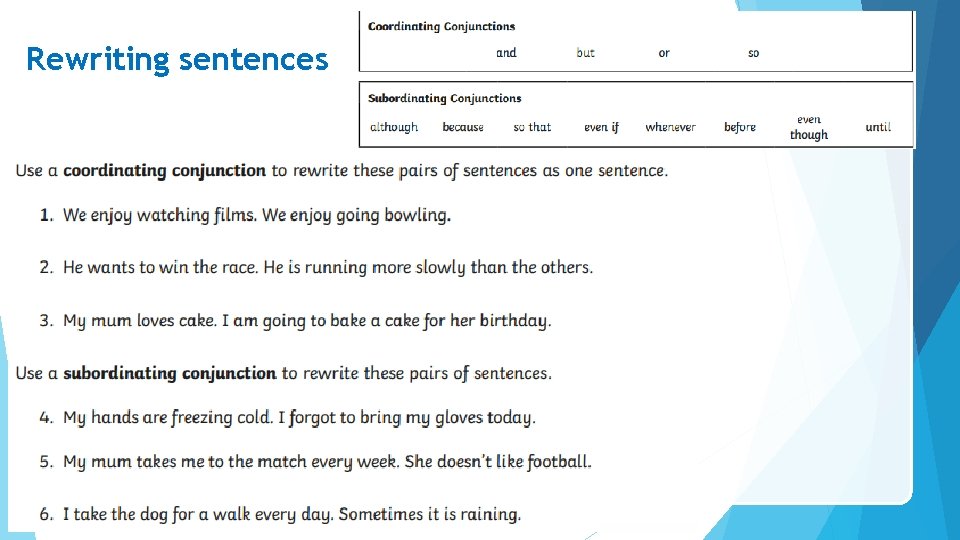
Rewriting sentences
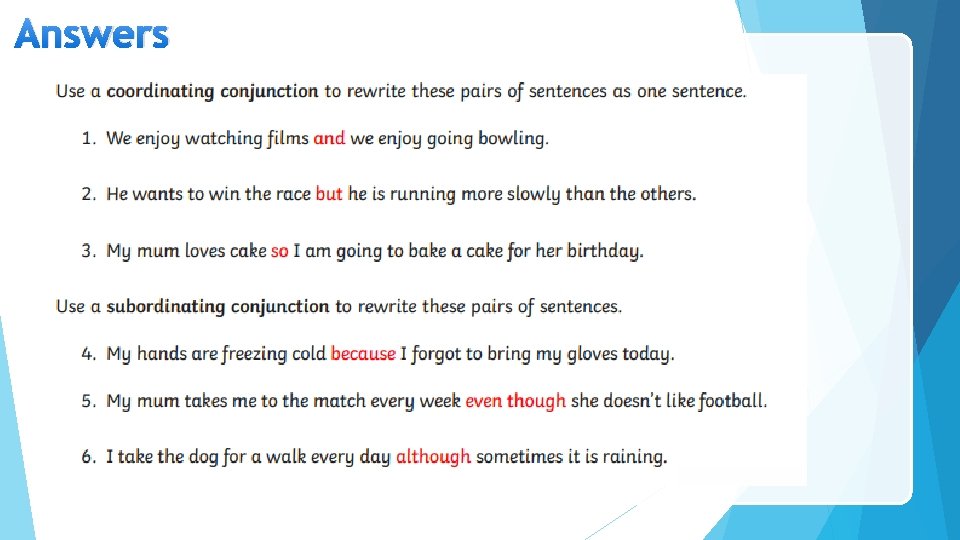
Answers