
Week 4 Reactions of Elements Group 1 metals
- Slides: 5
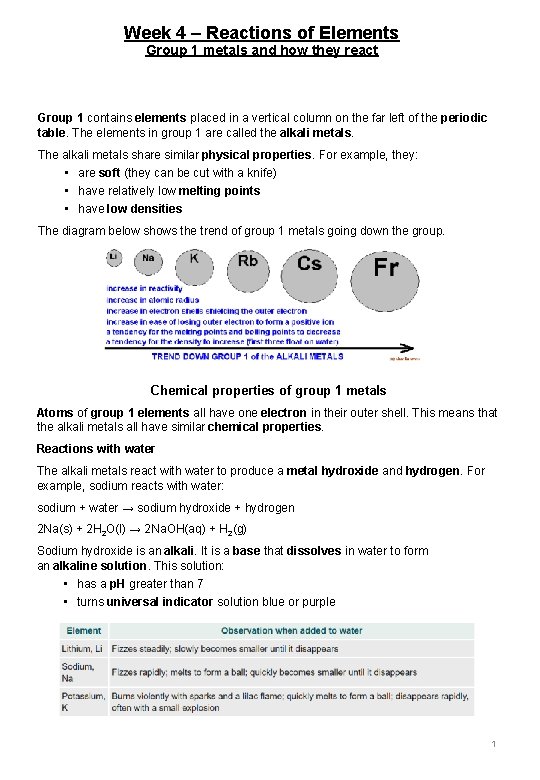
Week 4 – Reactions of Elements Group 1 metals and how they react Group 1 contains elements placed in a vertical column on the far left of the periodic table. The elements in group 1 are called the alkali metals. The alkali metals share similar physical properties. For example, they: • are soft (they can be cut with a knife) • have relatively low melting points • have low densities The diagram below shows the trend of group 1 metals going down the group. Chemical properties of group 1 metals Atoms of group 1 elements all have one electron in their outer shell. This means that the alkali metals all have similar chemical properties. Reactions with water The alkali metals react with water to produce a metal hydroxide and hydrogen. For example, sodium reacts with water: sodium + water → sodium hydroxide + hydrogen 2 Na(s) + 2 H 2 O(l) → 2 Na. OH(aq) + H 2(g) Sodium hydroxide is an alkali. It is a base that dissolves in water to form an alkaline solution. This solution: • has a p. H greater than 7 • turns universal indicator solution blue or purple 1
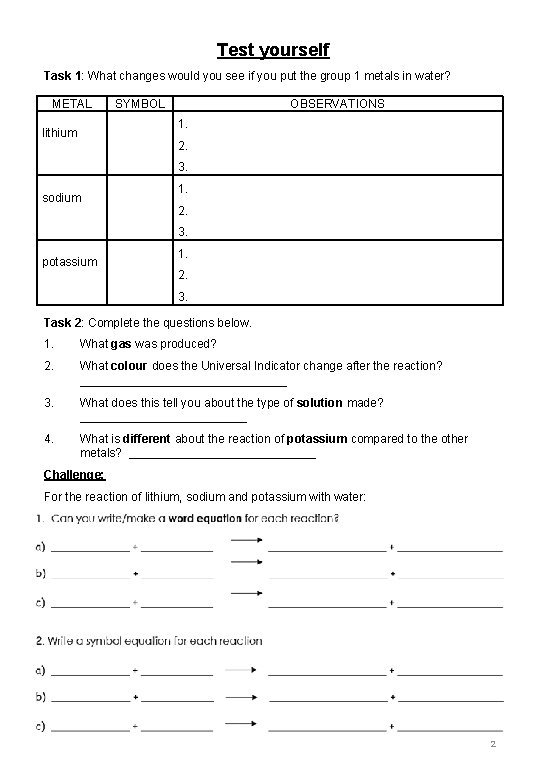
Test yourself Task 1: What changes would you see if you put the group 1 metals in water? METAL SYMBOL OBSERVATIONS 1. lithium 2. 3. sodium 1. 2. 3. potassium 1. 2. 3. Task 2: Complete the questions below. 1. What gas was produced? 2. What colour does the Universal Indicator change after the reaction? ________________ 3. What does this tell you about the type of solution made? _____________ 4. What is different about the reaction of potassium compared to the other metals? ______________ Challenge: For the reaction of lithium, sodium and potassium with water: 2
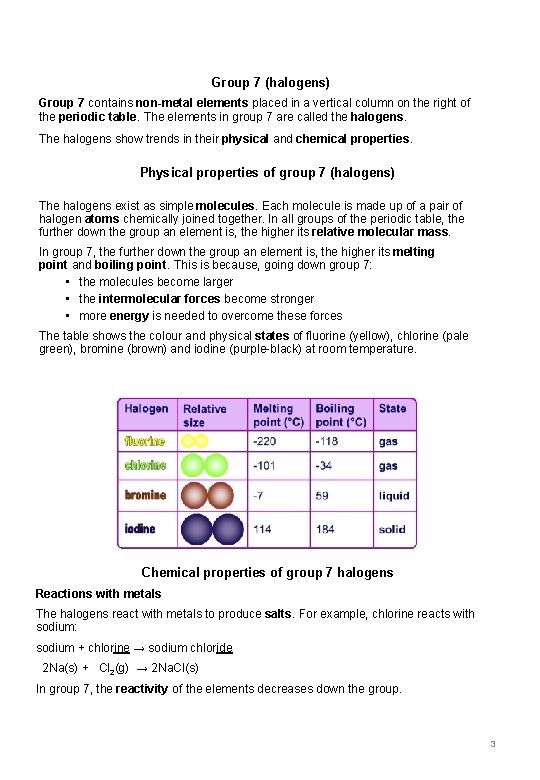
Group 7 (halogens) Group 7 contains non-metal elements placed in a vertical column on the right of the periodic table. The elements in group 7 are called the halogens. The halogens show trends in their physical and chemical properties. Physical properties of group 7 (halogens) The halogens exist as simple molecules. Each molecule is made up of a pair of halogen atoms chemically joined together. In all groups of the periodic table, the further down the group an element is, the higher its relative molecular mass. In group 7, the further down the group an element is, the higher its melting point and boiling point. This is because, going down group 7: • the molecules become larger • the intermolecular forces become stronger • more energy is needed to overcome these forces The table shows the colour and physical states of fluorine (yellow), chlorine (pale green), bromine (brown) and iodine (purple-black) at room temperature. Chemical properties of group 7 halogens Reactions with metals The halogens react with metals to produce salts. For example, chlorine reacts with sodium: sodium + chlorine → sodium chloride 2 Na(s) + Cl 2(g) → 2 Na. Cl(s) In group 7, the reactivity of the elements decreases down the group. 3
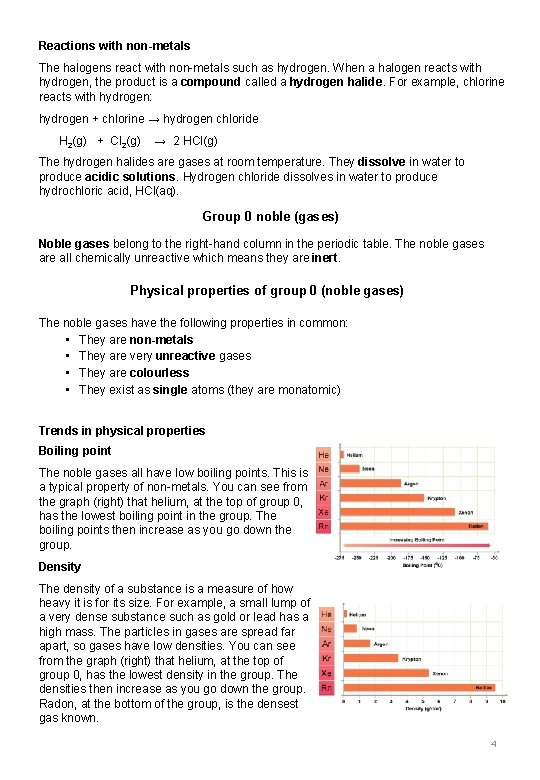
Reactions with non-metals The halogens react with non-metals such as hydrogen. When a halogen reacts with hydrogen, the product is a compound called a hydrogen halide. For example, chlorine reacts with hydrogen: hydrogen + chlorine → hydrogen chloride H 2(g) + Cl 2(g) → 2 HCl(g) The hydrogen halides are gases at room temperature. They dissolve in water to produce acidic solutions. Hydrogen chloride dissolves in water to produce hydrochloric acid, HCl(aq). Group 0 noble (gases) Noble gases belong to the right-hand column in the periodic table. The noble gases are all chemically unreactive which means they are inert. Physical properties of group 0 (noble gases) The noble gases have the following properties in common: • They are non-metals • They are very unreactive gases • They are colourless • They exist as single atoms (they are monatomic) Trends in physical properties Boiling point The noble gases all have low boiling points. This is a typical property of non-metals. You can see from the graph (right) that helium, at the top of group 0, has the lowest boiling point in the group. The boiling points then increase as you go down the group. Density The density of a substance is a measure of how heavy it is for its size. For example, a small lump of a very dense substance such as gold or lead has a high mass. The particles in gases are spread far apart, so gases have low densities. You can see from the graph (right) that helium, at the top of group 0, has the lowest density in the group. The densities then increase as you go down the group. Radon, at the bottom of the group, is the densest gas known. 4
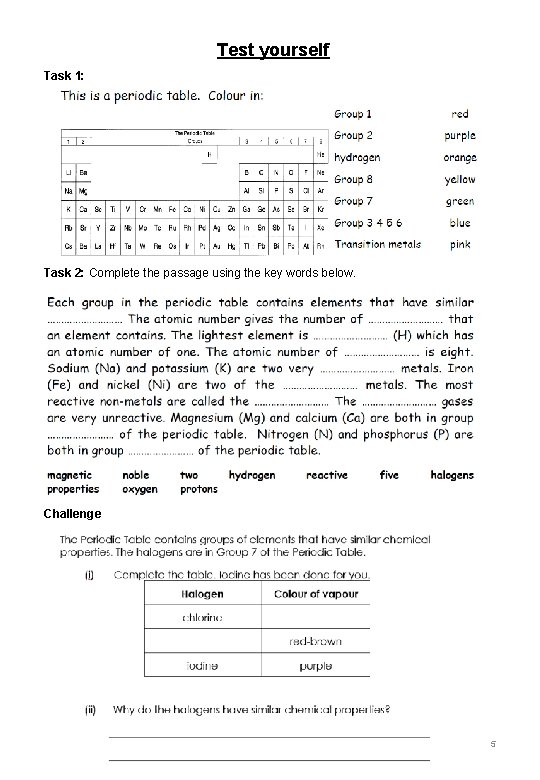
Test yourself Task 1: Task 2: Complete the passage using the key words below. Challenge 5