
Week 4 Lesson 1 Resource management MAP 1
- Slides: 25
Week 4 Lesson 1 Resource management. MAP
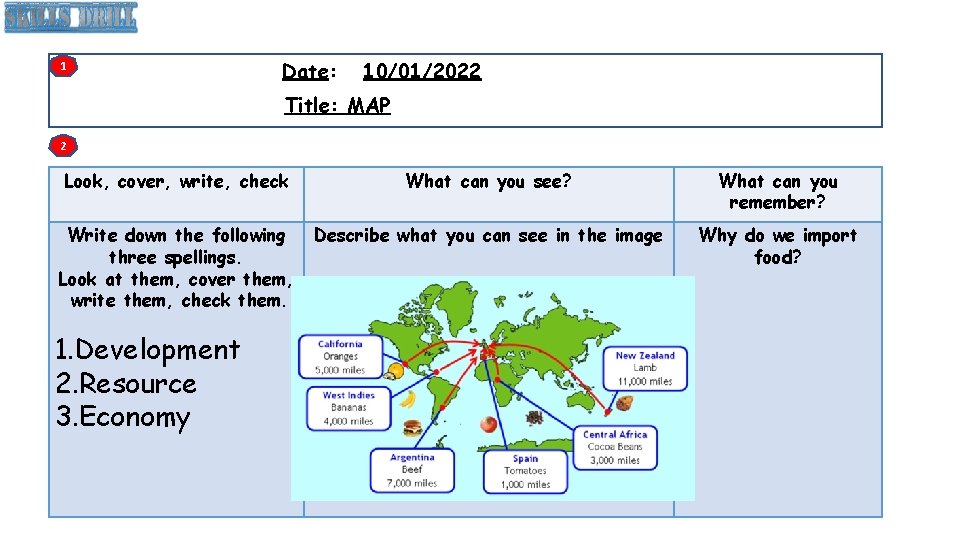
1 Date: 10/01/2022 Title: MAP 2 Look, cover, write, check What can you see? What can you remember? Write down the following three spellings. Look at them, cover them, write them, check them. Describe what you can see in the image Why do we import food? 1. Development 2. Resource 3. Economy
What do the exam words below mean? Describe Explain Evaluate To what extent
What do the exam words below mean? Describe – say what you can see. Remember in geography this can be bullet pointed. 4 marks = 4 points Explain – give reasons. Remember in geography you need to follow the BLT structure. Always divide your marks by 2 to determine the number of paragraphs needed. Evaluate – look at the advantages and disadvantages of something. Sometimes the examiner will just want you to look at one side. To what extent – Consider both sides of the argument but be clear about which side you are taking.
Using BLT • Remember in your answers to use BLT where appropriate! • B- Because • L- Leads to • T- Therefore
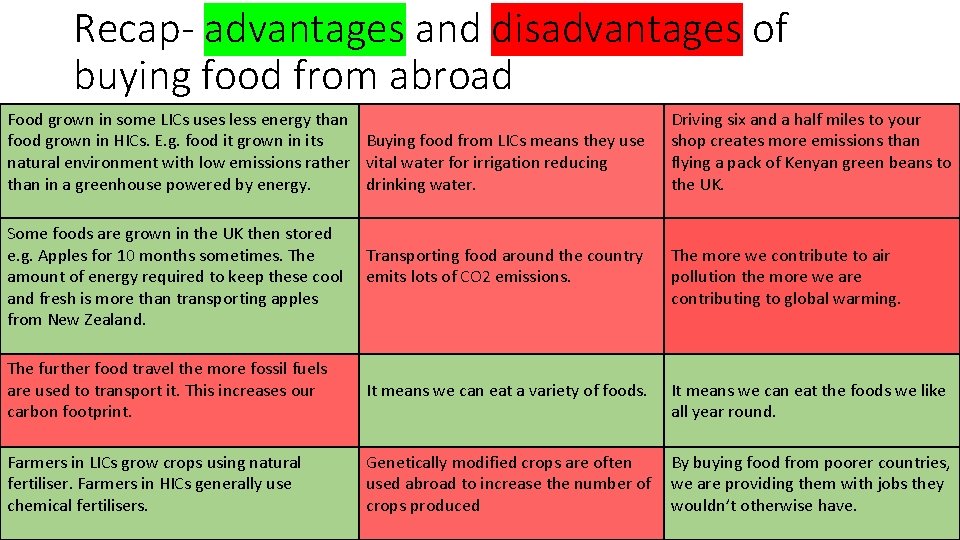
Recap- advantages and disadvantages of buying food from abroad Food grown in some LICs uses less energy than food grown in HICs. E. g. food it grown in its Buying food from LICs means they use natural environment with low emissions rather vital water for irrigation reducing than in a greenhouse powered by energy. drinking water. Driving six and a half miles to your shop creates more emissions than flying a pack of Kenyan green beans to the UK. Some foods are grown in the UK then stored e. g. Apples for 10 months sometimes. The amount of energy required to keep these cool and fresh is more than transporting apples from New Zealand. Transporting food around the country emits lots of CO 2 emissions. The more we contribute to air pollution the more we are contributing to global warming. The further food travel the more fossil fuels are used to transport it. This increases our carbon footprint. It means we can eat a variety of foods. It means we can eat the foods we like all year round. Farmers in LICs grow crops using natural fertiliser. Farmers in HICs generally use chemical fertilisers. Genetically modified crops are often used abroad to increase the number of crops produced By buying food from poorer countries, we are providing them with jobs they wouldn’t otherwise have.
MAP Next lesson we continue learning about resource management. Complete the MAP link below: https: //forms. office. com/Pages/Response. Page. aspx? id=g. Gf PFv. BL 70 -qgtugufq. Clgt. TXd 2 PTt. Ck. Drcxv. EN 6 Kl. UQlp. JT 0 o 1 U 0 M 3 VTd. M MUIw. SEp. SNl. Iy. Ul. I 5 US 4 u Please go to the link below. Read through the information and watch the videos. This will help you with the next lessons! https: //www. coolgeography. co. uk/ gcsen/CRM_Food_Global__Patter ns. php
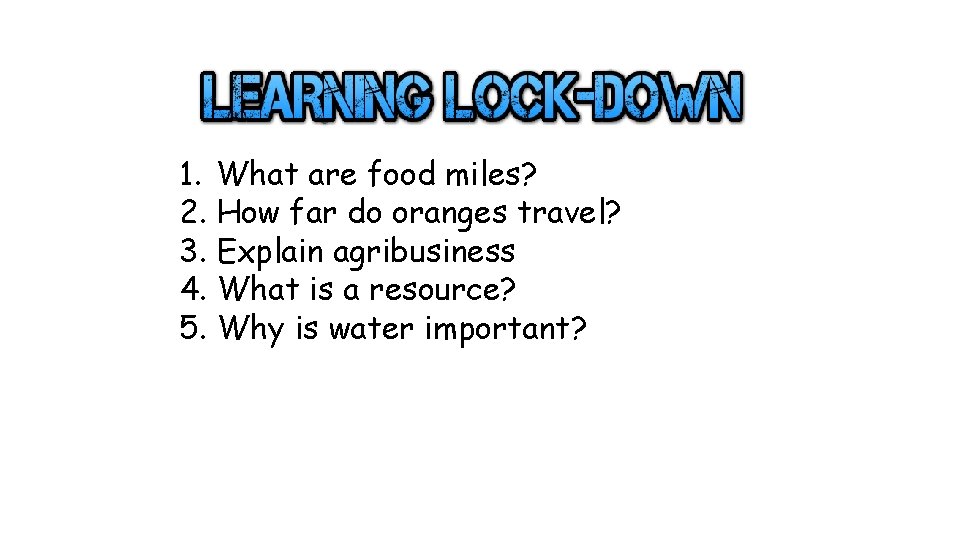
1. What are food miles? 2. How far do oranges travel? 3. Explain agribusiness 4. What is a resource? 5. Why is water important?
Week 4 Lesson 2 Resource management. Provision of energy in the UK
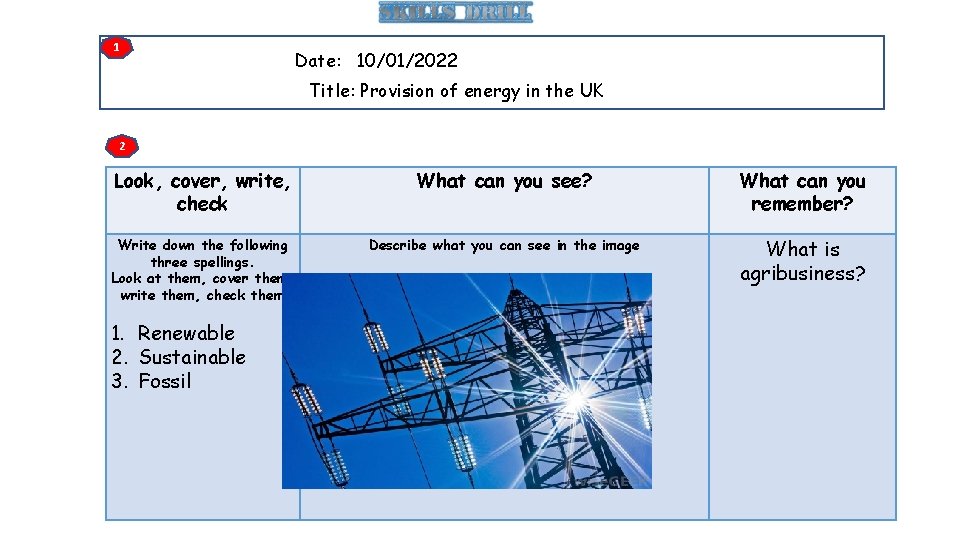
1 Date: 10/01/2022 Title: Provision of energy in the UK 2 Look, cover, write, check What can you see? What can you remember? Write down the following three spellings. Look at them, cover them, write them, check them. Describe what you can see in the image What is agribusiness? 1. Renewable 2. Sustainable 3. Fossil
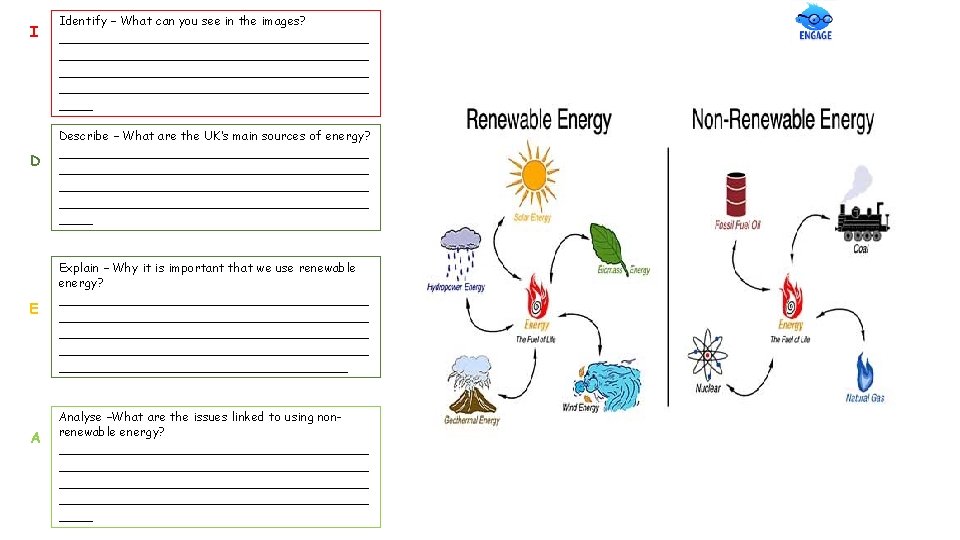
I Identify – What can you see in the images? _____________________________________________ _____ Describe – What are the UK’s main sources of energy? D _____________________________________________ _____ Explain – Why it is important that we use renewable energy? E A _____________________________________________ _____________________ Analyse –What are the issues linked to using nonrenewable energy? _____________________________________________ _____
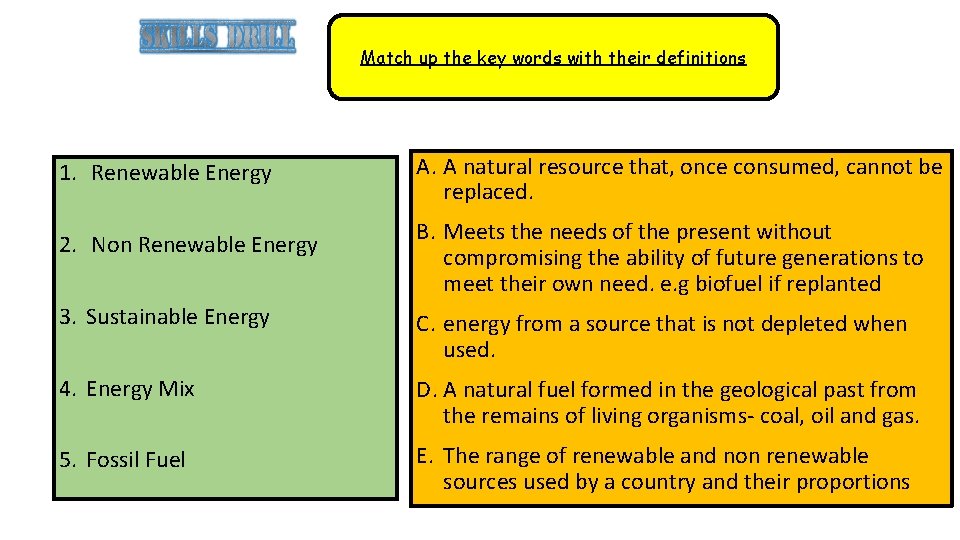
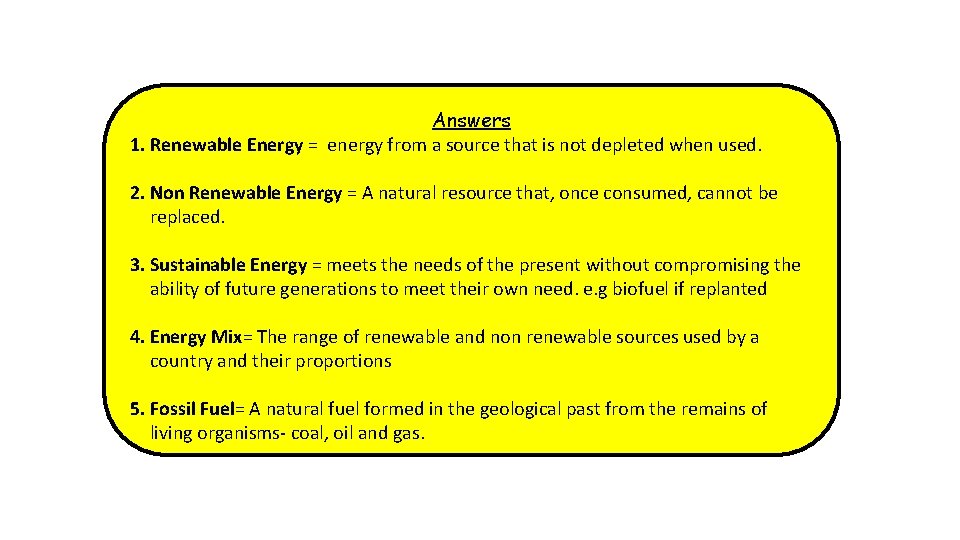
Match up the key words with their definitions 1. Renewable Energy 2. Non Renewable Energy A. A natural resource that, once consumed, cannot be replaced. B. Meets the needs of the present without compromising the ability of future generations to meet their own need. e. g biofuel if replanted 3. Sustainable Energy C. energy from a source that is not depleted when used. 4. Energy Mix D. A natural fuel formed in the geological past from the remains of living organisms- coal, oil and gas. 5. Fossil Fuel E. The range of renewable and non renewable sources used by a country and their proportions
Answers 1. Renewable Energy = energy from a source that is not depleted when used. 2. Non Renewable Energy = A natural resource that, once consumed, cannot be replaced. 3. Sustainable Energy = meets the needs of the present without compromising the ability of future generations to meet their own need. e. g biofuel if replanted 4. Energy Mix= The range of renewable and non renewable sources used by a country and their proportions 5. Fossil Fuel= A natural fuel formed in the geological past from the remains of living organisms- coal, oil and gas.
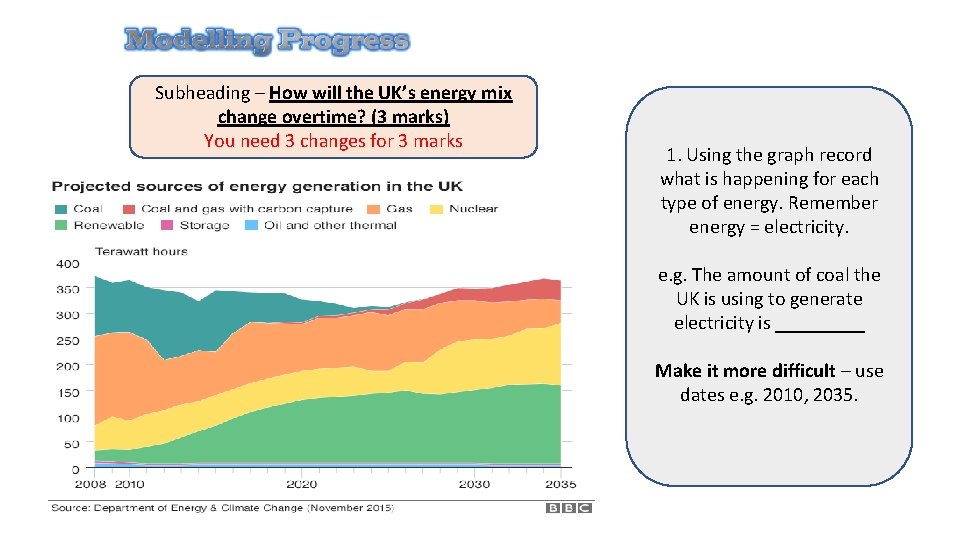
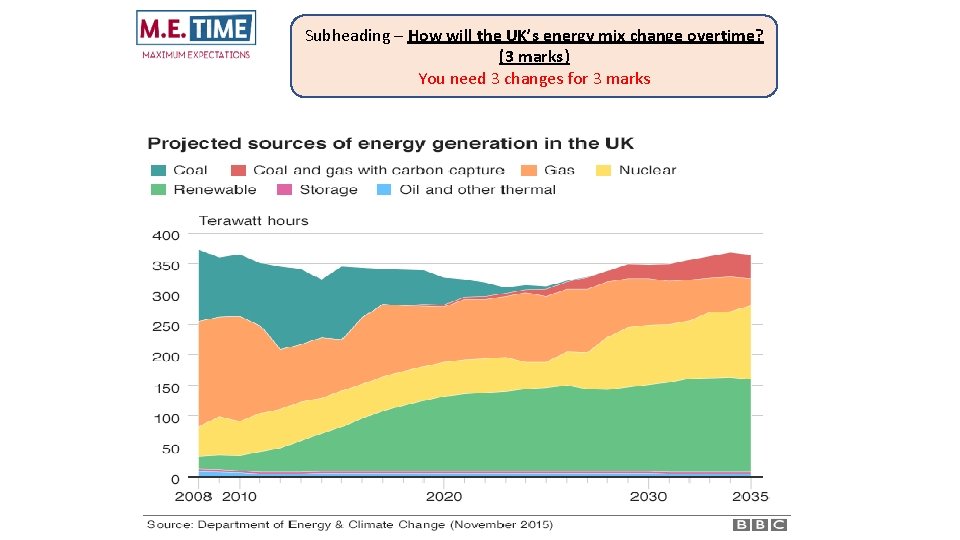
Subheading – How will the UK’s energy mix change overtime? (3 marks) You need 3 changes for 3 marks 1. Using the graph record what is happening for each type of energy. Remember energy = electricity. e. g. The amount of coal the UK is using to generate electricity is _____ Make it more difficult – use dates e. g. 2010, 2035.
Subheading – How will the UK’s energy mix change overtime? (3 marks) You need 3 changes for 3 marks
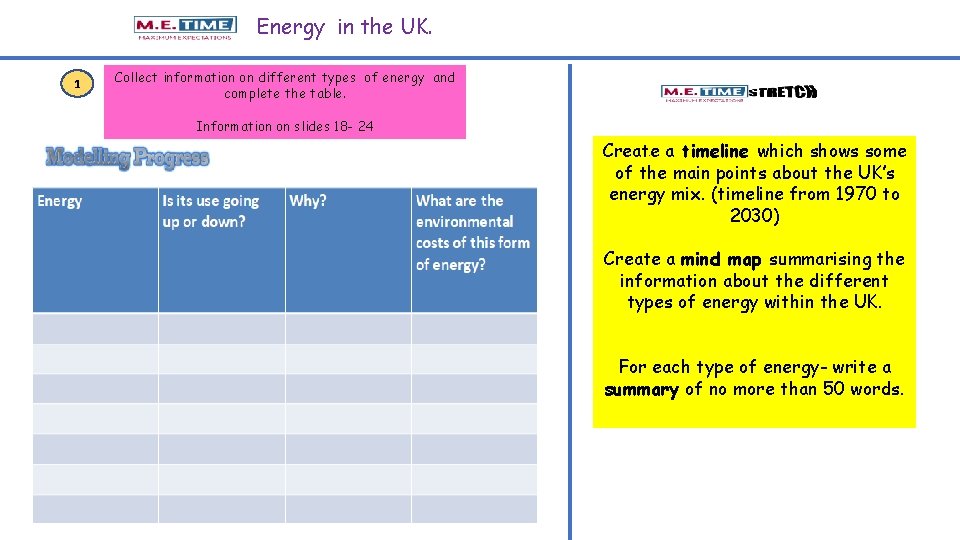
Energy in the UK. 1 Collect information on different types of energy and complete the table. Information on slides 18 - 24. Create a timeline which shows some of the main points about the UK’s energy mix. (timeline from 1970 to 2030) Create a mind map summarising the information about the different types of energy within the UK. For each type of energy- write a summary of no more than 50 words.
Type of energy Is its use going up or down? Why? What are the environmental costs of this form of energy?
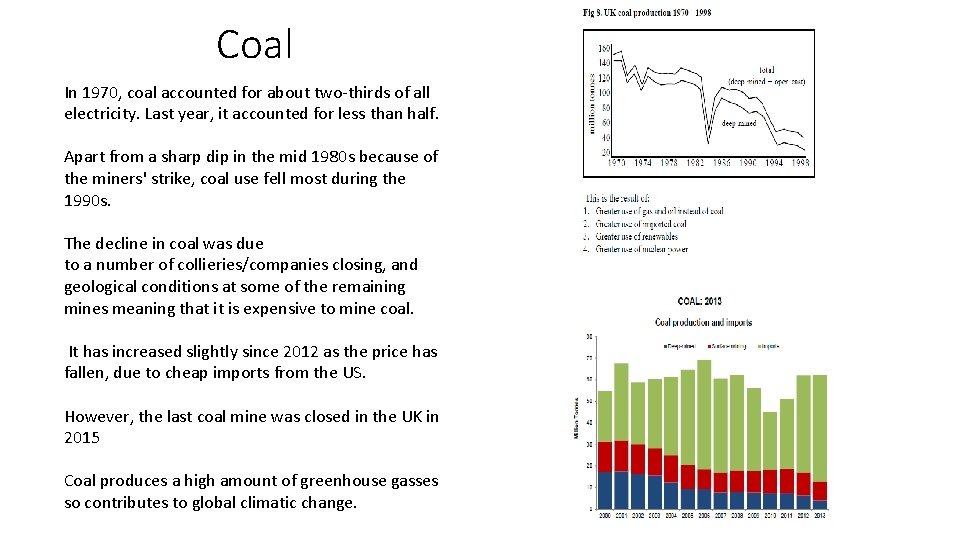
Coal In 1970, coal accounted for about two-thirds of all electricity. Last year, it accounted for less than half. Apart from a sharp dip in the mid 1980 s because of the miners' strike, coal use fell most during the 1990 s. The decline in coal was due to a number of collieries/companies closing, and geological conditions at some of the remaining mines meaning that it is expensive to mine coal. It has increased slightly since 2012 as the price has fallen, due to cheap imports from the US. However, the last coal mine was closed in the UK in 2015 Coal produces a high amount of greenhouse gasses so contributes to global climatic change.
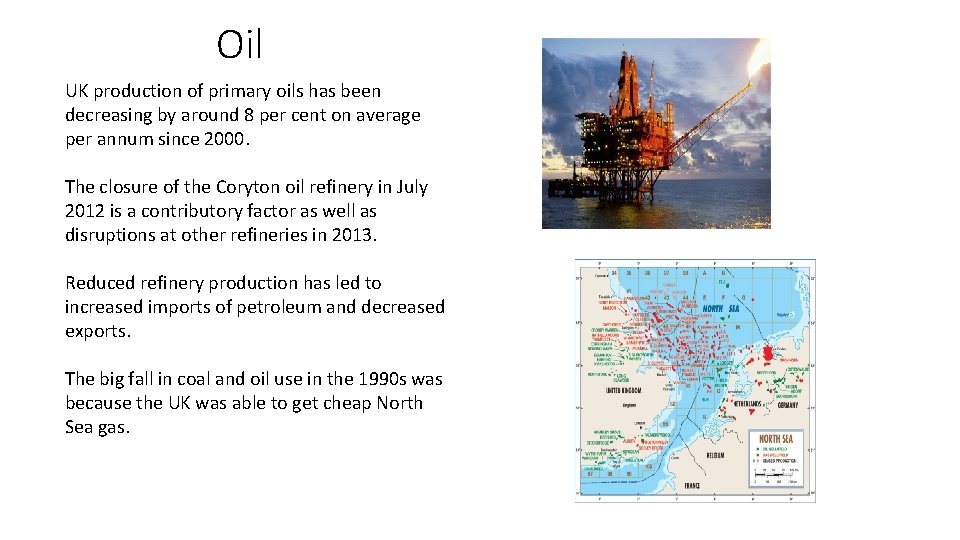
Oil UK production of primary oils has been decreasing by around 8 per cent on average per annum since 2000. The closure of the Coryton oil refinery in July 2012 is a contributory factor as well as disruptions at other refineries in 2013. Reduced refinery production has led to increased imports of petroleum and decreased exports. The big fall in coal and oil use in the 1990 s was because the UK was able to get cheap North Sea gas.
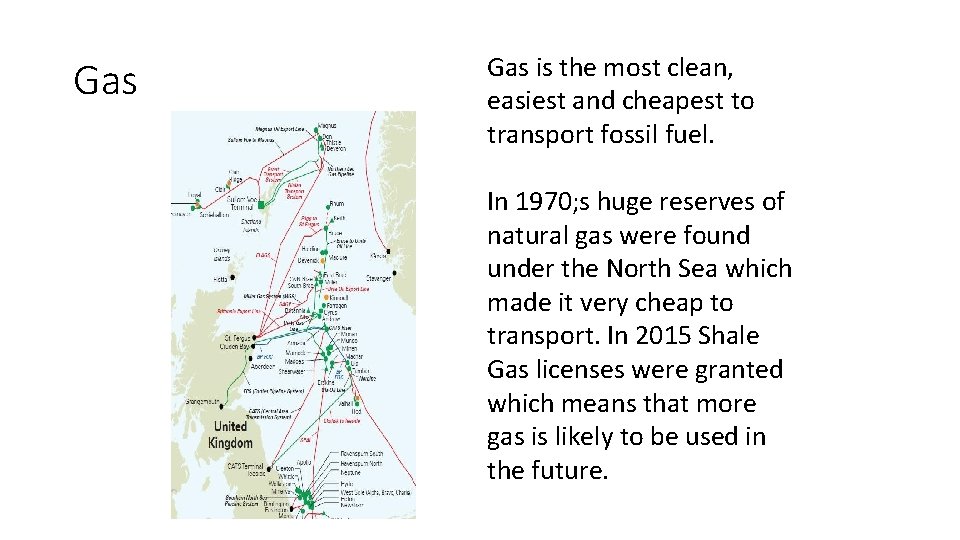
Gas is the most clean, easiest and cheapest to transport fossil fuel. In 1970; s huge reserves of natural gas were found under the North Sea which made it very cheap to transport. In 2015 Shale Gas licenses were granted which means that more gas is likely to be used in the future.
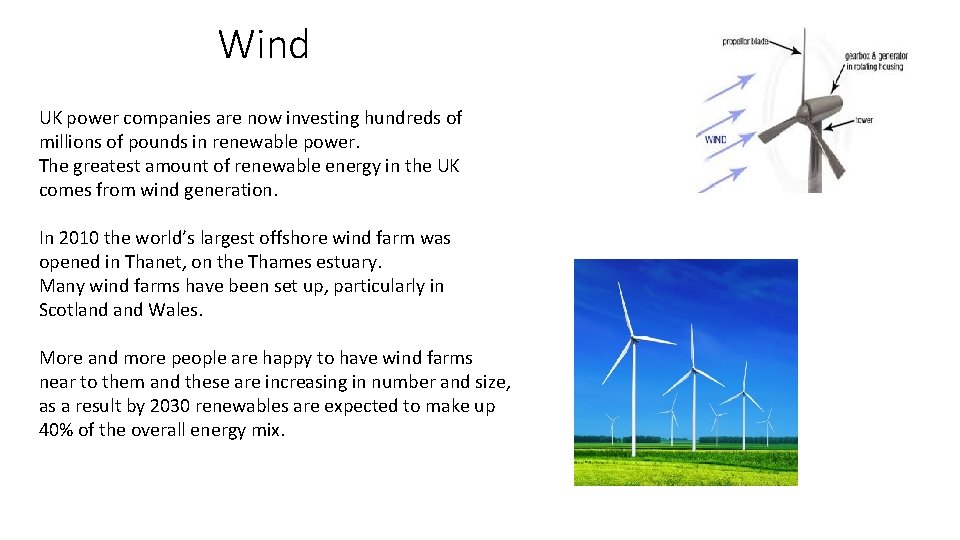
Wind UK power companies are now investing hundreds of millions of pounds in renewable power. The greatest amount of renewable energy in the UK comes from wind generation. In 2010 the world’s largest offshore wind farm was opened in Thanet, on the Thames estuary. Many wind farms have been set up, particularly in Scotland Wales. More and more people are happy to have wind farms near to them and these are increasing in number and size, as a result by 2030 renewables are expected to make up 40% of the overall energy mix.
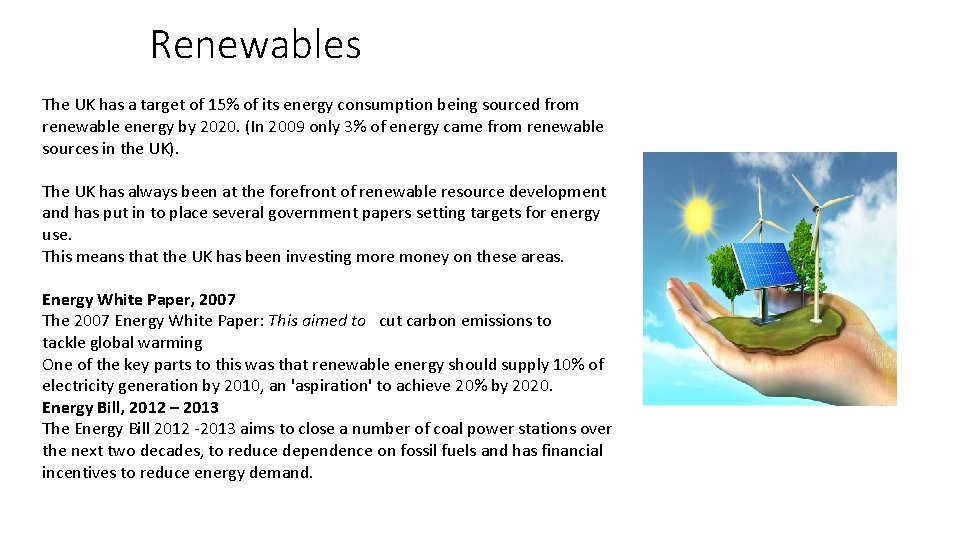
Renewables The UK has a target of 15% of its energy consumption being sourced from renewable energy by 2020. (In 2009 only 3% of energy came from renewable sources in the UK). The UK has always been at the forefront of renewable resource development and has put in to place several government papers setting targets for energy use. This means that the UK has been investing more money on these areas. Energy White Paper, 2007 The 2007 Energy White Paper: This aimed to cut carbon emissions to tackle global warming One of the key parts to this was that renewable energy should supply 10% of electricity generation by 2010, an 'aspiration' to achieve 20% by 2020. Energy Bill, 2012 – 2013 The Energy Bill 2012 -2013 aims to close a number of coal power stations over the next two decades, to reduce dependence on fossil fuels and has financial incentives to reduce energy demand.
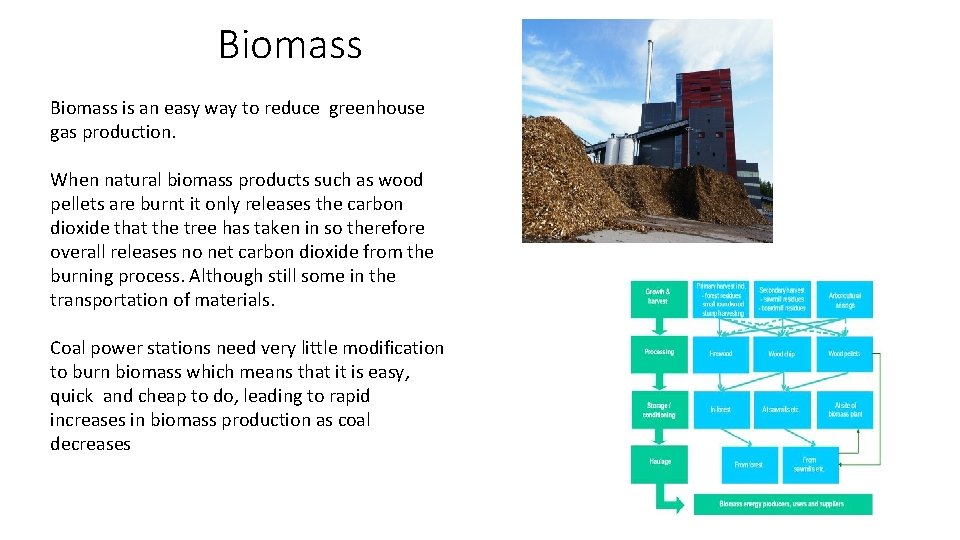
Biomass is an easy way to reduce greenhouse gas production. When natural biomass products such as wood pellets are burnt it only releases the carbon dioxide that the tree has taken in so therefore overall releases no net carbon dioxide from the burning process. Although still some in the transportation of materials. Coal power stations need very little modification to burn biomass which means that it is easy, quick and cheap to do, leading to rapid increases in biomass production as coal decreases
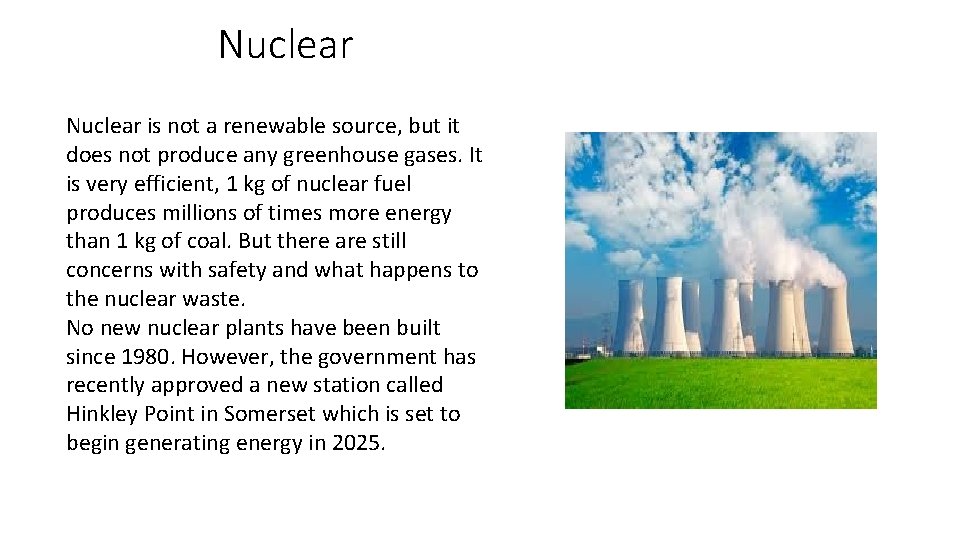
Nuclear is not a renewable source, but it does not produce any greenhouse gases. It is very efficient, 1 kg of nuclear fuel produces millions of times more energy than 1 kg of coal. But there are still concerns with safety and what happens to the nuclear waste. No new nuclear plants have been built since 1980. However, the government has recently approved a new station called Hinkley Point in Somerset which is set to begin generating energy in 2025.
1. What is renewable energy? 2. How is the UK’s energy mix changing? 3. What is good about organic farming?