
WEEK 3 RECAP Evidence Based Practice What is

WEEK 3 RECAP
Evidence Based Practice • What is it? • “Process in which practioners make practice decisions in light of the best research evidence available” (Rubin & Babbie, 2008). • Why is it important?
Research Question • A good research question can be answered using observable data, includes the relationship between two or more variables, and is logical (Blessing and Forister, 2013). • Why is it important to have a clearly framed and defined research question? • To set the stage for efficient and effective literature searching • To identify and retrieve the best evidence
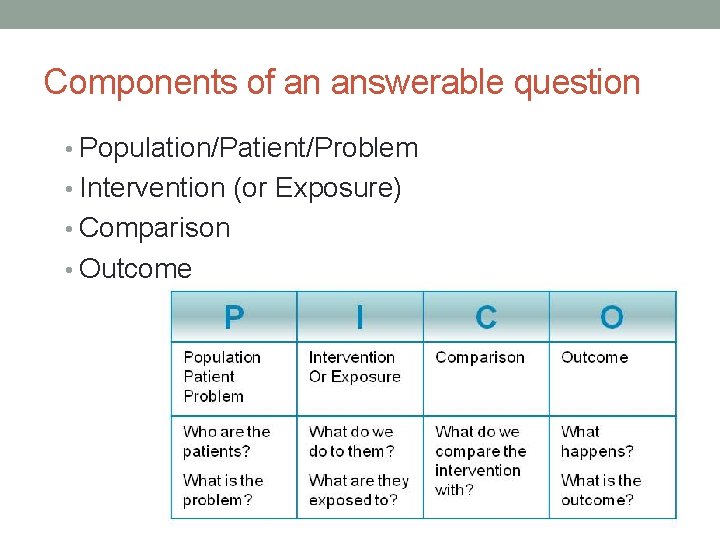
Components of an answerable question • Population/Patient/Problem • Intervention (or Exposure) • Comparison • Outcome

PICO Example Your next patient is a 72 -year-old woman with osteoarthritis of the knees and moderate hypertension, accompanied by her daughter, a lab tech from the hospital. The daughter wants you to give her mother a prescription for one of the new COX-2 inhibitors. She has heard that they cause less GI bleeding. Her mother is concerned that the new drugs will mean more out of pocket costs each month.

PICO Example continued… • Patient/Problem: 72 year old woman with osteoarthritis of the knee and moderate hypertension • Intervention: COX-2 inhibitors • Comparison Intervention: other NSAIDS • Outcome: less GI bleeding • SPEFICIC QUESTION: • In a 72 year old woman with osteoarthritis of the knee, can COX-2 Inhibitor use decrease the risk of GI bleeding compared with other NSAIDs?

PICO Example continued… Intervention Population Stroke patients with Early initiation of aphasia treatment (SLP SERVICES) Comparison Outcome Aphasia treatment after initial/spontaneous recovery time Functional communication abilities "Are stroke patients with aphasia who received SLP services shortly after their stroke more or less likely to achieve functional communication abilities than stroke patients who received such treatments later? "

Narrowing the Focus • Problem Statement • Question (Problem converted into a question) • Aim/Purpose • Objective (More specific than the aim): • What are you going to do to answer your question?
Finding the Evidence • Categories of Information Sources: • Studies • Systematic Reviews • Synopses • Systems
Criteria for Choosing Information Resources • Soundness of evidence based approach • How well does the resource indicate the strength of the evidence behind the recommendations or other content? • Comprehensiveness and Specificity • Does the resource cover questions of the type I am asking (e. g. therapy, diagnosis, prognosis, harm? • Ease of Use • Does it give me the kind of information I need quickly and consistently? • Availability • Is it available in all locations? • Can I afford it?
- Slides: 10