
Week 22 Physics Understand that a star is
- Slides: 22
Week 22 { Physics
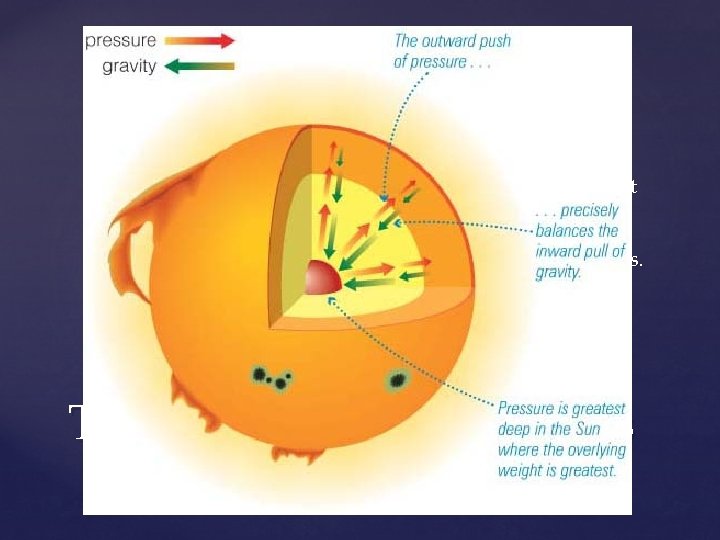
Understand that a star is in equilibrium under the action of two opposing forces, gravitation and the radiation pressure of the star Appreciate that nuclear fusion provides the energy source of a star Stellar Radiation
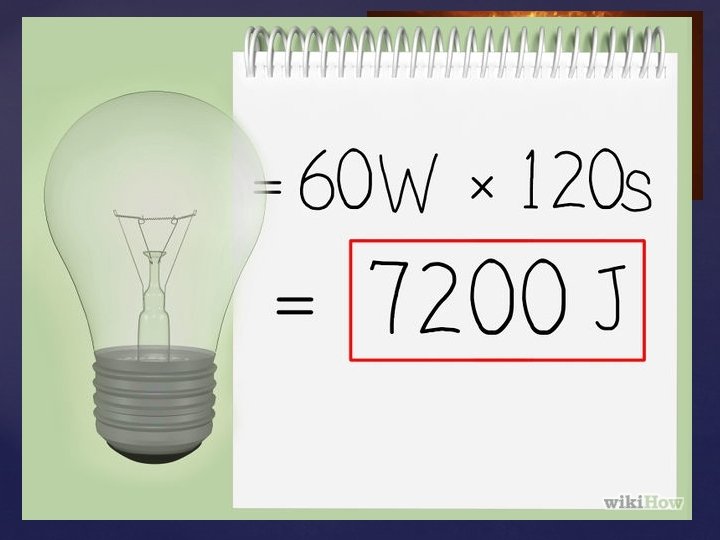
A star like the sun radiates about 1026 J/s 1, 000, 000, 00 0, 000 The source of this energy is nuclear fusion in the interior of the star. The energy source of stars
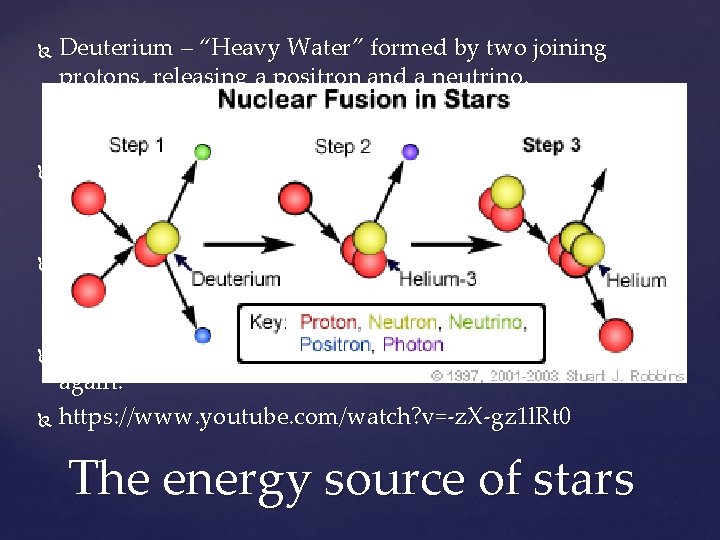
Deuterium – “Heavy Water” formed by two joining protons, releasing a positron and a neutrino. Positron – antiparticle of an electron, positive charge Neutrino – little or no mass no charge moves at the speed of light. Helium-3 – formed when a proton bombards a deuterium nucleus, releasing a photon in the form of a gamma ray. photon – a quantum of light (unit of light emission or absorption) Helium-4 – regular helium atom formed by a helium-3 nucleus bombarding another helium-3 nucleus, releasing two protons These two protons are free to continue the whole process again. https: //www. youtube. com/watch? v=-z. X-gz 1 l. Rt 0 The energy source of stars
High temperature in the star allows two protons to fuse. High pressure ensures a high probability of collision. Energy is released in each of the three steps but most comes out of the third step. Photons and neutrinos move the energy outward and collide with protons and electrons. This outward motion stabilizes the star against gravitational collapse. The energy source of stars
Each time the proton-proton cycle occurs 3. 98 x 10 -12 J is released 0. 000000398 J All of the helium created as a by product collects at the core of the star and due to the immense pressure, the helium is compacted into heavier elements like nickel and iron. The energy source of stars
Give the definitions of luminosity, L = σAT 4 as the power radiated into space by a star and apparent brightness, b =L/(4πd 2) , as the power received per unit area on earth. Luminosity - objective
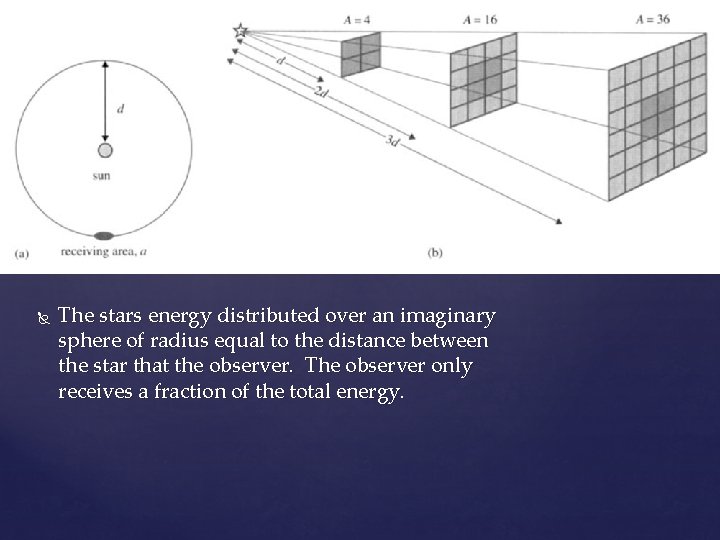
Luminosity is the amount of energy radiated by the star per second; that is, it is the power radiated by the star. Luminosity depends on the surface temperature and surface area of the star. Luminosity of a star = L Imagine a sphere of radius d centered at the location of the star. If the star is assumed to radiate in all directions, then the energy radiated in 1 s can be thought to be distributed around this sphere. Luminosity
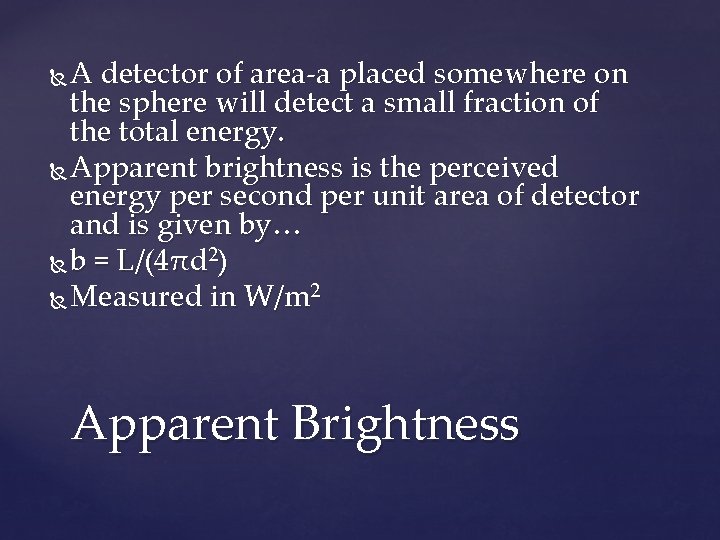
A detector of area-a placed somewhere on the sphere will detect a small fraction of the total energy. Apparent brightness is the perceived energy per second per unit area of detector and is given by… b = L/(4πd 2) Measured in W/m 2 Apparent Brightness
The stars energy distributed over an imaginary sphere of radius equal to the distance between the star that the observer. The observer only receives a fraction of the total energy.
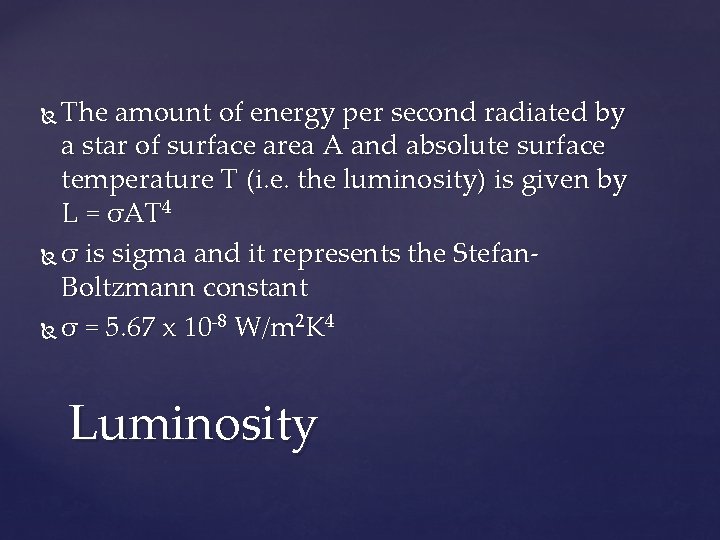
The amount of energy per second radiated by a star of surface area A and absolute surface temperature T (i. e. the luminosity) is given by L = σAT 4 σ is sigma and it represents the Stefan. Boltzmann constant σ = 5. 67 x 10 -8 W/m 2 K 4 Luminosity
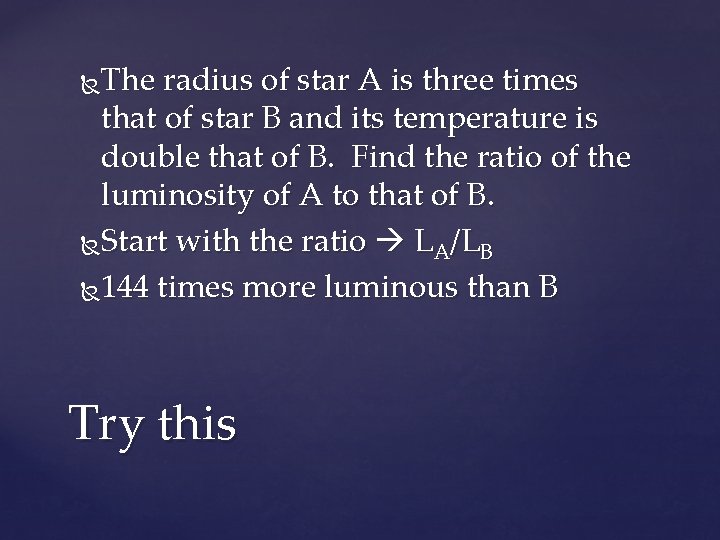
The radius of star A is three times that of star B and its temperature is double that of B. Find the ratio of the luminosity of A to that of B. Start with the ratio LA/LB 144 times more luminous than B Try this
The stars from the last problem have the same apparent brightness when viewed from the earth. Calculate the ratios of their distances. Start with the ratio b. A/b. B = 1 12 times the distance to Star B And this
The apparent brightness of a star is 6. 4 x 10 -8 W/m 2. If the distance is 15 ly, what is the luminosity? 1. 62 x 1028 W Try This
A star half the sun’s surface temperature and 400 times its luminosity. How many times bigger is it? Start with this ratio 400 = L/Lsun 80 times larger Try This Too
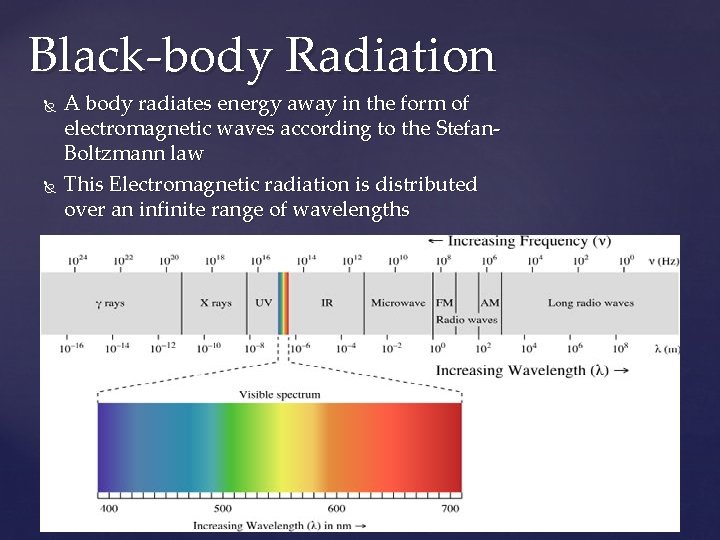
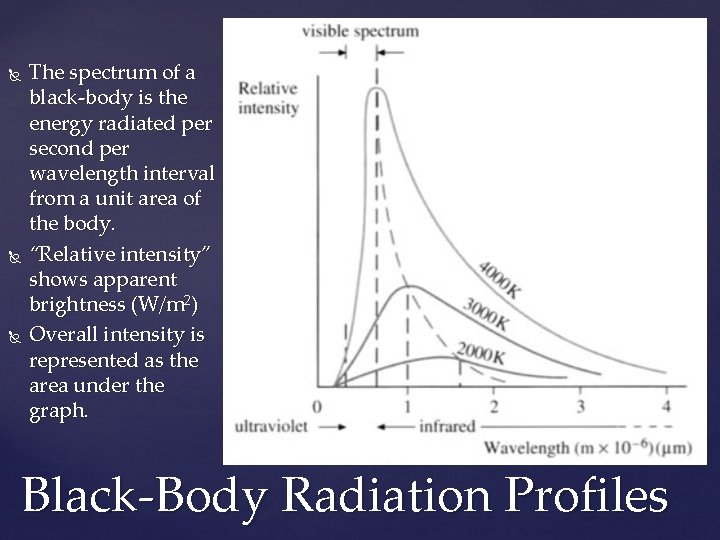
Black-body Radiation A body radiates energy away in the form of electromagnetic waves according to the Stefan. Boltzmann law This Electromagnetic radiation is distributed over an infinite range of wavelengths
The spectrum of a black-body is the energy radiated per second per wavelength interval from a unit area of the body. “Relative intensity” shows apparent brightness (W/m 2) Overall intensity is represented as the area under the graph. Black-Body Radiation Profiles
Peak wavelength (λ 0) emits the most energy The color of the star is mainly determined by the color corresponding to λ 0. Area under the curve is the total power radiated from a unit area irrespective of wavelength and is given by σT 4 Black-Body Radiation
The Wien displacement law relates wavelength to temperature. λ 0 T = constant = 2. 90 x 10 -3 K m The higher the temperature, the lower the wavelength at which most of the energy is radiated. Wien Displacement Law
The sun has approximate black-body spectrum with most of the energy radiated at a wavelength of 5. 0 x 10 -7 m. Find the surface temperature of the sun. T = 5800 K Try This
The sun (radius R = 7. 0 x 108 m) radiates a total power of 3. 9 x 1026 W. Find its surface temperature. T ≈ 5800 K And This
A great wealth of information can be gathered about a star from the studies of its spectrum. Temperature Chemical composition Radial velocity Rotation Magnetic fields Stellar Spectra