
Week 2 Year 5 English Diary entries This
- Slides: 21
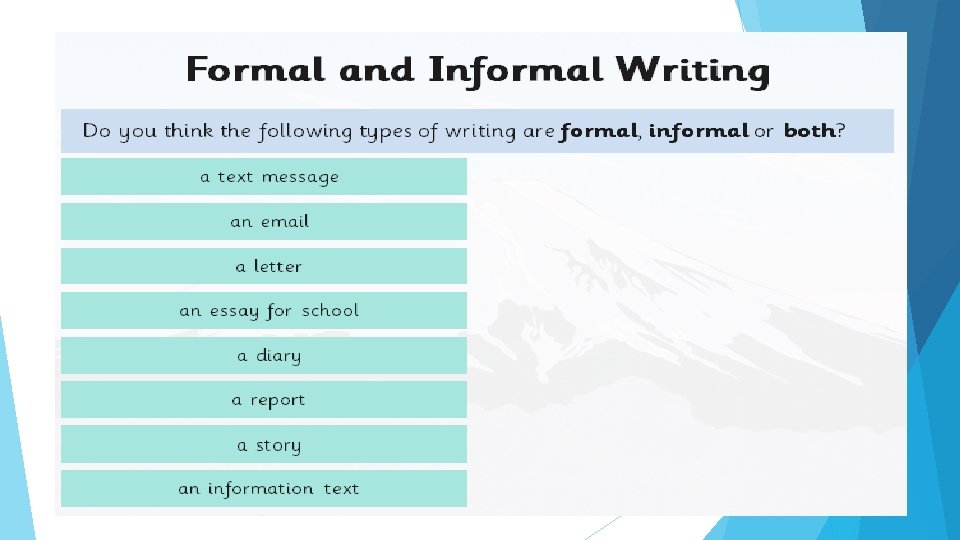
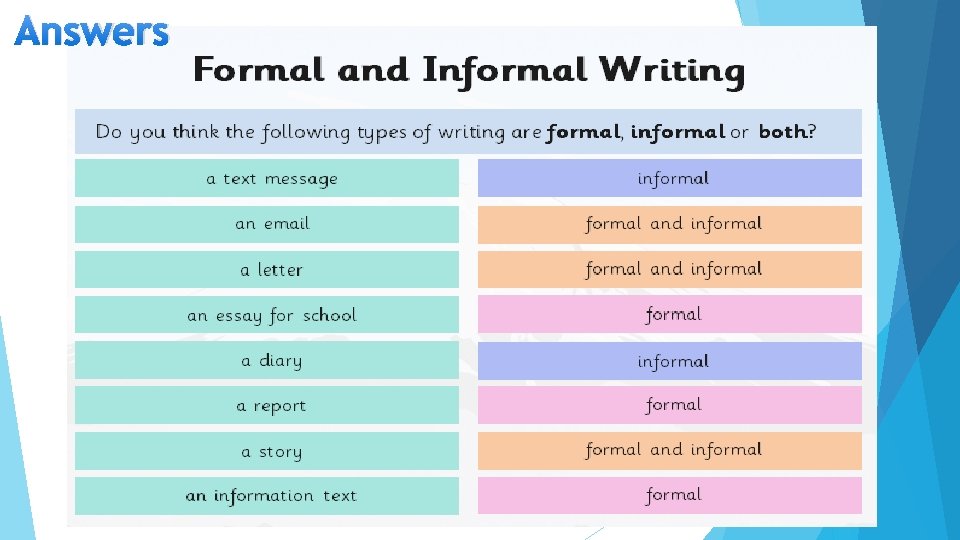
Week 2 Year 5 – English - Diary entries This week in Year 5, we are learning how to write diary entries. A diary entry is a form of recount in which the writer explains (or recounts) what has happened to them. As part of this, we will be focusing on features of informal writing which means writing in a chatty, relaxed style. Depending on the situation, we adjust our formality which means we change the way we write or speak. If we were speaking to the queen, we would talk in a much more formal way than we would if we were speaking to a friend on the playground or writing something (like a diary) that only we would read. In this week’s activities, you will read some diary entries and complete some reading practice and look at the features of diary entries. You will also learn about informal writing and by the end of the week, you will write your very own diary entry.
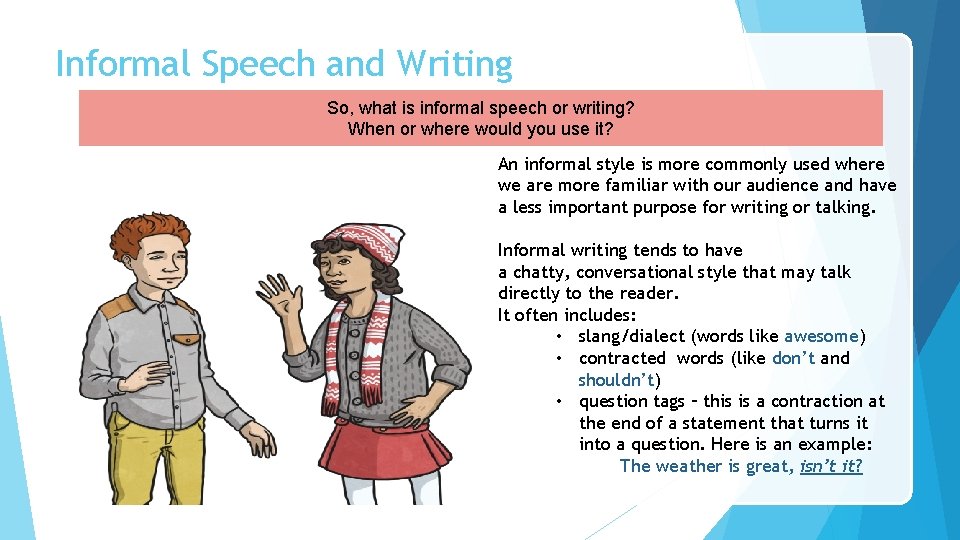
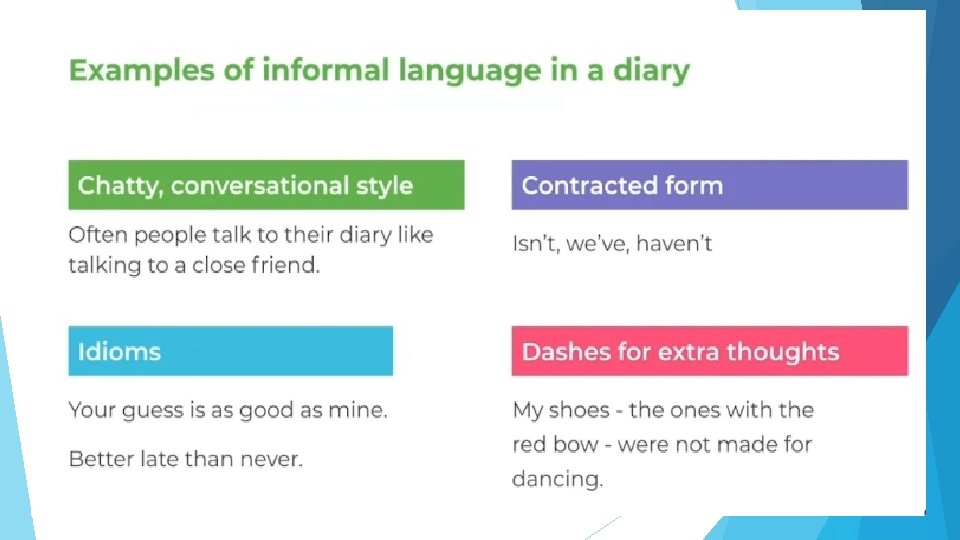
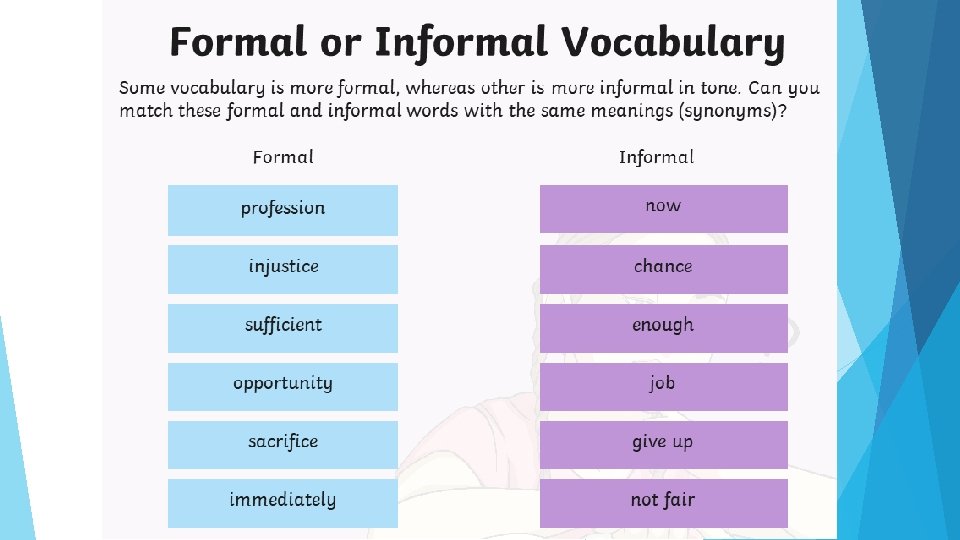
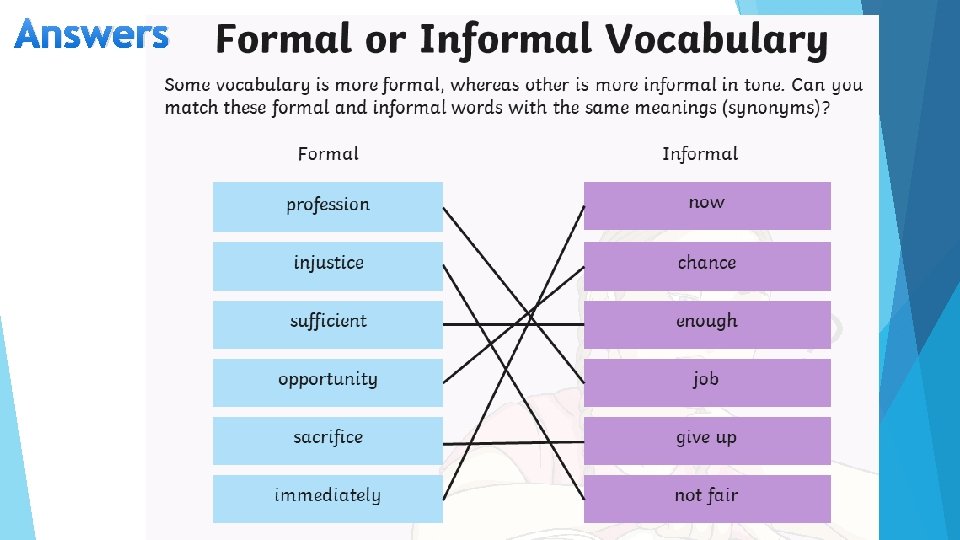
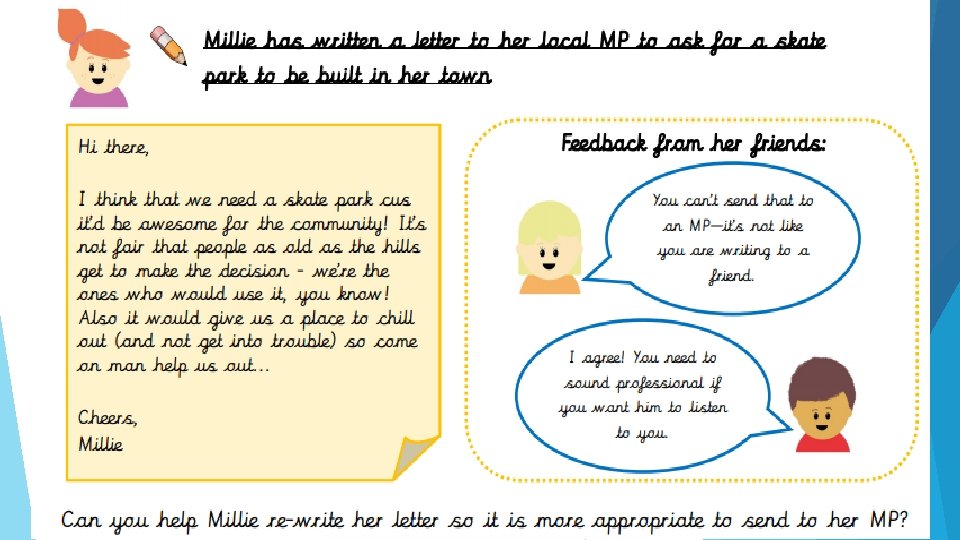
Informal Speech and Writing So, what is informal speech or writing? When or where would you use it? An informal style is more commonly used where we are more familiar with our audience and have a less important purpose for writing or talking. Informal writing tends to have a chatty, conversational style that may talk directly to the reader. It often includes: • slang/dialect (words like awesome) • contracted words (like don’t and shouldn’t) • question tags – this is a contraction at the end of a statement that turns it into a question. Here is an example: The weather is great, isn’t it?
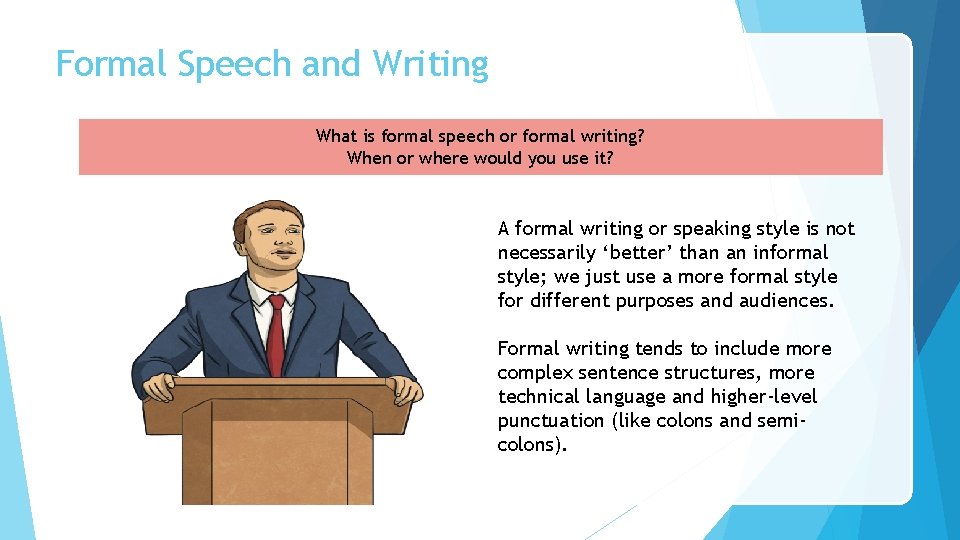
Formal Speech and Writing What is formal speech or formal writing? When or where would you use it? A formal writing or speaking style is not necessarily ‘better’ than an informal style; we just use a more formal style for different purposes and audiences. Formal writing tends to include more complex sentence structures, more technical language and higher-level punctuation (like colons and semicolons).
Week 2 Year 5 – Diary entries On the following page you will find a link to follow each day. 1. On each link, you will find a 15 minute teaching video - make sure that you have a pen and paper ready in case you are asked to write anything down. 2. After watching the video, click Next to turn to the following page and bring up an activity which you can complete online or print off. 3. Before finishing the work, test your knowledge by completing the quiz. 4. At the end of the week, come back to this Power. Point and try the challenge sheets, ‘Speedy SPAG’ at the end of this Power. Point to see how much you have remembered. Spellings: Don’t forget to practise your spellings each day at the end of each activity. To do this, you could choose a spelling task from the spelling slides!
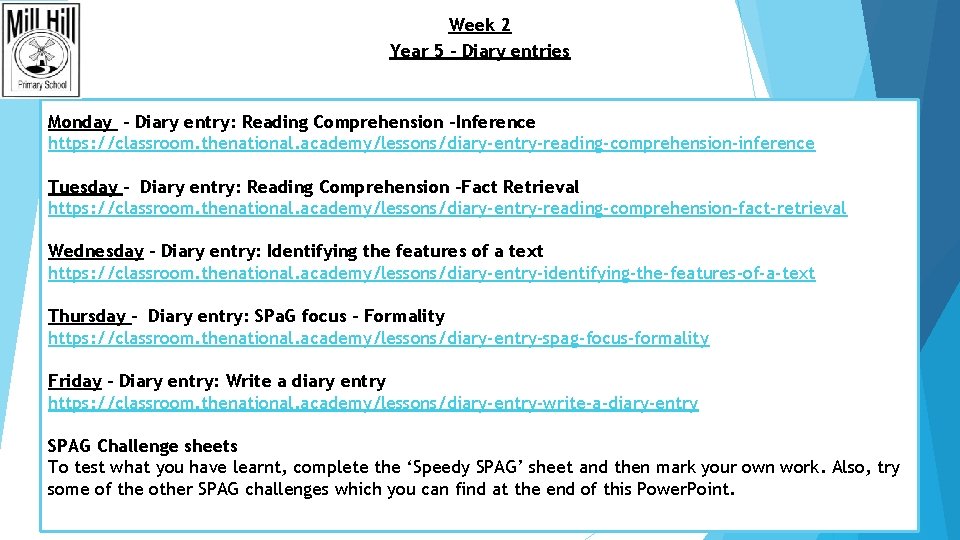
Week 2 Year 5 – Diary entries Monday - Diary entry: Reading Comprehension -Inference https: //classroom. thenational. academy/lessons/diary-entry-reading-comprehension-inference Tuesday - Diary entry: Reading Comprehension -Fact Retrieval https: //classroom. thenational. academy/lessons/diary-entry-reading-comprehension-fact-retrieval Wednesday – Diary entry: Identifying the features of a text https: //classroom. thenational. academy/lessons/diary-entry-identifying-the-features-of-a-text Thursday - Diary entry: SPa. G focus - Formality https: //classroom. thenational. academy/lessons/diary-entry-spag-focus-formality Friday – Diary entry: Write a diary entry https: //classroom. thenational. academy/lessons/diary-entry-write-a-diary-entry SPAG Challenge sheets To test what you have learnt, complete the ‘Speedy SPAG’ sheet and then mark your own work. Also, try some of the other SPAG challenges which you can find at the end of this Power. Point.
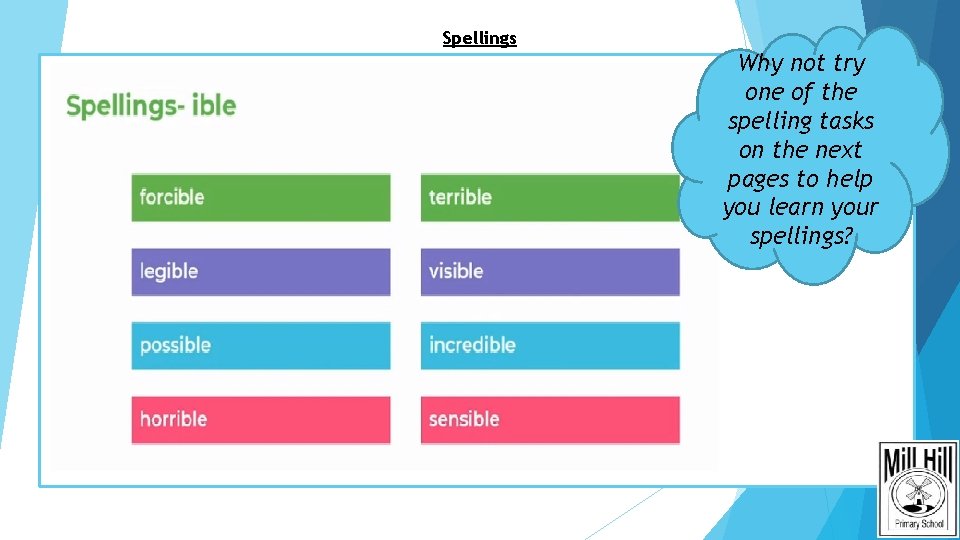
Spellings Why not try one of the spelling tasks on the next pages to help you learn your spellings?
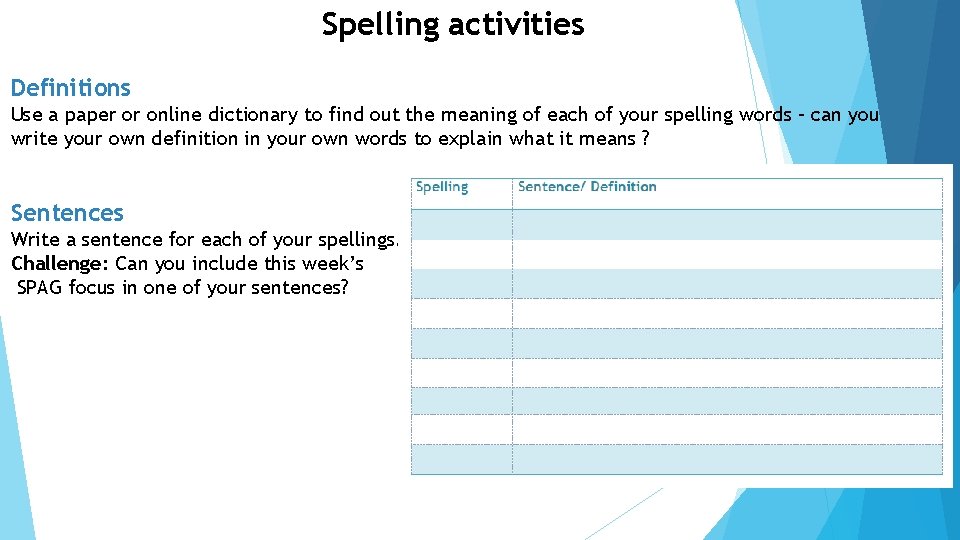
Spelling activities Definitions Use a paper or online dictionary to find out the meaning of each of your spelling words – can you write your own definition in your own words to explain what it means ? Sentences Write a sentence for each of your spellings. Challenge: Can you include this week’s SPAG focus in one of your sentences?
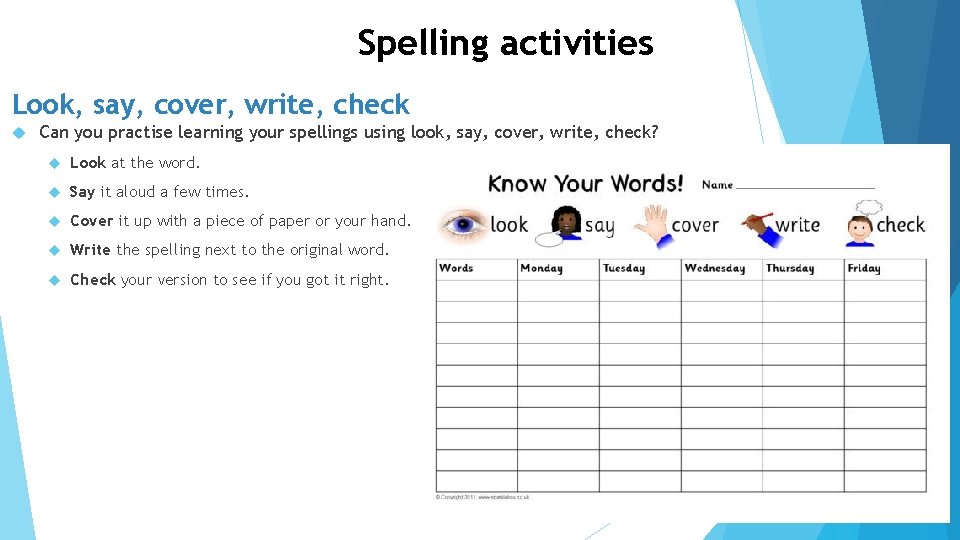
Spelling activities Look, say, cover, write, check Can you practise learning your spellings using look, say, cover, write, check? Look at the word. Say it aloud a few times. Cover it up with a piece of paper or your hand. Write the spelling next to the original word. Check your version to see if you got it right.
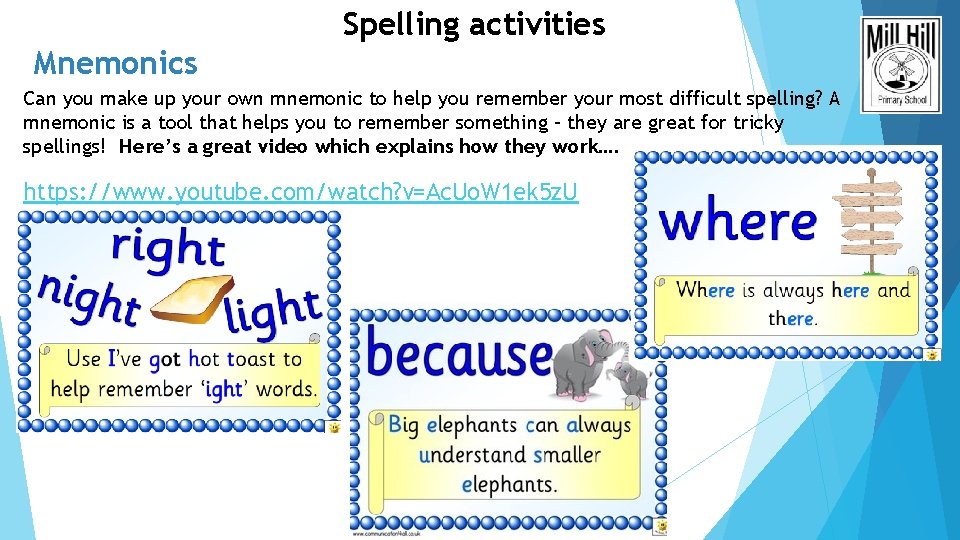
Spelling activities Mnemonics Can you make up your own mnemonic to help you remember your most difficult spelling? A mnemonic is a tool that helps you to remember something – they are great for tricky spellings! Here’s a great video which explains how they work…. https: //www. youtube. com/watch? v=Ac. Uo. W 1 ek 5 z. U
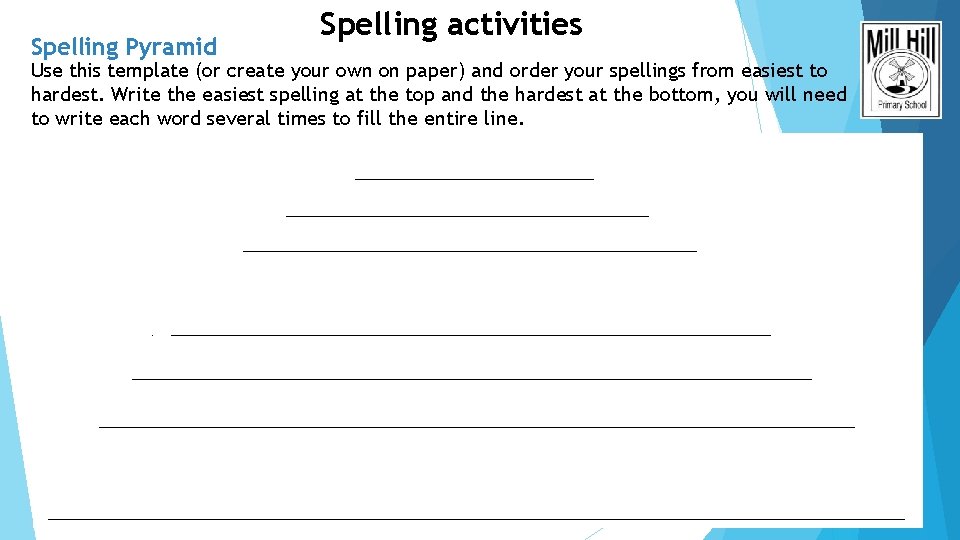
Spelling Pyramid Spelling activities Use this template (or create your own on paper) and order your spellings from easiest to hardest. Write the easiest spelling at the top and the hardest at the bottom, you will need to write each word several times to fill the entire line.
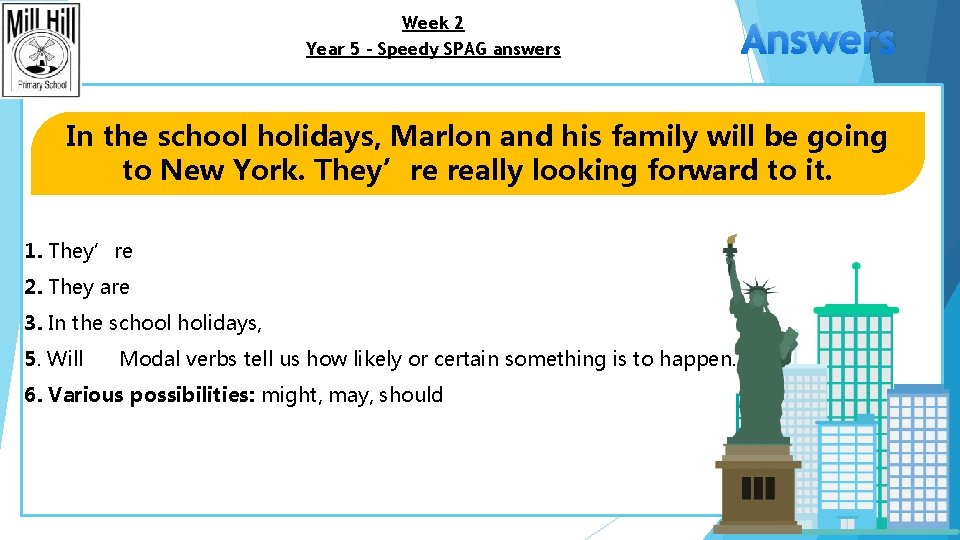
Week 2 Year 5 – Speedy SPAG An adverbial phrase does the same job as an adverb and is a group of words that tells us how, when or where the verb will happen. In the school holidays, Marlon and his family will be going to New York. They’re really looking forward to it. 1. Identify the contraction in the sentence. 2. Can you write the two words that have been contracted to make this contraction? 3. Can you find the adverbial phrase? 4. Can you identify the modal verb? What is a modal verb? 5. Can you replace the modal verb with another so the sentence still makes sense?
Week 2 Year 5 – Speedy SPAG Click onto the next page to see the answers
Week 2 Year 5 – Speedy SPAG answers Answers In the school holidays, Marlon and his family will be going to New York. They’re really looking forward to it. 1. They’re 2. They are 3. In the school holidays, 5. Will Modal verbs tell us how likely or certain something is to happen. 6. Various possibilities: might, may, should
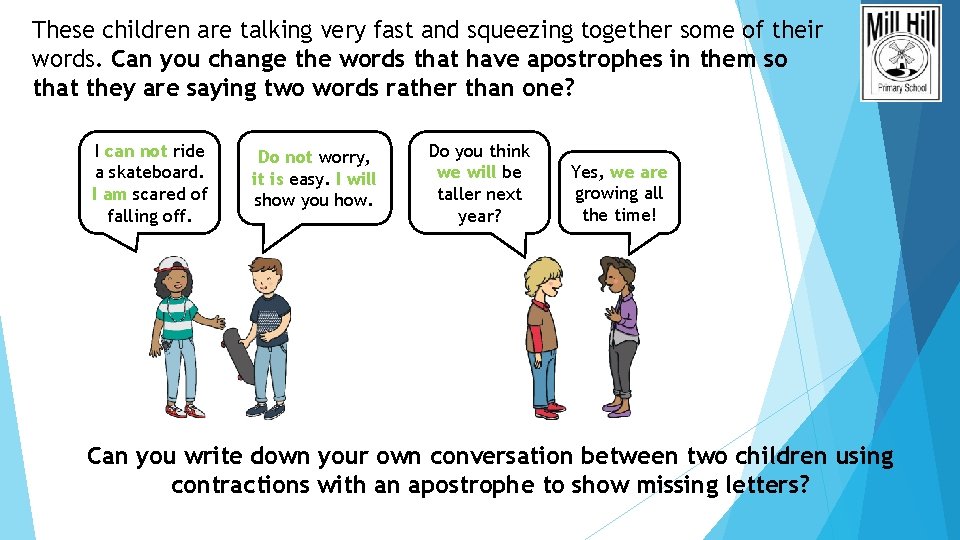
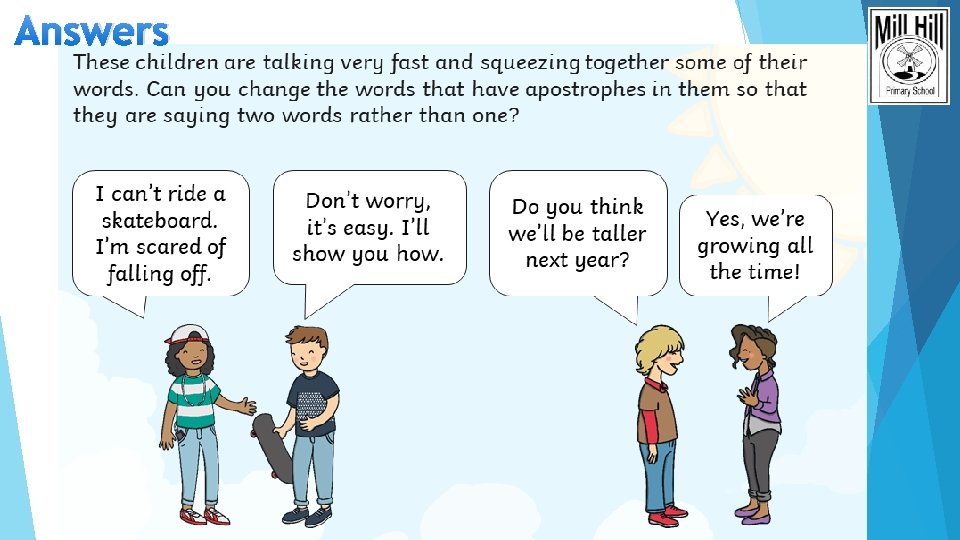
These children are talking very fast and squeezing together some of their words. Can you change the words that have apostrophes in them so that they are saying two words rather than one? II can’t not ride a askateboard. II’m am scared of of falling off. Do Don’t notworry, itit’s is easy. I I’ll will show you how. Do you think we will be we’ll be taller next year? Yes, we we’re are growing all the time! Can you write down your own conversation between two children using contractions with an apostrophe to show missing letters?
Answers
Answers
Answers