
Week 2 Logistics and Information Technology What did





- Slides: 35
Week 2 Logistics and Information Technology
What did we do last week? Summary of lectures document, consultation times and commitments Assessment 1, 2 and Exam discussion A brief overview and introduction into Logistics and Supply Chain Utility Systems and Total-Cost Approaches Today, you will attended your first tutorial, form groups and selected a topic to present
What are we doing today? To appreciate the importance of effective and efficient use of information for logistics management To learn about general types of information systems and their logistical applications To look at the Internet’s influence on logistics To learn about select information technology challenges
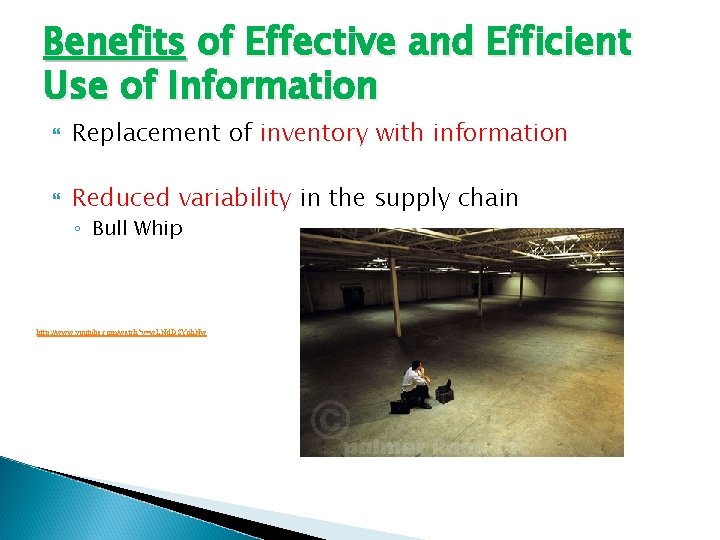
Benefits of Effective and Efficient Use of Information Replacement of inventory with information Reduced variability in the supply chain ◦ Bull Whip http: //www. youtube. com/watch? v=w. LNd. DSYqh. Nw
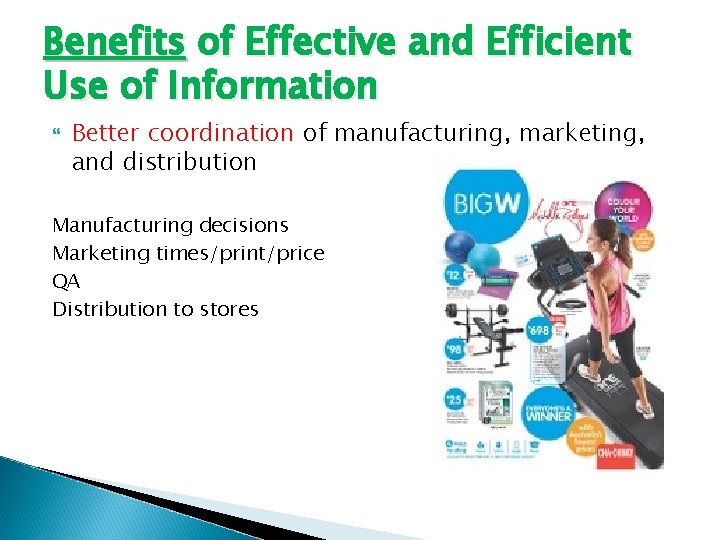
Benefits of Effective and Efficient Use of Information Better coordination of manufacturing, marketing, and distribution Manufacturing decisions Marketing times/print/price QA Distribution to stores
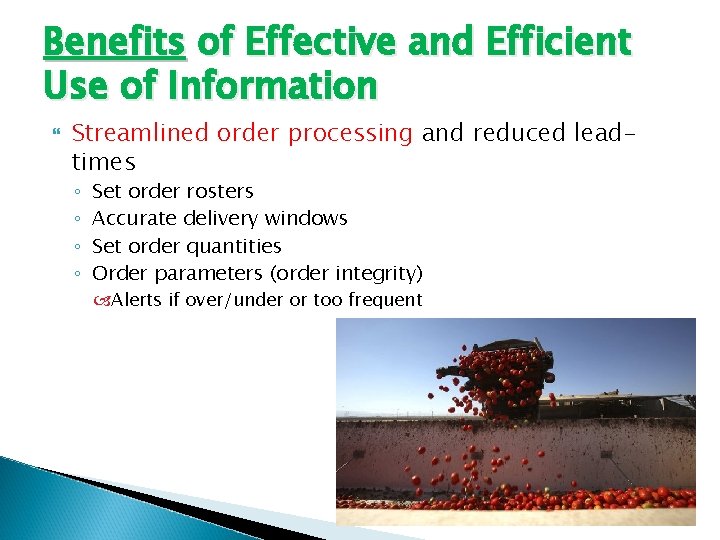
Benefits of Effective and Efficient Use of Information Streamlined order processing and reduced leadtimes ◦ ◦ Set order rosters Accurate delivery windows Set order quantities Order parameters (order integrity) Alerts if over/under or too frequent
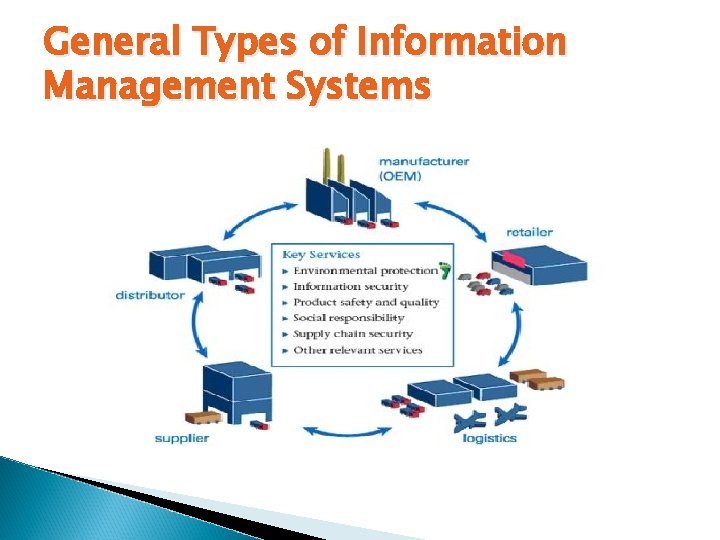
General Types of Information Management Systems
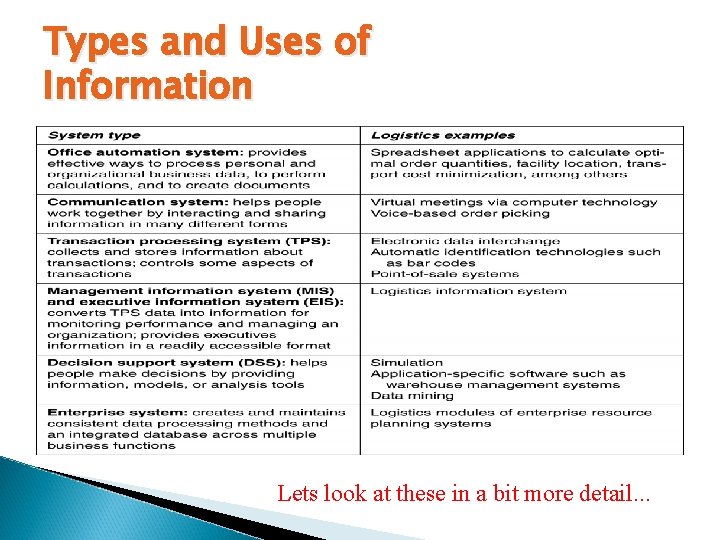
Types and Uses of Information Lets look at these in a bit more detail. . .
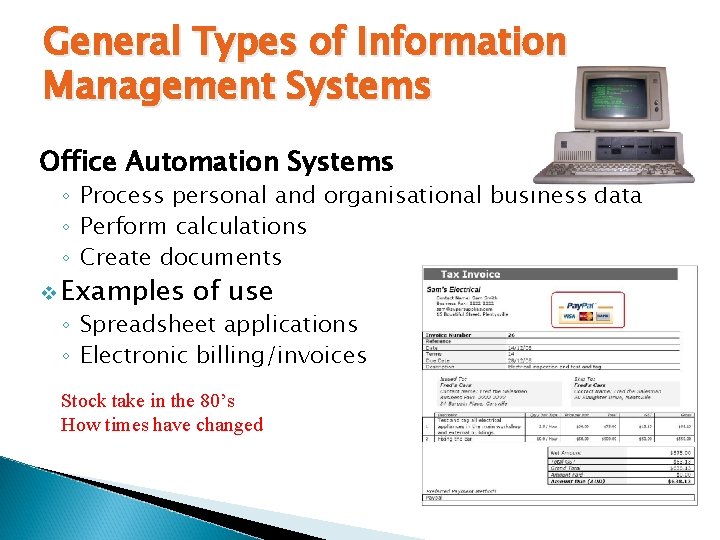
General Types of Information Management Systems Office Automation Systems ◦ Process personal and organisational business data ◦ Perform calculations ◦ Create documents v Examples of use ◦ Spreadsheet applications ◦ Electronic billing/invoices Stock take in the 80’s How times have changed
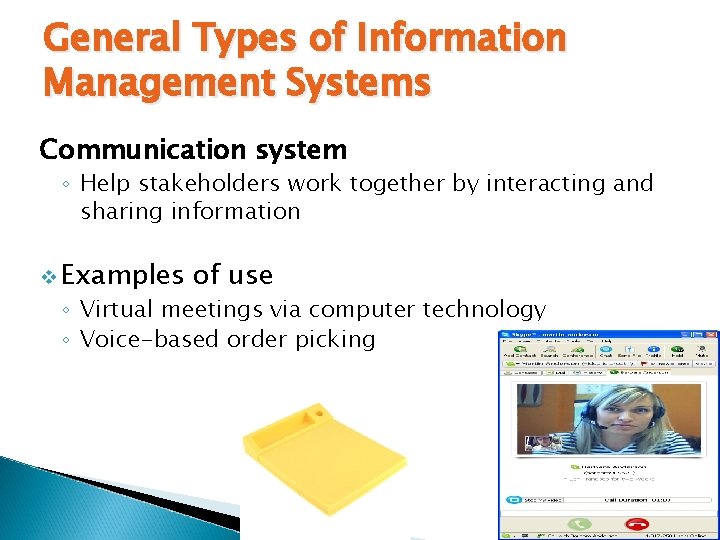
General Types of Information Management Systems Communication system ◦ Help stakeholders work together by interacting and sharing information v Examples of use ◦ Virtual meetings via computer technology ◦ Voice-based order picking
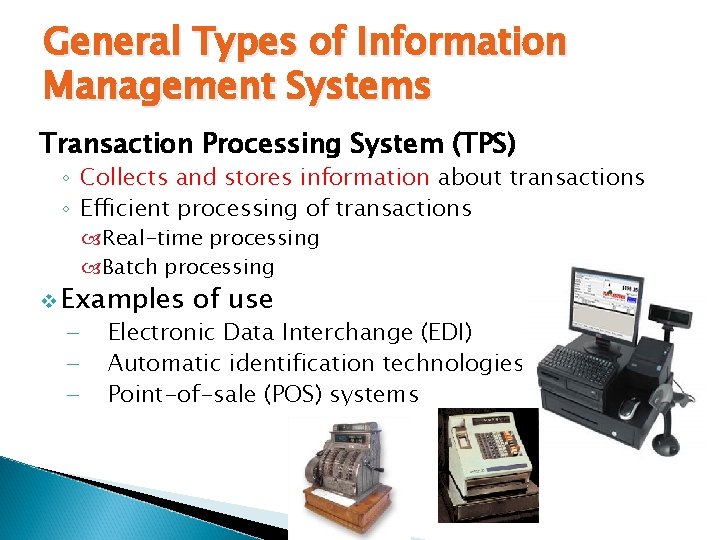
General Types of Information Management Systems Transaction Processing System (TPS) ◦ Collects and stores information about transactions ◦ Efficient processing of transactions Real-time processing Batch processing v Examples – – – of use Electronic Data Interchange (EDI) Automatic identification technologies Point-of-sale (POS) systems
General Types of Information Management Systems Transaction Processing System (TPS) (continued) ◦ Electronic Data Interchange Benefits Reduction in document preparation, processing, shipping errors and cycle times Compliance – know when you’re out of stock Drawbacks Batching Old technology – move to web-based systems http: //www. youtube. com/watch? v=9 nrp. Aka. YBf 8
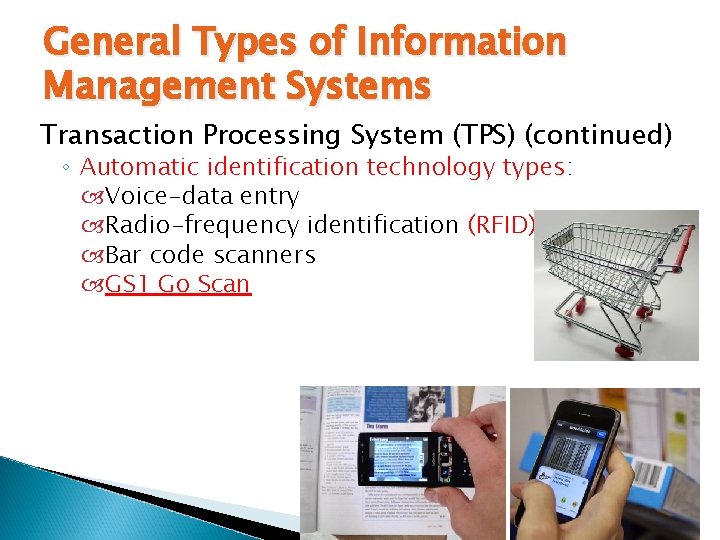
General Types of Information Management Systems Transaction Processing System (TPS) (continued) ◦ Automatic identification technology types: Voice-data entry Radio-frequency identification (RFID) Bar code scanners GS 1 Go Scan
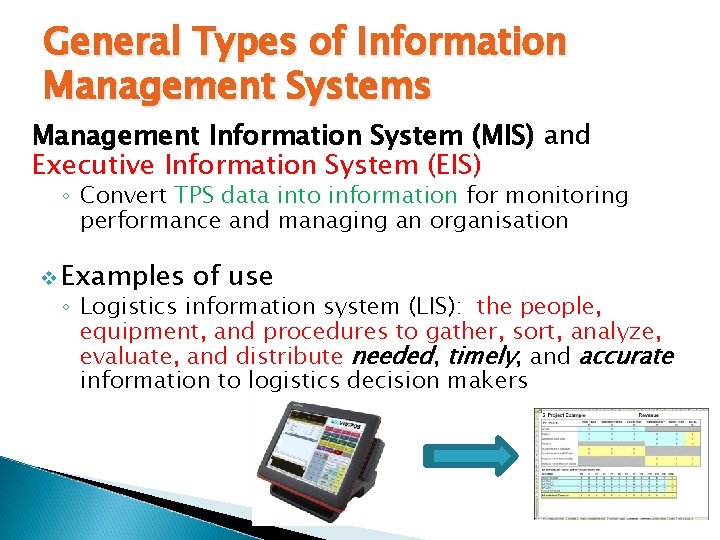
General Types of Information Management Systems Management Information System (MIS) and Executive Information System (EIS) ◦ Convert TPS data into information for monitoring performance and managing an organisation v Examples of use ◦ Logistics information system (LIS): the people, equipment, and procedures to gather, sort, analyze, evaluate, and distribute needed, timely, and accurate information to logistics decision makers
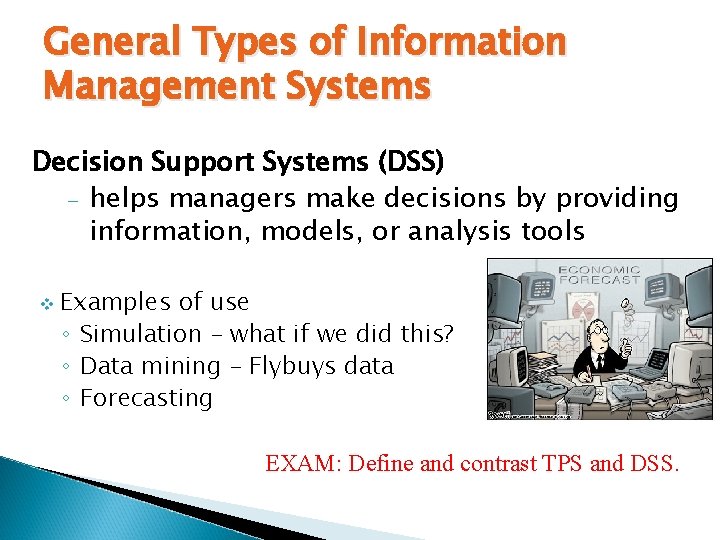
General Types of Information Management Systems Decision Support Systems (DSS) – helps managers make decisions by providing information, models, or analysis tools v Examples of use ◦ Simulation – what if we did this? ◦ Data mining – Flybuys data ◦ Forecasting EXAM: Define and contrast TPS and DSS.
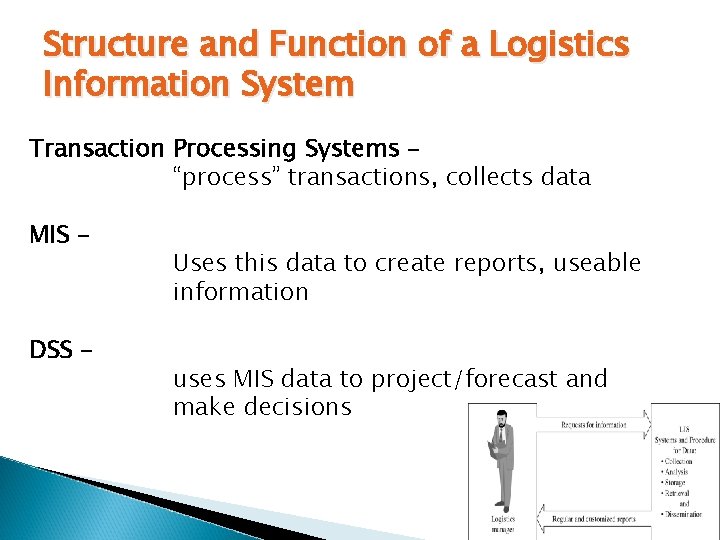
Structure and Function of a Logistics Information System Transaction Processing Systems – “process” transactions, collects data MIS – DSS – Uses this data to create reports, useable information uses MIS data to project/forecast and make decisions
General Types of Information Management Systems Enterprise resource planning (ERP) ◦ ISSUE: HR Vs. Inventory Vs. TPS Systems ◦ ◦ All company functional areas use a common database to: Standardize manufacturing processes Integrate financial data Standardize human resource data ◦ Benefits ◦ All functions input and get same information ◦ Shortcomings Costs of installation Time-consuming installation process
The Internet’s Influence on Logistics
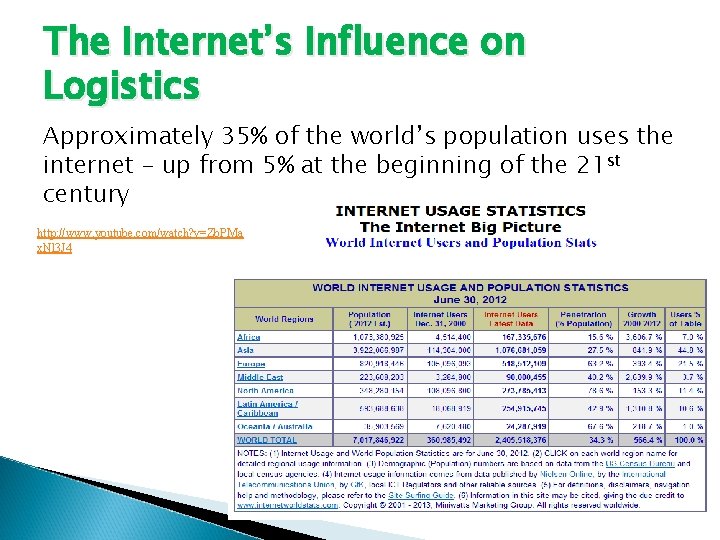
The Internet’s Influence on Logistics Approximately 35% of the world’s population uses the internet – up from 5% at the beginning of the 21 st century http: //www. youtube. com/watch? v=Zb. PMa x. Nl 3 J 4
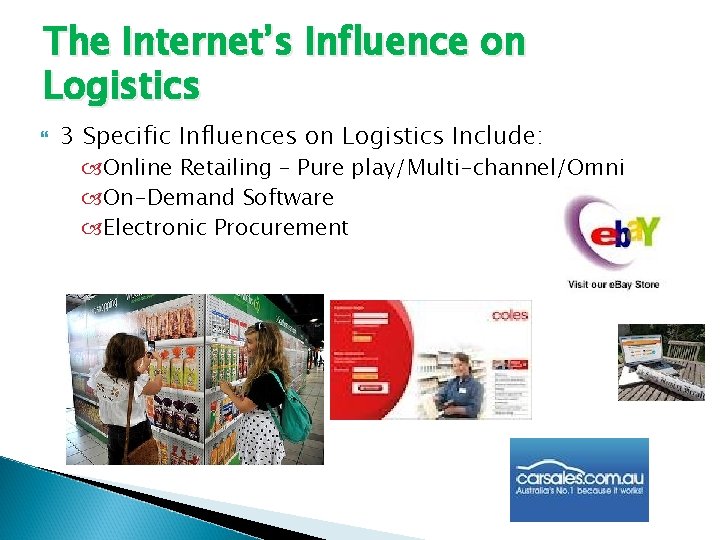
The Internet’s Influence on Logistics 3 Specific Influences on Logistics Include: Online Retailing – Pure play/Multi-channel/Omni On-Demand Software Electronic Procurement
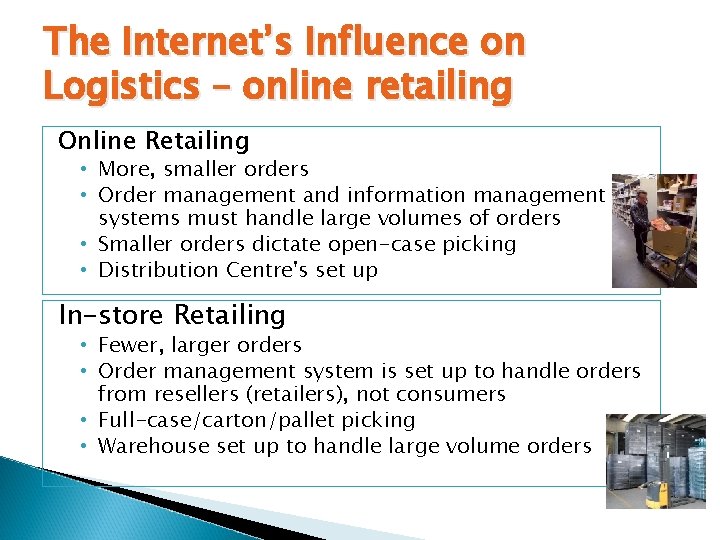
The Internet’s Influence on Logistics – online retailing Online Retailing • More, smaller orders • Order management and information management systems must handle large volumes of orders • Smaller orders dictate open-case picking • Distribution Centre's set up In-store Retailing • Fewer, larger orders • Order management system is set up to handle orders from resellers (retailers), not consumers • Full-case/carton/pallet picking • Warehouse set up to handle large volume orders
The Internet’s Influence on Logistics – online retailing Online Retailing • Totes and push carts used • Packaging is small cartons, envelopes, bags suited to holding small quantities In-store Retailing • Variety of materials handling equipment used • Packaging generally cartons that hold large volume orders
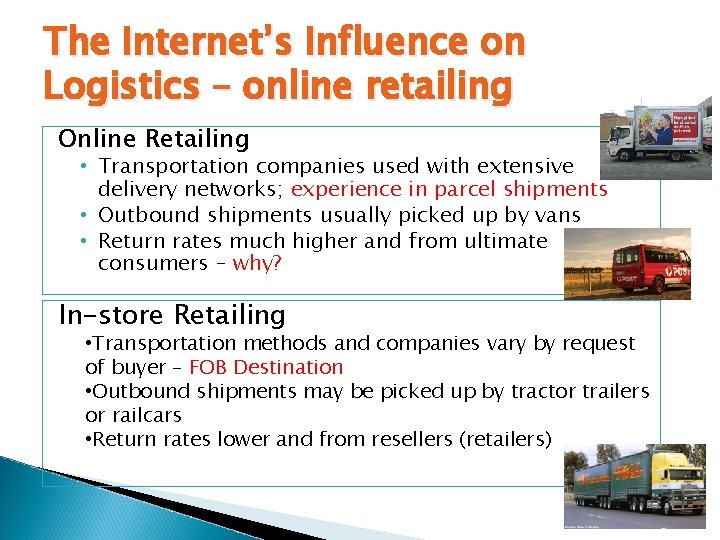
The Internet’s Influence on Logistics – online retailing Online Retailing • Transportation companies used with extensive delivery networks; experience in parcel shipments • Outbound shipments usually picked up by vans • Return rates much higher and from ultimate consumers – why? In-store Retailing • Transportation methods and companies vary by request of buyer – FOB Destination • Outbound shipments may be picked up by tractor trailers or railcars • Return rates lower and from resellers (retailers)
Other IT Issues Lets looks at other topical issues relating to modern logistics. . .
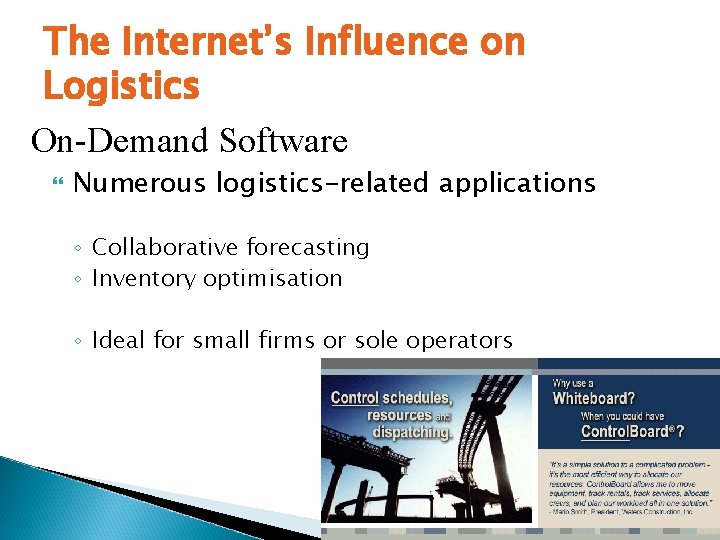
The Internet’s Influence on Logistics On-Demand Software Numerous logistics-related applications ◦ Collaborative forecasting ◦ Inventory optimisation ◦ Ideal for small firms or sole operators
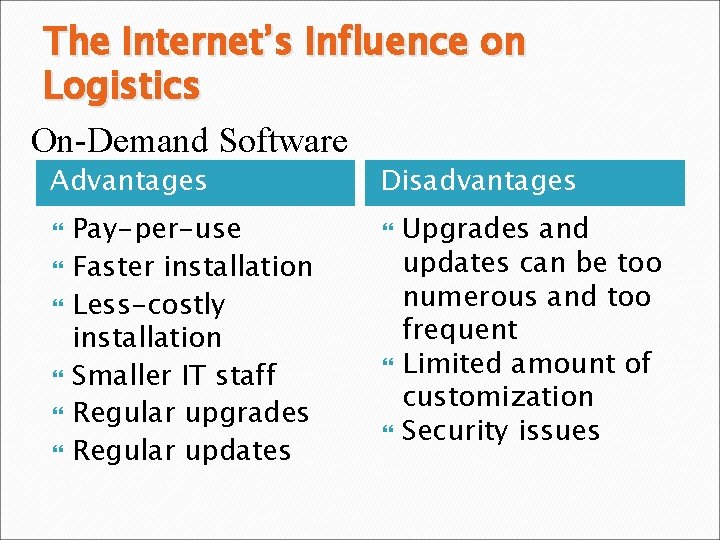
The Internet’s Influence on Logistics On-Demand Software Advantages Pay-per-use Faster installation Less-costly installation Smaller IT staff Regular upgrades Regular updates Disadvantages Upgrades and updates can be too numerous and too frequent Limited amount of customization Security issues
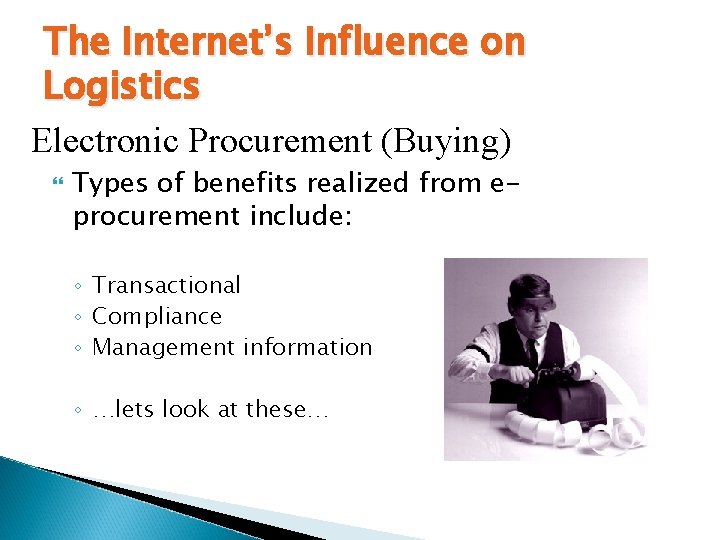
The Internet’s Influence on Logistics Electronic Procurement (Buying) Types of benefits realized from eprocurement include: ◦ Transactional ◦ Compliance ◦ Management information ◦ …lets look at these…
E-Procurement Easier, faster, Less Expensive Environment: ◦ Recognition of the large costs of procurement Complex, expertise needed, time-consuming ◦ 1998 -2000 hundreds of e-markets established While benefits to buyers were often clear, the benefits to suppliers were less so ◦ Evaluating Hard Benefits – Save money, lower prices Soft Benefits – Time saved by moving to e-procurement Intangible Benefits – Recognising that e-procurement is a potential market differentiation factor http: //www. youtube. com/watch? v=Oj. UVgqpbd. Sg
E-Procurement Other Benefits: ◦ Transactional Benefits – Reduce Invoice to Payment period, Automatic payment options. ◦ Compliance Benefits – Adherence to established procurement policies, OTB, approved suppliers ◦ Management Benefits – Information on processing speeds, customer satisfaction levels, Stock Outs. . . ◦ Price Benefits – Physical cost savings, eg. No paper invoices, no postage, etc. .
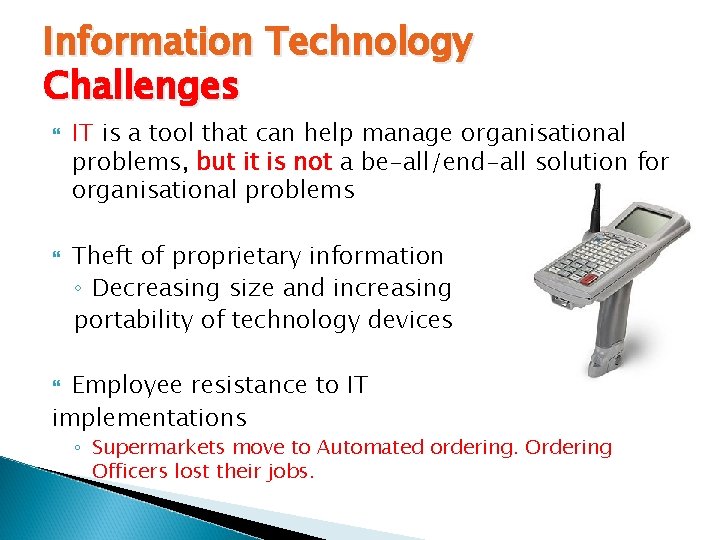
Information Technology Challenges IT is a tool that can help manage organisational problems, but it is not a be-all/end-all solution for organisational problems Theft of proprietary information ◦ Decreasing size and increasing portability of technology devices Employee resistance to IT implementations ◦ Supermarkets move to Automated ordering. Ordering Officers lost their jobs.
E-Procurement Issues: ◦ Security – Transmission of information, billing, accounts, order sizes. ◦ Impersonal – Loose that “human touch”, the ability to negotiate, network and establish working relationships ◦ Confidence – Concerns that staff lack the ability to effectively utilise the system to its potential
E-Procurement: The reality To capture these benefits from e. Procurement organisations need to invest heavily in: ◦ ◦ Changing internal procurement processes Integrating e-marketplaces in internal systems Purchasing B 2 B applications, and Paying e-marketplace transaction fee/subscription fee Source: Forrester Research 32
E-Procurement Reverse Auctions: ◦ Ability for organisation to place an order for Goods online and let potential suppliers bid. ◦ Unlike normal auction (Highest Bidder Wins), Reserve means (Lowest Bid gets the Business) ◦ Buyers – able to generate the lowest procurement price quickly ◦ Suppliers – concerns that the main focus is on price However, suppliers also gain information during the process, eg, how many bidders (competitors) in market, what is the market price, who are the buyers…
Exam Hints ◦ In order for firms to leverage the benefits of e. Procurement technology, they need to attain certain operational objectives. Describe and provide an example of each. ◦ There is debate about the benefits of Reverse Auctions. Describe what is meant by ‘Reverse Auction’ and explain the current debate. 34
Next Week Reading: Murphy & Wood, Ch. 2 Next week: Strategic and Financial Logistics