
Week 2 DecisionMaking Processes What is a Decision
- Slides: 49
Week 2 Decision-Making Processes
What is a Decision? n A choice made between alternative courses of action in a situation of uncertainty
Decisions Everywhere n Personal Decisions n n What to eat What movie to watch Whether or not to go to graduate school Business Decisions n n n How much to charge for a product Where to advertise Which job candidate to hire
Decision Making n Part of Problem Solving n n PS – the process of closing the gap between reality and a more desirable situation Need a Decision Statement or what are you trying to decide Alternatives – the possible decisions that you can make Decision making criteria – what you want to optimize in a decision
Decision Style n The manner by which decision makers think and react to problems n n perceive a problem cognitive response values and beliefs When making decisions, people… n n follow different steps/sequence give different emphasis, time allotment, and priority to each steps
Decision Style n n Personality temperament tests are often used to determine decision styles There are many such tests n n n Meyers/Briggs, True Colors (Birkman), Keirsey Temperament Theory, … Various tests measure somewhat different aspects of personality They cannot be equated!
Decision Style n Decision-making styles n n Heuristic versus Analytic Autocratic versus Democratic Consultative (with individuals or groups) A successful computerized system should fit the decision style and the decision situation n Should be flexible and adaptable to different users (individuals vs. groups)
What is your Decision Style? n Go to course website and complete Decision Style Inventory http: //faculty. tamucc. edu/rcutshall/dss 2011. html
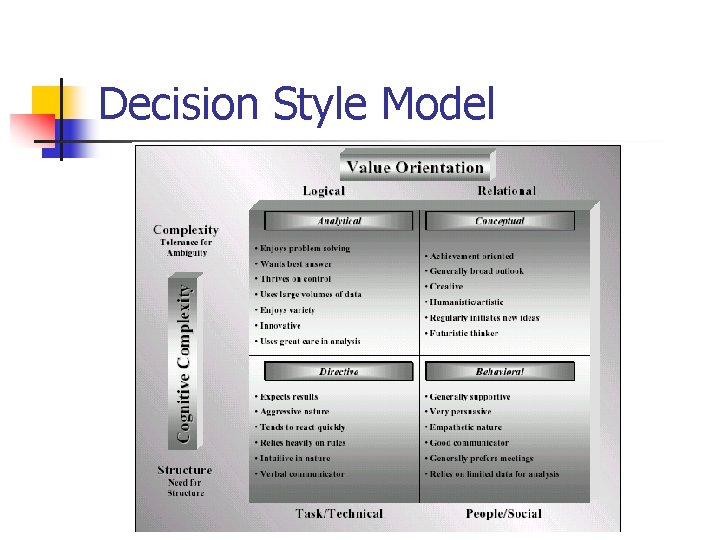
Decision Style Model
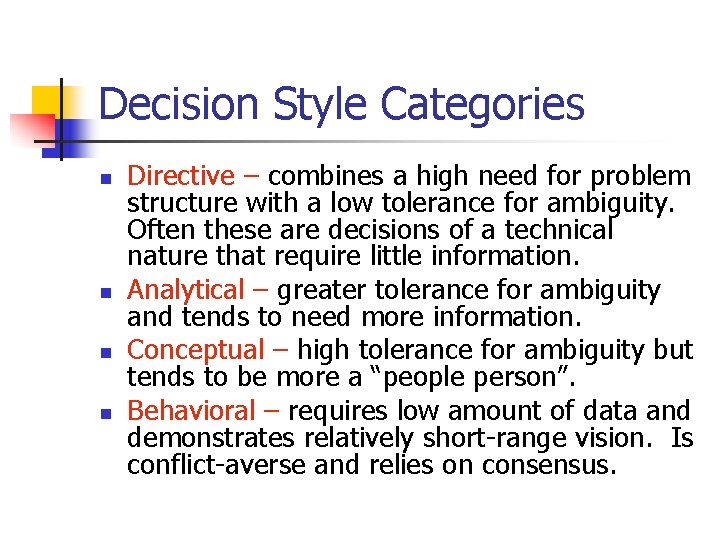
Decision Style Categories n n Directive – combines a high need for problem structure with a low tolerance for ambiguity. Often these are decisions of a technical nature that require little information. Analytical – greater tolerance for ambiguity and tends to need more information. Conceptual – high tolerance for ambiguity but tends to be more a “people person”. Behavioral – requires low amount of data and demonstrates relatively short-range vision. Is conflict-averse and relies on consensus.
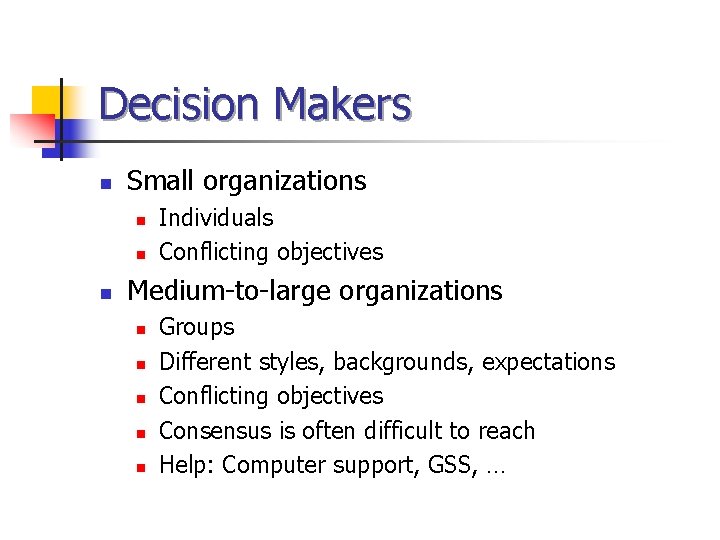
Decision Makers n Small organizations n n n Individuals Conflicting objectives Medium-to-large organizations n n n Groups Different styles, backgrounds, expectations Conflicting objectives Consensus is often difficult to reach Help: Computer support, GSS, …
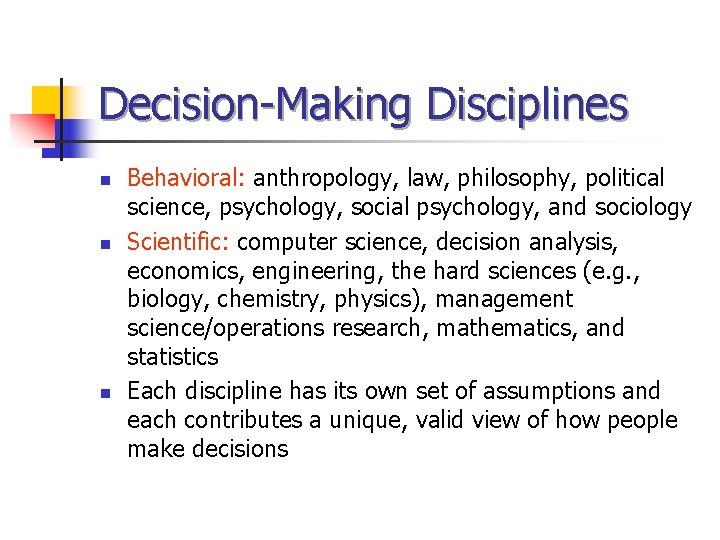
Decision-Making Disciplines n n n Behavioral: anthropology, law, philosophy, political science, psychology, social psychology, and sociology Scientific: computer science, decision analysis, economics, engineering, the hard sciences (e. g. , biology, chemistry, physics), management science/operations research, mathematics, and statistics Each discipline has its own set of assumptions and each contributes a unique, valid view of how people make decisions
Effectiveness vs. Efficiency n DSS supports effectiveness of the decision and efficiency may be a byproduct
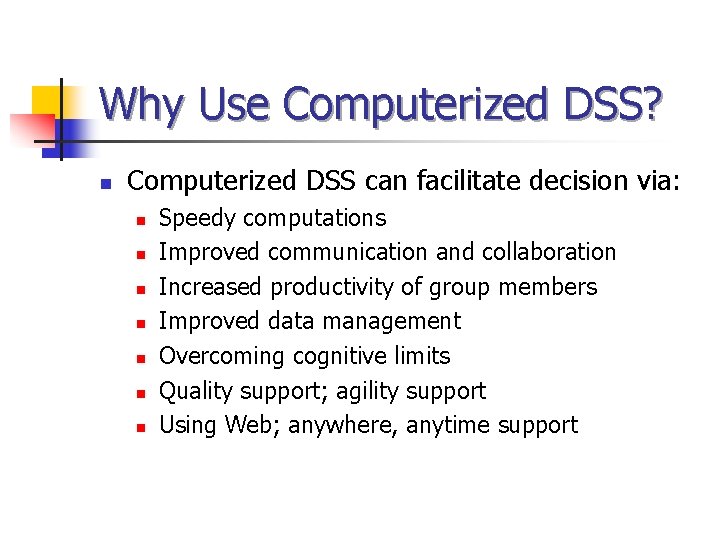
Why Use Computerized DSS? n Computerized DSS can facilitate decision via: n n n n Speedy computations Improved communication and collaboration Increased productivity of group members Improved data management Overcoming cognitive limits Quality support; agility support Using Web; anywhere, anytime support
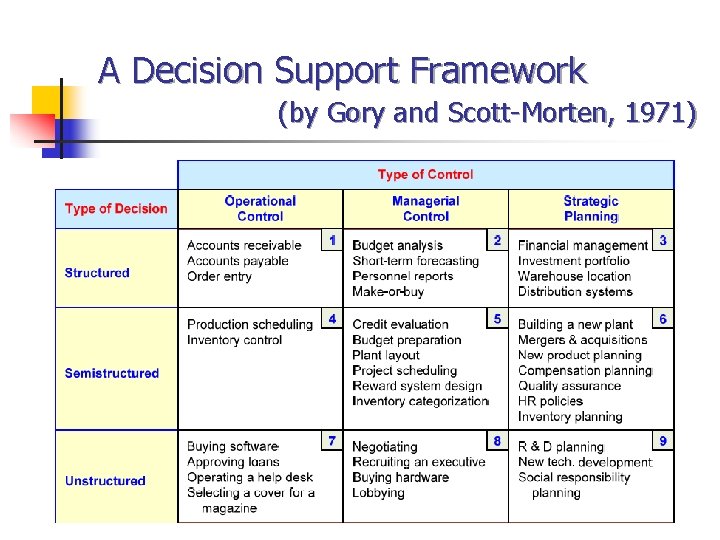
A Decision Support Framework (by Gory and Scott-Morten, 1971)
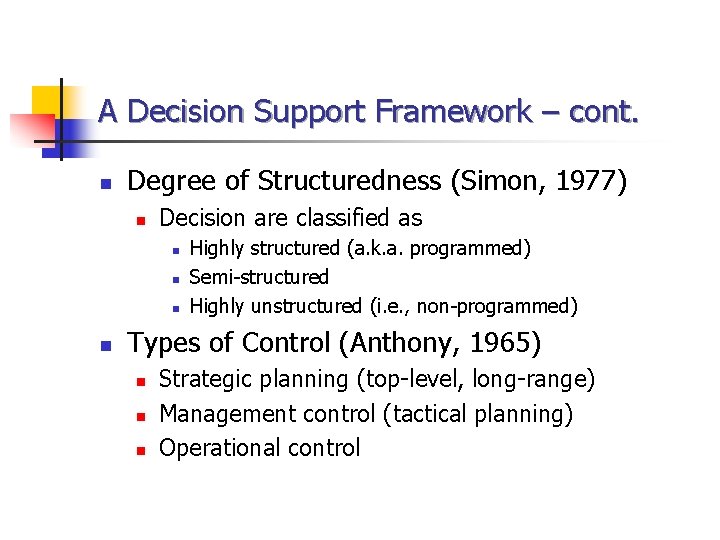
A Decision Support Framework – cont. n Degree of Structuredness (Simon, 1977) n Decision are classified as n n Highly structured (a. k. a. programmed) Semi-structured Highly unstructured (i. e. , non-programmed) Types of Control (Anthony, 1965) n n n Strategic planning (top-level, long-range) Management control (tactical planning) Operational control
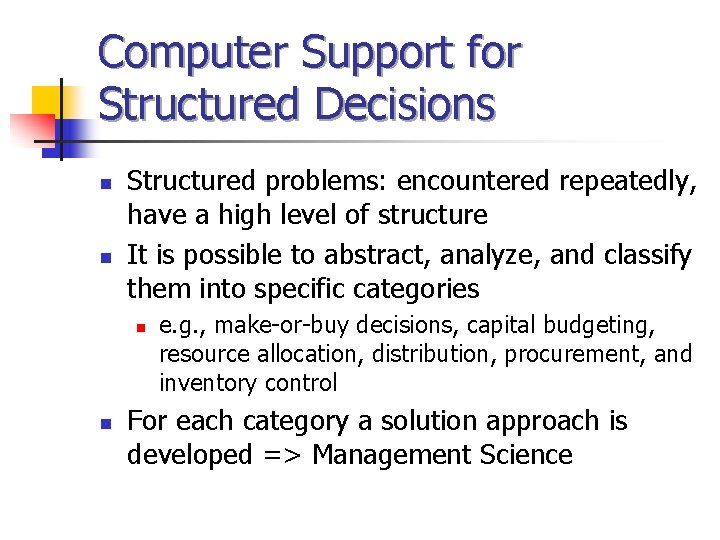
Computer Support for Structured Decisions n n Structured problems: encountered repeatedly, have a high level of structure It is possible to abstract, analyze, and classify them into specific categories n n e. g. , make-or-buy decisions, capital budgeting, resource allocation, distribution, procurement, and inventory control For each category a solution approach is developed => Management Science
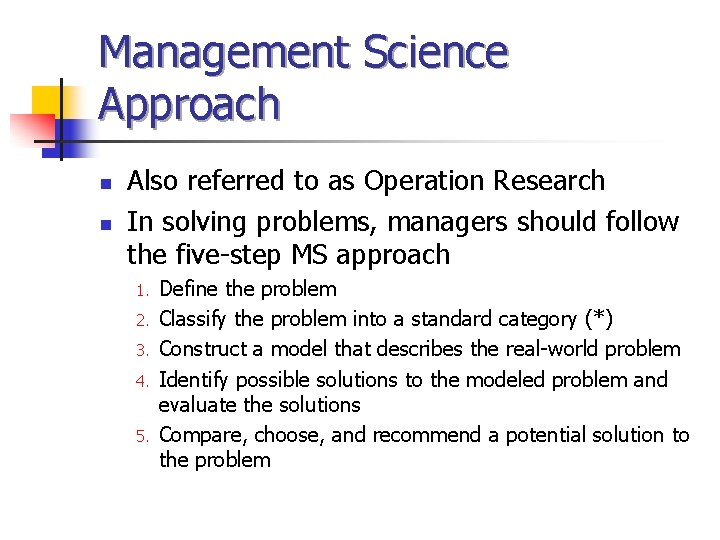
Management Science Approach n n Also referred to as Operation Research In solving problems, managers should follow the five-step MS approach 1. 2. 3. 4. 5. Define the problem Classify the problem into a standard category (*) Construct a model that describes the real-world problem Identify possible solutions to the modeled problem and evaluate the solutions Compare, choose, and recommend a potential solution to the problem
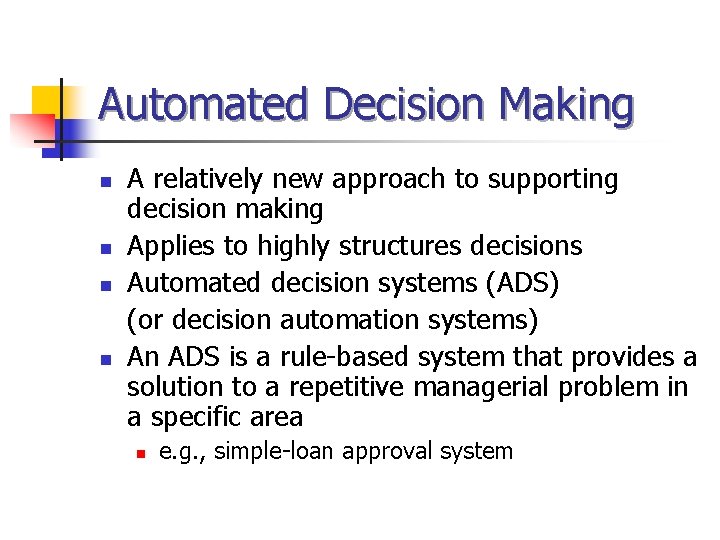
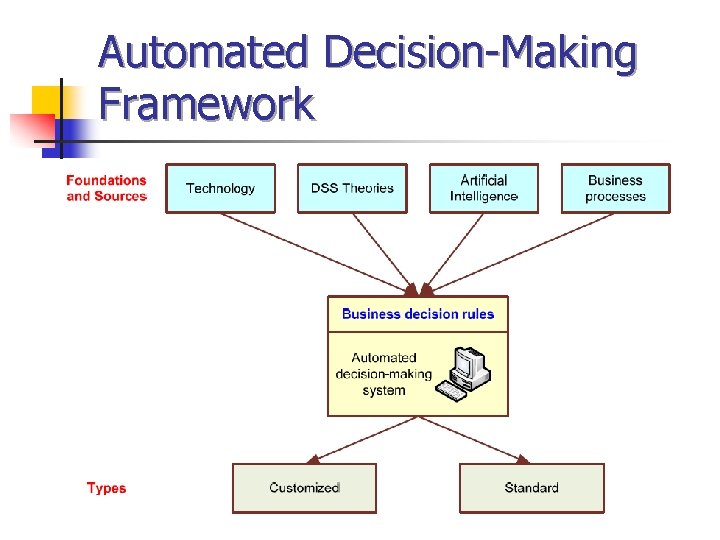
Automated Decision Making n n A relatively new approach to supporting decision making Applies to highly structures decisions Automated decision systems (ADS) (or decision automation systems) An ADS is a rule-based system that provides a solution to a repetitive managerial problem in a specific area n e. g. , simple-loan approval system
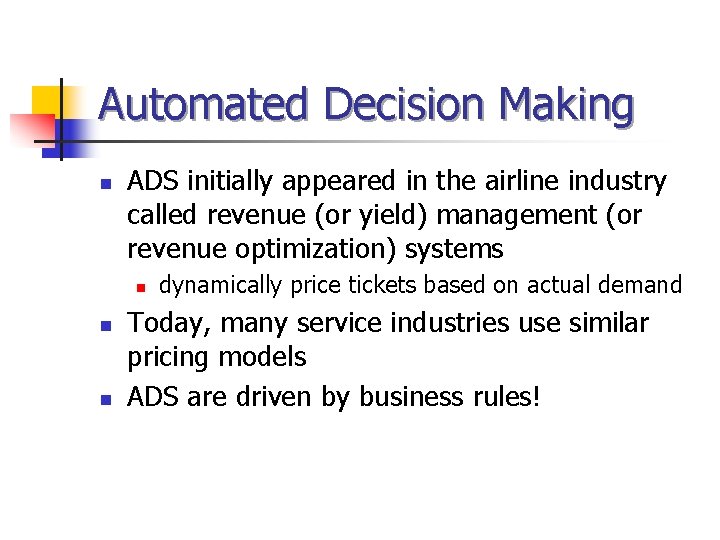
Automated Decision Making n ADS initially appeared in the airline industry called revenue (or yield) management (or revenue optimization) systems n n n dynamically price tickets based on actual demand Today, many service industries use similar pricing models ADS are driven by business rules!
Computer Support for Unstructured Decisions n n n Unstructured problems can be only partially supported by standard computerized quantitative methods They often require customized solutions They benefit from data and information Intuition and judgment may play a role Computerized communication and collaboration technologies along with knowledge management is often used
Computer Support for Semi-structured Problems n n n Solving semi-structured problems may involve a combination of standard solution procedures and human judgment MS handles the structured parts while DSS deals with the unstructured parts With proper data and information, a range of alternative solutions, along with their potential impacts
Automated Decision-Making Framework
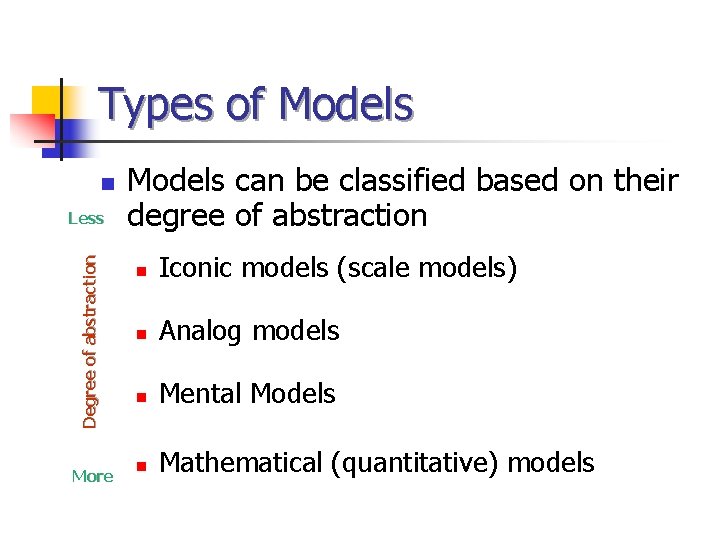
Model n n n A significant part of many DSS and BI systems A model is a simplified representation (or abstraction) of reality Often, reality is too complex to describe Much of the complexity is actually irrelevant in solving a specific problem Models can represent systems/problems at various degrees of abstraction
Types of Models n Degree of abstraction Less More Models can be classified based on their degree of abstraction n Iconic models (scale models) n Analog models n Mental Models n Mathematical (quantitative) models
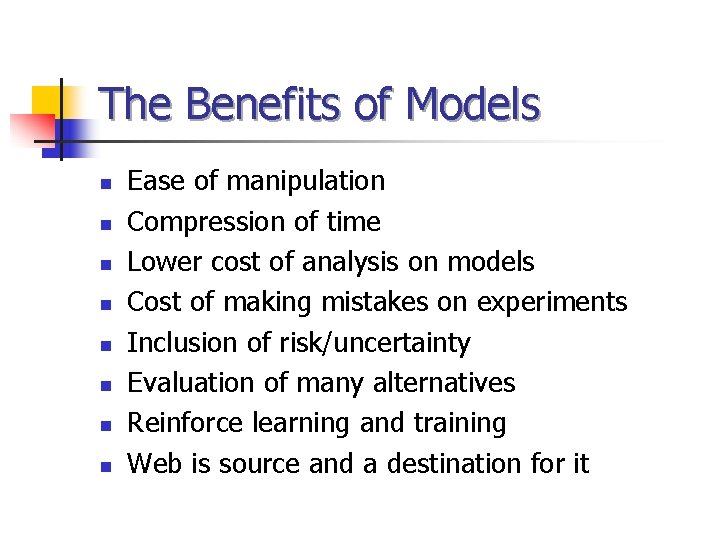
The Benefits of Models n n n n Ease of manipulation Compression of time Lower cost of analysis on models Cost of making mistakes on experiments Inclusion of risk/uncertainty Evaluation of many alternatives Reinforce learning and training Web is source and a destination for it
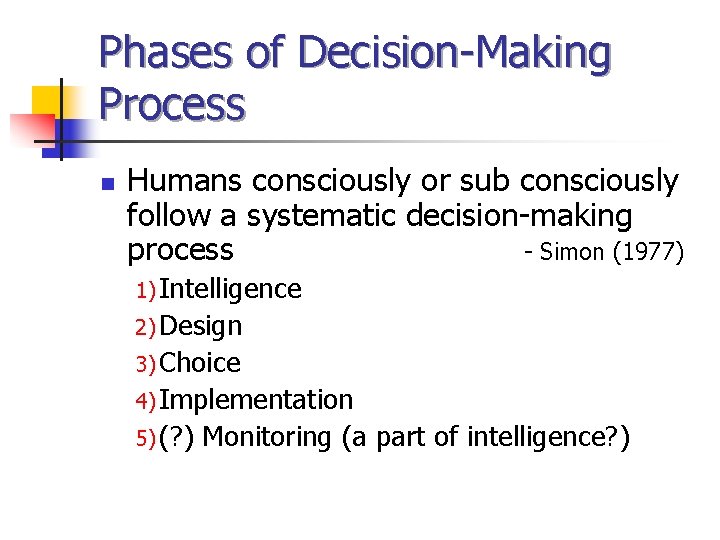
Phases of Decision-Making Process n Humans consciously or sub consciously follow a systematic decision-making process - Simon (1977) 1) Intelligence 2) Design 3) Choice 4) Implementation 5) (? ) Monitoring (a part of intelligence? )
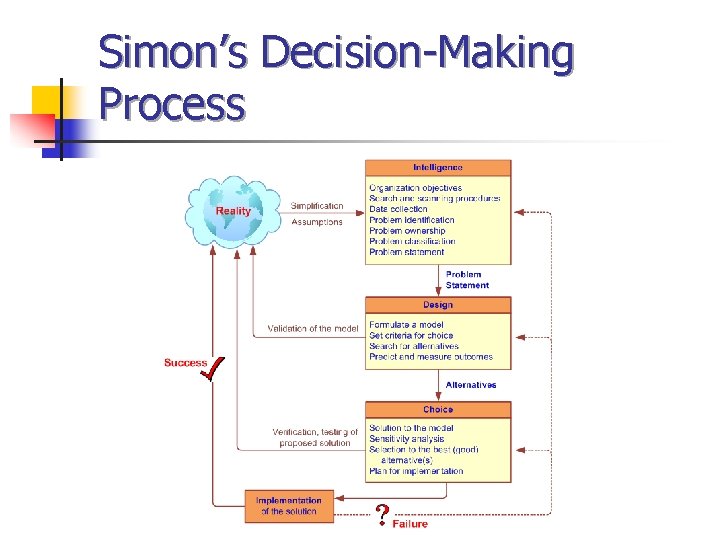
Simon’s Decision-Making Process
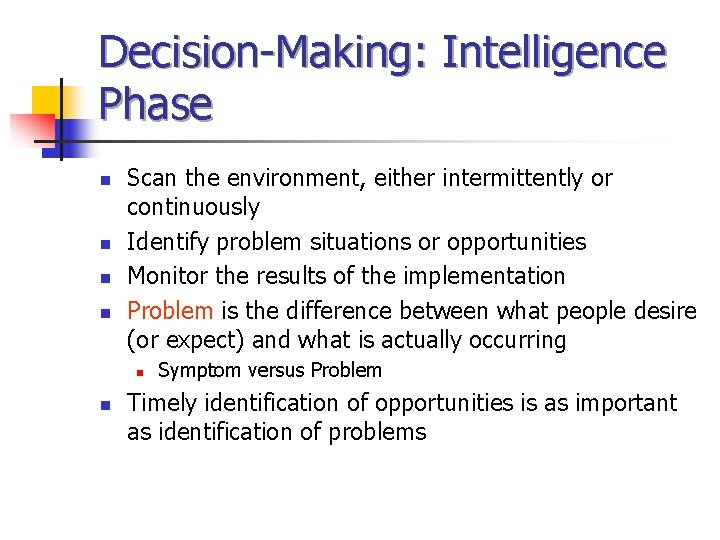
Decision-Making: Intelligence Phase n n Scan the environment, either intermittently or continuously Identify problem situations or opportunities Monitor the results of the implementation Problem is the difference between what people desire (or expect) and what is actually occurring n n Symptom versus Problem Timely identification of opportunities is as important as identification of problems
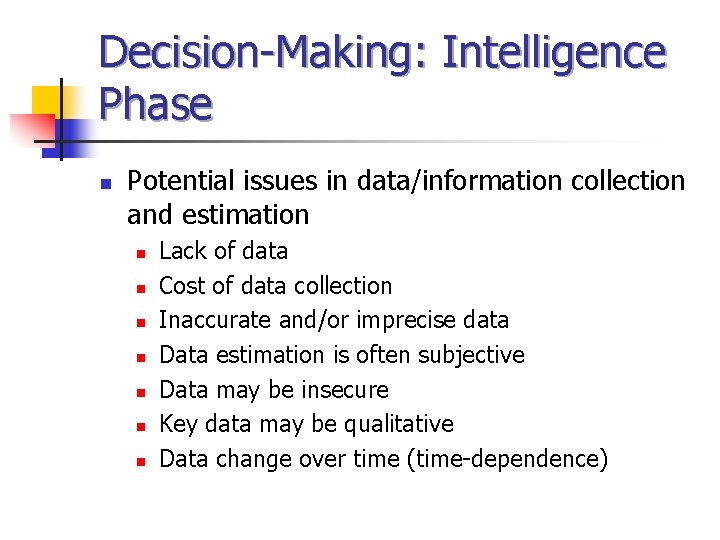
Decision-Making: Intelligence Phase n Potential issues in data/information collection and estimation n n n Lack of data Cost of data collection Inaccurate and/or imprecise data Data estimation is often subjective Data may be insecure Key data may be qualitative Data change over time (time-dependence)
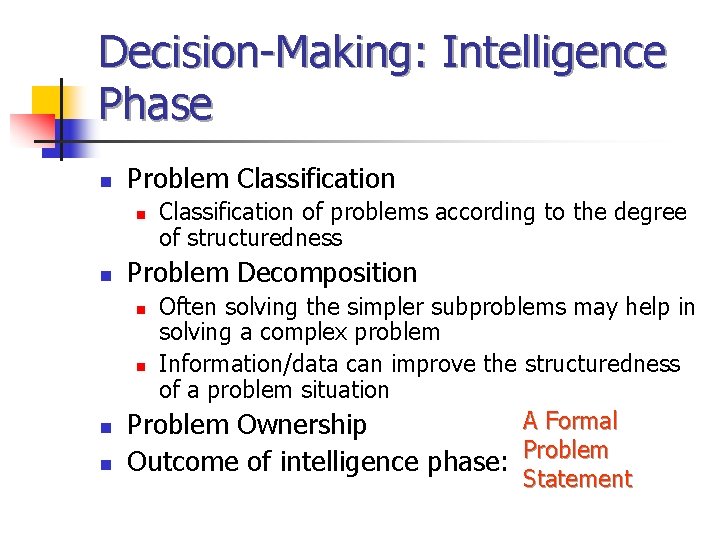
Decision-Making: Intelligence Phase n Problem Classification n n Problem Decomposition Often solving the simpler subproblems may help in solving a complex problem n Information/data can improve the structuredness of a problem situation A Formal Problem Ownership Outcome of intelligence phase: Problem Statement n n n Classification of problems according to the degree of structuredness
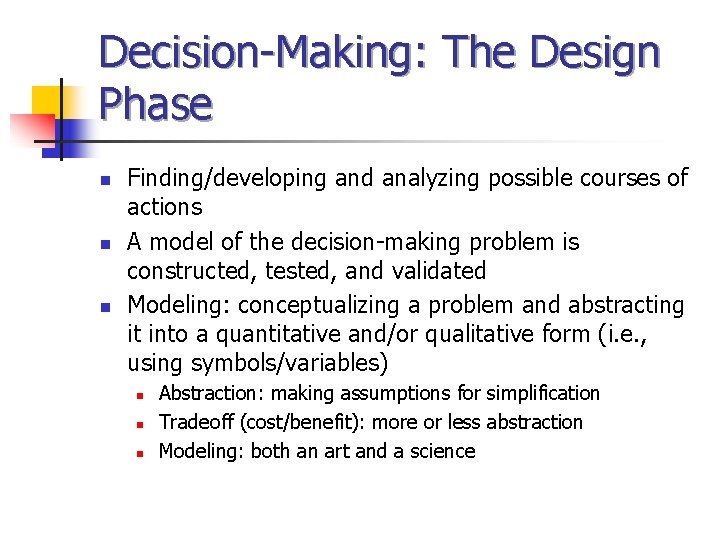
Decision-Making: The Design Phase n n n Finding/developing and analyzing possible courses of actions A model of the decision-making problem is constructed, tested, and validated Modeling: conceptualizing a problem and abstracting it into a quantitative and/or qualitative form (i. e. , using symbols/variables) n n n Abstraction: making assumptions for simplification Tradeoff (cost/benefit): more or less abstraction Modeling: both an art and a science
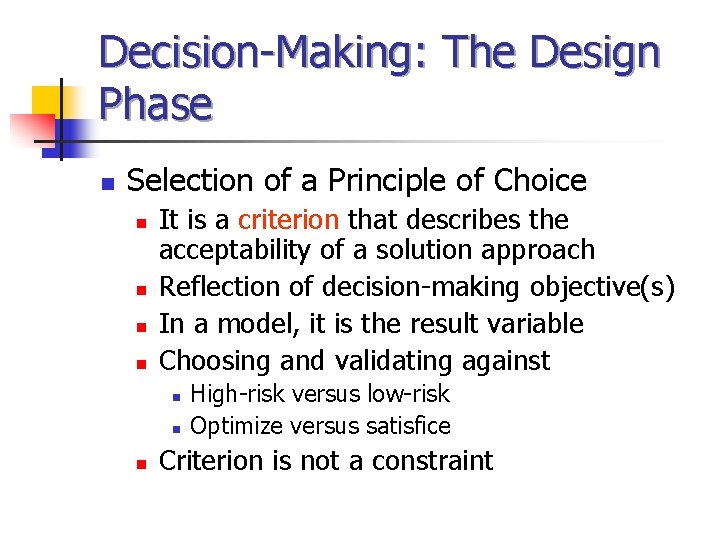
Decision-Making: The Design Phase n Selection of a Principle of Choice n n It is a criterion that describes the acceptability of a solution approach Reflection of decision-making objective(s) In a model, it is the result variable Choosing and validating against n n n High-risk versus low-risk Optimize versus satisfice Criterion is not a constraint
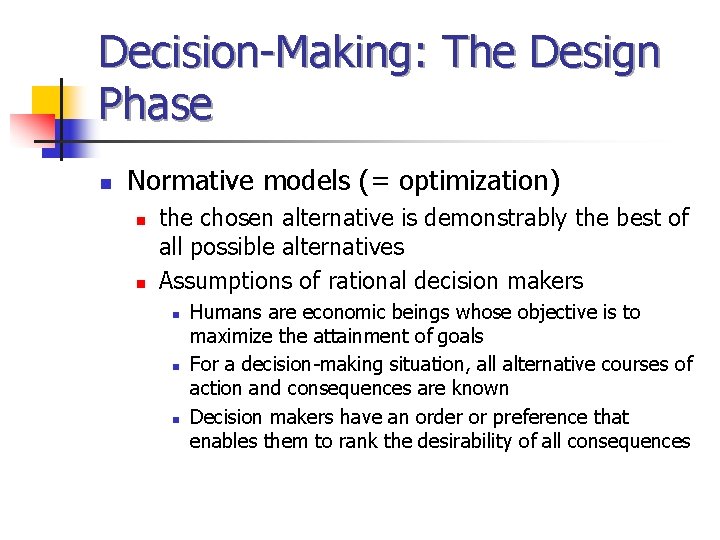
Decision-Making: The Design Phase n Normative models (= optimization) n n the chosen alternative is demonstrably the best of all possible alternatives Assumptions of rational decision makers n n n Humans are economic beings whose objective is to maximize the attainment of goals For a decision-making situation, all alternative courses of action and consequences are known Decision makers have an order or preference that enables them to rank the desirability of all consequences
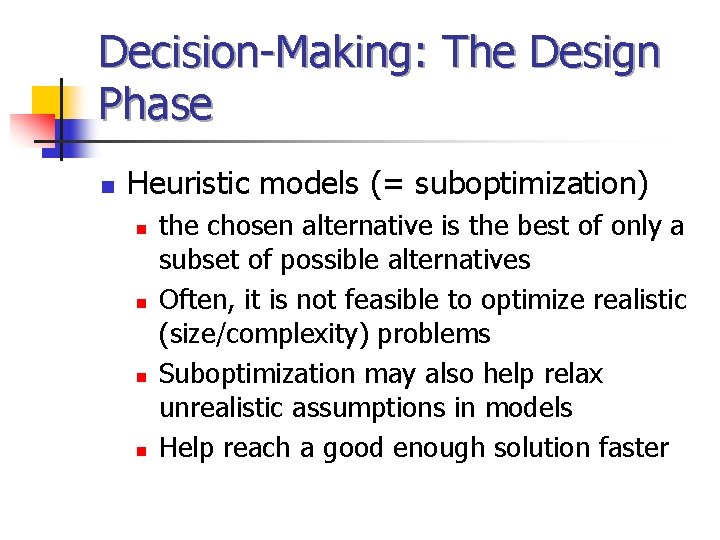
Decision-Making: The Design Phase n Heuristic models (= suboptimization) n n the chosen alternative is the best of only a subset of possible alternatives Often, it is not feasible to optimize realistic (size/complexity) problems Suboptimization may also help relax unrealistic assumptions in models Help reach a good enough solution faster
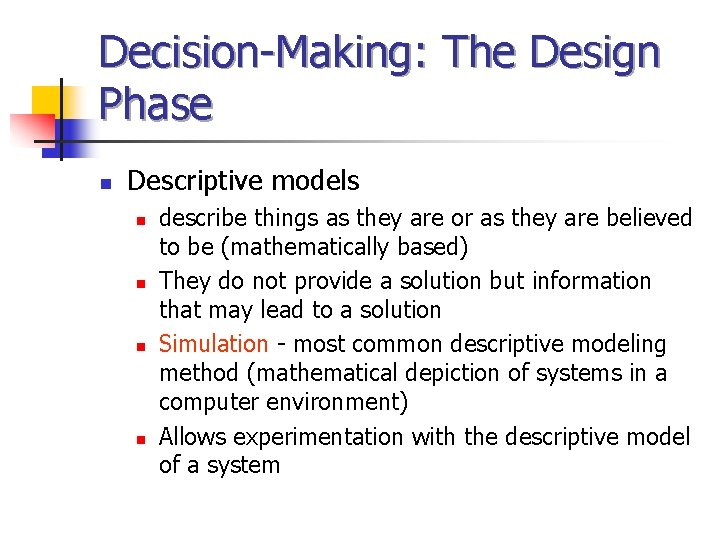
Decision-Making: The Design Phase n Descriptive models n n describe things as they are or as they are believed to be (mathematically based) They do not provide a solution but information that may lead to a solution Simulation - most common descriptive modeling method (mathematical depiction of systems in a computer environment) Allows experimentation with the descriptive model of a system
Decision-Making: The Design Phase n Good Enough, or Satisficing “something less than the best” n A form of suboptimization n Seeking to achieving a desired level of performance as opposed to the “best” n Benefit: time saving n Simon’s idea of bounded rationality
Decision-Making: The Design Phase n Developing (Generating) Alternatives n n In optimization models (such as linear programming), the alternatives may be generated automatically In most MSS situations, however, it is necessary to generate alternatives manually Use of GSS helps generating alternatives Measuring/ranking the outcomes n Using the principle of choice
Decision-Making: The Design Phase n Risk n n n Lack of precise knowledge (uncertainty) Risk can be measured with probability Scenario (what-if case) n n A statement of assumptions about the operating environment (variables) of a particular system at a given time Possible scenarios: best, worst, most likely, average (and custom intervals)
Decision-Making: The Choice Phase n n The actual decision and the commitment to follow a certain course of action are made here The boundary between the design and choice is often unclear (partially overlapping phases) n n n Generate alternatives while performing evaluations Includes the search, evaluation, and recommendation of an appropriate solution to the model Solving the model versus solving the problem!
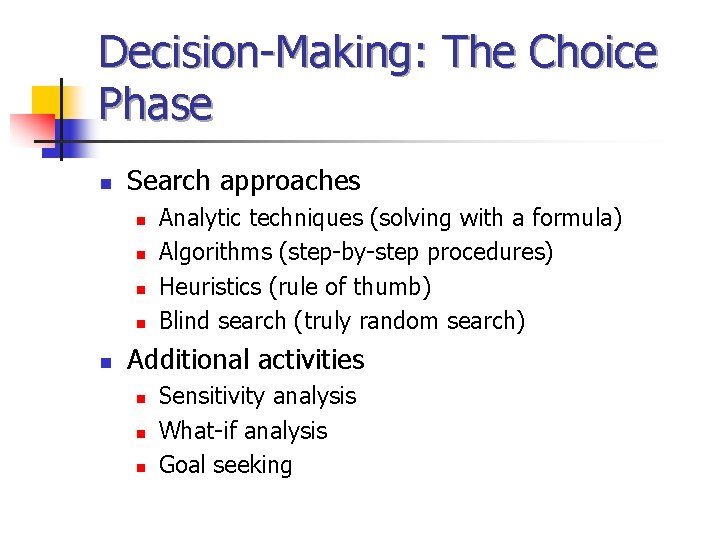
Decision-Making: The Choice Phase n Search approaches n n n Analytic techniques (solving with a formula) Algorithms (step-by-step procedures) Heuristics (rule of thumb) Blind search (truly random search) Additional activities n n n Sensitivity analysis What-if analysis Goal seeking
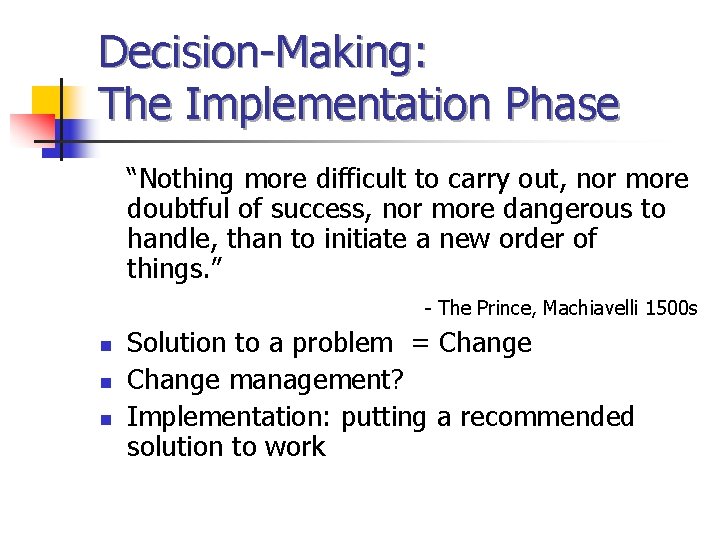
Decision-Making: The Implementation Phase “Nothing more difficult to carry out, nor more doubtful of success, nor more dangerous to handle, than to initiate a new order of things. ” - The Prince, Machiavelli 1500 s n n n Solution to a problem = Change management? Implementation: putting a recommended solution to work
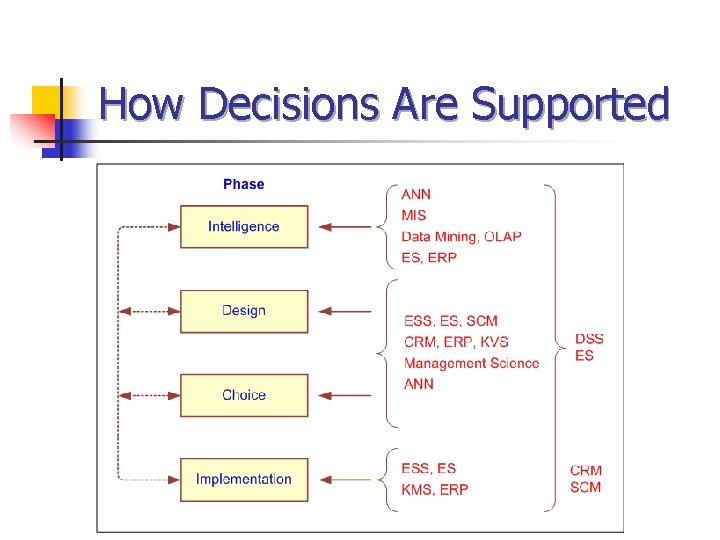
How Decisions Are Supported
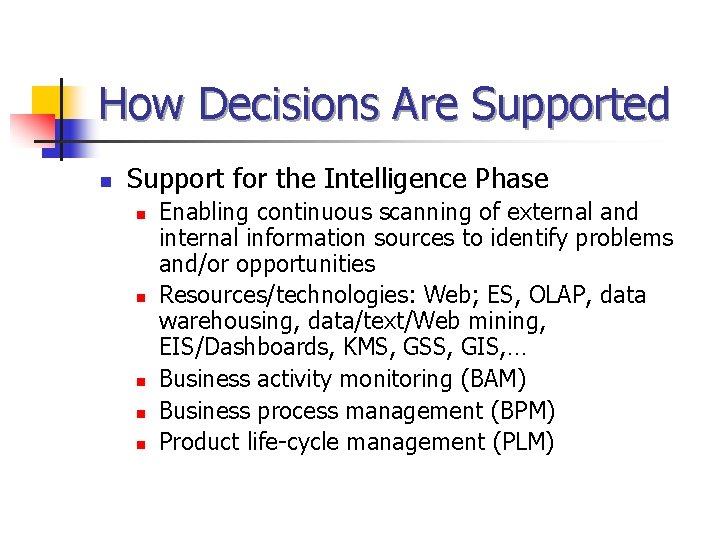
How Decisions Are Supported n Support for the Intelligence Phase n n n Enabling continuous scanning of external and internal information sources to identify problems and/or opportunities Resources/technologies: Web; ES, OLAP, data warehousing, data/text/Web mining, EIS/Dashboards, KMS, GSS, GIS, … Business activity monitoring (BAM) Business process management (BPM) Product life-cycle management (PLM)
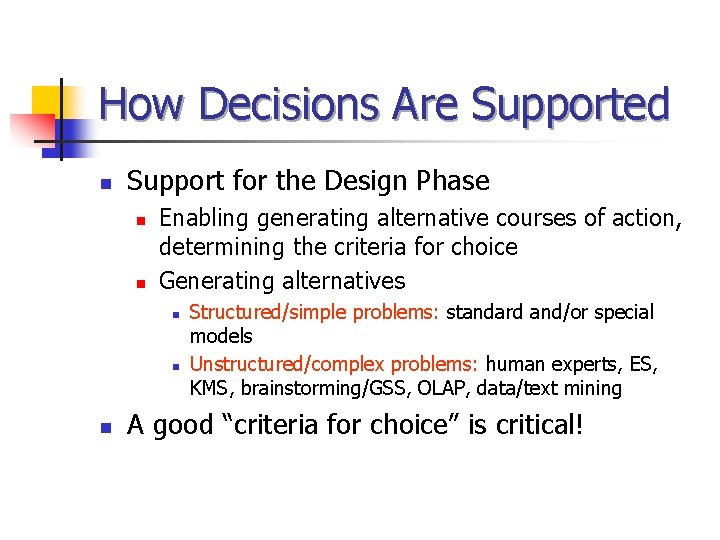
How Decisions Are Supported n Support for the Design Phase n n Enabling generating alternative courses of action, determining the criteria for choice Generating alternatives n n n Structured/simple problems: standard and/or special models Unstructured/complex problems: human experts, ES, KMS, brainstorming/GSS, OLAP, data/text mining A good “criteria for choice” is critical!
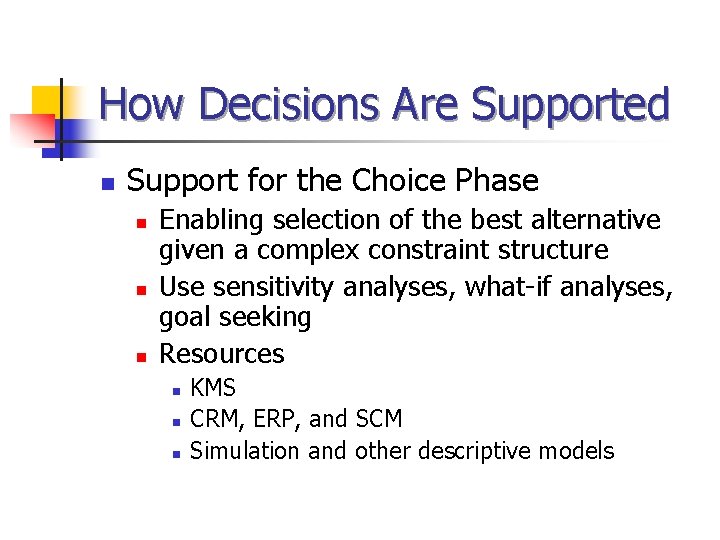
How Decisions Are Supported n Support for the Choice Phase n n n Enabling selection of the best alternative given a complex constraint structure Use sensitivity analyses, what-if analyses, goal seeking Resources n n n KMS CRM, ERP, and SCM Simulation and other descriptive models
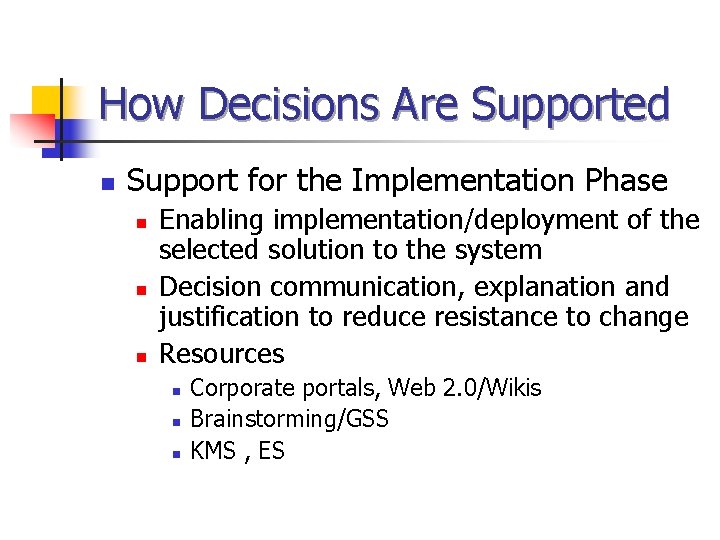
How Decisions Are Supported n Support for the Implementation Phase n n n Enabling implementation/deployment of the selected solution to the system Decision communication, explanation and justification to reduce resistance to change Resources n n n Corporate portals, Web 2. 0/Wikis Brainstorming/GSS KMS , ES
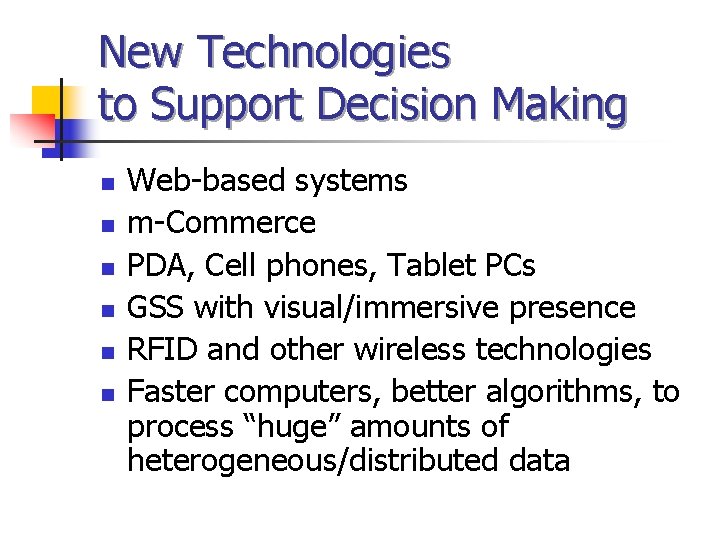
New Technologies to Support Decision Making n n n Web-based systems m-Commerce PDA, Cell phones, Tablet PCs GSS with visual/immersive presence RFID and other wireless technologies Faster computers, better algorithms, to process “huge” amounts of heterogeneous/distributed data
Your Turn Questions / Comments / Criticisms