
Week 2 Course Briefing Kristel Fobelets Adria JunyentFerre
Week 2 Course Briefing Kristel Fobelets, Adria Junyent-Ferre, Esther Perea
Welcome to EEE and EIE Dr Kristel Fobelets
Outline • Introduction to engineering and your course (Dr Kristel Fobelets) • The first year (Dr Adrià Junyent-Ferré) • Tutoring and student support (Mrs Esther Perea)
What makes a good engineer? Good technical background: lectures & study groups Maths, analogue & digital electronics, signals and communications, software Good practical skills: hardware and software laboratories Creativity: group design projects problem solving skills, teamwork, leadership, logical mind communicate with other
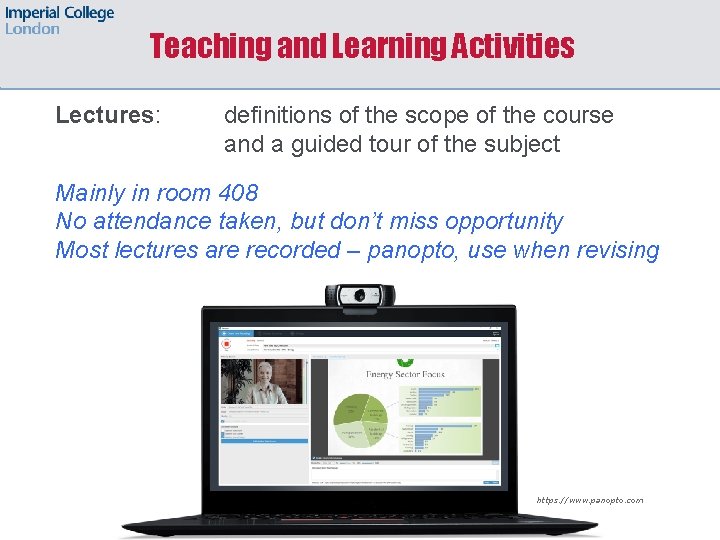
Teaching and Learning Activities Lectures: definitions of the scope of the course and a guided tour of the subject Mainly in room 408 No attendance taken, but don’t miss opportunity Most lectures are recorded – panopto, use when revising https: //www. panopto. com
Teaching and Learning Activities Lectures: definitions of the scope of the course and a guided tour of the subject Study Groups: worked examples that you try first: problem sheets In smaller groups. Attendance is compulsory – scan in Prepare before you come.
Teaching and Learning Activities Lectures: definitions of the scope of the course and a guided tour of the subject Study Groups: worked examples that you try first: problem sheets Tutorials: academic and pastoral; feedback on study habits, monitored by tutorial problems In groups of 3/4. Might still change a bit Attendance is compulsory. Prepare before you come.
Teaching and Learning Activities Lectures: definitions of the scope of the course and a guided tour of the subject Study Groups: worked examples that you try first: problem sheets Tutorials: academic and pastoral; feedback on study habits, monitored by tutorial problems Laboratory: building practical skills Attendance is compulsory – scan in Prepare before you come.
Teaching and Learning Activities Lectures: definitions of the scope of the course and a guided tour of the subject Study Groups: worked examples that you try first: problem sheets Tutorials: academic and pastoral; feedback on study habits, monitored by tutorial problems Laboratory: building practical skills Group Project: an opportunity for creativity Mainly self-propelled. Don’t postpone work. Opportunity to engineer.
Teaching and Learning Activities Lectures: definitions of the scope of the course and a guided tour of the subject Study Groups: worked examples that you try first: problem sheets Tutorials: academic and pastoral; feedback on study habits, monitored by tutorial problems Laboratory: building practical skills Group Project: an opportunity for creativity Private Study: your effort to understand, learn and practice the subjects Contact Hours: 550 Private Study Hours: 1, 100
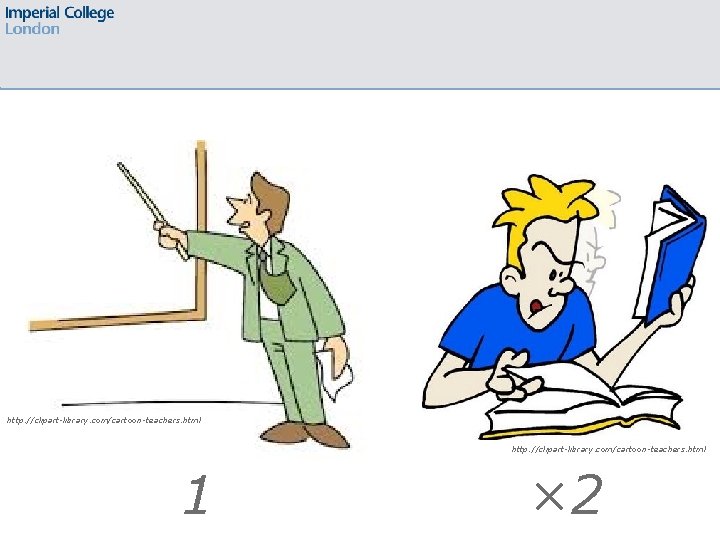
http: //clipart-library. com/cartoon-teachers. html 1 × 2
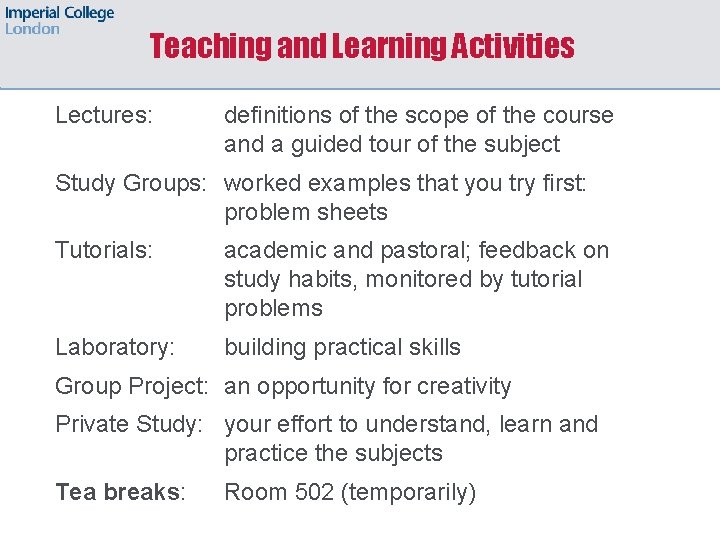
Teaching and Learning Activities Lectures: definitions of the scope of the course and a guided tour of the subject Study Groups: worked examples that you try first: problem sheets Tutorials: academic and pastoral; feedback on study habits, monitored by tutorial problems Laboratory: building practical skills Group Project: an opportunity for creativity Private Study: your effort to understand, learn and practice the subjects Tea breaks: Room 502 (temporarily)

Professionalism Applied to Study • Commitment: • study actively • work hard • self-study • Responsibility: • get yourself organised • plan for deadlines • pull your weight in groups • Awareness: • develop the skills you need in your career • grasp opportunities • reflect on your own progress • Integrity: • don’t copy and cheat • treat people with respect • treat rules with respect
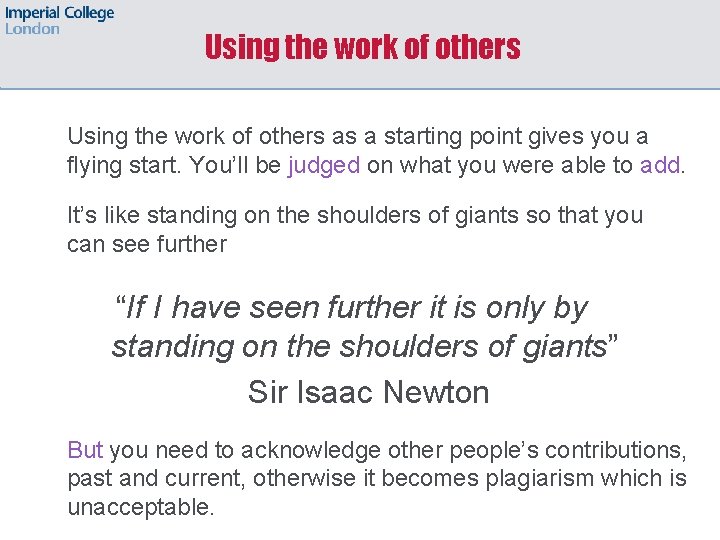
Using the work of others as a starting point gives you a flying start. You’ll be judged on what you were able to add. It’s like standing on the shoulders of giants so that you can see further “If I have seen further it is only by standing on the shoulders of giants” Sir Isaac Newton But you need to acknowledge other people’s contributions, past and current, otherwise it becomes plagiarism which is unacceptable.
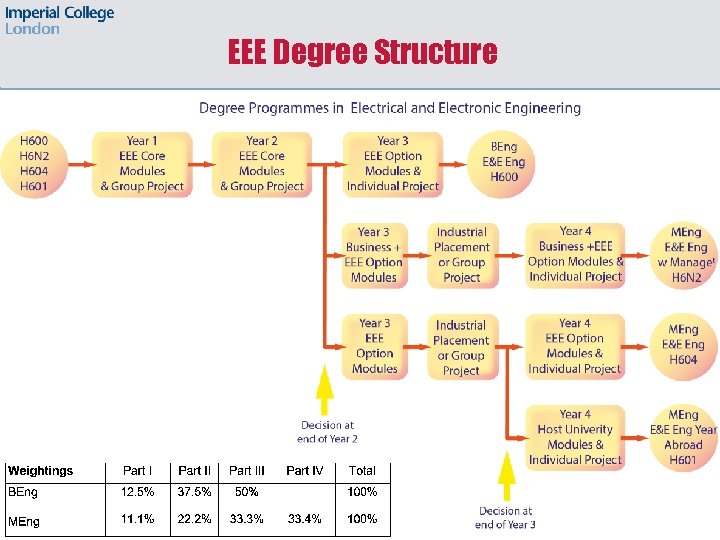
EEE Degree Structure
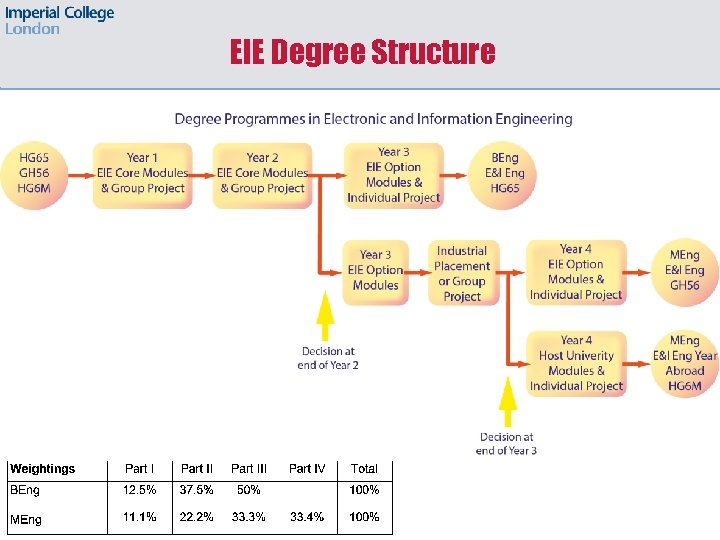
EIE Degree Structure
Where Are Our Degrees Defined The Programme Specification http: //www 3. imperial. ac. uk/electricalengineering/teaching/u ndergraduate/programmespecs The Scheme for Award of Honours http: //www 3. imperial. ac. uk/electricalengineering/teaching/u ndergraduate/assessment
Who teaches? Research Active Academic Staff • • 50% teaching activities 50% research activities Teaching fellows • • 100% teaching activities Dan, Ed, Max, Tom, Steve, Esther, Zohaib (50%) Graduate teaching assistants (GTA) • • Ph. D students help out in labs Cover academic staff duties occasionally Undergraduate teaching assistants (UTAs) • Students in higher years help out
The first year Dr Adrià Junyent-Ferré
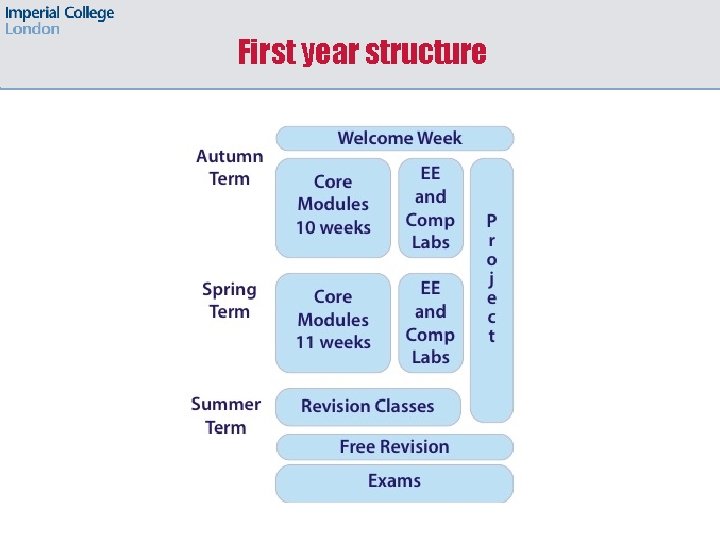
First year structure
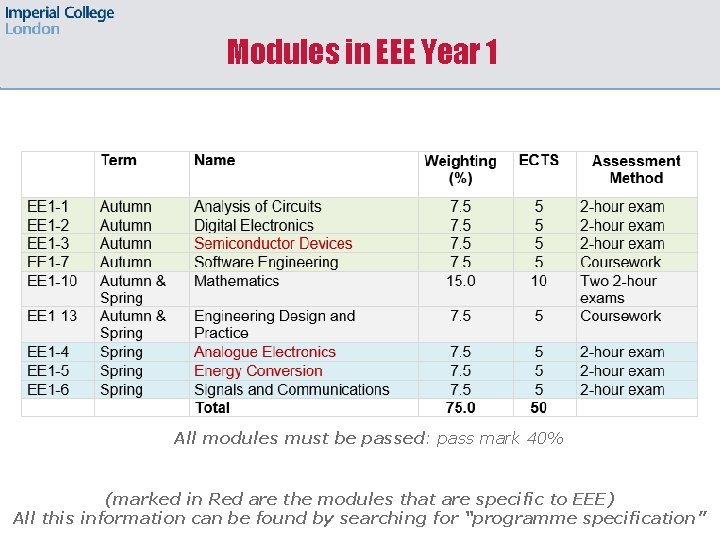
Modules in EEE Year 1 All modules must be passed: pass mark 40% (marked in Red are the modules that are specific to EEE) All this information can be found by searching for “programme specification”
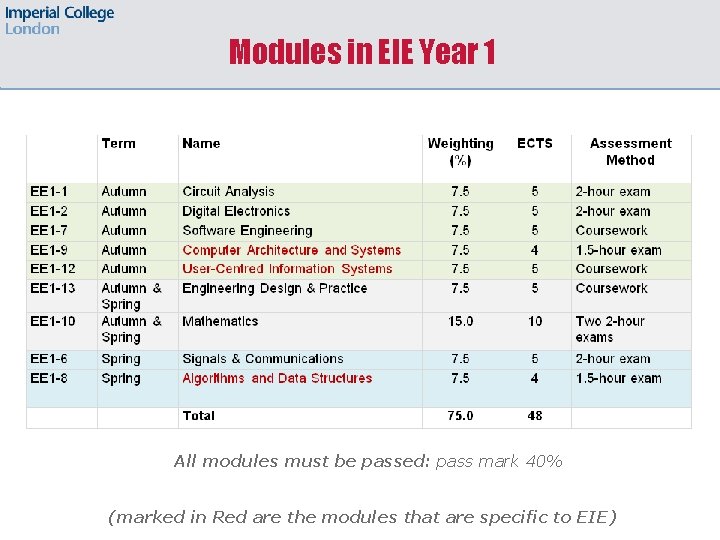
Modules in EIE Year 1 All modules must be passed: pass mark 40% (marked in Red are the modules that are specific to EIE)
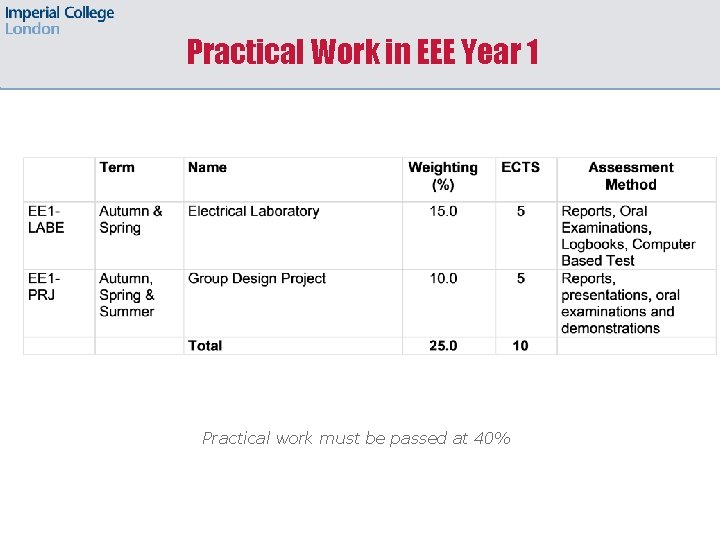
Practical Work in EEE Year 1 Practical work must be passed at 40%
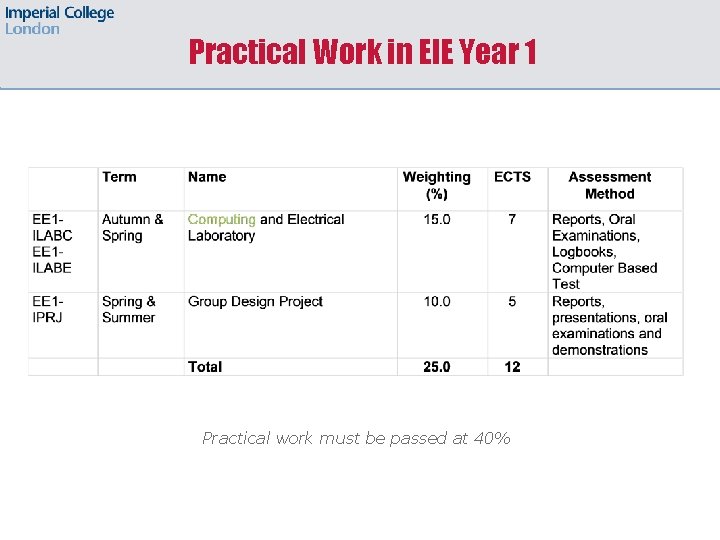
Practical Work in EIE Year 1 Practical work must be passed at 40%
Attend Tutorial • Your tutor is your first academic contact point. He/she is responsible for helping you, evaluating your performance and writing a tutor’s report at the end of the academic year. Tutors reports are used to make decisions in examiners’ meeting. Study groups • This is the place to solve those study groups questions you didn’t/couldn’t solve at home. Here you will be able to interact with a smaller group, ask questions and help from peers and study group leaders. Labs • Electrical and computer labs are very important for your training as an engineer. Prepare the lab before you arrive and take responsibility for yourself and your lab-partner by attending all.
Important (mock) Tests • Christmas test: first Tuesday of Spring term • Easter test : first Tuesday of Summer term Both will be done via Blackboard.
Important (mock) Tests • Christmas test: first Tuesday of Spring term • Easter test: first Tuesday of Summer term • Their purpose is to give you feedback about how well you are coping with the modules. They are very useful. • Revise consistently during the term and prepare for these tests well in advance. • They don’t carry marks for the end grade but they are compulsory, they might be taken into account for progression decisions and non-attendance might trigger a request to withdraw.
Coursework Deadlines Coursework will be submitted through Blackboard and will have strict and well-defined deadlines. Keep the following rules in mind:
Coursework Deadlines Coursework will be submitted through Blackboard and will have strict and well-defined deadlines. Keep the following rules in mind: • #1: Coursework must be handed in before the deadline • #2: Coursework must be handed in before the deadline • #3: Coursework must be handed in before the deadline
Coursework Deadlines Coursework will be submitted through Blackboard and will have strict and well-defined deadlines. Keep the following rules in mind: • #1: Coursework must be handed in before the deadline • #2: Coursework must be handed in before the deadline • #3: Coursework must be handed in before the deadline • Any coursework submitted late will be penalised: - if 24 hours late: marks capped at “pass” - more than 24 hours late: 0 marks awarded (unless there are well-proven mitigating circumstances –more detail later-)

Scholarship Opportunities Check the “Scholarships Search Tool” (http: //goo. gl/zt 9 YU 6) Some specific to our Dept. : - The IET Power Academy (18 th Oct @14. 00 in 611) - The UK Electronics Skills Foundation (both open only to Home and EU students). Some deadlines in October. Help: Clare Drysdale (Undergraduate Office)
All work and no play makes Jack a dull boy Workload can be intense at times but it is important that you find a balance between study and leisure that works for you. There’s a lot you can do: Find out more about: EESOC, Union Clubs, Union Events, Imperial College Advanced Hackspace, Centre for Languages, Culture and Communication Imperial College Music and Arts Ethos Sports Centre, “London”
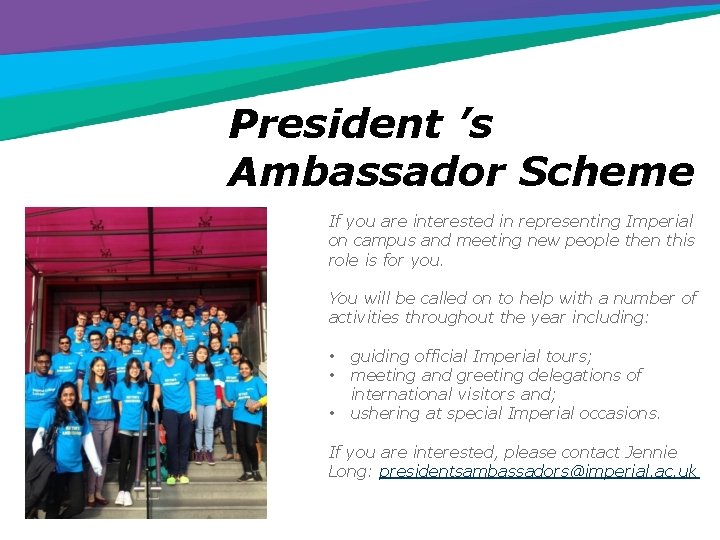
President ’s Ambassador Scheme If you are interested in representing Imperial on campus and meeting new people then this role is for you. You will be called on to help with a number of activities throughout the year including: • • • guiding official Imperial tours; meeting and greeting delegations of international visitors and; ushering at special Imperial occasions. If you are interested, please contact Jennie Long: presidentsambassadors@imperial. ac. uk
Tutoring and Student Support Mrs Esther Perea Senior Tutor
University ≠ School Five key changes 1) Class size 2) Number of courses 3) Assessment 4) Who is watching over you? 5) Grades
University ≠ School 1) Class size EEE/EIE: Not 8 – 30 people/class but 160! • Get involved in lectures/ study groups by asking and responding to questions. • Do not get isolated, don’t be shy. • Everyone else is on the same boat
University ≠ School 2) Number of courses No longer 3 – 4 A level courses: • 6 in autumn term • 5 in spring term • EE & computer labs Recommendation: • Work continuously and consistently • Then there is still time for entertainment
University ≠ School 3) Assessment • Coursework and lab work through the year • Exams in the Summer Term Try to keep up to date with lecture topics so that you only have to revise in the Summer Term (cramming does not work)
University ≠ School 4) Who is watching over you? Help is available: • study group leaders • extra maths tutorials • course lecturers • Personal Tutor • Senior Tutor • UG office • “Mums and Dads” • EESoc / Spark. EEE ladies • Student Hub But • You have to actively look and ask for it. • Don’t be shy, be pro-active, everyone is willing to help when you ask for it.
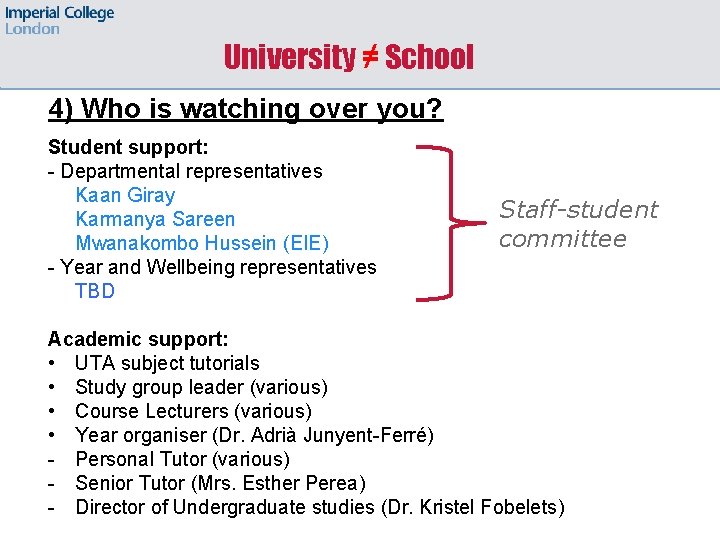
University ≠ School 4) Who is watching over you? Student support: - Departmental representatives Kaan Giray Karmanya Sareen Mwanakombo Hussein (EIE) - Year and Wellbeing representatives TBD Staff-student committee Academic support: • UTA subject tutorials • Study group leader (various) • Course Lecturers (various) • Year organiser (Dr. Adrià Junyent-Ferré) - Personal Tutor (various) - Senior Tutor (Mrs. Esther Perea) - Director of Undergraduate studies (Dr. Kristel Fobelets)
University ≠ School 4) Who is watching over you? Teaching office Clare Drysdale Lina Brazinskate Kay Hancox Emma Rainbow Time tabling Dr. Steve Wright Blackboard Dr. Max Cattafi Panopto Dr. Tom Clarke
University ≠ School 5) Grades • Not everyone will get As and A* anymore • You are all As and A*s • In order to differentiate, we will use the whole grade spectrum: A, B, C, D, E, F • Our questions in labs and exams are pitched such that this is possible
How to do well at EEE? • • • Prepare, attend and revise lectures Participate in tests, labs and group projects Deliver coursework on time If in doubt, find help in time ‒ your friends ‒ the study group leaders, lab demonstrators ‒ the course lecturer, lab organiser If in trouble, find help in time ‒ Your personal tutor ‒ the senior tutor ‒ the director of undergraduate studies ‒ the head of department Study throughout the year Revise for the exams Enjoy what you are doing Have faith
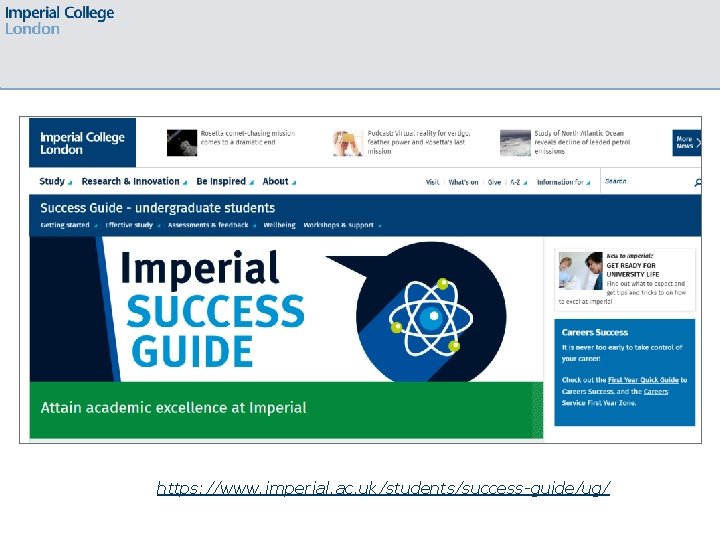
https: //www. imperial. ac. uk/students/success-guide/ug/
What if things go to plan? Communicate in time of trouble: • Long term and short term illness (physical, emotional, mental health problems), family or financial crisis: Talk to us. • We can help to solve these problems or support you through them • If you suffer from a long term illness: Talk to the Senior Tutor (E. Perea) • If you get ill or something serious happened: Contact the ST • Submit a Mitigating Circumstances form online: http: //www. imperial. ac. uk/electrical-engineering/internal/current-students-coursehandbook/mitigating-circumstances-/ • All will be kept in complete confidence and only disclosed with your written consent
What if things go to plan? Communicate in time of trouble: • If you do not have a GP: Register in the IC health centre • If you know you are going to be late with coursework: Talk to the coursework organiser beforehand. • If you have a valid reason, only the ST can extend the deadline Strict penalties are given in case of: • Late coursework submission (40% cap for 24 hours and 0% thereafter) Unless you have Mitigating Circumstances • Plagiarism (is decided by the Faculty who make severe decisions)
When in trouble, TALK! • Your friends and / or your family (your parents might yet surprise you) • Academic Support ‒ Course lecturers ‒ Study group leaders ‒ Lab demonstrators ‒ Personal Tutor ‒ Senior Tutor Director of Undergraduate Studies ‒ • Pastoral Support ‒ Senior Tutor ‒ Faculty of Engineering tutor (Dr. Lorraine Craigh) ‒ Sub Warden ‒ Doctor (IC health centre) ‒ College Counsellor
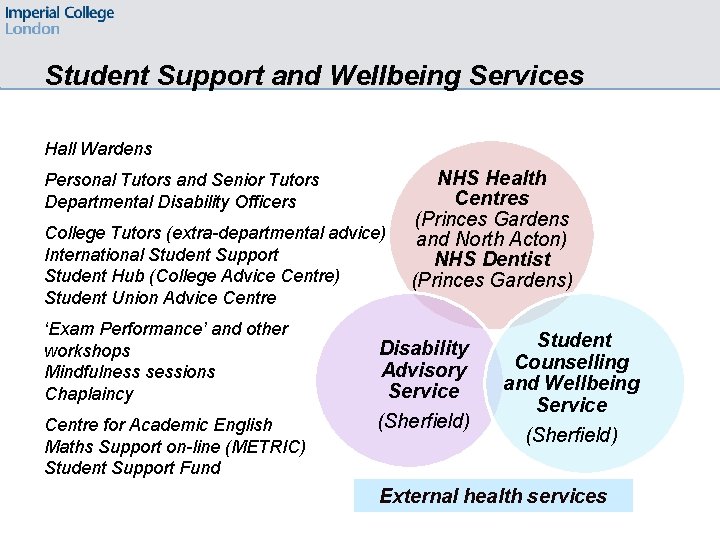
Student Support and Wellbeing Services Hall Wardens Personal Tutors and Senior Tutors Departmental Disability Officers College Tutors (extra-departmental advice) International Student Support Student Hub (College Advice Centre) Student Union Advice Centre ‘Exam Performance’ and other workshops Mindfulness sessions Chaplaincy Centre for Academic English Maths Support on-line (METRIC) Student Support Fund NHS Health Centres (Princes Gardens and North Acton) NHS Dentist (Princes Gardens) Disability Advisory Service (Sherfield) Student Counselling and Wellbeing Service (Sherfield) External health services
What does a Senior Tutor do? Academic: Oversee Tutorial Support System Monitor Attendance Oversee Prize awards Pastoral: Advise and help students in hardship/illness Evaluate and advocate Mitigating Circumstances Discipline: Oversee Discipline (e. g. Cheating, Plagiarism…. ) Participate in College Tribunals

Expectations https: //www. 123 rf. com/photo_44881067_stock-vector-an-emoticon-emoji -looking-very-scared-hiding-behind-his-hands. html (The Talk of Doom)
https: //silentlocations. wordpress. com/2012/02/29/how-harold-lloyd-filmed-safety-last/ Timeliness
Register attendance https: //www. hsbc. co. uk/1/2/contactless
Mobile phones http: //weclipart. com/no+mobile+phone+sign+clip+art https: //www. smartsign. com/no-cell-phone-signs

Visiting offices and appointments http: //www. mollieandfred. co. uk/homeware-c 1/storage-c 9/the-bright-side-the-doctor-will-see-you-now-first-aid-tin-p 806
• Always use your Imperial email • Include signature with your: Name, Course / Year CID • Be concise Imagine the reader is using their mobile phone to read it • State the desired outcome • Do not expect a reply outside of working hours (9. 00 -17. 00) or during the weekends • Allow 48 hours (2 working days) before chasing up https: //www. hotdesign. com/marketing/so-you-want-to-send-that-from-outlook/ emails

To write or not to write? https: //www. pinterest. com/pin/377246906260210924/
Have a wonderful 3 - 4 years. . . you are supposed to enjoy it! https: //www. pinterest. com/alcioneagnes/emoticons-feeling-faces/
Summary • Introduction to engineering and your course (Dr Kristel Fobelets) • The first year (Dr Adrià Junyent-Ferré) • Tutoring and student support (Mrs Esther Perea)
Any questions?
- Slides: 60