
Week 15 Psych Testing Ethics and legal issues
![n A Raja Yoga teaching (includes many forms, such as Bhakti [devotion], Gyana [wisdom],](https://slidetodoc.com/presentation_image_h2/62b49b00d2dbd499c4aa4ff96cdf45b3/image-5.jpg "n A Raja Yoga teaching (includes many forms, such as Bhakti [devotion], Gyana [wisdom],")

- Slides: 30
Week 15: Psych Testing Ethics and legal issues An alternative assessment framework: An Eastern approach Framework: Cycles Details: the Michael Teaching Week 15: Psych Testing 1
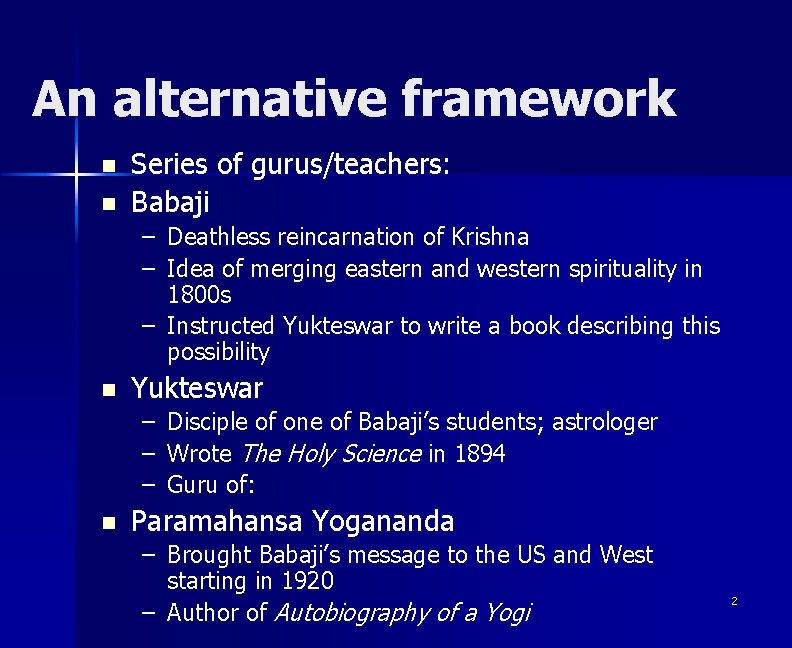
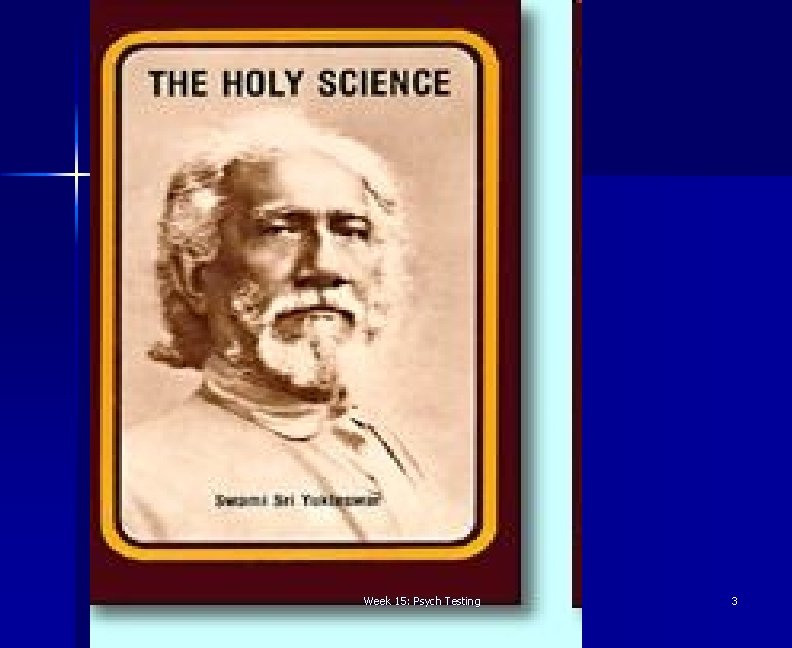
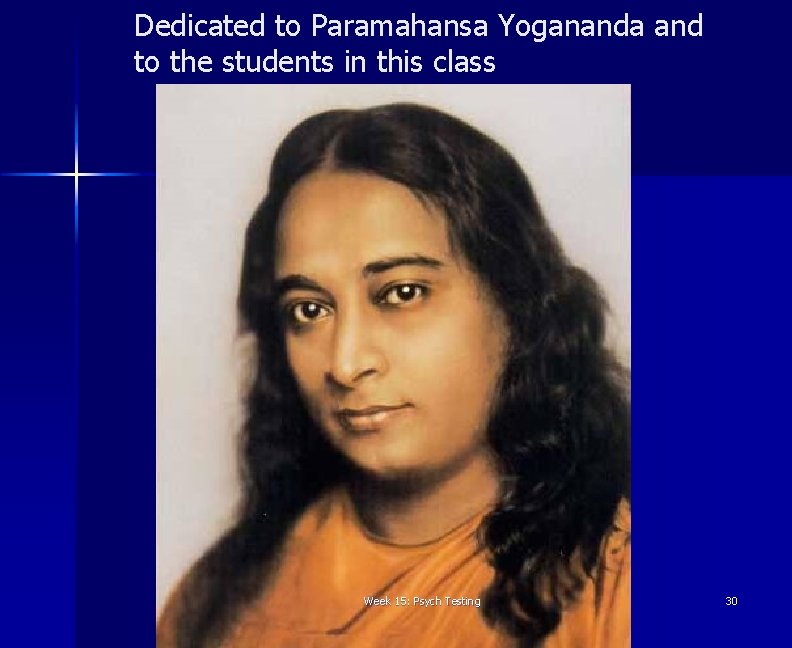
An alternative framework n n Series of gurus/teachers: Babaji – Deathless reincarnation of Krishna – Idea of merging eastern and western spirituality in 1800 s – Instructed Yukteswar to write a book describing this possibility n Yukteswar – Disciple of one of Babaji’s students; astrologer – Wrote The Holy Science in 1894 – Guru of: n Paramahansa Yogananda – Brought Babaji’s message to the US and West starting in 1920 – Author of Autobiography of a Yogi 2
Week 15: Psych Testing 3
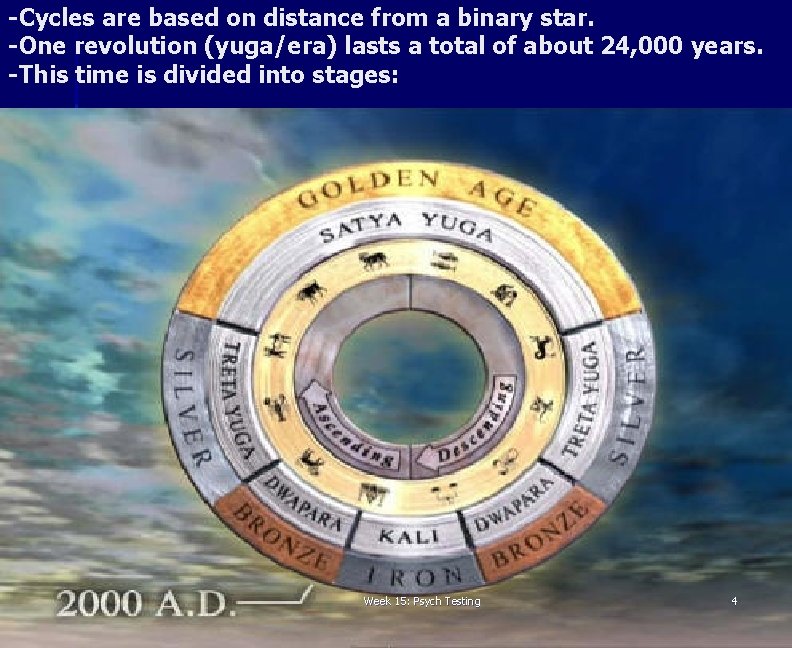
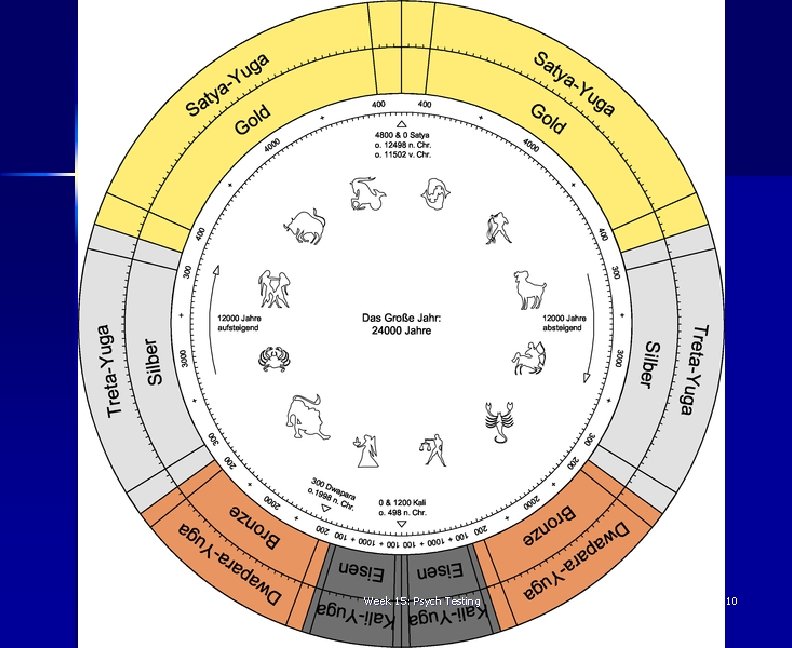
-Cycles are based on distance from a binary star. -One revolution (yuga/era) lasts a total of about 24, 000 years. -This time is divided into stages: Week 15: Psych Testing 4
n A Raja Yoga teaching (includes many forms, such as Bhakti [devotion], Gyana [wisdom], Kriya [activity], Prana [energy control], Hatha [physical movement], etc. n The evolutionary development of the solar system follows the following patterns: n The descending phase of Satya Yuga lasts 4800 years. Next of Treta Yuga--3600 years. Then of Dwapara Yuga --400 years. Finally of Kali Yuga--1200 years. The ascending phase of Kali Yuga then begins, also lasting 1200 years; and so on. The ascending phase of Kali Yuga began in September of 499 CE. Since September 1699, we have been in the ascending phase of Dwapara Yuga. n n n Week 15: Psych Testing 5
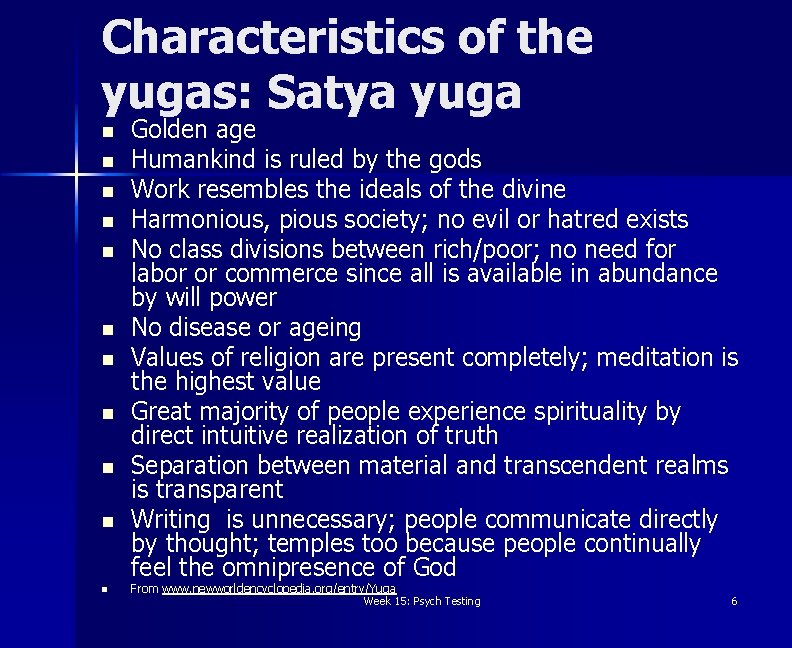
Characteristics of the yugas: Satya yuga n n n Golden age Humankind is ruled by the gods Work resembles the ideals of the divine Harmonious, pious society; no evil or hatred exists No class divisions between rich/poor; no need for labor or commerce since all is available in abundance by will power No disease or ageing Values of religion are present completely; meditation is the highest value Great majority of people experience spirituality by direct intuitive realization of truth Separation between material and transcendent realms is transparent Writing is unnecessary; people communicate directly by thought; temples too because people continually feel the omnipresence of God From www. newworldencyclopedia. org/entry/Yuga Week 15: Psych Testing 6
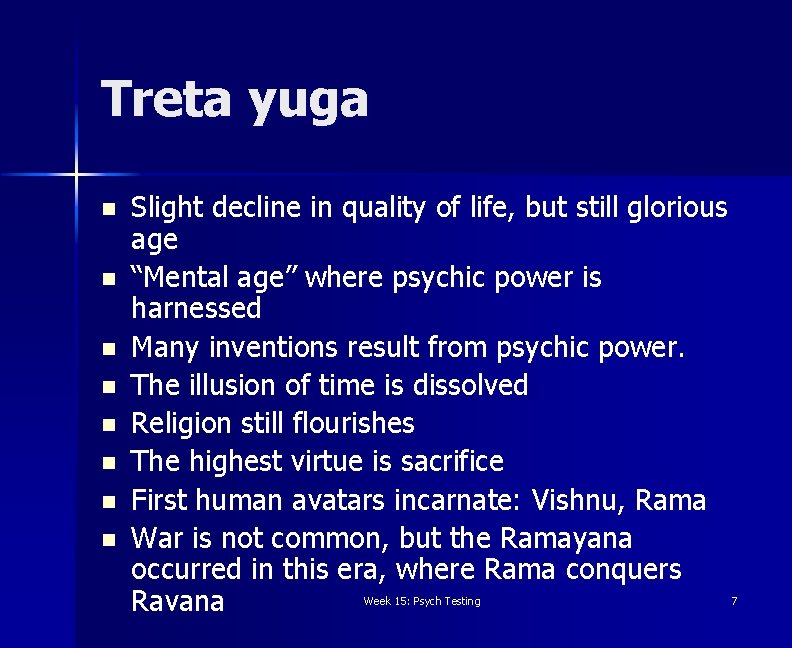
Treta yuga n n n n Slight decline in quality of life, but still glorious age “Mental age” where psychic power is harnessed Many inventions result from psychic power. The illusion of time is dissolved Religion still flourishes The highest virtue is sacrifice First human avatars incarnate: Vishnu, Rama War is not common, but the Ramayana occurred in this era, where Rama conquers Ravana Week 15: Psych Testing 7
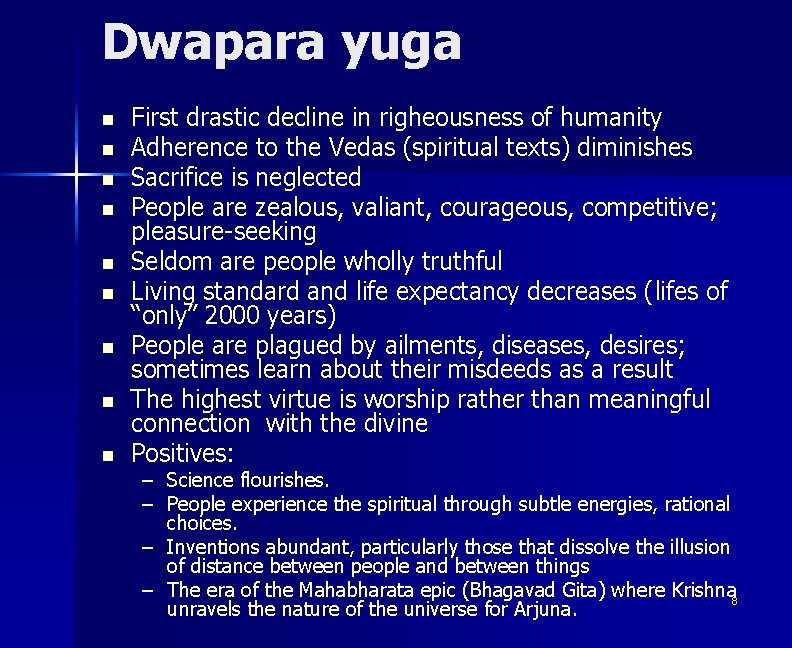
Dwapara yuga n n n n n First drastic decline in righeousness of humanity Adherence to the Vedas (spiritual texts) diminishes Sacrifice is neglected People are zealous, valiant, courageous, competitive; pleasure-seeking Seldom are people wholly truthful Living standard and life expectancy decreases (lifes of “only” 2000 years) People are plagued by ailments, diseases, desires; sometimes learn about their misdeeds as a result The highest virtue is worship rather than meaningful connection with the divine Positives: – Science flourishes. – People experience the spiritual through subtle energies, rational choices. – Inventions abundant, particularly those that dissolve the illusion of distance between people and between things – The era of the Mahabharata epic (Bhagavad Gita) where Krishna 8 unravels the nature of the universe for Arjuna.
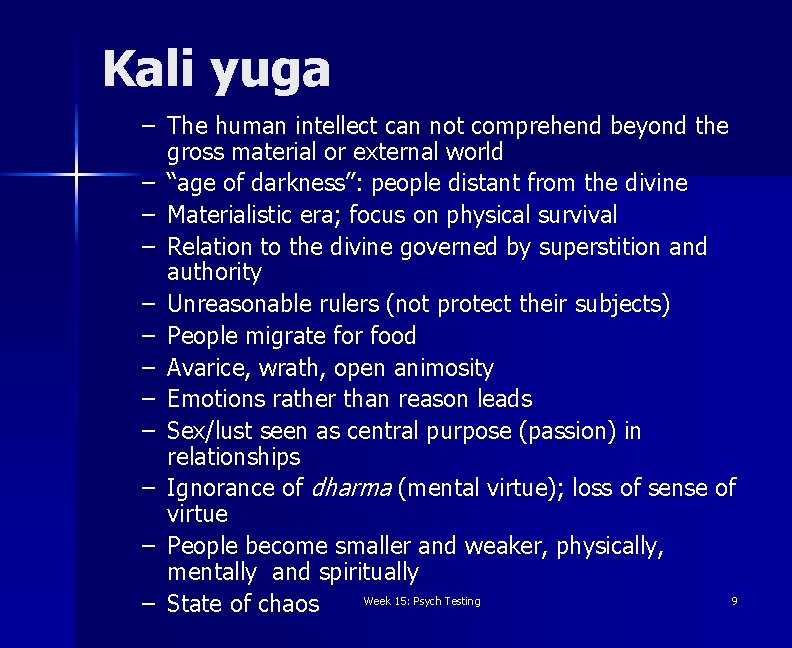
Kali yuga – The human intellect can not comprehend beyond the gross material or external world – “age of darkness”: people distant from the divine – Materialistic era; focus on physical survival – Relation to the divine governed by superstition and authority – Unreasonable rulers (not protect their subjects) – People migrate for food – Avarice, wrath, open animosity – Emotions rather than reason leads – Sex/lust seen as central purpose (passion) in relationships – Ignorance of dharma (mental virtue); loss of sense of virtue – People become smaller and weaker, physically, mentally and spiritually Week 15: Psych Testing 9 – State of chaos
Week 15: Psych Testing 10
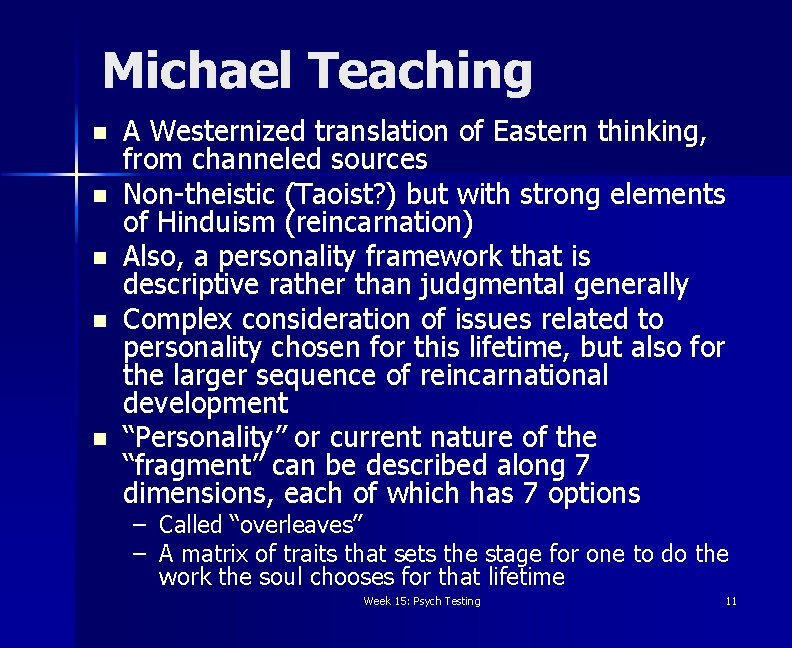
Michael Teaching n n n A Westernized translation of Eastern thinking, from channeled sources Non-theistic (Taoist? ) but with strong elements of Hinduism (reincarnation) Also, a personality framework that is descriptive rather than judgmental generally Complex consideration of issues related to personality chosen for this lifetime, but also for the larger sequence of reincarnational development “Personality” or current nature of the “fragment” can be described along 7 dimensions, each of which has 7 options – Called “overleaves” – A matrix of traits that sets the stage for one to do the work the soul chooses for that lifetime Week 15: Psych Testing 11
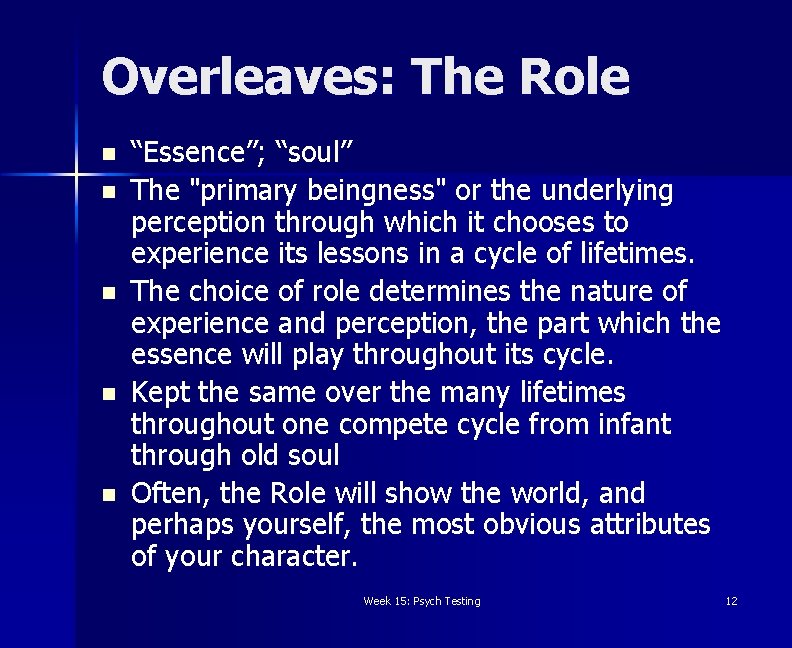
Overleaves: The Role n n n “Essence”; “soul” The "primary beingness" or the underlying perception through which it chooses to experience its lessons in a cycle of lifetimes. The choice of role determines the nature of experience and perception, the part which the essence will play throughout its cycle. Kept the same over the many lifetimes throughout one compete cycle from infant through old soul Often, the Role will show the world, and perhaps yourself, the most obvious attributes of your character. Week 15: Psych Testing 12
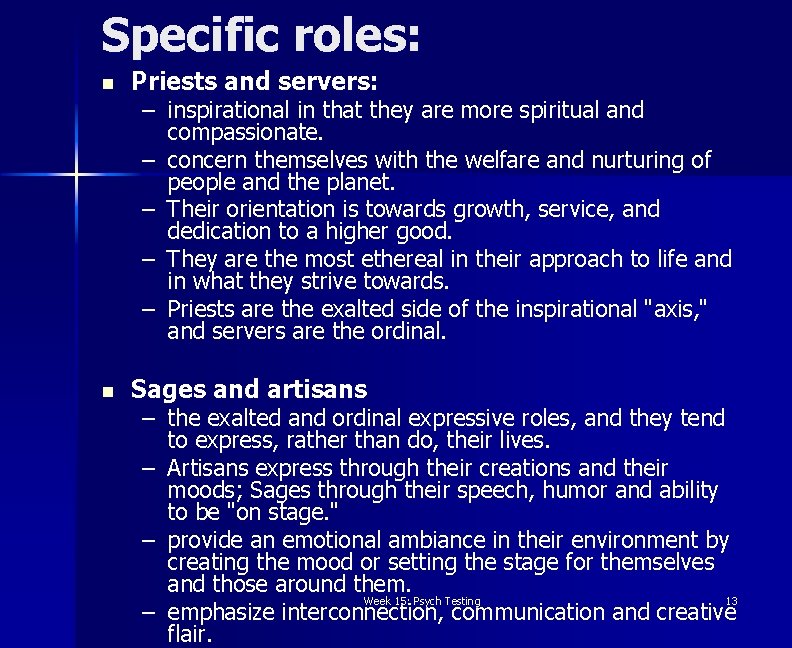
Specific roles: n Priests and servers: n Sages and artisans – inspirational in that they are more spiritual and compassionate. – concern themselves with the welfare and nurturing of people and the planet. – Their orientation is towards growth, service, and dedication to a higher good. – They are the most ethereal in their approach to life and in what they strive towards. – Priests are the exalted side of the inspirational "axis, " and servers are the ordinal. – the exalted and ordinal expressive roles, and they tend to express, rather than do, their lives. – Artisans express through their creations and their moods; Sages through their speech, humor and ability to be "on stage. " – provide an emotional ambiance in their environment by creating the mood or setting the stage for themselves and those around them. Week 15: Psych Testing 13 – emphasize interconnection, communication and creative flair.
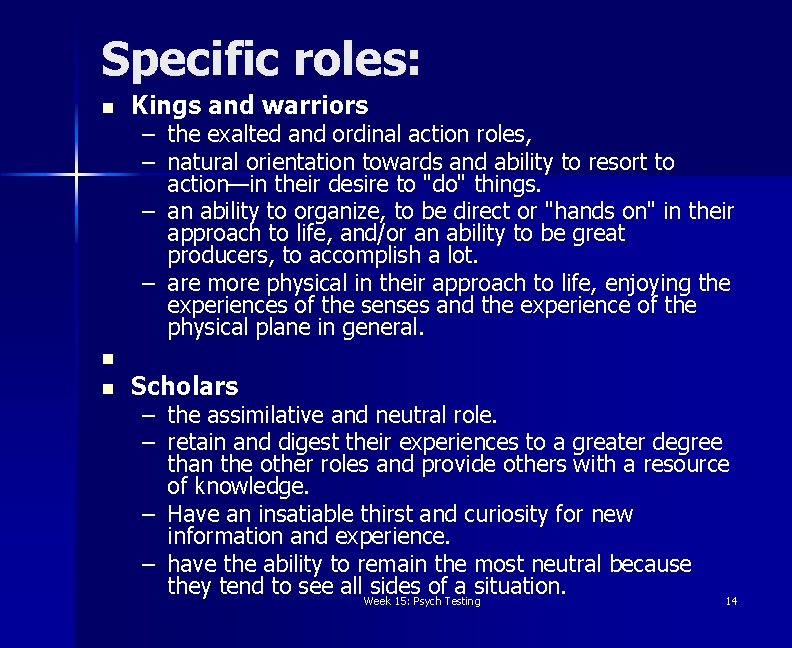
Specific roles: n Kings and warriors – the exalted and ordinal action roles, – natural orientation towards and ability to resort to action—in their desire to "do" things. – an ability to organize, to be direct or "hands on" in their approach to life, and/or an ability to be great producers, to accomplish a lot. – are more physical in their approach to life, enjoying the experiences of the senses and the experience of the physical plane in general. n n Scholars – the assimilative and neutral role. – retain and digest their experiences to a greater degree than the other roles and provide others with a resource of knowledge. – Have an insatiable thirst and curiosity for new information and experience. – have the ability to remain the most neutral because they tend to see all sides of a situation. Week 15: Psych Testing 14
Other overleaves n Other overleaves that an essence can choose during a particular lifetime: – goal, – mode, – attitude, – chief feature, and – centering Week 15: Psych Testing 15
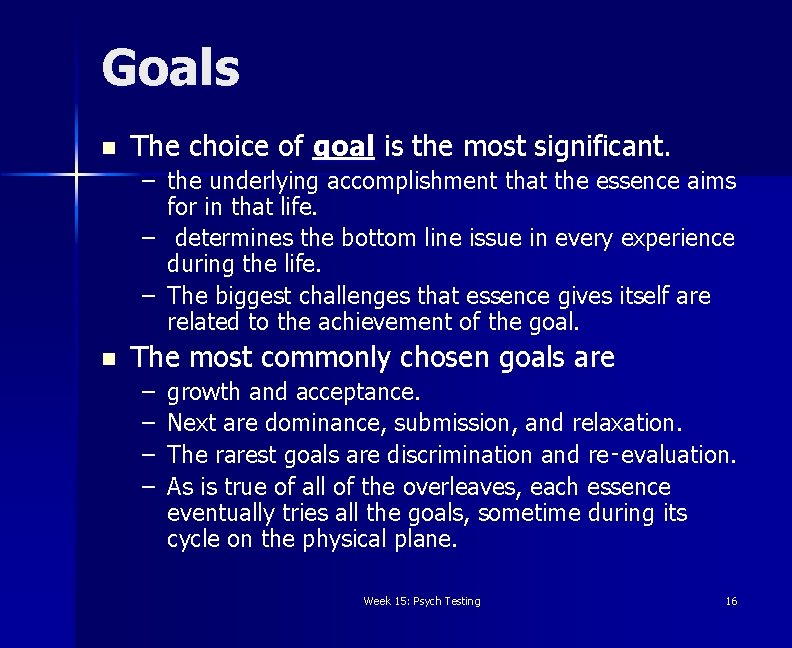
Goals n The choice of goal is the most significant. – the underlying accomplishment that the essence aims for in that life. – determines the bottom line issue in every experience during the life. – The biggest challenges that essence gives itself are related to the achievement of the goal. n The most commonly chosen goals are – – growth and acceptance. Next are dominance, submission, and relaxation. The rarest goals are discrimination and re‑evaluation. As is true of all of the overleaves, each essence eventually tries all the goals, sometime during its cycle on the physical plane. Week 15: Psych Testing 16
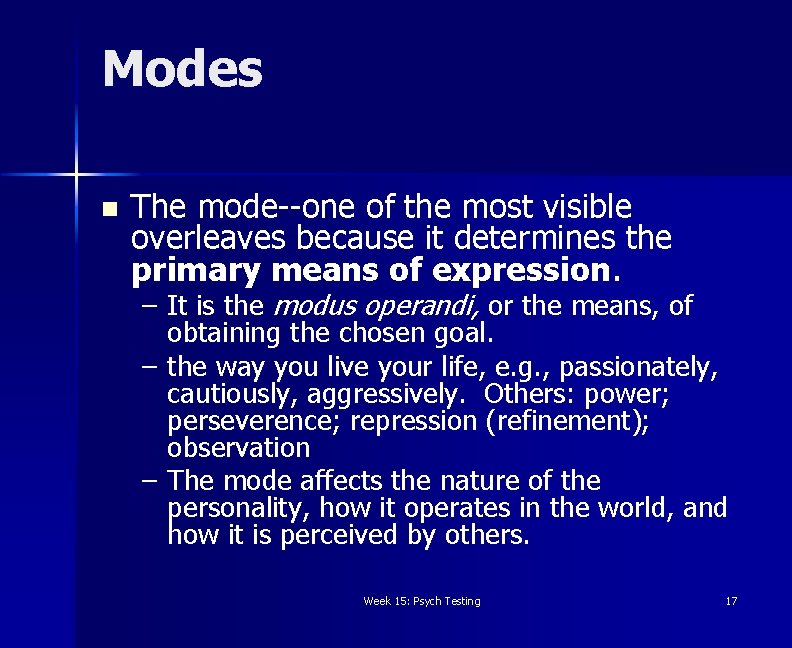
Modes n The mode--one of the most visible overleaves because it determines the primary means of expression. – It is the modus operandi, or the means, of obtaining the chosen goal. – the way you live your life, e. g. , passionately, cautiously, aggressively. Others: power; perseverence; repression (refinement); observation – The mode affects the nature of the personality, how it operates in the world, and how it is perceived by others. Week 15: Psych Testing 17
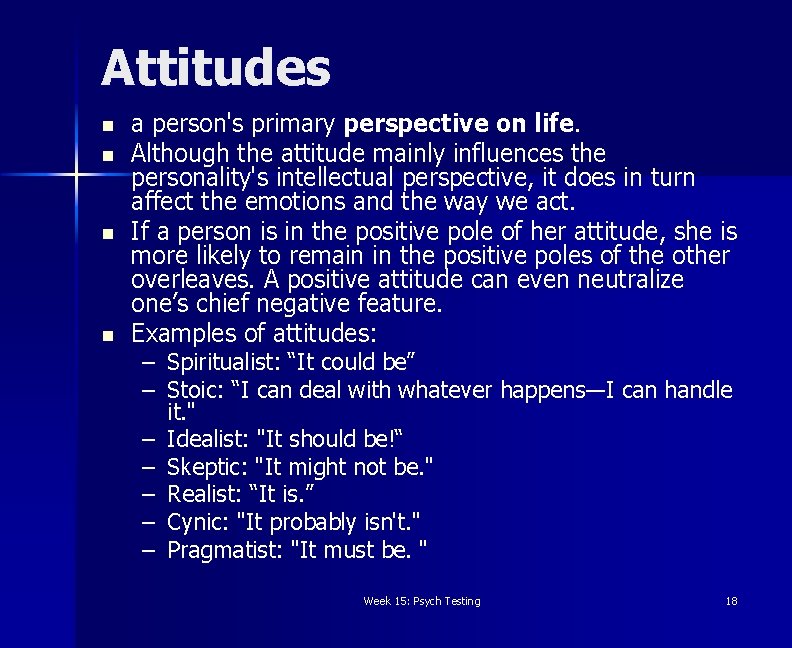
Attitudes n n a person's primary perspective on life. Although the attitude mainly influences the personality's intellectual perspective, it does in turn affect the emotions and the way we act. If a person is in the positive pole of her attitude, she is more likely to remain in the positive poles of the other overleaves. A positive attitude can even neutralize one’s chief negative feature. Examples of attitudes: – Spiritualist: “It could be” – Stoic: “I can deal with whatever happens―I can handle it. " – Idealist: "It should be!“ – Skeptic: "It might not be. " – Realist: “It is. ” – Cynic: "It probably isn't. " – Pragmatist: "It must be. " Week 15: Psych Testing 18
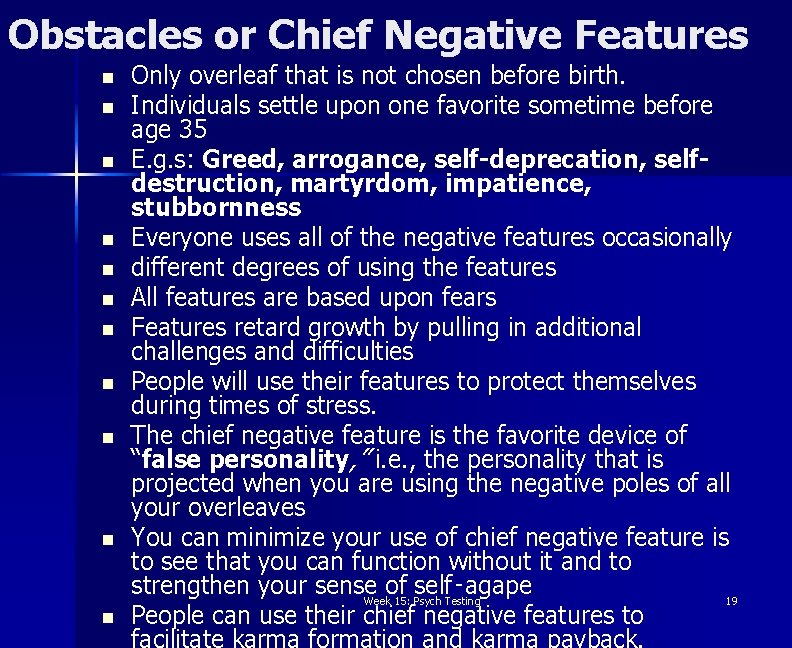
Obstacles or Chief Negative Features n n n Only overleaf that is not chosen before birth. Individuals settle upon one favorite sometime before age 35 E. g. s: Greed, arrogance, self-deprecation, selfdestruction, martyrdom, impatience, stubbornness Everyone uses all of the negative features occasionally different degrees of using the features All features are based upon fears Features retard growth by pulling in additional challenges and difficulties People will use their features to protect themselves during times of stress. The chief negative feature is the favorite device of “false personality, ” i. e. , the personality that is projected when you are using the negative poles of all your overleaves You can minimize your use of chief negative feature is to see that you can function without it and to strengthen your sense of self‑agape Week 15: Psych Testing 19 People can use their chief negative features to
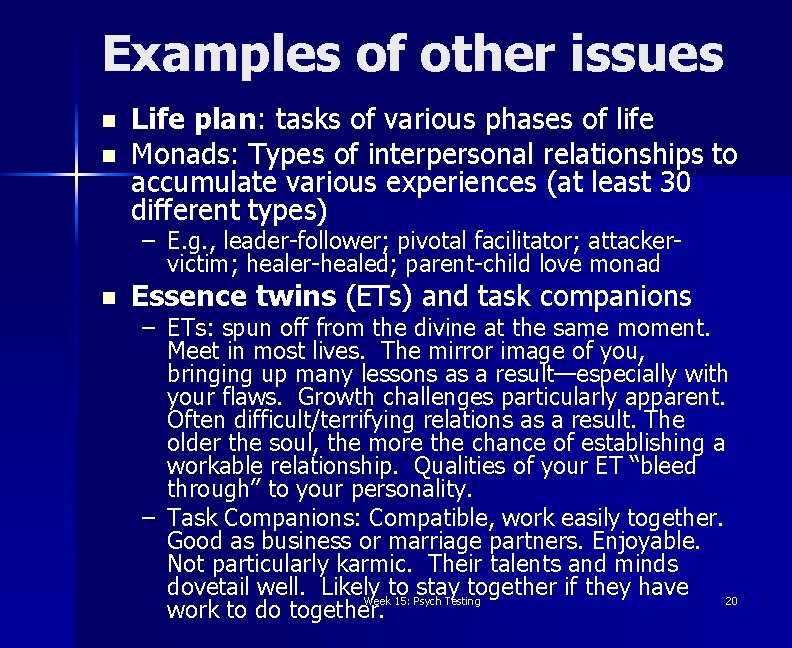
Examples of other issues n n Life plan: tasks of various phases of life Monads: Types of interpersonal relationships to accumulate various experiences (at least 30 different types) – E. g. , leader-follower; pivotal facilitator; attackervictim; healer-healed; parent-child love monad n Essence twins (ETs) and task companions – ETs: spun off from the divine at the same moment. Meet in most lives. The mirror image of you, bringing up many lessons as a result—especially with your flaws. Growth challenges particularly apparent. Often difficult/terrifying relations as a result. The older the soul, the more the chance of establishing a workable relationship. Qualities of your ET “bleed through” to your personality. – Task Companions: Compatible, work easily together. Good as business or marriage partners. Enjoyable. Not particularly karmic. Their talents and minds dovetail well. Likely to stay together if they have Week 15: Psych Testing 20 work to do together.
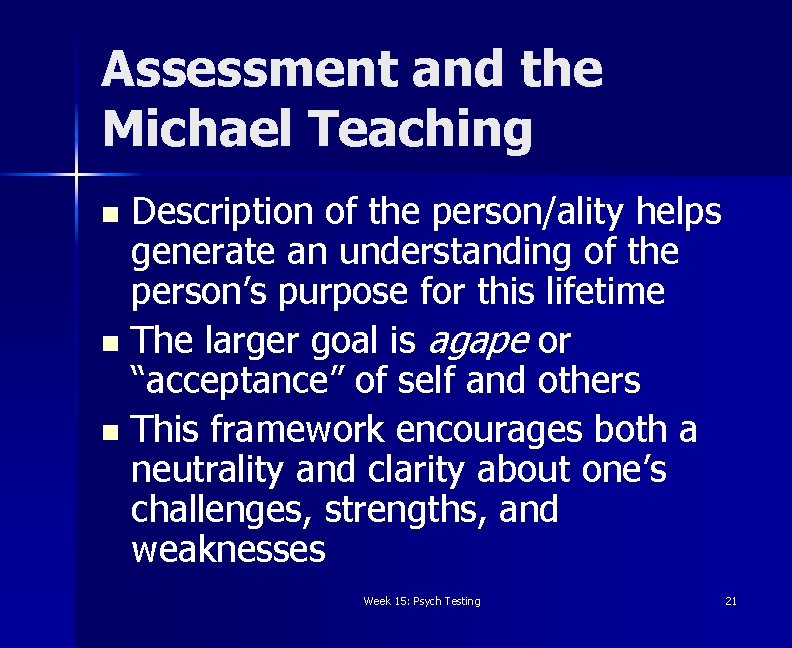
Assessment and the Michael Teaching Description of the person/ality helps generate an understanding of the person’s purpose for this lifetime n The larger goal is agape or “acceptance” of self and others n This framework encourages both a neutrality and clarity about one’s challenges, strengths, and weaknesses n Week 15: Psych Testing 21
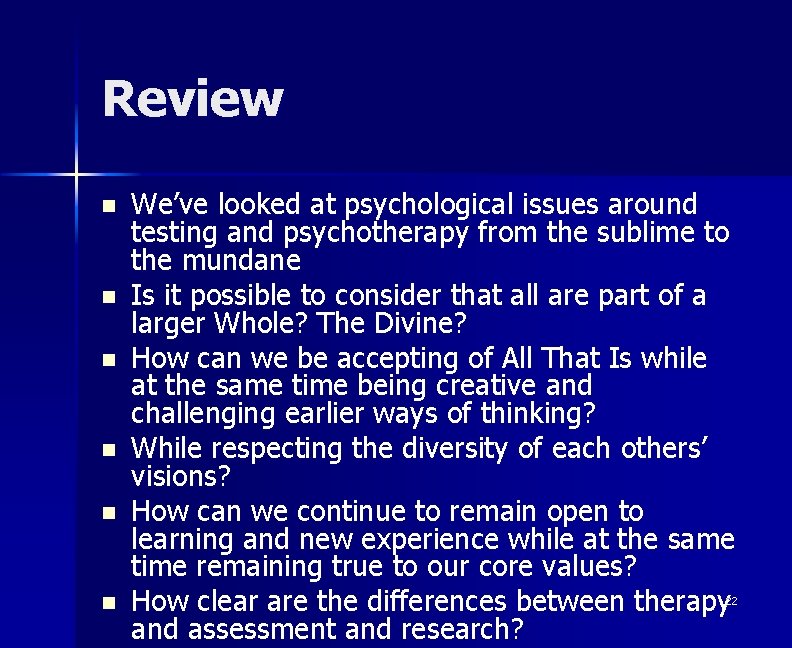
Review n n n We’ve looked at psychological issues around testing and psychotherapy from the sublime to the mundane Is it possible to consider that all are part of a larger Whole? The Divine? How can we be accepting of All That Is while at the same time being creative and challenging earlier ways of thinking? While respecting the diversity of each others’ visions? How can we continue to remain open to learning and new experience while at the same time remaining true to our core values? How clear are the differences between therapy and assessment and research? 22
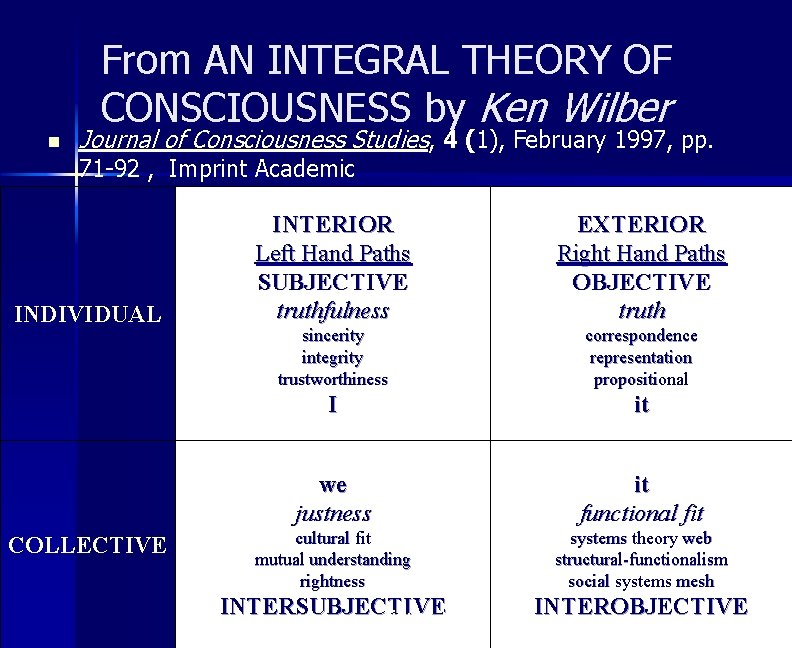
From AN INTEGRAL THEORY OF CONSCIOUSNESS by Ken Wilber n Journal of Consciousness Studies, 4 (1), February 1997, pp. 71 -92 , Imprint Academic INDIVIDUAL COLLECTIVE INTERIOR Left Hand Paths SUBJECTIVE truthfulness EXTERIOR Right Hand Paths OBJECTIVE truth sincerity integrity trustworthiness correspondence representation propositional I it we justness it functional fit cultural fit mutual understanding rightness systems theory web structural-functionalism social systems mesh INTERSUBJECTIVE Figure 2. Validity Claims. INTEROBJECTIVE 23
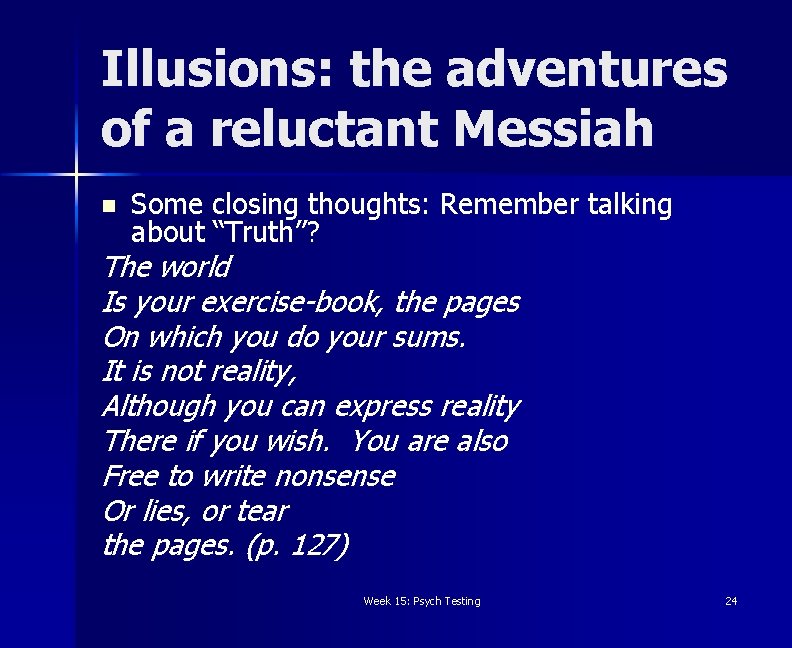
Illusions: the adventures of a reluctant Messiah n Some closing thoughts: Remember talking about “Truth”? The world Is your exercise-book, the pages On which you do your sums. It is not reality, Although you can express reality There if you wish. You are also Free to write nonsense Or lies, or tear the pages. (p. 127) Week 15: Psych Testing 24
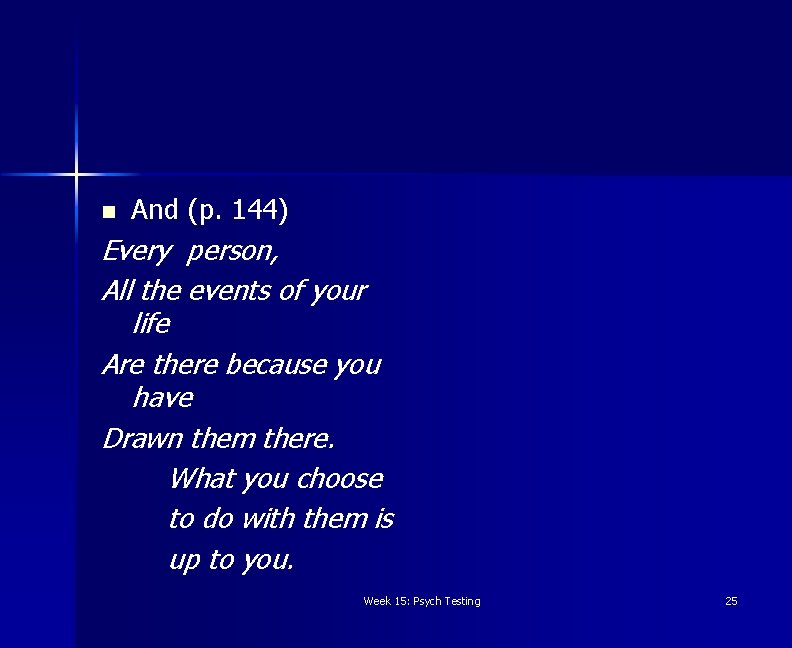
n And (p. 144) Every person, All the events of your life Are there because you have Drawn them there. What you choose to do with them is up to you. Week 15: Psych Testing 25
n We have been family for a short time. The bond n That links your true family n Is not one of blood, but n Of respect and joy in n Each other’s life n Rarely do members n Of one family grow up n Under the same n Roof (p. 84) n Week 15: Psych Testing 26
And from Manfred Mann’s Earth Band: “Questions” In a dream it would seem I went to those who close the open door Turning the key, I sat and spoke to those inside of me They answered my questions with questions And pointed me into the night Where the moon was a star-painted dancer And the world was just a spectrum of light They reached to my center of reason And pulled on the touchstone that's there The shock of that light had me reeling And I fell into the depths of despair They answered my questions with questions And set me to stand on the brink Where the sun and the moon were as brothers And all that was left was to think They answered my questions with questions And pointed me into the night The power that bore me had left me alone To figure out which way was right 27
Video of Leonard Cohen: I’m your man: Chpt. 21: Krishna Week 15: Psych Testing 28
Week 15: Psych Testing 29
Dedicated to Paramahansa Yogananda and to the students in this class Week 15: Psych Testing 30