
WEEK 12 Coating technology Chemical Vapour Deposition CVD
- Slides: 26
WEEK 12 Coating technology Chemical Vapour Deposition (CVD) & Physical Vapour Deposition (PVD)
WHY VAPOUR DEPOSITION ? • Vapour deposition is a coating technique, involving transfer of material on an atomic level. • It is used for – Improved hardness and wear resistance – Reduced friction – Improved oxidation resistance – Components to operate in special environments
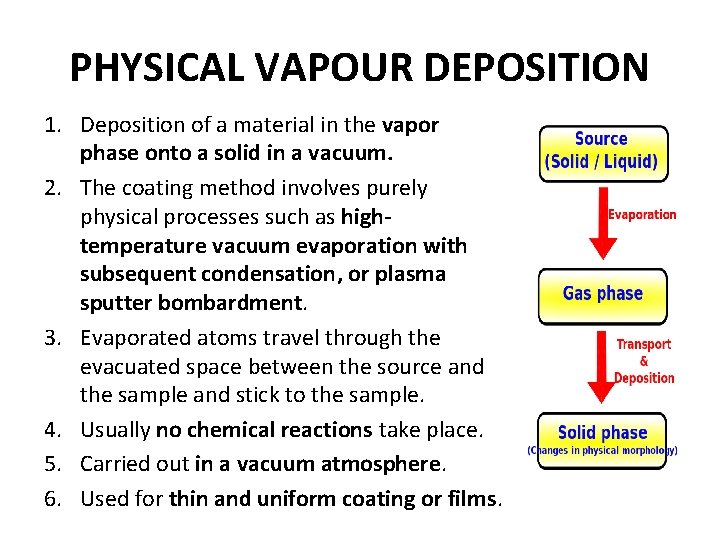
PHYSICAL VAPOUR DEPOSITION 1. Deposition of a material in the vapor phase onto a solid in a vacuum. 2. The coating method involves purely physical processes such as hightemperature vacuum evaporation with subsequent condensation, or plasma sputter bombardment. 3. Evaporated atoms travel through the evacuated space between the source and the sample and stick to the sample. 4. Usually no chemical reactions take place. 5. Carried out in a vacuum atmosphere. 6. Used for thin and uniform coating or films.
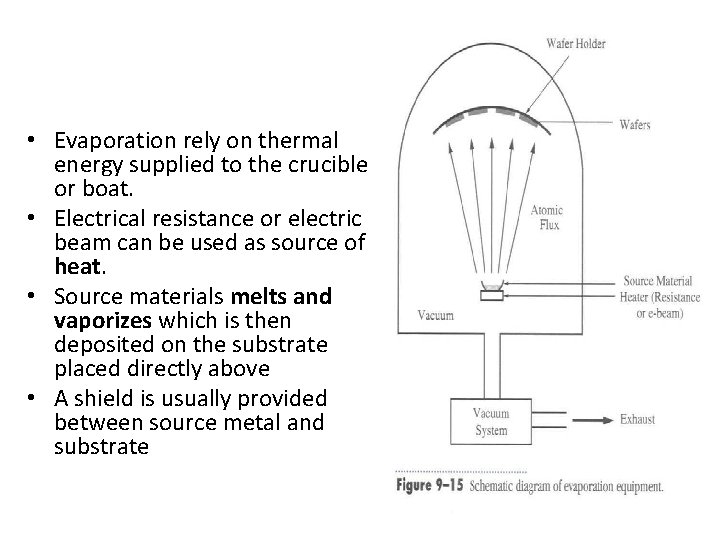
• Evaporation rely on thermal energy supplied to the crucible or boat. • Electrical resistance or electric beam can be used as source of heat. • Source materials melts and vaporizes which is then deposited on the substrate placed directly above • A shield is usually provided between source metal and substrate
PVD methods 1. Evaporation: Material is heated to a gas phase, where it then diffuses through a vacuum to the substrate. 2. Sputtering: Plasma is generated first; this plasma contains argon ions and electrons. Next, atoms from the target are ejected after being struck by argon ions. The atoms from the target travel through the plasma and form a layer on the substrate. 3. Molecular beam epitaxy: The substrate is cleaned and loaded into a chamber that is evacuated and heated to drive off surface contaminants and to roughen the surface of the substrate. The molecular beams emit a small amount of source material through a shutter, which then collects on the substrate.
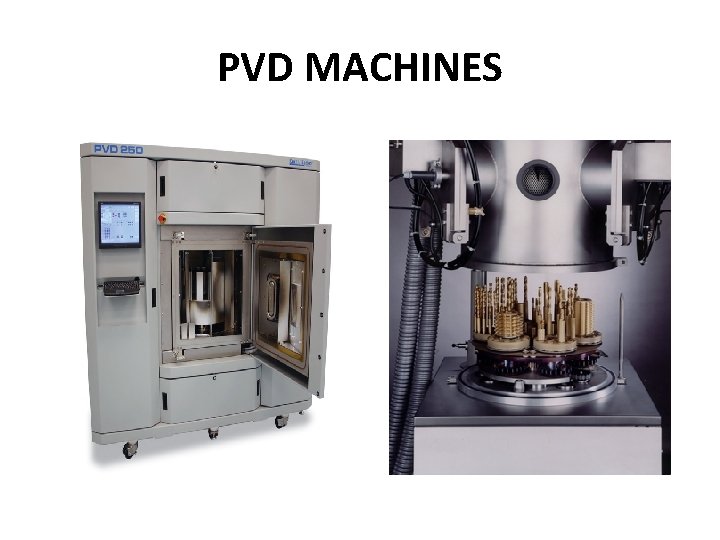
PVD MACHINES
Importance of PVD coatings 1. Improved hardness and wear resistance. 2. Reduced friction. 3. Improved Oxidation resistance (high temperature service). 4. The use of such coatings is aimed at improving efficiency through improved performance and longer component life. 5. They may also allow coated components to operate in environments that the uncoated component would not otherwise have been able to perform.
PVD ADVANTAGES 1. PVD coatings are harder and more corrosion resistant than coatings applied by the electroplating process. 2. Coatings have high temperature. 3. Good impact strength. 4. Excellent abrasion resistance. 5. Durable. 6. More environmental friendly process. 7. More than one technique can be used to deposit a given film.
PVD DISADVANTAGES • PVD needs high capital cost. • It is a line of sight technique meaning that it is extremely difficult to coat undercuts and similar surface features. • The rate of coating deposition is usually quite slow. • Processes requiring large amounts of heat require appropriate cooling systems.
CHEMICAL VAPOUR DEPOSITION (CVD)
CHEMICAL VAPOUR DEPOSITION • Chemical vapor deposition (CVD) is a chemical process used to produce high-purity, high-performance solid materials or coatings. • In a typical CVD process, the substrate is exposed to one or more volatile precursors which react and decompose on the substrate surface to produce the desired deposit. • Precursers include Halides (eg Ti. Cl 4), Hydrides (eg Si. H 4) and other compounds etc. • During this process, volatile by-products are also produced, which are removed by gas flow through the reaction chamber.
CVD SYSTEM 1. 2. 3. 4. 5. 6. 7. Gas delivery system – For the supply of precursors to the reactor chamber Reactor chamber – Chamber within which deposition takes place Substrate loading mechanism – A system for introducing and removing substrates, mandrels etc Energy source – Provide the energy/heat that is required to get the precursors to react/decompose Vacuum system – A system for removal of all other gaseous species other than those required for the reaction/deposition Exhaust system – System for removal of volatile by-products from the reaction chamber Process control equipment – Gauges, controls etc to monitor process parameters such as pressure, temperature and time
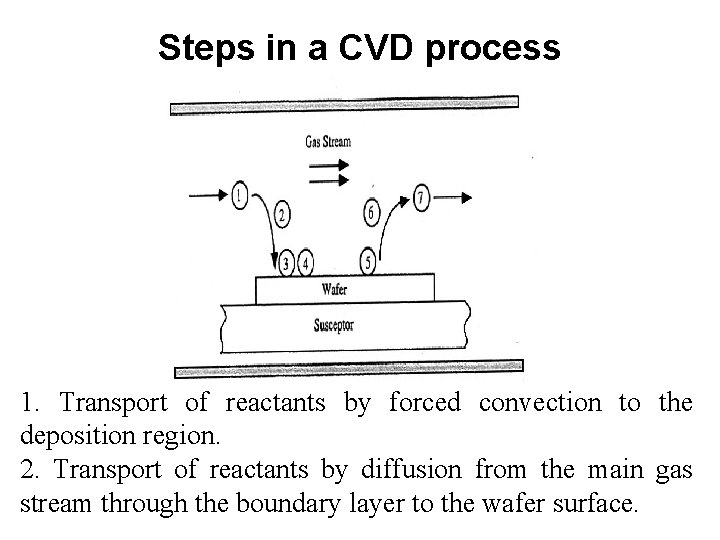
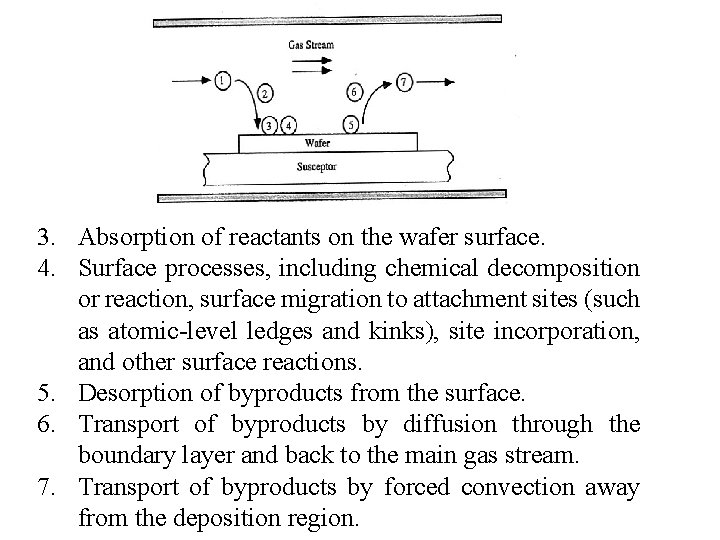
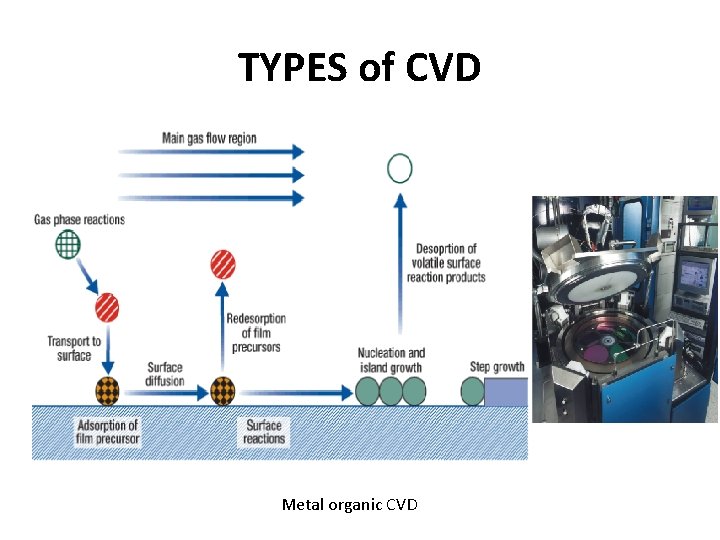
Steps in a CVD process 1. Transport of reactants by forced convection to the deposition region. 2. Transport of reactants by diffusion from the main gas stream through the boundary layer to the wafer surface.
3. Absorption of reactants on the wafer surface. 4. Surface processes, including chemical decomposition or reaction, surface migration to attachment sites (such as atomic-level ledges and kinks), site incorporation, and other surface reactions. 5. Desorption of byproducts from the surface. 6. Transport of byproducts by diffusion through the boundary layer and back to the main gas stream. 7. Transport of byproducts by forced convection away from the deposition region.
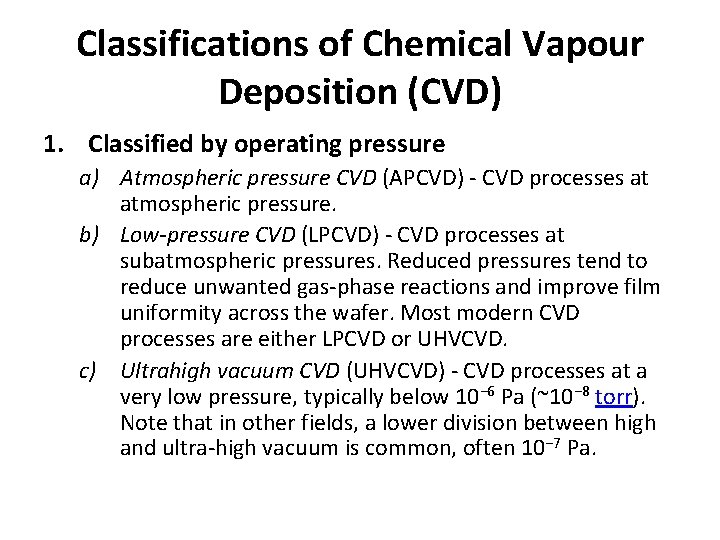
Classifications of Chemical Vapour Deposition (CVD) 1. Classified by operating pressure a) Atmospheric pressure CVD (APCVD) - CVD processes at atmospheric pressure. b) Low-pressure CVD (LPCVD) - CVD processes at subatmospheric pressures. Reduced pressures tend to reduce unwanted gas-phase reactions and improve film uniformity across the wafer. Most modern CVD processes are either LPCVD or UHVCVD. c) Ultrahigh vacuum CVD (UHVCVD) - CVD processes at a very low pressure, typically below 10− 6 Pa (~10− 8 torr). Note that in other fields, a lower division between high and ultra-high vacuum is common, often 10− 7 Pa.
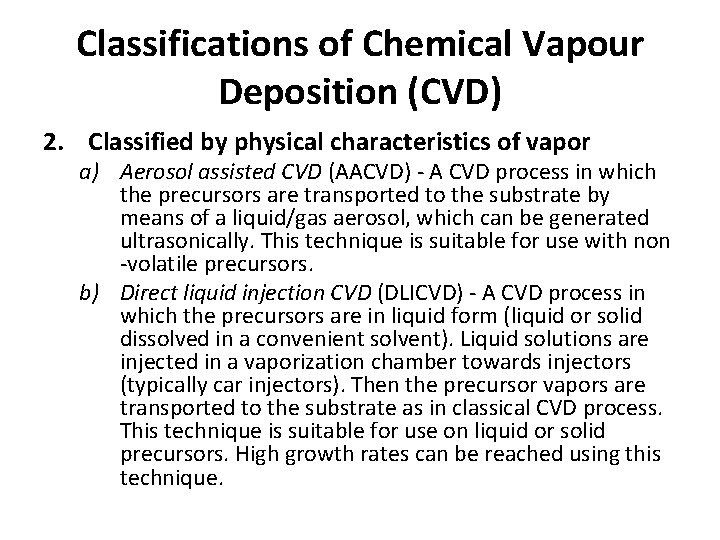
Classifications of Chemical Vapour Deposition (CVD) 2. Classified by physical characteristics of vapor a) Aerosol assisted CVD (AACVD) - A CVD process in which the precursors are transported to the substrate by means of a liquid/gas aerosol, which can be generated ultrasonically. This technique is suitable for use with non -volatile precursors. b) Direct liquid injection CVD (DLICVD) - A CVD process in which the precursors are in liquid form (liquid or solid dissolved in a convenient solvent). Liquid solutions are injected in a vaporization chamber towards injectors (typically car injectors). Then the precursor vapors are transported to the substrate as in classical CVD process. This technique is suitable for use on liquid or solid precursors. High growth rates can be reached using this technique.
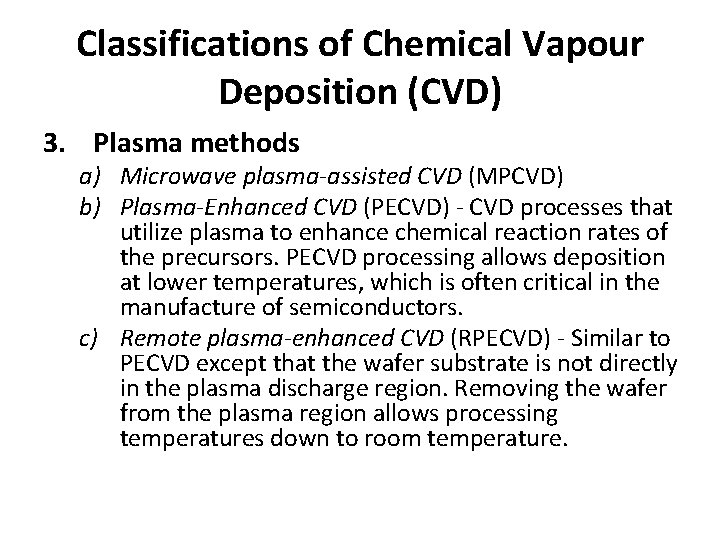
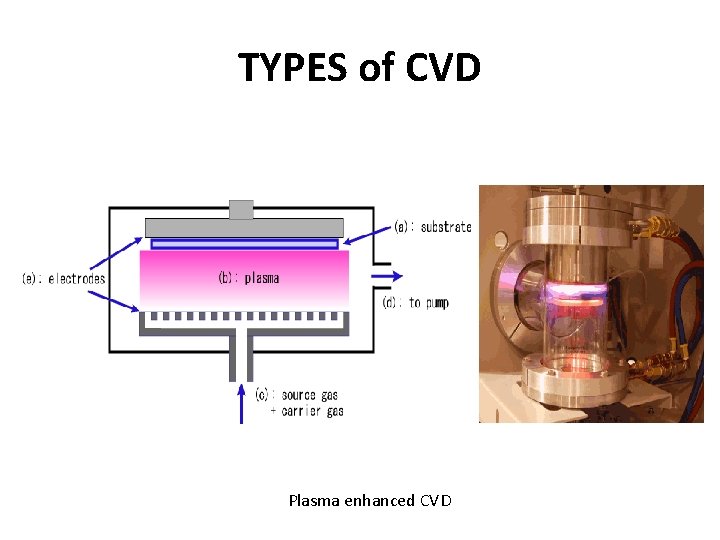
Classifications of Chemical Vapour Deposition (CVD) 3. Plasma methods a) Microwave plasma-assisted CVD (MPCVD) b) Plasma-Enhanced CVD (PECVD) - CVD processes that utilize plasma to enhance chemical reaction rates of the precursors. PECVD processing allows deposition at lower temperatures, which is often critical in the manufacture of semiconductors. c) Remote plasma-enhanced CVD (RPECVD) - Similar to PECVD except that the wafer substrate is not directly in the plasma discharge region. Removing the wafer from the plasma region allows processing temperatures down to room temperature.
TYPES of CVD Plasma enhanced CVD
TYPES of CVD Metal organic CVD
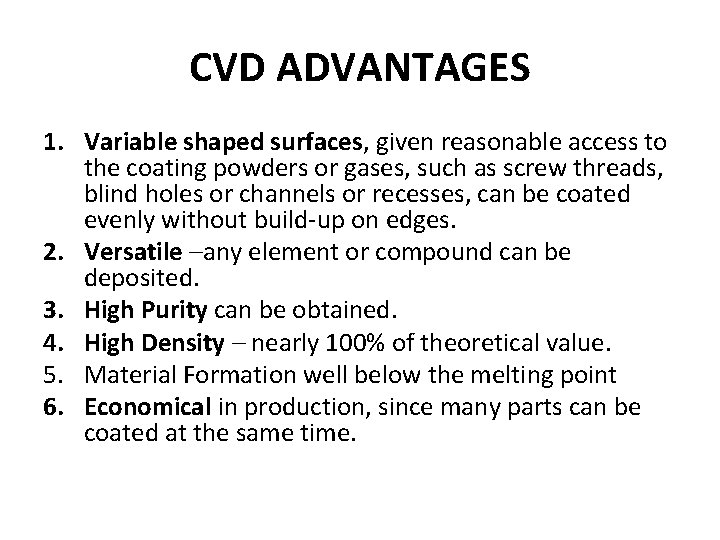
CVD ADVANTAGES 1. Variable shaped surfaces, given reasonable access to the coating powders or gases, such as screw threads, blind holes or channels or recesses, can be coated evenly without build-up on edges. 2. Versatile –any element or compound can be deposited. 3. High Purity can be obtained. 4. High Density – nearly 100% of theoretical value. 5. Material Formation well below the melting point 6. Economical in production, since many parts can be coated at the same time.
CVD APPLICATIONS CVD has applications across a wide range of industries such as: 1. Coatings – Coatings for a variety of applications such as wear resistance, corrosion resistance, high temperature protection, erosion protection and combinations thereof. 2. Semiconductors and related devices – Integrated circuits, sensors and optoelectronic devices 3. Dense structural parts – CVD can be used to produce components that are difficult or uneconomical to produce using conventional fabrication techniques. Dense parts produced via CVD are generally thin walled and maybe deposited onto a mandrel or former.
CVD APPLICATIONS 4. Optical Fibres – For telecommunications. 5. Composites – Preforms can be infiltrated using CVD techniques to produce ceramic matrix composites such as carbon-carbon, carbon-silicon carbide and silicon carbide composites. This process is sometimes called chemical vapour infiltration or CVI. 6. Powder production – Production of novel powders and fibres 7. Catalysts 8. Nanomachines
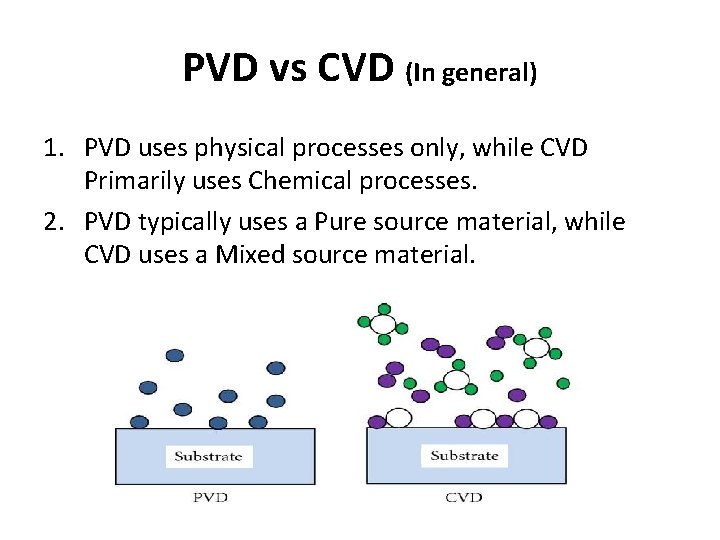
PVD vs CVD (In general) 1. PVD uses physical processes only, while CVD Primarily uses Chemical processes. 2. PVD typically uses a Pure source material, while CVD uses a Mixed source material.
PVD vs CVD (In detail) 1. One reason to use a PVD process (such as sputtering) instead of CVD is the temperature requirement. CVD processes run at much higher temperatures than PVD processes, usually between 300°C and 900°C. This heat is supplied by a furnace, RF coil, or laser, but it always heats the substrate. 2. Substrates that cannot tolerate this temperature must have thin films deposited by the physical form of vapor deposition instead. The benefit of the substrate temperature in some CVD processes is that there is less waste deposition, especially in cold-wall reactors, because only the heated surfaces are coated. With the use of a laser heating system, the CVD process becomes selective to the path of the laser; this is a distinct advantage over PVD methods such as sputtering.
3. Molecular beam epitaxy (PVD process) has a distinct advantage of atomic level control of chemical composition, film thickness, and transition sharpness. This process is relatively more expensive, but is worth the added cost for applications that demand higher precision. 4. Sputtering (PVD process) does not require the use of specialized precursor materials as used in CVD. Sputtering has a wider range of materials readily available for deposition. 5. Another advantage of PVD over CVD is the safety issue of the materials that are used for chemical vapor deposition. It is known that some precursors and some by-products are toxic, pyrophoric, or corrosive. This can cause issues with material handling and storage. 6. There applications that could use either deposition method successfully. However, an experienced engineer could easily recommend chemical or physical vapor deposition for a job based on criteria such as cost, film thickness, source material availability, and compositional control.
QUIZ (10 minutes) 1. Give 3 parameters in Water Jet Machining. 2. Explain why Electron Beam Machining (EBM) needs to operate in vacuum condition? . 3. What is MEMS? .