
Week 11 International Marketing Logistics Channels Learning Objectives
Week 11: International Marketing & Logistics Channels

Learning Objectives l Understand logistics’ impact on company strategy & competitive advantage l Identify various channels of domestic and International distribution l Discuss the need for channel intermediaries l Introduce the concept of supply chain management (SCM) l l Distinguish among types of channel intermediaries and describe their role in the supply chain Explore the integration of multiple logistics strategies and principles
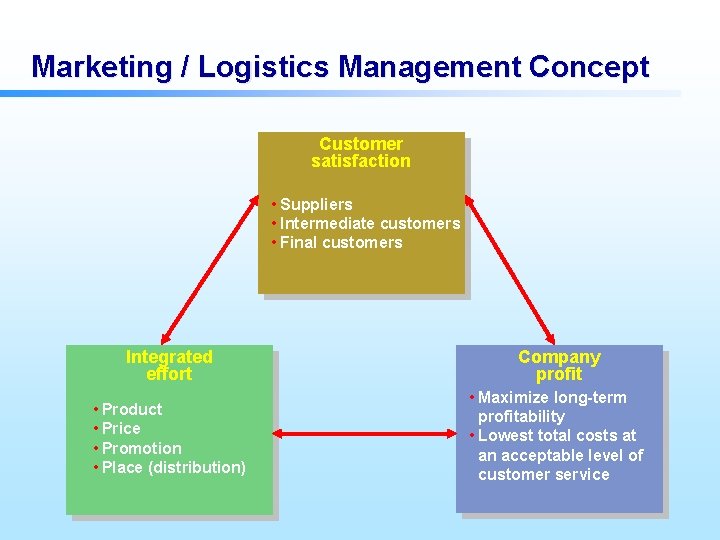
Marketing / Logistics Management Concept Customer satisfaction • Suppliers • Intermediate customers • Final customers Integrated effort Company profit • Product • Price • Promotion • Place (distribution) • Maximize long-term profitability • Lowest total costs at an acceptable level of customer service
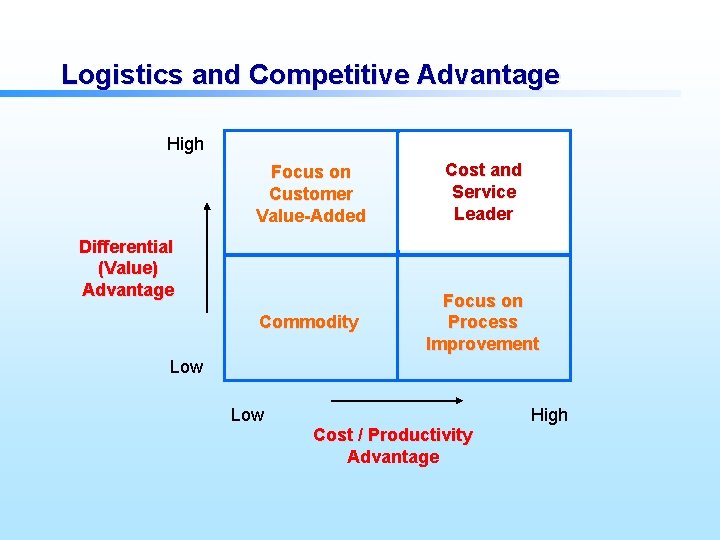
Logistics and Competitive Advantage High Focus on Customer Value-Added Cost and Service Leader Commodity Focus on Process Improvement Differential (Value) Advantage Low Cost / Productivity Advantage High
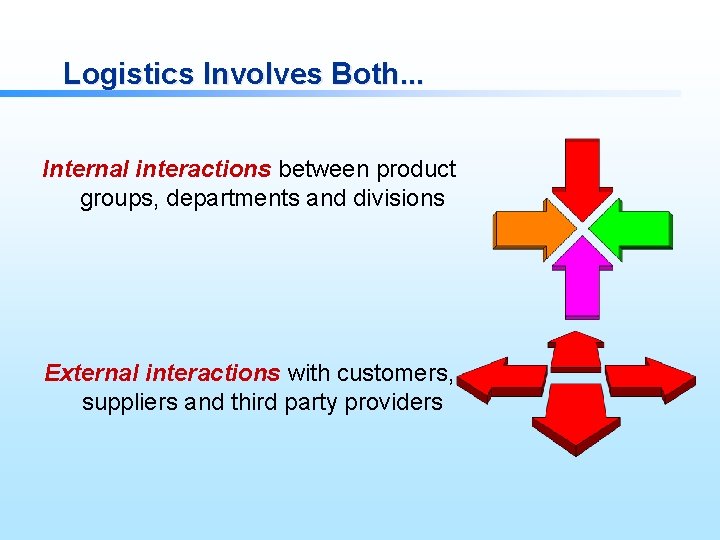
Logistics Involves Both. . . Internal interactions between product groups, departments and divisions External interactions with customers, suppliers and third party providers
Supply Chain Management (SCM) “Supply chain management involves the management of upstream and downstream relationships with suppliers, distributors and customers to achieve greater customer value-added at less total cost. ” (Christopher, M. 1998)
Partnering Through Supply Chain Management l SCM involves (& often requires) – Partnerships among channel members working to create a distribution system that reduces inefficiencies, costs, and redundancies while creating competitive advantage and satisfying customers. – The use of technology e. g. , bar code data, electronic data interchange, etc. to link supply chain partners. This increases productivity by reducing inventory, shortening cycle time, and removing wasted human effort.
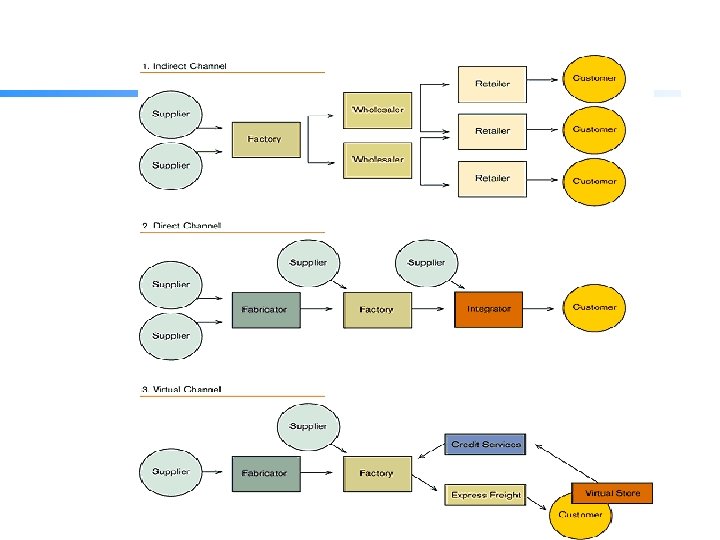
Channels of Distribution Definitions l l l A sequence of marketing organizations that directs a product from the producer to the ultimate (or end) user. Systems of relationships among businesses that participate in the process of buying and selling products and services May sometimes be referred to as a supply chain or marketing channel Multiple Channels for Consumer Products l Manufacturers/Suppliers use different channels to reach different market segments Formal (contract-based) vs. Informal (Partnerships) Channel Relationships

Distribution Channels – Consumer Products CONSUMER PRODUCTS Producer l Consumer Producer Consumer (Direct Channel) – Includes no intermediaries. – Used by services and consumer goods sold directly to the consumer Producer l Retailer Consumer Producer Retailer Consumer – Producers sell directly to large retailers (e. g. , Wal-Mart) – Used where shipping and handling costs are high, or with perishable products and/or fashion products with short product life cycles. Figure 15. 1
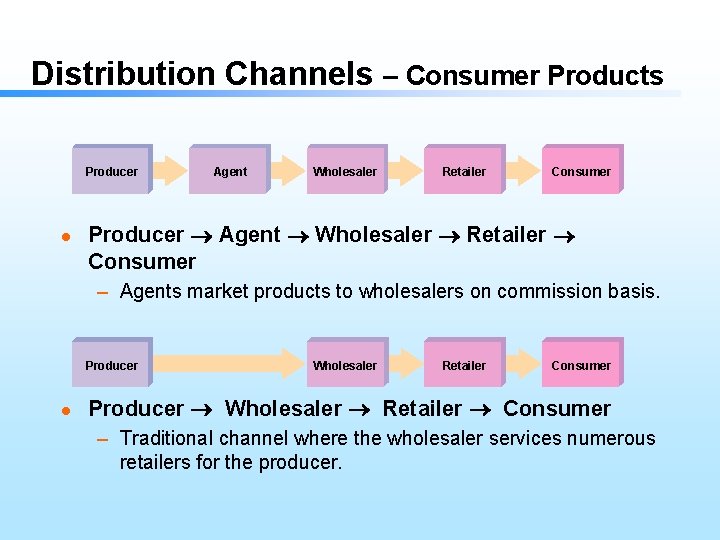
Distribution Channels – Consumer Products Producer l Agent Wholesaler Retailer Consumer Producer Agent Wholesaler Retailer Consumer – Agents market products to wholesalers on commission basis. Producer l Wholesaler Retailer Consumer Producer Wholesaler Retailer Consumer – Traditional channel where the wholesaler services numerous retailers for the producer.

Distribution Channels – Business Products BUSINESS PRODUCTS Business customer Producer l Producer Business user – Direct channel – Manufacturer’s sales force sells directly to the consumer. Producer l Agent middleman Business customer Producer Agent middleman Business user – Independent intermediary represents the manufacturer to the consumer.
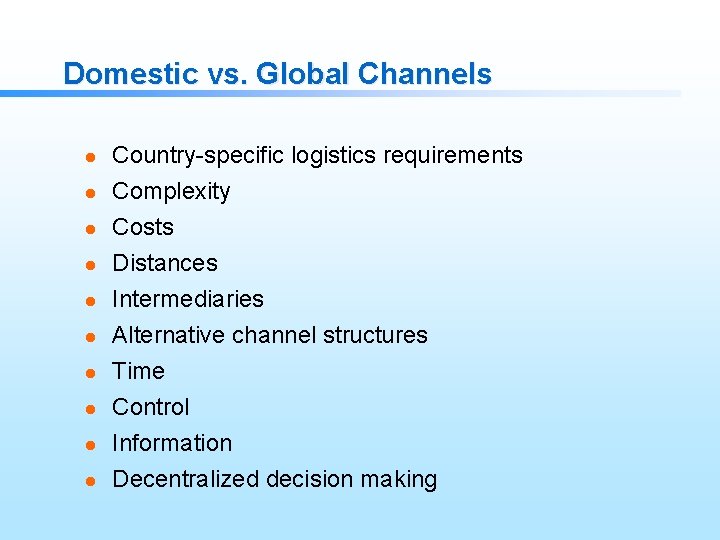
Domestic vs. Global Channels l l l l l Country-specific logistics requirements Complexity Costs Distances Intermediaries Alternative channel structures Time Control Information Decentralized decision making

Alternative International Channel Structures Manufacturer International Division Host Country Buying Office Wholesaler Trading Company /Agent Wholesaler Parent Company Trading Company /Agent Wholesaler Distributor Wholesaler Retailer Wholesaler Retailer Customer Retailer
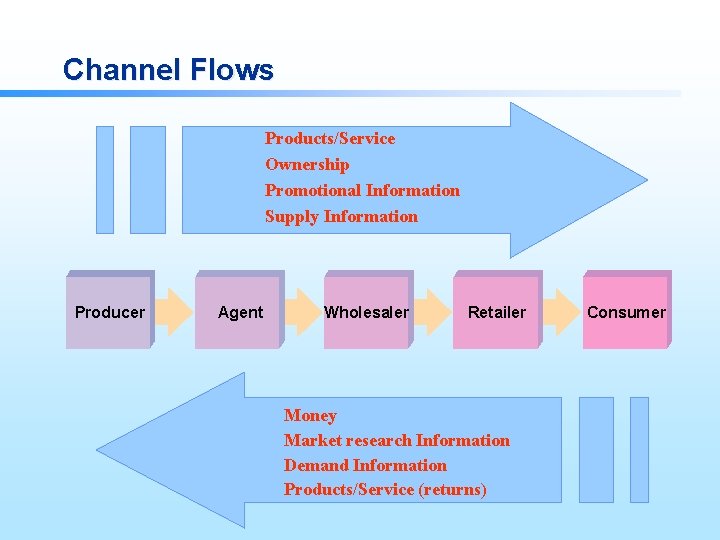
Channel Flows Products/Service Ownership Promotional Information Supply Information Producer Agent Wholesaler Retailer Money Market research Information Demand Information Products/Service (returns) Consumer
Middlemen
Middleman (or marketing intermediary) l A marketing organization that links a producer and user within a marketing channel. – Merchant middleman—takes title to products by buying them, e. g. distributors. – Functional middleman—helps in the transfer of ownership of products but does not take title to the products, e. g. , 3 pls. – Retailer—buys from producers or other middlemen and sells to consumers. – Wholesaler—a middleman that sells products to other firms.
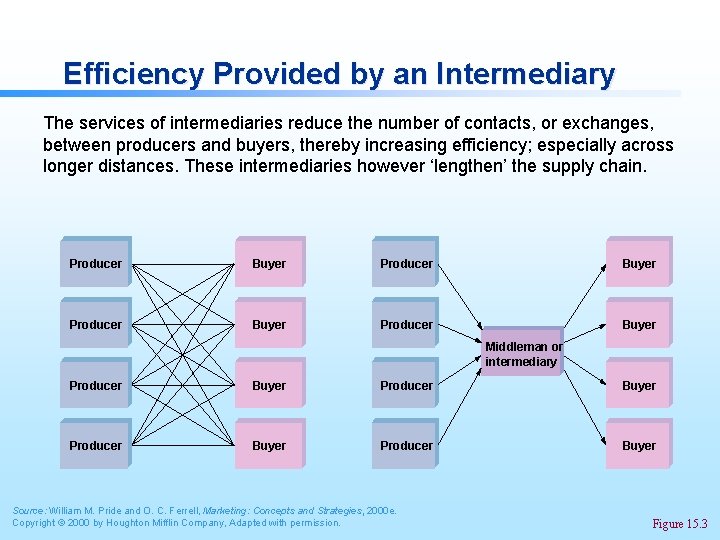
Efficiency Provided by an Intermediary The services of intermediaries reduce the number of contacts, or exchanges, between producers and buyers, thereby increasing efficiency; especially across longer distances. These intermediaries however ‘lengthen’ the supply chain. Producer Buyer Middleman or intermediary Producer Buyer Source: William M. Pride and O. C. Ferrell, Marketing: Concepts and Strategies, 2000 e. Copyright © 2000 by Houghton Mifflin Company, Adapted with permission. Figure 15. 3
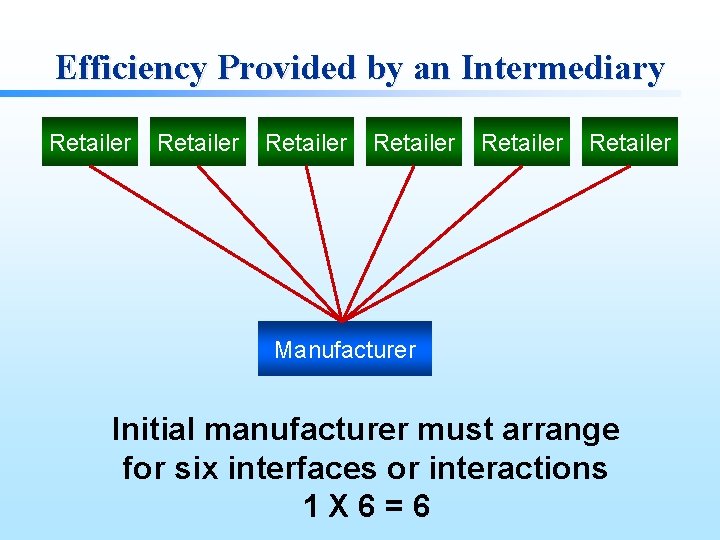
Efficiency Provided by an Intermediary Retailer Retailer Manufacturer Initial manufacturer must arrange for six interfaces or interactions 1 X 6=6
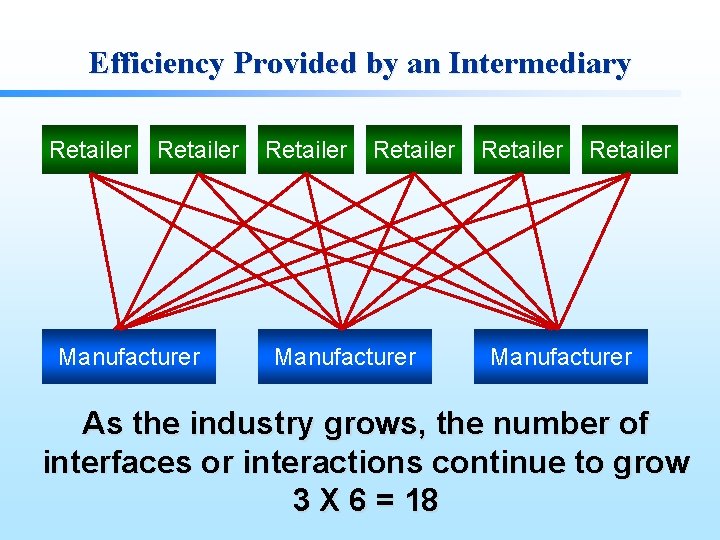
Efficiency Provided by an Intermediary Retailer Manufacturer Retailer Manufacturer As the industry grows, the number of interfaces or interactions continue to grow 3 X 6 = 18
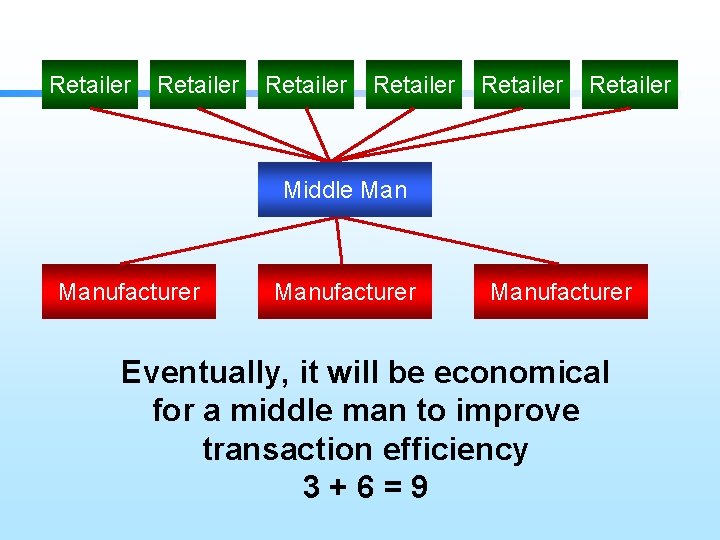
Retailer Retailer Middle Manufacturer Eventually, it will be economical for a middle man to improve transaction efficiency 3+6=9
Losing the Middle Man l l Can a company or product grow so large that as middle man does not make sense? At what point do we lose the middle man?
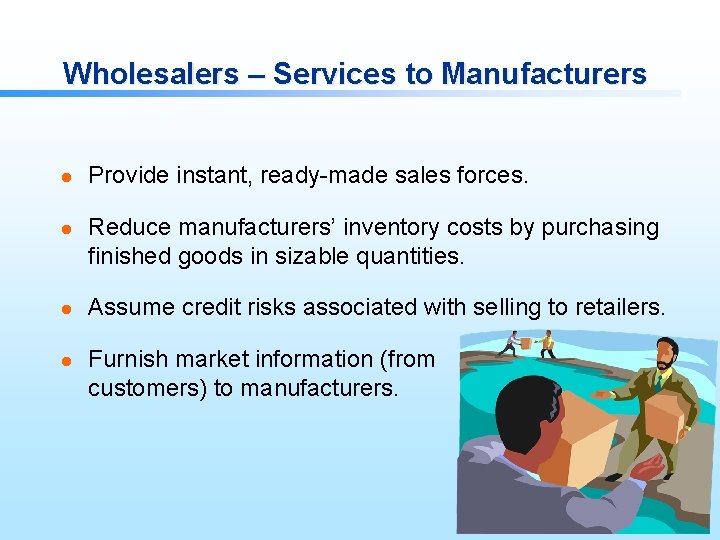
Wholesalers – Services to Manufacturers l l Provide instant, ready-made sales forces. Reduce manufacturers’ inventory costs by purchasing finished goods in sizable quantities. Assume credit risks associated with selling to retailers. Furnish market information (from customers) to manufacturers.
Wholesalers - Services to Retailers l l l Promotion: Promote products to retailers. Market Information: Two-way source of market information for both producers and retailers. Financial Aid: Provide timely product deliveries that reduce inventory costs for retailers and extend credit to retailers for inventory purchases.
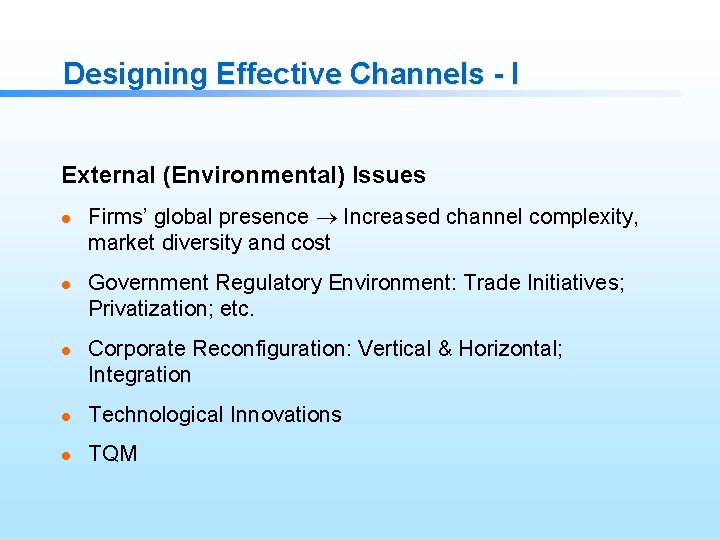
Designing Effective Channels - I External (Environmental) Issues l l l Firms’ global presence Increased channel complexity, market diversity and cost Government Regulatory Environment: Trade Initiatives; Privatization; etc. Corporate Reconfiguration: Vertical & Horizontal; Integration l Technological Innovations l TQM
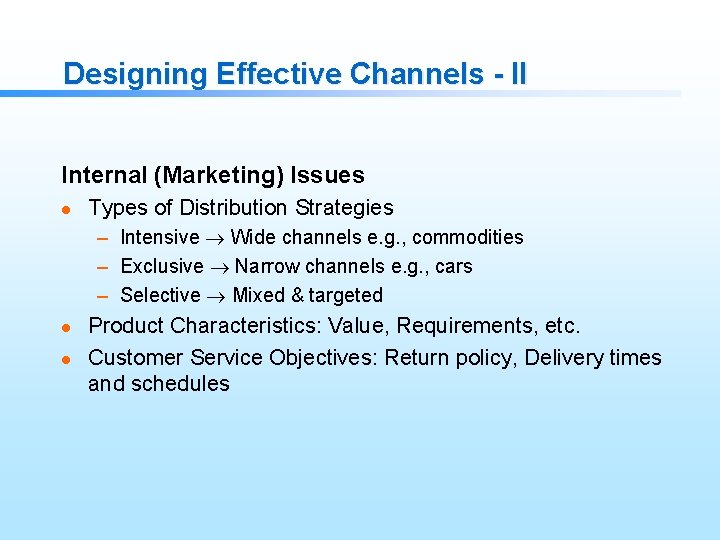
Designing Effective Channels - II Internal (Marketing) Issues l Types of Distribution Strategies – Intensive Wide channels e. g. , commodities – Exclusive Narrow channels e. g. , cars – Selective Mixed & targeted l l Product Characteristics: Value, Requirements, etc. Customer Service Objectives: Return policy, Delivery times and schedules
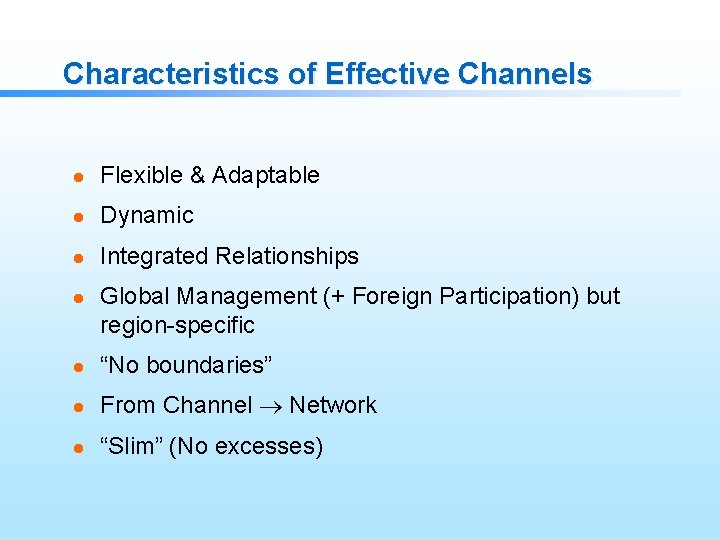
Characteristics of Effective Channels l Flexible & Adaptable l Dynamic l Integrated Relationships l Global Management (+ Foreign Participation) but region-specific l “No boundaries” l From Channel Network l “Slim” (No excesses)
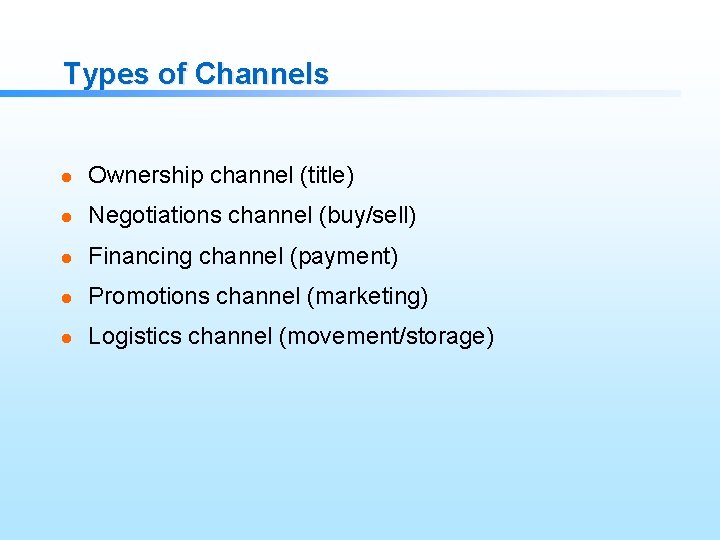
Types of Channels l Ownership channel (title) l Negotiations channel (buy/sell) l Financing channel (payment) l Promotions channel (marketing) l Logistics channel (movement/storage)
Logistics Channel Functions l Concentration – Combine multiple small shipments into larger shipments – Accumulating from different sources (consolidating) l Customization – A shipment of different pieces is assembled – Sorting heterogeneous products into homogeneous stocks l Dispersion – Large shipments are broken down into smaller shipments – Allocating into smaller lots (bulk-breaking) l Assorting – Building assortments of goods for resale
Different Channel Flows l l There are channels for the flow of information There are channels for the flow of product/service There are forward channels There are reverse channels
“Power” in the Channel l Each channel member has strengths and weaknesses The channel member with the greater power (known as the “Channel Captain”) will dictate roles within the channel or even develop alternative channels What’s wrong with this picture?
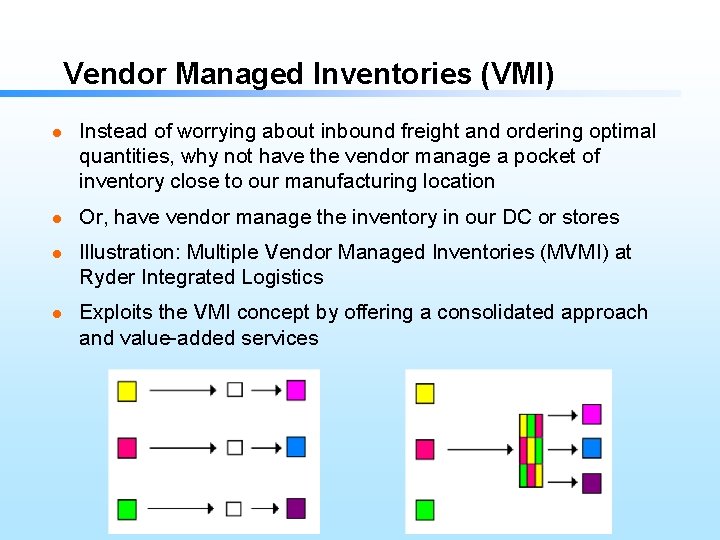
Vendor Managed Inventories (VMI) l l Instead of worrying about inbound freight and ordering optimal quantities, why not have the vendor manage a pocket of inventory close to our manufacturing location Or, have vendor manage the inventory in our DC or stores Illustration: Multiple Vendor Managed Inventories (MVMI) at Ryder Integrated Logistics Exploits the VMI concept by offering a consolidated approach and value-added services
Evolution of Logistics
Evolution of Logistics 1970 Stage Area Functional Trans/ Whse Driver Activity Metric Cost
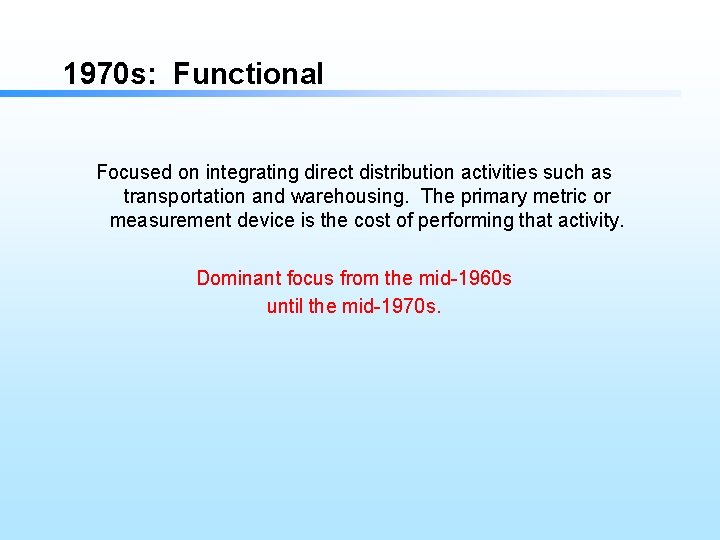
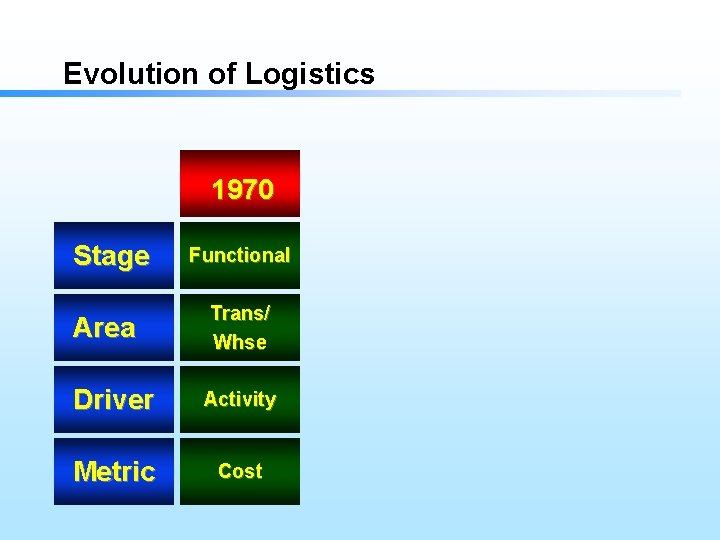
1970 s: Functional Focused on integrating direct distribution activities such as transportation and warehousing. The primary metric or measurement device is the cost of performing that activity. Dominant focus from the mid-1960 s until the mid-1970 s.
Evolution of Logistics 1970 Stage 1980 Functional Information Trans/ Whse Customer Service Driver Activity Information Metric Cost Response Area
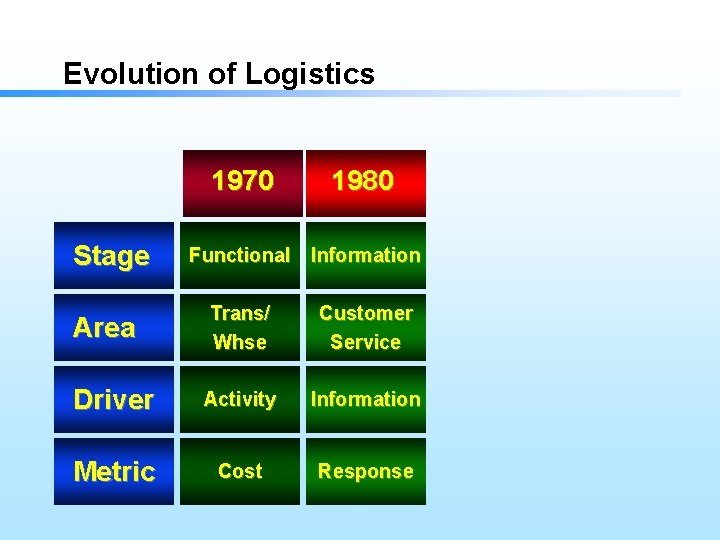
1980 s: Information Integration Logistics viewed as a system with both activity and information as part of the logistics process. Customer service focus provided the primary functionality with the metric becoming system response time to customer service requirements. Dominant from around the mid-1970 s until early in the decade of the 1980 s.
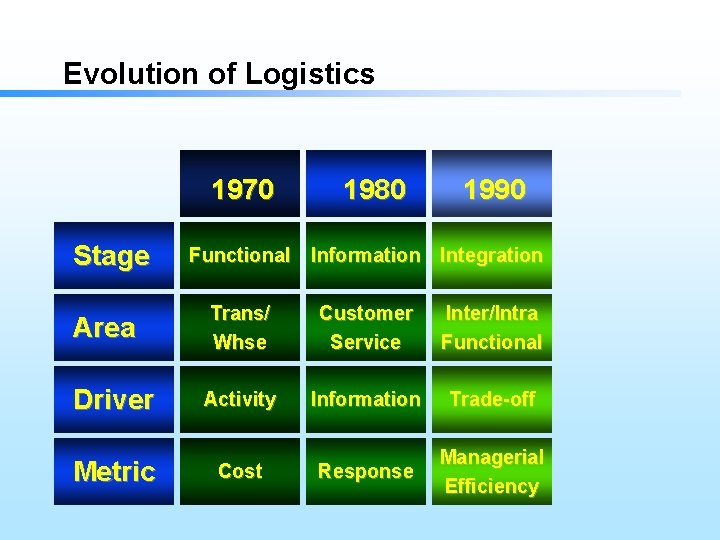
Evolution of Logistics 1970 Stage 1980 1990 Functional Information Integration Trans/ Whse Customer Service Inter/Intra Functional Driver Activity Information Trade-off Metric Cost Response Managerial Efficiency Area
1990 s: Interfunctional Integration The stage many firms are currently in. Requires managerial integration between major corporate functions. Perspective is total material flow integration with fully visible tradeoffs. Decisions are made in accordance with marginal contribution (or efficiency) of the individual functions to the overall objectives of the firm. Dominant theme into the 1990 s.
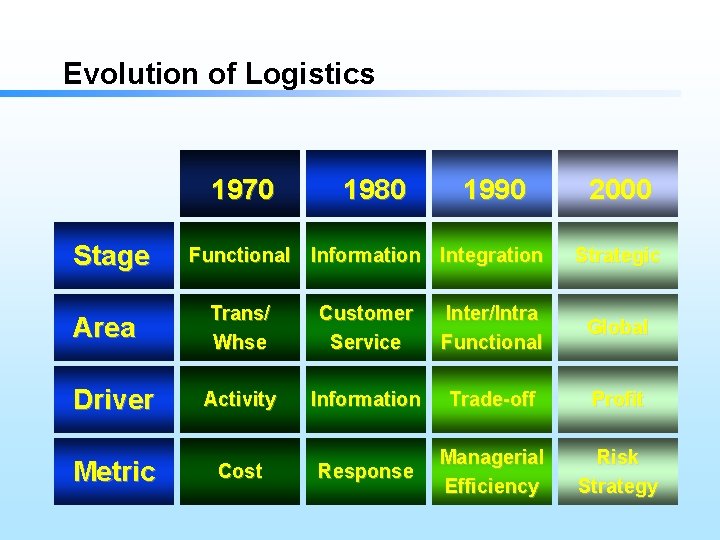
Evolution of Logistics 1970 Stage 1980 1990 Functional Information Integration 2000 Strategic Trans/ Whse Customer Service Inter/Intra Functional Global Driver Activity Information Trade-off Profit Metric Cost Response Managerial Efficiency Risk Strategy Area
2000 s: Strategic Integration The logistics function becomes the cornerstone to the strategic thrust of the firm. Functionality is global in that the logistics function spans both geographic and ownership boundaries. Shifts from a cost center to an important source of profitability for the firm. Logistics performance is measured in terms of risk rather than in terms of cost.
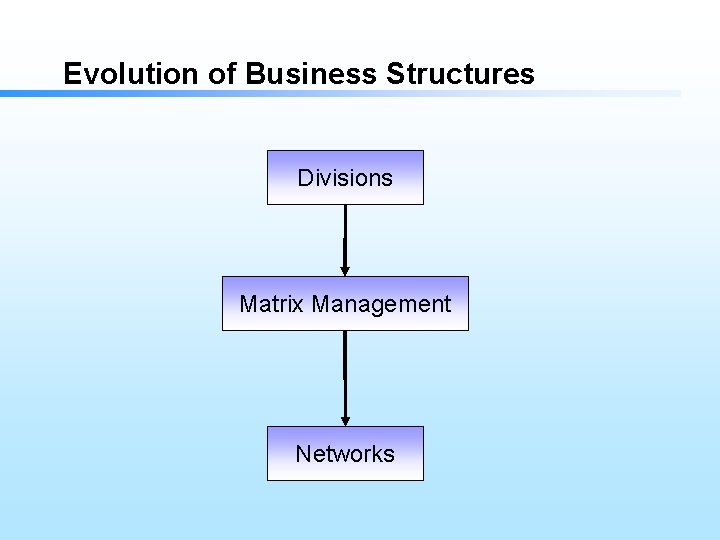
Evolution of Business Structures Divisions Matrix Management Networks
Functional ‘Silos’ l l l Structured around individual functional areas (divisions) “Silo Mentality” focuses primarily on internal operations – ignores “overall picture” Little consideration for cross-functional interaction Adversarial and competitive cross-functional relationships Often conflicting goals and objectives across functions and within overall corporate objectives Conflicting goals and poor communication results in higher total costs and reduced productivity
Matrix Organization l l l Provides linkages between divisions and overall corporate organization Developed from combinations of horizontal and vertical interactions Structured around cross-functional projects Teams l l l Structured around cross-product/service relationships May be Inter-organizational or inter-functional Popular within strategic and other forms of alliances
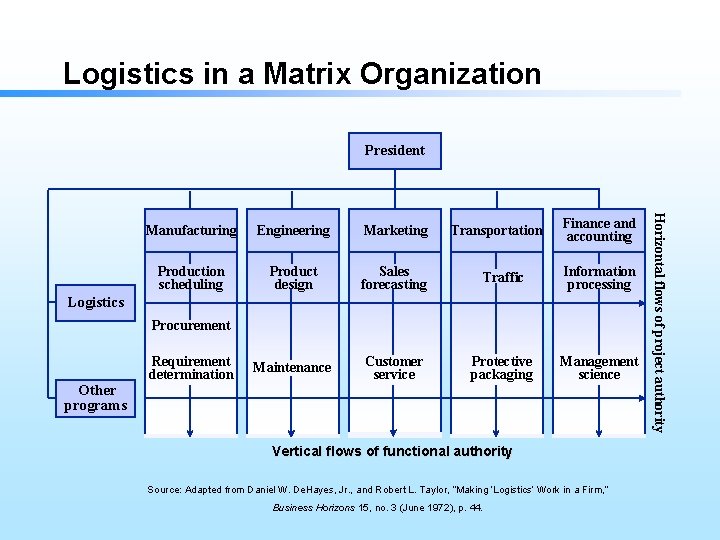
Logistics in a Matrix Organization President Engineering Marketing Production scheduling Product design Sales forecasting Traffic Information processing Maintenance Customer service Protective packaging Management science Logistics Procurement Other programs Requirement determination Vertical flows of functional authority Source: Adapted from Daniel W. De. Hayes, Jr. , and Robert L. Taylor, “Making ‘Logistics’ Work in a Firm, ” Business Horizons 15, no. 3 (June 1972), p. 44. Horizontal flows of project authority Transportation Finance and accounting Manufacturing
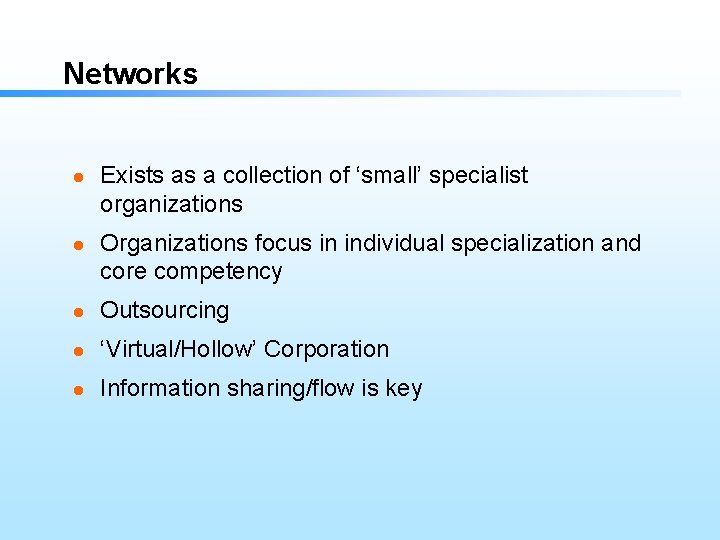
Networks l l Exists as a collection of ‘small’ specialist organizations Organizations focus in individual specialization and core competency l Outsourcing l ‘Virtual/Hollow’ Corporation l Information sharing/flow is key
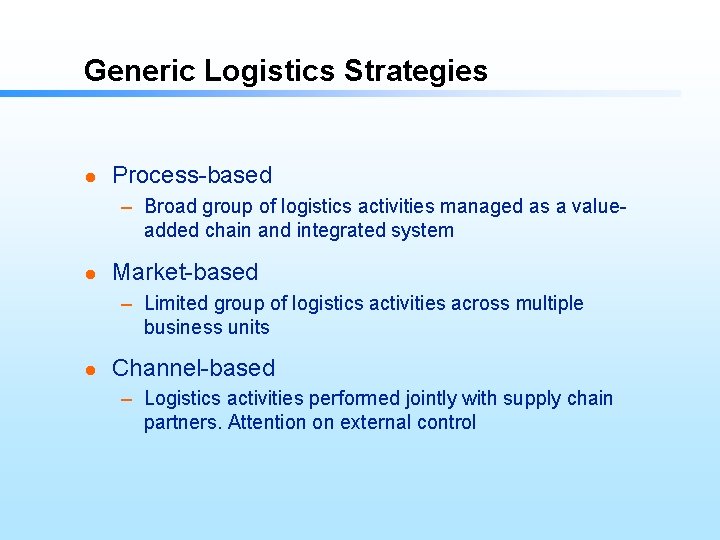
Generic Logistics Strategies l Process-based – Broad group of logistics activities managed as a valueadded chain and integrated system l Market-based – Limited group of logistics activities across multiple business units l Channel-based – Logistics activities performed jointly with supply chain partners. Attention on external control
Logistics Principles
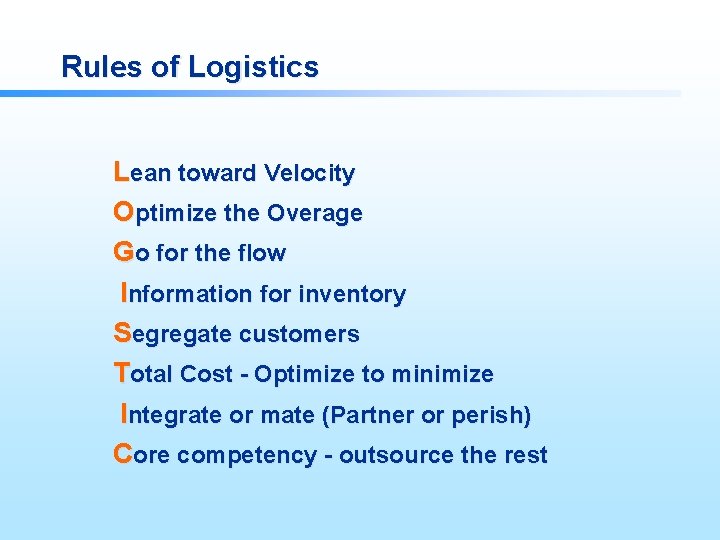
Rules of Logistics Lean toward Velocity Optimize the Overage Go for the flow Information for inventory Segregate customers Total Cost - Optimize to minimize Integrate or mate (Partner or perish) Core competency - outsource the rest
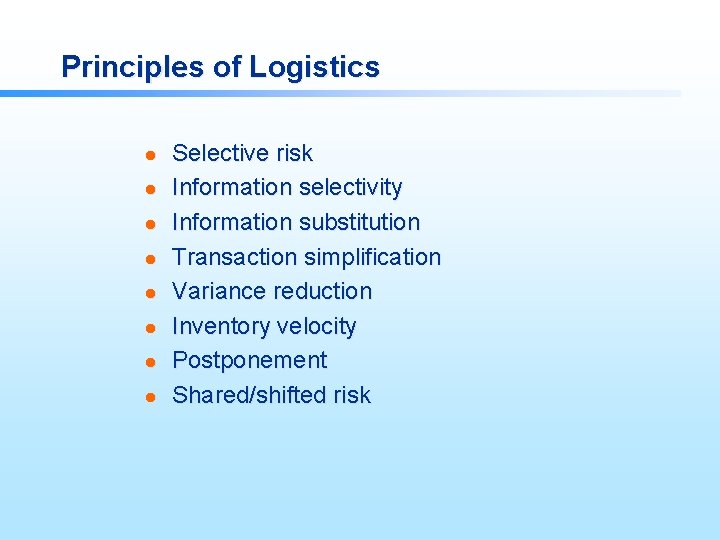
Principles of Logistics l l l l Selective risk Information selectivity Information substitution Transaction simplification Variance reduction Inventory velocity Postponement Shared/shifted risk
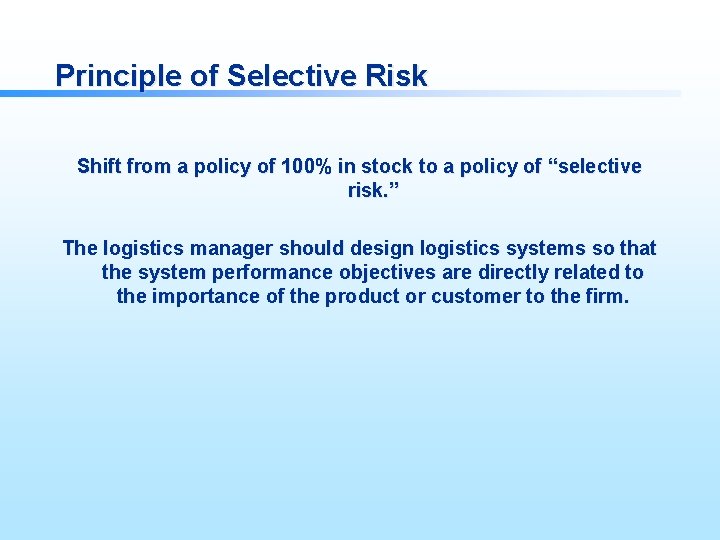
Principle of Selective Risk Shift from a policy of 100% in stock to a policy of “selective risk. ” The logistics manager should design logistics systems so that the system performance objectives are directly related to the importance of the product or customer to the firm.
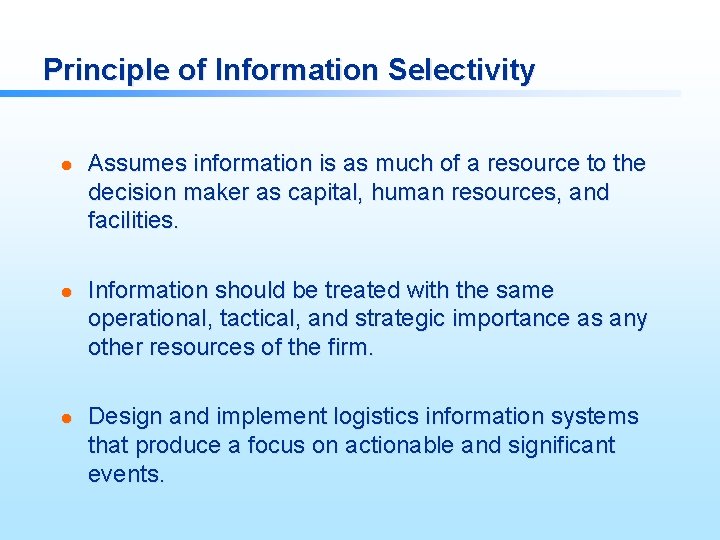
Principle of Information Selectivity l l l Assumes information is as much of a resource to the decision maker as capital, human resources, and facilities. Information should be treated with the same operational, tactical, and strategic importance as any other resources of the firm. Design and implement logistics information systems that produce a focus on actionable and significant events.
Principle of Information Substitution The primary target for the logistics manager should be the transformation of information for inventory. Another key area is the tradeoff between information and transportation.
Principle of Transaction Simplification Improve the efficiency and effectiveness of the transactional processes of the firm: l l l Upgrade systems to remove human intervention. Link the collection, transmission, and storage of data or information sets within the system or between the system and outside suppliers, customers, or third party providers. Efficiencies gained from cooperation among parties involved in the transaction.
Principle of Variance Reduction In any logistics system there a series of linkages between demand supply points. Failure to accurately anticipate demands leads to erosion of system productivity (excessive inventory, overtime, increased stockouts) A logistics manager can significantly influence the productivity of the system by reducing unplanned variance in the system.
Principle of Inventory Velocity Facilitating the flow of inventory from raw material to end user. A logistics manager must focus effort on both the level of inventory and the velocity of inventory (inventory turnover). Inventory turnover is not a particularly new concept to many managers; measuring it for the entire firm rather than a single profit center is.
Principle of Postponement A strategy aimed at reducing the amount of inventory necessary to meet target customer service levels. The primary cost trade-off is a reduction in inventory investment against the cost of transportation, information systems, or additional production/processing systems.
Principle of Postponement The two basic types of postponement are: l Geographic postponement where the product is not committed to a specific geographic location but is stored at a central location l Value-add postponement delays the personalization of the product
Principle of Shared/Shifted Risk Shift the logistics cost structure from a fixed cost base to a variable cost base. Shifting costs to a supplier upstream in the channel (e. g. Kanban) or downstream to a customer (e. g. placing order by computer terminal), the logistics manager can shift fixed investment cost and risk outside the firm.
- Slides: 59