
Week 11 Continuum models Part 1 Transients 11
![Week 11 -part 1: Transients in a population of neurons A [Hz] -low rate](https://slidetodoc.com/presentation_image_h2/a2df5877b9d67c03a770f9f92be6efb0/image-7.jpg "Week 11 -part 1: Transients in a population of neurons A [Hz] -low rate")

![Quiz 1, now Population equations [ ] A single cortical model population can exhibit](https://slidetodoc.com/presentation_image_h2/a2df5877b9d67c03a770f9f92be6efb0/image-12.jpg "Quiz 1, now Population equations [ ] A single cortical model population can exhibit")
- Slides: 40
Week 11 – Continuum models –Part 1: Transients 11. 1 Transients - sharp or slow Biological Modeling of Neural Networks: 11. 2 Spatial continuum - model connectivity - cortical connectivity 11. 3 Solution types - uniform solution - bump solution Week 11 – Continuum models: Cortical fields and perception 11. 4. Perception 11. 5. Head direction cells Wulfram Gerstner EPFL, Lausanne, Switzerland
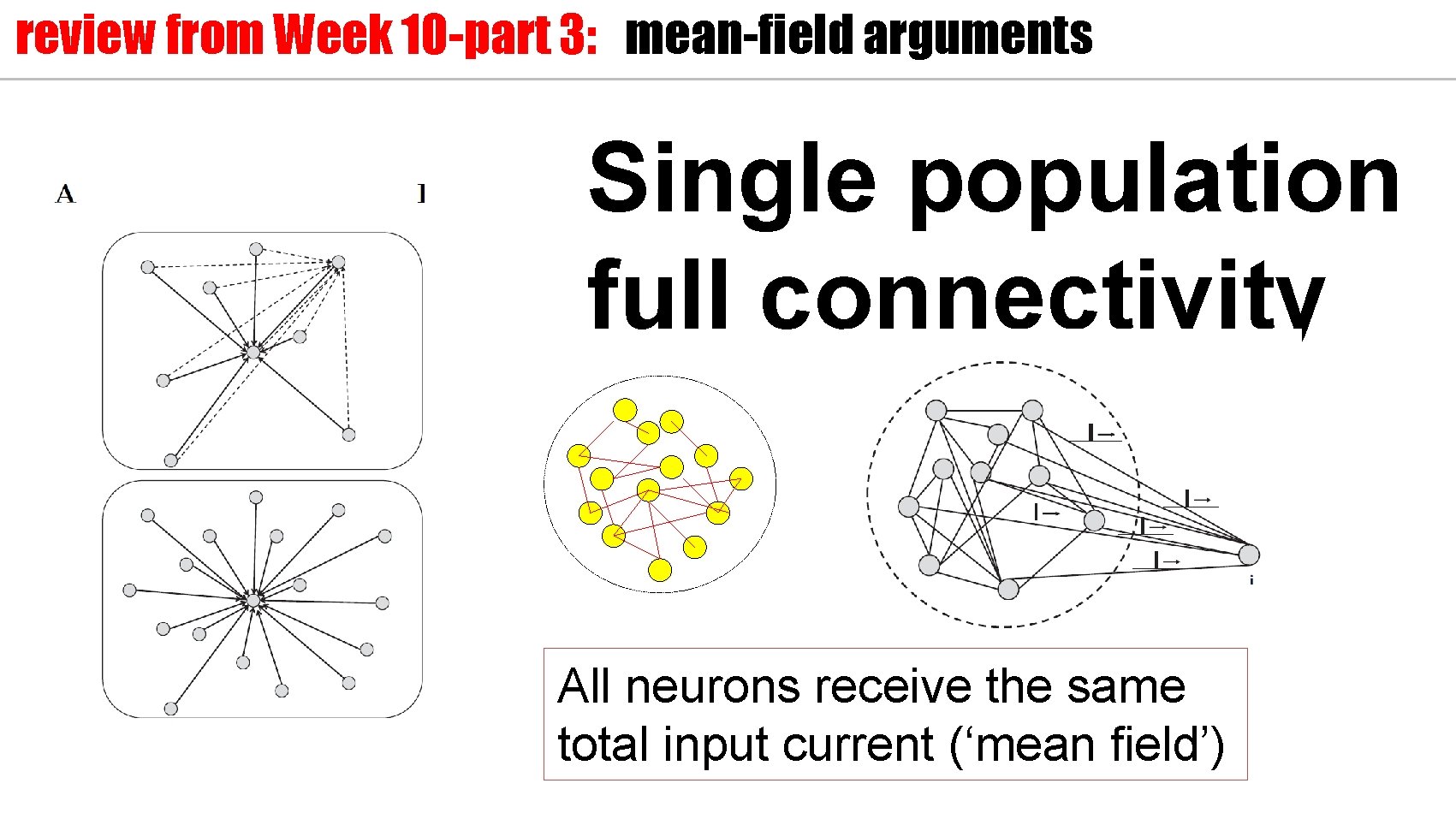
review from Week 10 -part 3: mean-field arguments Single population full connectivity All neurons receive the same total input current (‘mean field’)
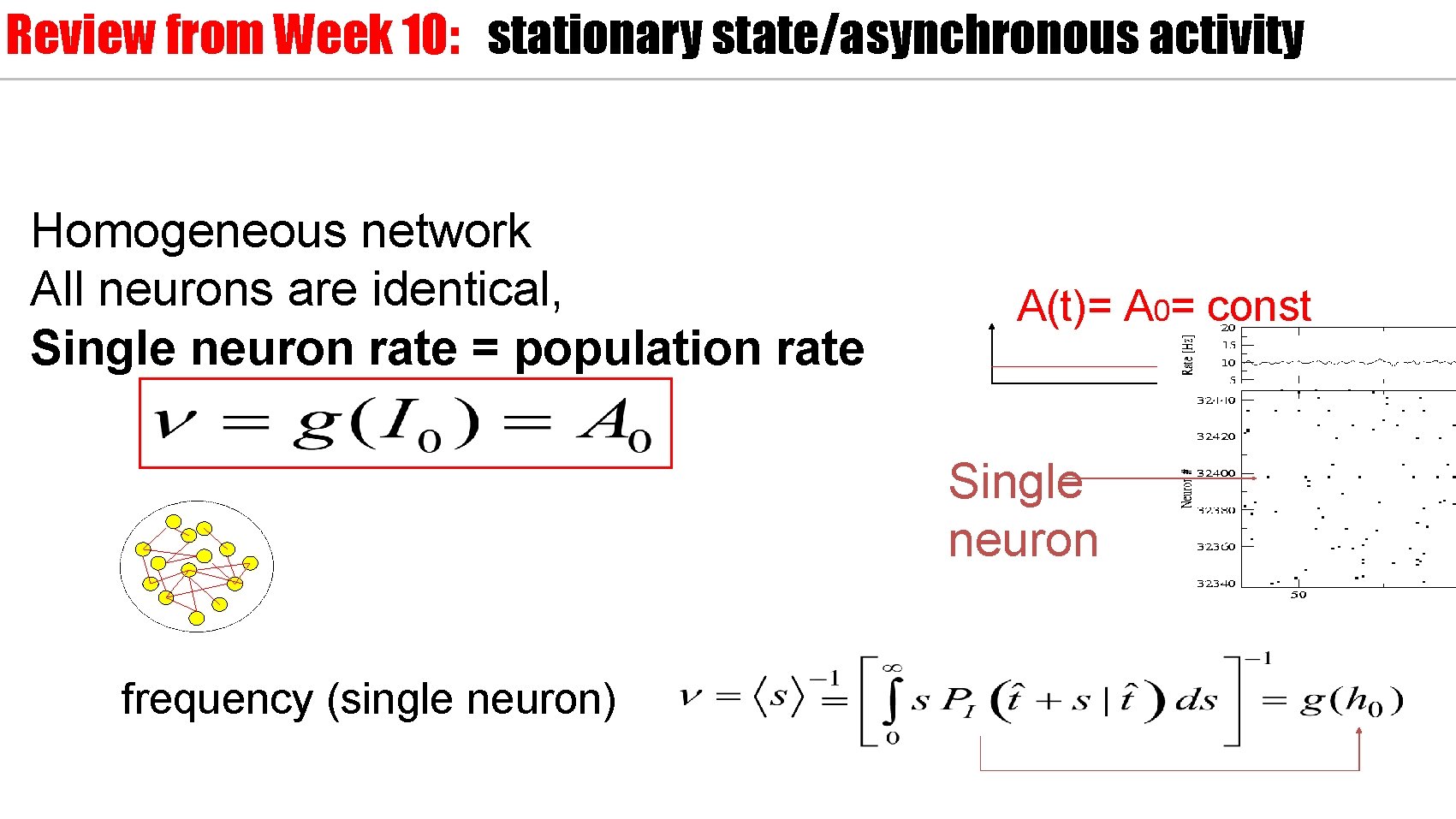
Review from Week 10: stationary state/asynchronous activity Homogeneous network All neurons are identical, Single neuron rate = population rate A(t)= A 0= const Single neuron frequency (single neuron)
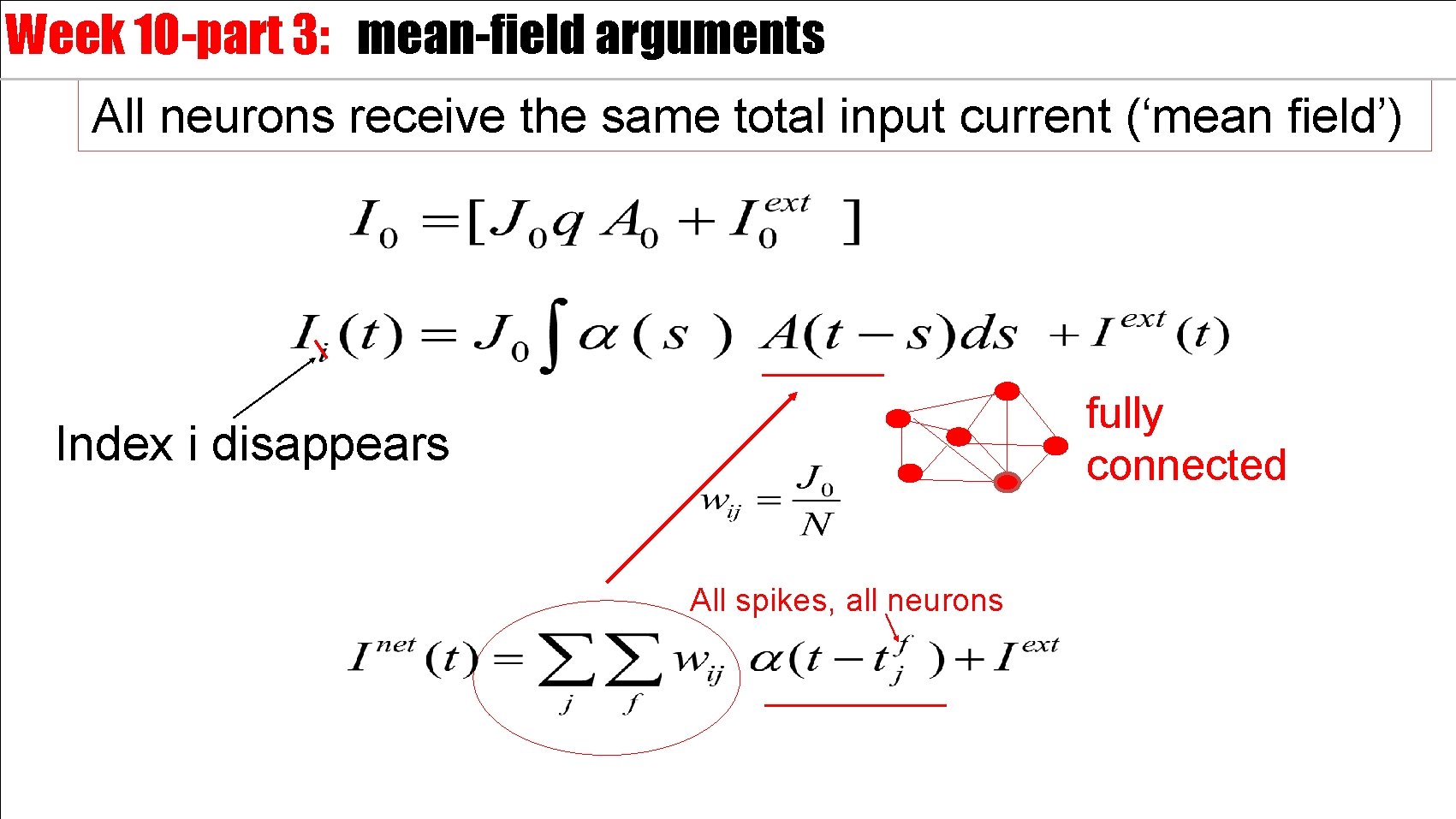
Week 10 -part 3: mean-field arguments All neurons receive the same total input current (‘mean field’) fully connected Index i disappears All spikes, all neurons
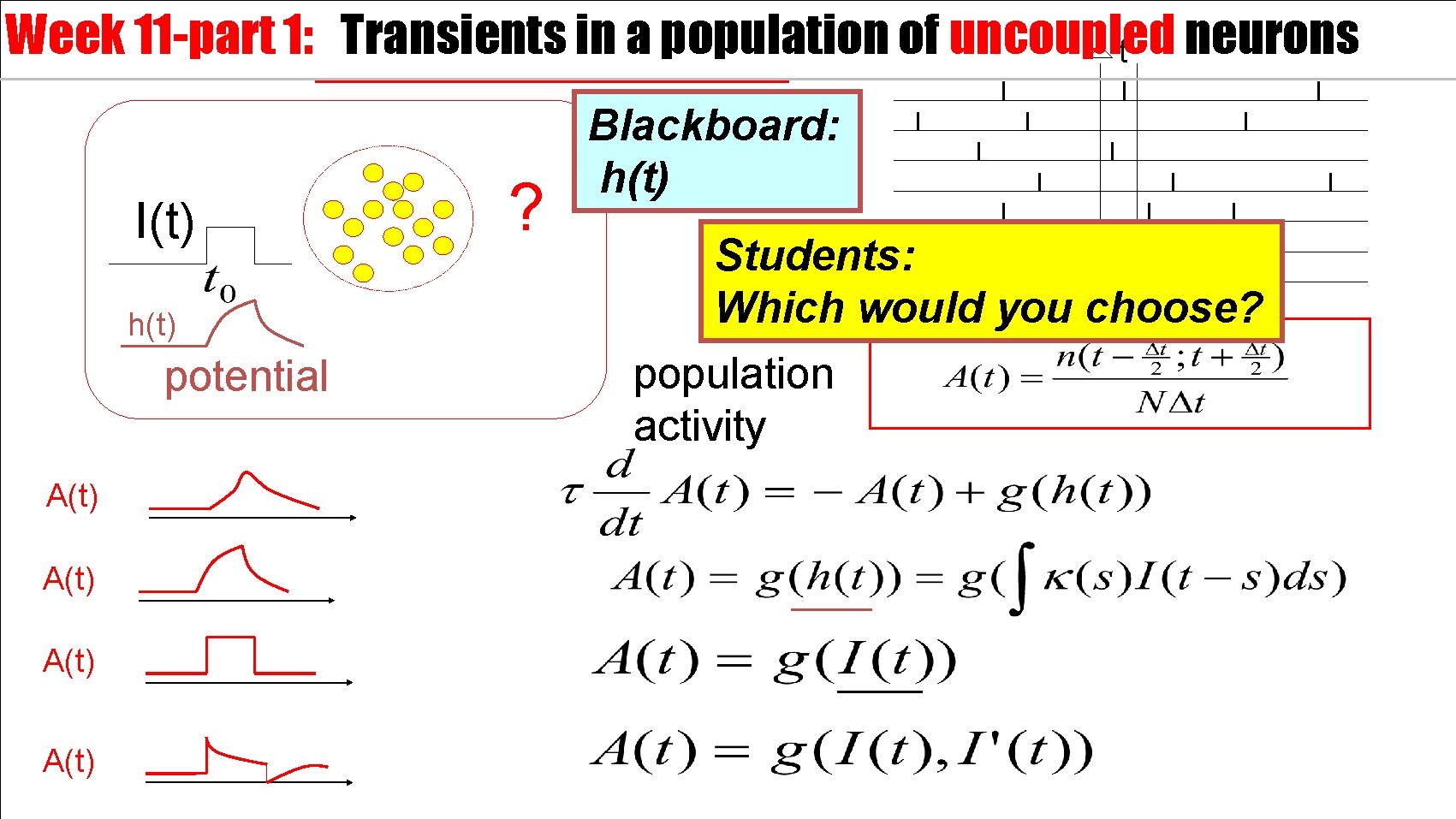
Week 11 -part 1: Transients in a population of uncoupled neurons t I(t) h(t) potential A(t) ? Blackboard: h(t) Students: Which would you choose? population activity
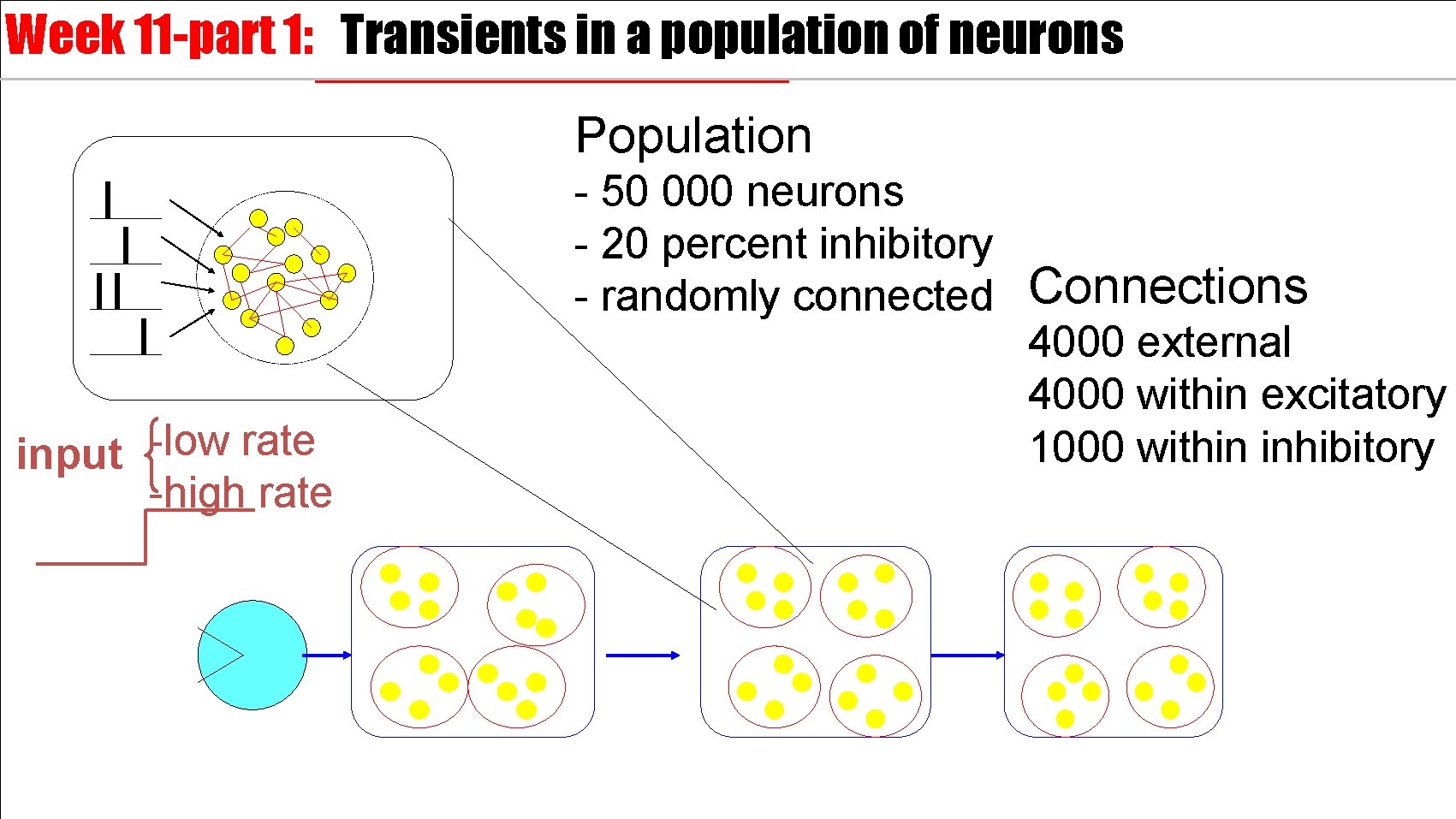
Week 11 -part 1: Transients in a population of neurons Population -low rate input -high rate - 50 000 neurons - 20 percent inhibitory - randomly connected Connections 4000 external 4000 within excitatory 1000 within inhibitory
Week 11 -part 1: Transients in a population of neurons A [Hz] -low rate input -high rate Population - 50 000 neurons - 20 percent inhibitory - randomly connected Neuron # 10 32440 32340 50 100 time [ms] 200 Neuron # 32374 u [m. V] 0 50 100 time [ms] 200
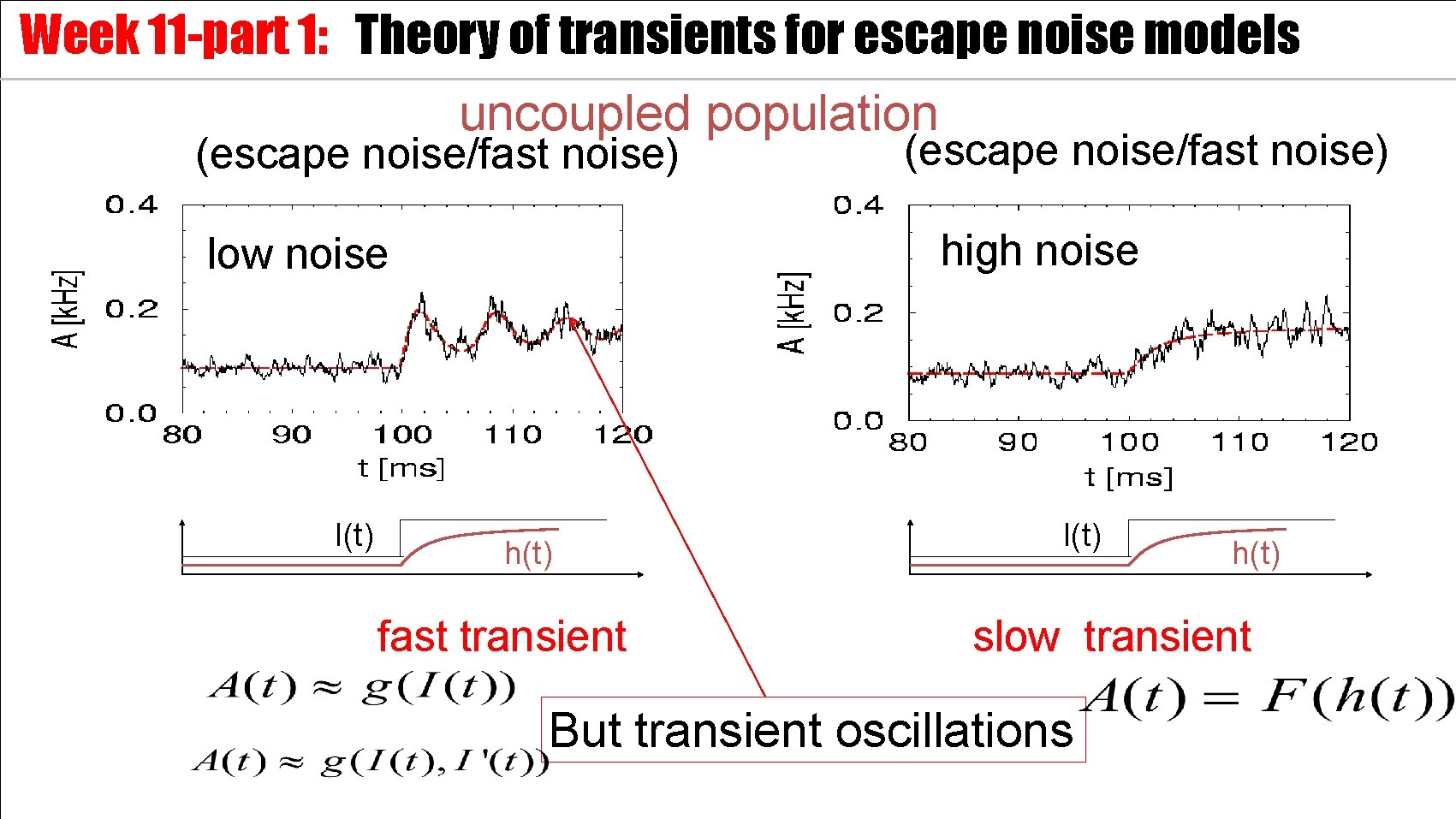
Week 11 -part 1: Theory of transients for escape noise models uncoupled population (escape noise/fast noise) low noise-free I(t) (escape noise/fast noise) high noise h(t) fast transient I(t) h(t) slow transient But transient oscillations
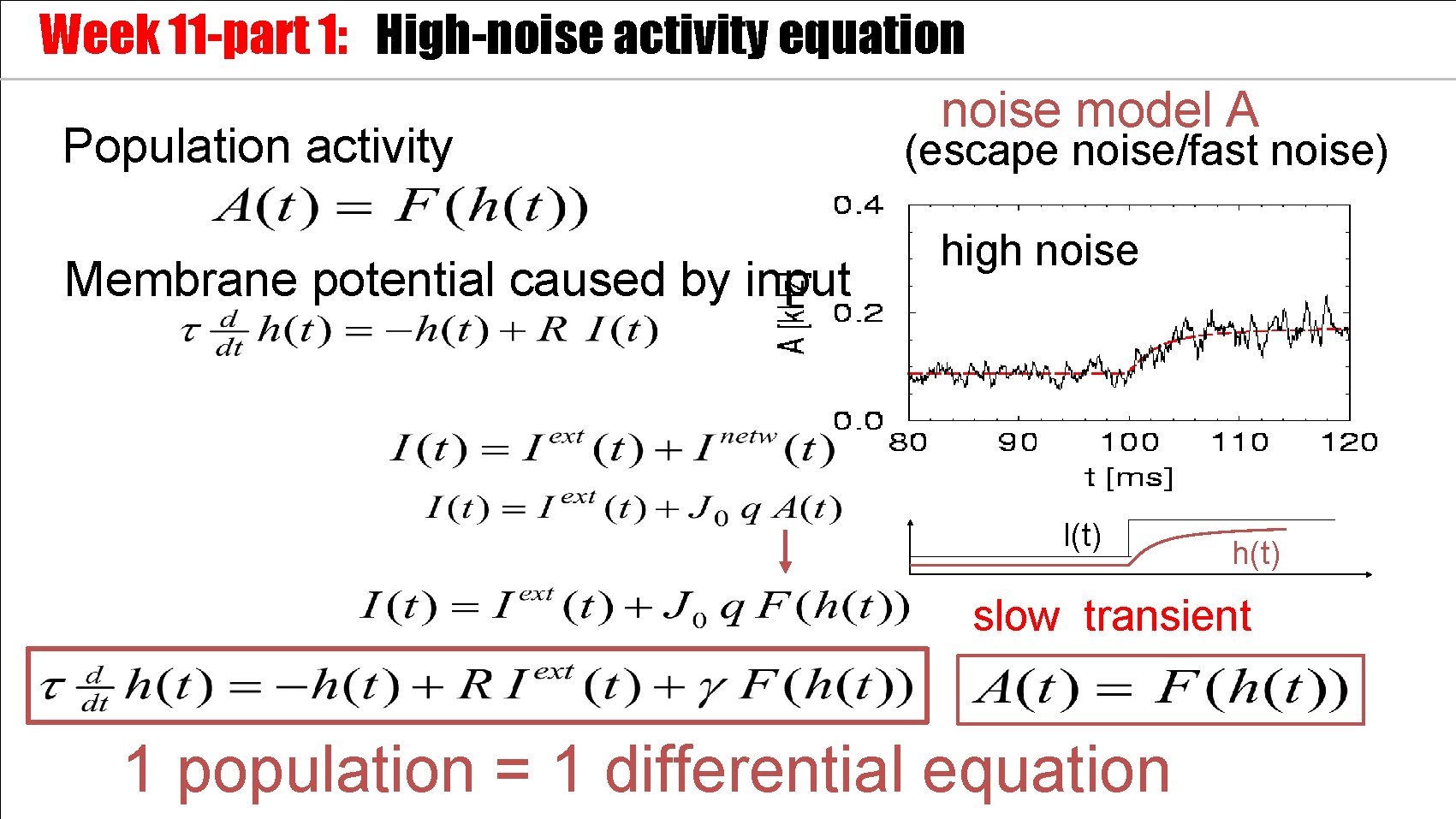
Week 11 -part 1: High-noise activity equation noise model A blackboard (escape noise/fast noise) In the limit of high noise, Population activity high noise Membrane potential caused by input I(t) h(t) slow transient
Week 11 -part 1: High-noise activity equation noise model A Population activity Membrane potential caused by input (escape noise/fast noise) high noise I(t) h(t) slow transient 1 population = 1 differential equation
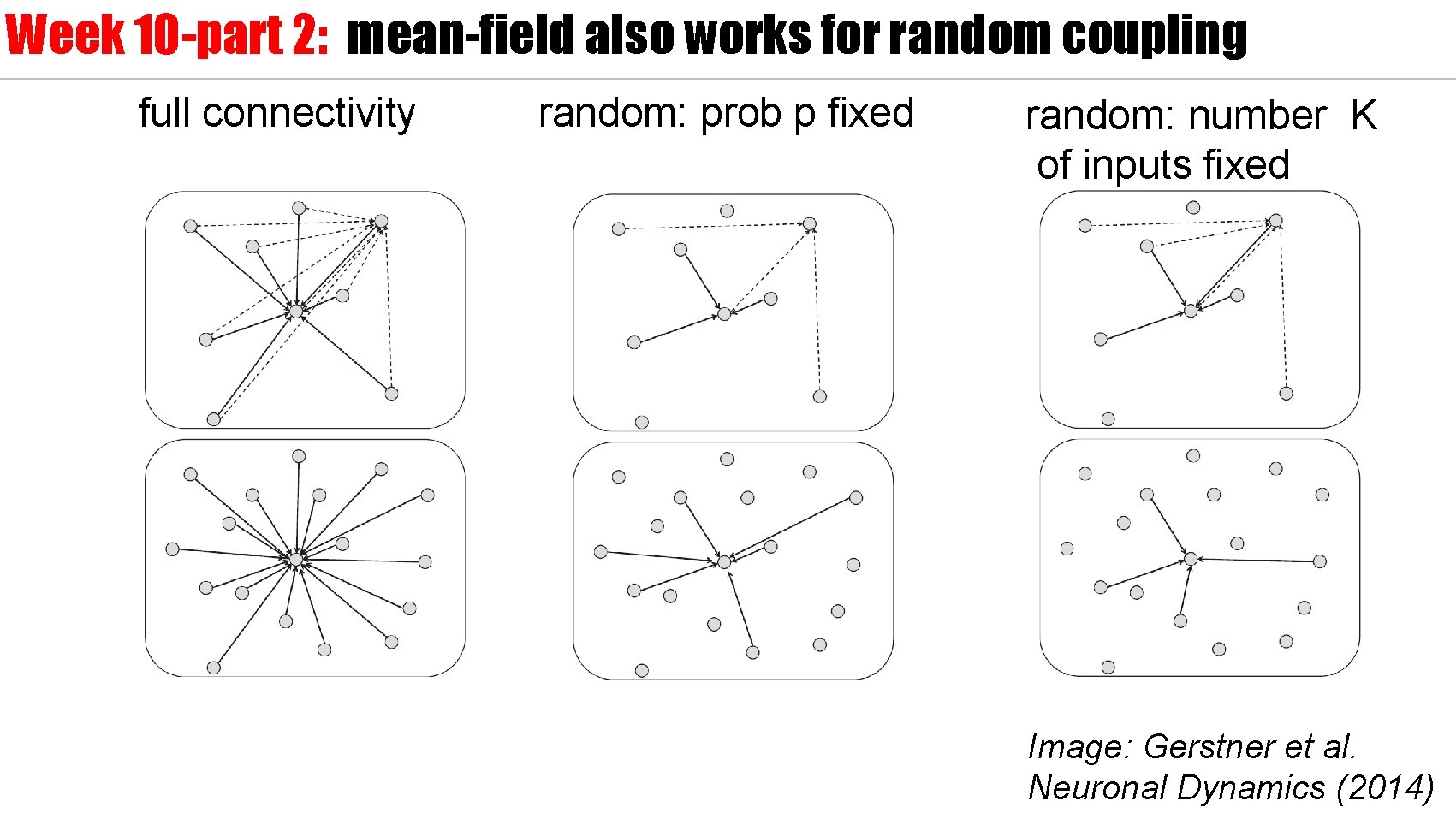
Week 10 -part 2: mean-field also works for random coupling full connectivity random: prob p fixed random: number K of inputs fixed Image: Gerstner et al. Neuronal Dynamics (2014)
Quiz 1, now Population equations [ ] A single cortical model population can exhibit transient oscillations [ ] Transients are always sharp [ ] Transients are always slow [ ] in a certain limit transients can be slow [ ] An escape noise model in the high-noise limit has transients which are always slow [ ] A single population described by a single first-order differential equation (no integrals/no delays) can exhibit transient oscillations
Week 11 – part 2 : 11. 1 Transients - sharp or slow Biological Modeling of Neural Networks: 11. 2 Spatial continuum - from multiple to continuous populations - cortical connectivity 11. 3 Solution types - uniform solution - bump solution Week 11 – Continuum models: Cortical fields and perception 11. 4. Perception 11. 5. Head direction cells Wulfram Gerstner EPFL, Lausanne, Switzerland
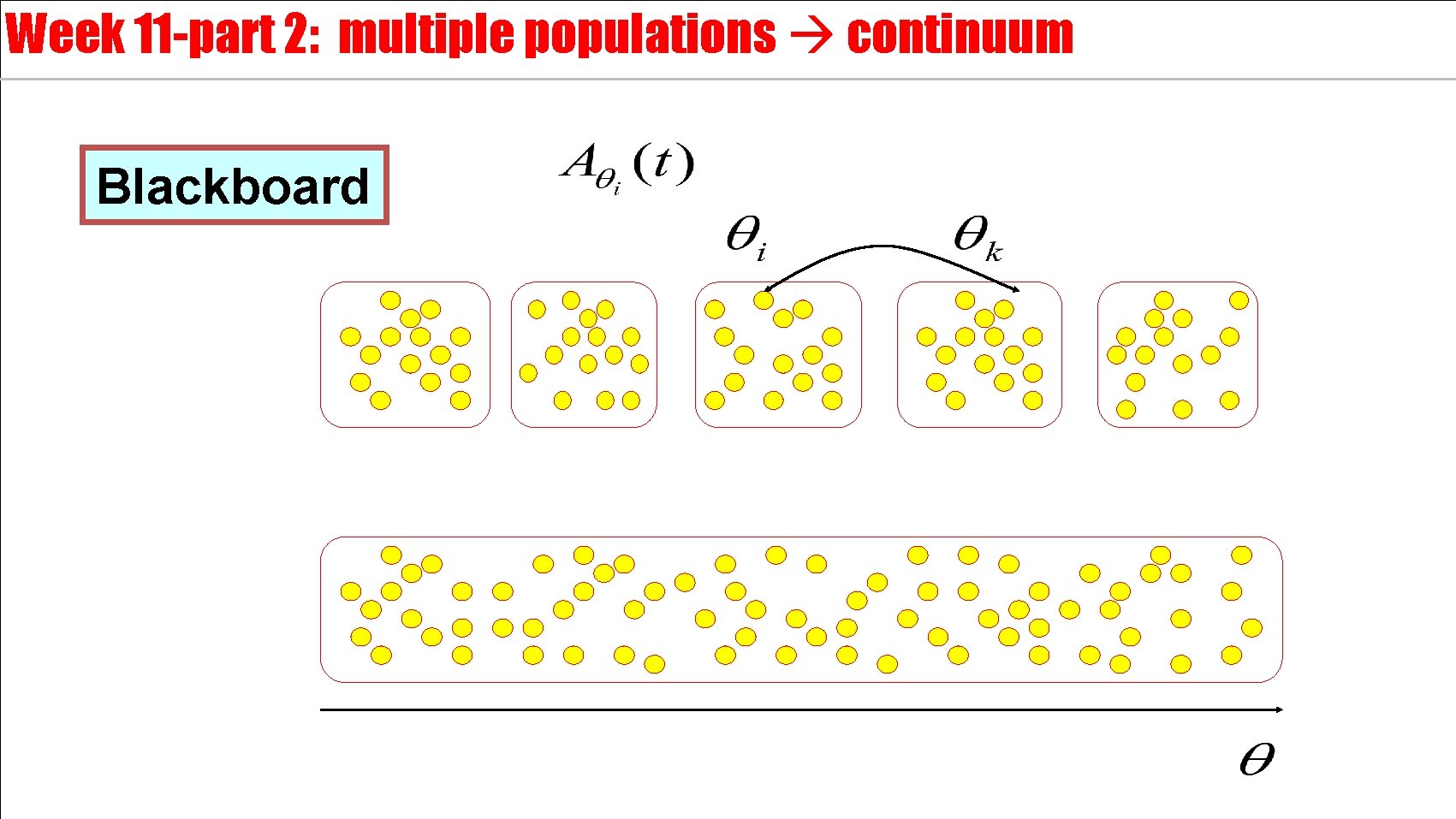
Week 11 -part 2: multiple populations continuum Blackboard
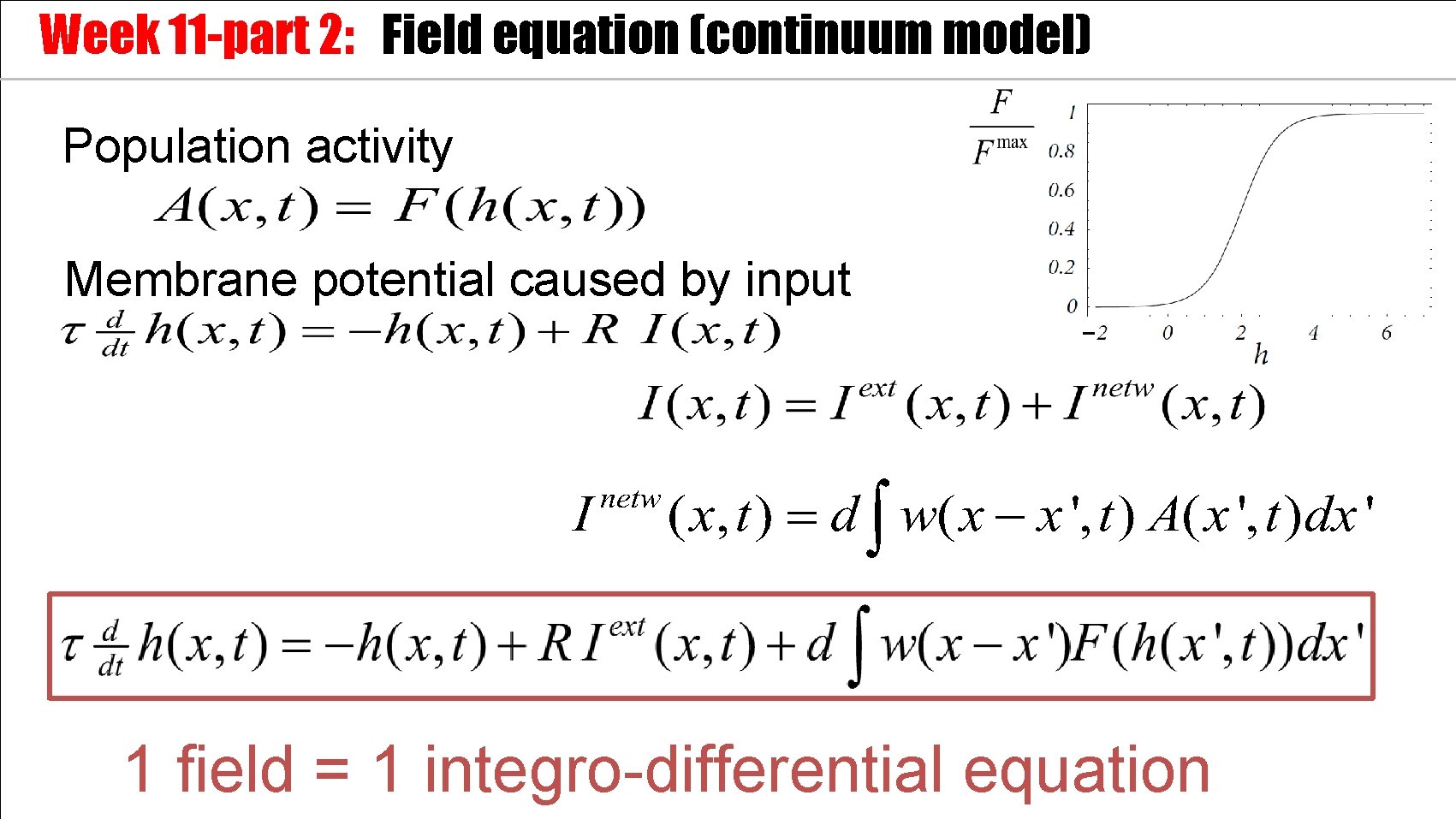
Week 11 -part 2: Field equation (continuum model) Population activity Membrane potential caused by input 1 field = 1 integro-differential equation
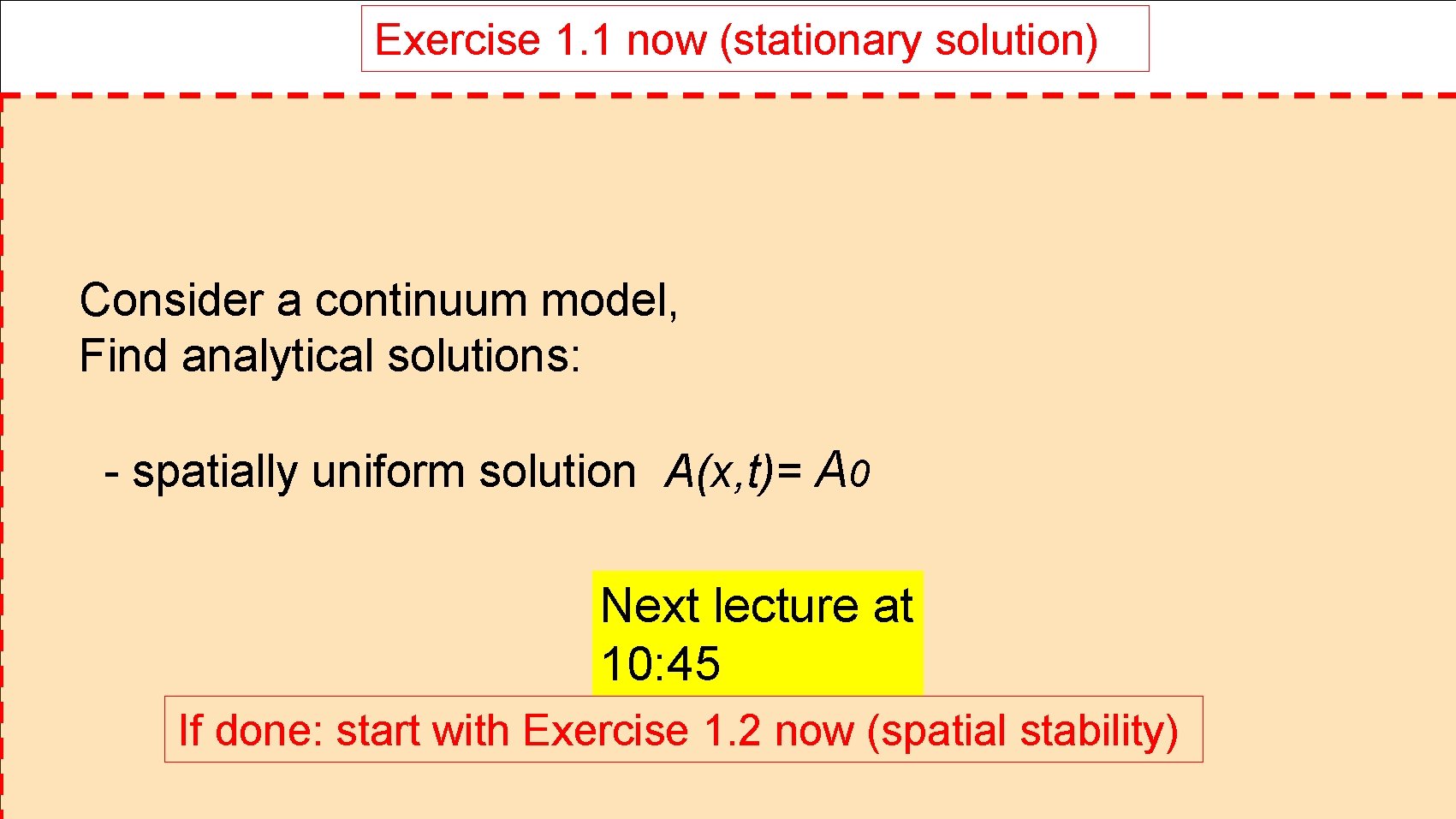
Exercise 1. 1 now (stationary solution) Consider a continuum model, Find analytical solutions: - spatially uniform solution A(x, t)= A 0 Next lecture at 10: 45 If done: start with Exercise 1. 2 now (spatial stability)
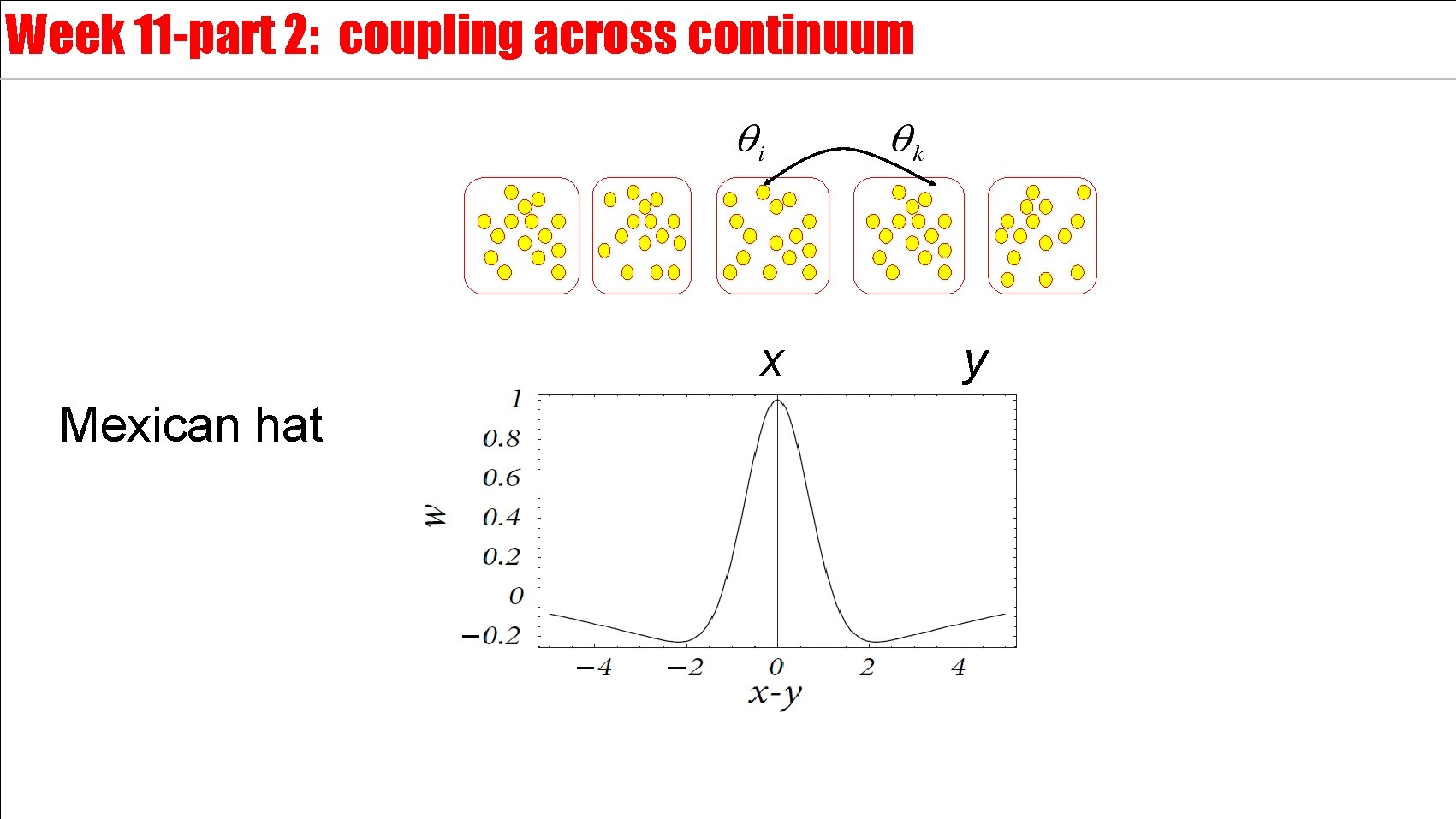
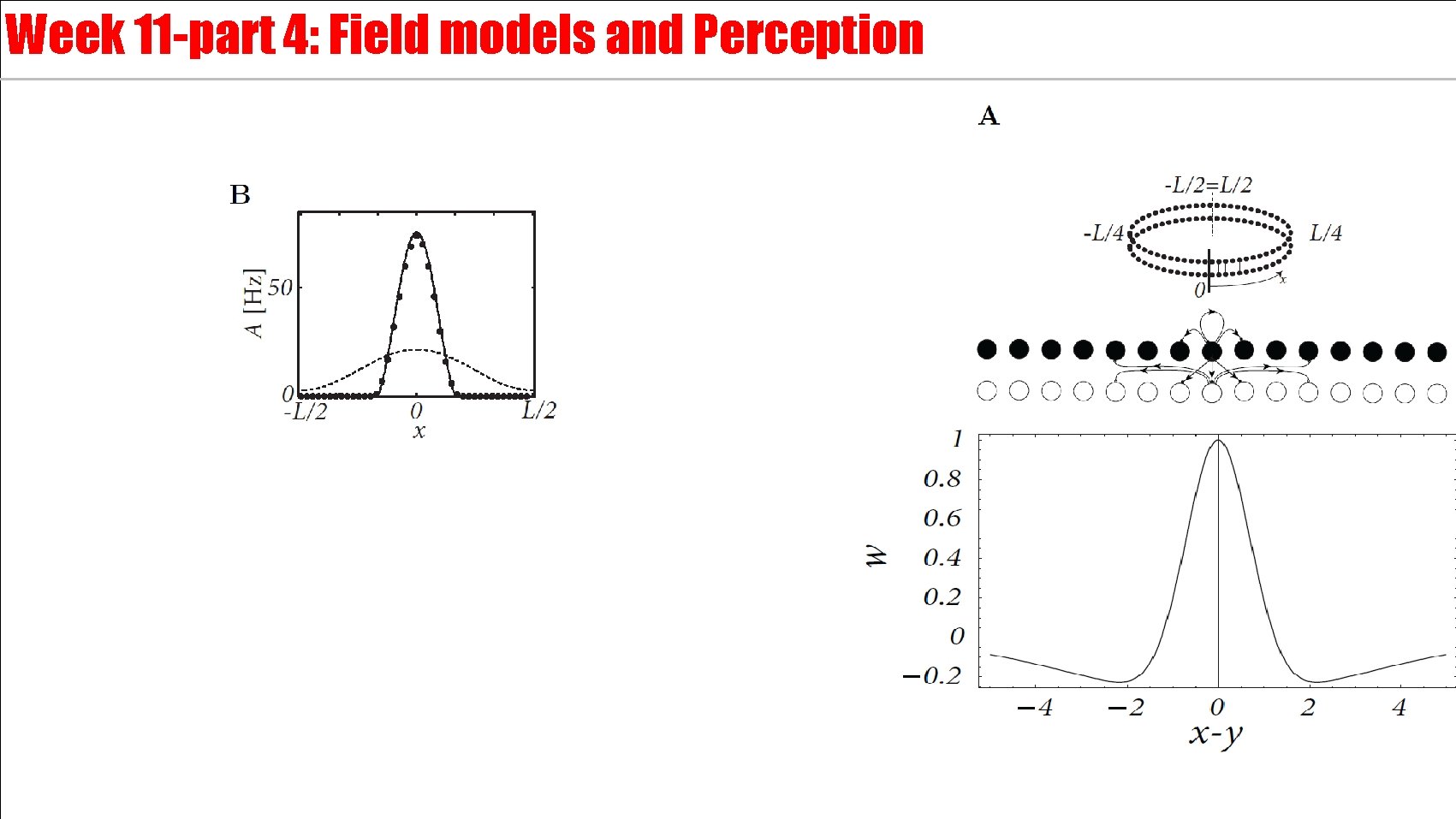
Week 11 -part 2: coupling across continuum x Mexican hat y
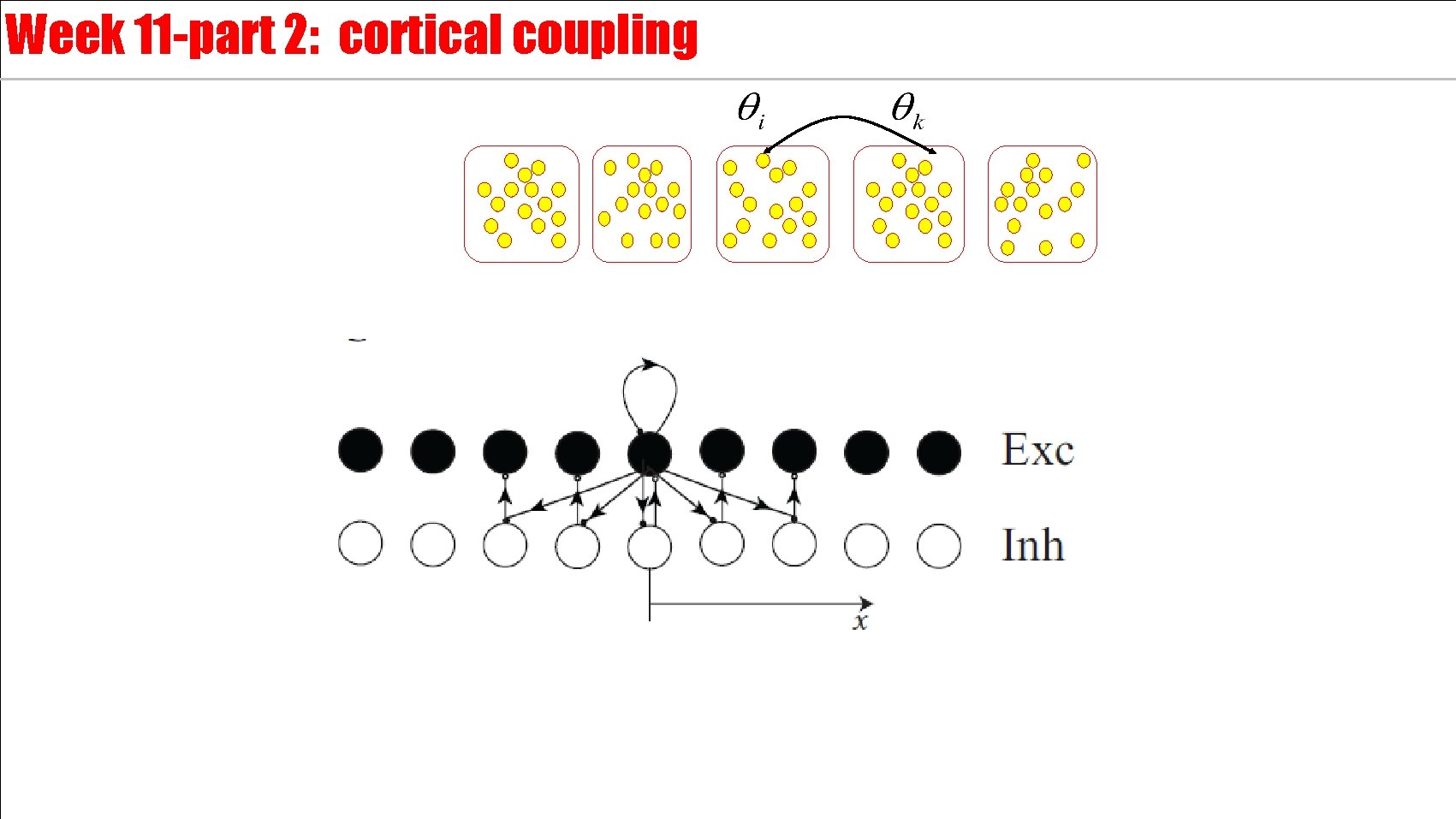
Week 11 -part 2: cortical coupling
Week 11 – part 3 : 11. 1 Transients - sharp or slow Biological Modeling of Neural Networks: 11. 2 Spatial continuum - from multiple to continuous populations - cortical connectivity 11. 3 Solution types - uniform solution - bump solution Week 11 – Continuum models: Cortical fields and perception 11. 4. Perception 11. 5. Head direction cells Wulfram Gerstner EPFL, Lausanne, Switzerland
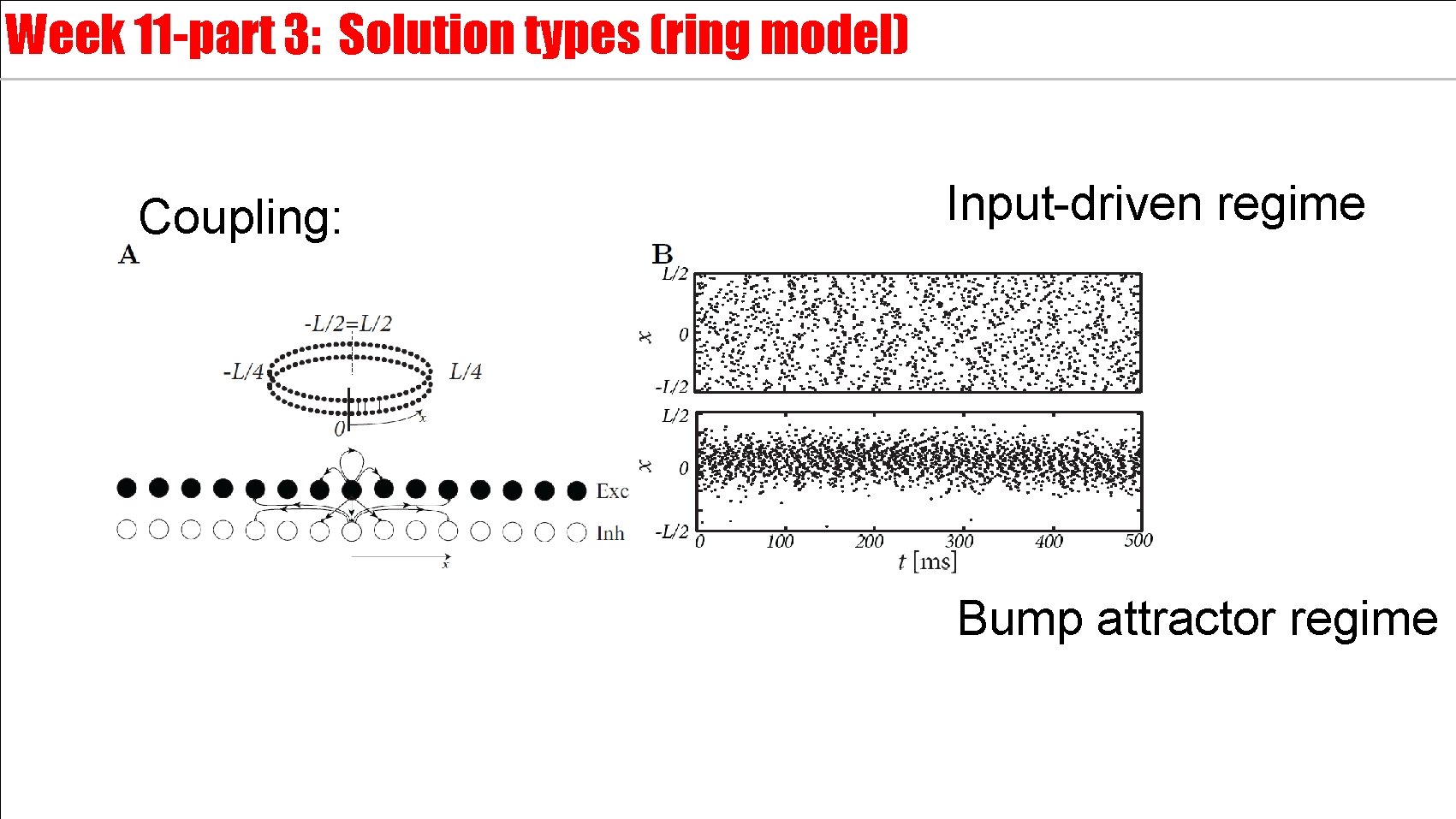
Week 11 -part 3: Solution types (ring model) Coupling: Input-driven regime Bump attractor regime
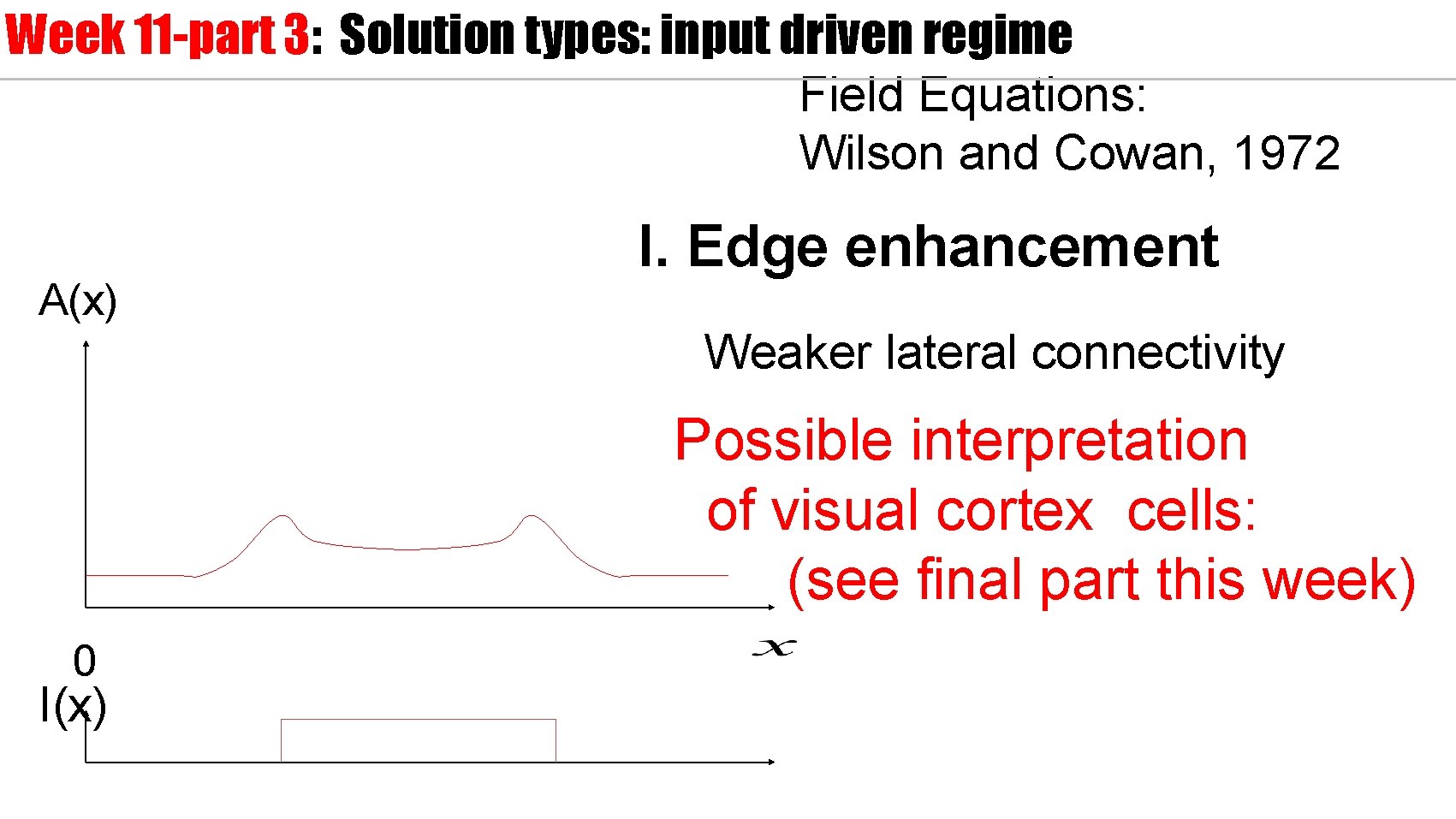
Week 11 -part 3: Solution types: input driven regime Field Equations: Wilson and Cowan, 1972 A(x) I. Edge enhancement Weaker lateral connectivity Possible interpretation of visual cortex cells: (see final part this week) 0 I(x)
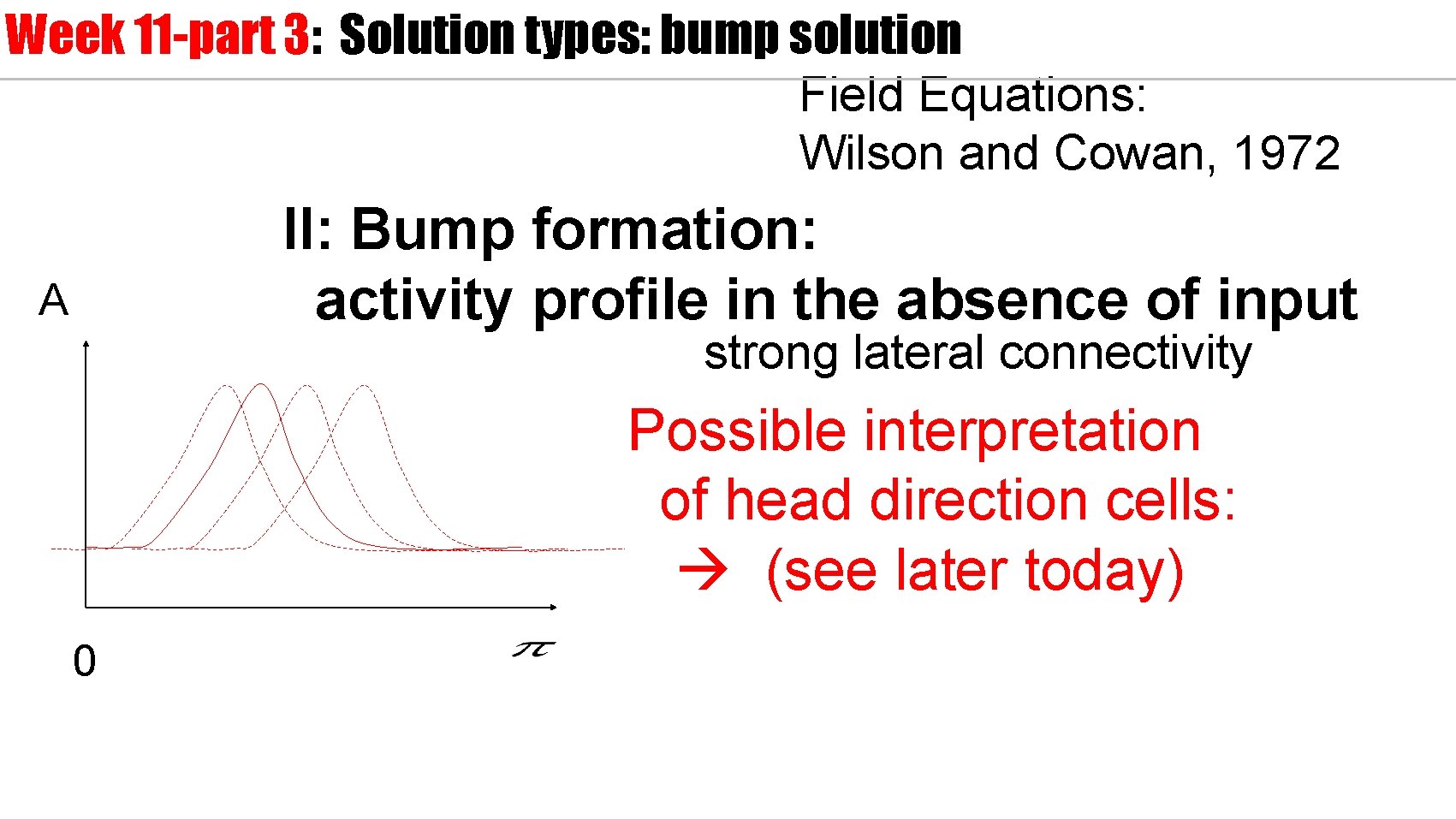
Week 11 -part 3: Solution types: bump solution Field Equations: Wilson and Cowan, 1972 II: Bump formation: activity profile in the absence of input A strong lateral connectivity Possible interpretation of head direction cells: (see later today) 0
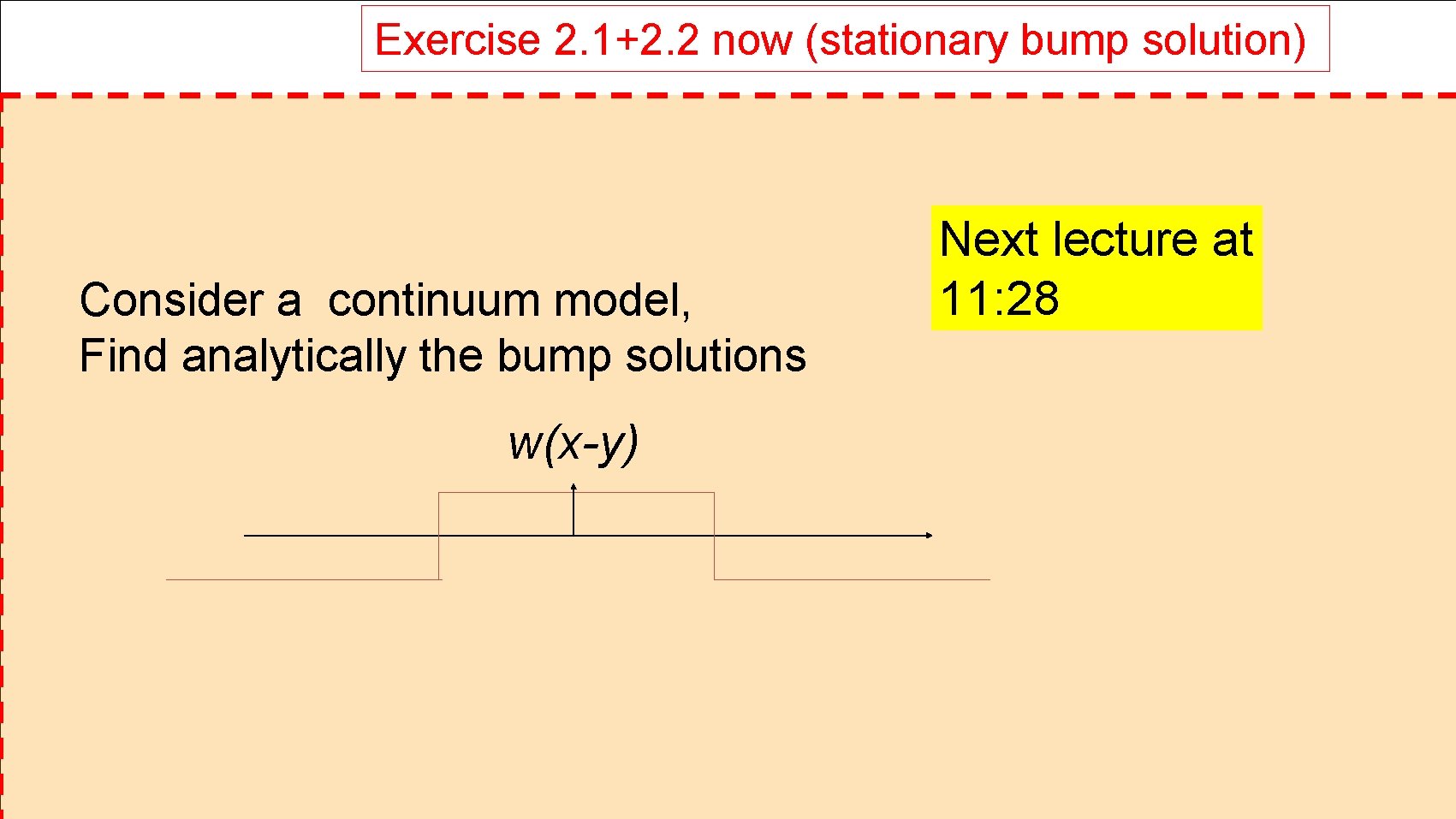
Exercise 2. 1+2. 2 now (stationary bump solution) Consider a continuum model, Find analytically the bump solutions w(x-y) Next lecture at 11: 28
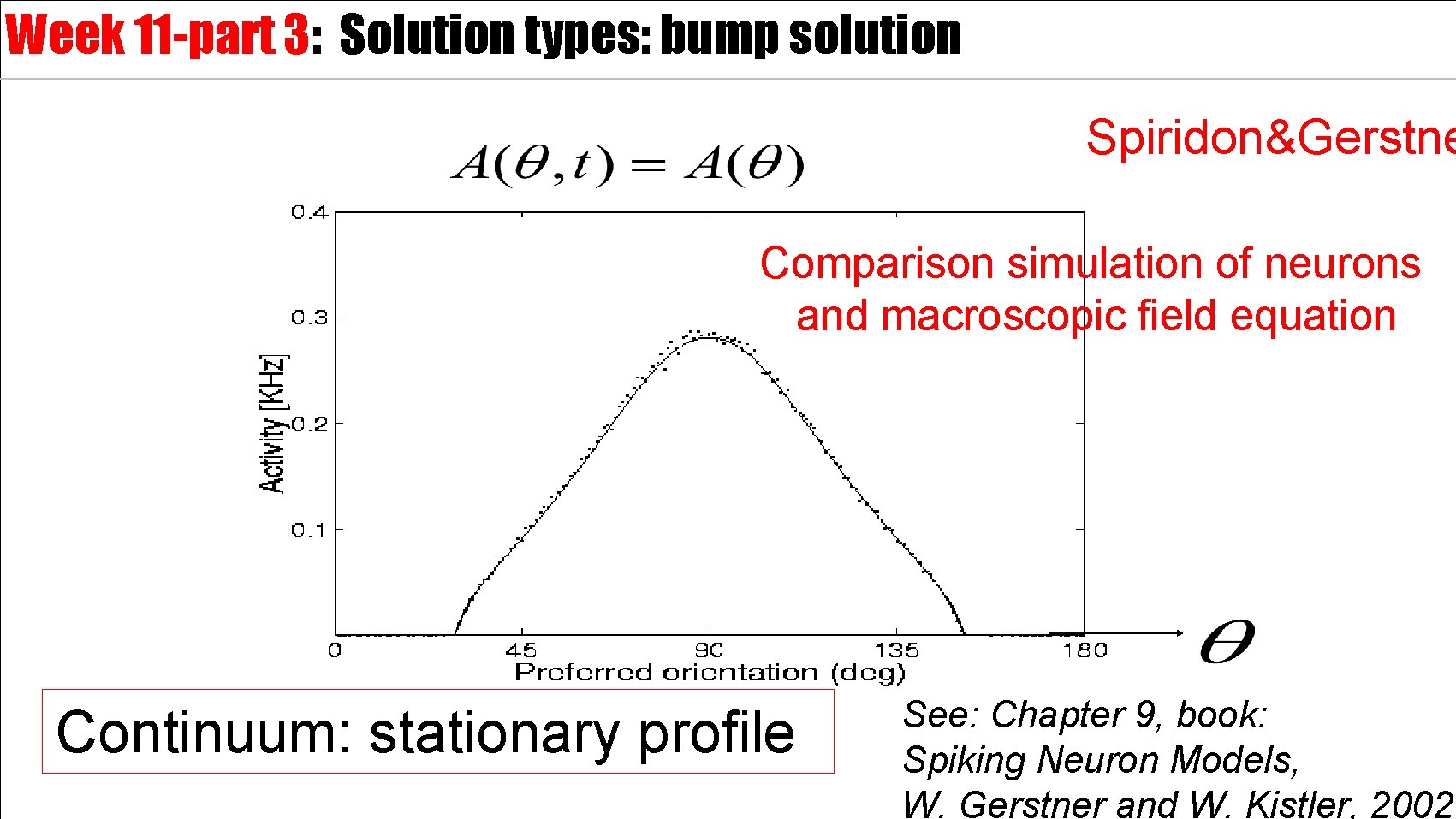
Week 11 -part 3: Solution types: bump solution Spiridon&Gerstne Comparison simulation of neurons and macroscopic field equation Continuum: stationary profile See: Chapter 9, book: Spiking Neuron Models, W. Gerstner and W. Kistler, 2002
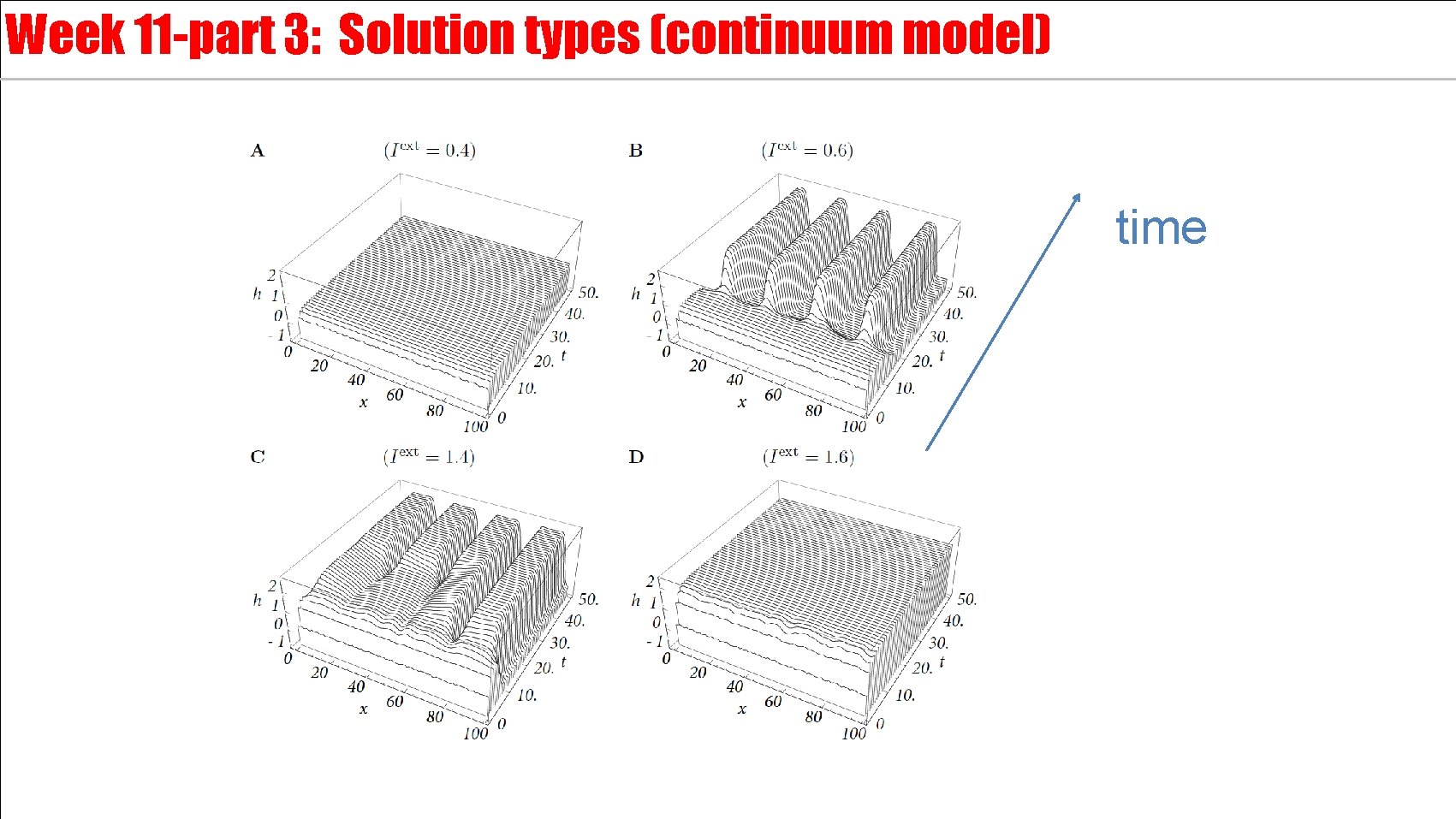
Week 11 -part 3: Solution types (continuum model) time
Week 11 – part 4: 11. 1 Transients - sharp or slow Biological Modeling of Neural Networks: 11. 2 Spatial continuum - model connectivity - cortical connectivity 11. 3 Solution types - uniform solution - bump solution Week 11 – Continuum models: Cortical fields and perception 11. 4. Perception 11. 5. Head direction cells Wulfram Gerstner EPFL, Lausanne, Switzerland
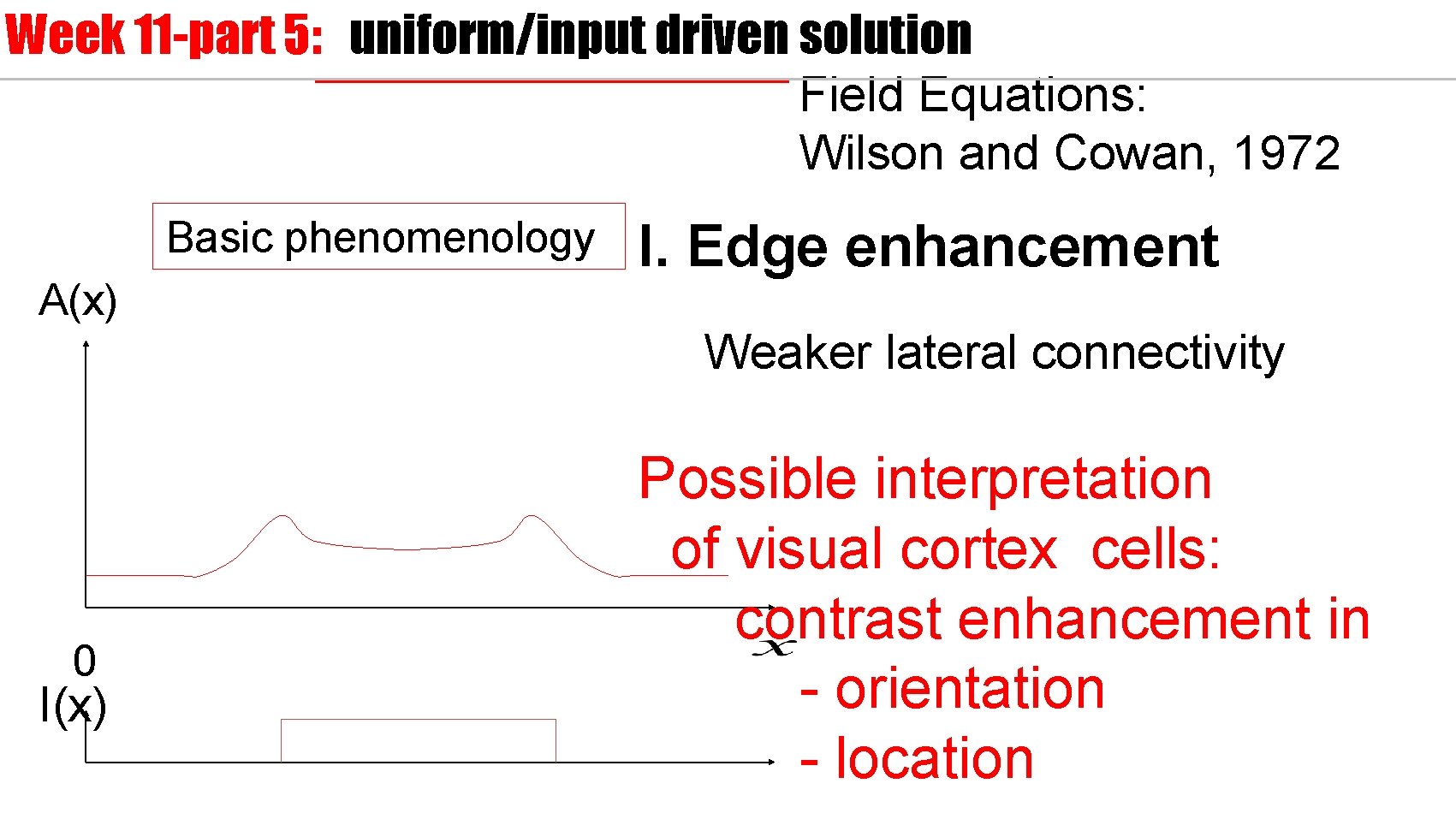
Week 11 -part 5: uniform/input driven solution Field Equations: Wilson and Cowan, 1972 Basic phenomenology A(x) I. Edge enhancement Weaker lateral connectivity 0 I(x) Possible interpretation of visual cortex cells: contrast enhancement in - orientation - location
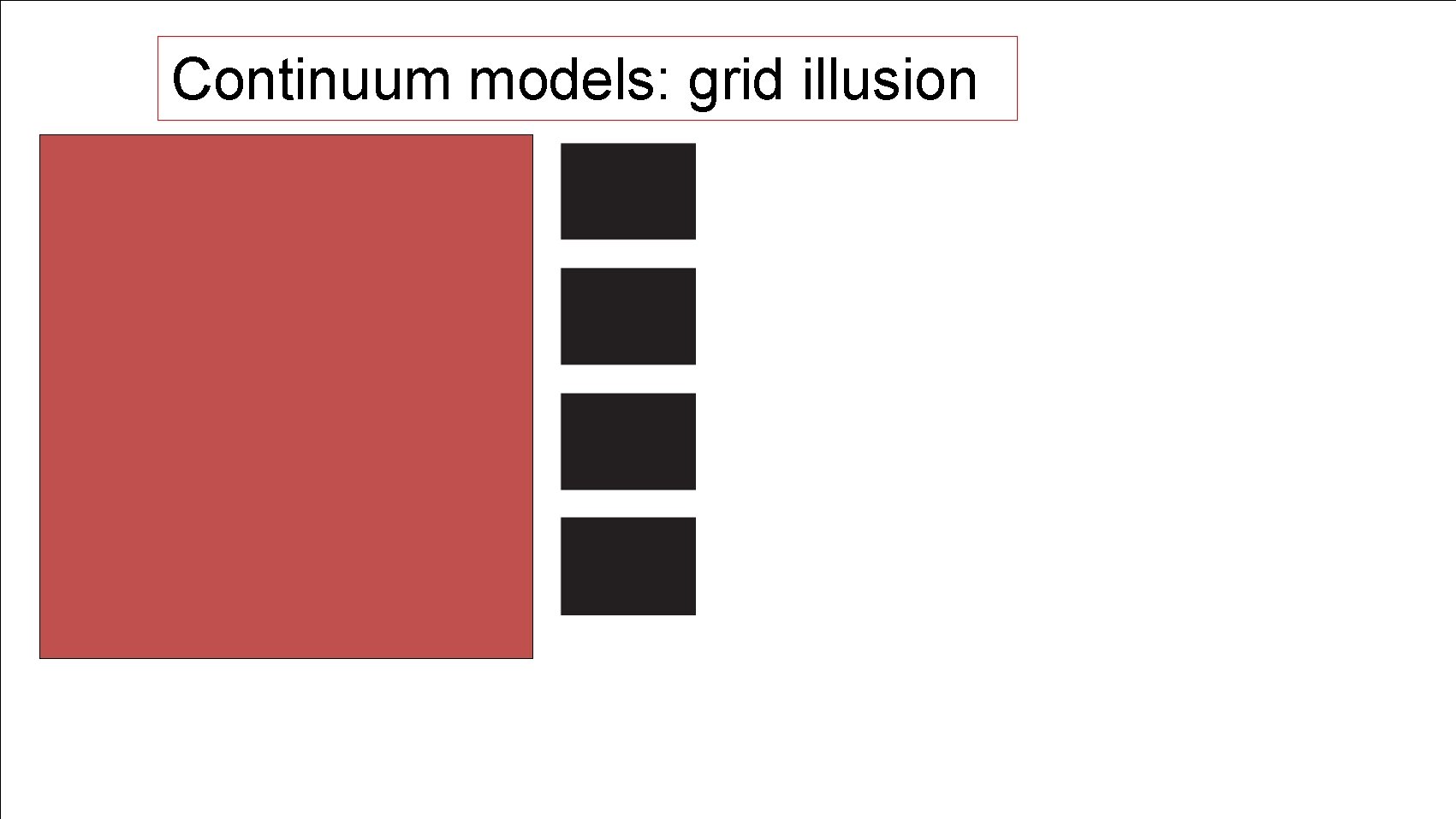
Continuum models: grid illusion
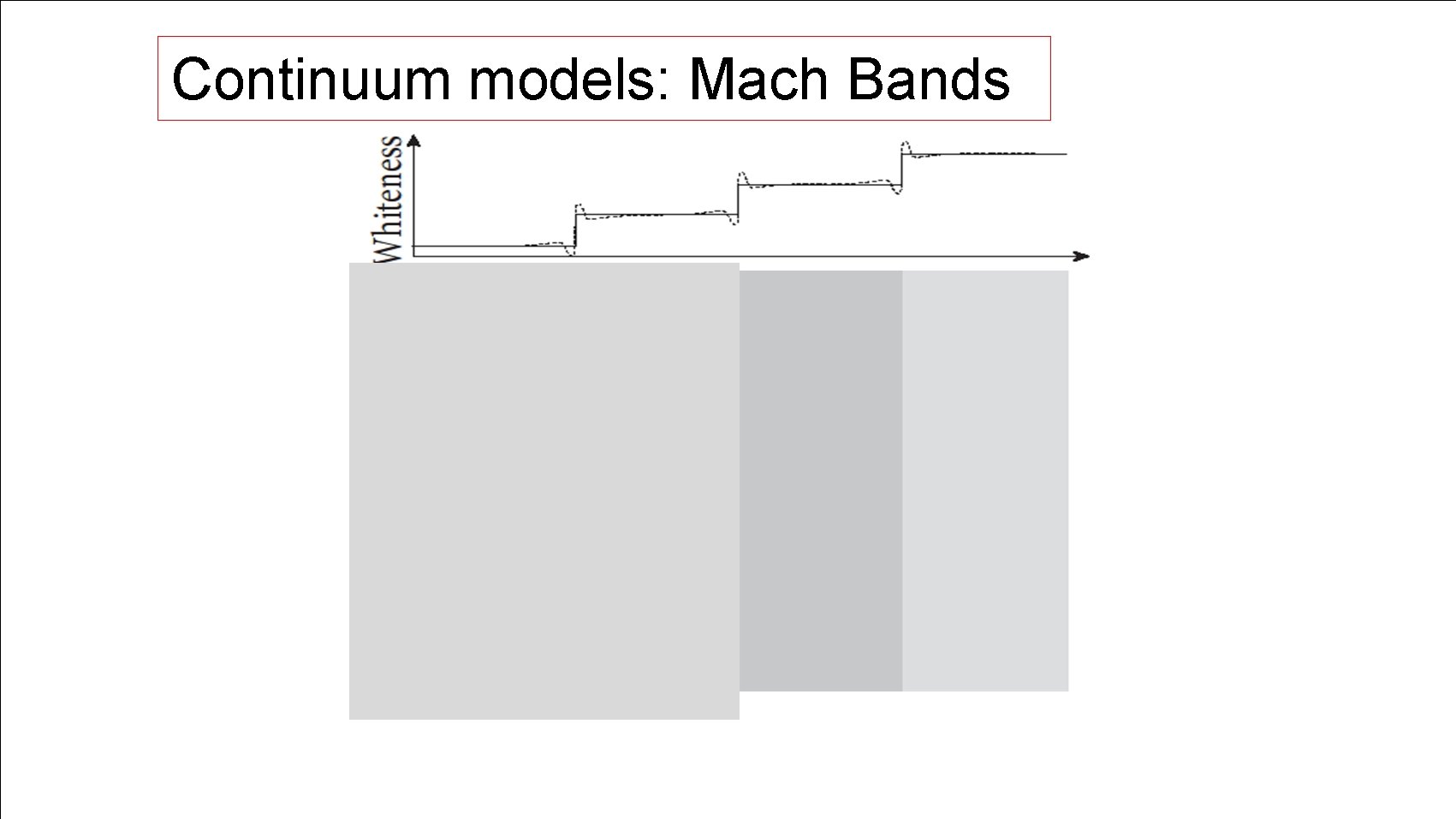
Continuum models: Mach Bands
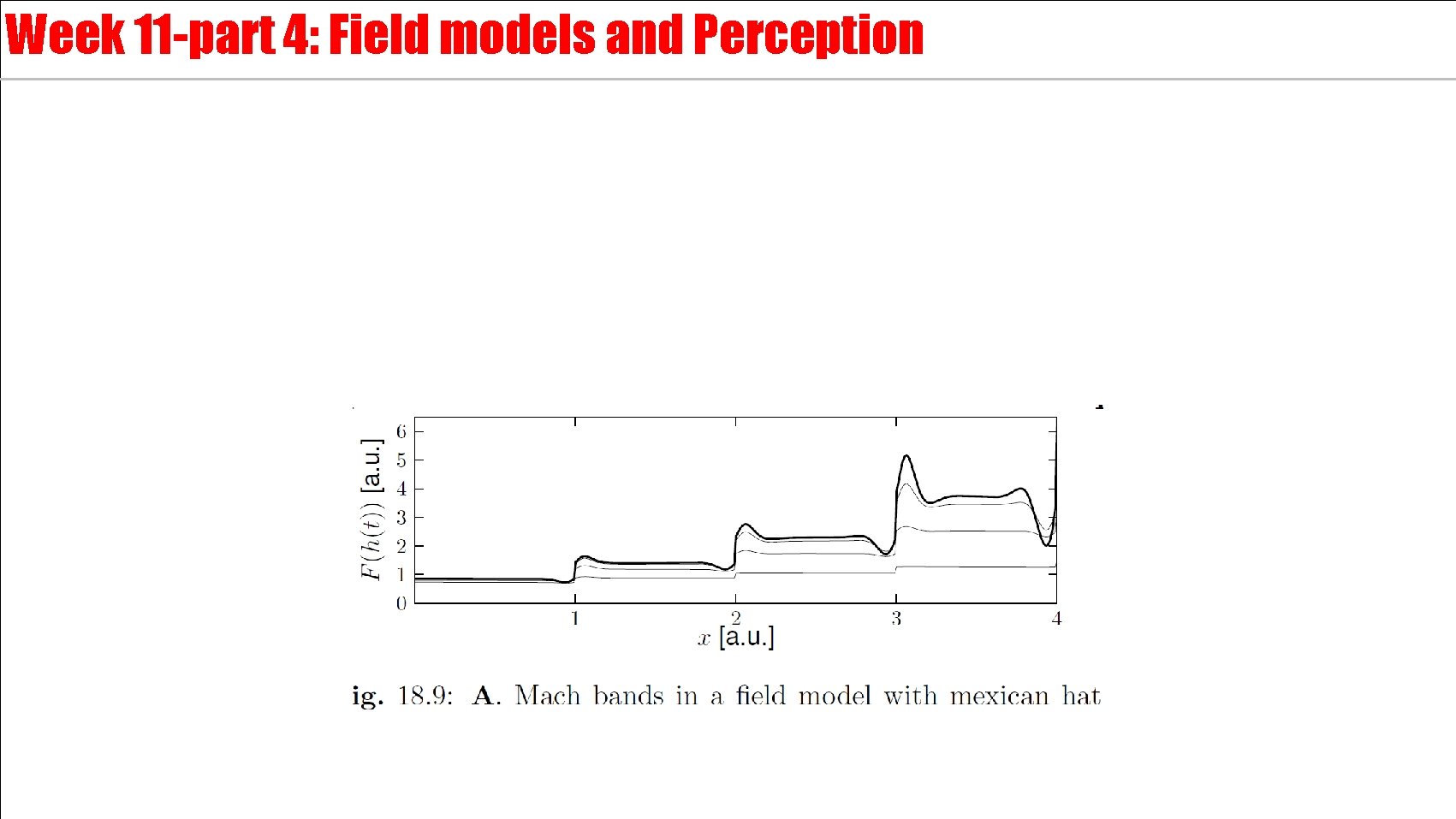
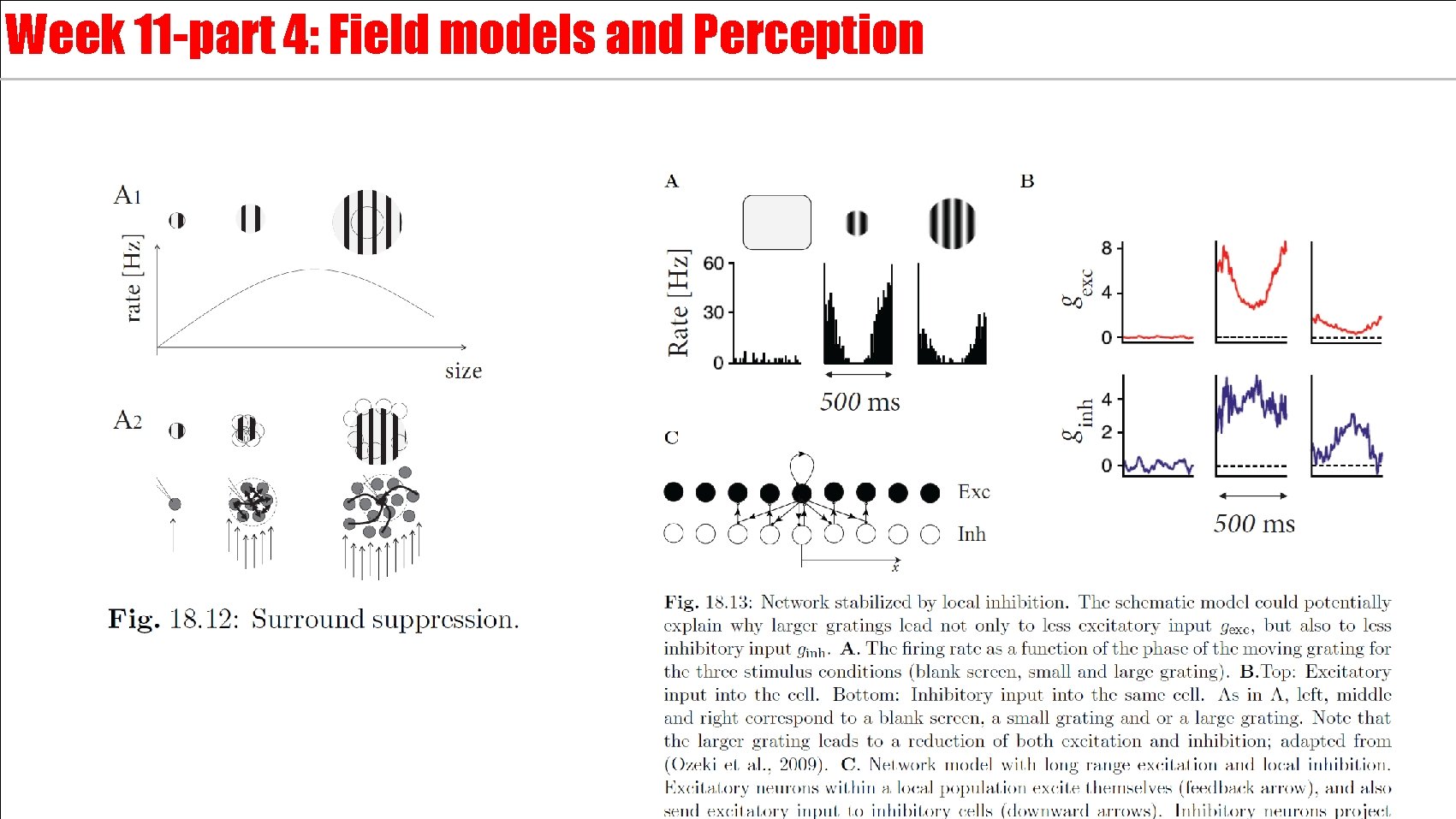
Week 11 -part 4: Field models and Perception
Week 11 -part 4: Field models and Perception
Week 11 -part 4: Field models and Perception
Week 11 – part 5: 11. 1 Transients - sharp or slow Biological Modeling of Neural Networks: 11. 2 Spatial continuum - model connectivity - cortical connectivity 11. 3 Solution types - uniform solution - bump solution Week 11 – Continuum models: Cortical fields and perception 11. 4. Perception 11. 5. Head direction cells Wulfram Gerstner EPFL, Lausanne, Switzerland
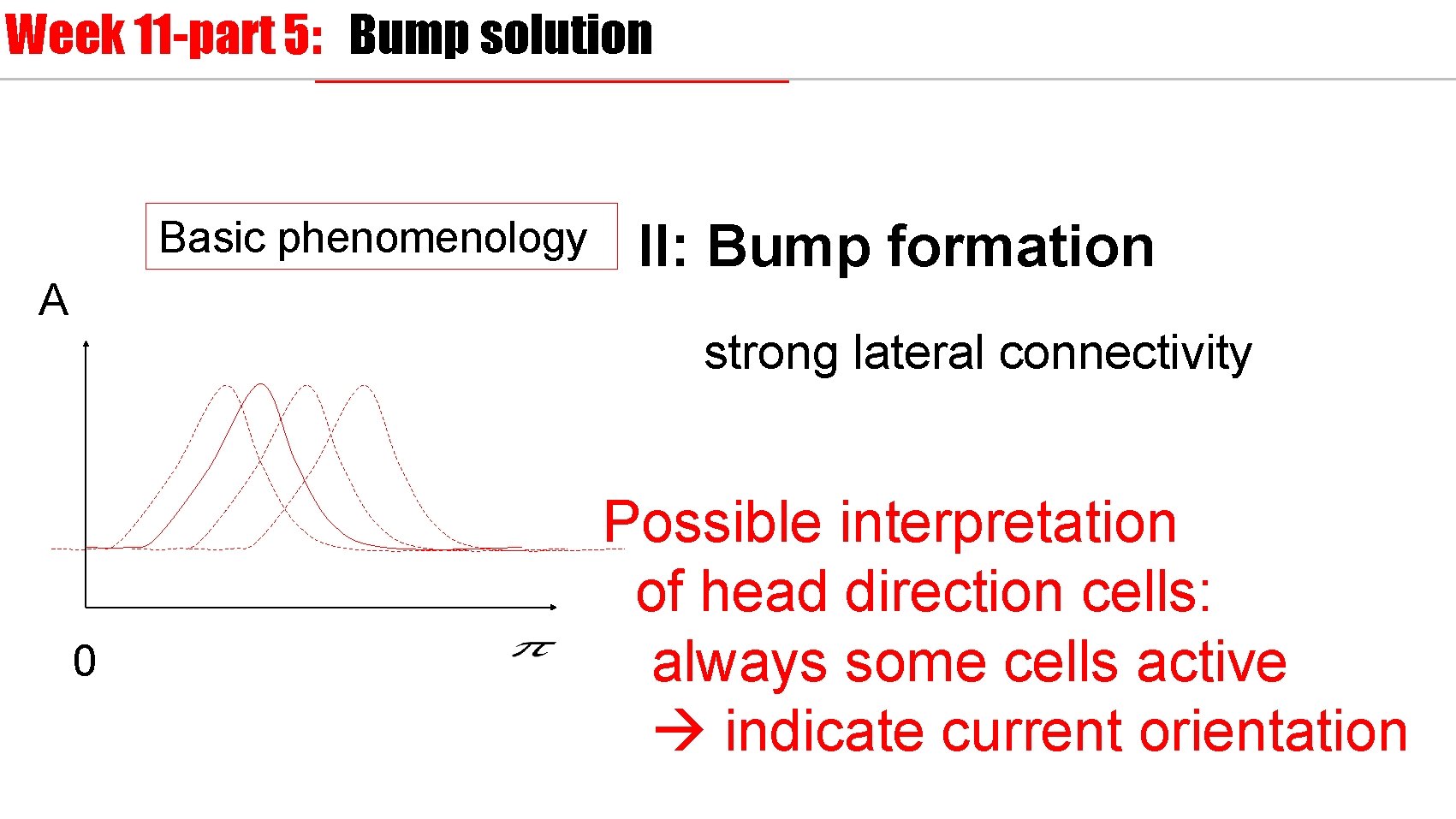
Week 11 -part 5: Bump solution Basic phenomenology A II: Bump formation strong lateral connectivity 0 Possible interpretation of head direction cells: always some cells active indicate current orientation
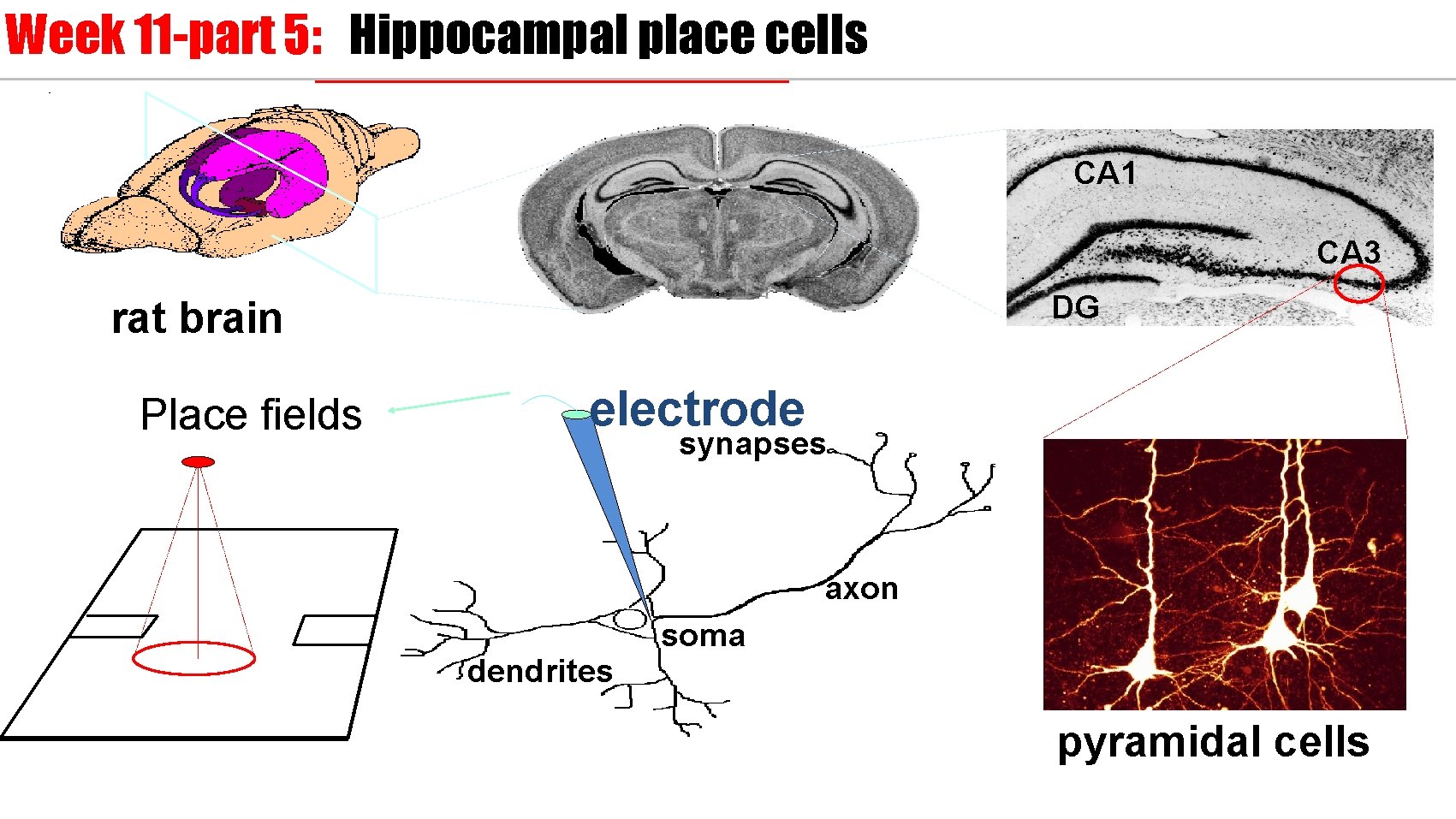
Week 11 -part 5: Hippocampal place cells CA 1 CA 3 DG rat brain Place fields electrode synapses axon soma dendrites pyramidal cells
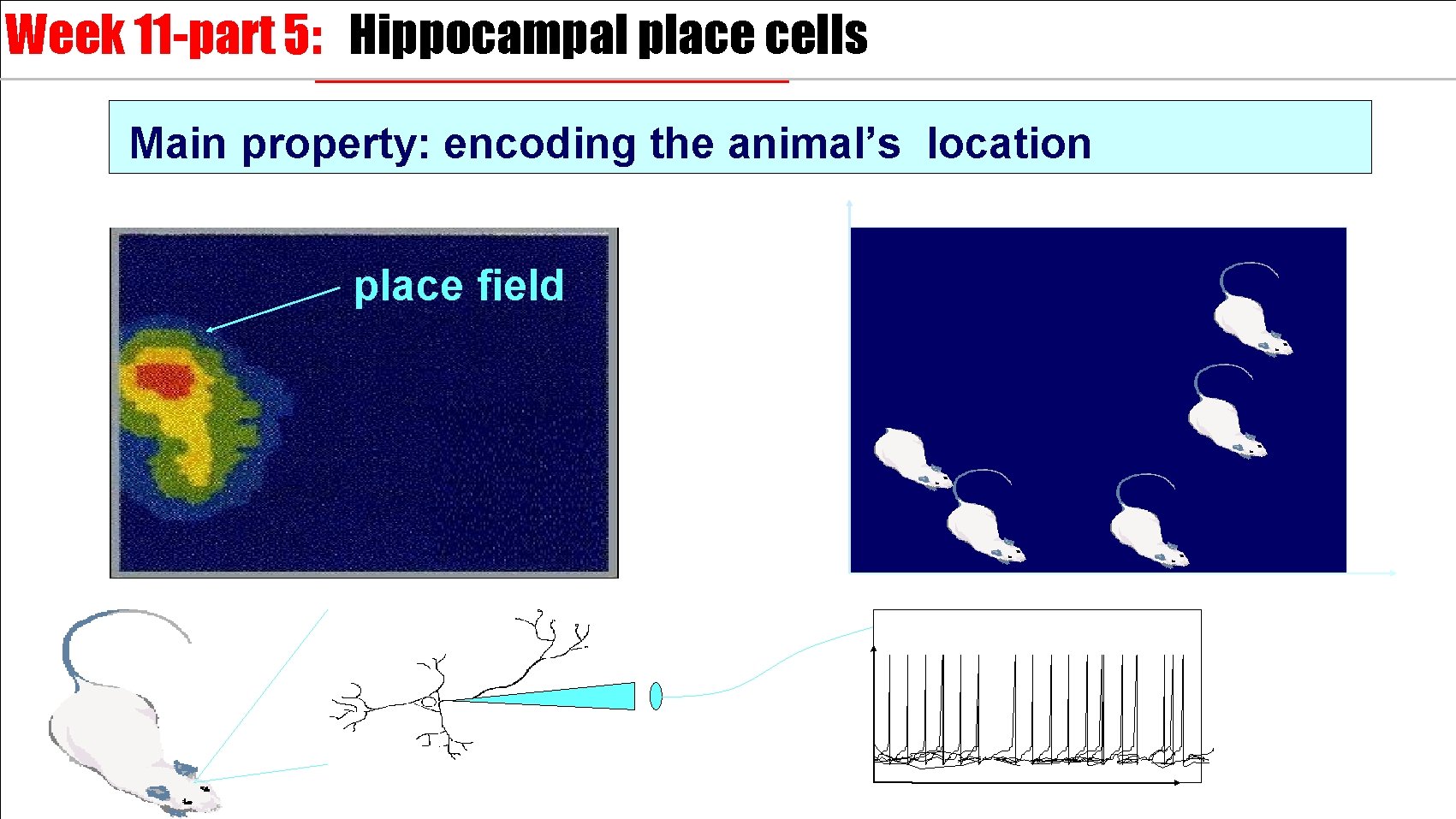
Week 11 -part 5: Hippocampal place cells Main property: encoding the animal’s location place field
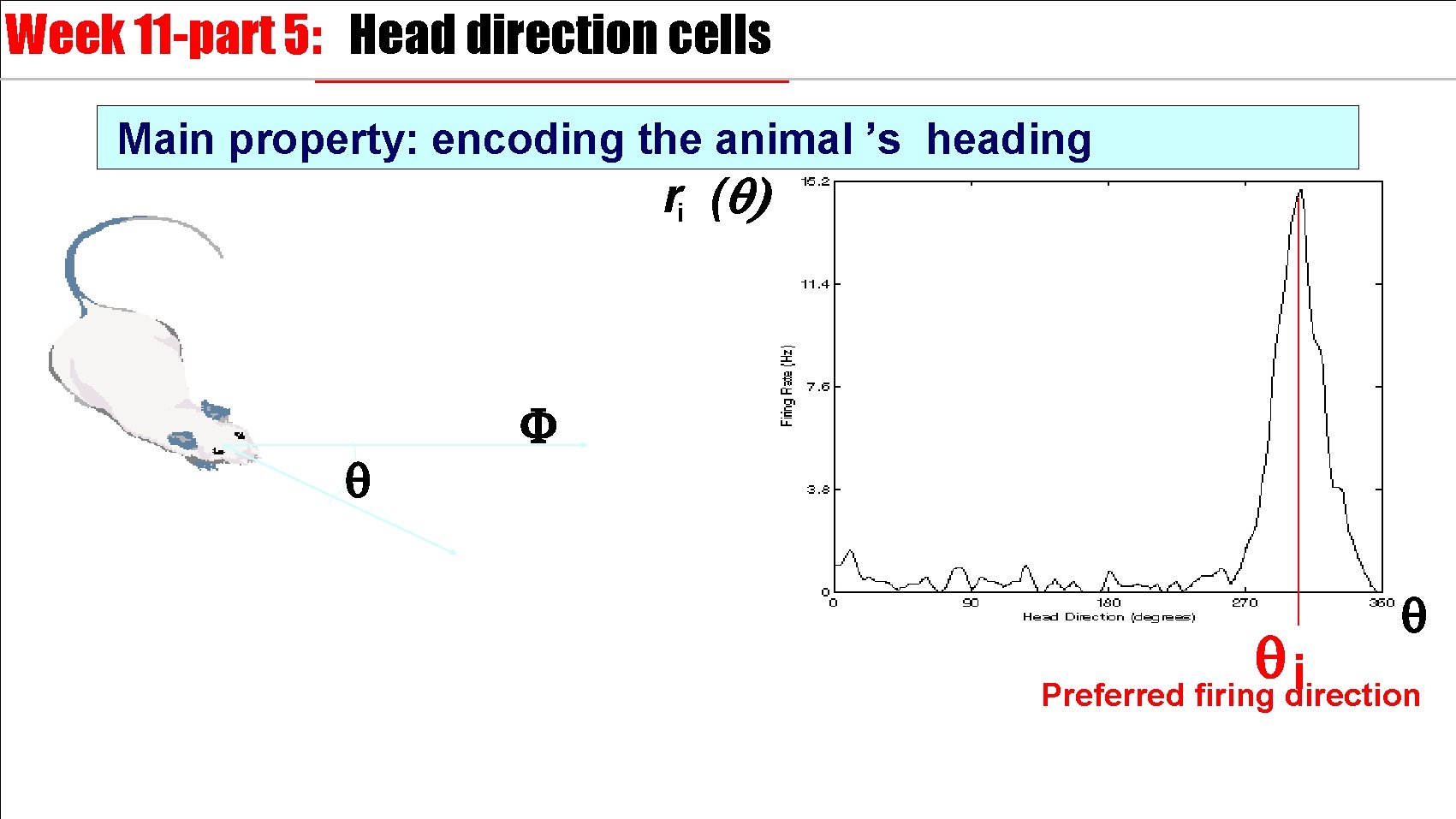
Week 11 -part 5: Head direction cells Main property: encoding the animal ’s heading ri (q) q F q q i Preferred firing direction
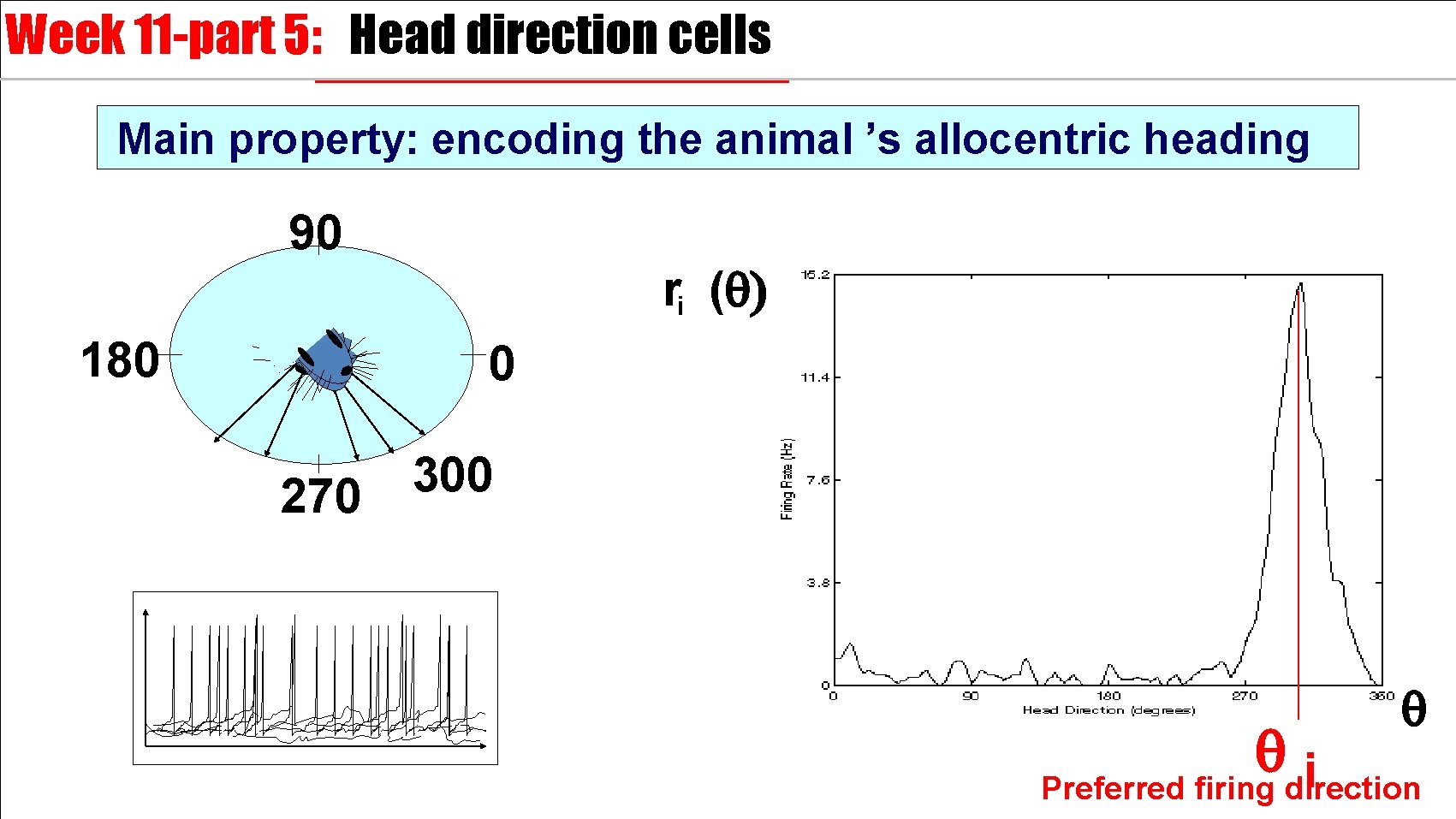
Week 11 -part 5: Head direction cells Main property: encoding the animal ’s allocentric heading 90 ri (q) 180 0 270 300 q q i Preferred firing direction
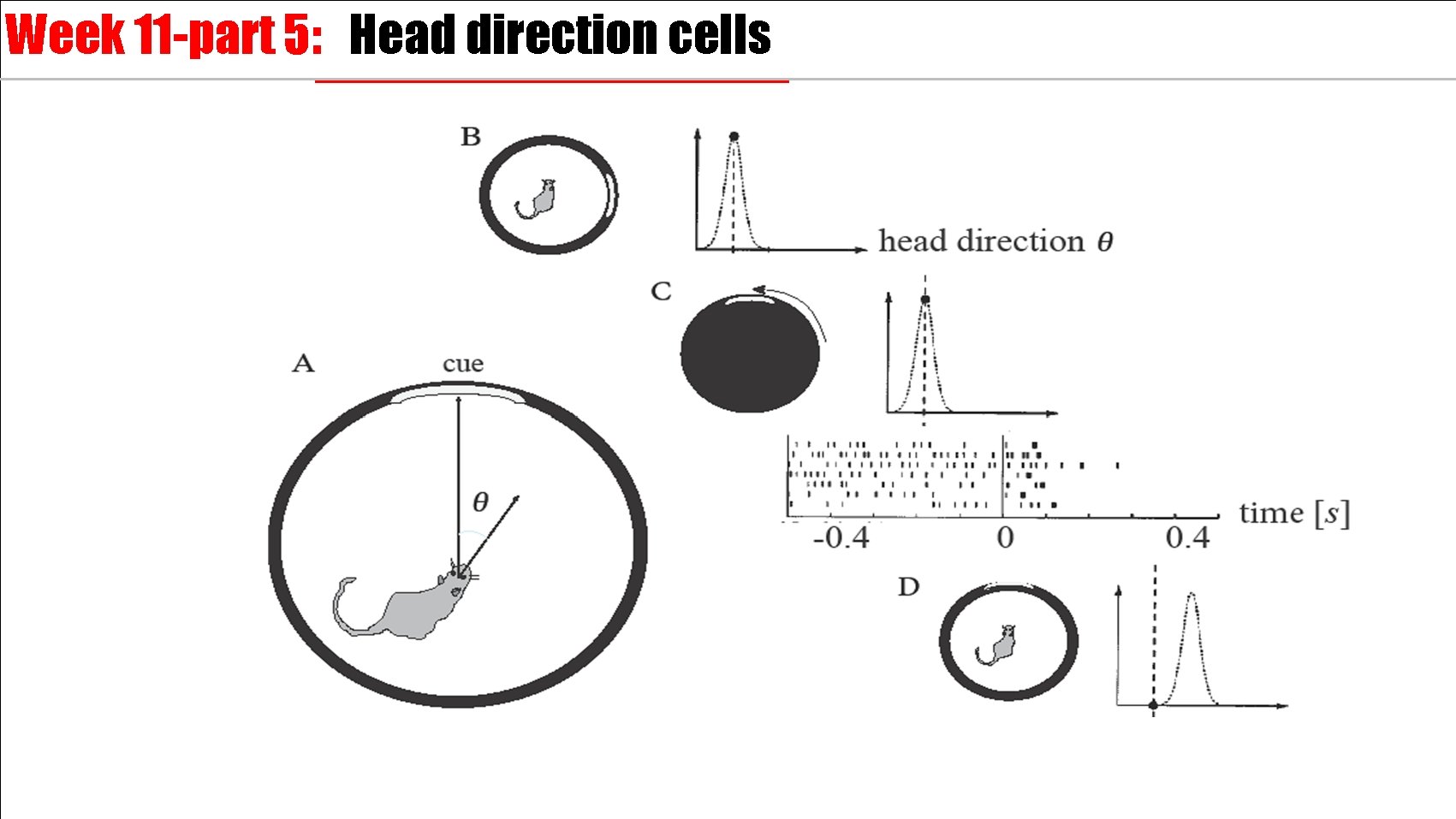
Week 11 -part 5: Head direction cells
Week 11 -Continuum models 11. 1 Transients - sharp or slow 11. 2 Spatial continuum The END - model connectivity - cortical connectivity 11. 3 Solution types - uniform solution - bump solution 11. 4. Perception 11. 5. Head direction cells