
Week 11 Ch 3 e Workbook lead exercise
Week 11 Ch. 3 e. Workbook lead exercise Interviewing and Observing activities AP style practice Beat Story #1 and 2 advice Ch. 4 e. Workbook exercises: 2. 1 and 2. 2. Cover Chapter 5 If time allows, exercise 5 -12
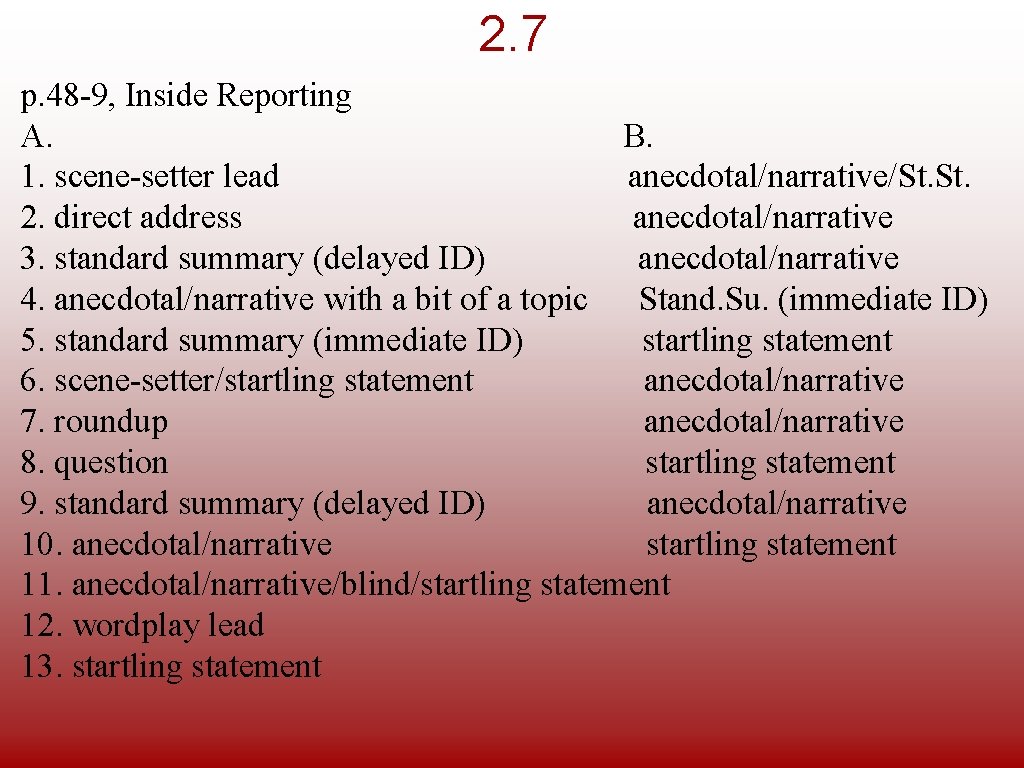
2. 7 p. 48 -9, Inside Reporting A. B. 1. scene-setter lead anecdotal/narrative/St. 2. direct address anecdotal/narrative 3. standard summary (delayed ID) anecdotal/narrative 4. anecdotal/narrative with a bit of a topic Stand. Su. (immediate ID) 5. standard summary (immediate ID) startling statement 6. scene-setter/startling statement anecdotal/narrative 7. roundup anecdotal/narrative 8. question startling statement 9. standard summary (delayed ID) anecdotal/narrative 10. anecdotal/narrative startling statement 11. anecdotal/narrative/blind/startling statement 12. wordplay lead 13. startling statement

Slide Interviewing/Observation Activities Interviewing Pair up. You are going to interview each other. Three rounds means three different partners. This will help you to focus the interview in the same way reporters focus interviews to get answers for a particular story. The topics are as follows: Round 1: What did you do over the May Day holiday? Round 2: What’s the most traumatic (embarrassing, funny, etc. ) event in your life? Round 3: Who has been the most influential person in your life and why? Observation Close your eyes. Spend three minutes, with your eyes closed, thinking of your favorite place. It could be your room at home, a football field, a restaurant, a certain store – whatever your favorite spot is. Now, open your eyes and write about that place. Your goal is to transport me and your classmates to that place through your observations – the sights, sounds, smells – of the place. You should pretend that the others in the room are blind and that the writing will help the others “see” the place. Mc. Graw-Hill © 2010 The Mc. Graw-Hill Companies, Inc. All rights reserved.
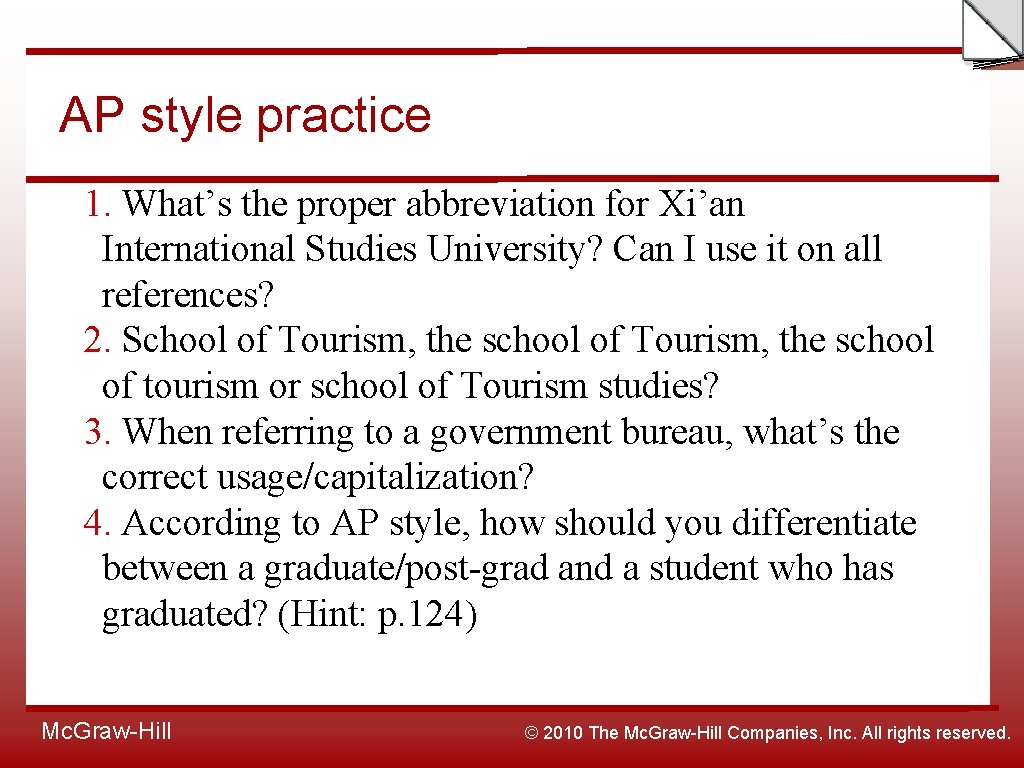
Slide AP style practice 1. What’s the proper abbreviation for Xi’an International Studies University? Can I use it on all references? 2. School of Tourism, the school of tourism or school of Tourism studies? 3. When referring to a government bureau, what’s the correct usage/capitalization? 4. According to AP style, how should you differentiate between a graduate/post-grad and a student who has graduated? (Hint: p. 124) Mc. Graw-Hill © 2010 The Mc. Graw-Hill Companies, Inc. All rights reserved.
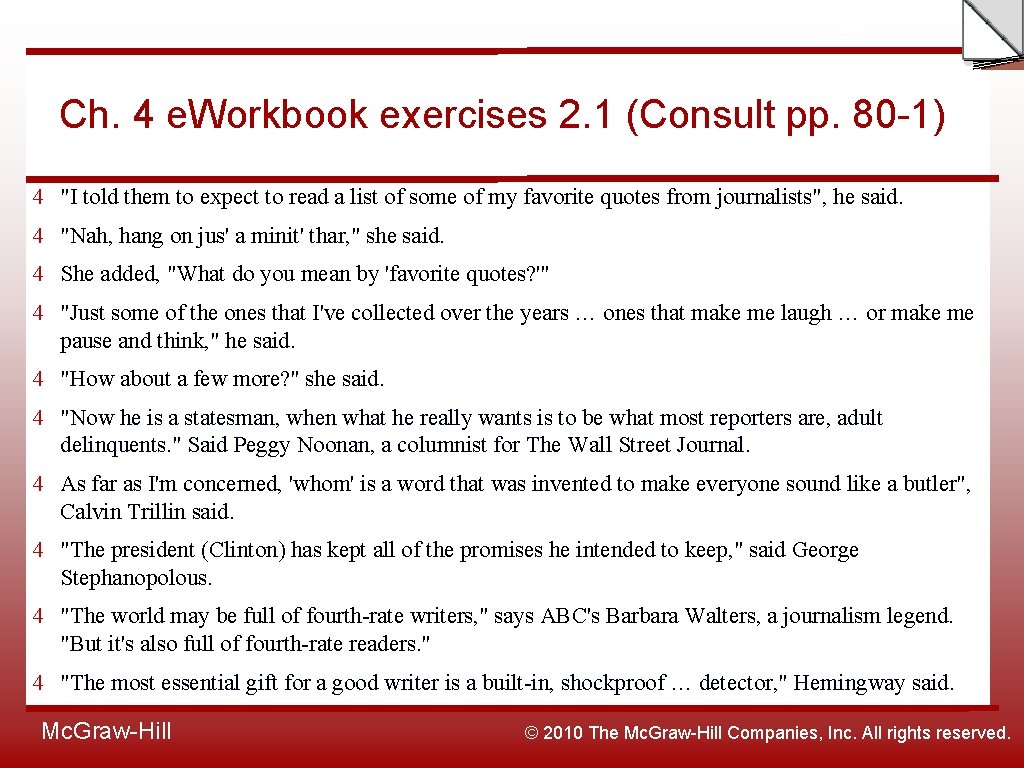
Slide Ch. 4 e. Workbook exercises 2. 1 (Consult pp. 80 -1) 4 "I told them to expect to read a list of some of my favorite quotes from journalists", he said. 4 "Nah, hang on jus' a minit' thar, " she said. 4 She added, "What do you mean by 'favorite quotes? '" 4 "Just some of the ones that I've collected over the years … ones that make me laugh … or make me pause and think, " he said. 4 "How about a few more? " she said. 4 "Now he is a statesman, when what he really wants is to be what most reporters are, adult delinquents. " Said Peggy Noonan, a columnist for The Wall Street Journal. 4 As far as I'm concerned, 'whom' is a word that was invented to make everyone sound like a butler", Calvin Trillin said. 4 "The president (Clinton) has kept all of the promises he intended to keep, " said George Stephanopolous. 4 "The world may be full of fourth-rate writers, " says ABC's Barbara Walters, a journalism legend. "But it's also full of fourth-rate readers. " 4 "The most essential gift for a good writer is a built-in, shockproof … detector, " Hemingway said. Mc. Graw-Hill © 2010 The Mc. Graw-Hill Companies, Inc. All rights reserved.
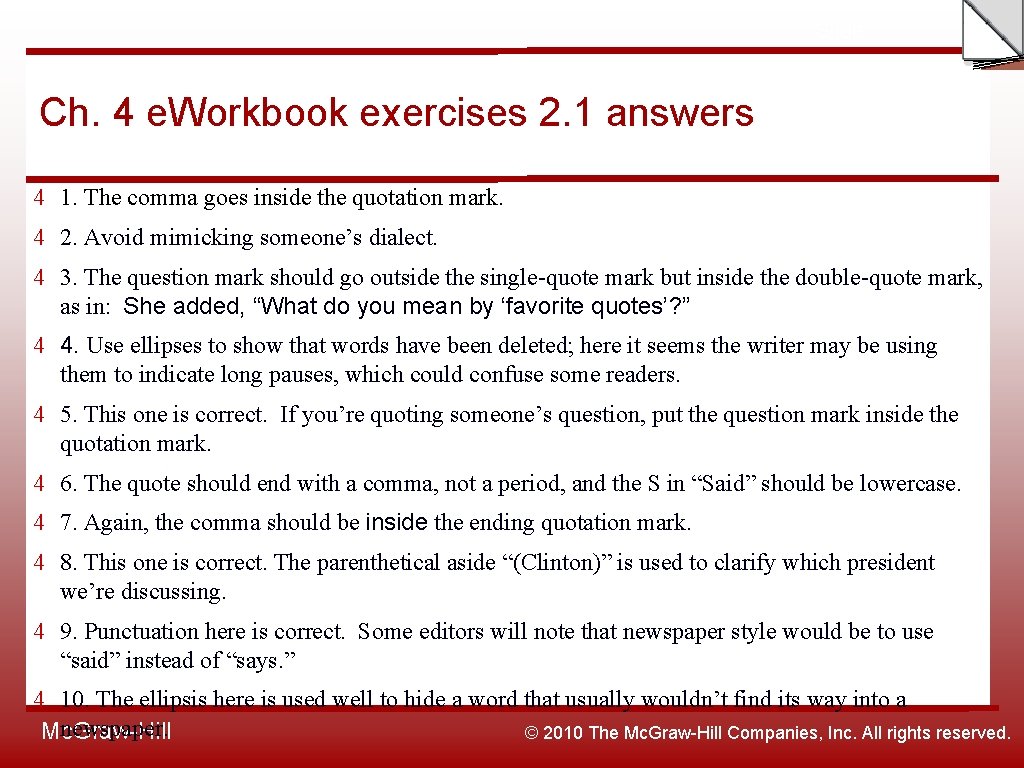
Slide Ch. 4 e. Workbook exercises 2. 1 answers 4 1. The comma goes inside the quotation mark. 4 2. Avoid mimicking someone’s dialect. 4 3. The question mark should go outside the single-quote mark but inside the double-quote mark, as in: She added, “What do you mean by ‘favorite quotes’? ” 4 4. Use ellipses to show that words have been deleted; here it seems the writer may be using them to indicate long pauses, which could confuse some readers. 4 5. This one is correct. If you’re quoting someone’s question, put the question mark inside the quotation mark. 4 6. The quote should end with a comma, not a period, and the S in “Said” should be lowercase. 4 7. Again, the comma should be inside the ending quotation mark. 4 8. This one is correct. The parenthetical aside “(Clinton)” is used to clarify which president we’re discussing. 4 9. Punctuation here is correct. Some editors will note that newspaper style would be to use “said” instead of “says. ” 4 10. The ellipsis here is used well to hide a word that usually wouldn’t find its way into a newspaper. © 2010 The Mc. Graw-Hill Companies, Inc. All rights reserved. Mc. Graw-Hill
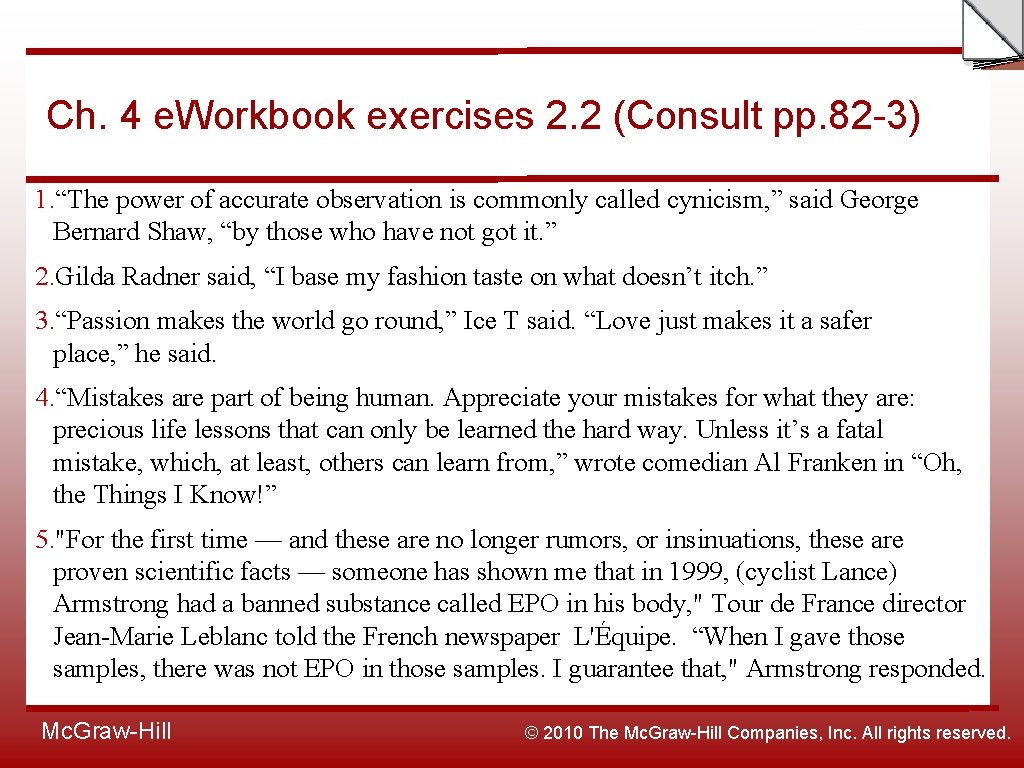
Slide Ch. 4 e. Workbook exercises 2. 2 (Consult pp. 82 -3) 1. “The power of accurate observation is commonly called cynicism, ” said George Bernard Shaw, “by those who have not got it. ” 2. Gilda Radner said, “I base my fashion taste on what doesn’t itch. ” 3. “Passion makes the world go round, ” Ice T said. “Love just makes it a safer place, ” he said. 4. “Mistakes are part of being human. Appreciate your mistakes for what they are: precious life lessons that can only be learned the hard way. Unless it’s a fatal mistake, which, at least, others can learn from, ” wrote comedian Al Franken in “Oh, the Things I Know!” 5. "For the first time — and these are no longer rumors, or insinuations, these are proven scientific facts — someone has shown me that in 1999, (cyclist Lance) Armstrong had a banned substance called EPO in his body, " Tour de France director Jean-Marie Leblanc told the French newspaper L'Équipe. “When I gave those samples, there was not EPO in those samples. I guarantee that, " Armstrong responded. Mc. Graw-Hill © 2010 The Mc. Graw-Hill Companies, Inc. All rights reserved.
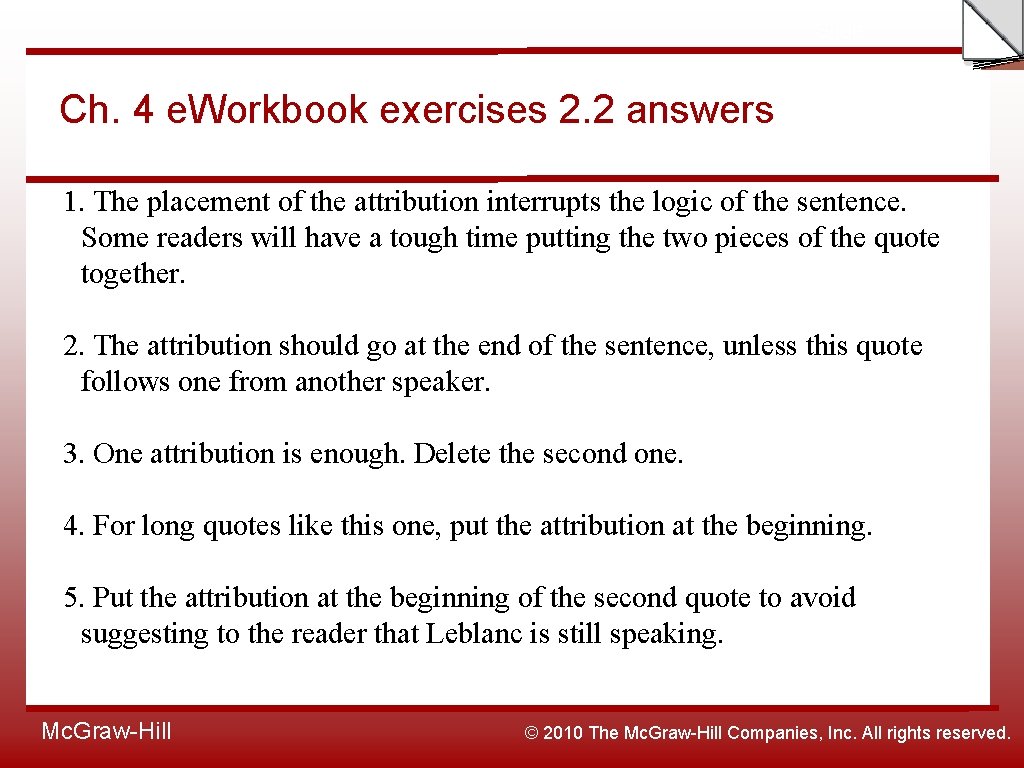
Slide Ch. 4 e. Workbook exercises 2. 2 answers 1. The placement of the attribution interrupts the logic of the sentence. Some readers will have a tough time putting the two pieces of the quote together. 2. The attribution should go at the end of the sentence, unless this quote follows one from another speaker. 3. One attribution is enough. Delete the second one. 4. For long quotes like this one, put the attribution at the beginning. 5. Put the attribution at the beginning of the second quote to avoid suggesting to the reader that Leblanc is still speaking. Mc. Graw-Hill © 2010 The Mc. Graw-Hill Companies, Inc. All rights reserved.
Slide Tips for Beat Story #1 and 2 Refer to pp. 52 -55, 57, 59 -61, 82 -85 for before, during, and after writing; rewriting, editing, a newswriting checklist and tips, quotes and attribution Lead; Nut graph/second paragraph Avoid personal pronouns, opinion, passive voice. Check grammar and punctuation. Attribution (who said) and Quotes (direct and indirect) Check for accuracy, fairness and balance, redundancy, cliches etc. AP stylebook Mc. Graw-Hill © 2010 The Mc. Graw-Hill Companies, Inc. All rights reserved.
lcome to the world of Every culture seeks effective constantly evolving, reflectingdramatically. The typi urnalism, where ways to spread new and shaping its culture. newspaper of 1800 wa porters have been information and gossip. In Others see it as an inspiring undisciplined mishma gging dirt, raking muck, ancient times, news was quest for free speech, an legislative proceeding king headlines and adlines written on clay tablets. In endless power struggle long-winded essays a for centuries Caesar’s age, Romans read between Authority (trying to secondhand gossip. B w. It’s a history full of newsletters compiled by control information) and the 1900, a new breed of bloid trash, of slimy correspondents and People (trying to learn the tor had emerged. Jour nsationalists, of runkards, handwritten by slaves. truth). Which brings to mind had become big busin deadbeats and mmers” (as Wandering minstrels spread the words of A. J. Liefling: Reporting was becom a Harvard iversity news (and the plague) in the “Freedom of the press is disciplined craft. And president once scribed Middle Ages. Them came ink guaranteed only to htose who newspapers were bec Tim Harrower reporters). on paper. Voices on airwaves. own one. ” more entertaining and esse But it’s a history full of Newsreels, Web sites, And 24 - In the pages ahead, we’ll takethan ever, w roes, too: men and hour cable news networks. a quick tour of 600 years of most of the features w exp men risking their lives tell Thus when scholars analyze journalism history, from today: Snappy headlines, stories of war and agedy, the rich history of journalism, hieroglyphics to hypertext: the Comic Sports pages. And risking prisonment to some view it in terms of media, the message and the “inverted pyramid” sty wr defend technological progress—for politics. that made stori tighter and ee speech. And as you example, the dramatic impact Technical advances and newsier. n see here, reports have of bigger, faster printing brilliant ideas forged a new Radio and television br come beloved characters ppresses. style of journalism. It was a an end to culture, too, turning up Others see journalism as a century of change, and newspapers’ media monop movies, comics and TV specialized form literary newspapers changed Why? Well yourself: Whi ows as if guided by an cult expression, one that’s did yo hand. Inside Reporting 5 Covering the news Mc. Graw-Hill © 2010 The Mc. Graw-Hill Companies, Inc. All rights reserved.
Slide Covering the news Covering a beat Writing obituaries Covering accidents and disasters Covering fires Covering crime Mc. Graw-Hill © 2010 The Mc. Graw-Hill Companies, Inc. All rights reserved.
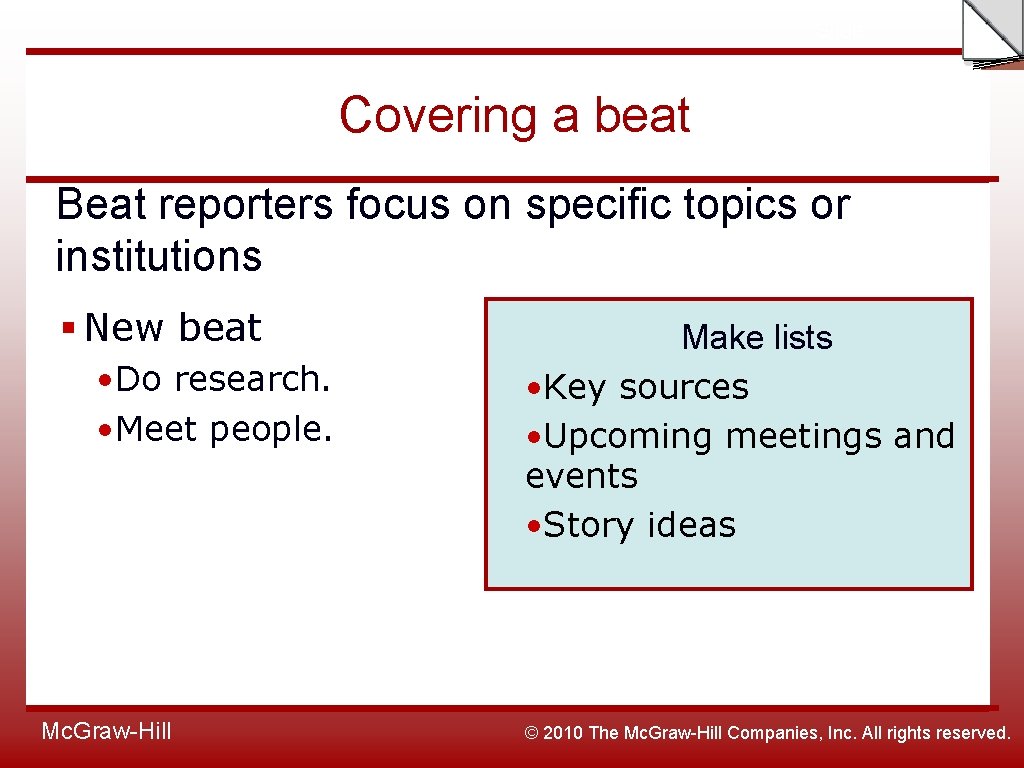
Slide Covering a beat Beat reporters focus on specific topics or institutions § New beat • Do research. • Meet people. Mc. Graw-Hill Make lists • Key sources • Upcoming meetings and events • Story ideas © 2010 The Mc. Graw-Hill Companies, Inc. All rights reserved.
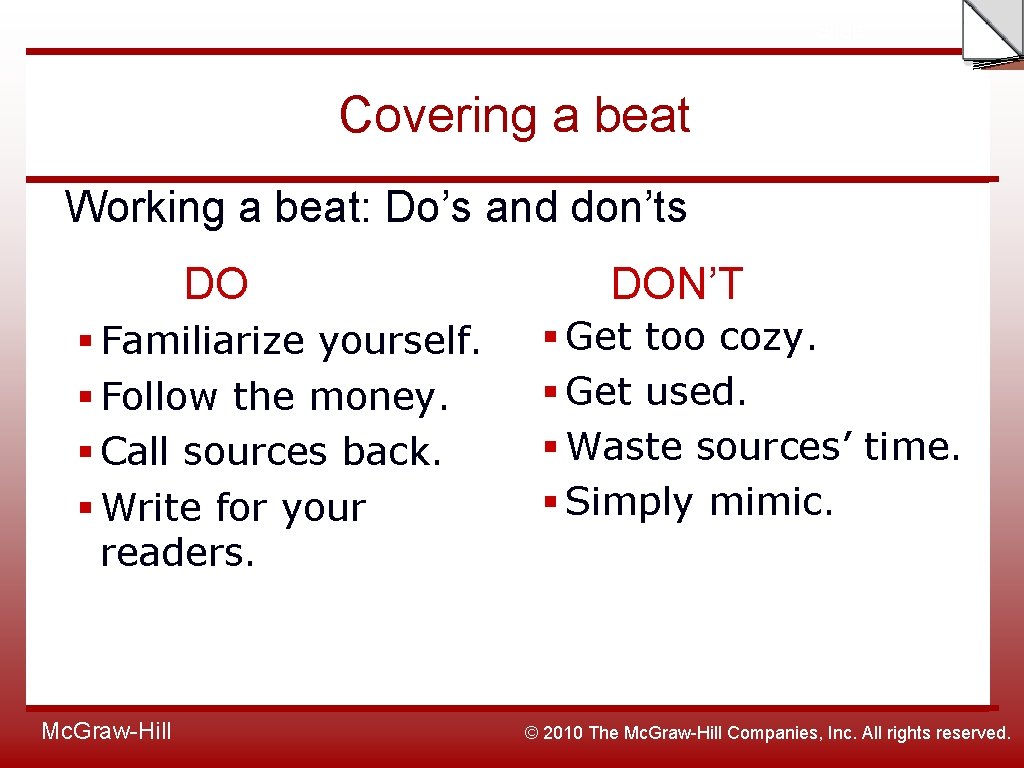
Slide Covering a beat Working a beat: Do’s and don’ts DO § Familiarize yourself. § Follow the money. § Call sources back. § Write for your readers. Mc. Graw-Hill DON’T § Get too cozy. § Get used. § Waste sources’ time. § Simply mimic. © 2010 The Mc. Graw-Hill Companies, Inc. All rights reserved.
Slide Writing obituaries Death is news § Obituaries are read more closely by more people than any other part of the paper. • They tell stories. • They touch hearts. • They honor and inspire. Mc. Graw-Hill What’s the difference? • Death notice — brief announcement with basic facts. • Obituary — longer announcement and provides more history and detail. © 2010 The Mc. Graw-Hill Companies, Inc. All rights reserved.
Slide Writing obituaries Watch your language § Addresses § Cause of death § Past personal problems § Flowery phrases Mc. Graw-Hill Other terminology • Funerals are scheduled. • Masses are celebrated. • People die unexpectedly. • People die after surgery. • A man is survived by his wife. © 2010 The Mc. Graw-Hill Companies, Inc. All rights reserved.
Slide Writing obituaries Obituary checklist üUse full names. üAvoid details in mentioning cause of üFind a phrase that death. best summarizes this person. üInclude birth date and birth place. üState age simply unless asked to omit. Mc. Graw-Hill © 2010 The Mc. Graw-Hill Companies, Inc. All rights reserved.
Slide Writing obituaries Obituary checklist üList education, military service, honors and career achievements. üName survivors in immediate family. Mc. Graw-Hill üInclude name and phone number for funeral home. © 2010 The Mc. Graw-Hill Companies, Inc. All rights reserved.
Slide Writing obituaries Writing standard news obituary §Emphasize person’s significance in lead. §Lead should include • Name. • Major accomplishment or occupation. • Day, location and cause of death. Mc. Graw-Hill § If natural cause of death, focus on personal history. • If unusual cause of death, details should precede the background info. § More prominent get more quotes. © 2010 The Mc. Graw-Hill Companies, Inc. All rights reserved.
Slide Writing obituaries The feature obituary §Looser, friendlier style. §Create an illusion of intimacy. §Omit attributions. Mc. Graw-Hill © 2010 The Mc. Graw-Hill Companies, Inc. All rights reserved.
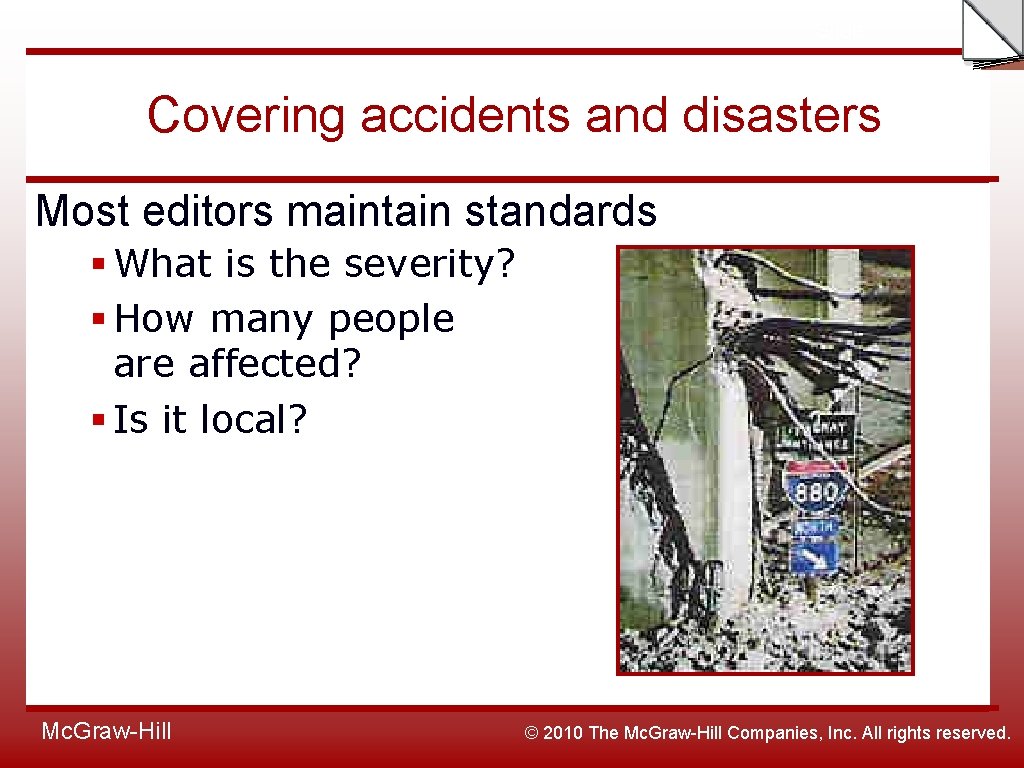
Slide Covering accidents and disasters Most editors maintain standards § What is the severity? § How many people are affected? § Is it local? Mc. Graw-Hill © 2010 The Mc. Graw-Hill Companies, Inc. All rights reserved.
Slide Covering accidents and disasters Writing stories on traffic accidents § Usually lead with WHAT or WHO. § Start with a delayed-identification lead. • Delay naming victims until 2 nd or 3 rd paragraph. • Distribute key facts logically through first few paragraphs. • Generally no need to identify police by name. Mc. Graw-Hill © 2010 The Mc. Graw-Hill Companies, Inc. All rights reserved.
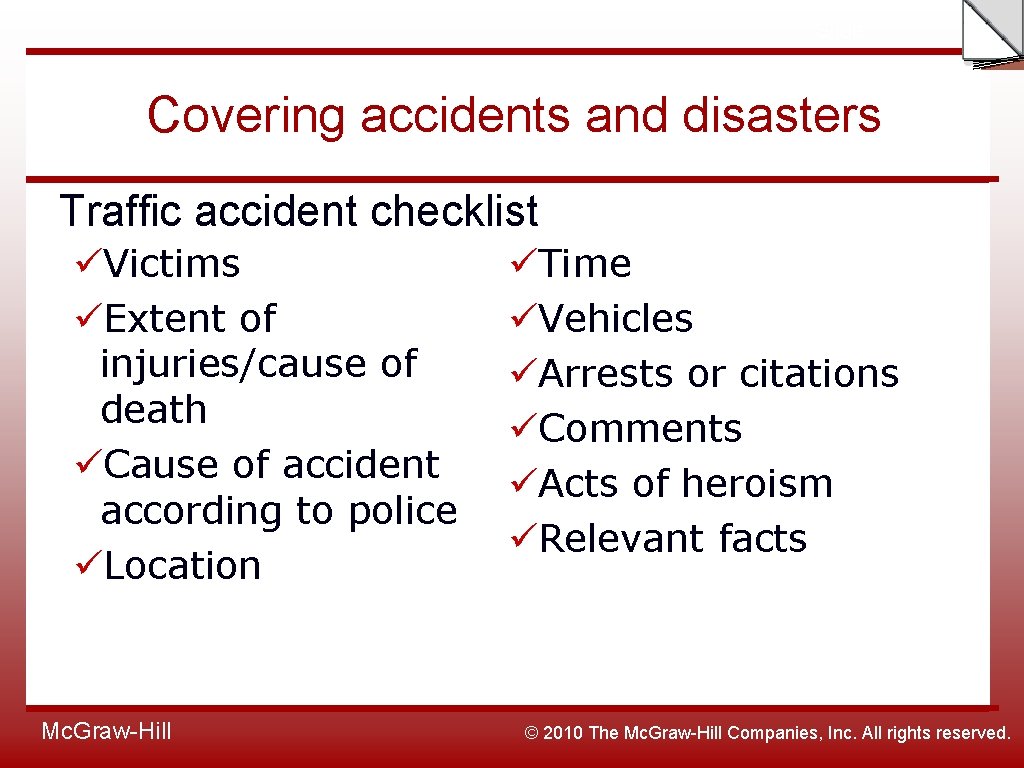
Slide Covering accidents and disasters Traffic accident checklist üVictims üExtent of injuries/cause of death üCause of accident according to police üLocation Mc. Graw-Hill üTime üVehicles üArrests or citations üComments üActs of heroism üRelevant facts © 2010 The Mc. Graw-Hill Companies, Inc. All rights reserved.
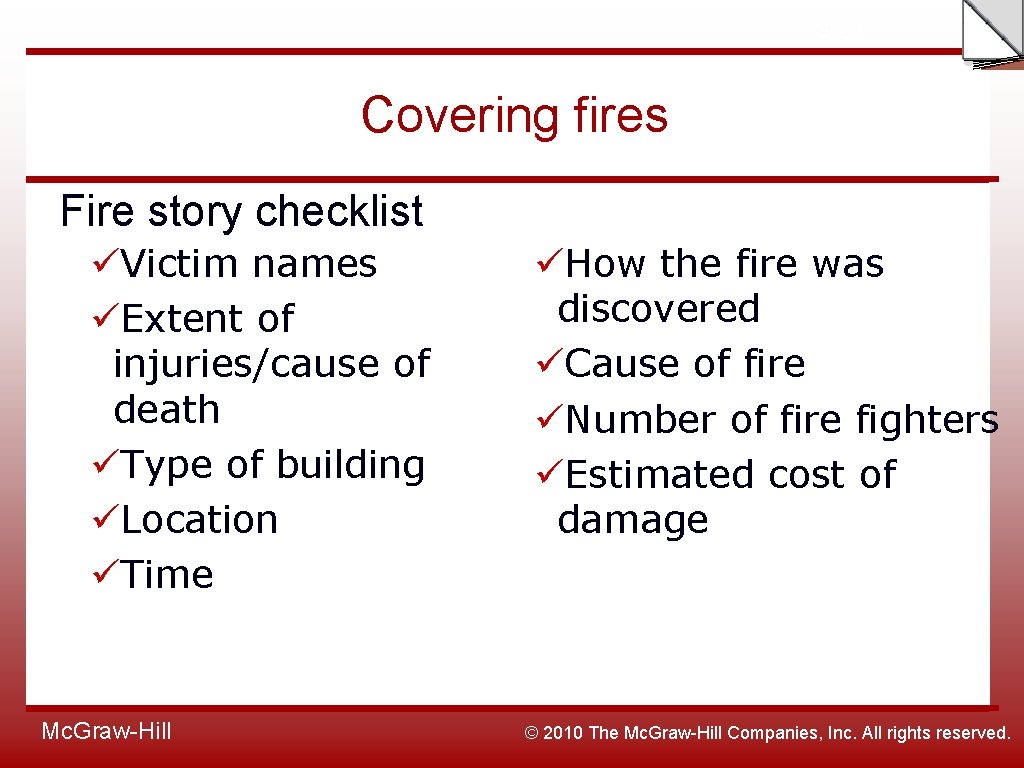
Slide Covering fires Fire story checklist üVictim names üExtent of injuries/cause of death üType of building üLocation üTime Mc. Graw-Hill üHow the fire was discovered üCause of fire üNumber of fire fighters üEstimated cost of damage © 2010 The Mc. Graw-Hill Companies, Inc. All rights reserved.
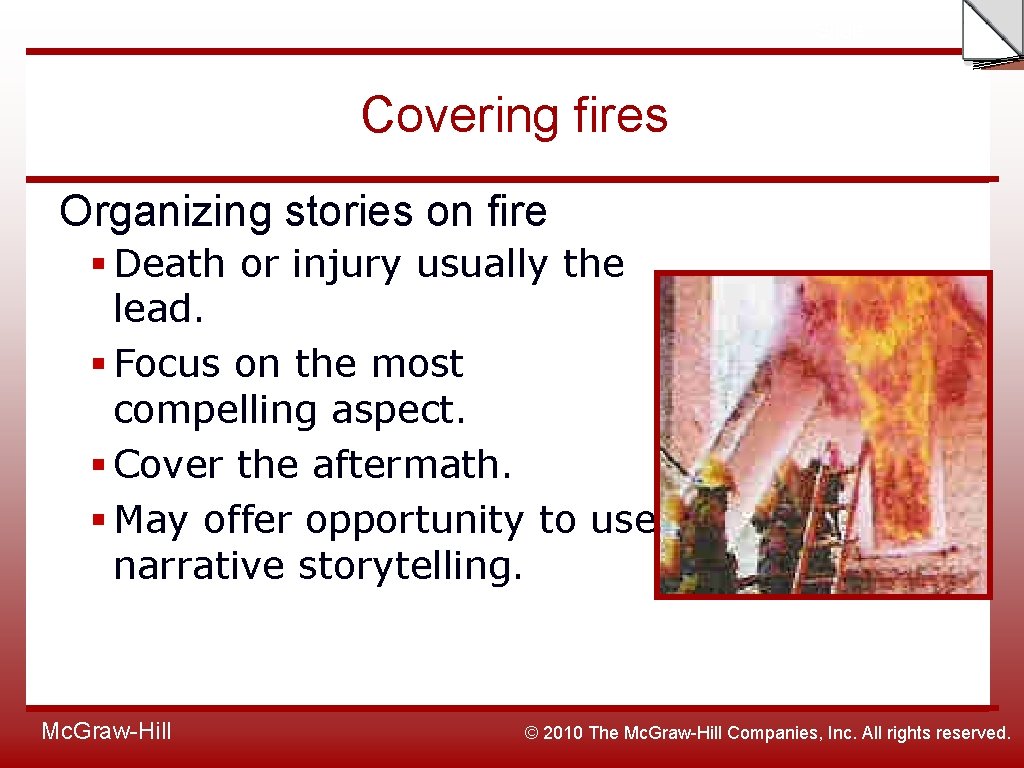
Slide Covering fires Organizing stories on fire § Death or injury usually the lead. § Focus on the most compelling aspect. § Cover the aftermath. § May offer opportunity to use narrative storytelling. Mc. Graw-Hill © 2010 The Mc. Graw-Hill Companies, Inc. All rights reserved.
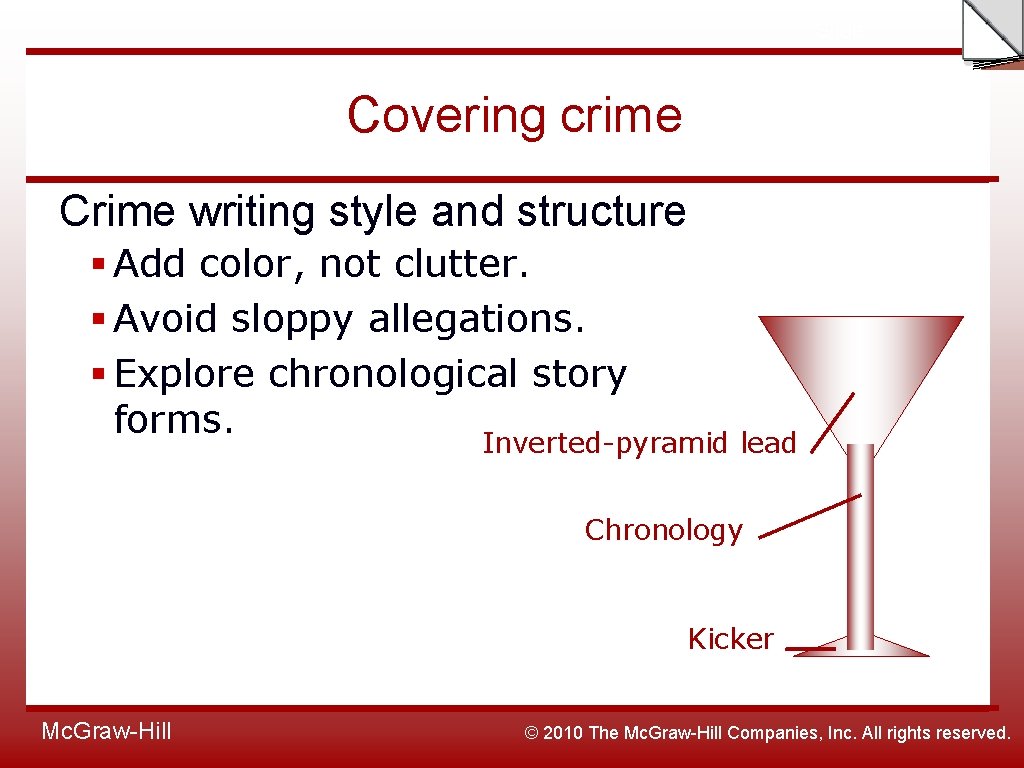
Slide Covering crime Crime writing style and structure § Add color, not clutter. § Avoid sloppy allegations. § Explore chronological story forms. Inverted-pyramid lead Chronology Kicker Mc. Graw-Hill © 2010 The Mc. Graw-Hill Companies, Inc. All rights reserved.
Slide Covering crime What you should withhold § Names of minors § Names of victims of sensitive crimes § Names of endangered victims § Labeling people as suspects § Stereotypes Mc. Graw-Hill © 2010 The Mc. Graw-Hill Companies, Inc. All rights reserved.
Slide Covering crime Homicide or assault story checklist üVictim’s name üExtent of injuries/cause of death üLocation üTime üCircumstances Mc. Graw-Hill üDescription of suspect üName and identification of anyone arrested üComments üUnusual factors © 2010 The Mc. Graw-Hill Companies, Inc. All rights reserved.
Slide Covering crime Theft story checklist üType, value of items taken üVictim üLocation üTime üCircumstances Mc. Graw-Hill üDescription of suspect üName and identification of anyone arrested üComments üUnusual factors © 2010 The Mc. Graw-Hill Companies, Inc. All rights reserved.
Slide Covering speeches Speeches: Before, during and after § Before § During • Research the speaker. • Get a good seat. • Request an advance • Estimate the size of the copy of speech. audience. • Ask if picture- taking will • Monitor the mood of the be allowed. crowd. • Take along a tape recorder. Mc. Graw-Hill © 2010 The Mc. Graw-Hill Companies, Inc. All rights reserved.
Slide Covering speeches Speeches: Before, during and after § After • Create a compelling lead. • Highlight speaker’s key points. • Avoid topic leads. • Convey tone of • Include minimal speech. background/ • Beware of false or biographical data. libelous comments. Mc. Graw-Hill © 2010 The Mc. Graw-Hill Companies, Inc. All rights reserved.
Slide Covering speeches Speech story checklist ü Speaker’s name ü Relevant credentials ü Reason for speech ü Time, day and location üDescription of audience üQuotes üComments üResponses üSpeaker’s fee Mc. Graw-Hill © 2010 The Mc. Graw-Hill Companies, Inc. All rights reserved.
Slide Covering meetings Explain issues, how decisions are made, and what it means § Start with research. § Go early. § Clarify. Condense. § Dress Concentrate. appropriately. § Encourage readers to attend meetings. Mc. Graw-Hill © 2010 The Mc. Graw-Hill Companies, Inc. All rights reserved.
Slide Covering meetings Explain issues, how decisions are made, and what it means § Stick around after the § Remember, meetings meeting. are not always news. Mc. Graw-Hill © 2010 The Mc. Graw-Hill Companies, Inc. All rights reserved.
Slide Covering meetings Meeting story checklist üGroup/agency name üCrowd size üLocation and length of üAtmosphere meeting üGraphics üImportant decisions üUnusual events üQuotes üReactions Mc. Graw-Hill üWhat happens next? © 2010 The Mc. Graw-Hill Companies, Inc. All rights reserved.
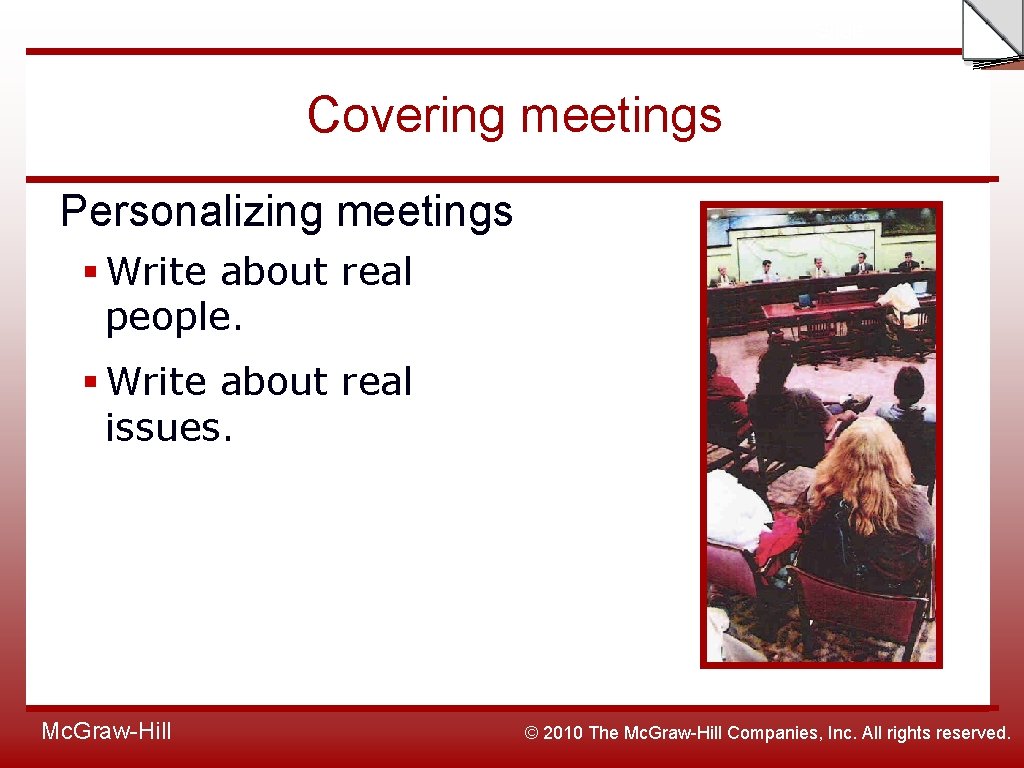
Slide Covering meetings Personalizing meetings § Write about real people. § Write about real issues. Mc. Graw-Hill © 2010 The Mc. Graw-Hill Companies, Inc. All rights reserved.
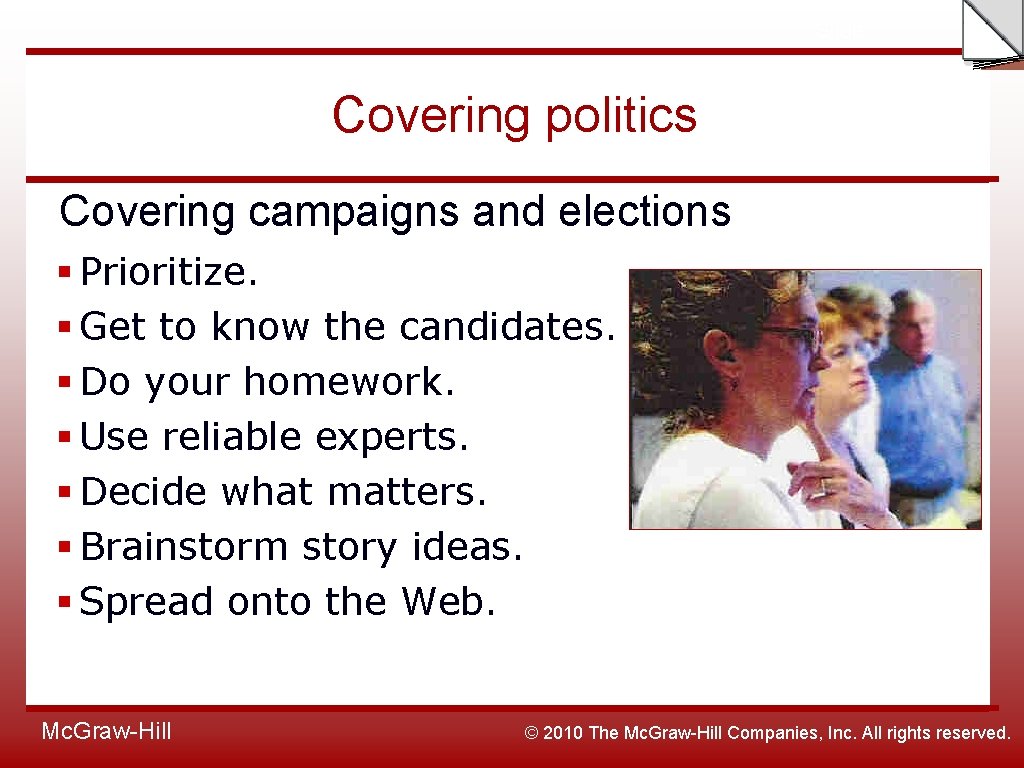
Slide Covering politics Covering campaigns and elections § Prioritize. § Get to know the candidates. § Do your homework. § Use reliable experts. § Decide what matters. § Brainstorm story ideas. § Spread onto the Web. Mc. Graw-Hill © 2010 The Mc. Graw-Hill Companies, Inc. All rights reserved.
Slide Covering politics Keeping tabs of governmental policies and players § Decision making § The election process § Money Mc. Graw-Hill Getting the facts • Meetings • Speeches • News releases • News conferences • Network of sources • Documents © 2010 The Mc. Graw-Hill Companies, Inc. All rights reserved.
Slide Covering politics 5 Unfortunate truths about covering politics § People don’t want to read about government process. § Politicians lie. § Politicians will schmooze you so they can use you. § You must peel away § Everybody believes layer after layer to get your stories are biased. to the truth. Mc. Graw-Hill © 2010 The Mc. Graw-Hill Companies, Inc. All rights reserved.
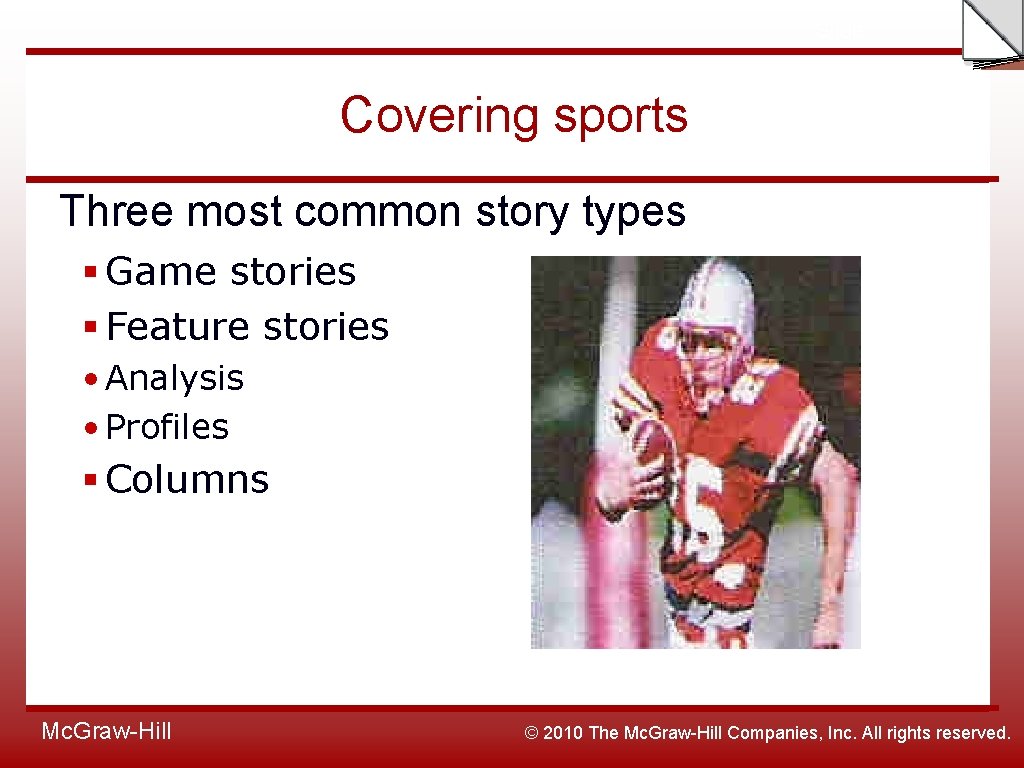
Slide Covering sports Three most common story types § Game stories § Feature stories • Analysis • Profiles § Columns Mc. Graw-Hill © 2010 The Mc. Graw-Hill Companies, Inc. All rights reserved.
Slide Covering sports Game story checklist üFinal score üKey statistics üTeams’ names üInjuries üWhen and where üBoth teams’ records üKey players and key plays üWhat the game means üQuotes üOther relevant factors üStrategies Mc. Graw-Hill © 2010 The Mc. Graw-Hill Companies, Inc. All rights reserved.
Slide Covering sports Advance sporting event checklist üSignificance of game üStrategies üHistory üInjuries üKey players üOther factors üRecords and recent performances üWho’s favored üQuotes Mc. Graw-Hill üTime, place and ticket information © 2010 The Mc. Graw-Hill Companies, Inc. All rights reserved.
Slide Covering sports Sports style § Team name usually plural. § High school athletes are girls and boys. § Abbreviate league names. Mc. Graw-Hill §Use figures for measurements. §Use numerals for scores and time. © 2010 The Mc. Graw-Hill Companies, Inc. All rights reserved.
Slide Covering sports Tips for the sports beat § Covering events § Writing stories • Know the sport. • Cultivate your sources. • Ask tough, pointed questions. • Think plot, not play-byplay. • Avoid jargon and clichés. • Remember, it’s a game. Mc. Graw-Hill © 2010 The Mc. Graw-Hill Companies, Inc. All rights reserved.
Slide Ch. 5 e. Workbook exercise 5 -12 http: //highered. mcgrawhill. com/sites/0073378917/student_view 0/chapter 5/exercise_512. html She had a 7 par to finish 2 -up for the round. The Fountain Valley High School girls soccer team won 12 games last year. The Barons beat the Eagles 7 -0. Walter Payton was the NFL's leading career rusher. She threw five strikeouts in the fourth inning. On third down, he rushed 5 yards for the touchdown. The 6 -10 Cal graduate shot a 3 -pointer at the buzzer. Minnesota lost its only home game this week. After his team started 0 -3, coach Lawrence Hannah shook up the roster. Mc. Graw-Hill © 2010 The Mc. Graw-Hill Companies, Inc. All rights reserved.
Slide Week 11 Assignments Read Chapter 6 Group Work Submit second draft of Beat Story #1 § Deadline: Monday, May 12 by 8 a. m. Submit first draft of Beat Story #2 § Deadline: Wednesday, May 14 by 8 a. m. Mc. Graw-Hill © 2010 The Mc. Graw-Hill Companies, Inc. All rights reserved.
- Slides: 45