
Week 11 12 Multiple Access Channel Characterization Contents
- Slides: 44
Week 11 - 12. Multiple Access (Channel Characterization)
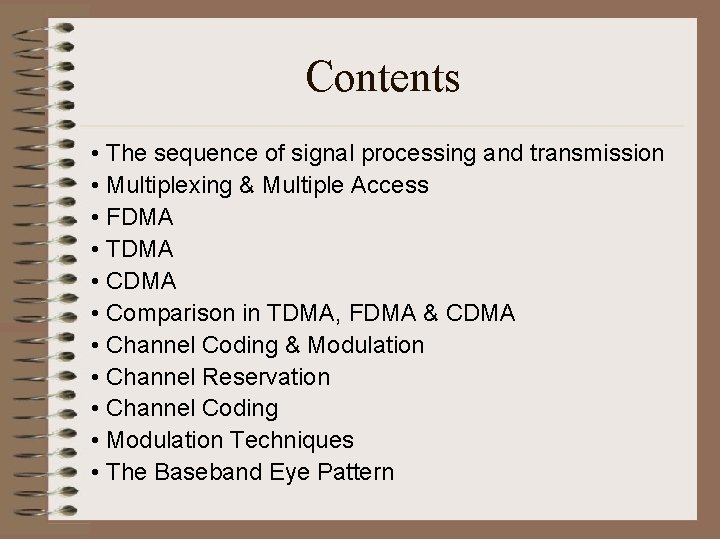
Contents • The sequence of signal processing and transmission • Multiplexing & Multiple Access • FDMA • TDMA • Comparison in TDMA, FDMA & CDMA • Channel Coding & Modulation • Channel Reservation • Channel Coding • Modulation Techniques • The Baseband Eye Pattern
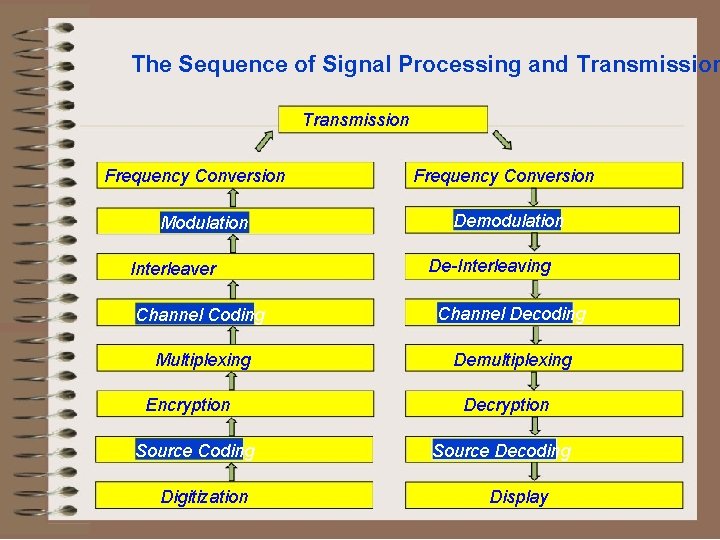
The Sequence of Signal Processing and Transmission Frequency Conversion Modulation Interleaver Frequency Conversion Demodulation De-Interleaving Channel Coding Channel Decoding Multiplexing Demultiplexing Encryption Source Coding Digitization Decryption Source Decoding Display
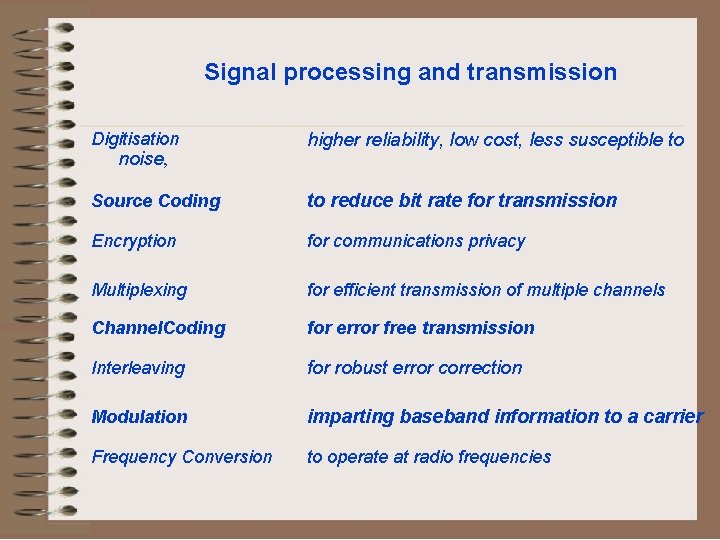
Signal processing and transmission Digitisation higher reliability, low cost, less susceptible to Source Coding to reduce bit rate for transmission Encryption for communications privacy Multiplexing for efficient transmission of multiple channels Channel. Coding for error free transmission Interleaving for robust error correction Modulation imparting baseband information to a carrier Frequency Conversion to operate at radio frequencies noise,
Multiplexing and Multiple Access • For the majority of data communications that take place, there is a requirement for several users to share a common channel resource at the same time. • For multiple users to be able to share a common resource in a managed and effective way requires some form of access protocol that defines when or how the sharing is to take place and the means by which messages from individual users are to be identified upon receipt. These sharing process come to be known as multiplexing and multiple access in digital communications.
Multiple Access and Multiplexing • Multiple Access: is the ability for several earth stations to transmit their respective carriers simultaneously into the same satellite transponder • Multiplexing: is the reversible operation of combining several information-bearing signals to form a single, more complex signal.
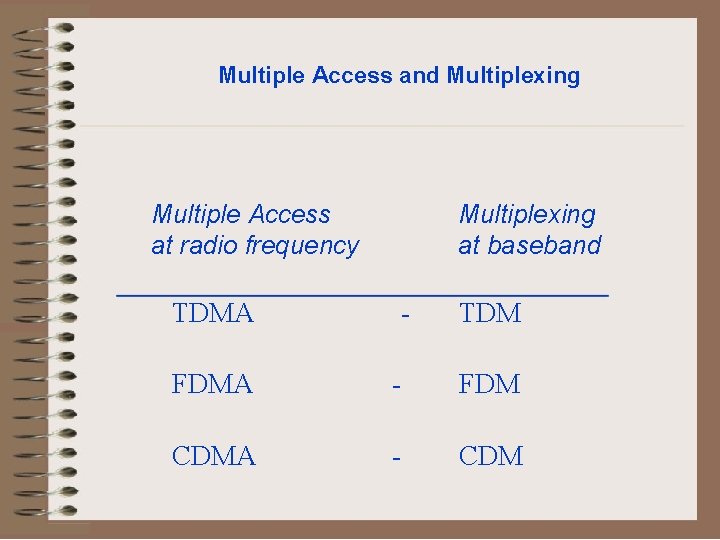
Multiple Access and Multiplexing Multiple Access at radio frequency TDMA Multiplexing at baseband - TDM FDMA - FDM CDMA - CDM
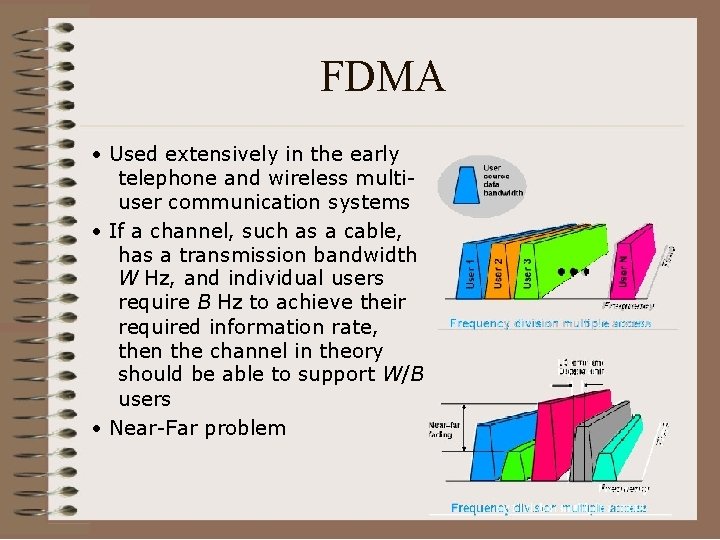
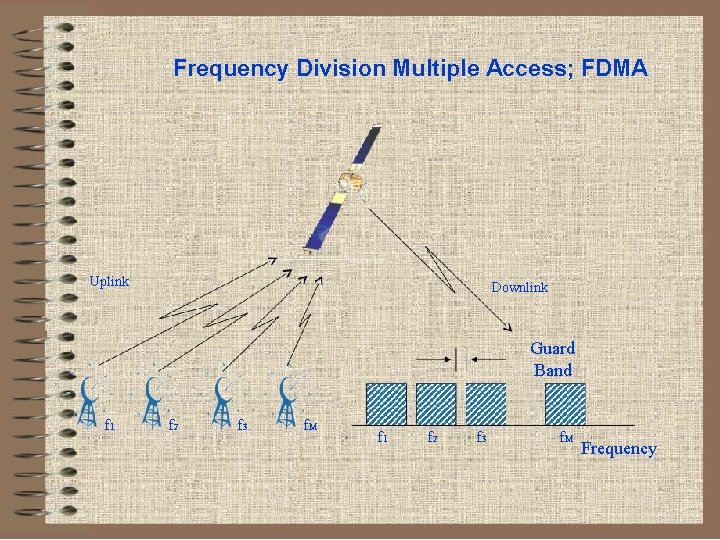
FDMA • Used extensively in the early telephone and wireless multiuser communication systems • If a channel, such as a cable, has a transmission bandwidth W Hz, and individual users require B Hz to achieve their required information rate, then the channel in theory should be able to support W/B users • Near-Far problem
Frequency Division Multiple Access; FDMA Uplink Downlink Guard Band f 1 f 2 f 3. f. M f 1 f 2 f 3 f. M Frequency
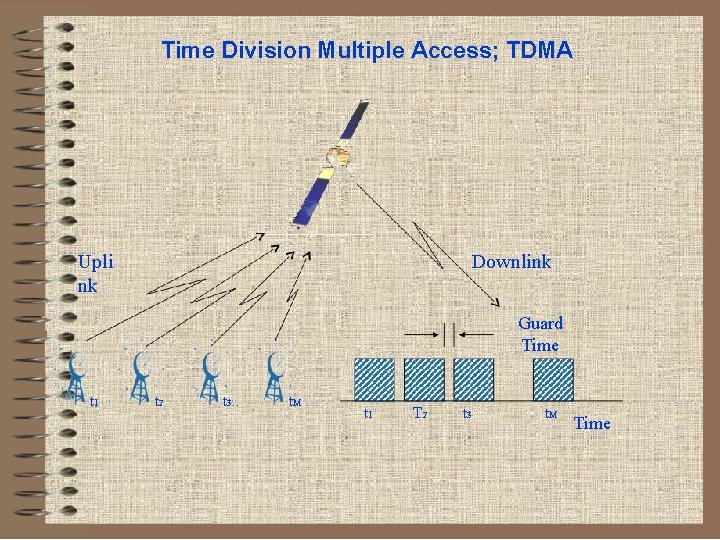
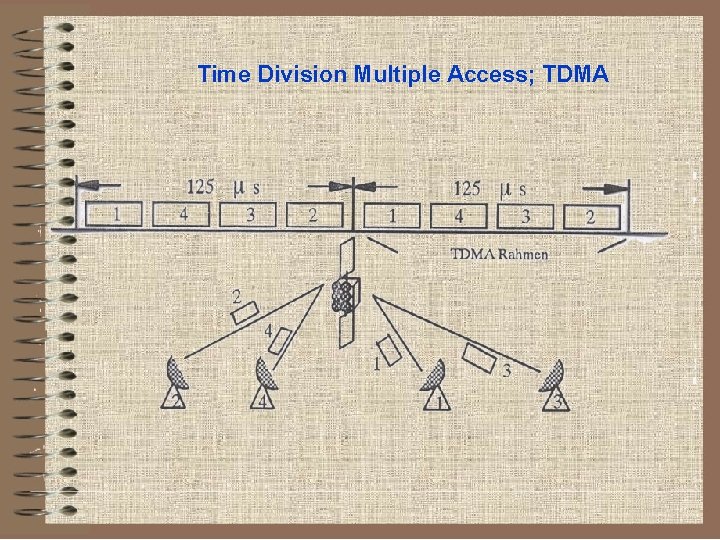
TDMA • The basic principle behind time division multiplexing is that the user has access to a modem operating at a rate several times that required to support his own data throughput, such that he can send his information in a time slot that is shorter than his own message transaction. Other users can then be assigned similar time slots on the same channel. Clearly if the data rate on the channel is w bits/second, and each individual user requires only b bits/second, then the system can support w/b simultaneous users. • In TDM systems, users are assigned a time slot for the duration of their call whether they require it or not.
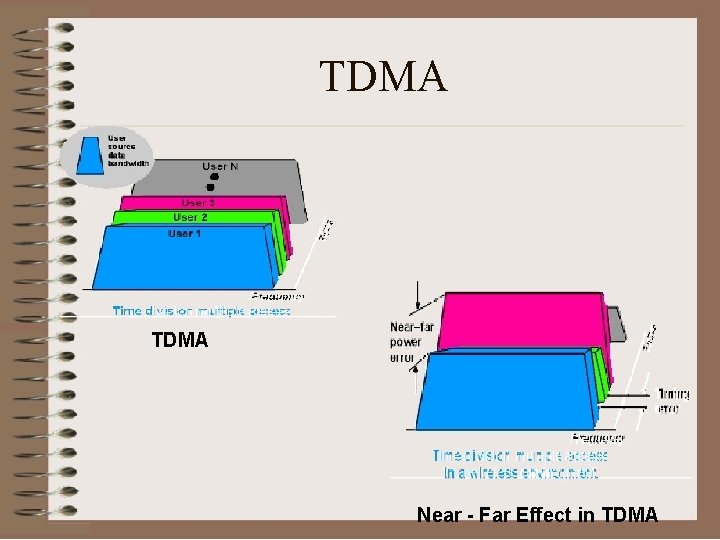
TDMA Near - Far Effect in TDMA
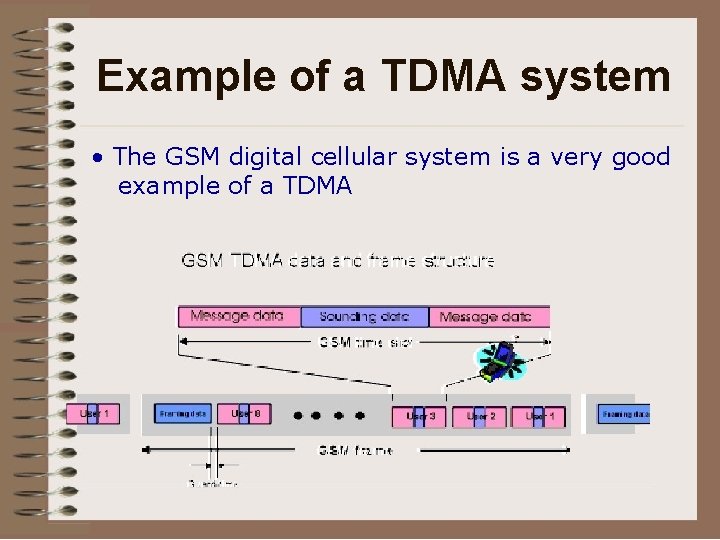
Example of a TDMA system • The GSM digital cellular system is a very good example of a TDMA
Time Division Multiple Access; TDMA Upli nk Downlink Guard Time t 1 t 2 t 3. . t. M t 1 T 2 t 3 t. M Time
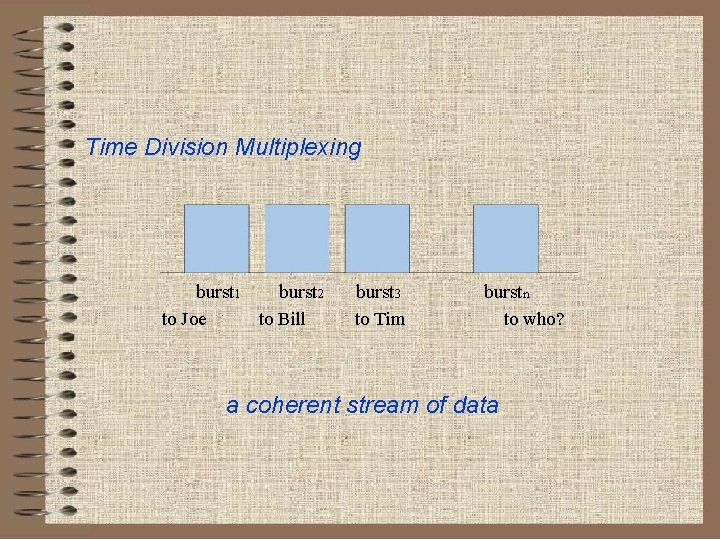
Time Division Multiplexing burst 1 burst 2 to Joe to Bill burst 3 to Tim burstn to who? a coherent stream of data
Time Division Multiple Access; TDMA
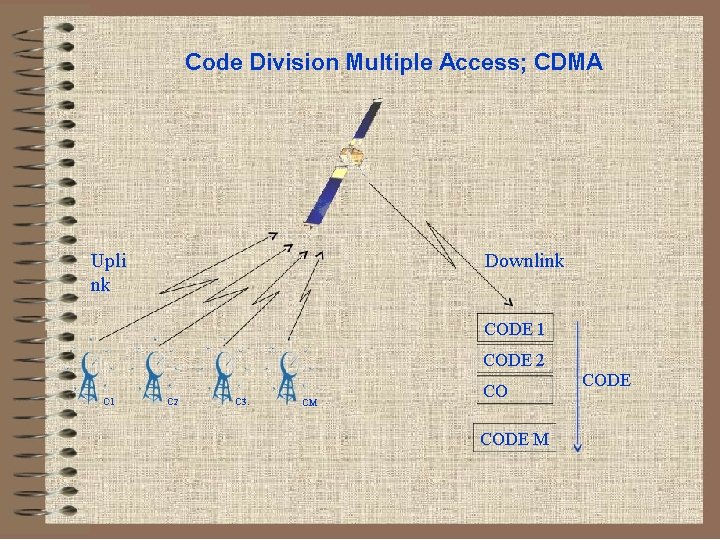
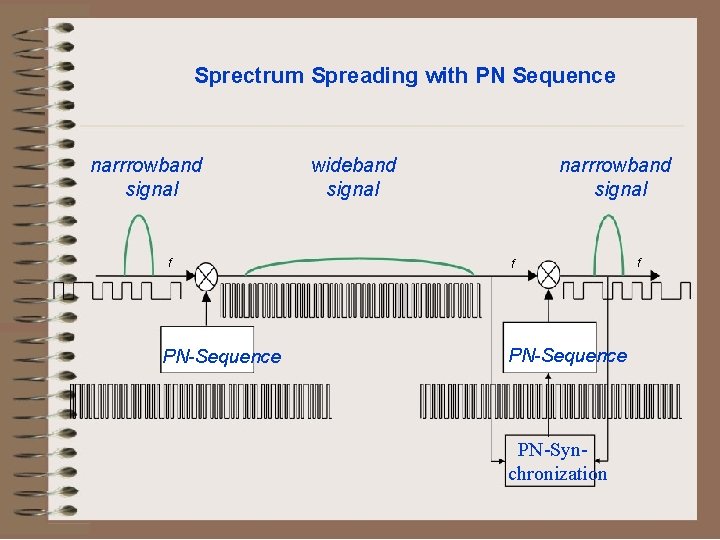
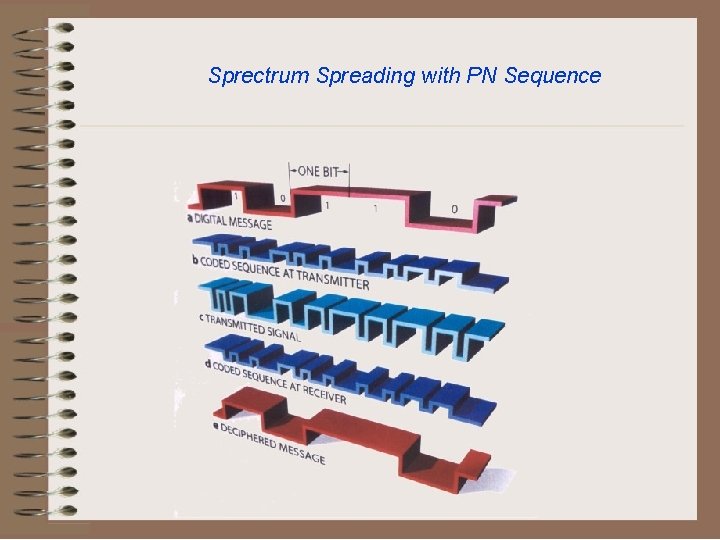
CDMA • In recent years, the interference immunity of CDMA for multi-user communications, together with its very good spectral efficiency characteristics, has been seen to offer distinct advantages for public cellular-type communications. • There are two very distinct types of CDMA system, classified as direct sequence CDMA and frequency hopping CDMA. Both of these systems involve transmission bandwidths that are many times that required by an individual user, with the energy of each user's signal spread with time throughout this wide channel. Consequently these techniques are often referred to as spread spectrum systems.
Code Division Multiple Access; CDMA Upli nk Downlink CODE 1 CODE 2 c 1 c 2 c 3. c. M CO CODE M CODE
Sprectrum Spreading with PN Sequence narrrowband signal f PN-Sequence wideband signal narrrowband signal f PN-Sequence PN-Synchronization f
Sprectrum Spreading with PN Sequence
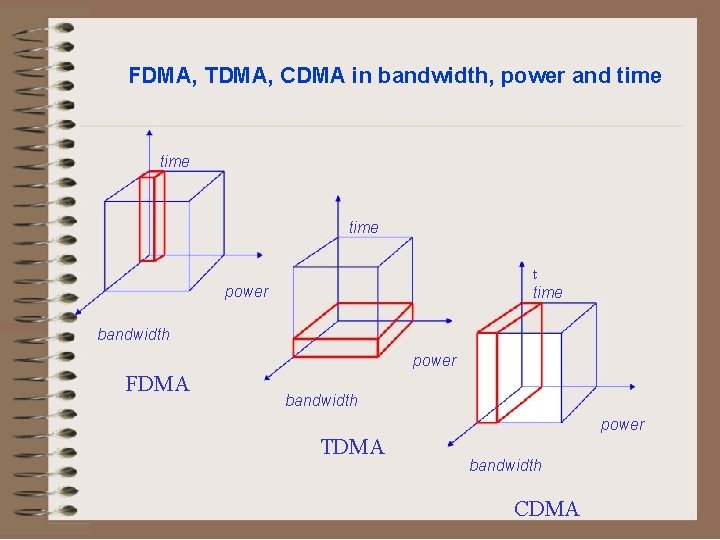
FDMA, TDMA, CDMA in bandwidth, power and time t time power bandwidth power FDMA bandwidth power TDMA bandwidth CDMA
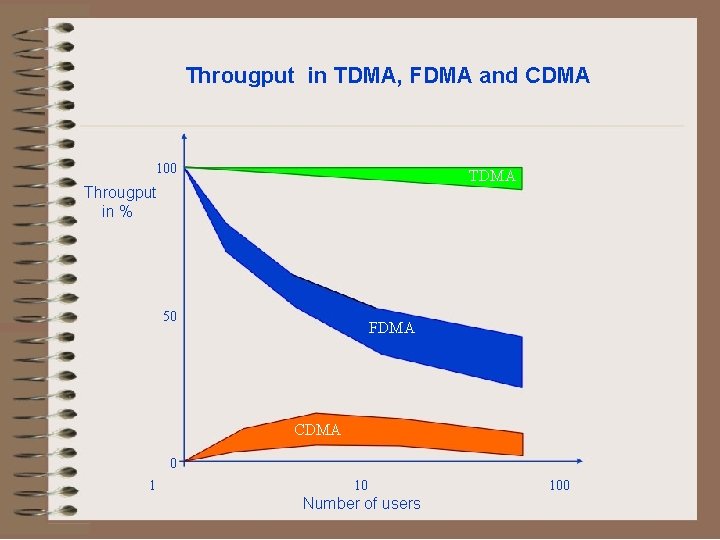
Througput in TDMA, FDMA and CDMA 100 TDMA Througput in % 50 FDMA CDMA 0 1 10 Number of users 100
Channel Coding & Modulation
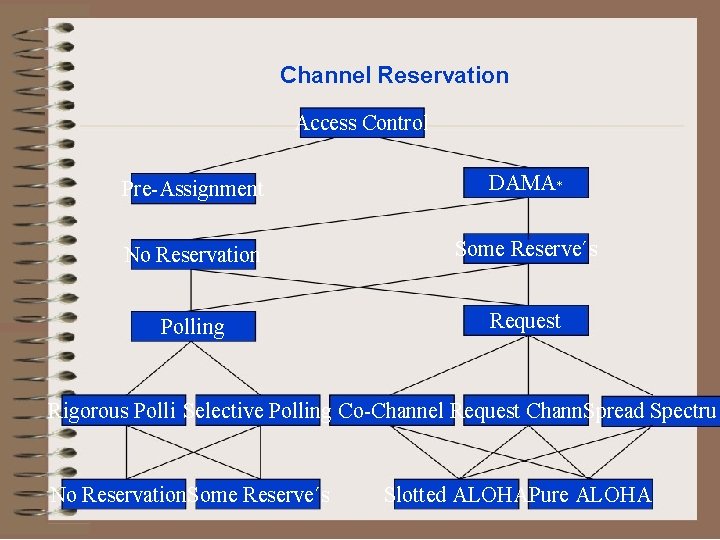
Channel Reservation Access Control Pre-Assignment DAMA* No Reservation Some Reserve´s Polling Request Rigorous Polli Selective Polling Co-Channel Request Chann. Spread Spectru No Reservation. Some Reserve´s Slotted ALOHAPure ALOHA
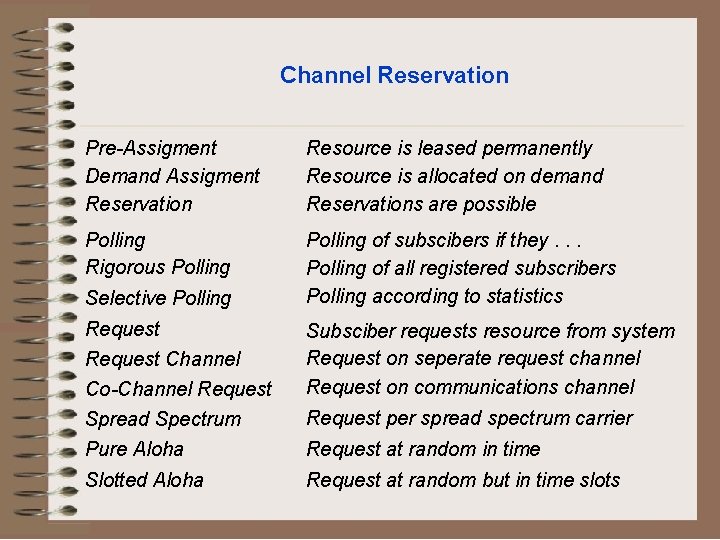
Channel Reservation Pre-Assigment Demand Assigment Reservation Resource is leased permanently Resource is allocated on demand Reservations are possible Polling Rigorous Polling of subscibers if they. . . Polling of all registered subscribers Polling according to statistics Selective Polling Request Channel Co-Channel Request Spread Spectrum Pure Aloha Slotted Aloha Subsciber requests resource from system Request on seperate request channel Request on communications channel Request per spread spectrum carrier Request at random in time Request at random but in time slots
Channel Coding • Every communication system operates in a noisy environment • To develop a robust system one may choose: - Transmit signals with higher power - Repeat every signal - Repeat only erroneous signals - Apply forward error correction
Modulation Techniques How can signals be employed to transmit information? Sine Waves: Information is in amplitude, phase, or frequency Pulses: Information is in amplitude, phase, position or pulse width
Analog signals modulation schemes • Amplitude Modulation (AM) • Phase Modulation (PM) • Frequency Modulation (FM)
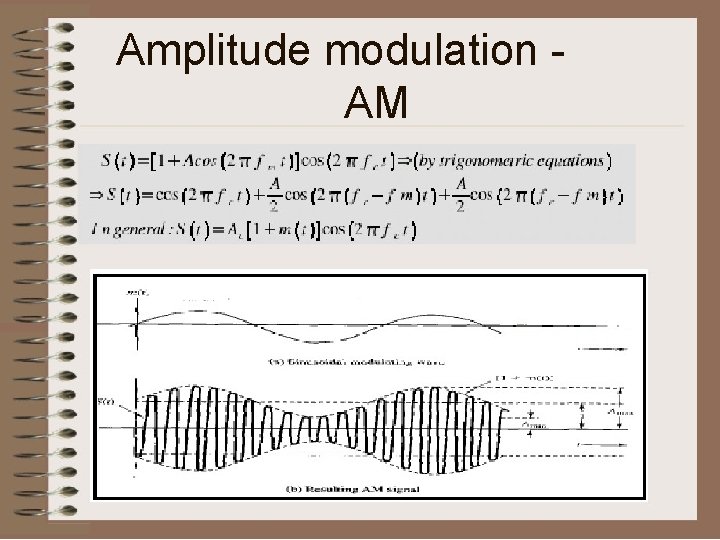
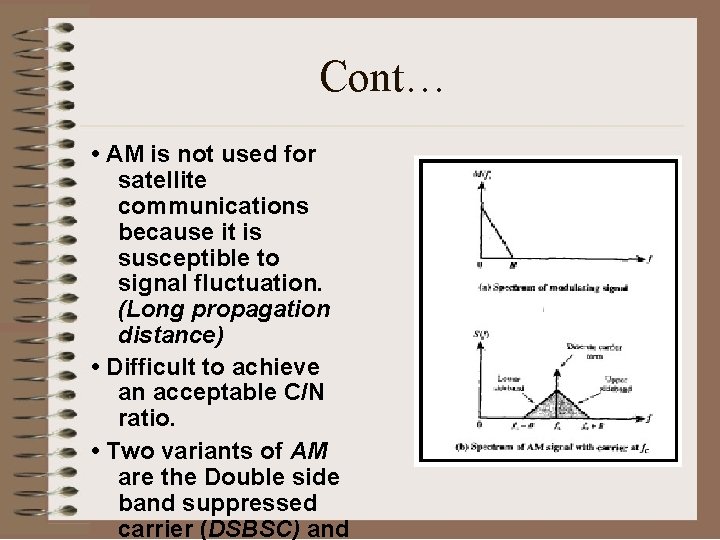
Amplitude modulation AM
Cont… • AM is not used for satellite communications because it is susceptible to signal fluctuation. (Long propagation distance) • Difficult to achieve an acceptable C/N ratio. • Two variants of AM are the Double side band suppressed carrier (DSBSC) and
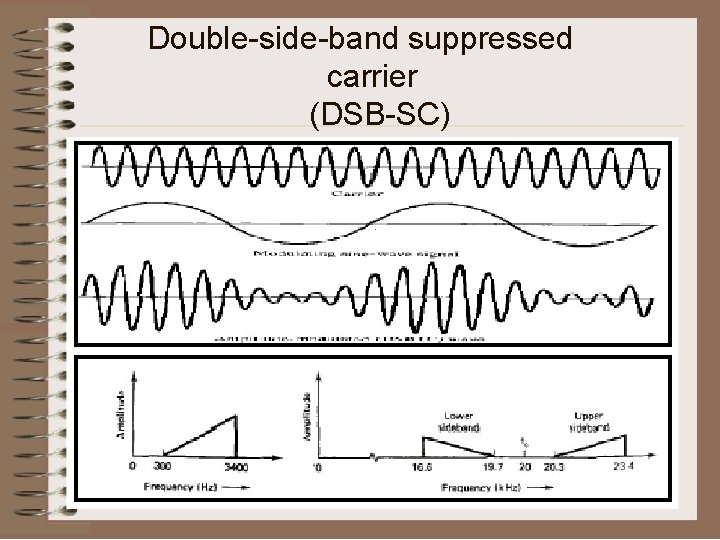
Double-side-band suppressed carrier (DSB-SC)
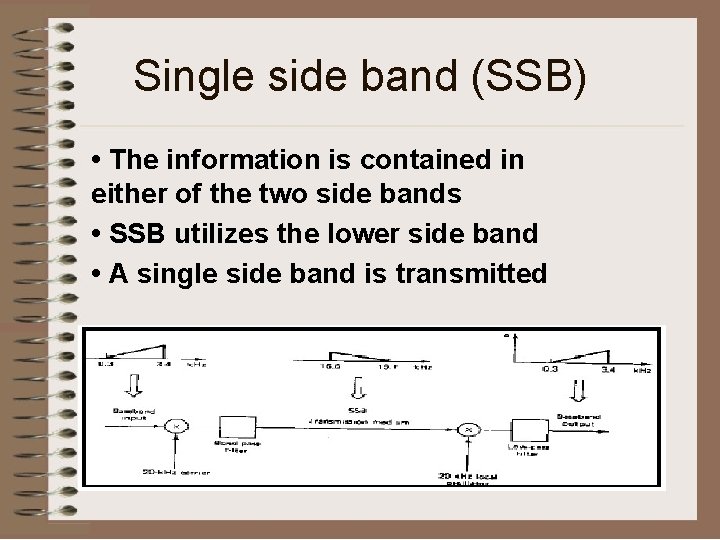
Single side band (SSB) • The information is contained in either of the two side bands • SSB utilizes the lower side band • A single side band is transmitted
DSB-SC, SSB and CSSB • DSB-SC and SSB are not used in satellite communications - The carrier frequency is very low compared to the frequencies used in satellites (More susceptible to noise) • CSSB (Companded single side band) - A Technique in which the speech signal levels are compressed before transmission, and, at the receiver are expanded again back to their original levels. - It reduces idle noise
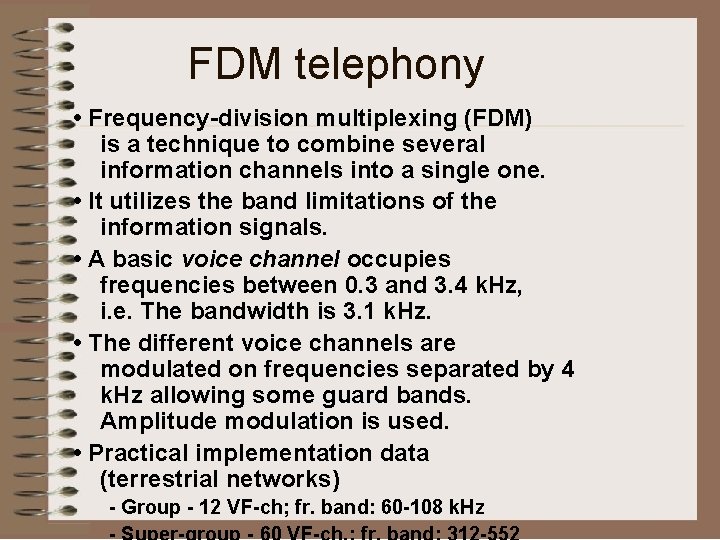
FDM telephony • Frequency-division multiplexing (FDM) is a technique to combine several information channels into a single one. • It utilizes the band limitations of the information signals. • A basic voice channel occupies frequencies between 0. 3 and 3. 4 k. Hz, i. e. The bandwidth is 3. 1 k. Hz. • The different voice channels are modulated on frequencies separated by 4 k. Hz allowing some guard bands. Amplitude modulation is used. • Practical implementation data (terrestrial networks) - Group - 12 VF-ch; fr. band: 60 -108 k. Hz
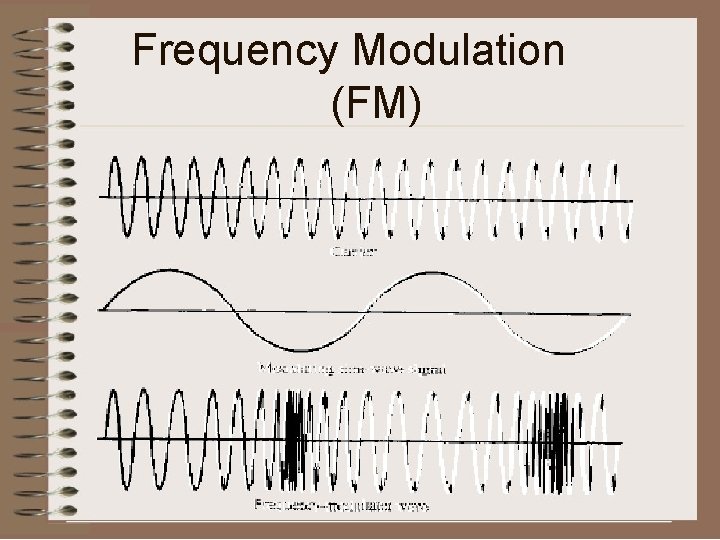
Frequency Modulation (FM)
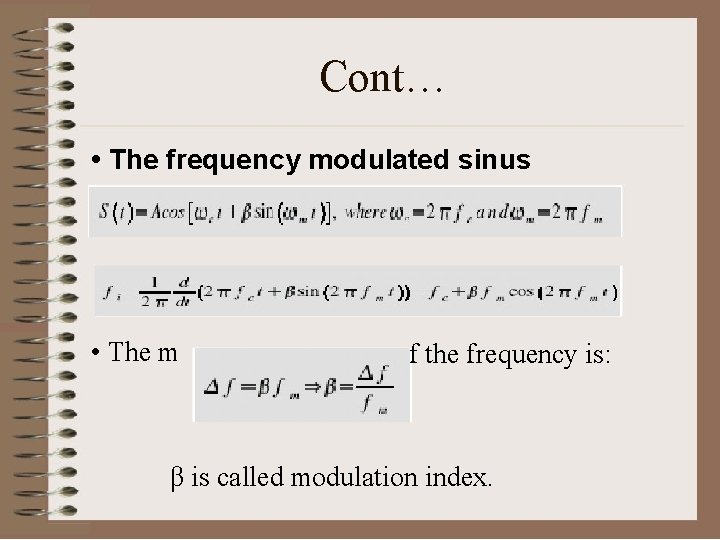
Cont… • The frequency modulated sinus • The m f the frequency is: β is called modulation index.
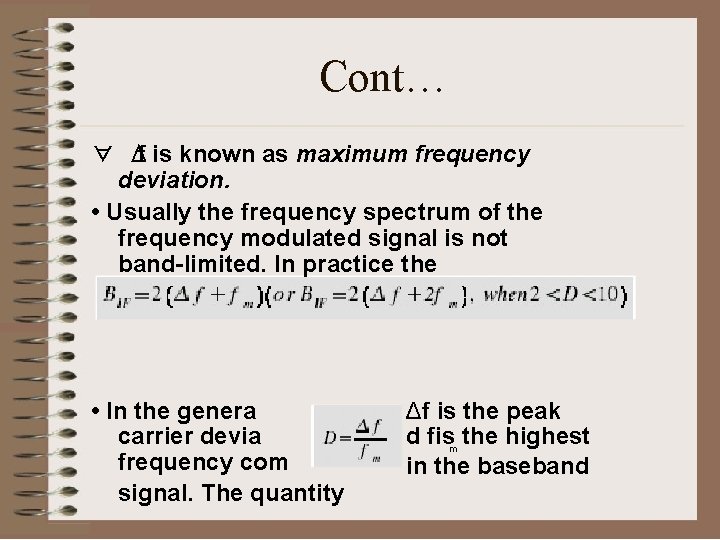
Cont… ∀ Δ f is known as maximum frequency deviation. • Usually the frequency spectrum of the frequency modulated signal is not band-limited. In practice the • In the genera carrier devia frequency com signal. The quantity Δf is the peak d fism the highest in the baseband
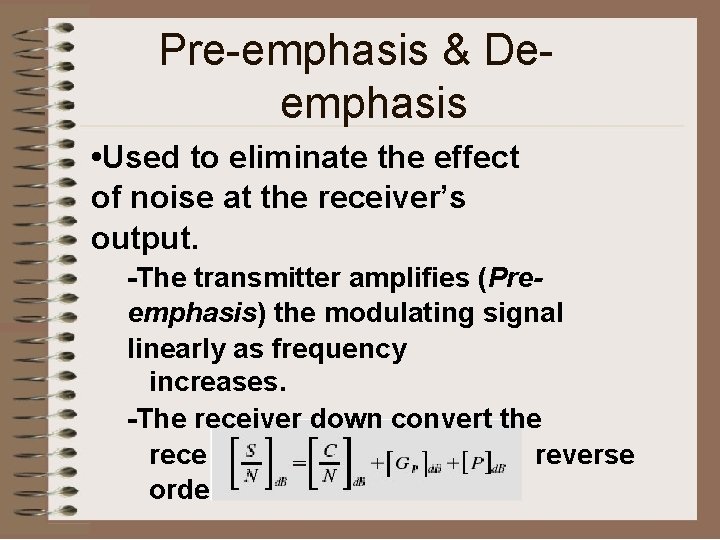
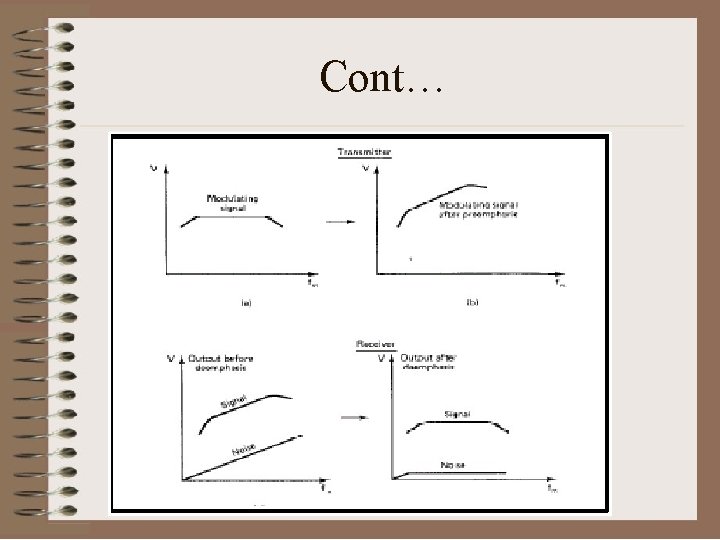
Pre-emphasis & Deemphasis • Used to eliminate the effect of noise at the receiver’s output. -The transmitter amplifies (Preemphasis) the modulating signal linearly as frequency increases. -The receiver down convert the rece reverse orde
Cont…
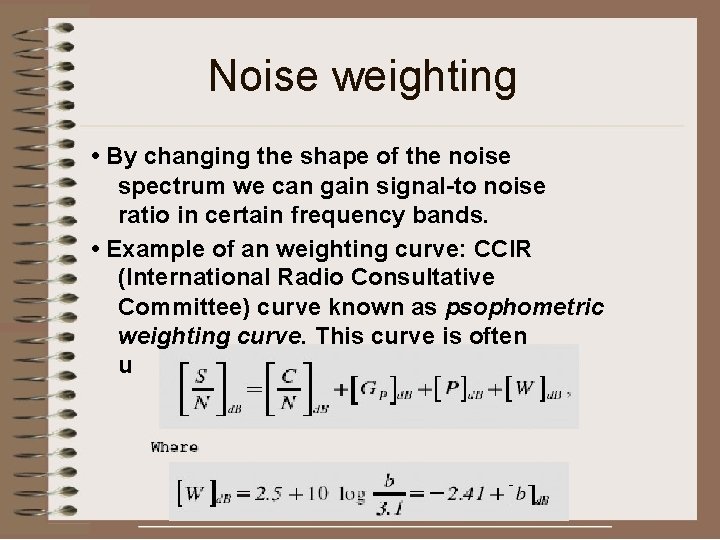
Noise weighting • By changing the shape of the noise spectrum we can gain signal-to noise ratio in certain frequency bands. • Example of an weighting curve: CCIR (International Radio Consultative Committee) curve known as psophometric weighting curve. This curve is often u
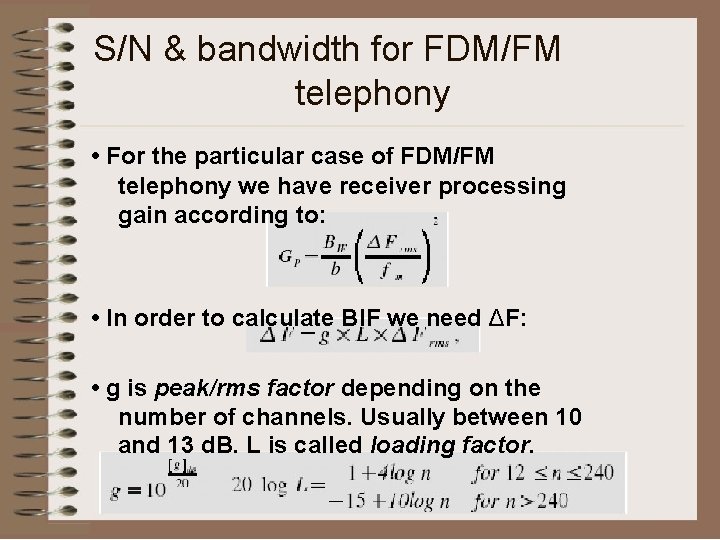
S/N & bandwidth for FDM/FM telephony • For the particular case of FDM/FM telephony we have receiver processing gain according to: • In order to calculate BIF we need ΔF: • g is peak/rms factor depending on the number of channels. Usually between 10 and 13 d. B. L is called loading factor.
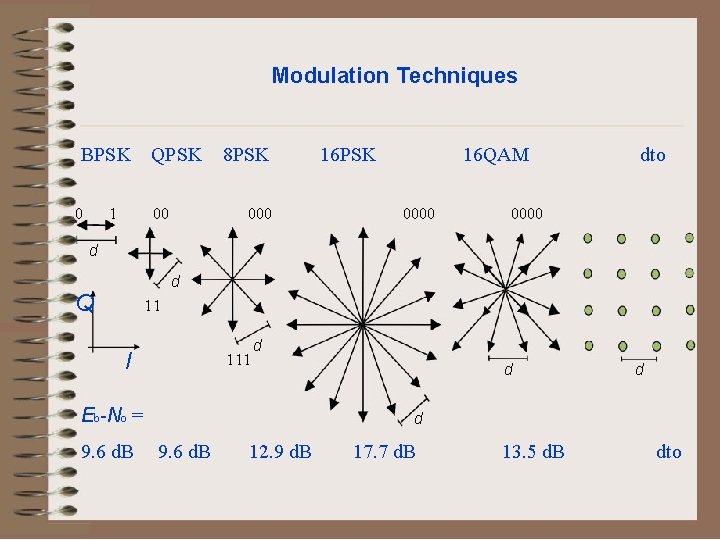
Modulation Techniques BPSK 0 1 QPSK 00 8 PSK 000 16 PSK 16 QAM 0000 dto 0000 d d Q 11 I 111 d Eb-No = 9. 6 d. B d d d 9. 6 d. B 12. 9 d. B 17. 7 d. B 13. 5 d. B dto
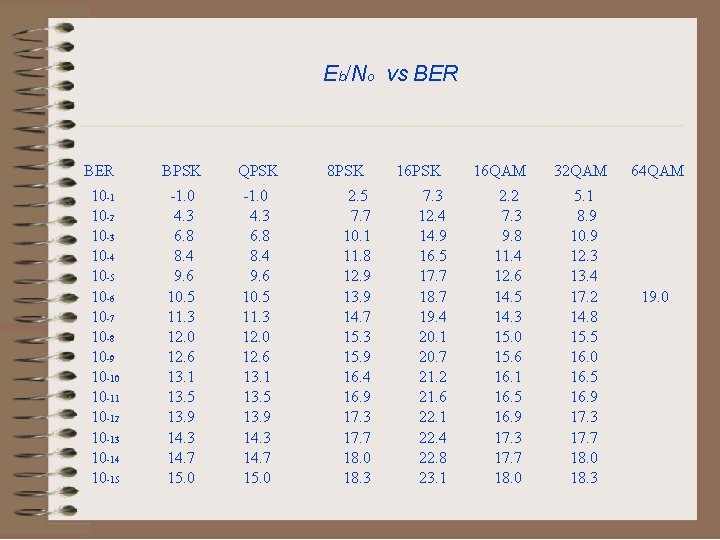
Eb/No vs BER 10 -1 10 -2 10 -3 10 -4 10 -5 10 -6 10 -7 10 -8 10 -9 10 -10 10 -11 10 -12 10 -13 10 -14 10 -15 BPSK QPSK -1. 0 4. 3 6. 8 8. 4 9. 6 10. 5 11. 3 12. 0 12. 6 13. 1 13. 5 13. 9 14. 3 14. 7 15. 0 8 PSK 2. 5 7. 7 10. 1 11. 8 12. 9 13. 9 14. 7 15. 3 15. 9 16. 4 16. 9 17. 3 17. 7 18. 0 18. 3 16 PSK 7. 3 12. 4 14. 9 16. 5 17. 7 18. 7 19. 4 20. 1 20. 7 21. 2 21. 6 22. 1 22. 4 22. 8 23. 1 16 QAM 2. 2 7. 3 9. 8 11. 4 12. 6 14. 5 14. 3 15. 0 15. 6 16. 1 16. 5 16. 9 17. 3 17. 7 18. 0 32 QAM 5. 1 8. 9 10. 9 12. 3 13. 4 17. 2 14. 8 15. 5 16. 0 16. 5 16. 9 17. 3 17. 7 18. 0 18. 3 64 QAM 19. 0
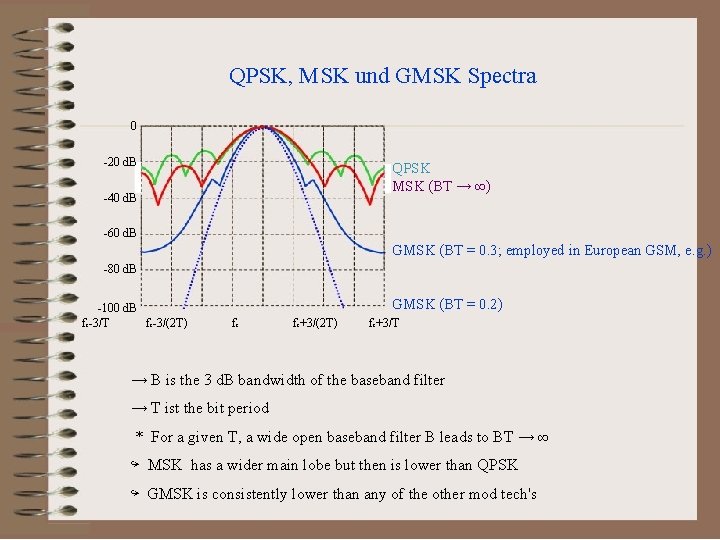
QPSK, MSK und GMSK Spectra 0 -20 d. B QPSK MSK (BT → ∞) -40 d. B -60 d. B GMSK (BT = 0. 3; employed in European GSM, e. g. ) -80 d. B -100 d. B fc-3/T fc-3/(2 T) GMSK (BT = 0. 2) fc fc+3/(2 T) fc+3/T → B is the 3 d. B bandwidth of the baseband filter → T ist the bit period * For a given T, a wide open baseband filter B leads to BT → ∞ ↪ MSK has a wider main lobe but then is lower than QPSK ↪ GMSK is consistently lower than any of the other mod tech's
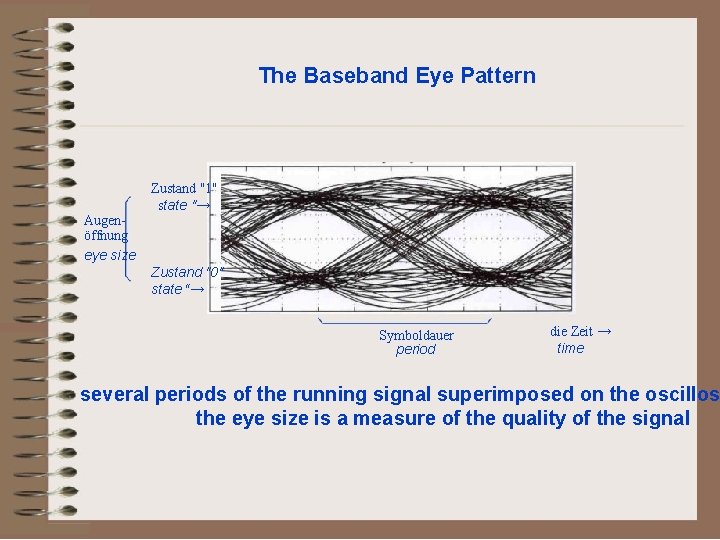
The Baseband Eye Pattern Augenöffnung eye size Zustand "1" state "→ Zustand "0" state “→ Symboldauer period die Zeit → time several periods of the running signal superimposed on the oscillos the eye size is a measure of the quality of the signal