
Week 10 Other Construction Drawings Objective This chapter
Week 10 Other Construction Drawings
Objective • This chapter gives an overview of building systems and the drawings that represent them, specifically demolition, plumbing, heating, ventilation and air conditioning, and site plans
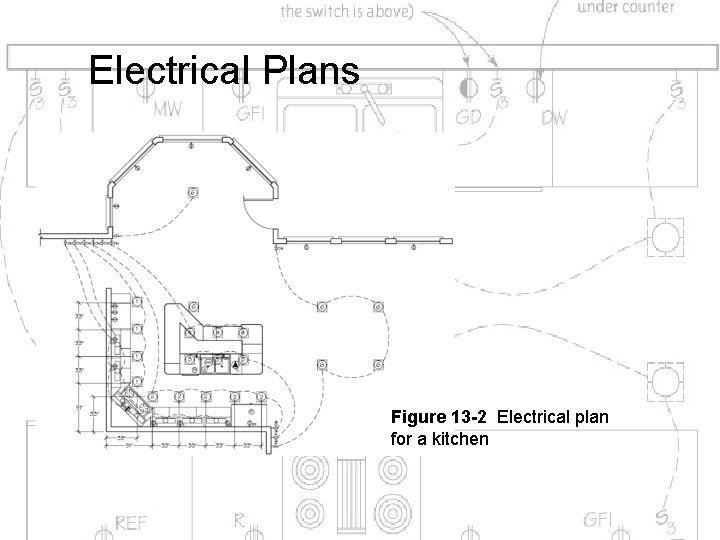
Electrical Plans Figure 13 -2 Electrical plan for a kitchen
Electricity and its Delivery • Electricity is the flow of electrical power – Generated at a power plant using fuel • Fuel sources include: – Coal, oil, and nuclear raw materials – Solar, wind, and combustible gas from landfills – Decomposing corn stalks

Electricity and its Delivery (cont’d. ) Figure 13 -6 How electricity is delivered within the house
Electrical Terms • Flow of electrons: current measured in amps • Household electrical consumption measured in kilowatt (1000 watts) abbreviated k. W • Total amount of electrical energy used is measured in kilowatt-hours (k. Wh) – k. Wh: work performed by one kilowatt in one hour
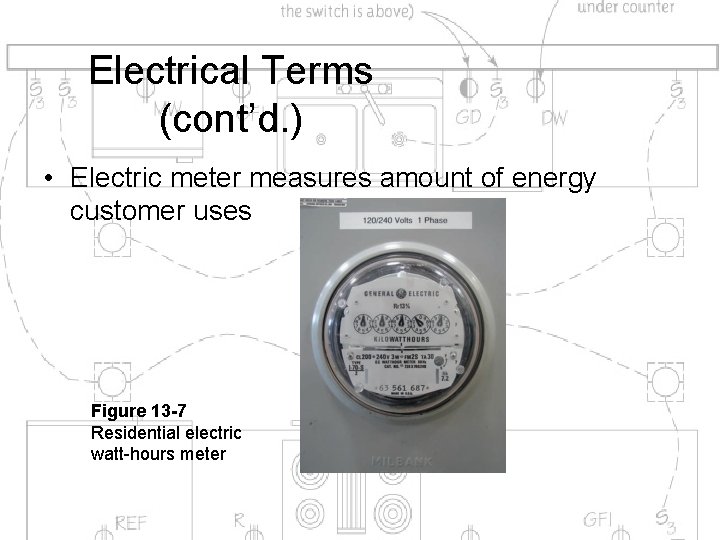
Electrical Terms (cont’d. ) • Electric meter measures amount of energy customer uses Figure 13 -7 Residential electric watt-hours meter
Electrical Terms (cont’d. ) • Service panel – Receives electricity into the house from the service entrance or meter box – Distributes it throughout via branch circuits – Large metal box • Contains circuit breakers or fuses • Circuit – Includes the conductor, switching device(s), and the outlet for a load
Electrical Terms (cont’d. ) • Voltage: pressure that forces electrons through a wire • Current: flow of electrons through a wire, measured in amperes • Appliance: general term for any item powered through a plug and a flexible cable • Watt: unit of power, calculated as energy per unit of time • Lamp: technical term for light bulb
Electrical Terms (cont’d. ) • Fixture: consists of map, reflector, opening, housing, and connection to power source – May contain ballast to regulate power • Conduit: hollow tube that holds conductors • Switch: electrical device that opens and closes circuit – Types: toggle, push-button, dimmer, timer, joystick, single-pole, three-way, four-way
Electrical Terms (cont’d. ) • Convenience outlet: receptacle; connection device • Ground fault circuit interrupter (GFCI): safety device installed on circuit • Ground: electrical connection to earth • Special outlets: phone jacks, TV antenna jacks, alarm systems, etc. • Automated systems: low-voltage, electronically controlled devices
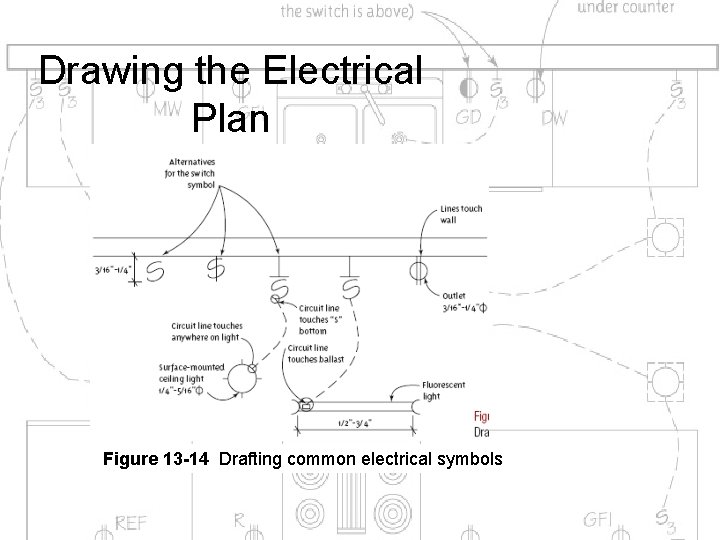
Drawing the Electrical Plan Figure 13 -14 Drafting common electrical symbols
Power/Telephone/Data /VOIP Plans • Shows where electrical outlets, phone jacks, data ports, computers, video equipment, and communications systems are located • Includes the following: – – Data ports Digital subscriber lines Telephony (includes Voice over IP) Communication systems
Reflected Ceiling Plan • View of the ceiling as if it were reflected onto a mirror that is flat on the floor • Shows ceiling materials, molding, ornamentation, exposed structural elements, HVAC, soffits, exposed beams, skylights, building grid lines, and anything else that is on or touches the ceiling
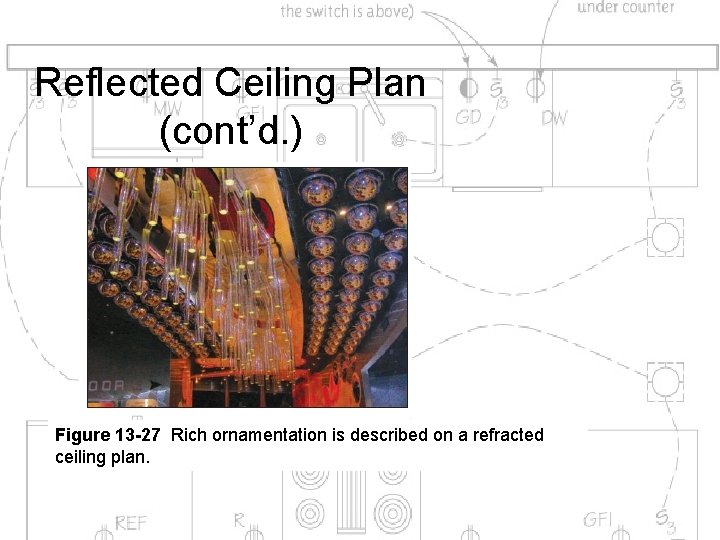
Reflected Ceiling Plan (cont’d. ) Figure 13 -27 Rich ornamentation is described on a refracted ceiling plan.
Climate Control Plans • Shows HVAC systems • Drawings: mechanical and equipment plans • Includes furnaces, air conditioners, water heaters, ducts, filters, humidifiers, pipes, control devices, outlets registers and vents
Climate Control Terms • Natural gas: energy source for gas-fueled furnaces • Furnace: appliance that produces heat • Air conditioner: appliance that cools, filters, and dehumidifies air • Heat pump: appliance that heats and cools a building • Thermostat: regulates temperature in a furnace or air conditioner via sensors and activating switches
Climate Control Terms (cont’d. ) • Zone: specific area heated or cooled by one unit • Hydronic: heating or cooling system that transfers heat via a circulating fluid • Pipes: copper tubes round in cross-section, that serve as the distribution method in hydronic systems • Humidifier: appliance that adds moisture to the house
Climate Control Terms (cont’d. ) • Ducts: distribution and return-air path in a forced-air system • Register: outlet in a forced-air system through which air is returned to a room • Forced-air heat systems: furnace draws room air through ductwork and returns the warmed air to the rooms • Flexible tubes and panels heat system: radiant system
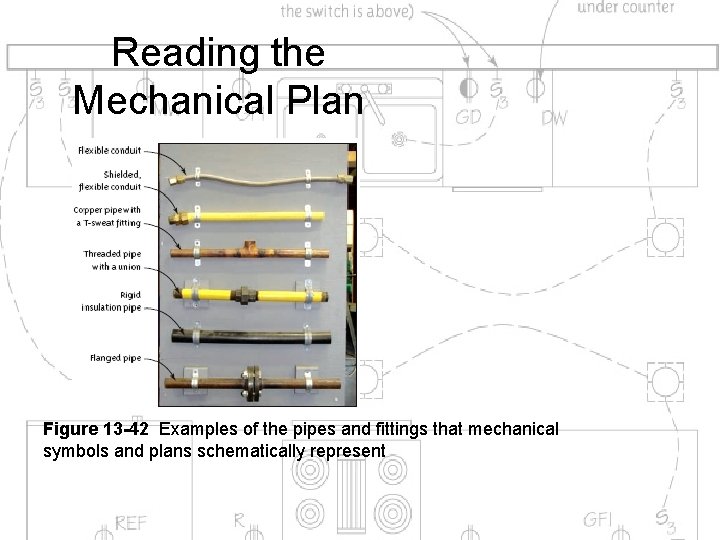
Reading the Mechanical Plan Figure 13 -42 Examples of the pipes and fittings that mechanical symbols and plans schematically represent
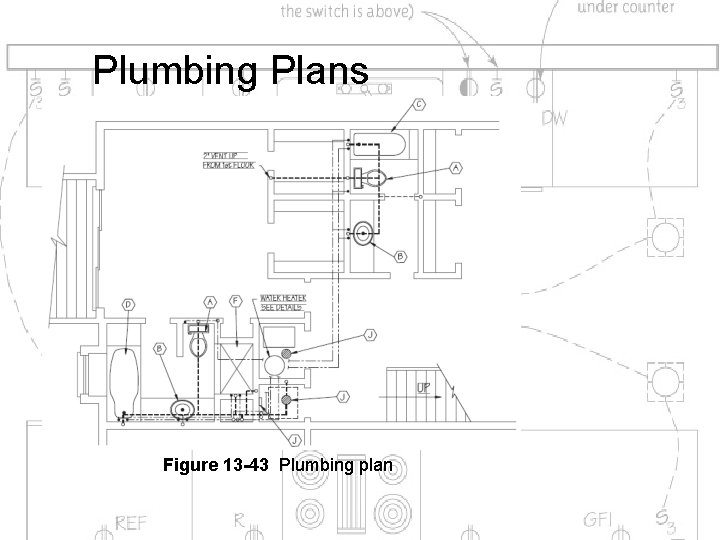
Plumbing Plans Figure 13 -43 Plumbing plan
Plumbing Terms • • • Water heater PEX: cross-linked polyethylene Water pipes Fixture Trap: S-shaped section of pipe Valve: controls flow Stack: vertical pipe Stack wall Clean-out
Plumbing Terms (cont’d. ) • • Well Main Hose bib Septic tank Sump pump Freshwater delivery Waste water discharge
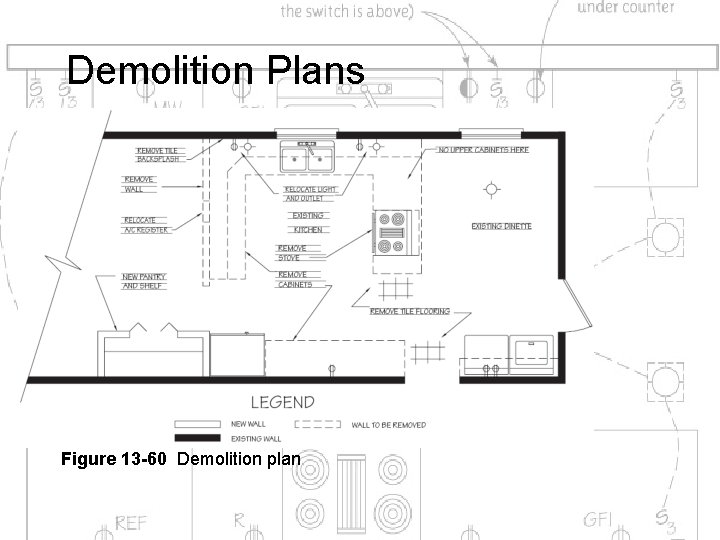
Demolition Plans Figure 13 -60 Demolition plan
Site Plans • North arrow: shows the solar orientation of the house • Engineer scale: used to dimension the property • Footprint: building’s shape, size and orientation • Property lines: physical boundaries • Hard surfaces: include walks, entries, driveways, access roads, and patios • Waterways: include rivers and lakes
Site Plans (cont’d. ) • Utility lines: include gas, electricity, water, and sewer lines • Vegetation: comprises trees and shrubs • Contour lines: show ground elevations • Legal description: includes location of the property lines • Details: construction drawings • Related drawings: survey, plots, landscape plans
Summary • Many different types of drawings are included in a set of instructions for constructing or renovating a building • Floor plans, elevations, sections, details, electrical, water, and building systems drawings are all necessary to describe the design • While the interior designer may not draw all of them, it is useful to be able to read them and recognize key features
- Slides: 27