
Week 10 Monday April 3 Strategic Outsourcing R
- Slides: 23
Week 10 Monday, April 3 • Strategic Outsourcing R. Ching, Ph. D. • MIS Area • California State University, Sacramento 1
Drivers of Outsourcing • General management’s concern about costs and quality – Tighter overhead cost control of fringe benefits (leaner overhead structures of outsourcer) – More aggressive use of low-cost labor pools by using geography creatively – Tough world-class standards applied to the company’s staff (appointed at time of contract) – More effective bulk purchasing and leasing arrangement for all aspect of the hardware/software configuration through discounts and better use of capacity R. Ching, Ph. D. • MIS Area • California State University, Sacramento 2
Drivers of Outsourcing • General management’s concern about costs and quality (cont. ) – Better management of excess hardware capacity – Better control over software licenses through both negotiated and realistic examination – More aggressive management of service and response time to meet corporate standards – Hustle – Ability to run with a leaner management structure – Ability to access higher levels of IT staff skills – Creative and more realistic structuring of leases R. Ching, Ph. D. • MIS Area • California State University, Sacramento 3
Drivers of Outsourcing • Breakdown in IT performance – Need to retool lacking technology • Intense supplier pressures – Sales of surplus supplier capacity • Simplified general management agenda – Outsource non-core competence operations • Financial factors – Reduce sporadic capital investments in IT – Downsizing IT operating costs – Greater organizational awareness of IT’s costs – More appealing for takeovers R. Ching, Ph. D. • MIS Area • California State University, Sacramento 4
Drivers of Outsourcing • Corporate culture – Resistance to change within the organization – Labor unions • Eliminating an internal irritant – Conflicts between users and IT staff • Other factors – Quick access to current technology and skills – Need to quickly response to changes in the market R. Ching, Ph. D. • MIS Area • California State University, Sacramento 5
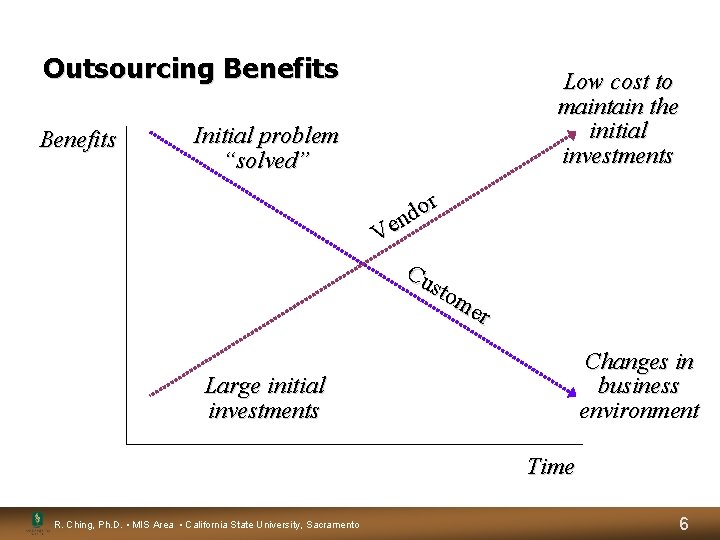
Outsourcing Benefits Low cost to maintain the initial investments Initial problem “solved” or d n e V Cu sto me r Changes in business environment Large initial investments Time R. Ching, Ph. D. • MIS Area • California State University, Sacramento 6
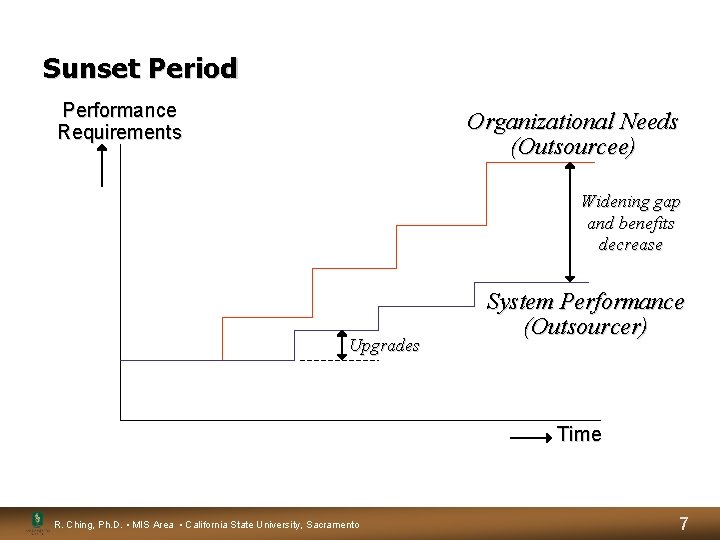
Sunset Period Performance Requirements Organizational Needs (Outsourcee) Widening gap and benefits decrease Upgrades System Performance (Outsourcer) Time R. Ching, Ph. D. • MIS Area • California State University, Sacramento 7
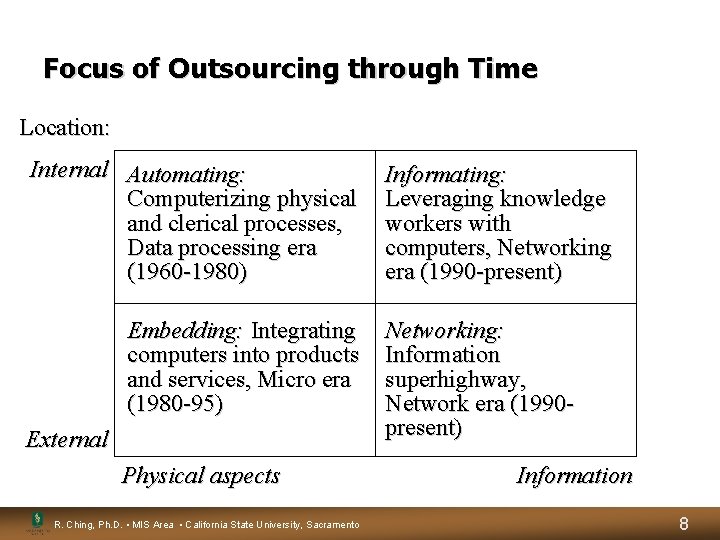
Focus of Outsourcing through Time Location: Internal Automating: Computerizing physical and clerical processes, Data processing era (1960 -1980) Embedding: Integrating computers into products and services, Micro era (1980 -95) External Physical aspects R. Ching, Ph. D. • MIS Area • California State University, Sacramento Informating: Leveraging knowledge workers with computers, Networking era (1990 -present) Networking: Information superhighway, Network era (1990 present) Information 8
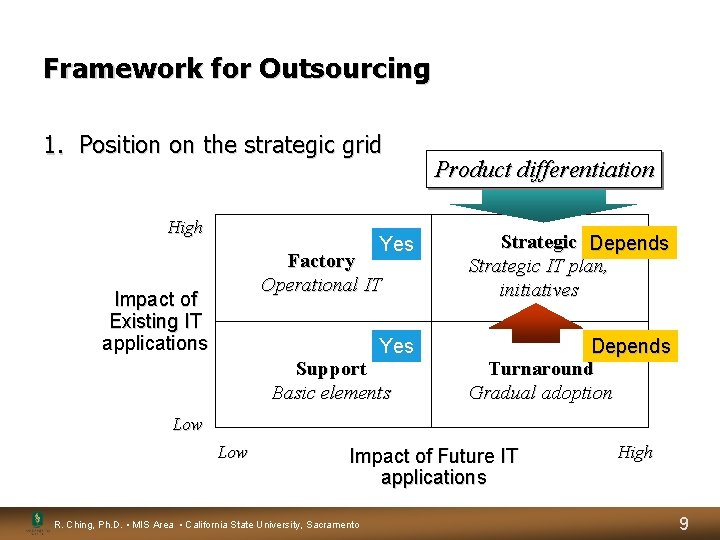
Framework for Outsourcing 1. Position on the strategic grid High Yes Strategic Depends Strategic IT plan, initiatives Yes Depends Turnaround Gradual adoption Factory Operational IT Impact of Existing IT applications Product differentiation Support Basic elements Low Impact of Future IT applications R. Ching, Ph. D. • MIS Area • California State University, Sacramento High 9
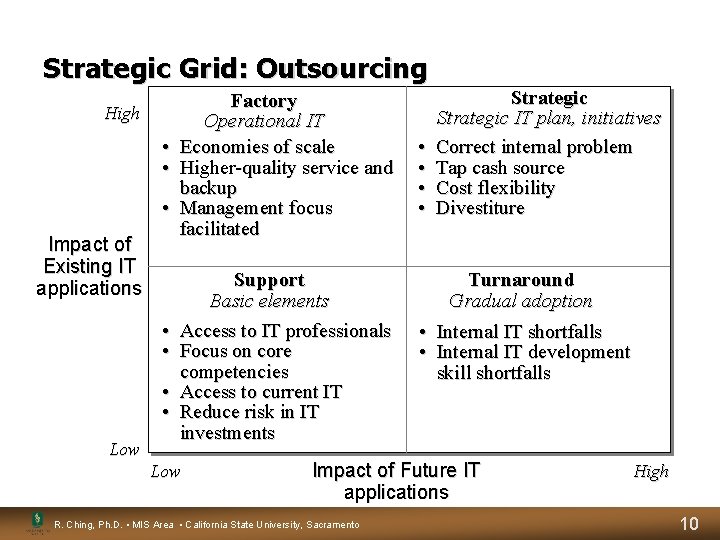
Strategic Grid: Outsourcing High Impact of Existing IT applications Factory Operational IT • Economies of scale • Higher-quality service and backup • Management focus facilitated • • Low Support Basic elements Access to IT professionals Focus on core competencies Access to current IT Reduce risk in IT investments Low • • Strategic IT plan, initiatives Correct internal problem Tap cash source Cost flexibility Divestiture Turnaround Gradual adoption • Internal IT shortfalls • Internal IT development skill shortfalls Impact of Future IT applications R. Ching, Ph. D. • MIS Area • California State University, Sacramento High 10
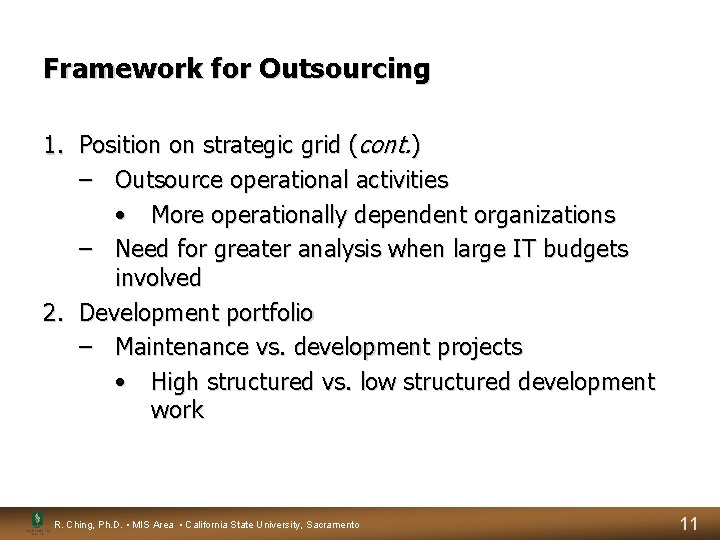
Framework for Outsourcing 1. Position on strategic grid (cont. ) – Outsource operational activities • More operationally dependent organizations – Need for greater analysis when large IT budgets involved 2. Development portfolio – Maintenance vs. development projects • High structured vs. low structured development work R. Ching, Ph. D. • MIS Area • California State University, Sacramento 11
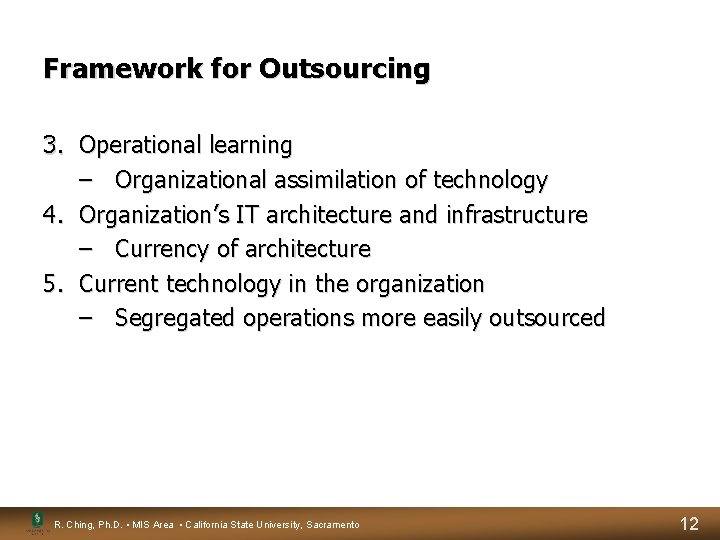
Framework for Outsourcing 3. Operational learning – Organizational assimilation of technology 4. Organization’s IT architecture and infrastructure – Currency of architecture 5. Current technology in the organization – Segregated operations more easily outsourced R. Ching, Ph. D. • MIS Area • California State University, Sacramento 12
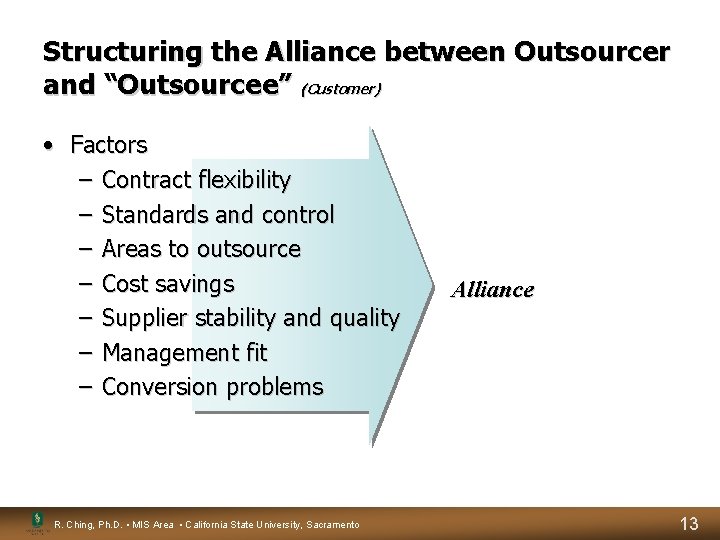
Structuring the Alliance between Outsourcer and “Outsourcee” (Customer) • Factors – Contract flexibility – Standards and control – Areas to outsource – Cost savings – Supplier stability and quality – Management fit – Conversion problems R. Ching, Ph. D. • MIS Area • California State University, Sacramento Alliance 13
Structuring the Alliance between Outsourcer and “Outsourcee” (Customer) • Contract flexibility – Accommodating changes in the environment • Information needs • Competitive needs • Advances in IT • Standards and control – Risk (i. e. , lost of control, disruptions) in operations – Risk in introducing innovations to the organization – Risk in revealing internal secrets R. Ching, Ph. D. • MIS Area • California State University, Sacramento 14
Structuring the Alliance between Outsourcer and “Outsourcee” (Customer) • Areas to outsource – Determine • Are operations segregated or tightly embedded? • Can specialized competencies be acquired in the long run? • Are operations core to the organization? • Cost savings – Objective evaluation of costs and savings R. Ching, Ph. D. • MIS Area • California State University, Sacramento 15
Structuring the Alliance between Outsourcer and “Outsourcee” (Customer) • Supplier Stability and Quality – Financial stability • Difficult to insource • Difficult to change outsourcers – Incompatibility between the organization and outsourcer • Technology • Organization culture • Between technology and organization’s strategy R. Ching, Ph. D. • MIS Area • California State University, Sacramento 16
Structuring the Alliance between Outsourcer and “Outsourcee” (Customer) • Management fit – Compatibility between management styles and cultures • Conversion problems – Mergers and acquisitions • Incompatibilities R. Ching, Ph. D. • MIS Area • California State University, Sacramento 17
Managing the Alliance • Critical areas: – CIO Function • Management (balance between organization and outsourcer) • Planning (vision) • Awareness of emerging technologies • Continuous adaptation (evolution) – Performance measurements • Essential standards, measurements and interpretations R. Ching, Ph. D. • MIS Area • California State University, Sacramento 18
Managing the Alliance – Mix and coordination of Tasks • Development versus maintenance (portfolios) – Associated risks inherent to each – Customer-outsourcer interface • Delegation of authority, not responsibility R. Ching, Ph. D. • MIS Area • California State University, Sacramento 19
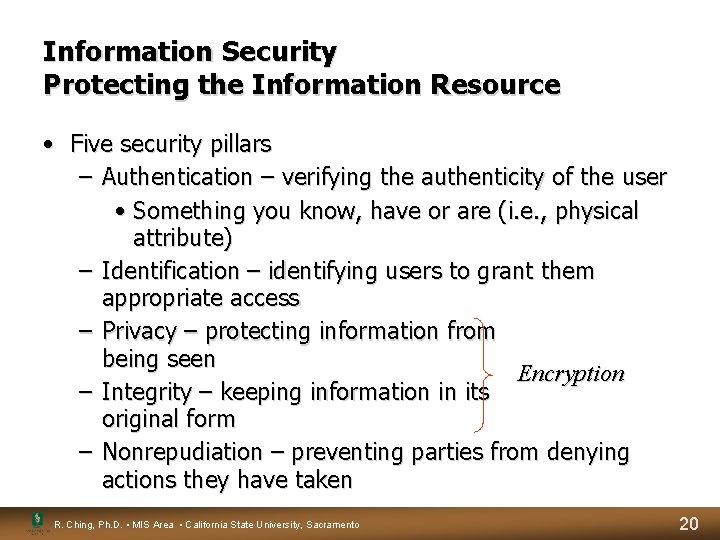
Information Security Protecting the Information Resource • Five security pillars – Authentication – verifying the authenticity of the user • Something you know, have or are (i. e. , physical attribute) – Identification – identifying users to grant them appropriate access – Privacy – protecting information from being seen Encryption – Integrity – keeping information in its original form – Nonrepudiation – preventing parties from denying actions they have taken R. Ching, Ph. D. • MIS Area • California State University, Sacramento 20
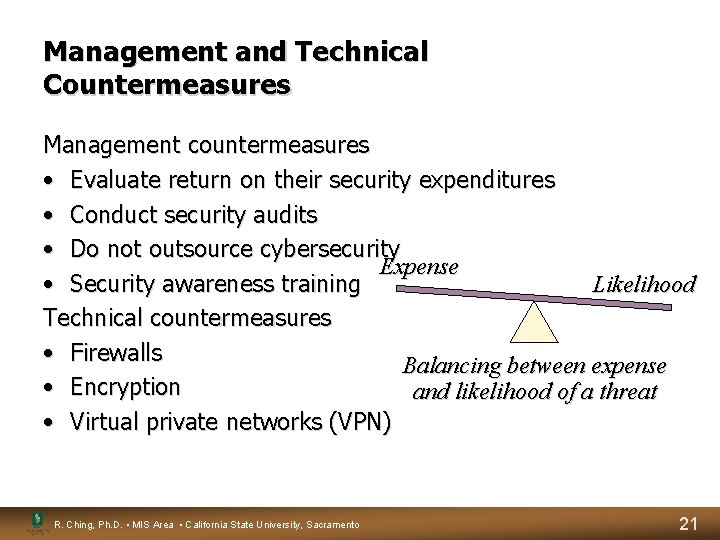
Management and Technical Countermeasures Management countermeasures • Evaluate return on their security expenditures • Conduct security audits • Do not outsource cybersecurity Expense • Security awareness training Likelihood Technical countermeasures • Firewalls Balancing between expense • Encryption and likelihood of a threat • Virtual private networks (VPN) R. Ching, Ph. D. • MIS Area • California State University, Sacramento 21
Planning for Business Continuity • Recognize threats • Contingency plans if a threat is realized – Alternate workspaces for people to resume work – Backup IT sites – Up-to-date evacuation plans – Backed up computers and servers – Helping people cope with disaster R. Ching, Ph. D. • MIS Area • California State University, Sacramento 22
Internal and External Resources Internal • Multiple data centers • Distributed processing • Backup communications facilities • LANs External • Integrated disaster recovery services • Specialized disaster recovery services • Online and off-line data storage R. Ching, Ph. D. • MIS Area • California State University, Sacramento 23