
WEEK 10 CHAPTER 10 Group and Personal Influence
- Slides: 30
WEEK 10 CHAPTER 10 Group and Personal Influence COPYRIGHT © 2012 Cengage Learning Asia
A) Group and Personal Influences on Individuals Reference group: any person or group of people who significantly influences an individual’s behavior May be individuals (celebrities, athletes, or political leaders) or groups of individuals with similarities (musical groups or sports teams) COPYRIGHT © 2012 Cengage Learning Asia
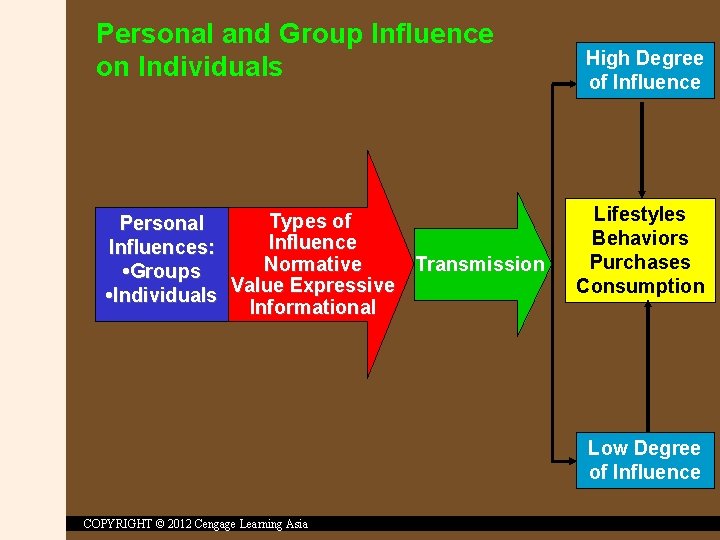
Personal and Group Influence on Individuals Types of Personal Influences: Normative Transmission • Groups • Individuals Value Expressive Informational High Degree of Influence Lifestyles Behaviors Purchases Consumption Low Degree of Influence COPYRIGHT © 2012 Cengage Learning Asia
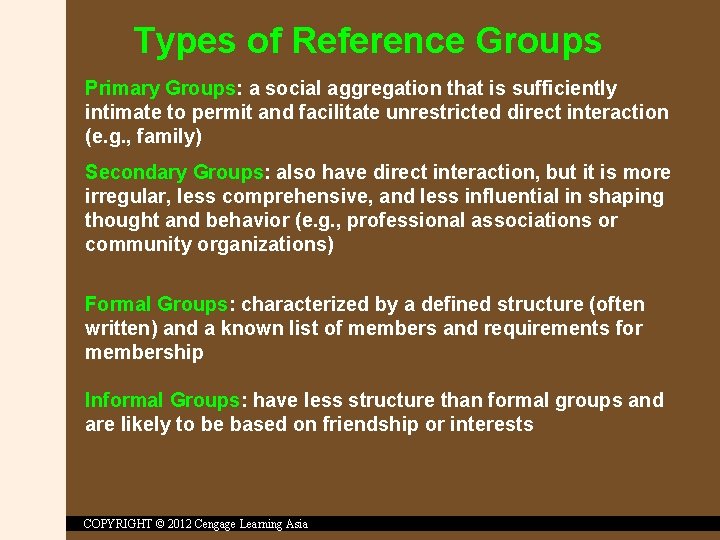
Types of Reference Groups Primary Groups: a social aggregation that is sufficiently intimate to permit and facilitate unrestricted direct interaction (e. g. , family) Secondary Groups: also have direct interaction, but it is more irregular, less comprehensive, and less influential in shaping thought and behavior (e. g. , professional associations or community organizations) Formal Groups: characterized by a defined structure (often written) and a known list of members and requirements for membership Informal Groups: have less structure than formal groups and are likely to be based on friendship or interests COPYRIGHT © 2012 Cengage Learning Asia
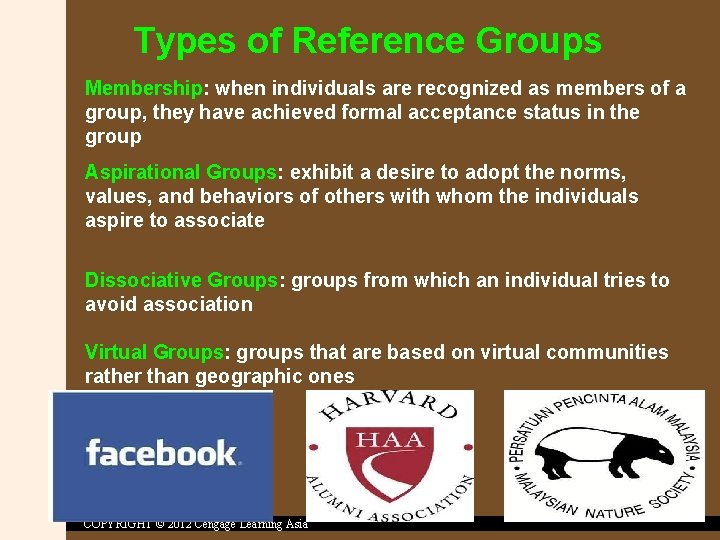
Types of Reference Groups Membership: when individuals are recognized as members of a group, they have achieved formal acceptance status in the group Aspirational Groups: exhibit a desire to adopt the norms, values, and behaviors of others with whom the individuals aspire to associate Dissociative Groups: groups from which an individual tries to avoid association Virtual Groups: groups that are based on virtual communities rather than geographic ones COPYRIGHT © 2012 Cengage Learning Asia
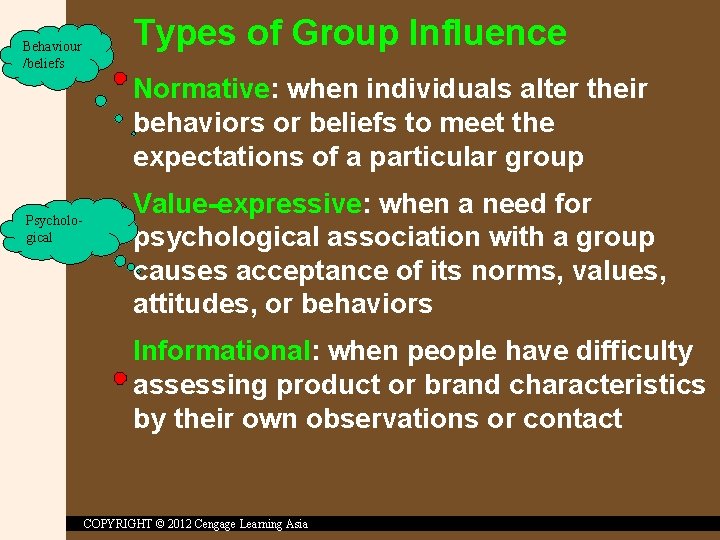
Behaviour /beliefs Types of Group Influence Normative: when individuals alter their behaviors or beliefs to meet the expectations of a particular group Psychological Value-expressive: when a need for psychological association with a group causes acceptance of its norms, values, attitudes, or behaviors Informational: when people have difficulty assessing product or brand characteristics by their own observations or contact COPYRIGHT © 2012 Cengage Learning Asia
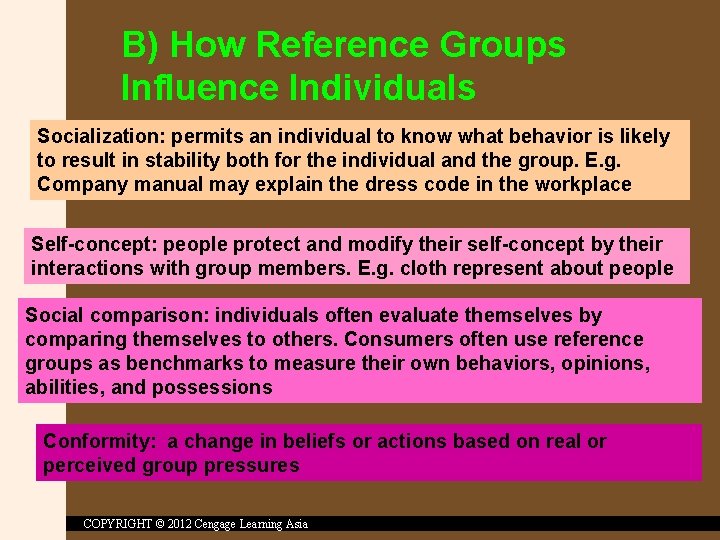
B) How Reference Groups Influence Individuals Socialization: permits an individual to know what behavior is likely to result in stability both for the individual and the group. E. g. Company manual may explain the dress code in the workplace Self-concept: people protect and modify their self-concept by their interactions with group members. E. g. cloth represent about people Social comparison: individuals often evaluate themselves by comparing themselves to others. Consumers often use reference groups as benchmarks to measure their own behaviors, opinions, abilities, and possessions Conformity: a change in beliefs or actions based on real or perceived group pressures COPYRIGHT © 2012 Cengage Learning Asia
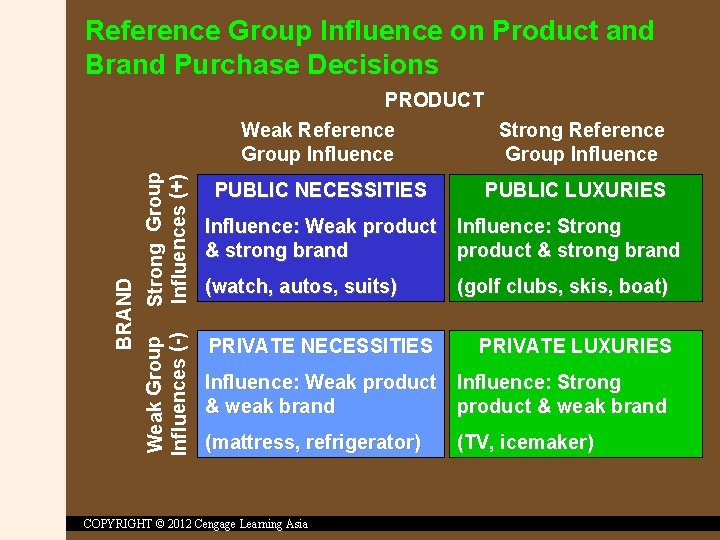
Reference Group Influence on Product and Brand Purchase Decisions BRAND Weak Group Strong Group Influences (-) Influences (+) PRODUCT Weak Reference Strong Reference Group Influence PUBLIC NECESSITIES PUBLIC LUXURIES Influence: Weak product Influence: Strong & strong brand product & strong brand (watch, autos, suits) PRIVATE NECESSITIES (golf clubs, skis, boat) PRIVATE LUXURIES Influence: Weak product Influence: Strong & weak brand product & weak brand (mattress, refrigerator) COPYRIGHT © 2012 Cengage Learning Asia (TV, icemaker)
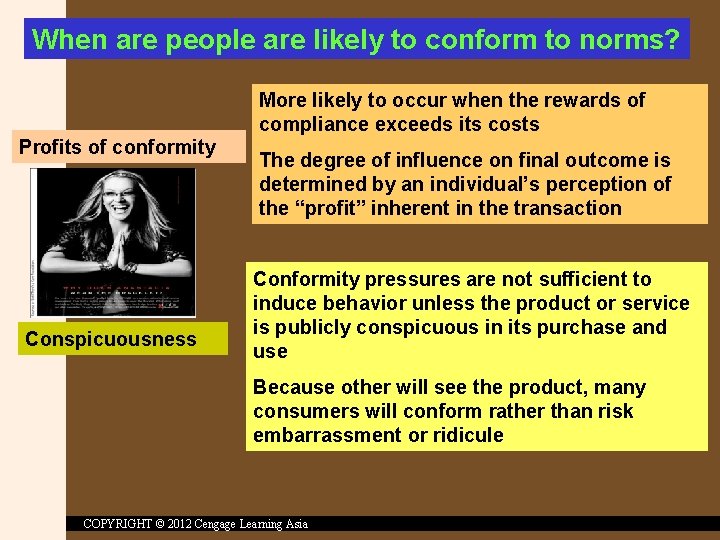
When are people are likely to conform to norms? More likely to occur when the rewards of compliance exceeds its costs Profits of conformity Conspicuousness The degree of influence on final outcome is determined by an individual’s perception of the “profit” inherent in the transaction Conformity pressures are not sufficient to induce behavior unless the product or service is publicly conspicuous in its purchase and use Because other will see the product, many consumers will conform rather than risk embarrassment or ridicule COPYRIGHT © 2012 Cengage Learning Asia
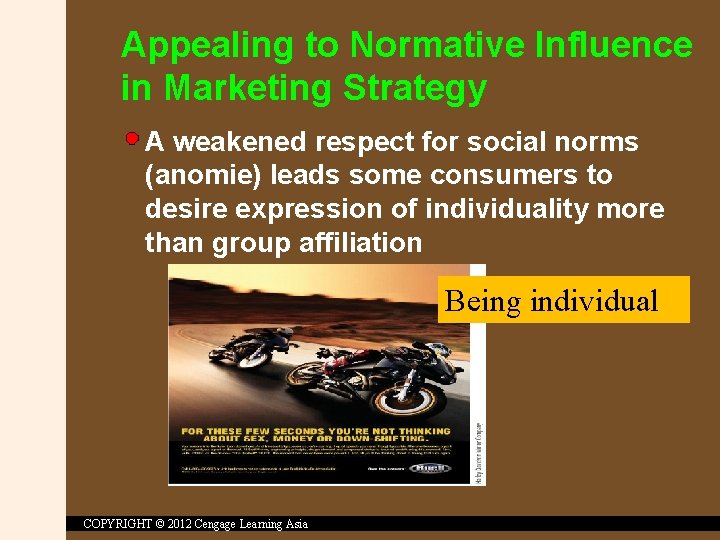
Appealing to Normative Influence in Marketing Strategy A weakened respect for social norms (anomie) leads some consumers to desire expression of individuality more than group affiliation Being individual COPYRIGHT © 2012 Cengage Learning Asia
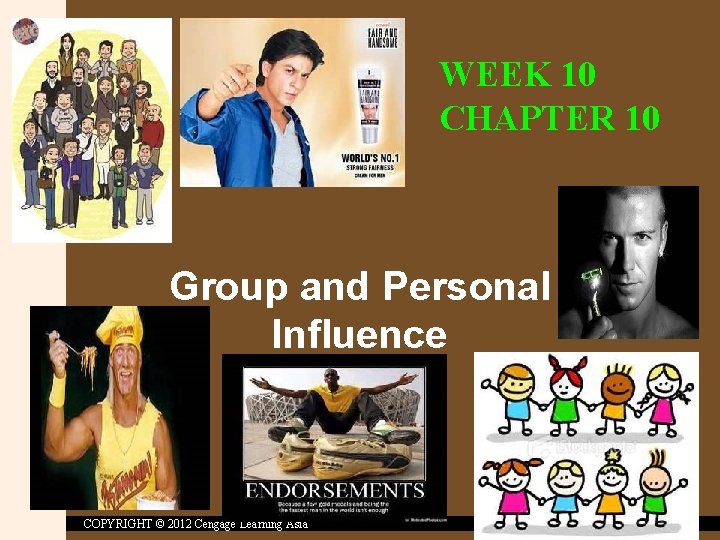
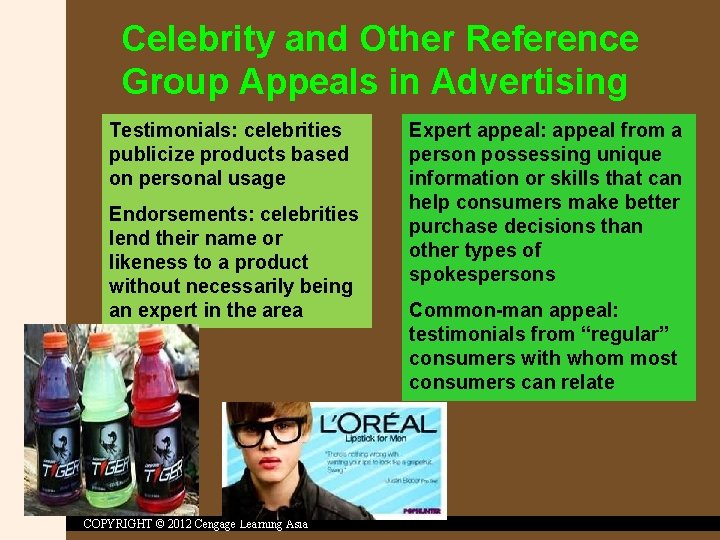
Celebrity and Other Reference Group Appeals in Advertising Testimonials: celebrities publicize products based on personal usage Endorsements: celebrities lend their name or likeness to a product without necessarily being an expert in the area COPYRIGHT © 2012 Cengage Learning Asia Expert appeal: appeal from a person possessing unique information or skills that can help consumers make better purchase decisions than other types of spokespersons Common-man appeal: testimonials from “regular” consumers with whom most consumers can relate
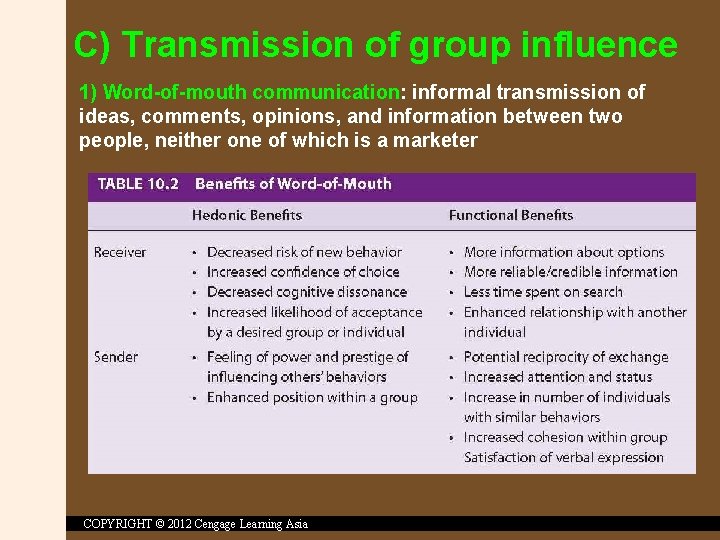
C) Transmission of group influence 1) Word-of-mouth communication: informal transmission of ideas, comments, opinions, and information between two people, neither one of which is a marketer COPYRIGHT © 2012 Cengage Learning Asia
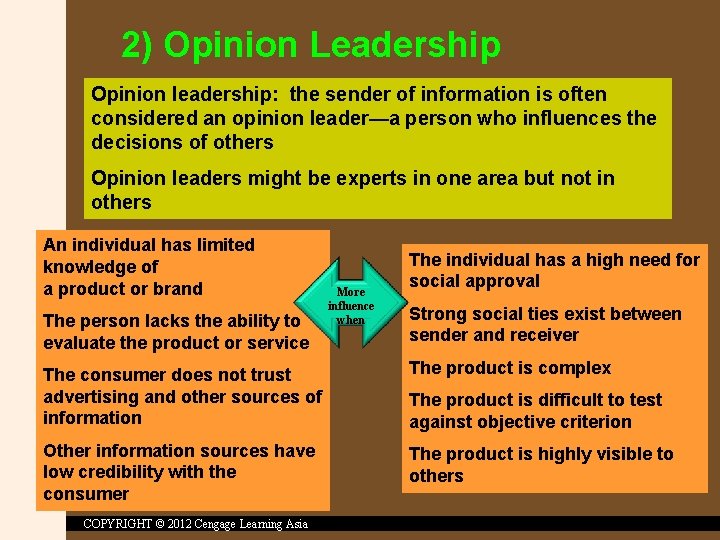
2) Opinion Leadership Opinion leadership: the sender of information is often considered an opinion leader—a person who influences the decisions of others Opinion leaders might be experts in one area but not in others An individual has limited knowledge of a product or brand The person lacks the ability to evaluate the product or service More influence when The individual has a high need for social approval Strong social ties exist between sender and receiver The consumer does not trust advertising and other sources of information The product is complex Other information sources have low credibility with the consumer The product is highly visible to others COPYRIGHT © 2012 Cengage Learning Asia The product is difficult to test against objective criterion
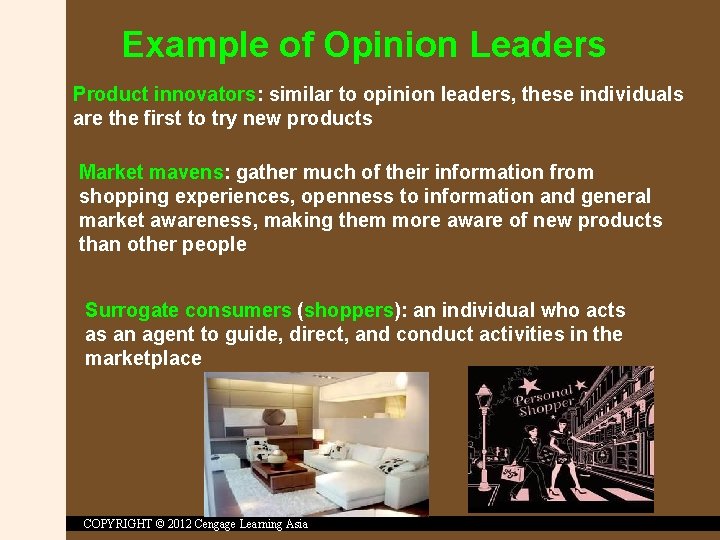
Example of Opinion Leaders Product innovators: similar to opinion leaders, these individuals are the first to try new products Market mavens: gather much of their information from shopping experiences, openness to information and general market awareness, making them more aware of new products than other people Surrogate consumers (shoppers): an individual who acts as an agent to guide, direct, and conduct activities in the marketplace COPYRIGHT © 2012 Cengage Learning Asia
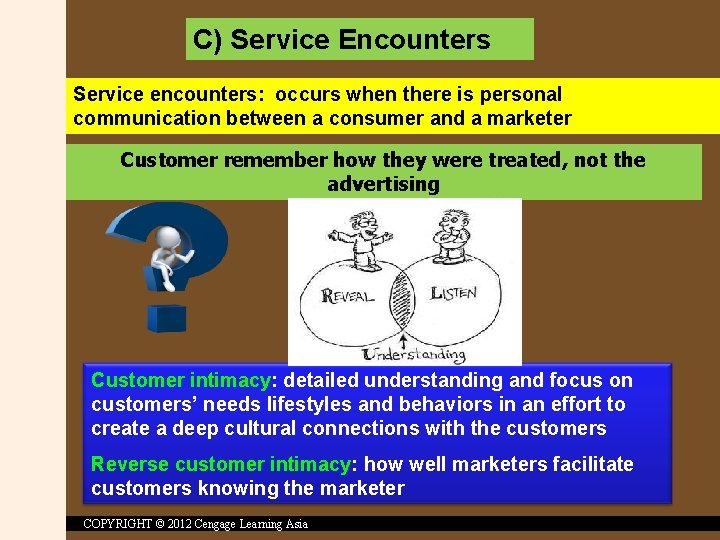
C) Service Encounters Service encounters: occurs when there is personal communication between a consumer and a marketer Customer remember how they were treated, not the advertising Customer intimacy: detailed understanding and focus on customers’ needs lifestyles and behaviors in an effort to create a deep cultural connections with the customers Reverse customer intimacy: how well marketers facilitate customers knowing the marketer COPYRIGHT © 2012 Cengage Learning Asia
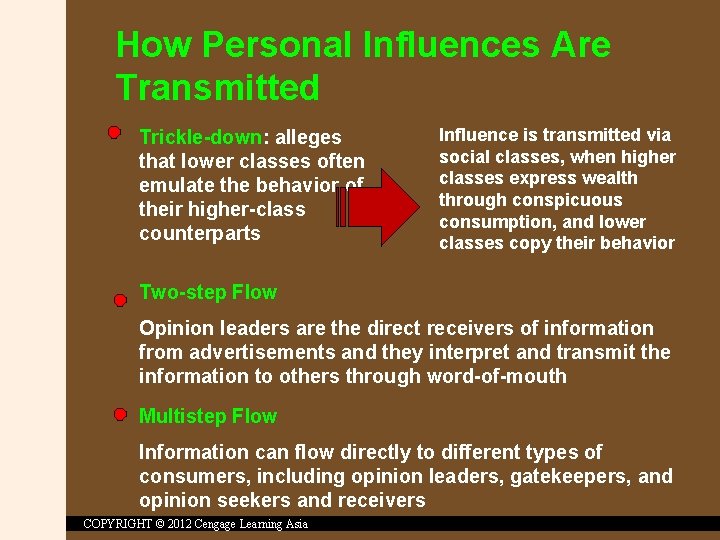
How Personal Influences Are Transmitted Trickle-down: alleges that lower classes often emulate the behavior of their higher-class counterparts Influence is transmitted via social classes, when higher classes express wealth through conspicuous consumption, and lower classes copy their behavior Two-step Flow Opinion leaders are the direct receivers of information from advertisements and they interpret and transmit the information to others through word-of-mouth Multistep Flow Information can flow directly to different types of consumers, including opinion leaders, gatekeepers, and opinion seekers and receivers COPYRIGHT © 2012 Cengage Learning Asia
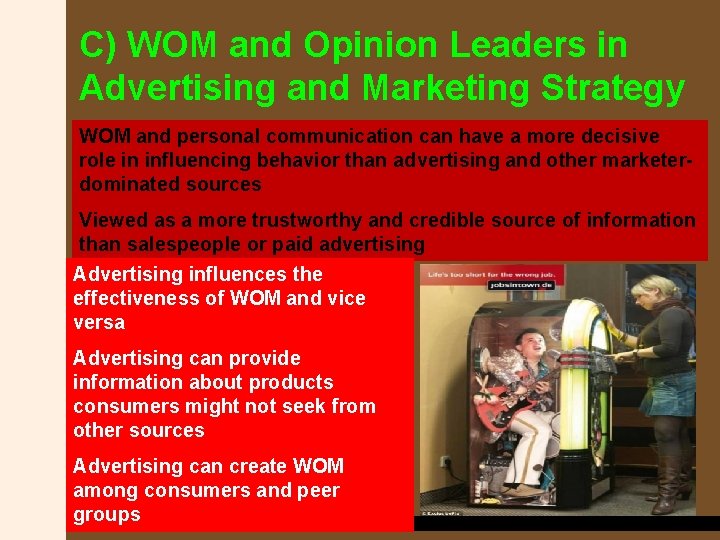
C) WOM and Opinion Leaders in Advertising and Marketing Strategy WOM and personal communication can have a more decisive role in influencing behavior than advertising and other marketerdominated sources Viewed as a more trustworthy and credible source of information than salespeople or paid advertising Advertising influences the effectiveness of WOM and vice versa Advertising can provide information about products consumers might not seek from other sources Advertising can create WOM among consumers and peer groups COPYRIGHT © 2012 Cengage Learning Asia
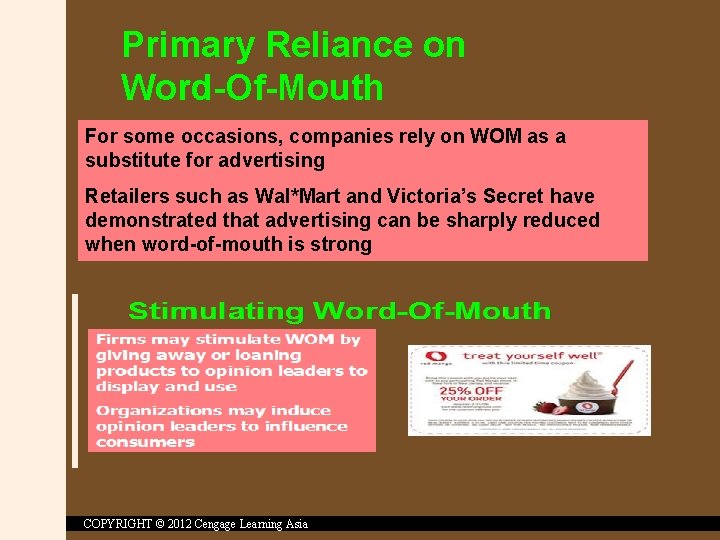
Primary Reliance on Word-Of-Mouth For some occasions, companies rely on WOM as a substitute for advertising Retailers such as Wal*Mart and Victoria’s Secret have demonstrated that advertising can be sharply reduced when word-of-mouth is strong COPYRIGHT © 2012 Cengage Learning Asia
Managing Negative WOM is usually given high priority and weighs heavily in decision making The dissatisfied buyer is more motivated to share information When something goes terribly wrong, denying the problem is not the answer The best strategy is immediate acknowledgement by a credible company spokesperson as negative WOM rarely goes away by itself Make sure you have all your facts straight and tell the truth COPYRIGHT © 2012 Cengage Learning Asia
D) Diffusion of Innovations Innovation: any idea or product perceived by the potential adopter to be new Consumers can view innovations subjectively (thought) or objectively (external criteria; innovations are ideas, behaviors, or things) The use of the word “new” in advertising is limited to products available for less than six months COPYRIGHT © 2012 Cengage Learning Asia
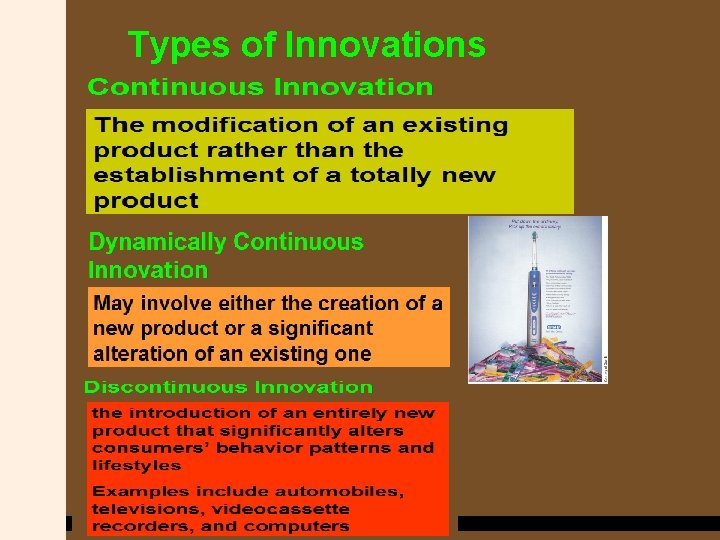
Types of Innovations COPYRIGHT © 2012 Cengage Learning Asia
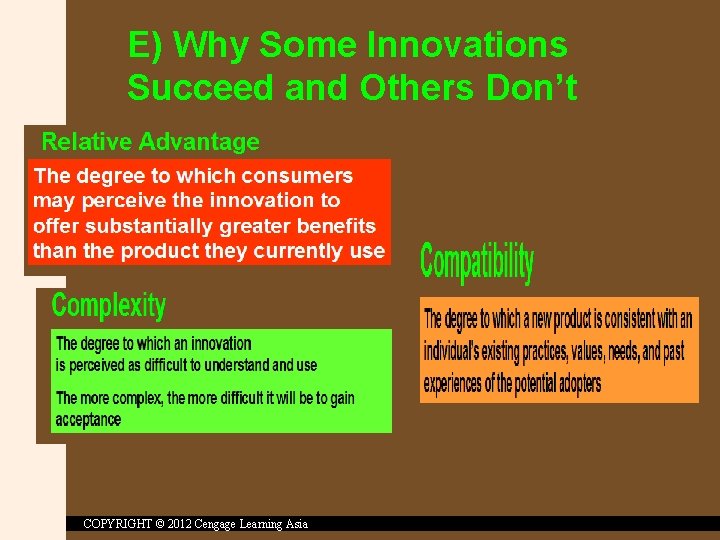
E) Why Some Innovations Succeed and Others Don’t COPYRIGHT © 2012 Cengage Learning Asia
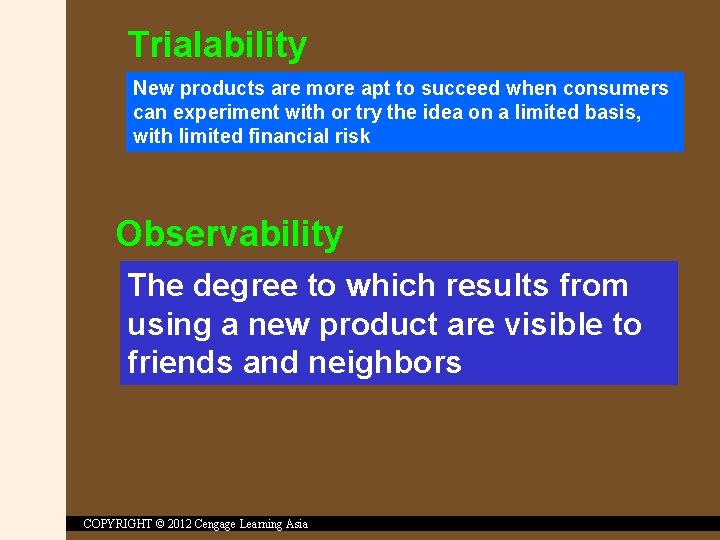
Trialability New products are more apt to succeed when consumers can experiment with or try the idea on a limited basis, with limited financial risk Observability The degree to which results from using a new product are visible to friends and neighbors COPYRIGHT © 2012 Cengage Learning Asia
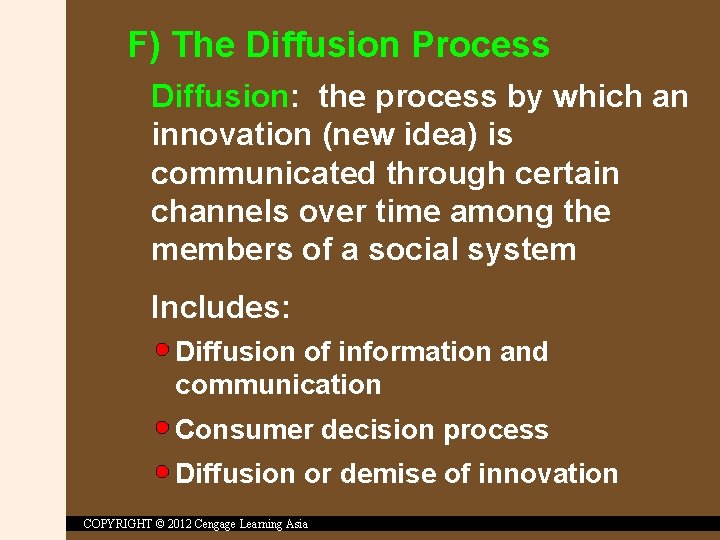
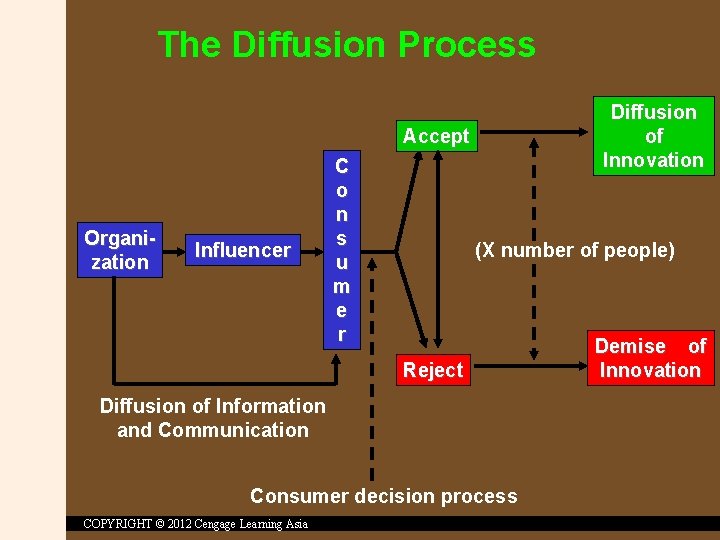
F) The Diffusion Process Diffusion: the process by which an innovation (new idea) is communicated through certain channels over time among the members of a social system Includes: Diffusion of information and communication Consumer decision process Diffusion or demise of innovation COPYRIGHT © 2012 Cengage Learning Asia
The Diffusion Process Diffusion of Innovation Accept Organization Influencer C o n s u m e r (X number of people) Reject Diffusion of Information and Communication Consumer decision process COPYRIGHT © 2012 Cengage Learning Asia Demise of Innovation
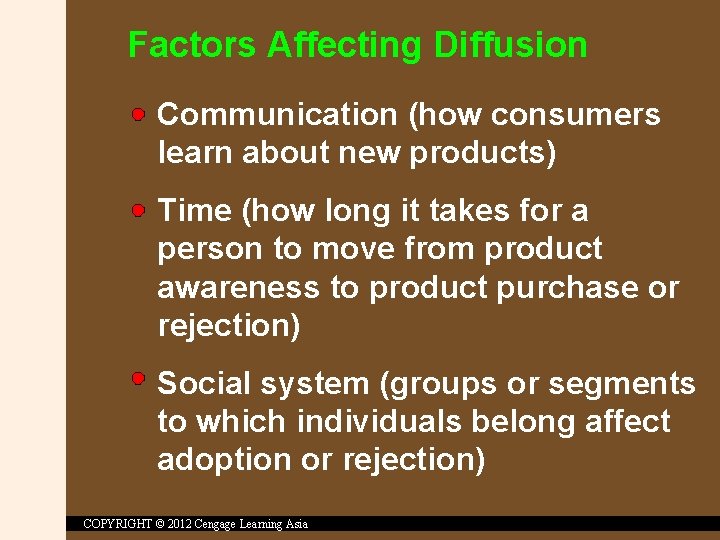
Factors Affecting Diffusion Communication (how consumers learn about new products) Time (how long it takes for a person to move from product awareness to product purchase or rejection) Social system (groups or segments to which individuals belong affect adoption or rejection) COPYRIGHT © 2012 Cengage Learning Asia
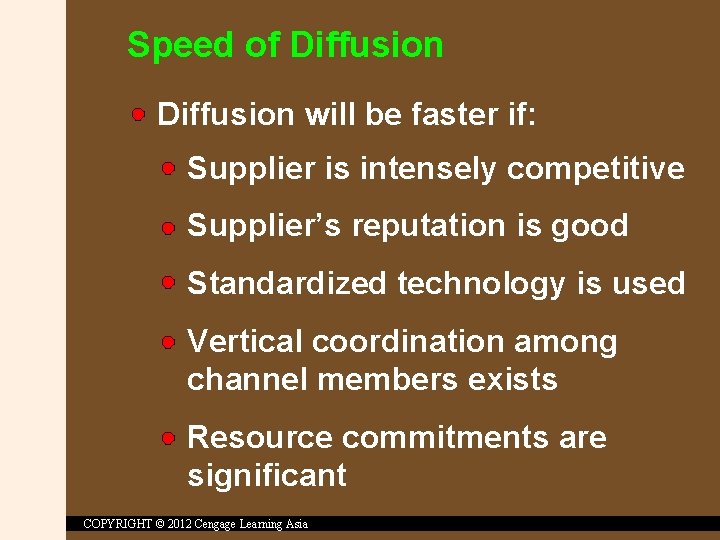
Speed of Diffusion will be faster if: Supplier is intensely competitive Supplier’s reputation is good Standardized technology is used Vertical coordination among channel members exists Resource commitments are significant COPYRIGHT © 2012 Cengage Learning Asia
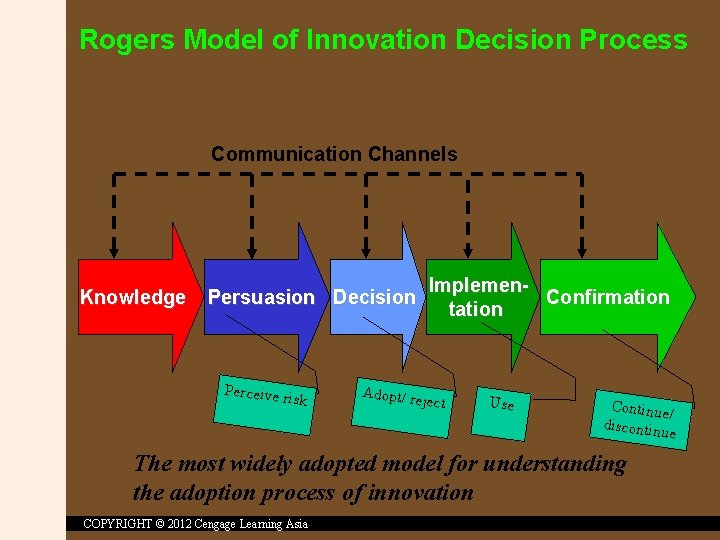
Rogers Model of Innovation Decision Process Communication Channels Knowledge Implemen. Confirmation tation Persuasion Decision Perceive risk Adopt/ re ject Use Continue / discontin ue The most widely adopted model for understanding the adoption process of innovation COPYRIGHT © 2012 Cengage Learning Asia
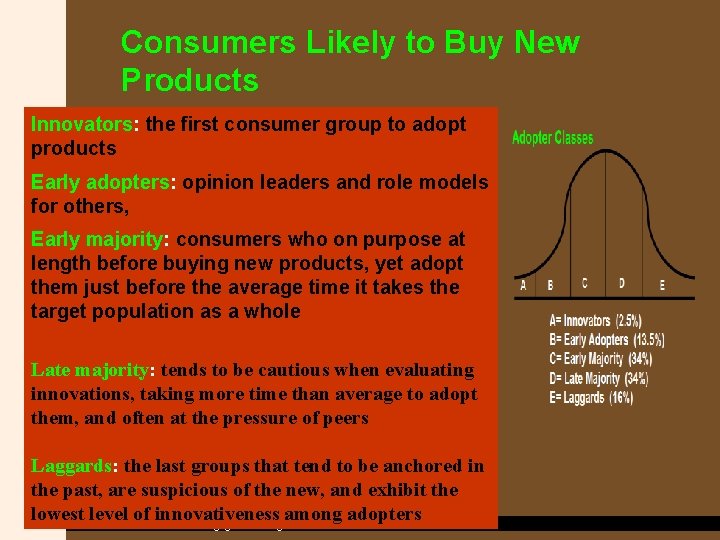
Consumers Likely to Buy New Products Innovators: the first consumer group to adopt products Early adopters: opinion leaders and role models for others, Early majority: consumers who on purpose at length before buying new products, yet adopt them just before the average time it takes the target population as a whole Late majority: tends to be cautious when evaluating innovations, taking more time than average to adopt them, and often at the pressure of peers Laggards: the last groups that tend to be anchored in the past, are suspicious of the new, and exhibit the lowest. COPYRIGHT level of innovativeness among adopters © 2012 Cengage Learning Asia
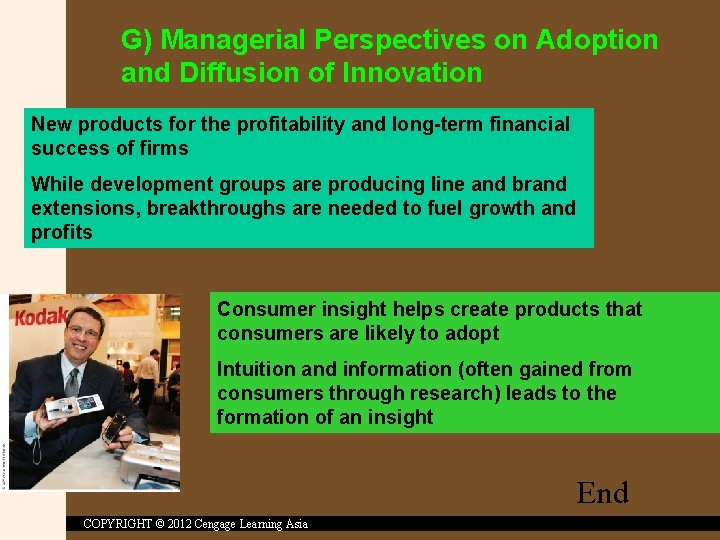
G) Managerial Perspectives on Adoption and Diffusion of Innovation New products for the profitability and long-term financial success of firms While development groups are producing line and brand extensions, breakthroughs are needed to fuel growth and profits Consumer insight helps create products that consumers are likely to adopt Intuition and information (often gained from consumers through research) leads to the formation of an insight End COPYRIGHT © 2012 Cengage Learning Asia