
Week 1 The History of Computing PART II
- Slides: 15
Week 1: The History of Computing (PART II) • READING: Chapter 1 1
First Generation (1951 - 1959): Vacuum tubes • Commercial electronic computers in the first generation were built using vacuum tubes to store information. The vacuum tubes were used as switches • Primary storage device was a magnetic drum that rotated under a read/write head • The vacuum tubes generate a lot of heat, so heavy-duty air-conditioning was required 2 2
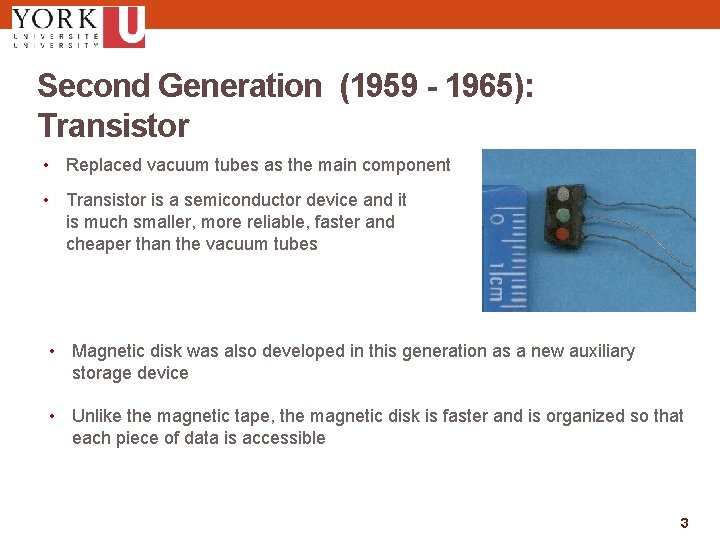
Second Generation (1959 - 1965): Transistor • Replaced vacuum tubes as the main component • Transistor is a semiconductor device and it is much smaller, more reliable, faster and cheaper than the vacuum tubes • Magnetic disk was also developed in this generation as a new auxiliary storage device • Unlike the magnetic tape, the magnetic disk is faster and is organized so that each piece of data is accessible 3 3
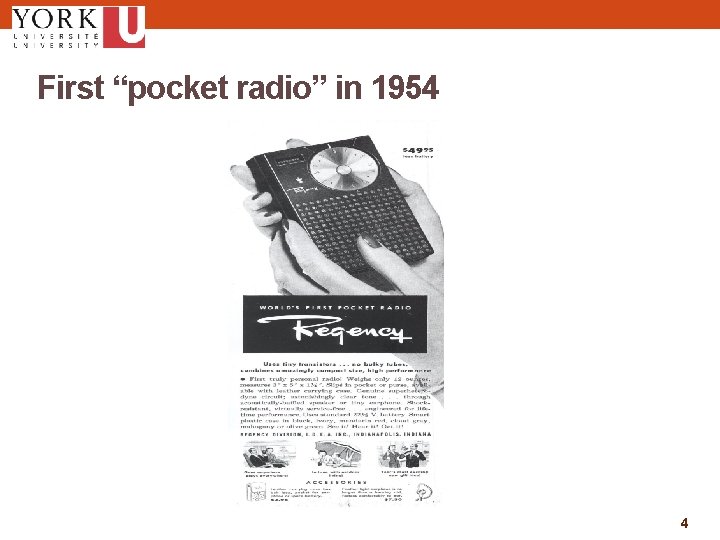
First “pocket radio” in 1954 4 4
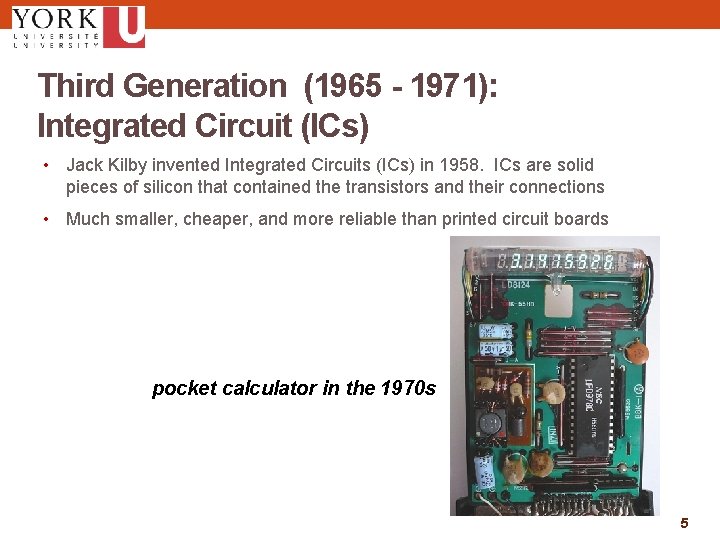
Third Generation (1965 - 1971): Integrated Circuit (ICs) • Jack Kilby invented Integrated Circuits (ICs) in 1958. ICs are solid pieces of silicon that contained the transistors and their connections • Much smaller, cheaper, and more reliable than printed circuit boards pocket calculator in the 1970 s 5 5
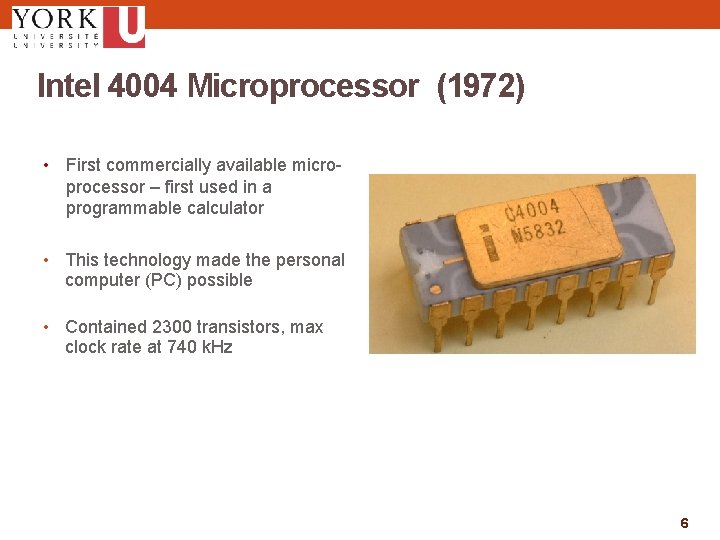
Intel 4004 Microprocessor (1972) • First commercially available microprocessor – first used in a programmable calculator • This technology made the personal computer (PC) possible • Contained 2300 transistors, max clock rate at 740 k. Hz 6 6
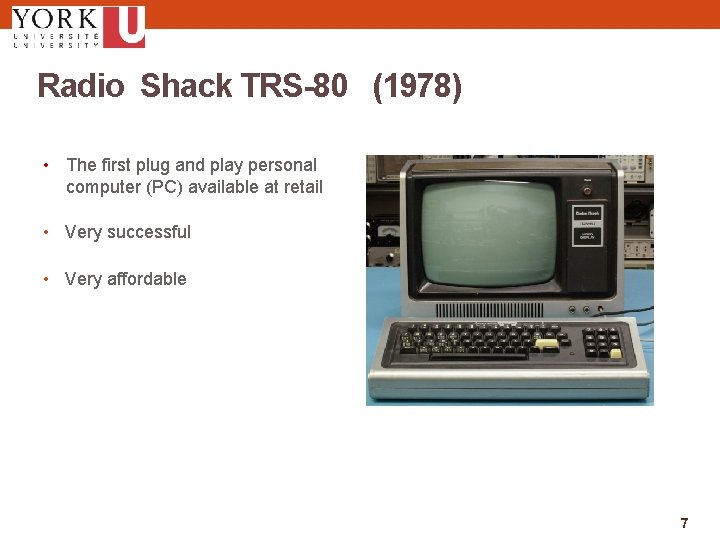
Radio Shack TRS-80 (1978) • The first plug and play personal computer (PC) available at retail • Very successful • Very affordable 7 7
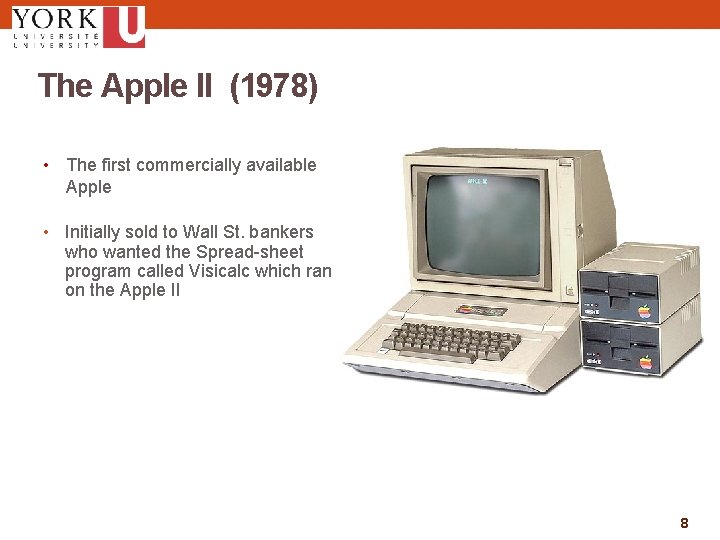
The Apple II (1978) • The first commercially available Apple • Initially sold to Wall St. bankers who wanted the Spread-sheet program called Visicalc which ran on the Apple II 8 8
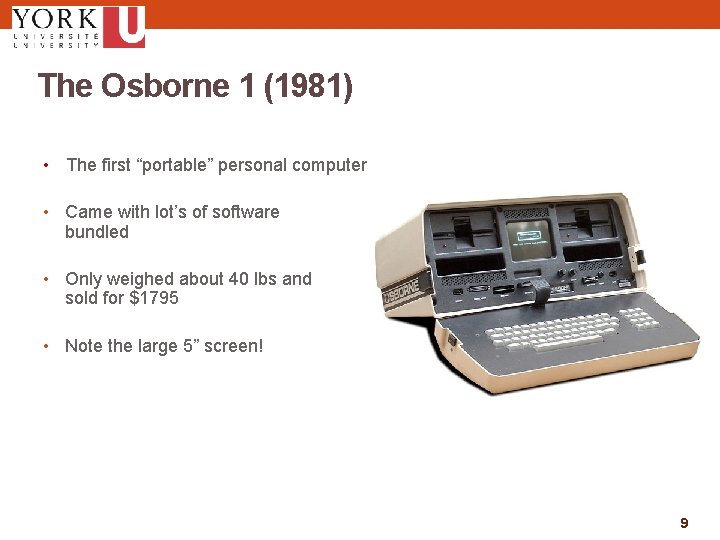
The Osborne 1 (1981) • The first “portable” personal computer • Came with lot’s of software bundled • Only weighed about 40 lbs and sold for $1795 • Note the large 5” screen! 9 9
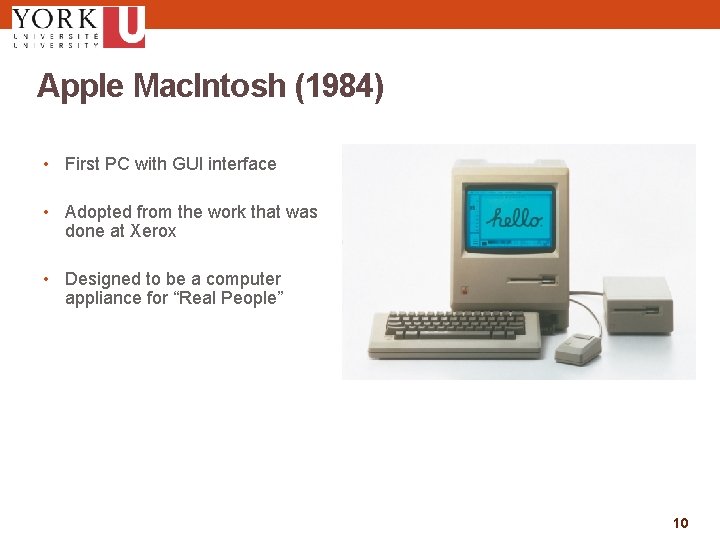
Apple Mac. Intosh (1984) • First PC with GUI interface • Adopted from the work that was done at Xerox • Designed to be a computer appliance for “Real People” 10 10
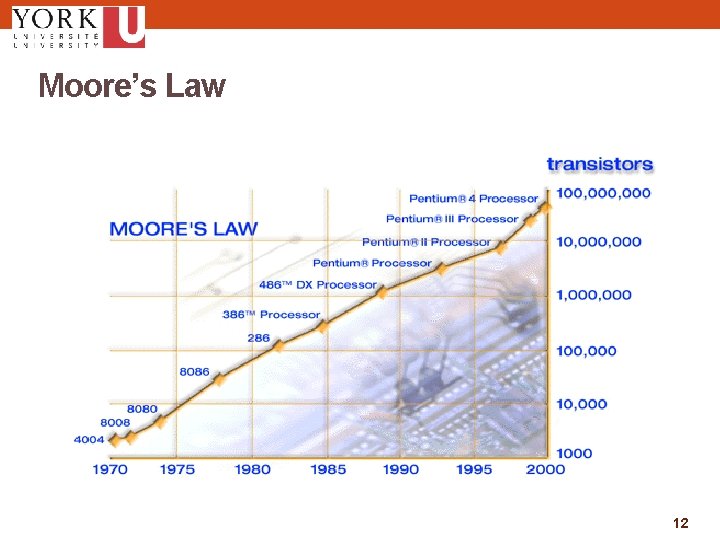
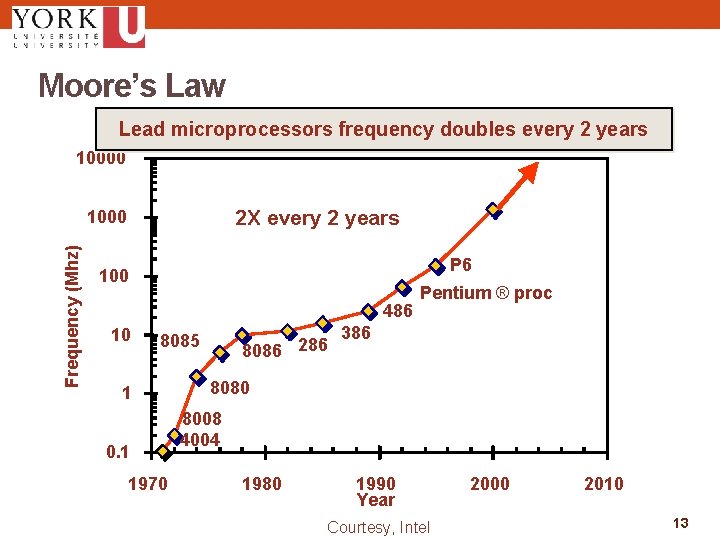
Moore’s Law • In 1965, Gordon Moore (one of the co-founders of Intel) predicted that the number of transistors that can be integrated on a die would double every 18 to 24 months (i. e. , grow exponentially with time). • Amazing visionary – million transistor/chip barrier was crossed in the 1980’s. • 2300 transistors, 1 MHz clock (Intel 4004) - 1971 • 42 Million, 2 GHz clock (Intel P 4) - 2001 • 140 Million transistor (HP PA-8500) 11 11
Moore’s Law 12 12
Moore’s Law Lead microprocessors frequency doubles every 2 years 10000 2 X every 2 years Frequency (Mhz) 1000 P 6 100 486 10 8085 1 0. 1 1970 8086 286 Pentium ® proc 386 8080 8008 4004 1980 1990 Year Courtesy, Intel 2000 2010 13 13
Today’s Price/Performance • Over 3 Billion operations per second costs less than $1000 • Memory is measured in Megabytes/Gigabytes…. not Kilobytes • Communications speeds are measured in Megabits per second, not Kilobits or even lower 14 14
Video • Video: “The Machine that Changed the world” Primary Website: http: //waxy. org/2008/06/the_machine_that_changed_the_world/ 15 15