
Week 1 Particle Technology Fundamentals MARTIN RHODES 2008



- Slides: 72
Week # 1 Particle Technology Fundamentals MARTIN RHODES (2008) Introduction to Particle Technology , 2 nd Edition. Publisher John Wiley & Son, Chichester, West Sussex, England.
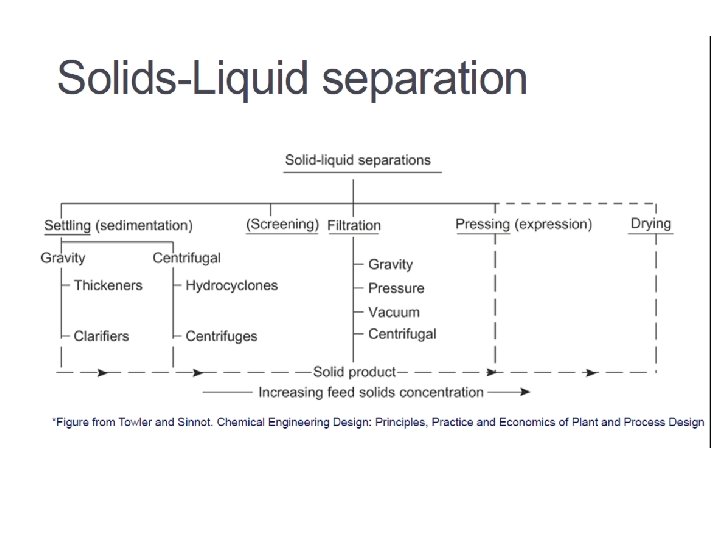
Solids Handling / Particle Technology
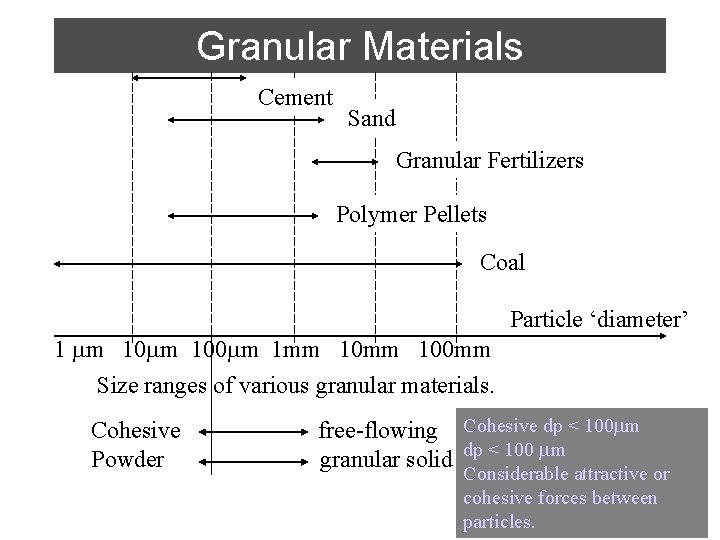
Granular Materials Cement Sand Granular Fertilizers Polymer Pellets Coal Particle ‘diameter’ 1 mm 100 mm 10 mm 100 mm Size ranges of various granular materials. Cohesive Powder free-flowing Cohesive dp < 100 mm granular solid dp < 100 mm Considerable attractive or cohesive forces between particles.
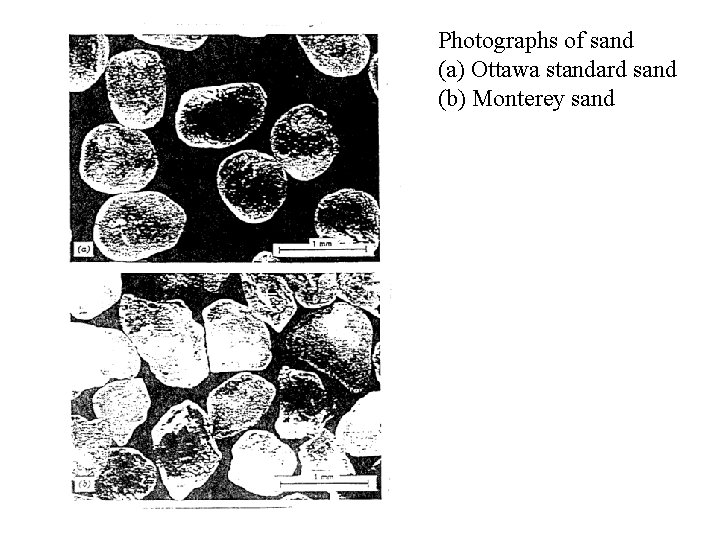
Photographs of sand (a) Ottawa standard sand (b) Monterey sand
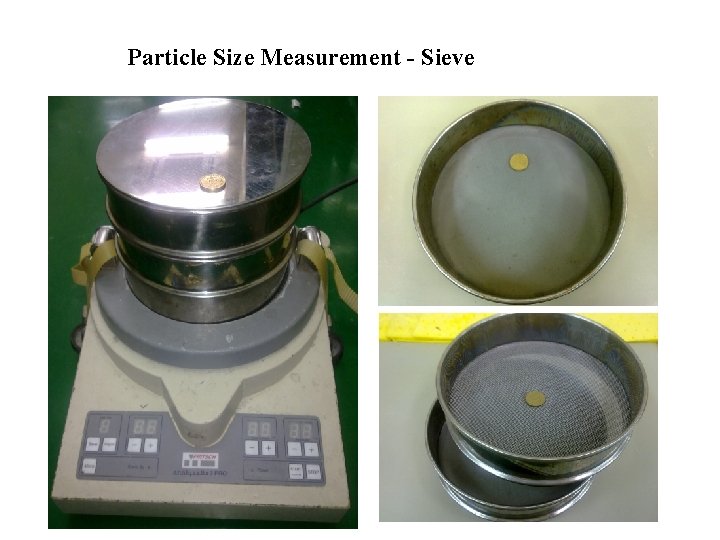
Particle Size Measurement - Sieve
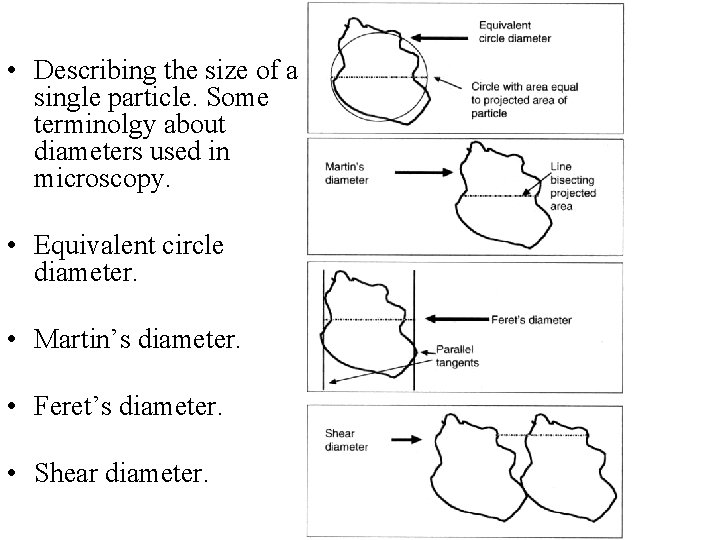
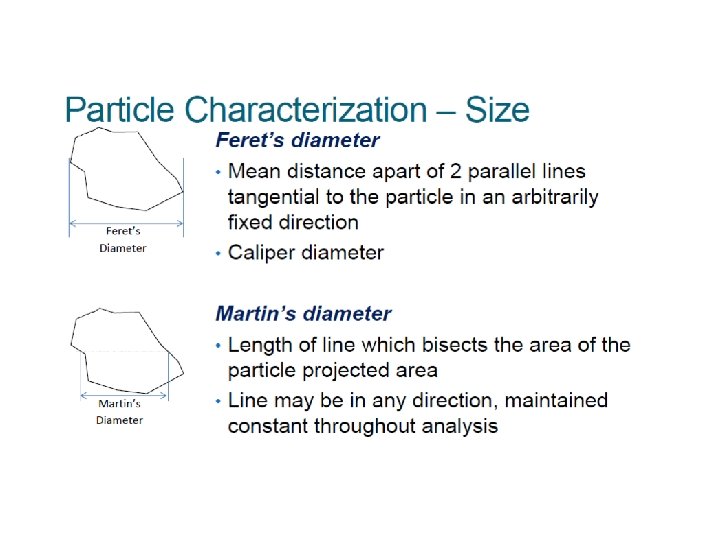
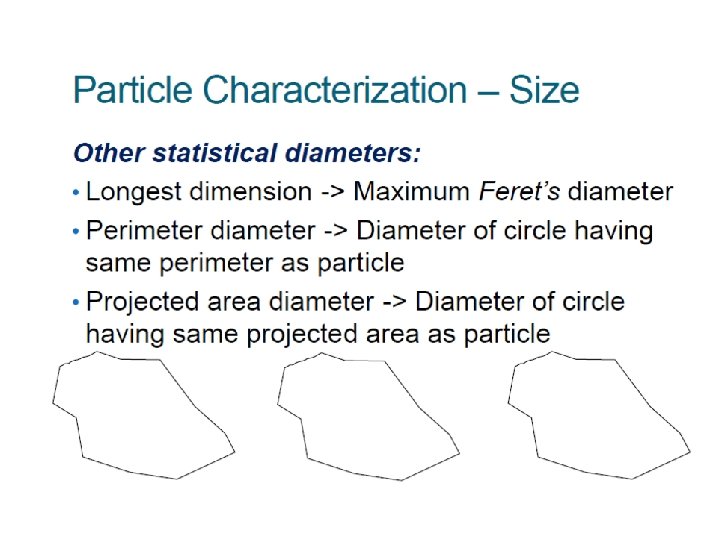
• Describing the size of a single particle. Some terminolgy about diameters used in microscopy. • Equivalent circle diameter. • Martin’s diameter. • Feret’s diameter. • Shear diameter.
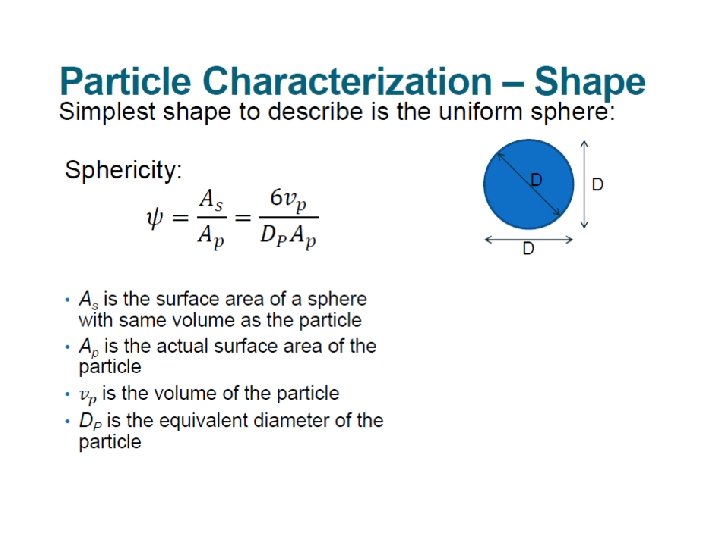
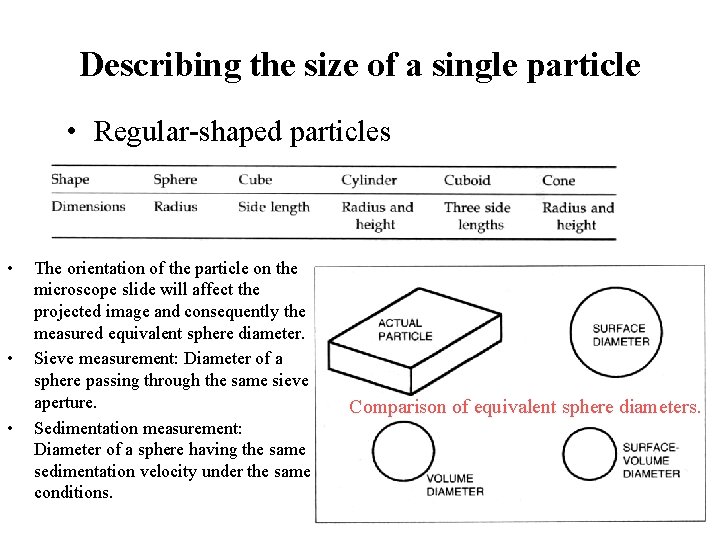
Describing the size of a single particle • Regular-shaped particles • • • The orientation of the particle on the microscope slide will affect the projected image and consequently the measured equivalent sphere diameter. Sieve measurement: Diameter of a sphere passing through the same sieve aperture. Sedimentation measurement: Diameter of a sphere having the same sedimentation velocity under the same conditions. Comparison of equivalent sphere diameters.
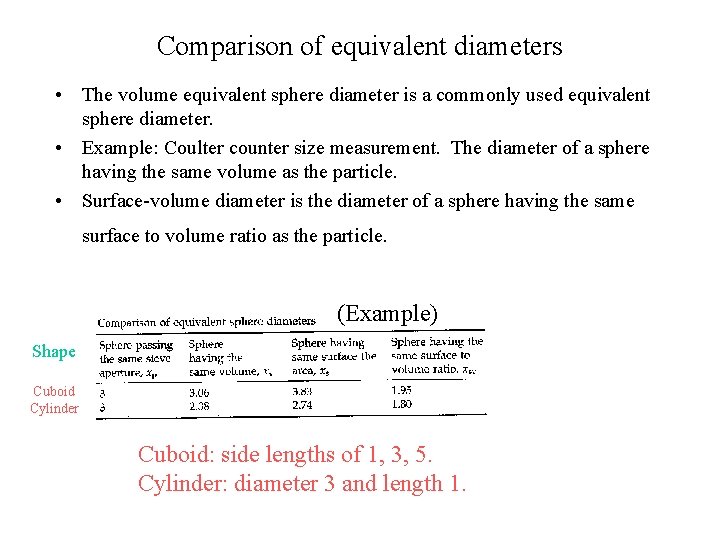
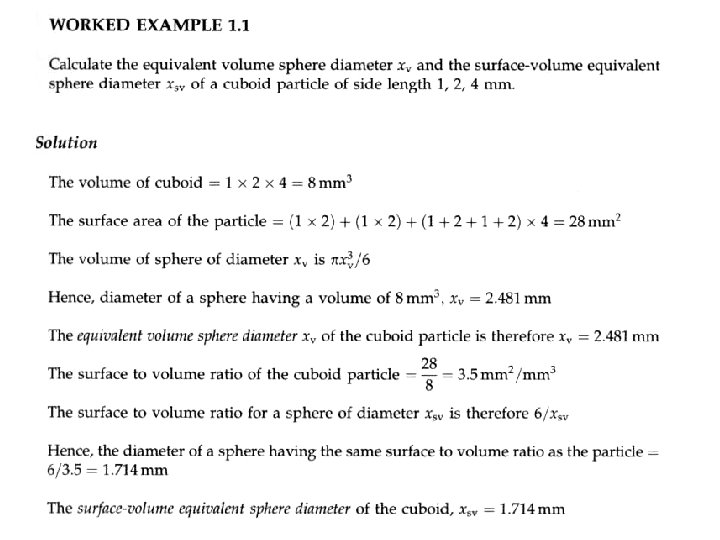
Comparison of equivalent diameters • The volume equivalent sphere diameter is a commonly used equivalent sphere diameter. • Example: Coulter counter size measurement. The diameter of a sphere having the same volume as the particle. • Surface-volume diameter is the diameter of a sphere having the same surface to volume ratio as the particle. (Example) Shape Cuboid Cylinder Cuboid: side lengths of 1, 3, 5. Cylinder: diameter 3 and length 1.
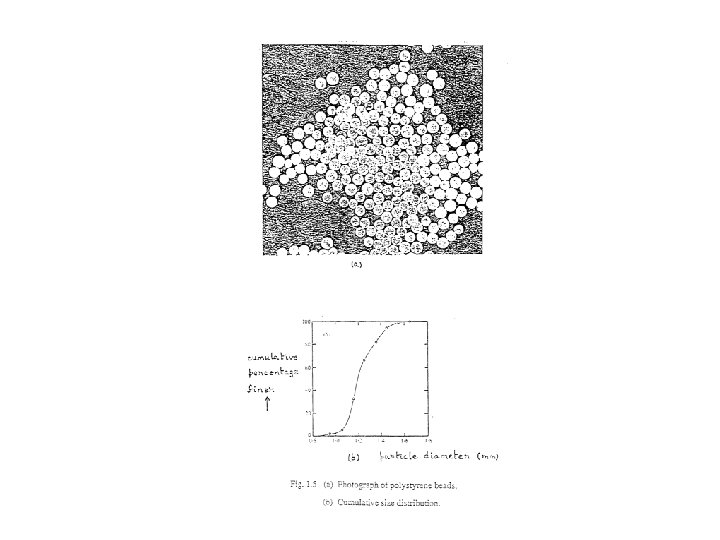
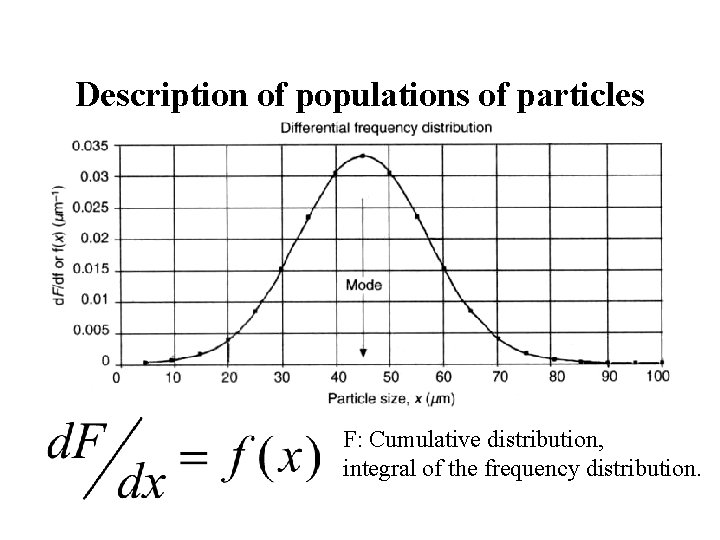
Description of populations of particles • Typical differential frequency distribution F: Cumulative distribution, integral of the frequency distribution.
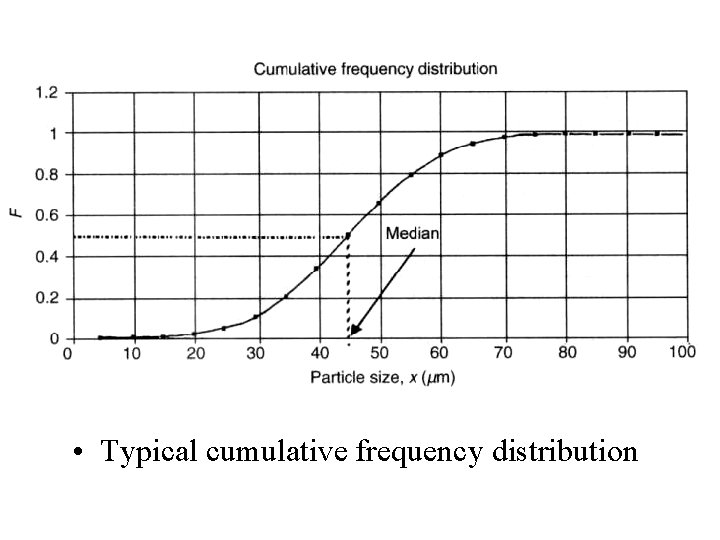
• Typical cumulative frequency distribution
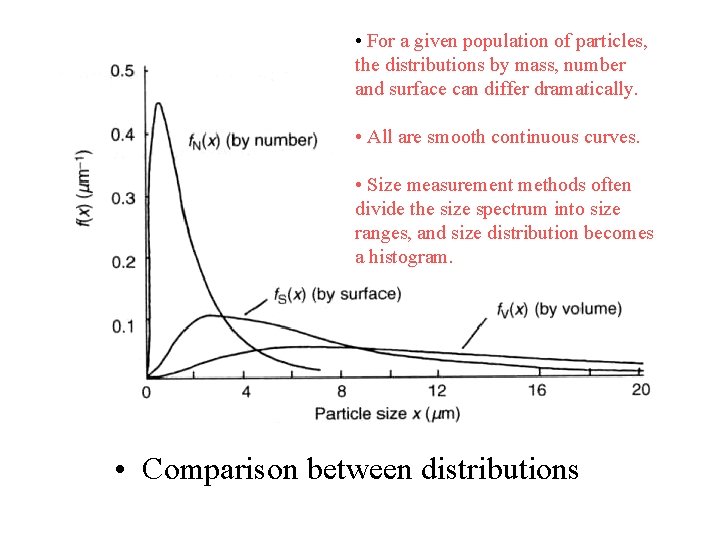
• For a given population of particles, the distributions by mass, number and surface can differ dramatically. • All are smooth continuous curves. • Size measurement methods often divide the size spectrum into size ranges, and size distribution becomes a histogram. • Comparison between distributions
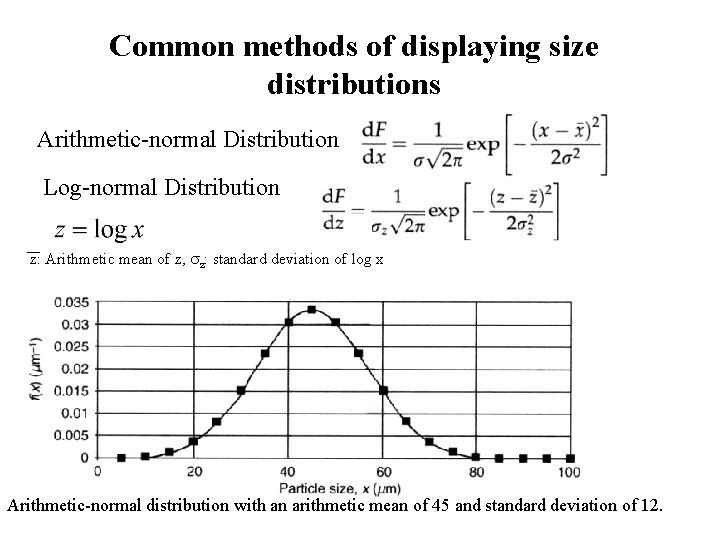
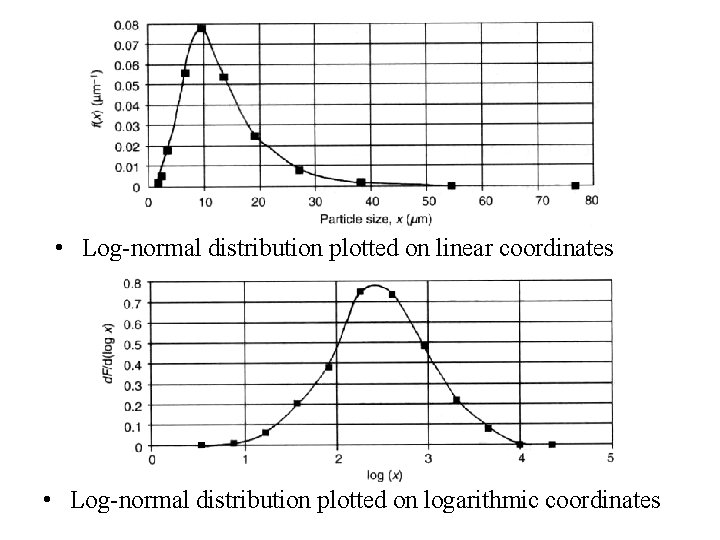
Common methods of displaying size distributions Arithmetic-normal Distribution Log-normal Distribution z: Arithmetic mean of z, sz: standard deviation of log x Arithmetic-normal distribution with an arithmetic mean of 45 and standard deviation of 12.
• Log-normal distribution plotted on linear coordinates • Log-normal distribution plotted on logarithmic coordinates
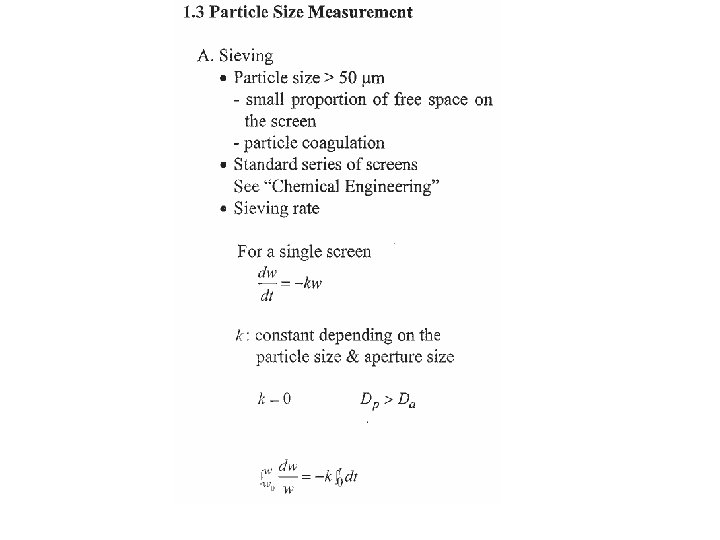
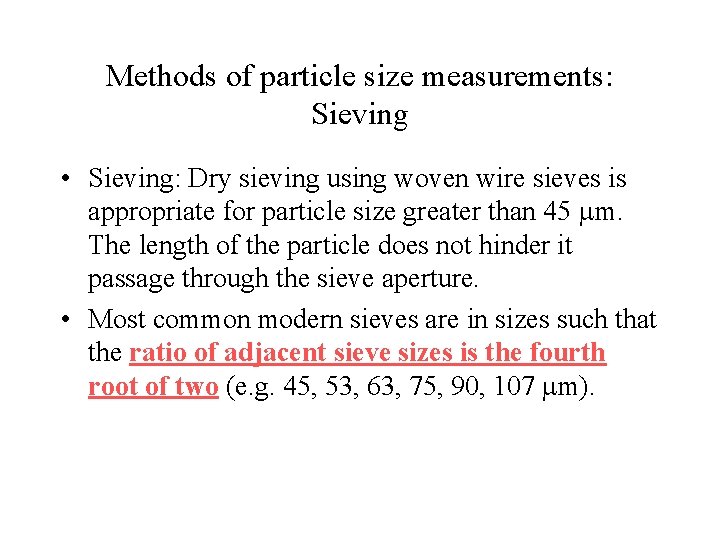
Methods of particle size measurements: Sieving • Sieving: Dry sieving using woven wire sieves is appropriate for particle size greater than 45 mm. The length of the particle does not hinder it passage through the sieve aperture. • Most common modern sieves are in sizes such that the ratio of adjacent sieve sizes is the fourth root of two (e. g. 45, 53, 63, 75, 90, 107 mm).
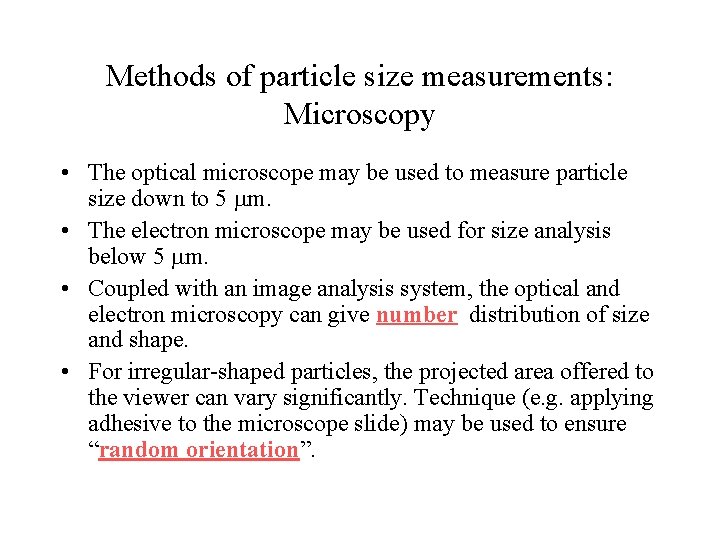
Methods of particle size measurements: Microscopy • The optical microscope may be used to measure particle size down to 5 mm. • The electron microscope may be used for size analysis below 5 mm. • Coupled with an image analysis system, the optical and electron microscopy can give number distribution of size and shape. • For irregular-shaped particles, the projected area offered to the viewer can vary significantly. Technique (e. g. applying adhesive to the microscope slide) may be used to ensure “random orientation”.
MR Chapter 2 • Tutorial • MR # 2. 1, 2. 4. MARTIN RHODES (2008) Introduction to Particle Technology , 2 nd Edition. Publisher John Wiley & Son, Chichester, West Sussex, England.
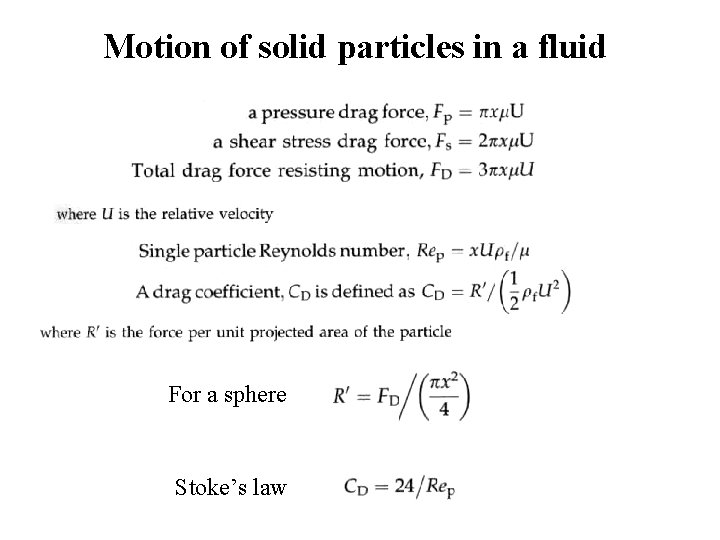
Motion of solid particles in a fluid For a sphere Stoke’s law
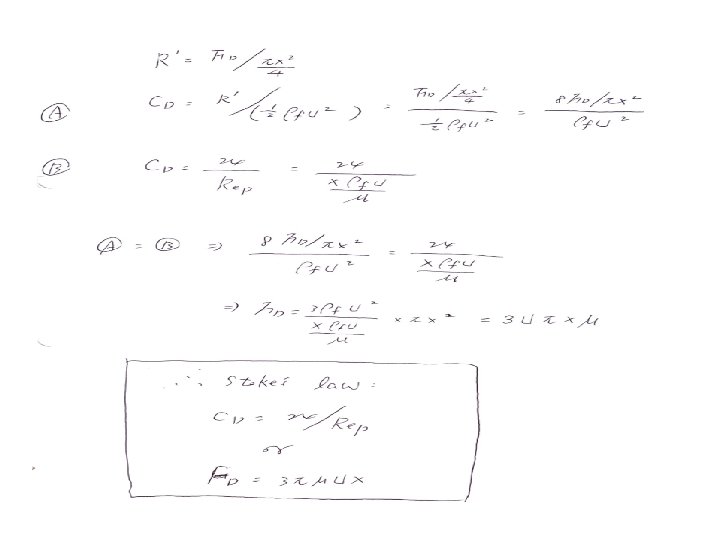
Motion of solid particles in a fluid For a sphere Stoke’s law
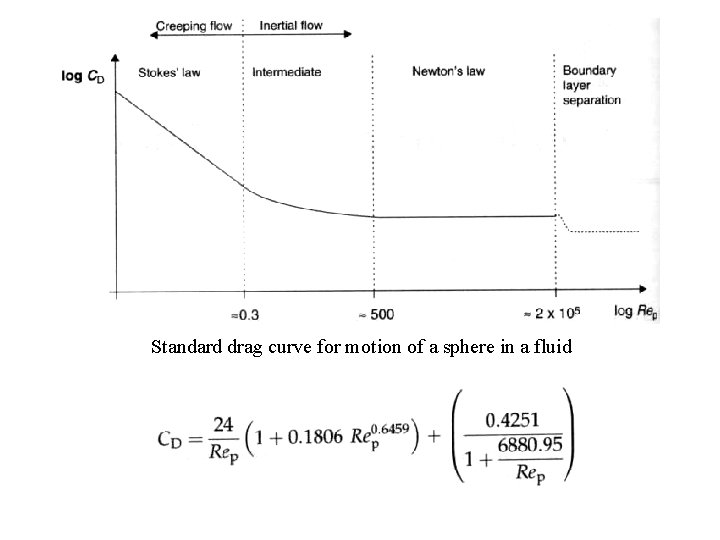
Standard drag curve for motion of a sphere in a fluid
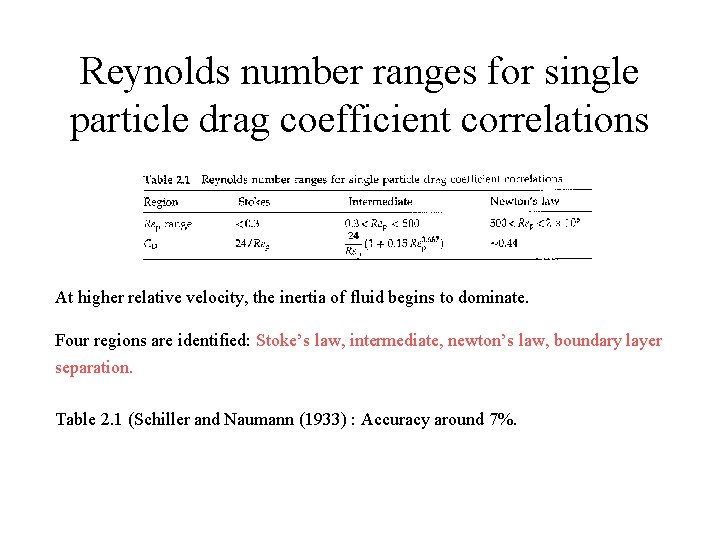
Reynolds number ranges for single particle drag coefficient correlations At higher relative velocity, the inertia of fluid begins to dominate. Four regions are identified: Stoke’s law, intermediate, newton’s law, boundary layer separation. Table 2. 1 (Schiller and Naumann (1933) : Accuracy around 7%.
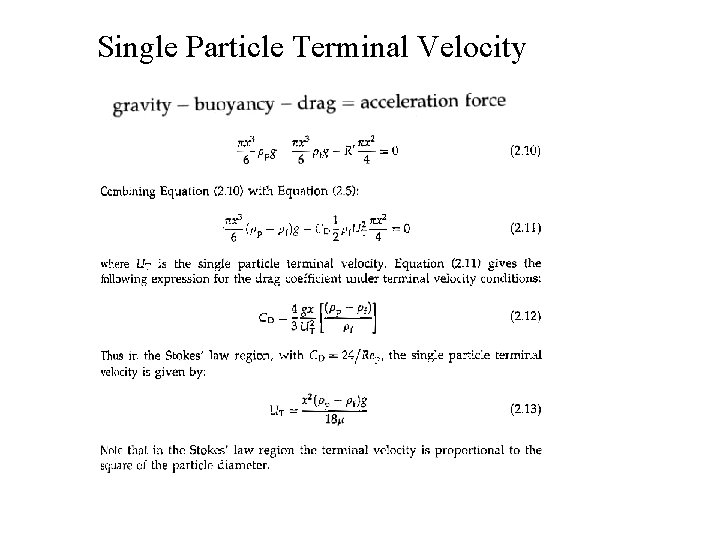
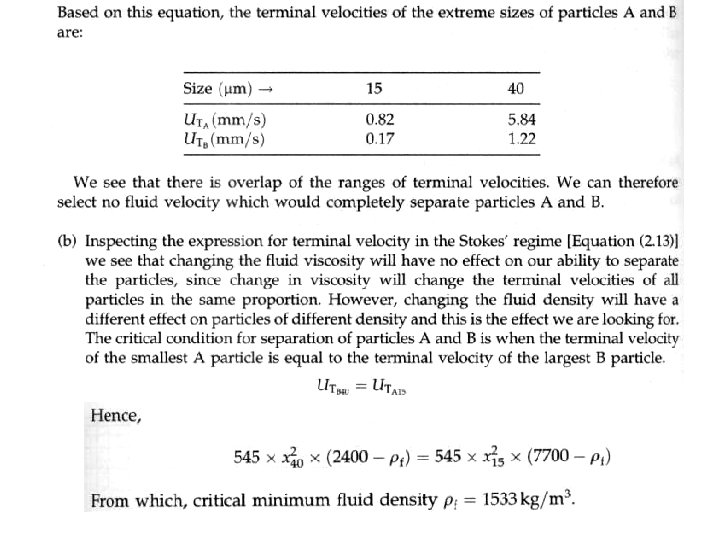
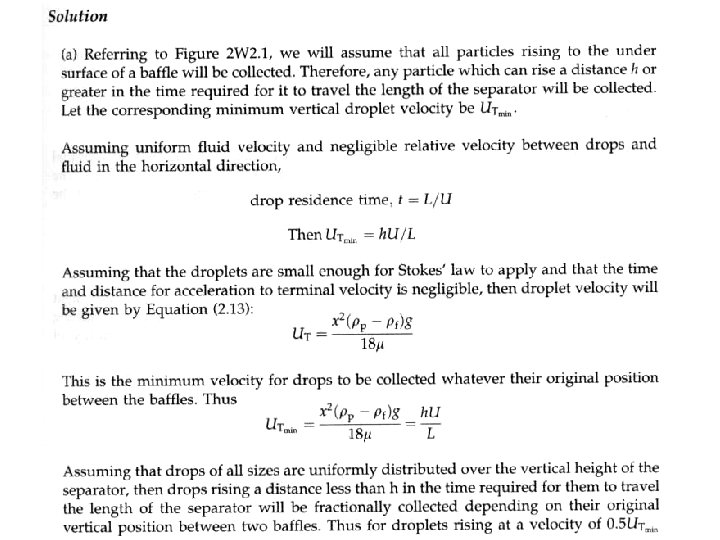
Single Particle Terminal Velocity
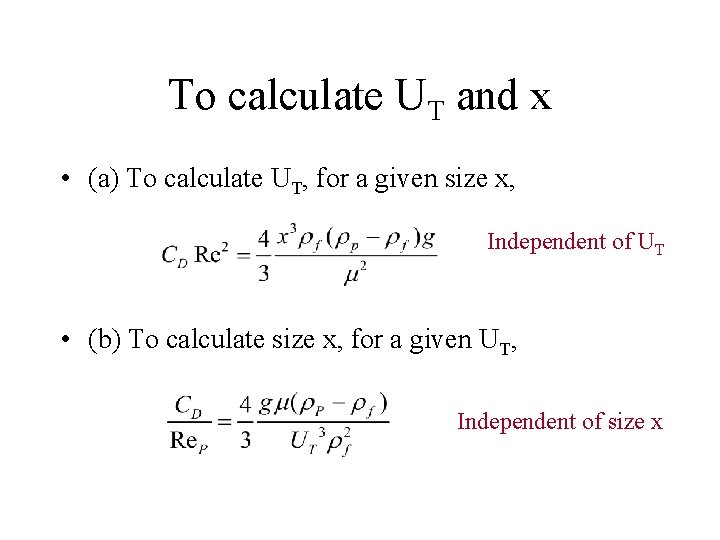
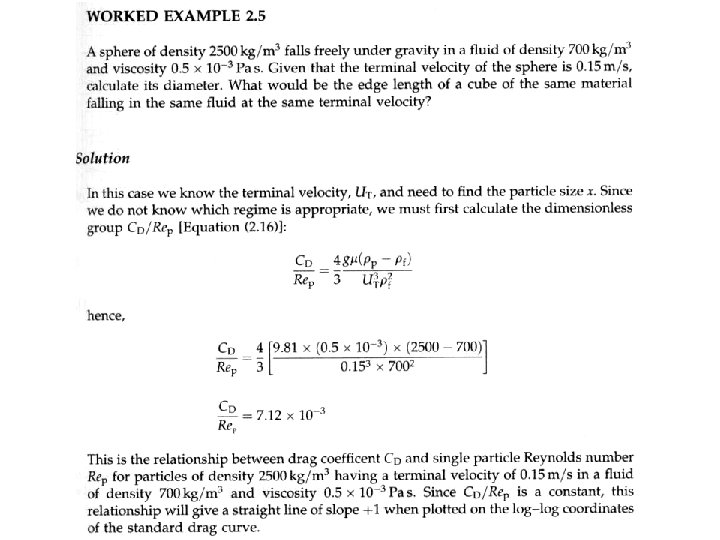
To calculate UT and x • (a) To calculate UT, for a given size x, Independent of UT • (b) To calculate size x, for a given UT, Independent of size x
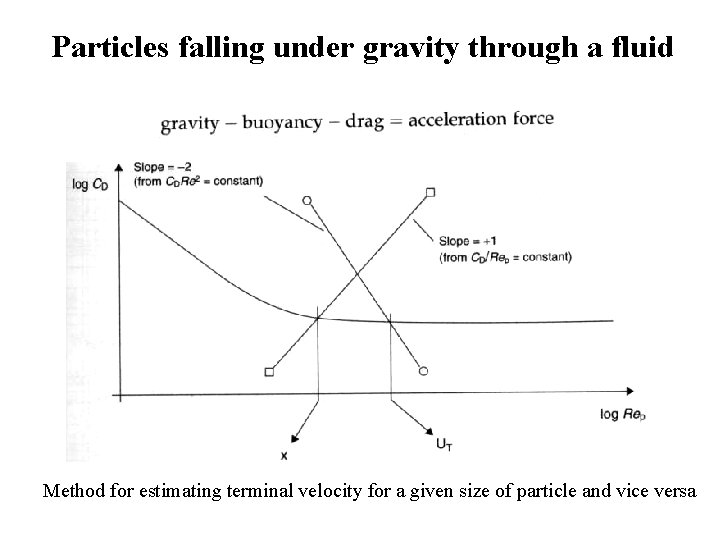
Particles falling under gravity through a fluid Method for estimating terminal velocity for a given size of particle and vice versa
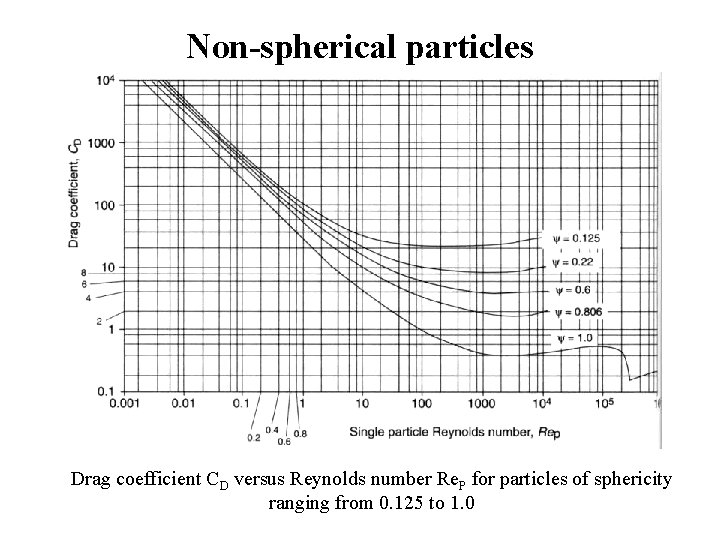
Non-spherical particles Drag coefficient CD versus Reynolds number Re. P for particles of sphericity ranging from 0. 125 to 1. 0
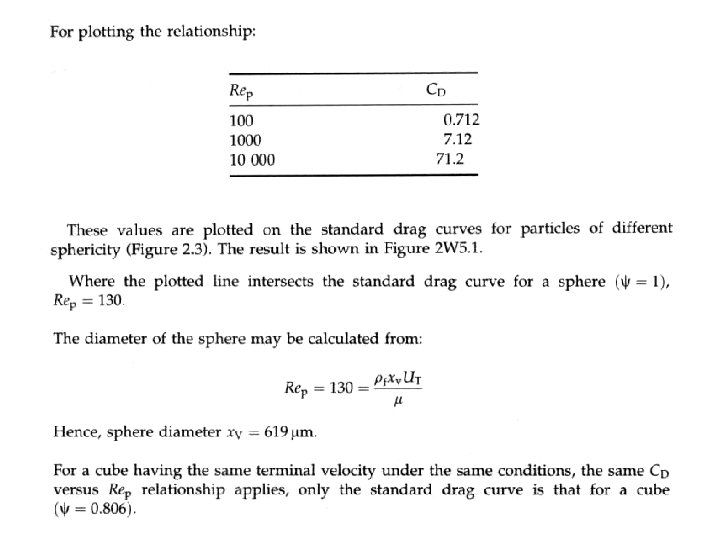
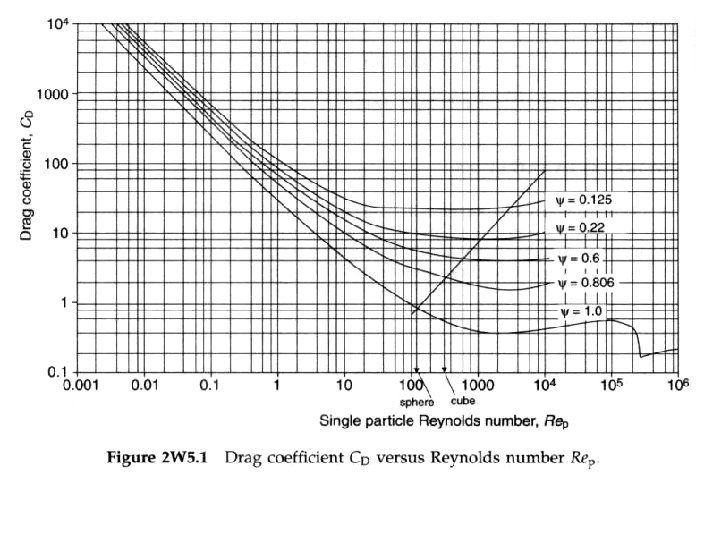
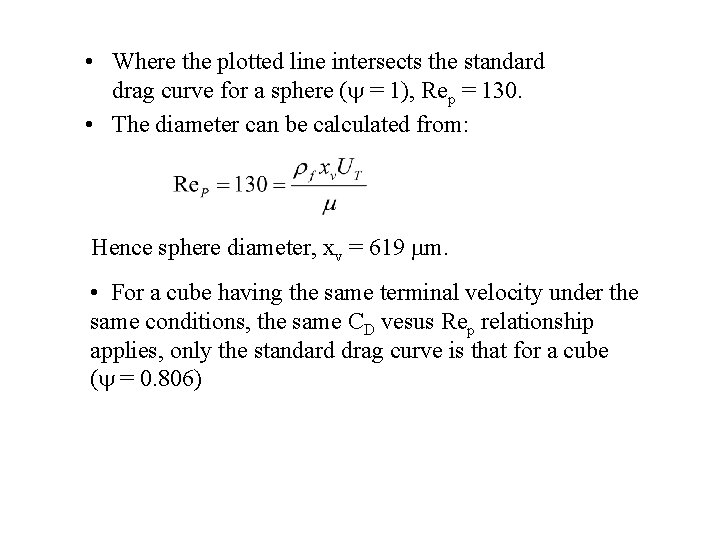
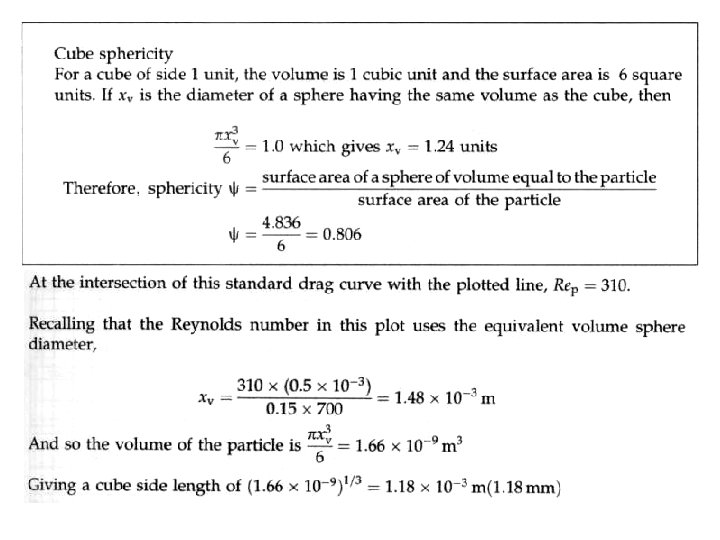
• Where the plotted line intersects the standard drag curve for a sphere (y = 1), Rep = 130. • The diameter can be calculated from: Hence sphere diameter, xv = 619 mm. • For a cube having the same terminal velocity under the same conditions, the same CD vesus Rep relationship applies, only the standard drag curve is that for a cube (y = 0. 806)
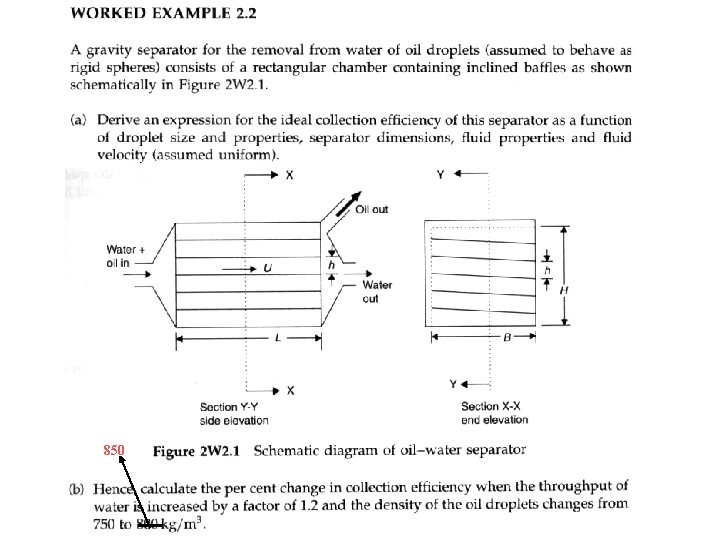
850
Packed Beds: Ergun Equation Pressure Drop-Flow Relation
MR Chapter 6 Fluid Flow Through a Packed Bed of Particles • Tutorial • MR #6. 1, 6. 3, 6. 5, 6. 7, MARTIN RHODES (2008) Introduction to Particle Technology , 2 nd Edition. Publisher John Wiley & Son, Chichester, West Sussex, England.
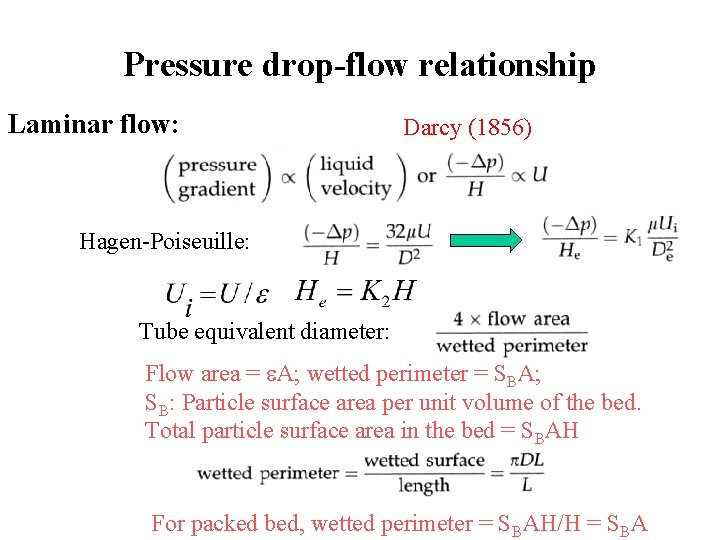
Pressure drop-flow relationship Laminar flow: Darcy (1856) Hagen-Poiseuille: Tube equivalent diameter: Flow area = e. A; wetted perimeter = SBA; SB: Particle surface area per unit volume of the bed. Total particle surface area in the bed = SBAH For packed bed, wetted perimeter = SBAH/H = SBA
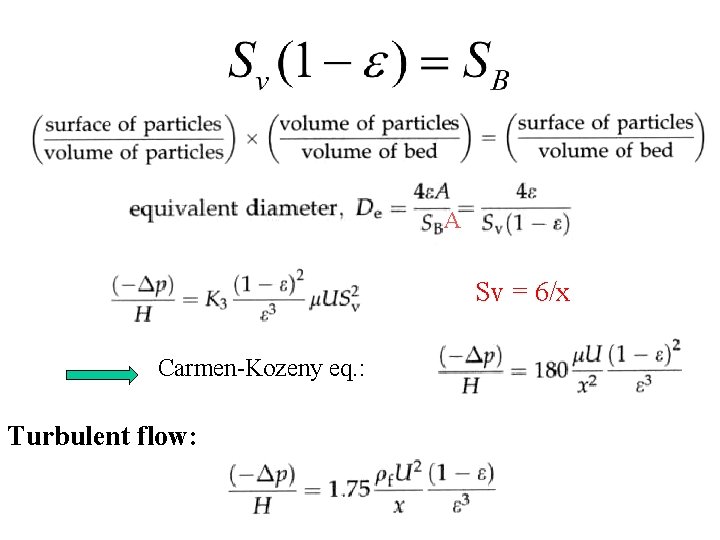
A Sv = 6/x Carmen-Kozeny eq. : Turbulent flow:
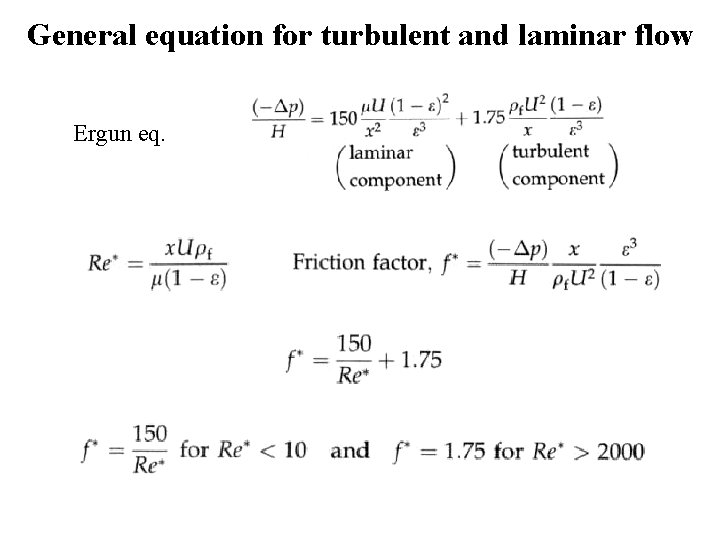
General equation for turbulent and laminar flow Ergun eq.
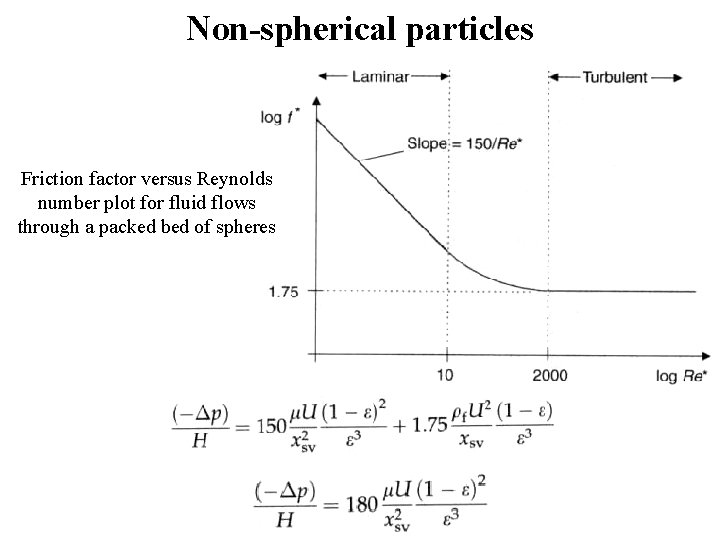
Non-spherical particles Friction factor versus Reynolds number plot for fluid flows through a packed bed of spheres
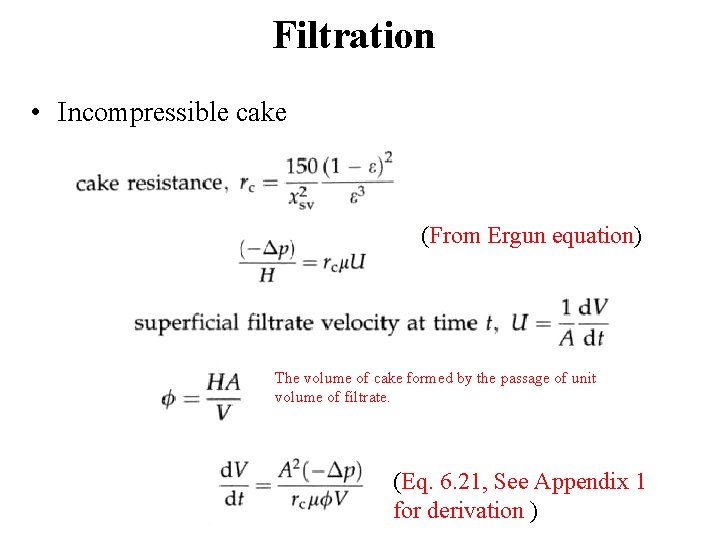
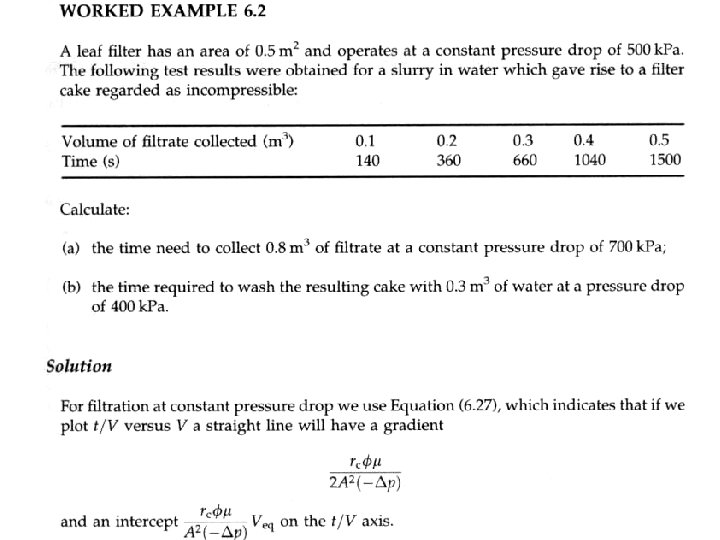
Filtration • Incompressible cake (From Ergun equation) The volume of cake formed by the passage of unit volume of filtrate. (Eq. 6. 21, See Appendix 1 for derivation )
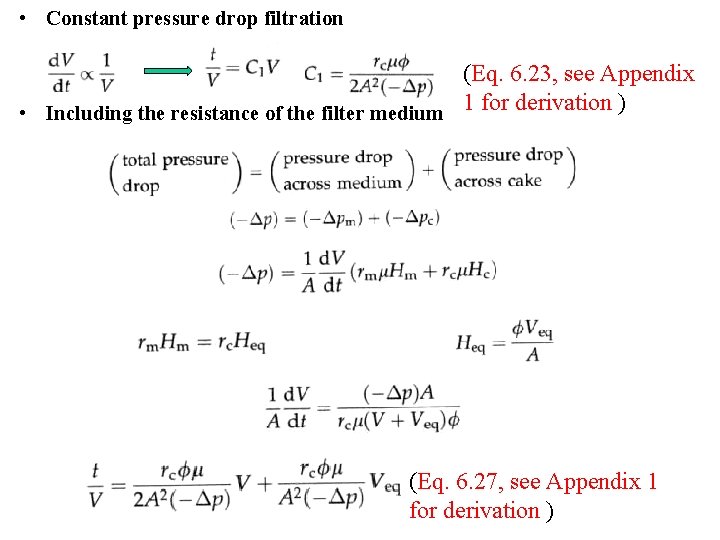
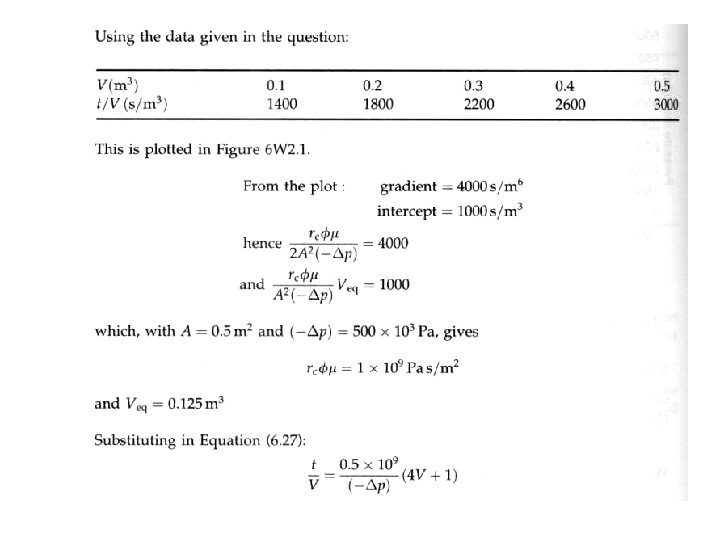
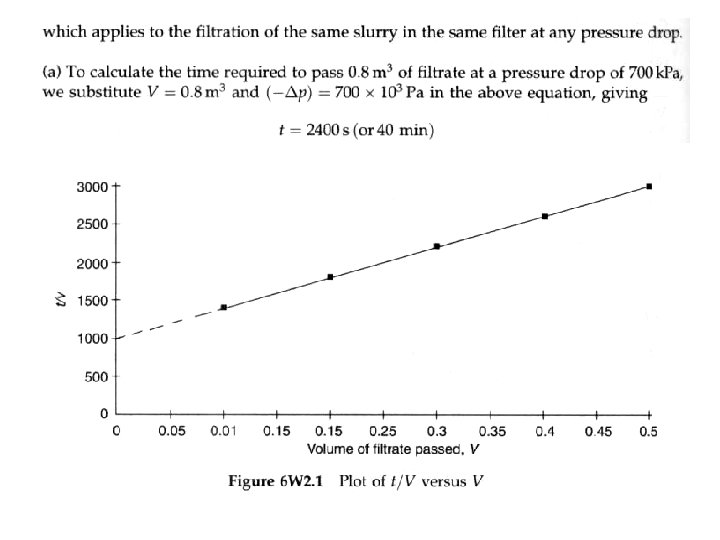
• Constant pressure drop filtration (Eq. 6. 23, see Appendix • Including the resistance of the filter medium 1 for derivation ) (Eq. 6. 27, see Appendix 1 for derivation )
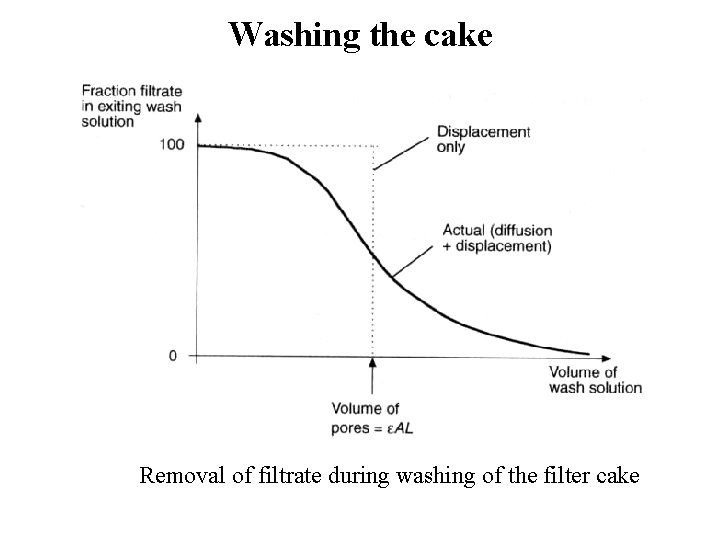
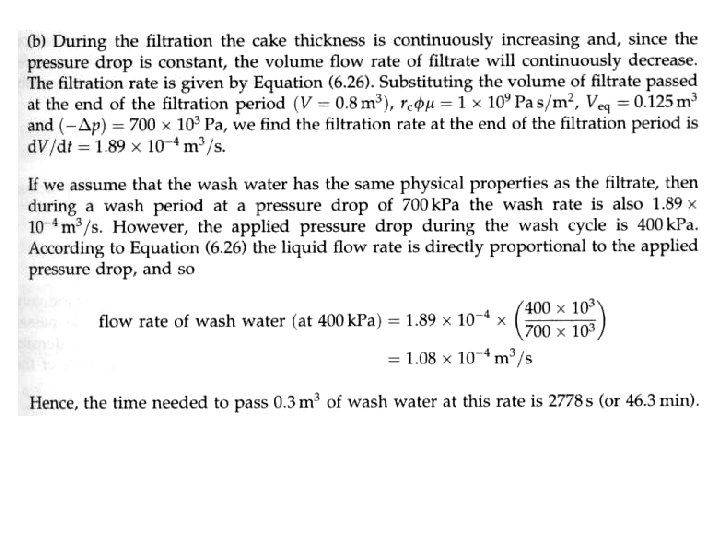
Washing the cake Removal of filtrate during washing of the filter cake
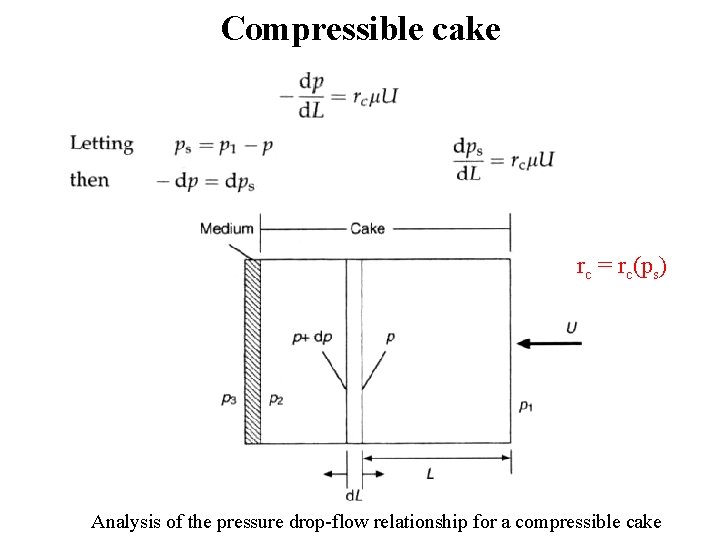
Compressible cake rc = rc(ps) Analysis of the pressure drop-flow relationship for a compressible cake
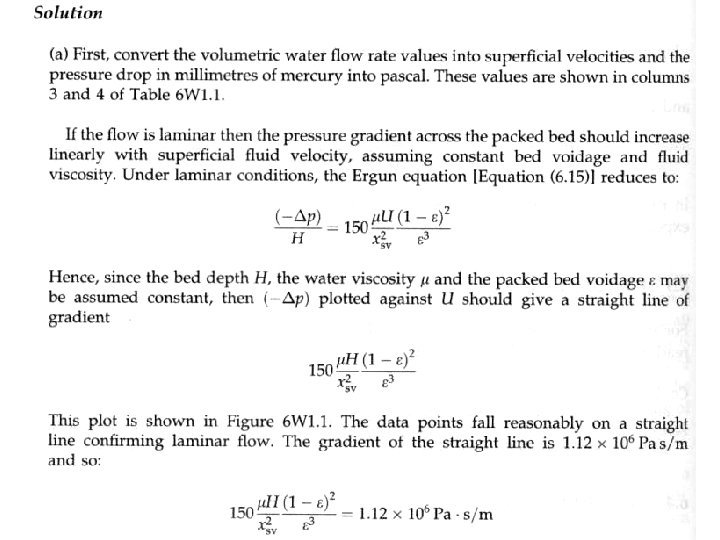
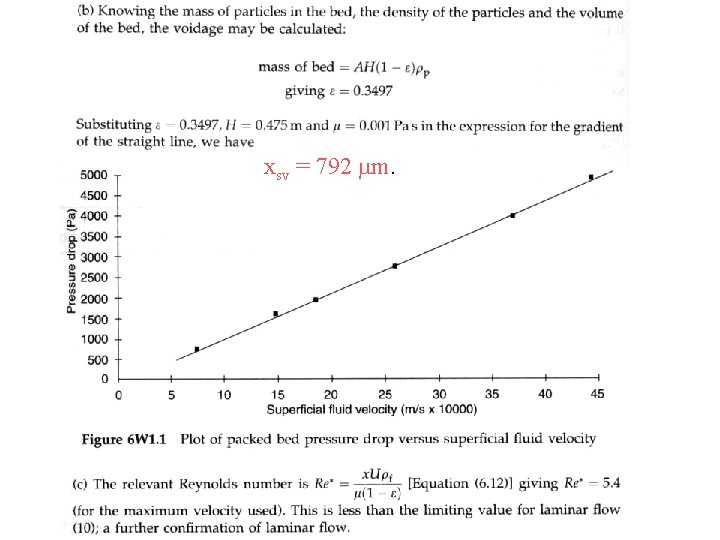
xsv = 792 mm.