Week 1 Introduction to the Social Sciences Anthropology


- Slides: 12
Week 1 Introduction to the Social Sciences: Anthropology Prof. Joel Stocker, Ph. D. Kaohsiung Medical University
Course Textbook Schultz, E. A. , & Lavenda, R. H. (2005). Cultural anthropology: a perspective on the human condition (6 th ed. ). New York: Oxford University Press. (Available in the library)
Course Grading (5 weeks) ► 20% Attendance (including guest lecture) ► 25% Participation and discussion (in class and online) ► 20% Assignment: Anthropological field work exercise ► 35% Quizzes (2)
Schedule Highlights ► Week 2: Quiz 1 (during discussion section) ► Week 4: Hand in your written Assignment: fieldwork exercise (2 -3 pages in English) ► Week 4: Before class, watch the film Nanook of the North online or in the library ► Week 5: Quiz 2 (during discussion section) ► Dec. 8: Guest speaker, Dr. Huang (Friday, 2 PM)
The Social Sciences ► The rise of the social sciences § Anthropology, Sociology, Psychology
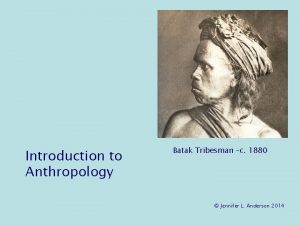
What is anthropology? The study of § human nature, human culture and society, and the human past; § how human biology, prehistory and history, economics, politics, religion, and kinship shape one another to make human life what it is; § local contexts situated in broader social, cultural, and political matrices; § what it means to be human.
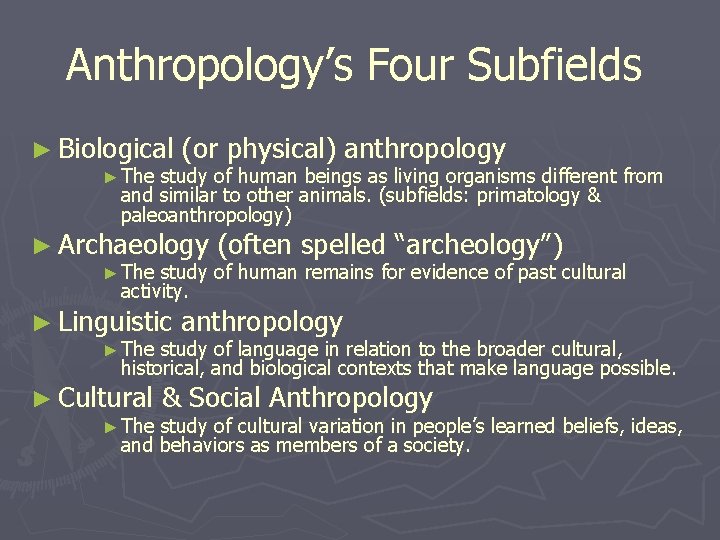
Anthropology’s Four Subfields ► Biological ► The (or physical) anthropology study of human beings as living organisms different from and similar to other animals. (subfields: primatology & paleoanthropology) ► Archaeology ► The (often spelled “archeology”) study of human remains for evidence of past cultural activity. ► Linguistic ► The anthropology study of language in relation to the broader cultural, historical, and biological contexts that make language possible. ► Cultural ► The & Social Anthropology study of cultural variation in people’s learned beliefs, ideas, and behaviors as members of a society.
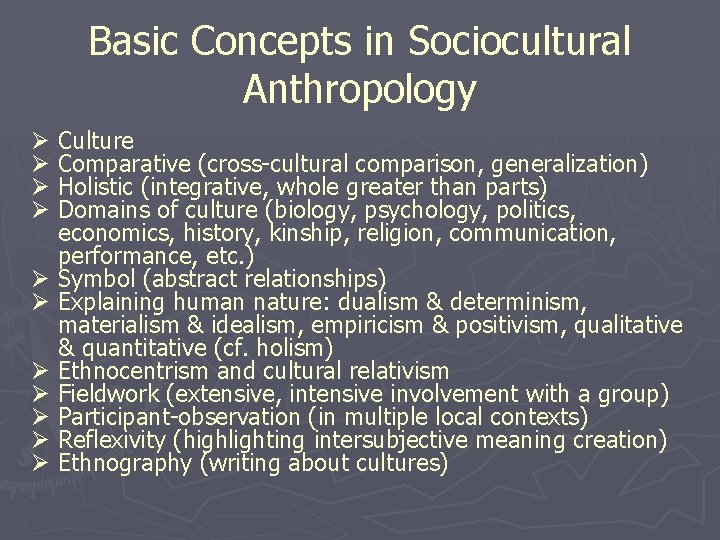
Basic Concepts in Sociocultural Anthropology Ø Culture Ø Comparative (cross-cultural comparison, generalization) Ø Holistic (integrative, whole greater than parts) Ø Domains of culture (biology, psychology, politics, economics, history, kinship, religion, communication, performance, etc. ) Ø Symbol (abstract relationships) Ø Explaining human nature: dualism & determinism, materialism & idealism, empiricism & positivism, qualitative & quantitative (cf. holism) Ø Ethnocentrism and cultural relativism Ø Fieldwork (extensive, intensive involvement with a group) Ø Participant-observation (in multiple local contexts) Ø Reflexivity (highlighting intersubjective meaning creation) Ø Ethnography (writing about cultures)
Culture ► People’s learned beliefs, ideas, and behaviors as members of a society. ► Human culture is learned, shared, patterned, adaptive, and symbolic. ► The main way in which human groups differ from one another. ► Began over 5 million years ago with hominid bipedalism and opposable thumb & fingers; 2. 5 million years ago with stone tools; 200, 000 years ago with homo sapiens’ complex symbolic representation and social organization.
Assignment: field work exercise ► Due Week 4 (beginning of class). ► 2 -3 pages, in English, typed & printed. ► 30 minutes or more, observe and participate in the lives of several, or a group, of people. ► Record their as well as your own behavior, thoughts, and feelings. Take notes. ► Include in your report: method of observation, location and participants (setting and characters), research-related issues you experienced, and the social patterns and forms of cultural communication you observed.
Next Week’s Reading ► Schultz & Lavenda, Chapter 5. Language.
Discussion Questions Can cultural anthropology be used to study modern societies and large-scale urban societies? ► What’s the difference between sociology and anthropology? Is it a matter of methods, topics, scale, academic tradition, or what? ► Share your ideas about the difference between society and culture (which we’ll discuss more in the coming weeks). ► Is cultural anthropology, as a “soft” science, less valid as a means of understanding reality, compared with “hard sciences” such as mathematics, physics, biology, and chemistry? ► Is there a universal knowledge? If so, could you call it a universal culture? Are the “natural sciences” really so “natural”? ►