
Week 1 Introduction to the Philosophy of Knowledge
- Slides: 7
Week 1: Introduction to the Philosophy of Knowledge A Part of PRDPK (slides will be available on Moodle and at http: //cfpm. org/doctrain) Introduction to the Philosophy of Knowledge, RDPK Module, Bruce Edmonds, http: //cfpm. org/doctrain slide-‹#›
Part 2: Some examples Introduction to the Philosophy of Knowledge, RDPK Module, Bruce Edmonds, http: //cfpm. org/doctrain Introduction to the Philosophy of Knowledge, RDPK Module, Bruce Edmonds, slide-‹#› http: //cfpm. org/doctrain slide-‹#›
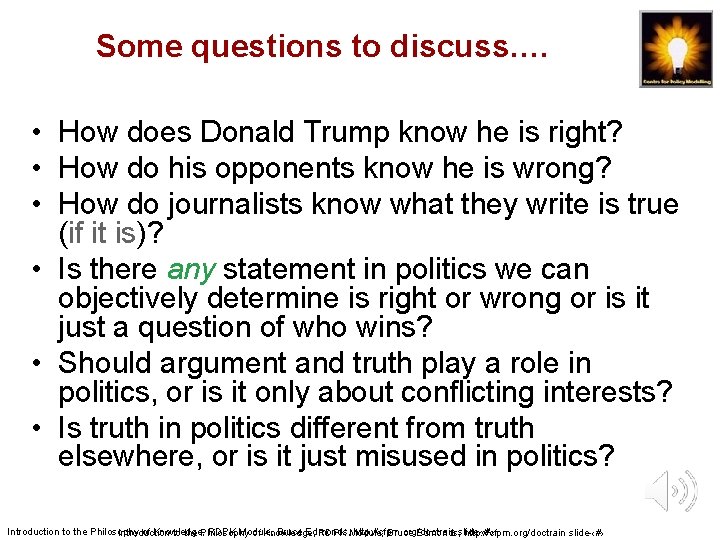
Some questions to discuss. … • How does Donald Trump know he is right? • How do his opponents know he is wrong? • How do journalists know what they write is true (if it is)? • Is there any statement in politics we can objectively determine is right or wrong or is it just a question of who wins? • Should argument and truth play a role in politics, or is it only about conflicting interests? • Is truth in politics different from truth elsewhere, or is it just misused in politics? Introduction to the Philosophy of Knowledge, RDPK Module, Bruce Edmonds, http: //cfpm. org/doctrain Introduction to the Philosophy of Knowledge, RDPK Module, Bruce Edmonds, slide-‹#› http: //cfpm. org/doctrain slide-‹#›
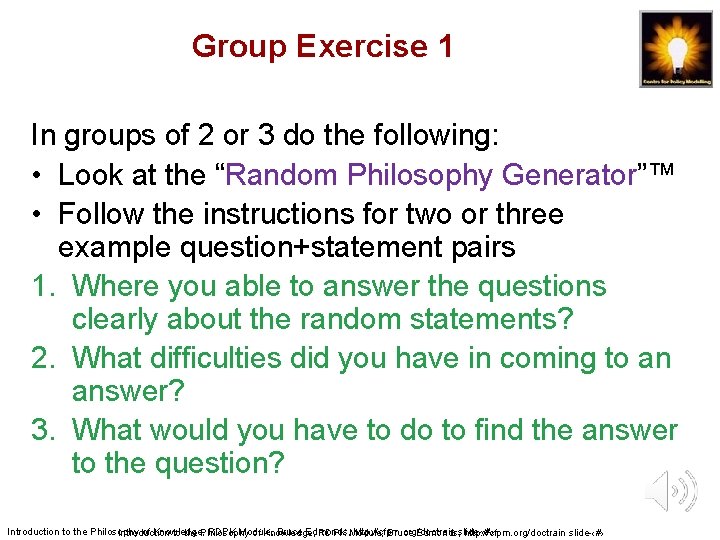
Group Exercise 1 In groups of 2 or 3 do the following: • Look at the “Random Philosophy Generator”™ • Follow the instructions for two or three example question+statement pairs 1. Where you able to answer the questions clearly about the random statements? 2. What difficulties did you have in coming to an answer? 3. What would you have to do to find the answer to the question? Introduction to the Philosophy of Knowledge, RDPK Module, Bruce Edmonds, http: //cfpm. org/doctrain Introduction to the Philosophy of Knowledge, RDPK Module, Bruce Edmonds, slide-‹#› http: //cfpm. org/doctrain slide-‹#›
Brainstorm of Difficulties • Make a list of the difficulties that you encountered when trying to do this…. • Did you all have the same difficulties, or different ones? • After you have made a list, look at the next slide and compare your list with those listed by previous students. Introduction to the Philosophy of Knowledge, RDPK Module, Bruce Edmonds, http: //cfpm. org/doctrain Introduction to the Philosophy of Knowledge, RDPK Module, Bruce Edmonds, slide-‹#› http: //cfpm. org/doctrain slide-‹#›
Previous List of Difficulties • • • Difficult to define terms We did not have enough context Different points of view Unsaid underlying assumptions Not enough knowledge to answer the question • The question becomes more difficult the more you think about it • No way to check the right answer Introduction to the Philosophy of Knowledge, RDPK Module, Bruce Edmonds, http: //cfpm. org/doctrain Introduction to the Philosophy of Knowledge, RDPK Module, Bruce Edmonds, slide-‹#› http: //cfpm. org/doctrain slide-‹#›
Contact details: Centre for Policy Modelling Email: bruce@edmonds. name All materials will be at: cfpm. org/doctrain (as well as on Moodle) Introduction to the Philosophy of Knowledge, RDPK Module, Bruce Edmonds, http: //cfpm. org/doctrain slide-‹#›