
Week 1 Introduction to Social Psychology Course outline

- Slides: 21
Week 1: Introduction to Social Psychology § Course outline and requirements § What is social psychology? § Examples of social psychological phenomena § Definitions; Key features § Compared to other scientific disciplines § Important themes § Goals for the course § Doing social psychology § Hypotheses and variables § Methods for testing hypotheses § Correlational research § Experimental research § Social Psychology pre-test § Did you know it all along? § The common sense criticism § Problems with this criticism
Companion Web Site www. pearsoned. ca/baron 4_ca § Contains: § § § Chapter objectives Essay questions Multiple choice questions Destinations (links)
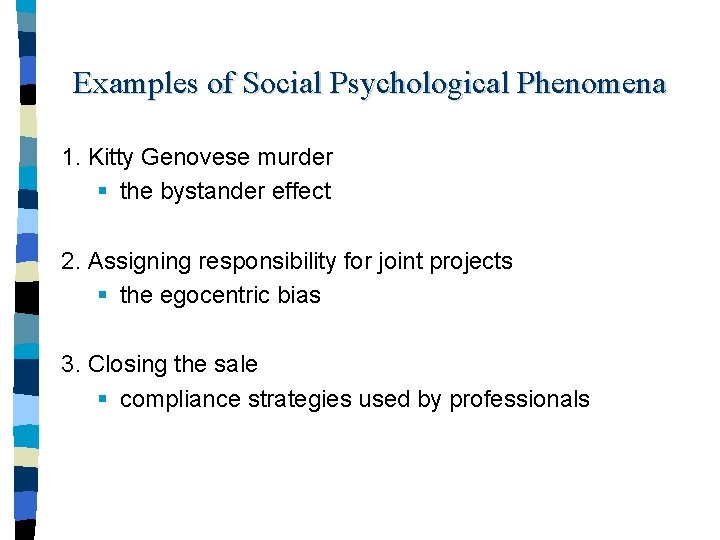
Examples of Social Psychological Phenomena 1. Kitty Genovese murder § the bystander effect 2. Assigning responsibility for joint projects § the egocentric bias 3. Closing the sale § compliance strategies used by professionals
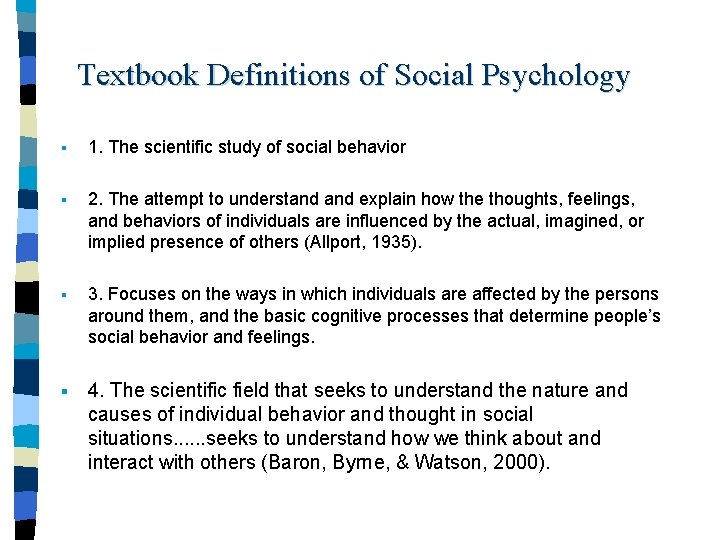
Textbook Definitions of Social Psychology § 1. The scientific study of social behavior § 2. The attempt to understand explain how the thoughts, feelings, and behaviors of individuals are influenced by the actual, imagined, or implied presence of others (Allport, 1935). § 3. Focuses on the ways in which individuals are affected by the persons around them, and the basic cognitive processes that determine people’s social behavior and feelings. § 4. The scientific field that seeks to understand the nature and causes of individual behavior and thought in social situations. . . seeks to understand how we think about and interact with others (Baron, Byrne, & Watson, 2000).
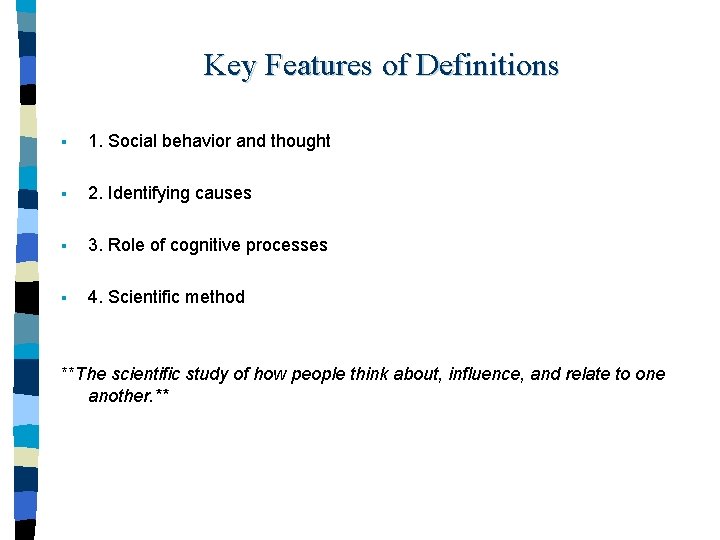
Key Features of Definitions § 1. Social behavior and thought § 2. Identifying causes § 3. Role of cognitive processes § 4. Scientific method **The scientific study of how people think about, influence, and relate to one another. **
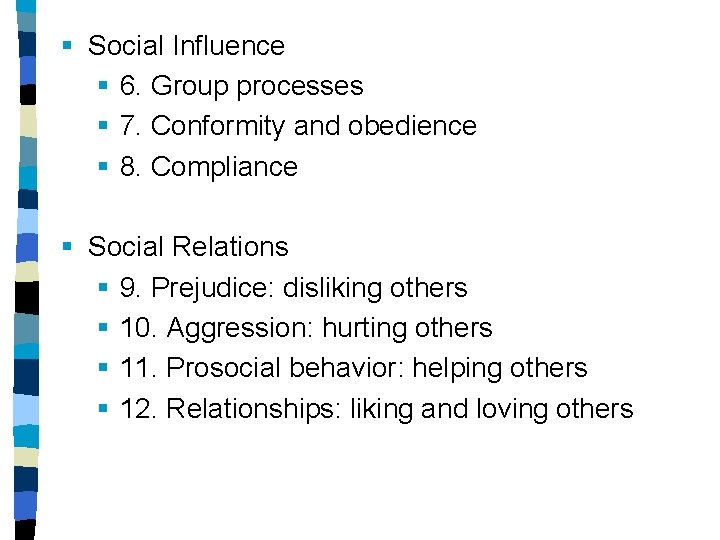
SOCIAL PSYCHOLOGY: COURSE OUTLINE § Introduction to Social Psychology § 1. Introduction § Social Thinking § 2. Attitudes and behavior § 3. Social perception; attribution § 4. Social cognition § 5. The self and identity
§ Social Influence § 6. Group processes § 7. Conformity and obedience § 8. Compliance § Social Relations § 9. Prejudice: disliking others § 10. Aggression: hurting others § 11. Prosocial behavior: helping others § 12. Relationships: liking and loving others
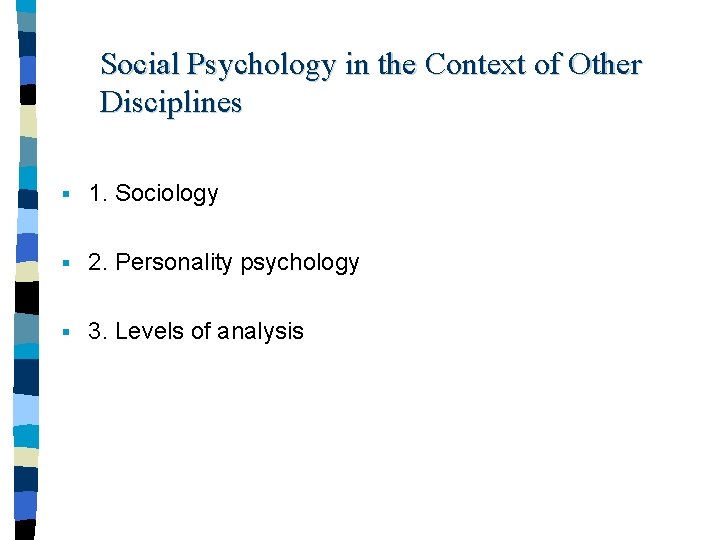
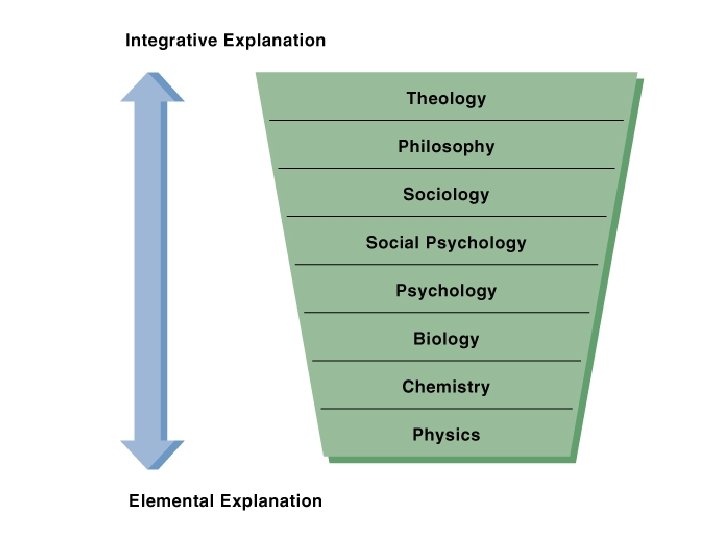
Social Psychology in the Context of Other Disciplines § 1. Sociology § 2. Personality psychology § 3. Levels of analysis
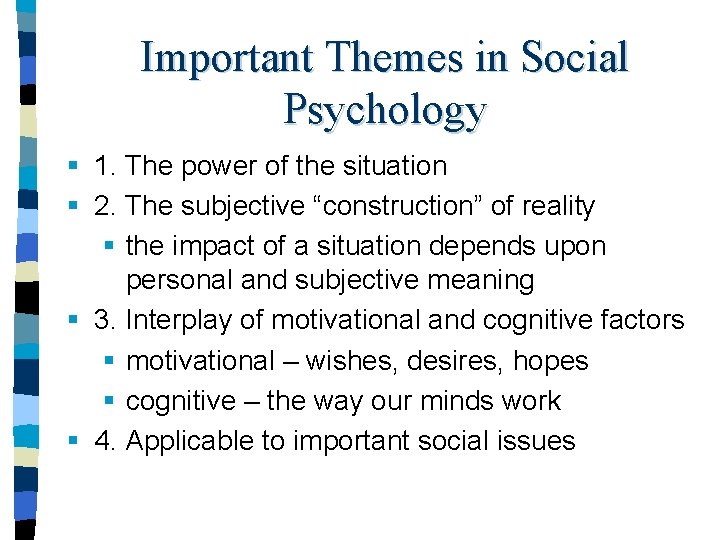
Important Themes in Social Psychology § 1. The power of the situation § 2. The subjective “construction” of reality § the impact of a situation depends upon personal and subjective meaning § 3. Interplay of motivational and cognitive factors § motivational – wishes, desires, hopes § cognitive – the way our minds work § 4. Applicable to important social issues
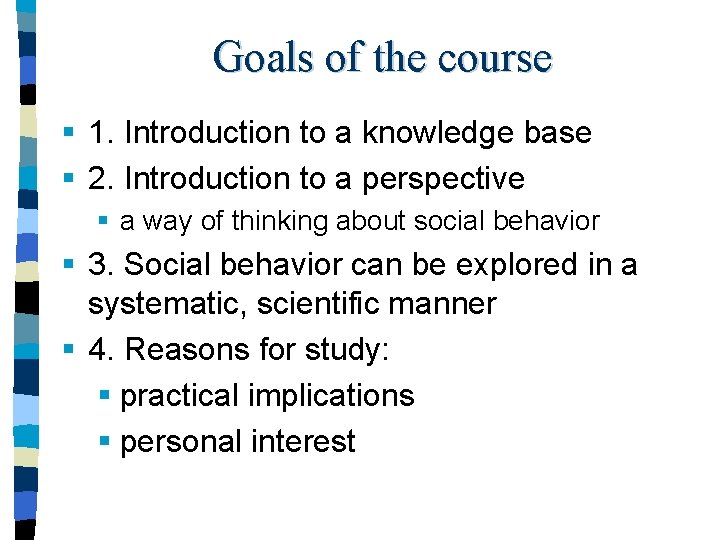
Goals of the course § 1. Introduction to a knowledge base § 2. Introduction to a perspective § a way of thinking about social behavior § 3. Social behavior can be explored in a systematic, scientific manner § 4. Reasons for study: § practical implications § personal interest
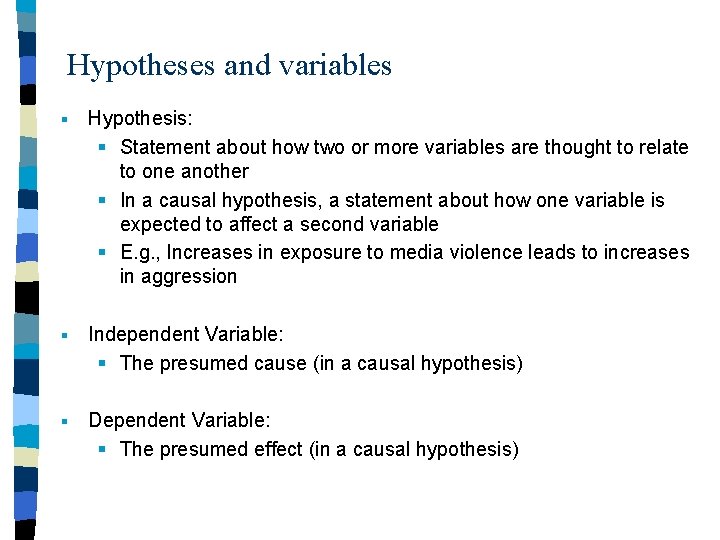
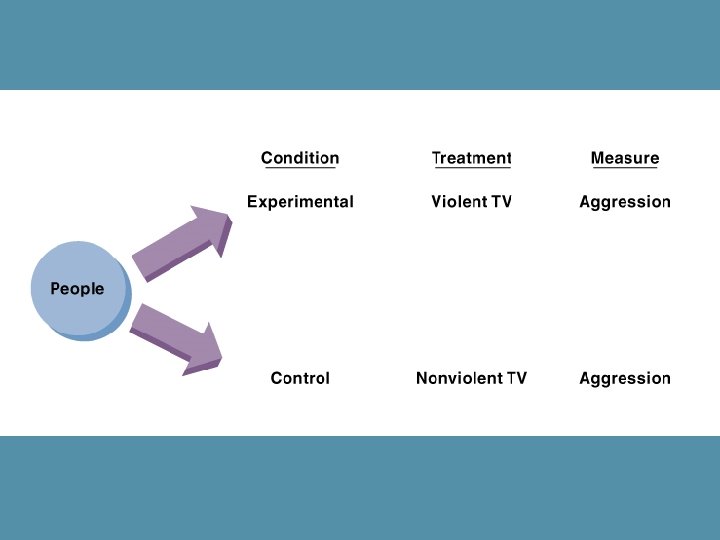
Hypotheses and variables § Hypothesis: § Statement about how two or more variables are thought to relate to one another § In a causal hypothesis, a statement about how one variable is expected to affect a second variable § E. g. , Increases in exposure to media violence leads to increases in aggression § Independent Variable: § The presumed cause (in a causal hypothesis) § Dependent Variable: § The presumed effect (in a causal hypothesis)
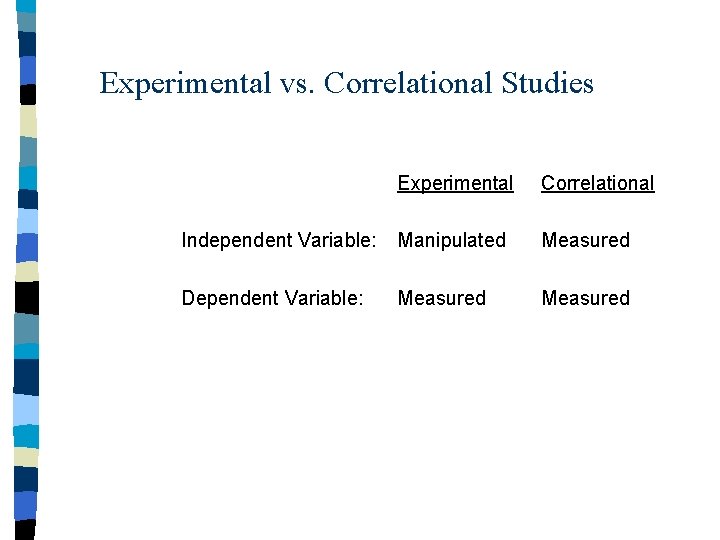
Experimental vs. Correlational Studies Experimental Correlational Independent Variable: Manipulated Measured Dependent Variable: Measured
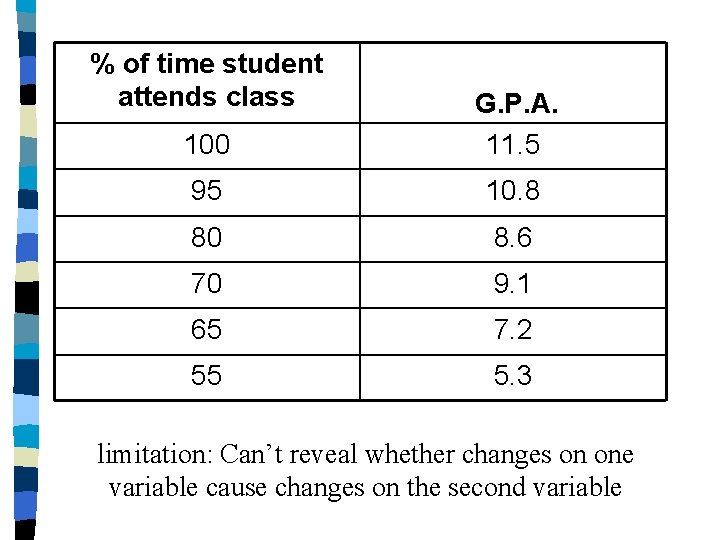
Correlational Research § can reveal whether changes on one variable co-occur with changes on a second variable § e. g. , correlational study relating class attendance to G. P. A. § Strength of relationship indexed by the Pearson correlation coefficient (r = -1. 0 to r = 1. 0)
% of time student attends class 100 G. P. A. 11. 5 95 10. 8 80 8. 6 70 9. 1 65 7. 2 55 5. 3 limitation: Can’t reveal whether changes on one variable cause changes on the second variable
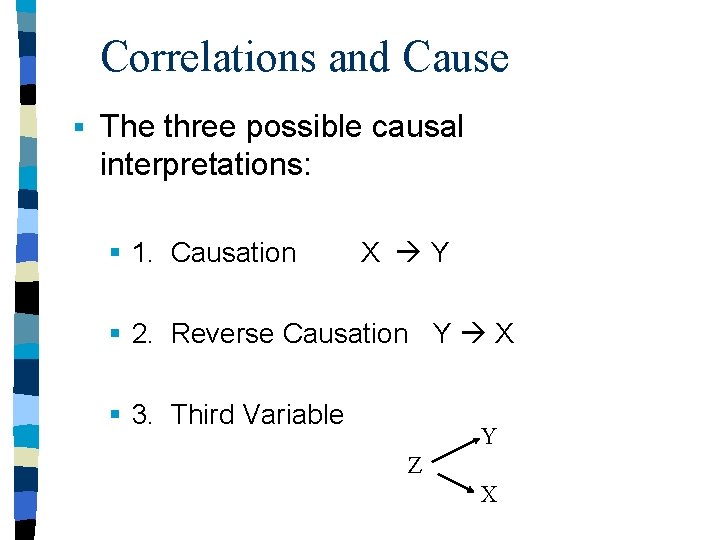
Correlations and Cause § The three possible causal interpretations: § 1. Causation X Y § 2. Reverse Causation Y X § 3. Third Variable Y Z X
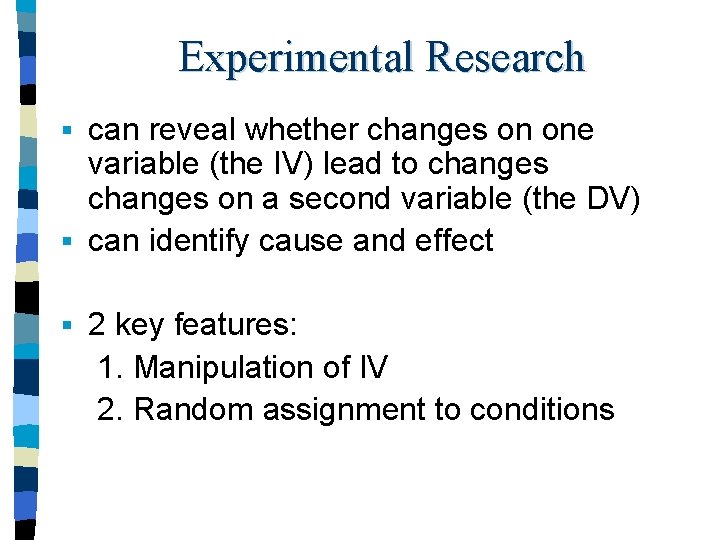
Experimental Research can reveal whether changes on one variable (the IV) lead to changes on a second variable (the DV) § can identify cause and effect § § 2 key features: 1. Manipulation of IV 2. Random assignment to conditions
Social Psychology and Common Sense § The “common sense” criticism § e. g. , “day after day social scientists go into the world and discover that people’s behavior is pretty much what you’d expect” § e. g. , Historians’ criticisms of social scientists’ studies of WWII soldiers.
§ Problems with the common-sense criticism: § 1. Common wisdom is unclear, ambiguous, contradictory § 2. Common wisdom is often inaccurate § 3. Hindsight bias (I-knew-it-all-along effect)
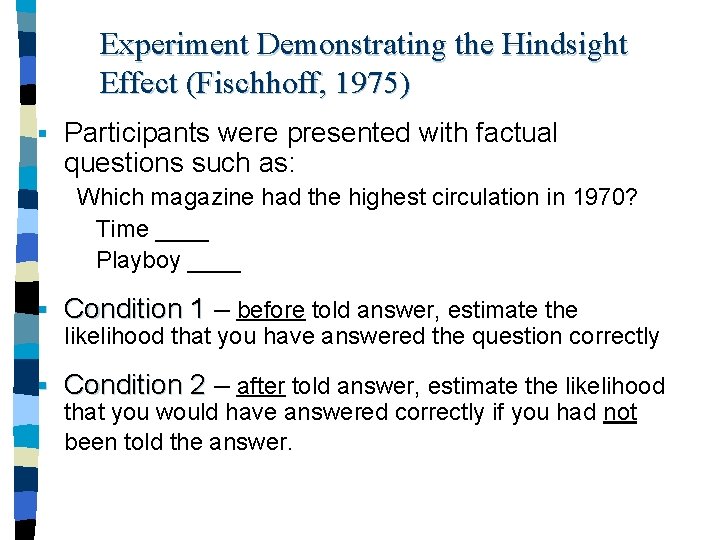
Experiment Demonstrating the Hindsight Effect (Fischhoff, 1975) § Participants were presented with factual questions such as: Which magazine had the highest circulation in 1970? Time ____ Playboy ____ § Condition 1 – Condition 1 before told answer, estimate the § Condition 2 – Condition 2 after told answer, estimate the likelihood that you have answered the question correctly that you would have answered correctly if you had not been told the answer.