
Week 1 Atomic Structure Elements Mixtures and Compounds
- Slides: 6
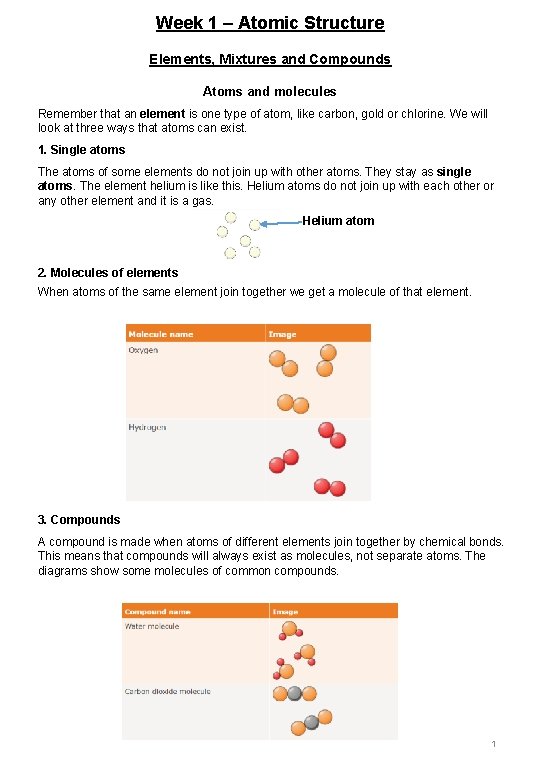
Week 1 – Atomic Structure Elements, Mixtures and Compounds Atoms and molecules Remember that an element is one type of atom, like carbon, gold or chlorine. We will look at three ways that atoms can exist. 1. Single atoms The atoms of some elements do not join up with other atoms. They stay as single atoms. The element helium is like this. Helium atoms do not join up with each other or any other element and it is a gas. Helium atom 2. Molecules of elements When atoms of the same element join together we get a molecule of that element. 3. Compounds A compound is made when atoms of different elements join together by chemical bonds. This means that compounds will always exist as molecules, not separate atoms. The diagrams show some molecules of common compounds. 1
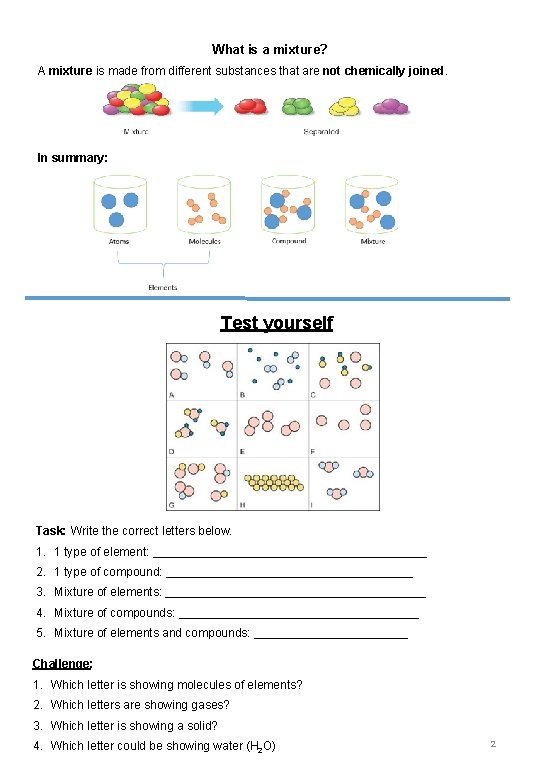
What is a mixture? A mixture is made from different substances that are not chemically joined. In summary: Test yourself Task: Write the correct letters below. 1. 1 type of element: _____________________ 2. 1 type of compound: ___________________ 3. Mixture of elements: ____________________ 4. Mixture of compounds: __________________ 5. Mixture of elements and compounds: ____________ Challenge: 1. Which letter is showing molecules of elements? 2. Which letters are showing gases? 3. Which letter is showing a solid? 4. Which letter could be showing water (H 2 O) 2
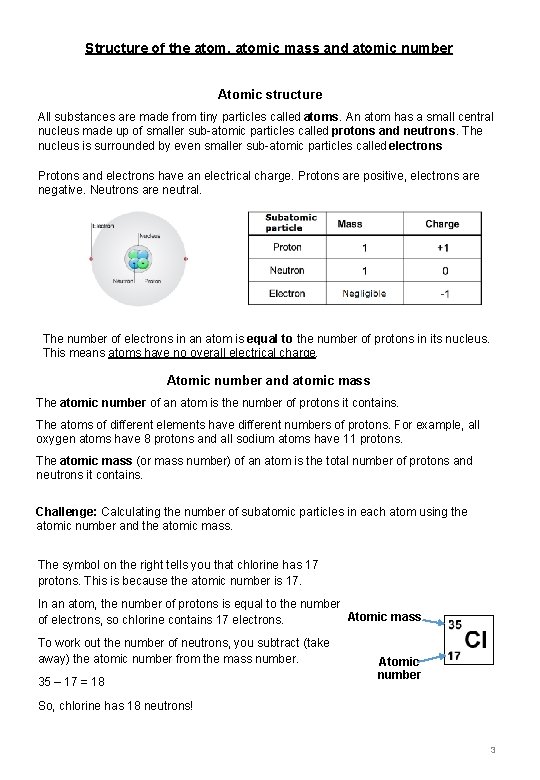
Structure of the atom, atomic mass and atomic number Atomic structure All substances are made from tiny particles called atoms. An atom has a small central nucleus made up of smaller sub-atomic particles called protons and neutrons. The nucleus is surrounded by even smaller sub-atomic particles called electrons Protons and electrons have an electrical charge. Protons are positive, electrons are negative. Neutrons are neutral. The number of electrons in an atom is equal to the number of protons in its nucleus. This means atoms have no overall electrical charge. Atomic number and atomic mass The atomic number of an atom is the number of protons it contains. The atoms of different elements have different numbers of protons. For example, all oxygen atoms have 8 protons and all sodium atoms have 11 protons. The atomic mass (or mass number) of an atom is the total number of protons and neutrons it contains. Challenge: Calculating the number of subatomic particles in each atom using the atomic number and the atomic mass. The symbol on the right tells you that chlorine has 17 protons. This is because the atomic number is 17. In an atom, the number of protons is equal to the number Atomic mass of electrons, so chlorine contains 17 electrons. To work out the number of neutrons, you subtract (take away) the atomic number from the mass number. 35 – 17 = 18 Atomic number So, chlorine has 18 neutrons! 3
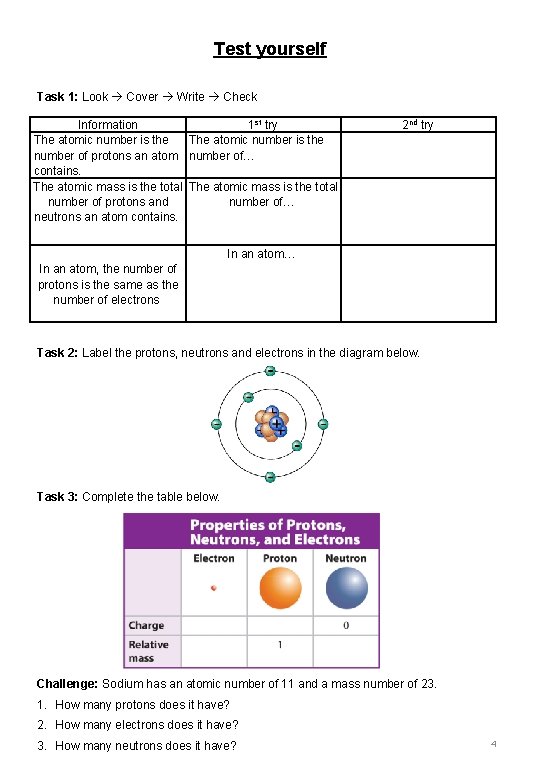
Test yourself Task 1: Look Cover Write Check Information 1 st try The atomic number is the number of protons an atom number of… contains. The atomic mass is the total number of protons and number of… neutrons an atom contains. 2 nd try In an atom… In an atom, the number of protons is the same as the number of electrons Task 2: Label the protons, neutrons and electrons in the diagram below. Task 3: Complete the table below. Challenge: Sodium has an atomic number of 11 and a mass number of 23. 1. How many protons does it have? 2. How many electrons does it have? 3. How many neutrons does it have? 4
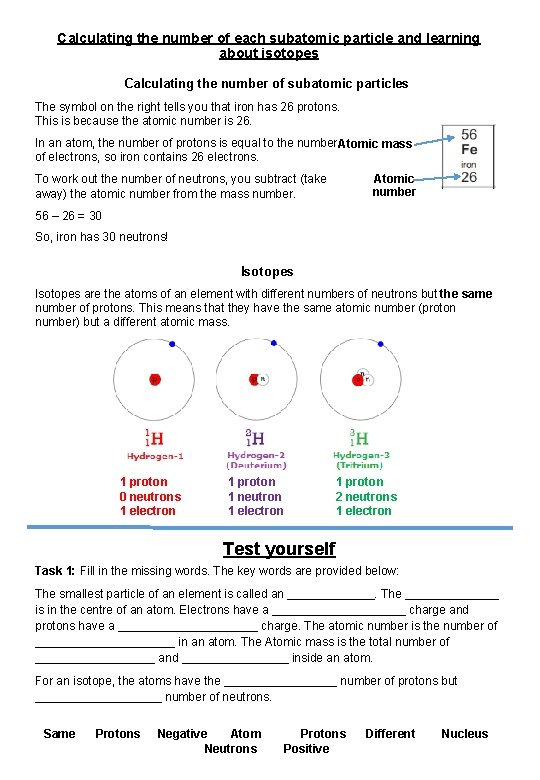
Calculating the number of each subatomic particle and learning about isotopes Calculating the number of subatomic particles The symbol on the right tells you that iron has 26 protons. This is because the atomic number is 26. In an atom, the number of protons is equal to the number Atomic mass of electrons, so iron contains 26 electrons. Atomic number To work out the number of neutrons, you subtract (take away) the atomic number from the mass number. 56 – 26 = 30 So, iron has 30 neutrons! Isotopes are the atoms of an element with different numbers of neutrons but the same number of protons. This means that they have the same atomic number (proton number) but a different atomic mass. 1 proton 0 neutrons 1 electron 1 proton 1 neutron 1 electron 1 proton 2 neutrons 1 electron Test yourself Task 1: Fill in the missing words. The key words are provided below: The smallest particle of an element is called an _______. The _______ is in the centre of an atom. Electrons have a __________ charge and protons have a ___________ charge. The atomic number is the number of ___________ in an atom. The Atomic mass is the total number of _________ and ________ inside an atom. For an isotope, the atoms have the _________ number of protons but __________ number of neutrons. Same Protons Negative Atom Neutrons Protons Positive Different Nucleus
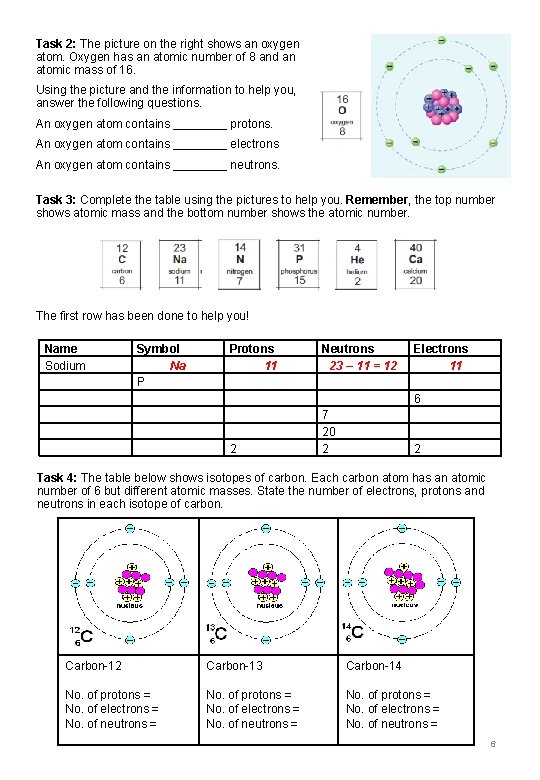
Task 2: The picture on the right shows an oxygen atom. Oxygen has an atomic number of 8 and an atomic mass of 16. Using the picture and the information to help you, answer the following questions. An oxygen atom contains ____ protons. An oxygen atom contains ____ electrons An oxygen atom contains ____ neutrons. Task 3: Complete the table using the pictures to help you. Remember, the top number shows atomic mass and the bottom number shows the atomic number. The first row has been done to help you! Name Sodium Symbol Na P Protons 11 Neutrons 23 – 11 = 12 Electrons 11 6 2 7 20 2 2 Task 4: The table below shows isotopes of carbon. Each carbon atom has an atomic number of 6 but different atomic masses. State the number of electrons, protons and neutrons in each isotope of carbon. Carbon-12 Carbon-13 Carbon-14 No. of protons = No. of electrons = No. of neutrons = 6