
Wednesday October 14 1998 Chapter 7 Angular measurements
Wednesday, October 14, 1998 Chapter 7: Angular measurements displacements speed acceleration
Circular Motion The Universal Law of Gravity We’ve spent the first 6 weeks of our class examining the motion of objects that move in straight lines or parabolic arcs (under the influence of gravity). We now look at objects that move in circles.
To make our life simpler, we’re going to use the angular unit of measure known as the radian when discussing the motion of objects in circular arcs. Let’s spend a little time trying to motivate our choice of radians over degrees as the unit of choice for measuring angles.
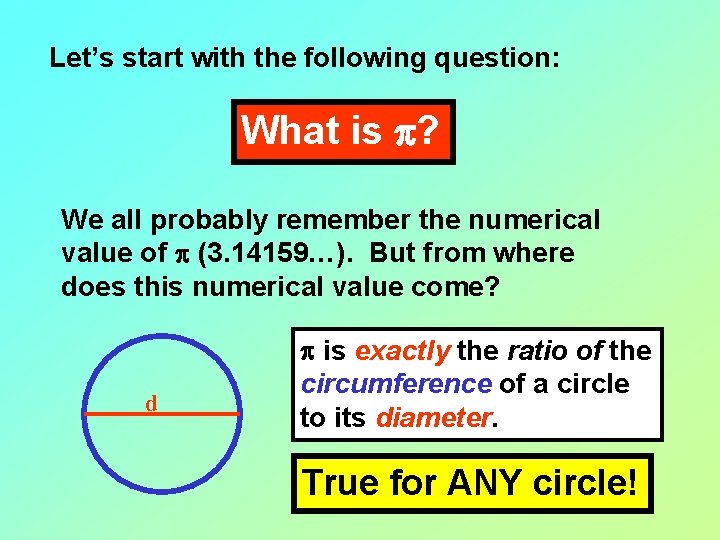
Let’s start with the following question: What is p? We all probably remember the numerical value of p (3. 14159…). But from where does this numerical value come? d p is exactly the ratio of the circumference of a circle to its diameter. True for ANY circle!
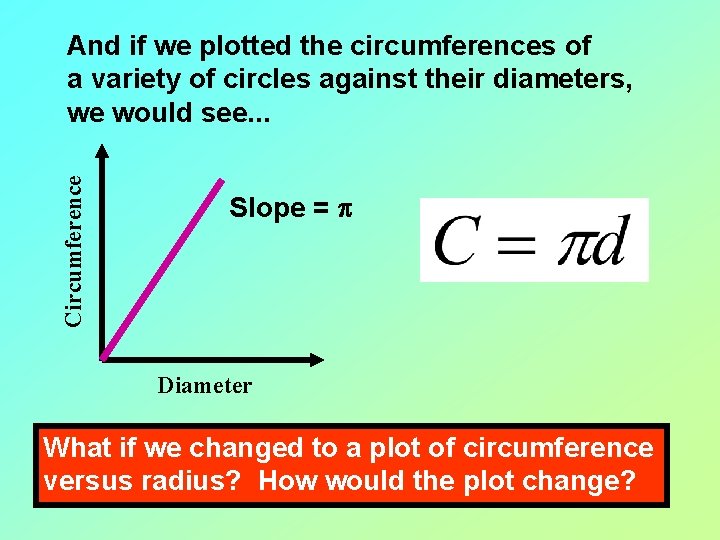
Circumference And if we plotted the circumferences of a variety of circles against their diameters, we would see. . . Slope = p Diameter What if we changed to a plot of circumference versus radius? How would the plot change?
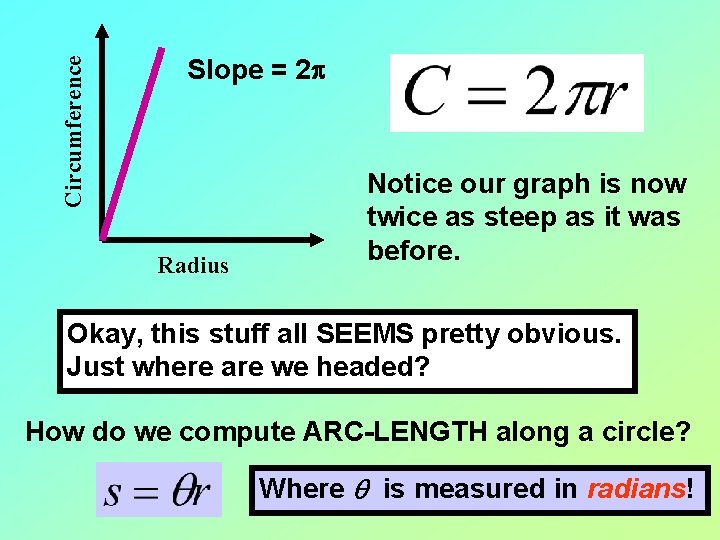
Circumference Slope = 2 p Radius Notice our graph is now twice as steep as it was before. Okay, this stuff all SEEMS pretty obvious. Just where are we headed? How do we compute ARC-LENGTH along a circle? Where q is measured in radians!
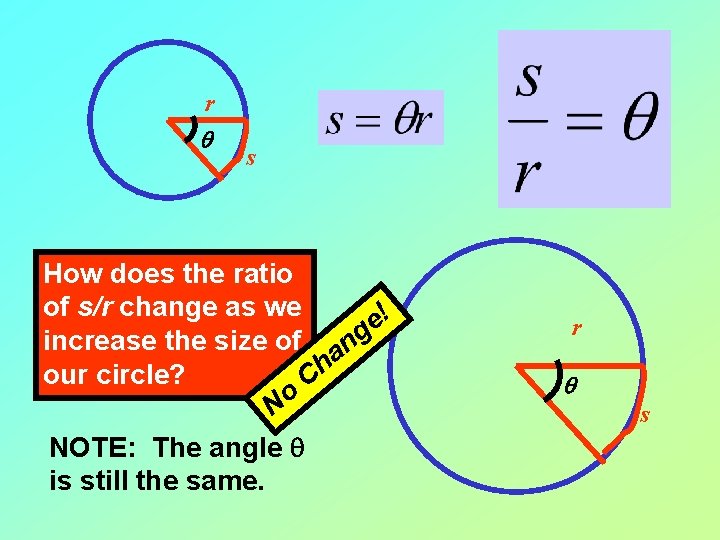
r q s How does the ratio of s/r change as we ! e g increase the size of n a h our circle? C o N NOTE: The angle q is still the same. r q s
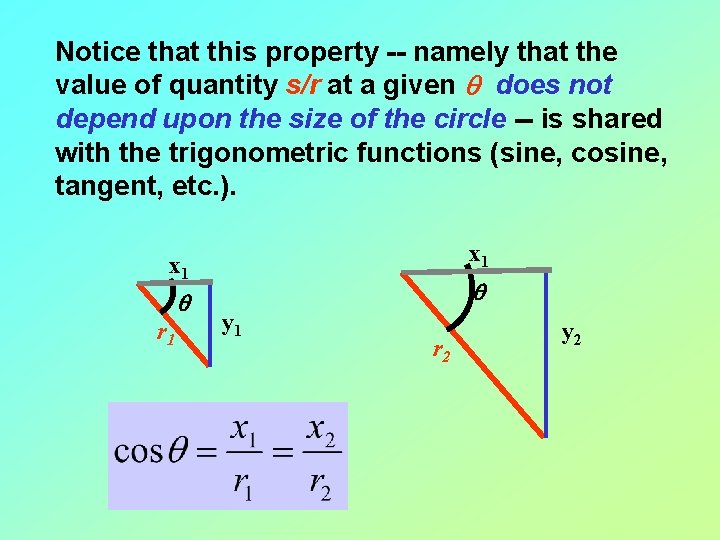
Notice that this property -- namely that the value of quantity s/r at a given q does not depend upon the size of the circle -- is shared with the trigonometric functions (sine, cosine, tangent, etc. ). x 1 q r 1 q y 1 r 2 y 2
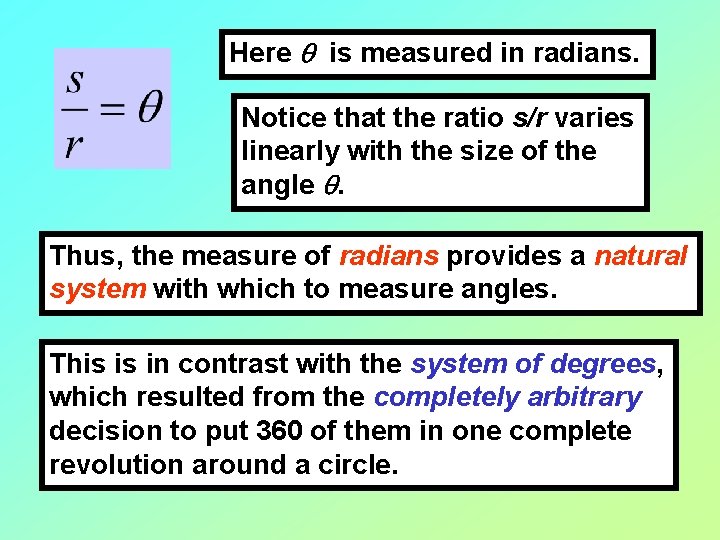
Here q is measured in radians. Notice that the ratio s/r varies linearly with the size of the angle q. Thus, the measure of radians provides a natural system with which to measure angles. This is in contrast with the system of degrees, which resulted from the completely arbitrary decision to put 360 of them in one complete revolution around a circle.
Now that we’ve seen that the natural system in which to measure in the “angular world” is the radian system, we are free to explore angular motions. Completely analogous to our discussion of the linear motion quantities of We can now define the angular quantities displacement velocity acceleration angular displacement angular velocity angular acceleration
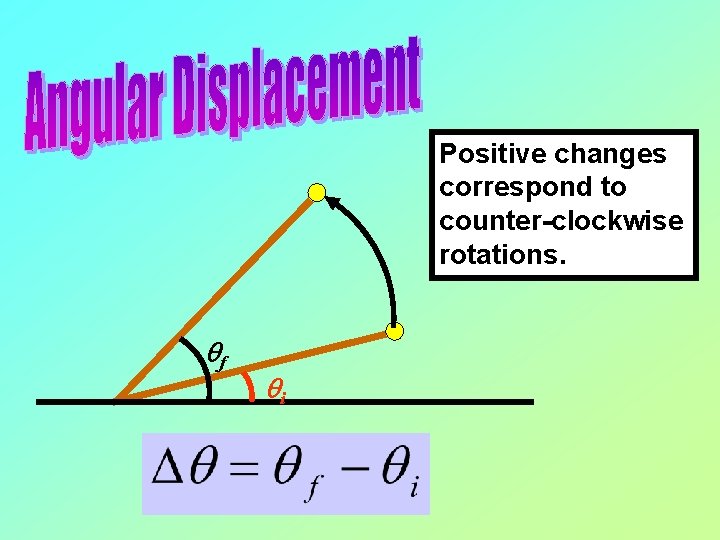
Positive changes correspond to counter-clockwise rotations. qf qi
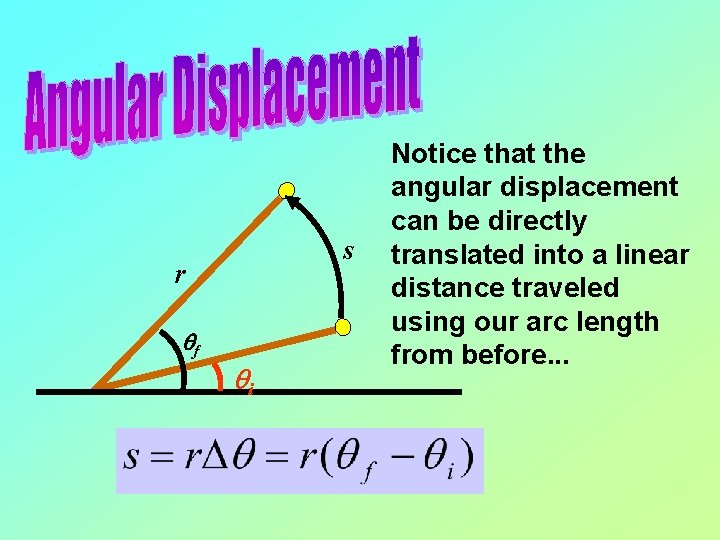
s r qf qi Notice that the angular displacement can be directly translated into a linear distance traveled using our arc length from before. . .
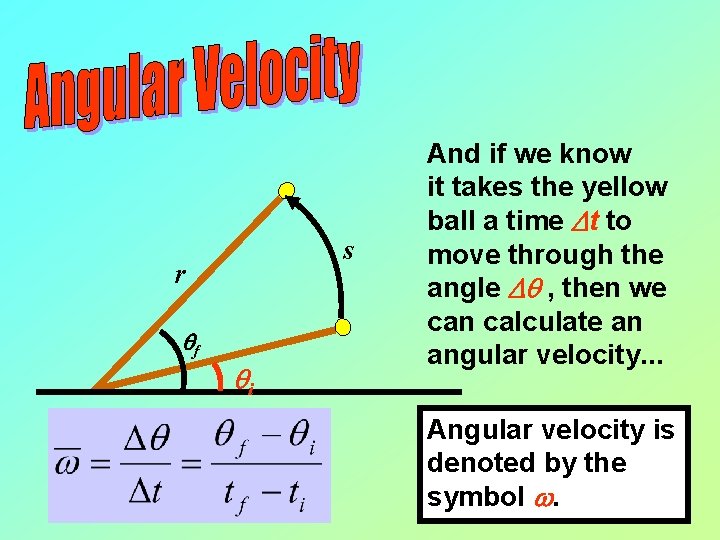
s r qf qi And if we know it takes the yellow ball a time Dt to move through the angle Dq , then we can calculate an angular velocity. . . Angular velocity is denoted by the symbol w.
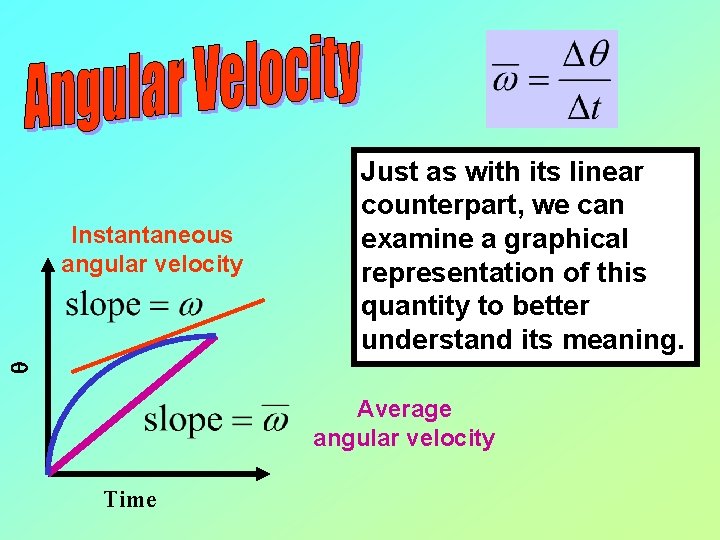
q Instantaneous angular velocity Just as with its linear counterpart, we can examine a graphical representation of this quantity to better understand its meaning. Average angular velocity Time
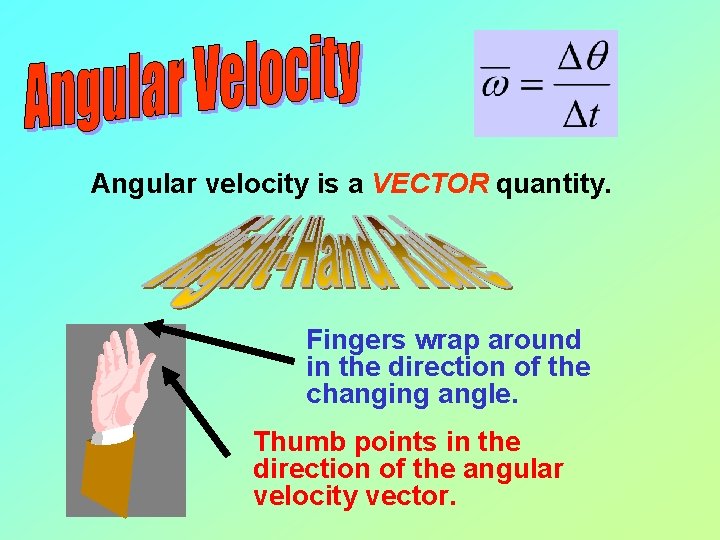
Angular velocity is a VECTOR quantity. Fingers wrap around in the direction of the changing angle. Thumb points in the direction of the angular velocity vector.

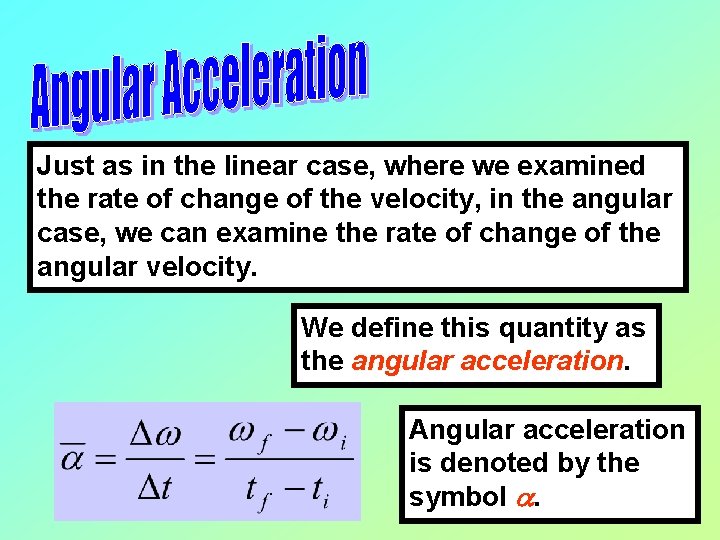
Just as in the linear case, where we examined the rate of change of the velocity, in the angular case, we can examine the rate of change of the angular velocity. We define this quantity as the angular acceleration. Angular acceleration is denoted by the symbol a.
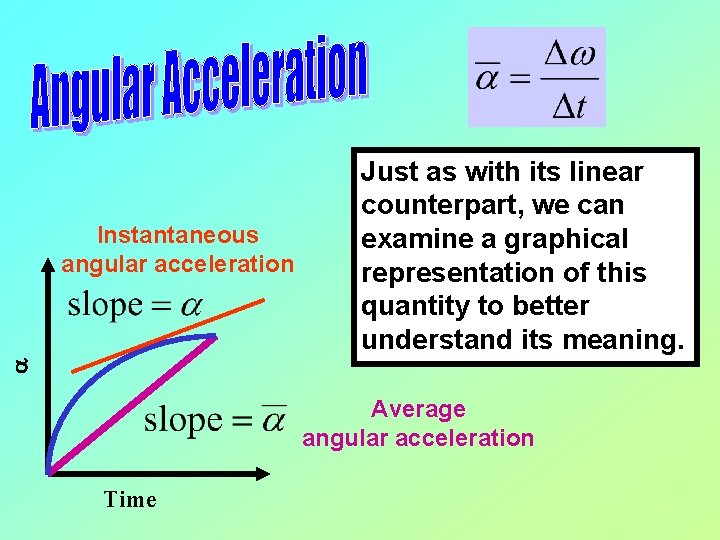
a Instantaneous angular acceleration Just as with its linear counterpart, we can examine a graphical representation of this quantity to better understand its meaning. Average angular acceleration Time
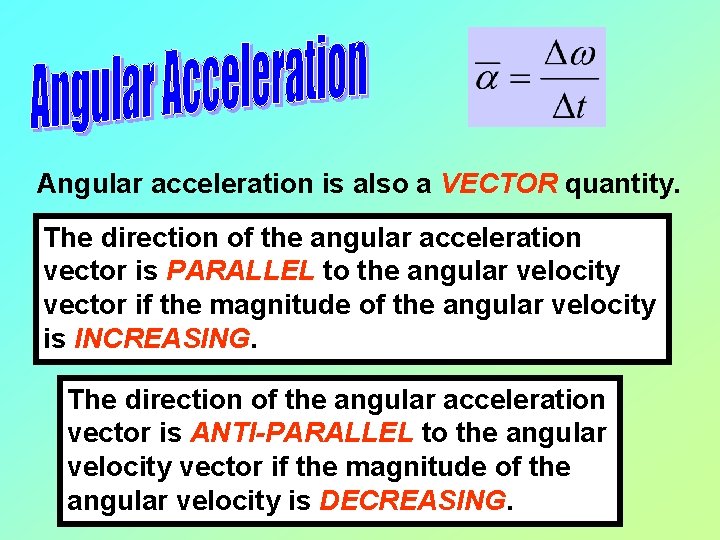
Angular acceleration is also a VECTOR quantity. The direction of the angular acceleration vector is PARALLEL to the angular velocity vector if the magnitude of the angular velocity is INCREASING. The direction of the angular acceleration vector is ANTI-PARALLEL to the angular velocity vector if the magnitude of the angular velocity is DECREASING.

Equations for Systems Involving Rotational Motion with Constant Angular Acceleration Again, these are completely analogous to what we derived for the kinetic equations of a linear system with constant linear acceleration!
- Slides: 20