
Wednesday December 2 THINK BACK TO THE NATIVE
Wednesday, December 2 THINK BACK TO THE NATIVE AMERICAN ACTIVITY WE DID ANSWER THE FOLLOWING QUESTIONS ON A SHEET OF PAPER WITH PARTNER: 1. WHAT WAS THE HISTORIC MIGRATION ROUTES THAT NATIVE AMERICANS' TOOK SINCE THE DEVELOPMENT OF THE US? 2. WHAT WERE SOME EFFECTS OF THE DAWES ACT (LATE 1800 S) AND THE INDIAN REORGANIZATION ACT (1930 S) ? 3. WHAT MIGRATION PATTERNS OCCURRED WITH THE URBAN RELOCATION PROGRAM (1960 S)? 4. LIST BOTH CULTURAL LOSSES WITH TRIBES OVERALL, AND HOW SOME TRIBES HAVE IMPLEMENTED REVITALIZATION EFFORTS
The Dawes Act of 1887 ◦ The new policy focused specifically on breaking up reservations by granting land allotments to individual Native Americans. If a person adopted white clothing and ways, and was responsible for his own farm, he would gradually drop his Indian-ness and be assimilated into the population. It would then no longer be necessary for the government to oversee Indian welfare in the paternalistic way it had been obligated to do, or provide meager annuities that seemed to keep the Indian in a subservient and poverty-stricken position. ◦ The purpose of the Dawes Act was to protect Indian property rights, particularly during the land rushes of the 1890 s, but in many instances the results were different. The land allotted to the Indians included desert or near-desert lands unsuitable for farming. Many Indians did not want to take up agriculture, and those who did want to farm could not afford the tools, animals, seed, and other supplies necessary to get started. There were also problems with inheritance. Often young children inherited allotments that they could not farm because they had been sent away to boarding schools. Multiple heirs also caused a problem; when several people inherited an allotment, the size of the holdings became too small for efficient farming.
Indian Reorganization Act- 1934 ◦ The act curtailed the future allotment of tribal communal lands to individuals and provided for the return of surplus lands to the tribes rather than to homesteaders. It also encouraged written constitutions and charters giving Indians the power to manage their internal affairs. Finally, funds were authorized for the establishment of a revolving credit program for tribal land purchases, for educational assistance, and for aiding tribal organization. ◦ With the funds for purchase of land, millions of additional acres were added to the reservations. Greatly improved staffs and services were provided in health and education, with more than half of all Indian children in public school by 1950.

Urban Relocation Program- 1960 s ◦ It was designed to entice reservation dwellers to seven major urban cities where the jobs supposedly were plentiful ( Chicago, Denver, Los Angeles, San Francisco, San Jose, St. Louis, Cincinnati, Cleveland Dallas). ◦ Relocatees were supposed to receive temporary housing, counseling and guidance in finding a job, permanent housing, community and social resources. That's what they were promised. ◦ Not every relocatee found a job, and those that did were generally at the lower end of the economic ladder. Others succumbed to alcohol and those who were accustomed to drinking in public on their home reservations got into trouble with the law when they drank on city streets. Many more were simply homesick so far away from their families and familiar landscapes. ◦ Still more decided to return to their reservation. But over the years, it's estimated that as many as 750, 000 Native Americans migrated to the cities between 1950 and 1980.
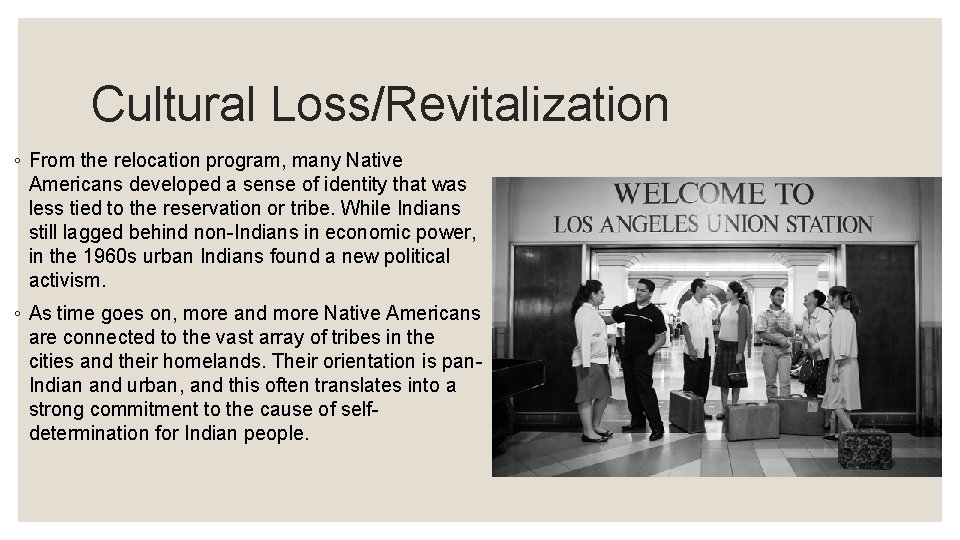
Cultural Loss/Revitalization ◦ From the relocation program, many Native Americans developed a sense of identity that was less tied to the reservation or tribe. While Indians still lagged behind non-Indians in economic power, in the 1960 s urban Indians found a new political activism. ◦ As time goes on, more and more Native Americans are connected to the vast array of tribes in the cities and their homelands. Their orientation is pan. Indian and urban, and this often translates into a strong commitment to the cause of selfdetermination for Indian people.
- Slides: 6