
Wednesday 30 th July 2020 Fluency Questions ANGLES
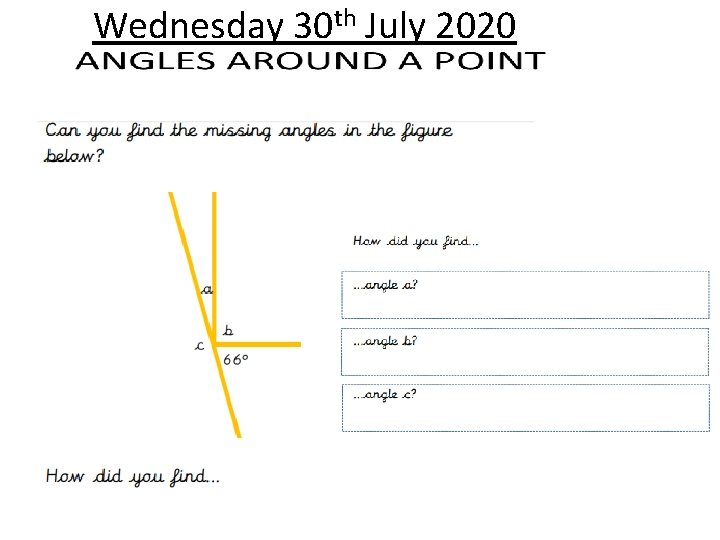
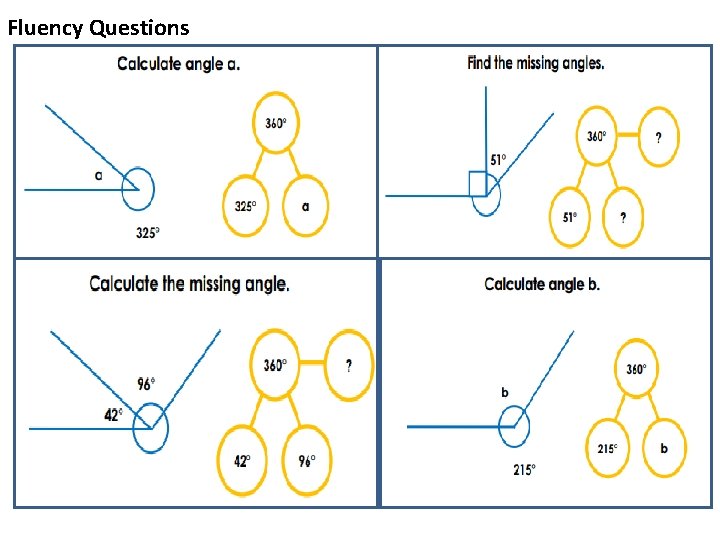
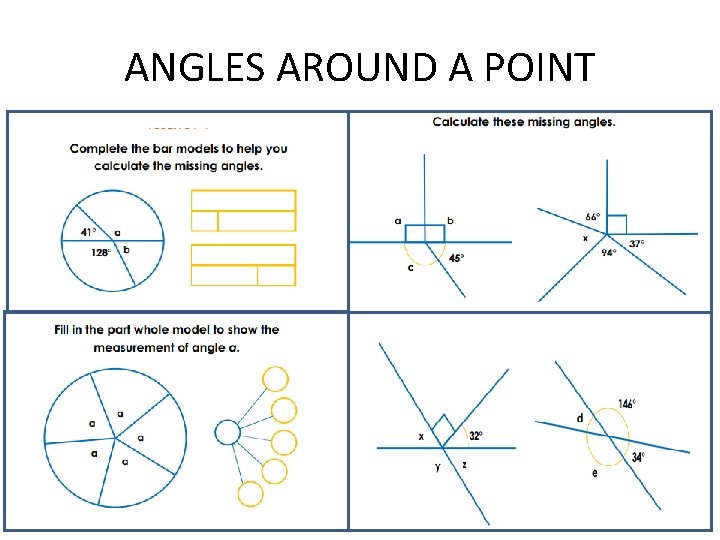

- Slides: 10
Wednesday 30 th July 2020
Fluency Questions
ANGLES AROUND A POINT
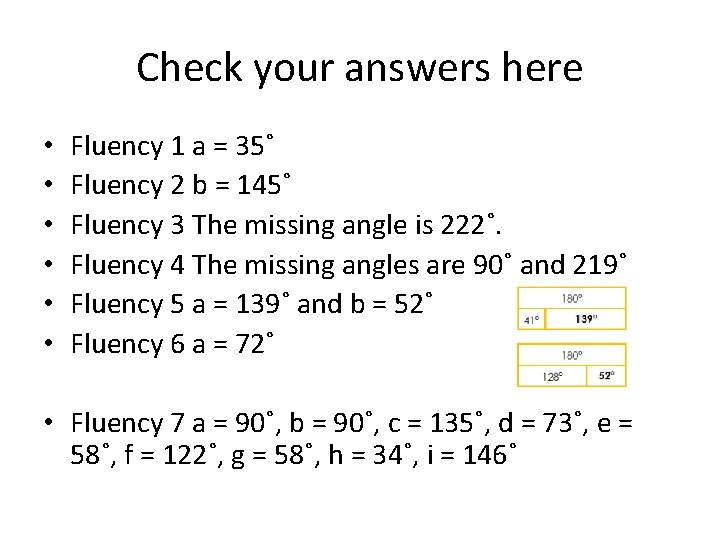
Check your answers here • • • Fluency 1 a = 35˚ Fluency 2 b = 145˚ Fluency 3 The missing angle is 222˚. Fluency 4 The missing angles are 90˚ and 219˚ Fluency 5 a = 139˚ and b = 52˚ Fluency 6 a = 72˚ • Fluency 7 a = 90˚, b = 90˚, c = 135˚, d = 73˚, e = 58˚, f = 122˚, g = 58˚, h = 34˚, i = 146˚
Explain your reasoning here:
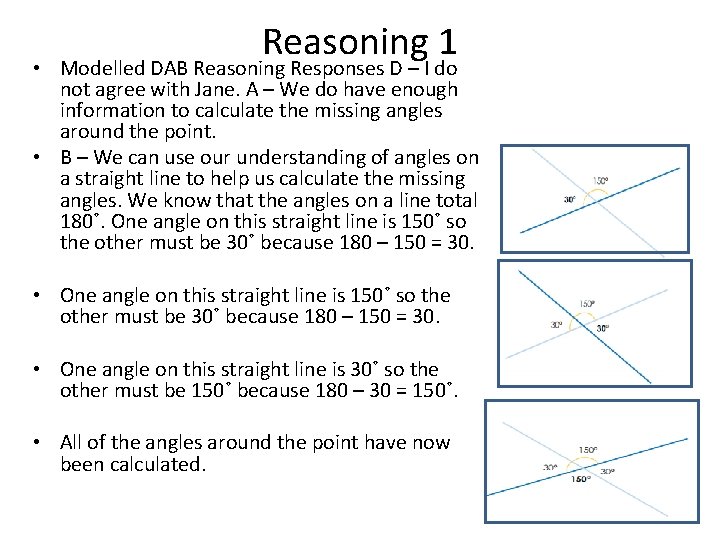
Reasoning 1 • Modelled DAB Reasoning Responses D – I do not agree with Jane. A – We do have enough information to calculate the missing angles around the point. • B – We can use our understanding of angles on a straight line to help us calculate the missing angles. We know that the angles on a line total 180˚. One angle on this straight line is 150˚ so the other must be 30˚ because 180 – 150 = 30. • One angle on this straight line is 30˚ so the other must be 150˚ because 180 – 30 = 150˚. • All of the angles around the point have now been calculated.
Explain your reasoning here:
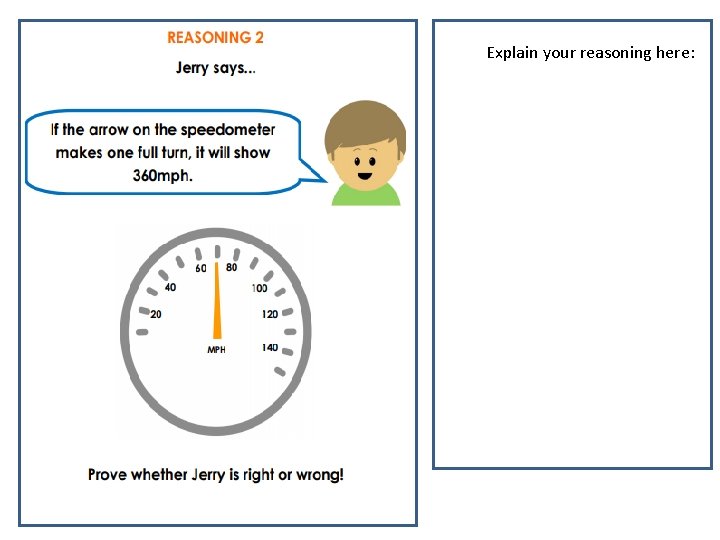
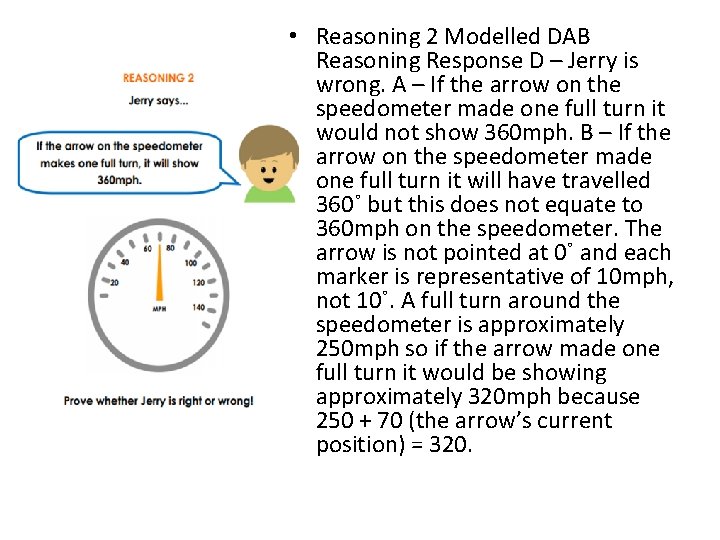
• Reasoning 2 Modelled DAB Reasoning Response D – Jerry is wrong. A – If the arrow on the speedometer made one full turn it would not show 360 mph. B – If the arrow on the speedometer made one full turn it will have travelled 360˚ but this does not equate to 360 mph on the speedometer. The arrow is not pointed at 0˚ and each marker is representative of 10 mph, not 10˚. A full turn around the speedometer is approximately 250 mph so if the arrow made one full turn it would be showing approximately 320 mph because 250 + 70 (the arrow’s current position) = 320.
Explain your reasoning here:
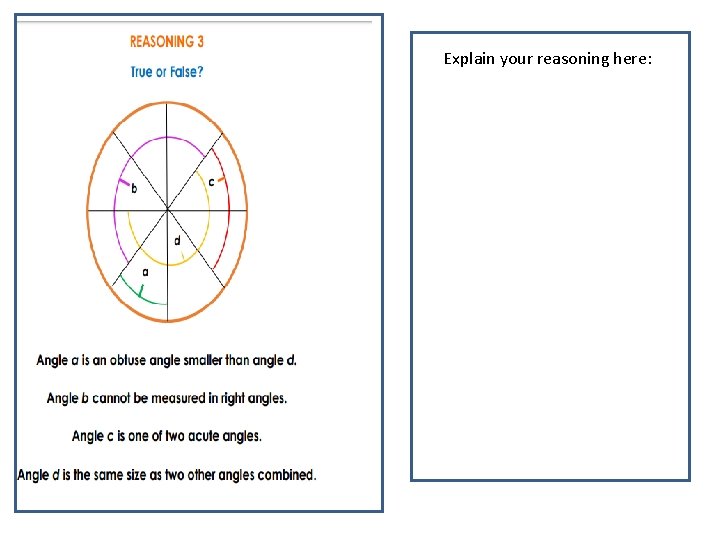
Reasoning 3 Modelled DAB Reasoning Response D – One statement is true and three are false. A – Angle d is the same size as two other angles combined but a is not an obtuse angle, b can be measured in right angles and c is not an acute angle. B – Angle a is smaller than a right angle so it is an acute angle. It covers the angle of one of the 8 equal parts so it must measure 45˚ because 360 ÷ 8 = 45. Angle b covers a whole straight line. It is made up of 4 x 45˚ parts or 2 right angles and measures 180˚. Angle c takes up two of the 45˚ parts so it is 90˚ or a right angle. Angle d is 225˚ which is the total of angle a and b combined.