
Wednesday 14 th Semptember 2016 How do we
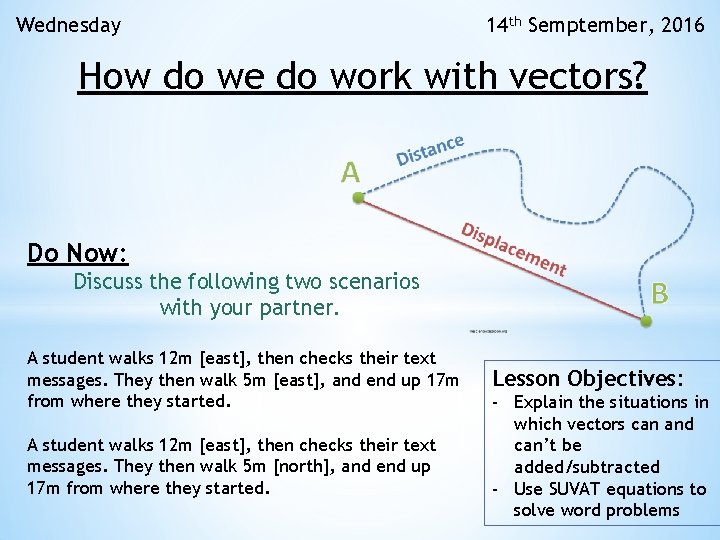
Wednesday 14 th Semptember, 2016 How do we do work with vectors? Do Now: Discuss the following two scenarios with your partner. A student walks 12 m [east], then checks their text messages. They then walk 5 m [east], and end up 17 m from where they started. A student walks 12 m [east], then checks their text messages. They then walk 5 m [north], and end up 17 m from where they started. Lesson Objectives: - Explain the situations in which vectors can and can’t be added/subtracted - Use SUVAT equations to solve word problems
![Scenario 1: A student walks 12 m [east], then checks their text messages. They](http://slidetodoc.com/presentation_image_h2/6bd60f570ac14634af7b9aba06b9d29c/image-2.jpg "Scenario 1: A student walks 12 m [east], then checks their text messages. They")
Scenario 1: A student walks 12 m [east], then checks their text messages. They then walk 5 m [east], and end up 17 m from where they started. Total Displacement = 17 m [east] 12 m [east] 5 m [east] When two vectors act collinearly (along the same line), they can be added or subtracted normally.
![Scenario 2: s 5 m [north] A student walks 12 m [east], then checks](http://slidetodoc.com/presentation_image_h2/6bd60f570ac14634af7b9aba06b9d29c/image-3.jpg "Scenario 2: s 5 m [north] A student walks 12 m [east], then checks")
Scenario 2: s 5 m [north] A student walks 12 m [east], then checks their text messages. They then walk 5 m [north], and end up 17 m from where they started. a 2 + b 2 = c 2 52 + 122 = s 2 25 + 144 = s 2 169 = s 2 13 = s 12 m [east] The vectors form a right triangle. Instead of adding them directly, we need to use Pythagorean Theorem When two are not collinear, they cannot be operated on normally.
What does this mean? This means that the equations we are about to learn and use, work only when all components are collinear. In physics we refer to this situation as one dimensional motion. If you attempt to use them in any other situation, you will get the wrong answer*! * Roughly 20% of students typically get this wrong in assessments, costing ALL the marks for those questions.

Sue Who? SUVAT! S – Displacement U – Initial velocity V – Final velocity A - Acceleration T – Time elapsed These five variables make up what are called the SUVAT equations.

Worth note is that only the UK calls these SUVAT equations. The rest of the world calls them Kinematics equations, and use different variables. …Don’t ask me why we use “s” for displacement instead of “d”, or “u” for initial velocity instead of vi –there isn’t a good answer.
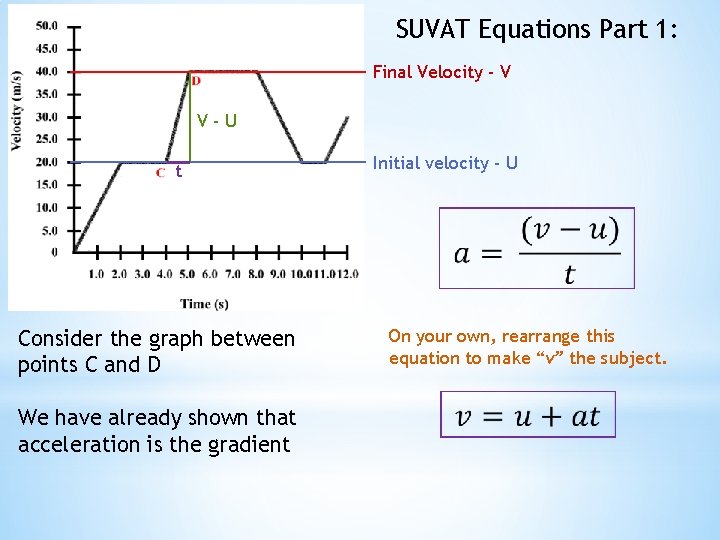
SUVAT Equations Part 1: Final Velocity - V V-U t Consider the graph between points C and D We have already shown that acceleration is the gradient Initial velocity - U On your own, rearrange this equation to make “v” the subject.
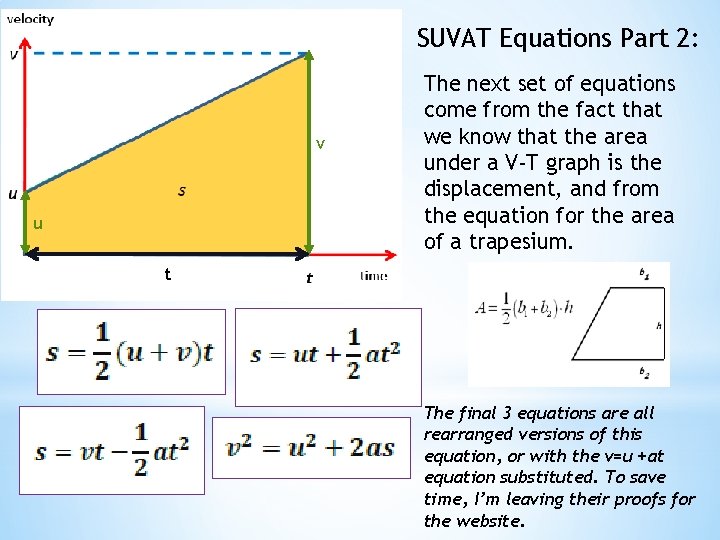
SUVAT Equations Part 2: v u The next set of equations come from the fact that we know that the area under a V-T graph is the displacement, and from the equation for the area of a trapesium. t The final 3 equations are all rearranged versions of this equation, or with the v=u +at equation substituted. To save time, I’m leaving their proofs for the website.
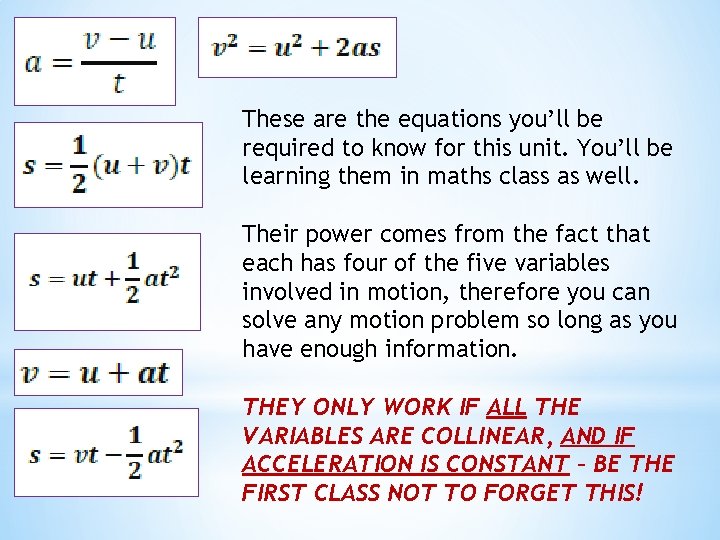
These are the equations you’ll be required to know for this unit. You’ll be learning them in maths class as well. Their power comes from the fact that each has four of the five variables involved in motion, therefore you can solve any motion problem so long as you have enough information. THEY ONLY WORK IF ALL THE VARIABLES ARE COLLINEAR, AND IF ACCELERATION IS CONSTANT – BE THE FIRST CLASS NOT TO FORGET THIS!
SUVAT Examples 1) a) Ms Izmis is driving his car, when suddenly the engine stops working! If he is travelling at 10 ms-1 and his decceleration is 2 ms-2 how long will it take for the car to come to rest? b) Mr Man steps into the road, 30 metres from where Ms Izmis’s engine stops working. Ms Ismis does not see him. Will the car stop in time to miss hitting him? 2) A ball is thrown straight upward at 31 m/s. a) What will be the maximum height the ball goes to before falling down b) How fast will the ball hit the ground?
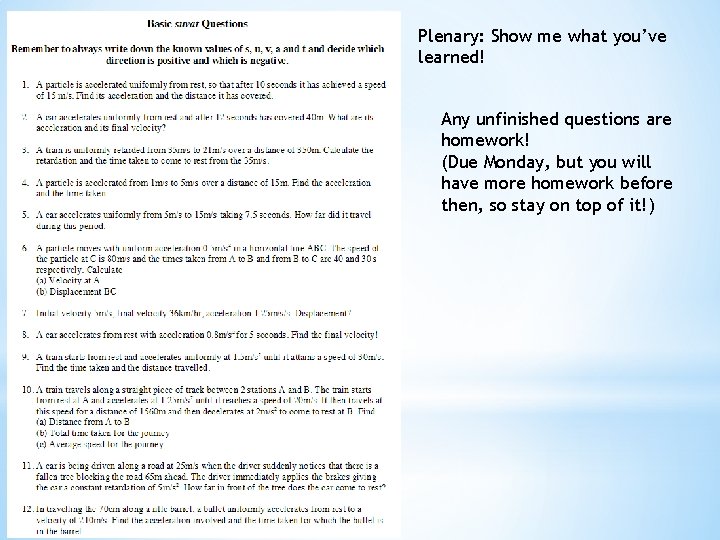
Plenary: Show me what you’ve learned! Any unfinished questions are homework! (Due Monday, but you will have more homework before then, so stay on top of it!)
- Slides: 11