
WECC Renewable Energy Modeling Workshop Conducted by the
WECC Renewable Energy Modeling Workshop Conducted by the WECC Renewable Energy Modeling Task Force (REMTF) and Modeling and Validation Work Group (MVWG) June 17, 2012 - Salt Lake City, UT Abraham Ellis, Ryan Elliott, Ben Karlson – Sandia National Laboratories Donald Davies, Kent Bolton – WECC Pouyan Pourbeik – EPRI Juan Sanchez-Gasca – General Electric Jay Senthil – Siemens Jamie Weber – Power. World Irina Green – CAISO
PV and Wind Plants • Wind, and increasingly PV, represent a significant amount of generating capacity in WECC – 2015 HS case: 16 GW wind, 4 GW of PV (~15% of min load) – Additional >1 GW of distribution-connected PV – PV and wind capacity projected to increase rapidly • Adequate models are required for compliance with reliability standards and generator interconn. studies • WECC REMTF is leading effort to develop generic, nonproprietary models for planning studies – Alternative to vendor-specific, proprietary, user-written, which are generally not suitable for regional planning 2
WECC REMTF Charter • The Renewable Energy Modeling Task Force shall – Develop specifications for generic, non-proprietary, positivesequence power flow and dynamic simulation models for solar and wind generation for use in bulk system studies – Coordinate implementation of models in commercial simulation software – Develop model application and validation guidelines – Coordinate with stakeholders • REMTF reports to the WECC Modeling & Validation Work Group (MVWG), which in turns reports to WECC Technical Studies Subcommittee (TSS)
Modeling Needs and Standards • Improving accessibility to PV and wind power plant models is indispensable to properly assess the reliability of the bulk power system • NERC’s point of view: “Validated, generic, non-confidential, and public standard power flow and stability (positive-sequence) models for variable generation technologies are needed. Such models should be readily validated and publicly available to power utilities and all other industry stakeholders. Model parameters should be provided by variable generation manufacturers and a common model validation standard across all technologies should be adopted. . . ” Reference: NERC IVGTF Special Report, Accommodating High Levels of Variable Generation, http: //www. nerc. com/files/IVGTF_Report_041609. pdf 4
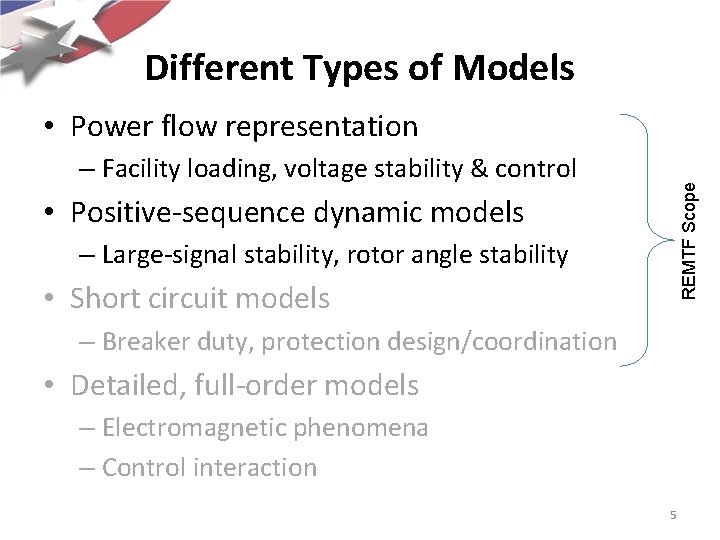
Different Types of Models • Power flow representation REMTF Scope – Facility loading, voltage stability & control • Positive-sequence dynamic models – Large-signal stability, rotor angle stability • Short circuit models – Breaker duty, protection design/coordination • Detailed, full-order models – Electromagnetic phenomena – Control interaction 5
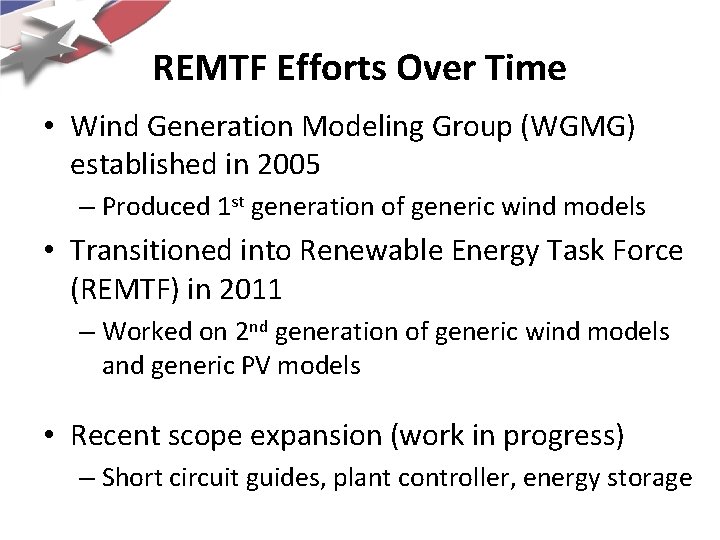
REMTF Efforts Over Time • Wind Generation Modeling Group (WGMG) established in 2005 – Produced 1 st generation of generic wind models • Transitioned into Renewable Energy Task Force (REMTF) in 2011 – Worked on 2 nd generation of generic wind models and generic PV models • Recent scope expansion (work in progress) – Short circuit guides, plant controller, energy storage
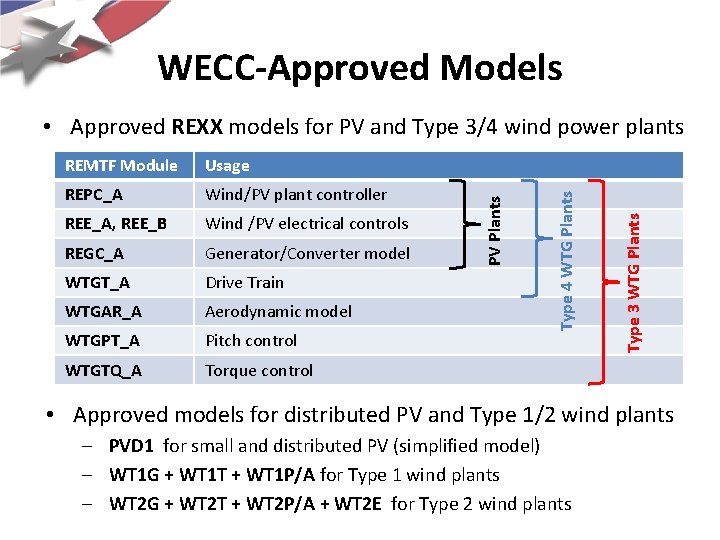
WECC-Approved Models REPC_A Wind/PV plant controller REE_A, REE_B Wind /PV electrical controls REGC_A Generator/Converter model WTGT_A Drive Train WTGAR_A Aerodynamic model WTGPT_A Pitch control WTGTQ_A Torque control Type 3 WTG Plants Usage Type 4 WTG Plants REMTF Module PV Plants • Approved REXX models for PV and Type 3/4 wind power plants • Approved models for distributed PV and Type 1/2 wind plants – PVD 1 for small and distributed PV (simplified model) – WT 1 G + WT 1 T + WT 1 P/A for Type 1 wind plants – WT 2 G + WT 2 T + WT 2 P/A + WT 2 E for Type 2 wind plants
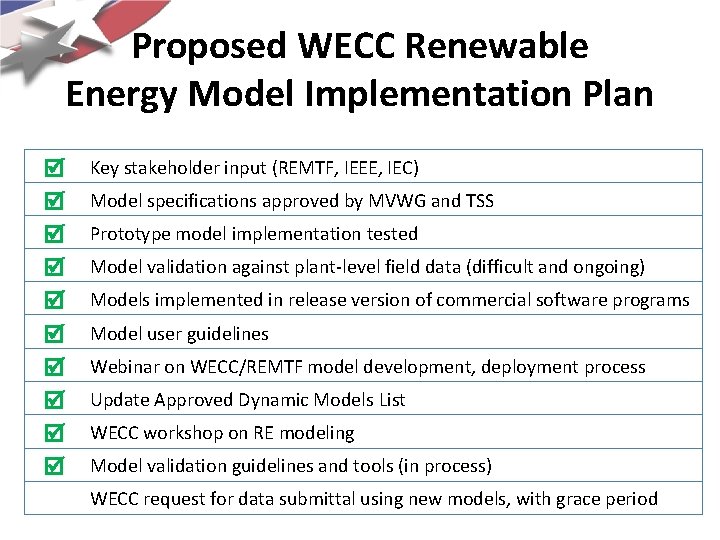
Proposed WECC Renewable Energy Model Implementation Plan Key stakeholder input (REMTF, IEEE, IEC) Model specifications approved by MVWG and TSS Prototype model implementation tested Model validation against plant-level field data (difficult and ongoing) Models implemented in release version of commercial software programs Model user guidelines Webinar on WECC/REMTF model development, deployment process Update Approved Dynamic Models List WECC workshop on RE modeling Model validation guidelines and tools (in process) WECC request for data submittal using new models, with grace period
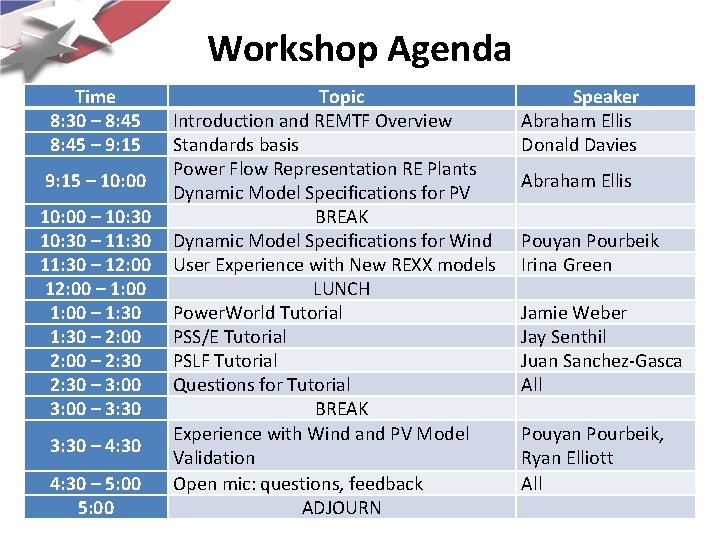
Workshop Agenda Time 8: 30 – 8: 45 – 9: 15 – 10: 00 – 10: 30 – 11: 30 – 12: 00 – 1: 30 – 2: 00 – 2: 30 – 3: 00 – 3: 30 – 4: 30 – 5: 00 Topic Introduction and REMTF Overview Standards basis Power Flow Representation RE Plants Dynamic Model Specifications for PV BREAK Dynamic Model Specifications for Wind User Experience with New REXX models LUNCH Power. World Tutorial PSS/E Tutorial PSLF Tutorial Questions for Tutorial BREAK Experience with Wind and PV Model Validation Open mic: questions, feedback ADJOURN Speaker Abraham Ellis Donald Davies Abraham Ellis Pouyan Pourbeik Irina Green Jamie Weber Jay Senthil Juan Sanchez-Gasca All Pouyan Pourbeik, Ryan Elliott All
Standards Framework for Wind and PV Modeling in WECC D. Davies
Power Flow Representation of PV and Wind Power Plants A. Ellis
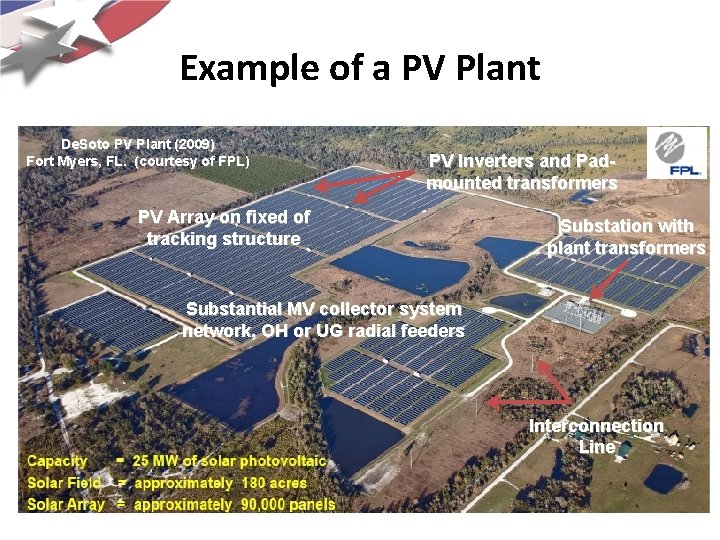
Example of a PV Plant De. Soto PV Plant (2009) Fort Myers, FL. (courtesy of FPL) PV Inverters and Padmounted transformers PV Array on fixed of tracking structure Substation with plant transformers Substantial MV collector system network, OH or UG radial feeders Interconnection Line
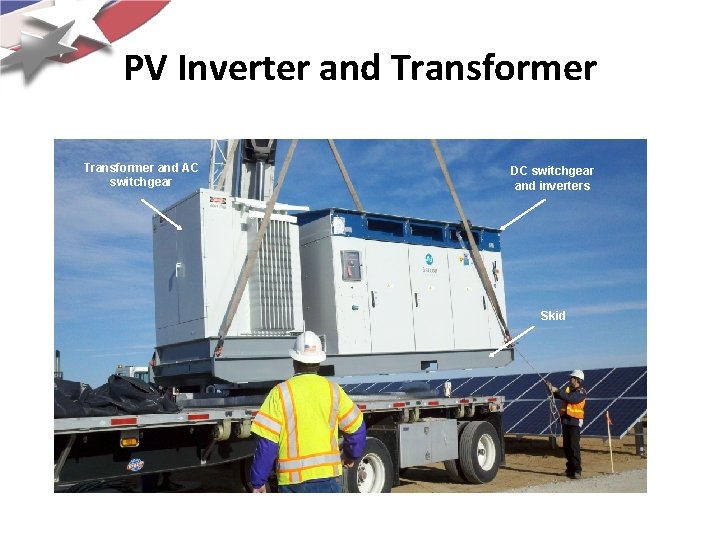
PV Inverter and Transformer and AC switchgear DC switchgear and inverters Skid
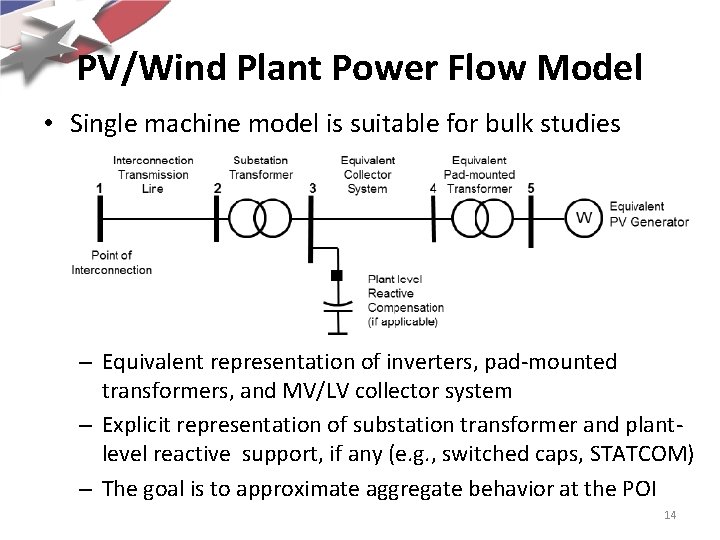
PV/Wind Plant Power Flow Model • Single machine model is suitable for bulk studies – Equivalent representation of inverters, pad-mounted transformers, and MV/LV collector system – Explicit representation of substation transformer and plantlevel reactive support, if any (e. g. , switched caps, STATCOM) – The goal is to approximate aggregate behavior at the POI 14
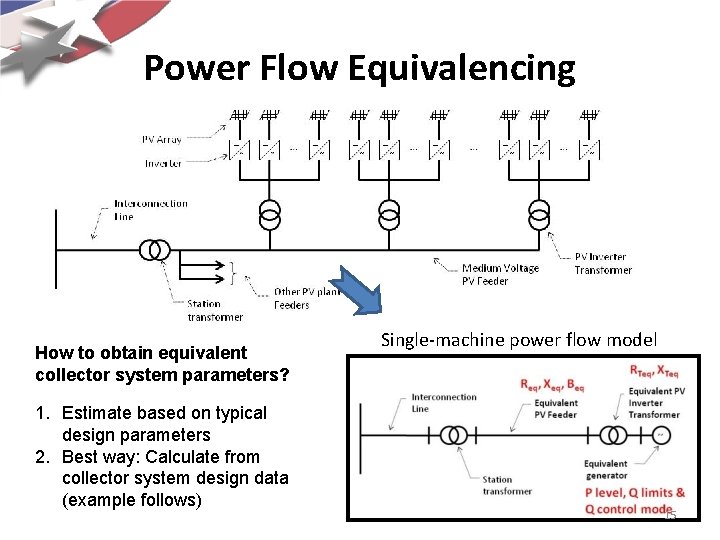
Power Flow Equivalencing How to obtain equivalent collector system parameters? 1. Estimate based on typical design parameters 2. Best way: Calculate from collector system design data (example follows) Single-machine power flow model 15
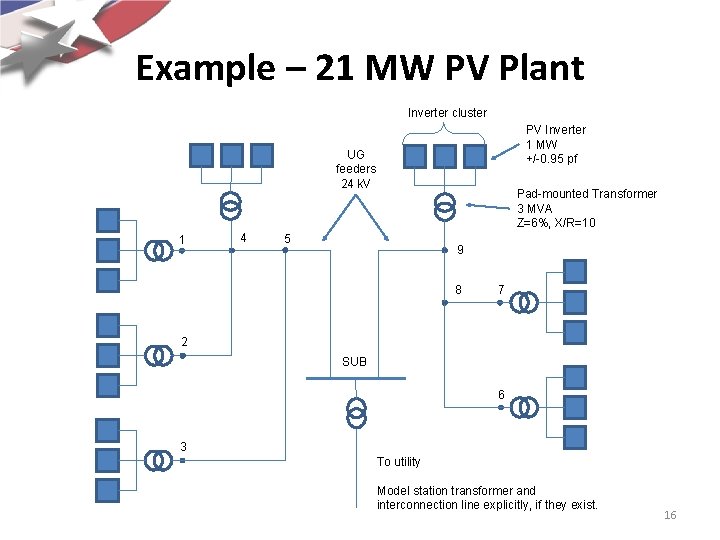
Example – 21 MW PV Plant Inverter cluster PV Inverter 1 MW +/-0. 95 pf UG feeders 24 k. V 1 4 Pad-mounted Transformer 3 MVA Z=6%, X/R=10 5 9 8 7 2 SUB 6 3 To utility Model station transformer and interconnection line explicitly, if they exist. 16
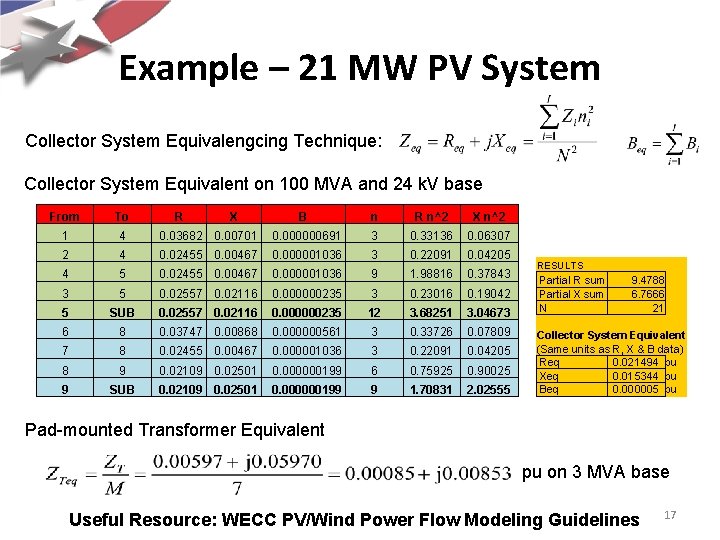
Example – 21 MW PV System Collector System Equivalengcing Technique: Collector System Equivalent on 100 MVA and 24 k. V base From To R X B 1 4 0. 03682 0. 00701 0. 000000691 3 0. 33136 0. 06307 2 4 0. 02455 0. 00467 0. 000001036 3 0. 22091 0. 04205 4 5 0. 02455 0. 00467 0. 000001036 9 1. 98816 0. 37843 3 5 0. 02557 0. 02116 0. 000000235 3 0. 23016 0. 19042 5 SUB 0. 02557 0. 02116 0. 000000235 12 6 8 0. 03747 0. 00868 0. 000000561 3 0. 33726 0. 07809 7 8 0. 02455 0. 00467 0. 000001036 3 0. 22091 0. 04205 8 9 0. 02109 0. 02501 0. 000000199 6 0. 75925 0. 90025 9 SUB 0. 02109 0. 02501 9 0. 000000199 n R n^2 3. 68251 1. 70831 X n^2 3. 04673 2. 02555 Partial R sum 9. 4788 Partial X sum 6. 7666 N 21 Collector System Equivalent (Same units as R, X & B data) Req 0. 021494 pu Xeq 0. 015344 pu Beq 0. 000005 pu RESULTS Pad-mounted Transformer Equivalent pu on 3 MVA base Useful Resource: WECC PV/Wind Power Flow Modeling Guidelines 17
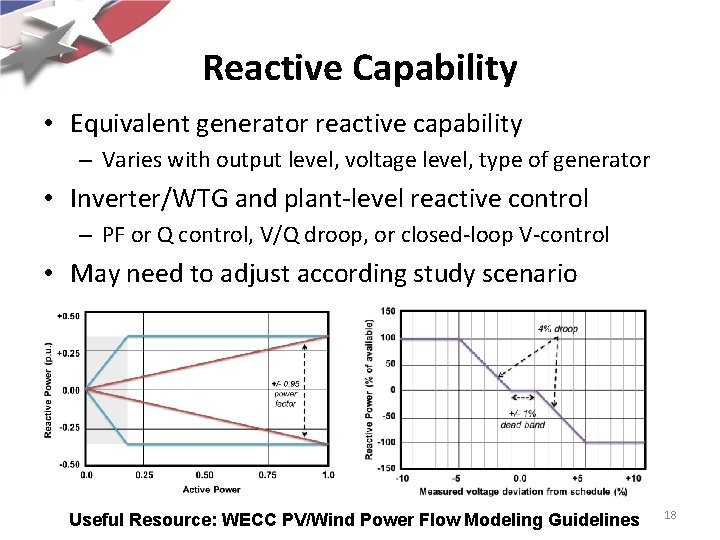
Reactive Capability • Equivalent generator reactive capability – Varies with output level, voltage level, type of generator • Inverter/WTG and plant-level reactive control – PF or Q control, V/Q droop, or closed-loop V-control • May need to adjust according study scenario Useful Resource: WECC PV/Wind Power Flow Modeling Guidelines 18
Dynamic Models for PV Power Plants A. Ellis
REMTF Dynamic Model Specs. • Consistent with established modeling approach at the transmission (bulk system) level – Positive-sequence, for large-scale bulk-level simulations – Suitable for use with equivalent (single-generator) power flow plant representation – Reproduce fundamental dynamic characteristics following electrical disturbances (as opposed to wind/solar events) – Bandwidth: Steady-state to 5 Hz; faster dynamics expressed algebraically or ignored – Generic: parametrically adjustable so that equipment of the same type (e. g. , Type 3 WTG plants, PV plants, etc. ) – Available as standard library models in commercial software 20
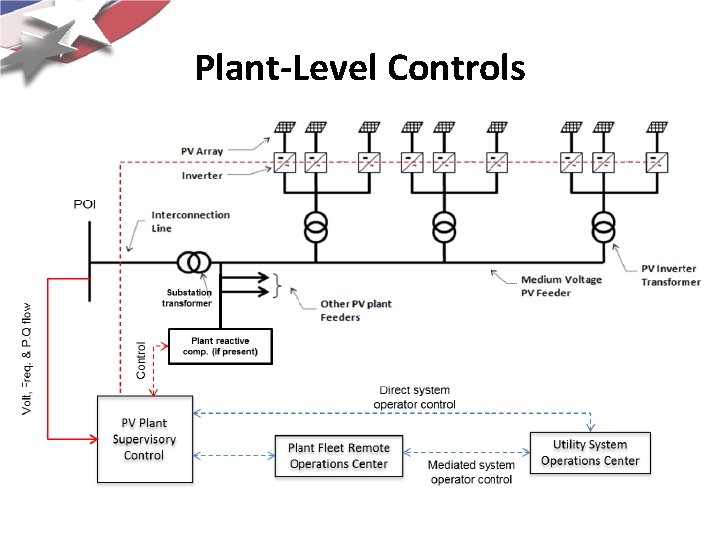
Plant-Level Controls
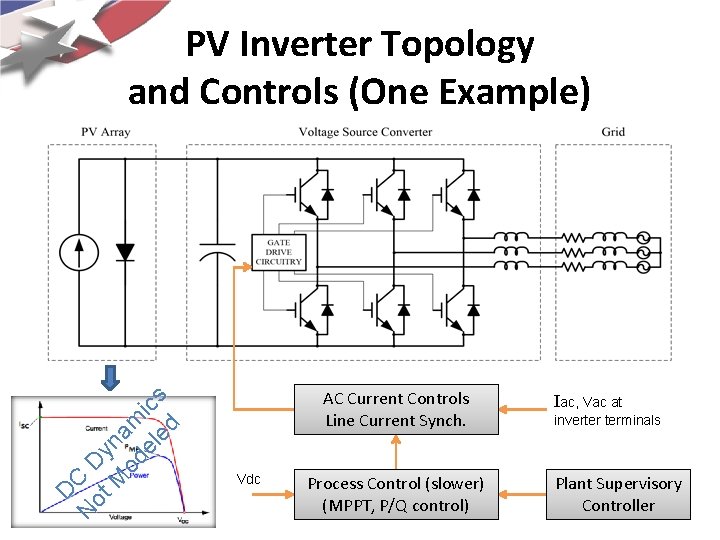
D N C D ot M yna od m e l ics ed PV Inverter Topology and Controls (One Example) AC Current Controls Line Current Synch. Vdc Process Control (slower) (MPPT, P/Q control) Iac, Vac at inverter terminals Plant Supervisory Controller

Representation of Discrete PV Plants • Two options for dynamic representation – Full-featured PV Plant Model (REXX) – Simplified Model (PVD 1) PVD 1 Model REXX Model • Both require generator explicitly represented in power flow and equivalent feeder/collector 23
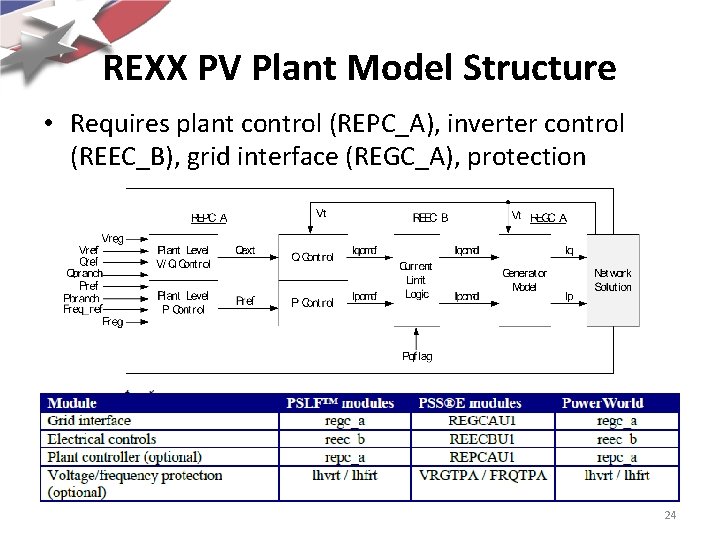
REXX PV Plant Model Structure • Requires plant control (REPC_A), inverter control (REEC_B), grid interface (REGC_A), protection 24
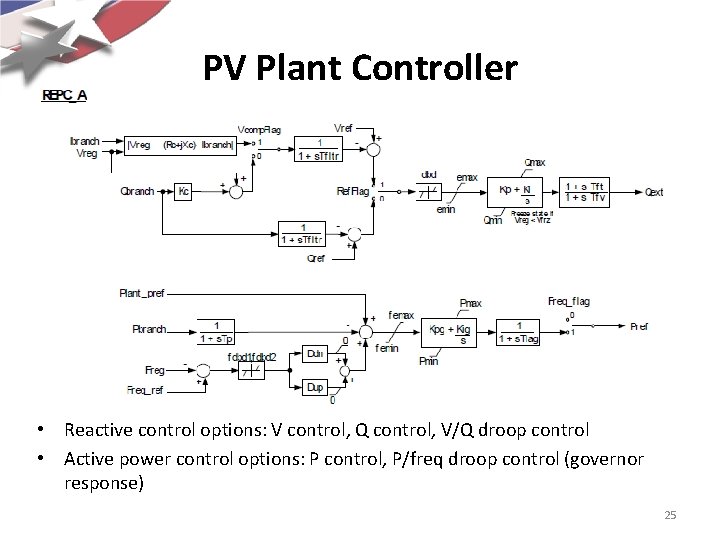
PV Plant Controller • Reactive control options: V control, Q control, V/Q droop control • Active power control options: P control, P/freq droop control (governor response) 25
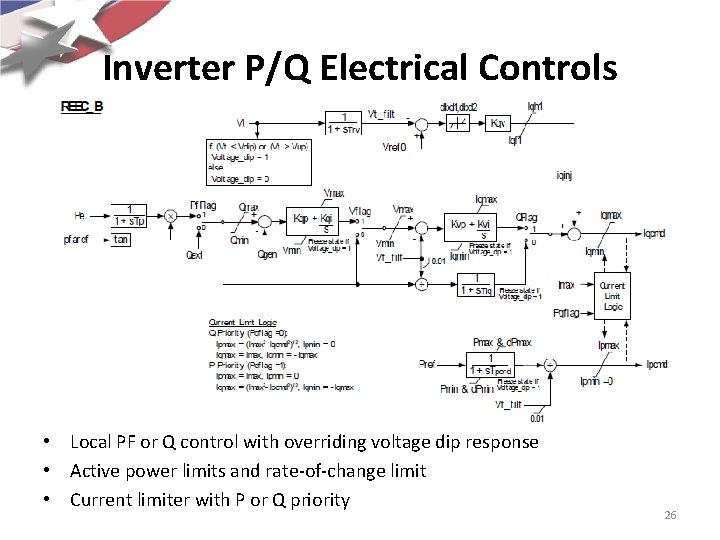
Inverter P/Q Electrical Controls • Local PF or Q control with overriding voltage dip response • Active power limits and rate-of-change limit • Current limiter with P or Q priority 26
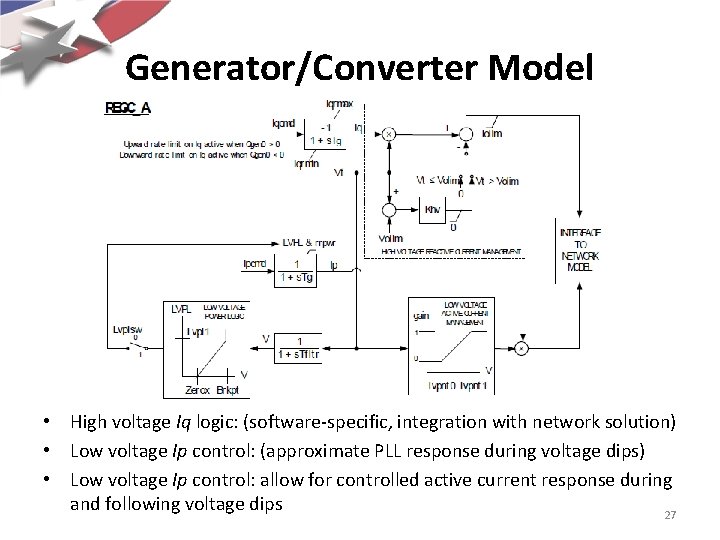
Generator/Converter Model • High voltage Iq logic: (software-specific, integration with network solution) • Low voltage Ip control: (approximate PLL response during voltage dips) • Low voltage Ip control: allow for controlled active current response during and following voltage dips 27
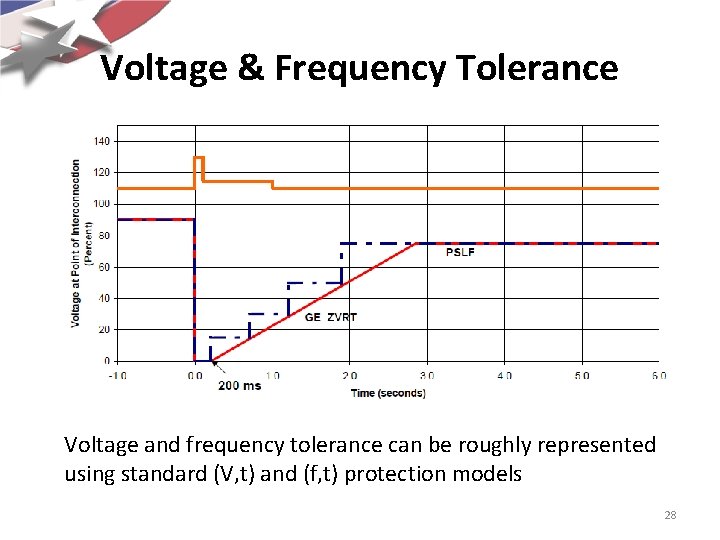
Voltage & Frequency Tolerance Voltage and frequency tolerance can be roughly represented using standard (V, t) and (f, t) protection models 28
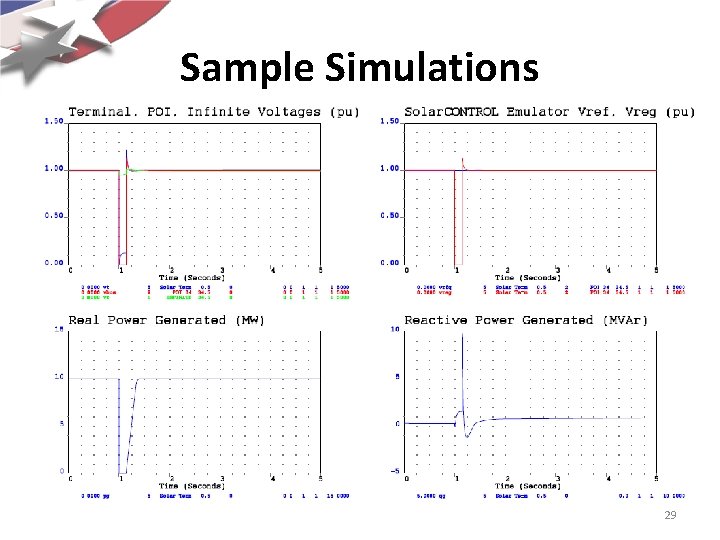
Sample Simulations 29
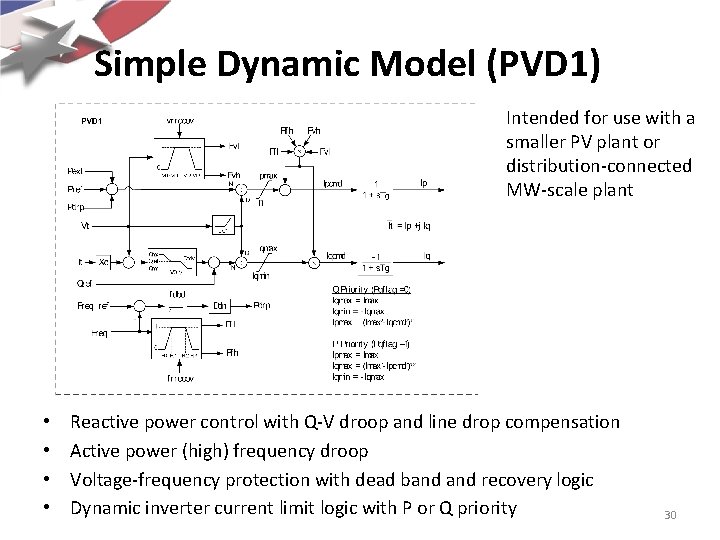
Simple Dynamic Model (PVD 1) Intended for use with a smaller PV plant or distribution-connected MW-scale plant • • Reactive power control with Q-V droop and line drop compensation Active power (high) frequency droop Voltage-frequency protection with dead band recovery logic Dynamic inverter current limit logic with P or Q priority 30
Dynamic Model Specifications for Wind Power Plants P. Pourbeik

User Experience With REXX Models I. Green

Software Tutorials J. Sanchez-Gasca, J. Senthil, J. Weber

Experience with Model Validation P. Pourbeik, R. Elliott

Open Discussion

Contact A. Ellis, REMTF Chair aellis@sandia. gov
- Slides: 36