
Website Credibility TYPES OF WEB RESOURCES Business and
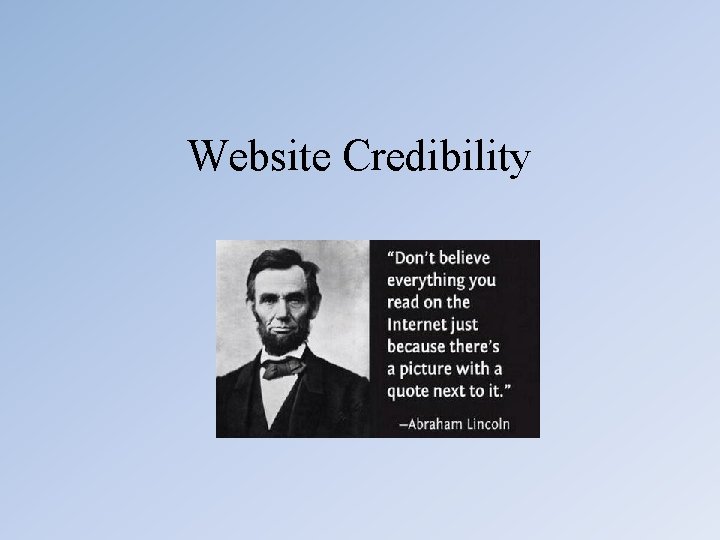
Website Credibility
TYPES OF WEB RESOURCES • • • Business and marketing News and current events Informational Advocacy Personal
What is a Credible Source? Credible sources are ones the reader can trust. We trust that the author's ideas are his or her own and can be backed up with evidence. When writing a research paper, doing research, or reading for background information, writers should ALWAYS use a credible source.
Credible • Journals by authors respected and well-known in their specific fields • Websites from credible institutions like Mayo Clinic, Department of Justice, and University-affiliated institutions’ • Materials published in the last ten years • Websites: The more information available, the more credible the website. There is a specific author, the audience is clear, the purpose is informative not biased, and the information is regularly updated. Non-Credible • Blogs, Face. Book posts, or other self authored sites • Research articles without citations • Websites with information not from an author or governmental department • Materials published over 15 years ago • Websites: There is not much information available. If the purpose is not informative but may have other motives, like to persuade, the site may not be credible. The website is not regularly updated or the author is unreliable Adapted from http: //writingcenter. appstate. edu/sites/writingcenter. appstate. edu/files/Credible%20 v%20 Non. Credible%20 Sources 13. pdf
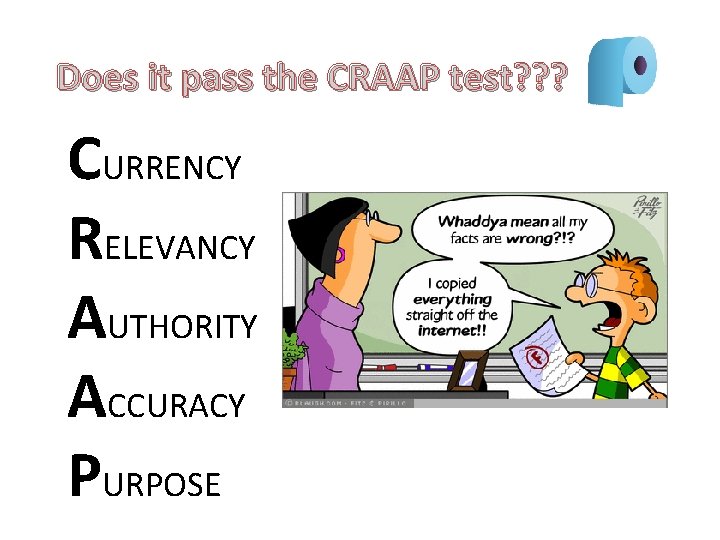
Does it pass the CRAAP test? ? ? CURRENCY RELEVANCY AUTHORITY ACCURACY PURPOSE
Currency • When was it published/posted or last updated? • Do you need current information, or are older sources acceptable? • Are the links functional?
Relevance • Does it relate to your topic or answer your question? • Who is the intended audience? • Is the information at an appropriate level? Too advanced? Too easy?
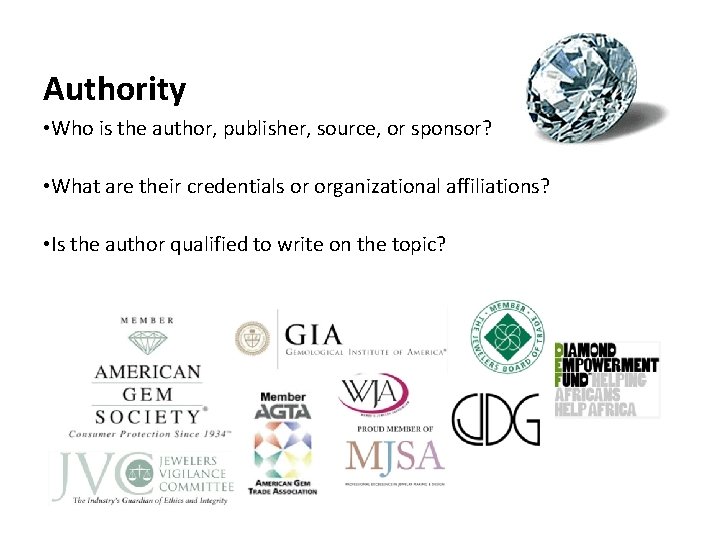
Authority • Who is the author, publisher, source, or sponsor? • What are their credentials or organizational affiliations? • Is the author qualified to write on the topic?
• Is the domain for the site a. org (an organization), . edu (an educational • If there is a group or site), . gov (a federal organization (called a government site), . mil (a corporate author) creating military site), . com (a the page, establish the commercial site), . net (a group’s authority. “Google” web-sponsoring site), . TV the name. Are they a wellknown, reputable (a television site) organization for this subject? Learn about the organization on their home page. Look for “About Us” on the home page. . org
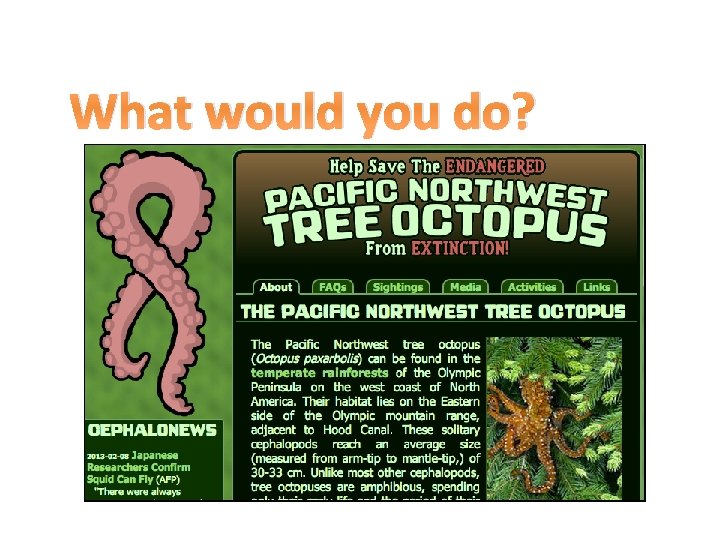
What would you do?
Accuracy • Where does the information come from? • Is the information supported by evidence? • Has the information been reviewed? • Can you verify any of the information in another source or from personal knowledge? • Are there spelling, grammar or typographical errors?
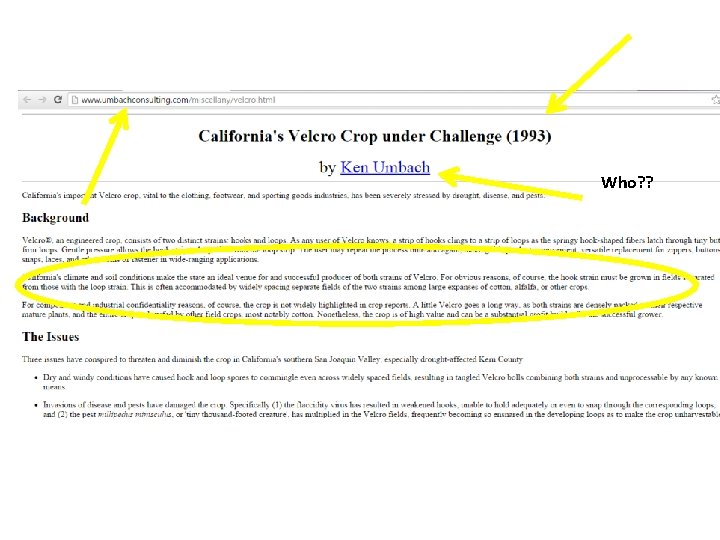
Who? ?
Purpose • What is the purpose of the information? Is it to inform, teach, sell, entertain or persuade? • Is the information fact, opinion or propaganda? • Does the point of view appear objective and impartial? • Are there political, ideological, cultural, religious, institutional or personal biases?
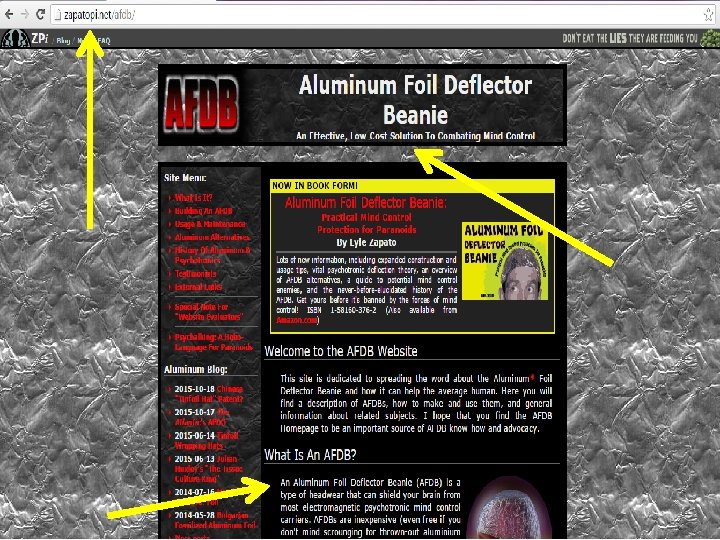
Other Tips: • Check the header and footer information to determine the author and source. • In the URL, a tilde ~ usually indicated a personal web directory rather than being part of the organization's official web site. Ask a Librarian for Help! • In order to verify an author's credentials, you may need to consult some printed sources such as Who's Who in America or the Biography Index. • Check and compare the web site to others which are both similar and different.
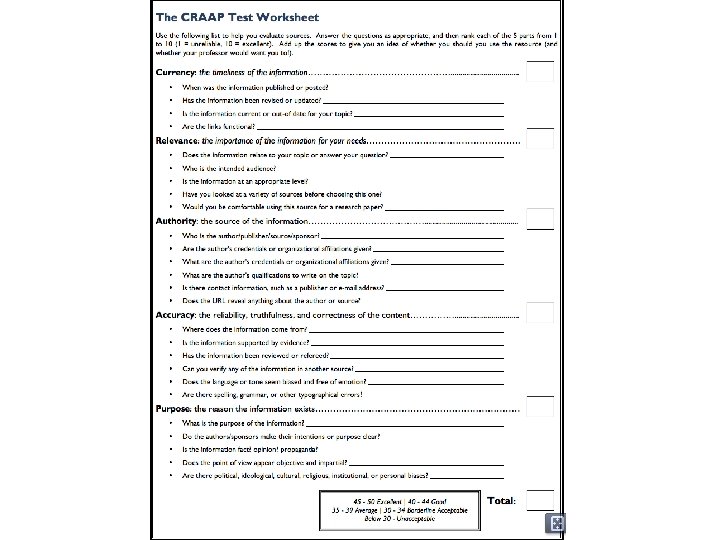
• WALK to the computer lab • Find three sources you MIGHT use in your essay • Evaluate them using the CRAAP test/handout
References University Writing Center. (March, 2013). Credible versus non credible sources. Retrieved from: http: //writingcenter. appstate. edu/sites/writingcenter. appstate. edu/files/Credible%20 v%20 Non. Credible%20 Sources 13. pdf Meriam Library, California State University, Chico. (September, 2010). Evaluating information – applying the CRAAP test. Retrieved from: https: //www. csuchico. edu/lins/handouts/eval_websites. pdf Eastern Michigan University Library. (n. d. ). Evaluating web sites using the CRAAP test. Retrieved from: http: //www. emich. edu/library/help/craap/
- Slides: 18