
WEBINAR Pricing Transparency Whats Your Strategy for 2021

WEBINAR Pricing Transparency – What’s Your Strategy for 2021 & Beyond? October 20, 2020

Today’s Speakers Len Mandel Director As a Director in the Healthcare practice, Len Mandel is focused on end to end revenue cycle transformation for healthcare providers nationally. With over 20+ years expertise in both the provider and consulting space, his expertise yields optimized net revenue and sustainable margin. Len is the solutions development leader for Robotics Process Automation (RPA) for the Revenue Cycle Practice, developing methodology to reduce overall cost to collect while maximizing operational efficiencies. Mark Spehar Associate Director Kevin Mc. Carthy Associate Director Mark brings more than 20 years experience leading Strategic Pricing, CDM, Financial Feasibility Studies and Revenue Cycle Assessments. Mark is active in the healthcare industry by speaking nationally on Pricing Transparency Issues and recently serving on the Healthcare Financial Management Association’s National Advisory Committee on Payment Models. Mark has also served as a past president and board member for the Western Pennsylvania Chapter of HFMA and is active within the South Florida Chapter. Kevin has over 15 years of experience working extensively with payer and providers clients to meet their managed care needs, including strategic pricing, contracting, systems and negotiation support. Kevin also has extensive experience working with payers and providers, specifically focused on contract language review and scoring with large national payers and large multi state health systems. Pricing Transparency – What’s Your Strategy for 2021 & Beyond? 1
Today’s Agenda 1. Brief Overview of Price Transparency Rule 2. Shift from Traditional Pricing to a Dynamic Pricing Approach 3. Other Strategic Considerations 4. Q&A Pricing Transparency – What’s Your Strategy for 2021 & Beyond? 2

3 1. Brief Overview of Price Transparency Rule
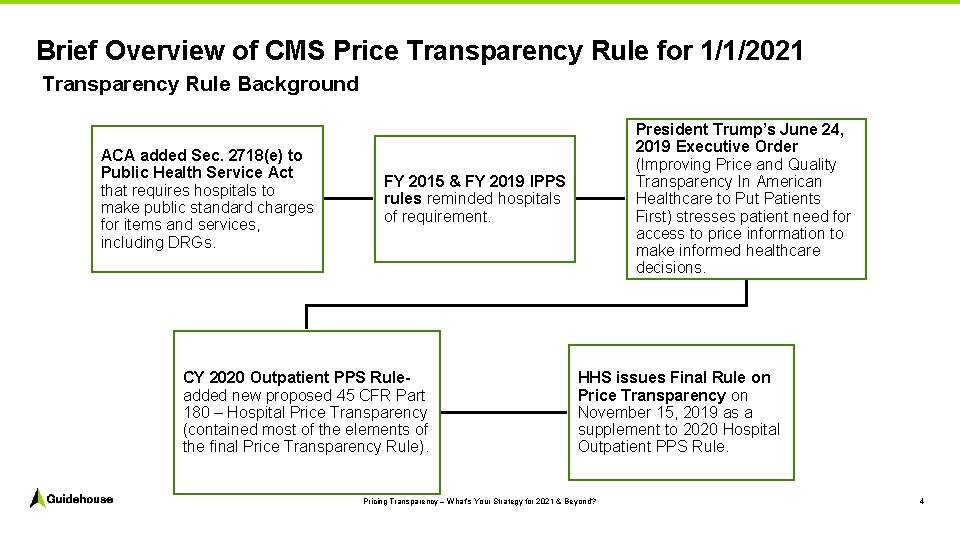
Brief Overview of CMS Price Transparency Rule for 1/1/2021 Transparency Rule Background ACA added Sec. 2718(e) to Public Health Service Act that requires hospitals to make public standard charges for items and services, including DRGs. President Trump’s June 24, 2019 Executive Order (Improving Price and Quality Transparency In American Healthcare to Put Patients First) stresses patient need for access to price information to make informed healthcare decisions. FY 2015 & FY 2019 IPPS rules reminded hospitals of requirement. CY 2020 Outpatient PPS Ruleadded new proposed 45 CFR Part 180 – Hospital Price Transparency (contained most of the elements of the final Price Transparency Rule). HHS issues Final Rule on Price Transparency on November 15, 2019 as a supplement to 2020 Hospital Outpatient PPS Rule. Pricing Transparency – What’s Your Strategy for 2021 & Beyond? 4

Price Transparency Rule Emphasizes Several Key Terms CMS has issued clear guidance on some terms, while others are more open to interpretation • In response to price variation, many policy and legislative activities have promoted the need for greater price transparency for consumers. A stated CMS goal…lower healthcare spending by increasing competition to "begin to narrow price differences for the same services, in the same health care markets". Unstated… drive price variation downward (e. g. , towards market 50 th percentile) • CMS step 1 was the January 2019 rule on "current standard charges. " • CMS step 2 for January 2021, requires disclosure of negotiated rate and allowed payment information for all 3 rd party payors… for facilities and employed physicians. • CMS step 3 (hypothesis)… significantly expand required consumer shoppable services… ? date. Pricing Transparency – What’s Your Strategy for 2021 & Beyond? 5
Poll Question #1 Do you believe the Pricing Transparency Requirements are still going to go into effect on January 1 st 2021? A. Yes B. No Pricing Transparency – What’s Your Strategy for 2021 & Beyond? 6
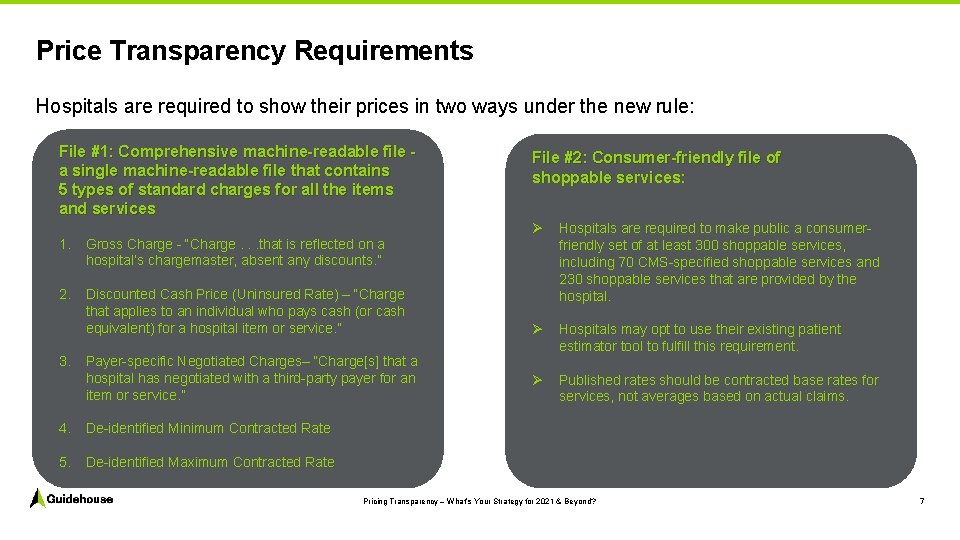
Price Transparency Requirements Hospitals are required to show their prices in two ways under the new rule: File #1: Comprehensive machine-readable file a single machine-readable file that contains 5 types of standard charges for all the items and services 1. Gross Charge “Charge. . . that is reflected on a hospital’s chargemaster, absent any discounts. ” 2. Discounted Cash Price (Uninsured Rate) – “Charge that applies to an individual who pays cash (or cash equivalent) for a hospital item or service. ” 3. Payer specific Negotiated Charges– “Charge[s] that a hospital has negotiated with a third party payer for an item or service. ” 4. De identified Minimum Contracted Rate 5. De identified Maximum Contracted Rate File #2: Consumer-friendly file of shoppable services: Ø Hospitals are required to make public a consumer friendly set of at least 300 shoppable services, including 70 CMS specified shoppable services and 230 shoppable services that are provided by the hospital. Ø Hospitals may opt to use their existing patient estimator tool to fulfill this requirement. Ø Published rates should be contracted base rates for services, not averages based on actual claims. Pricing Transparency – What’s Your Strategy for 2021 & Beyond? 7
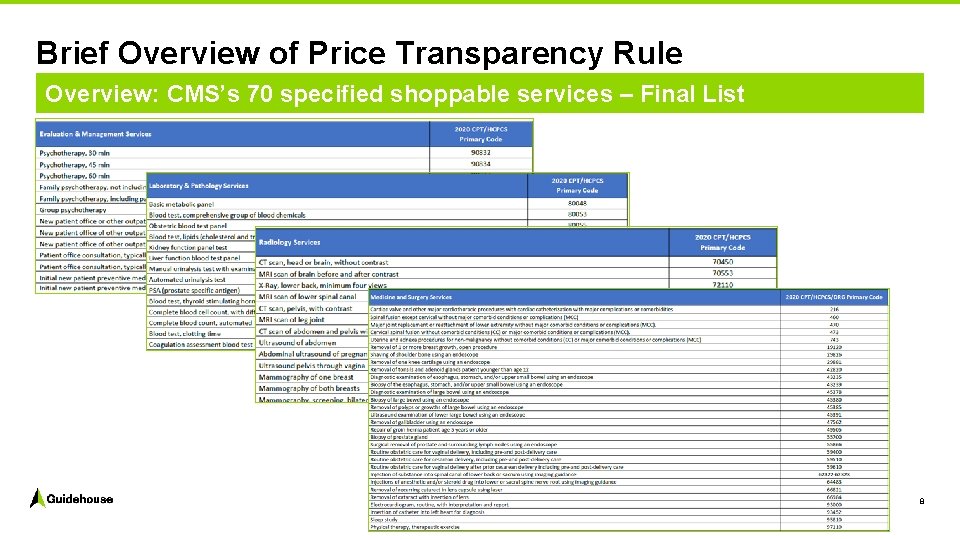
Brief Overview of Price Transparency Rule Overview: CMS’s 70 specified shoppable services – Final List 8
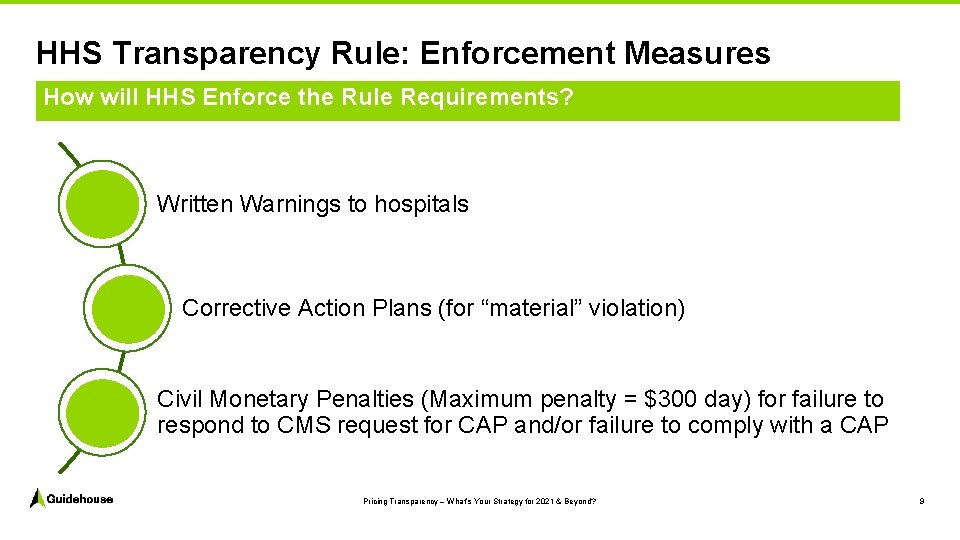
HHS Transparency Rule: Enforcement Measures How will HHS Enforce the Rule Requirements? Written Warnings to hospitals Corrective Action Plans (for “material” violation) Civil Monetary Penalties (Maximum penalty = $300 day) for failure to respond to CMS request for CAP and/or failure to comply with a CAP Pricing Transparency – What’s Your Strategy for 2021 & Beyond? 9
Additional Pricing Transparency Requirements Final FY 2021 Medicare IPPS Rule • Hospitals will be required to report on the Medicare cost report the median payer specific negotiated charge that the hospital has negotiated with its Medicare Advantage (MA) organizations payers, by MS DRG, for cost reporting periods ending on or after January 1, 2021 • Goal is to “reduce the Medicare program’s reliance on the hospital chargemaster and to support the development of a market based approach to payment under the Medicare FFS system” Pricing Transparency – What’s Your Strategy for 2021 & Beyond? 10
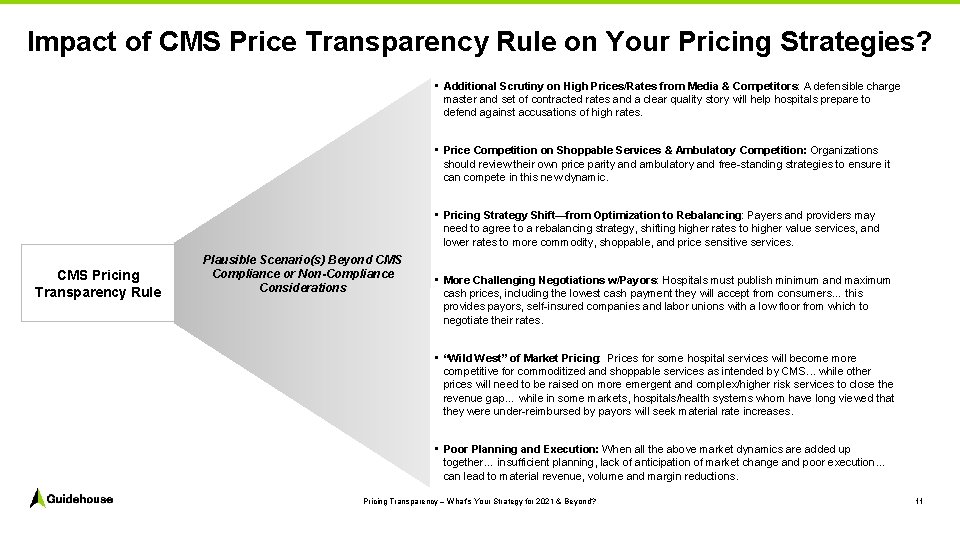
Impact of CMS Price Transparency Rule on Your Pricing Strategies? • Additional Scrutiny on High Prices/Rates from Media & Competitors: A defensible charge master and set of contracted rates and a clear quality story will help hospitals prepare to defend against accusations of high rates. • Price Competition on Shoppable Services & Ambulatory Competition: Organizations should review their own price parity and ambulatory and free standing strategies to ensure it can compete in this new dynamic. • Pricing Strategy Shift—from Optimization to Rebalancing: Payers and providers may need to agree to a rebalancing strategy, shifting higher rates to higher value services, and lower rates to more commodity, shoppable, and price sensitive services. CMS Pricing Transparency Rule Plausible Scenario(s) Beyond CMS Compliance or Non-Compliance Considerations • More Challenging Negotiations w/Payors: Hospitals must publish minimum and maximum cash prices, including the lowest cash payment they will accept from consumers… this provides payors, self insured companies and labor unions with a low floor from which to negotiate their rates. • “Wild West” of Market Pricing: Prices for some hospital services will become more competitive for commoditized and shoppable services as intended by CMS. . . while other prices will need to be raised on more emergent and complex/higher risk services to close the revenue gap… while in some markets, hospitals/health systems whom have long viewed that they were under reimbursed by payors will seek material rate increases. • Poor Planning and Execution: When all the above market dynamics are added up together… insufficient planning, lack of anticipation of market change and poor execution… can lead to material revenue, volume and margin reductions. Pricing Transparency – What’s Your Strategy for 2021 & Beyond? 11
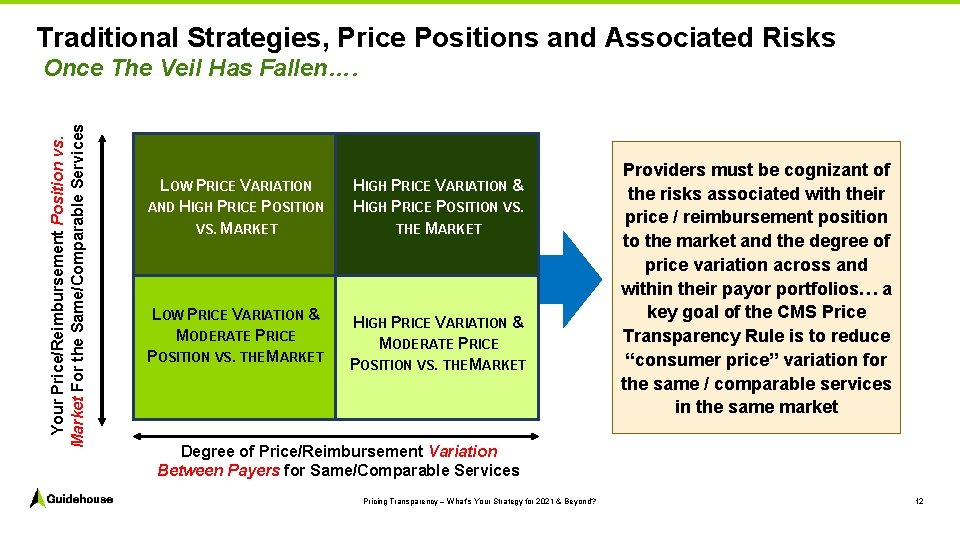
Traditional Strategies, Price Positions and Associated Risks Your Price/Reimbursement Position vs. Market For the Same/Comparable Services Once The Veil Has Fallen…. LOW PRICE VARIATION AND HIGH PRICE POSITION VS. MARKET HIGH PRICE VARIATION & HIGH PRICE POSITION VS. THE MARKET LOW PRICE VARIATION & MODERATE PRICE POSITION VS. THE MARKET HIGH PRICE VARIATION & MODERATE PRICE POSITION VS. THE MARKET Providers must be cognizant of the risks associated with their price / reimbursement position to the market and the degree of price variation across and within their payor portfolios… a key goal of the CMS Price Transparency Rule is to reduce “consumer price” variation for the same / comparable services in the same market Degree of Price/Reimbursement Variation Between Payers for Same/Comparable Services Pricing Transparency – What’s Your Strategy for 2021 & Beyond? 12
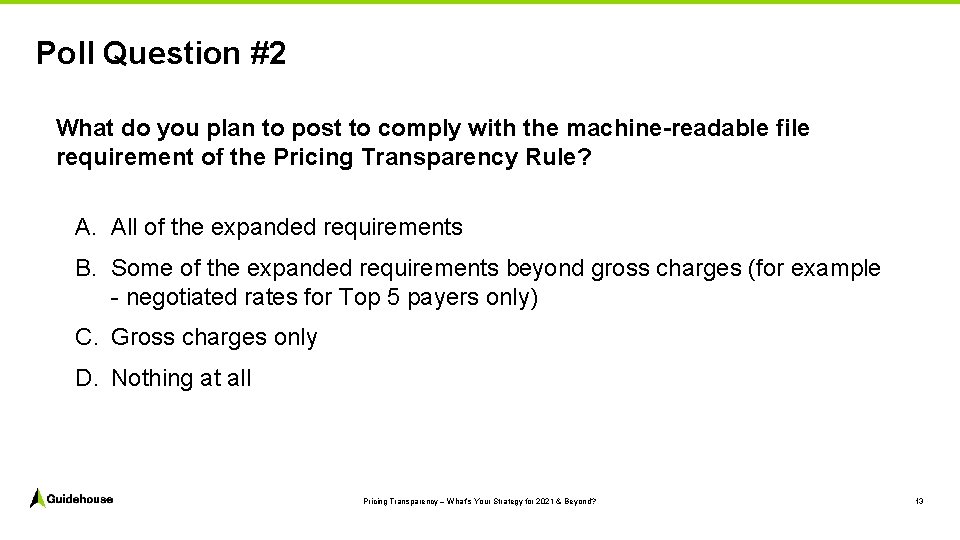
Poll Question #2 What do you plan to post to comply with the machine-readable file requirement of the Pricing Transparency Rule? A. All of the expanded requirements B. Some of the expanded requirements beyond gross charges (for example negotiated rates for Top 5 payers only) C. Gross charges only D. Nothing at all Pricing Transparency – What’s Your Strategy for 2021 & Beyond? 13

1 4 2. Shift from Traditional Pricing to a Dynamic Pricing Approach
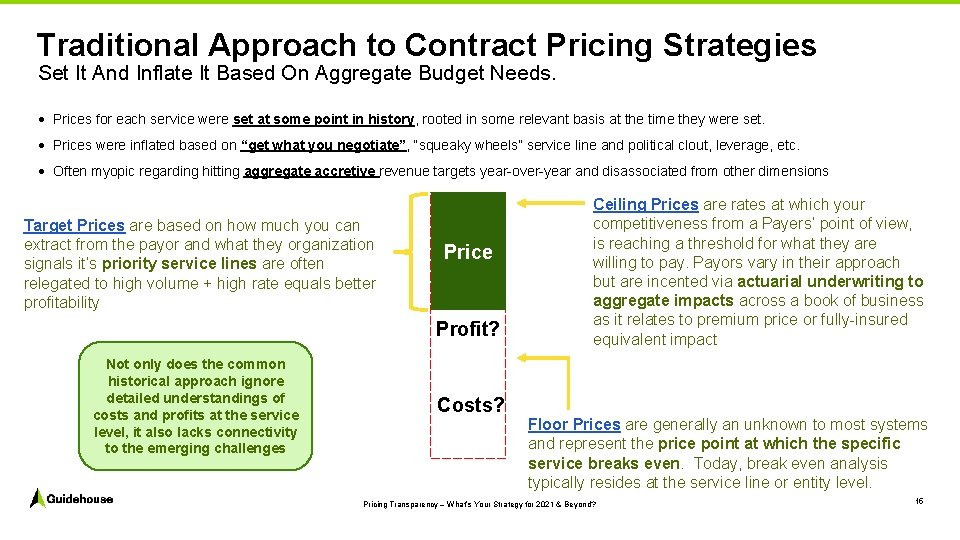
Traditional Approach to Contract Pricing Strategies Set It And Inflate It Based On Aggregate Budget Needs. · Prices for each service were set at some point in history, rooted in some relevant basis at the time they were set. · Prices were inflated based on “get what you negotiate”, “squeaky wheels” service line and political clout, leverage, etc. · Often myopic regarding hitting aggregate accretive revenue targets year over year and disassociated from other dimensions Target Prices are based on how much you can extract from the payor and what they organization signals it’s priority service lines are often relegated to high volume + high rate equals better profitability Price Profit? Not only does the common historical approach ignore detailed understandings of costs and profits at the service level, it also lacks connectivity to the emerging challenges Costs? Ceiling Prices are rates at which your competitiveness from a Payers’ point of view, is reaching a threshold for what they are willing to pay. Payors vary in their approach but are incented via actuarial underwriting to aggregate impacts across a book of business as it relates to premium price or fully insured equivalent impact Floor Prices are generally an unknown to most systems and represent the price point at which the specific service breaks even. Today, break even analysis typically resides at the service line or entity level. Pricing Transparency – What’s Your Strategy for 2021 & Beyond? 15
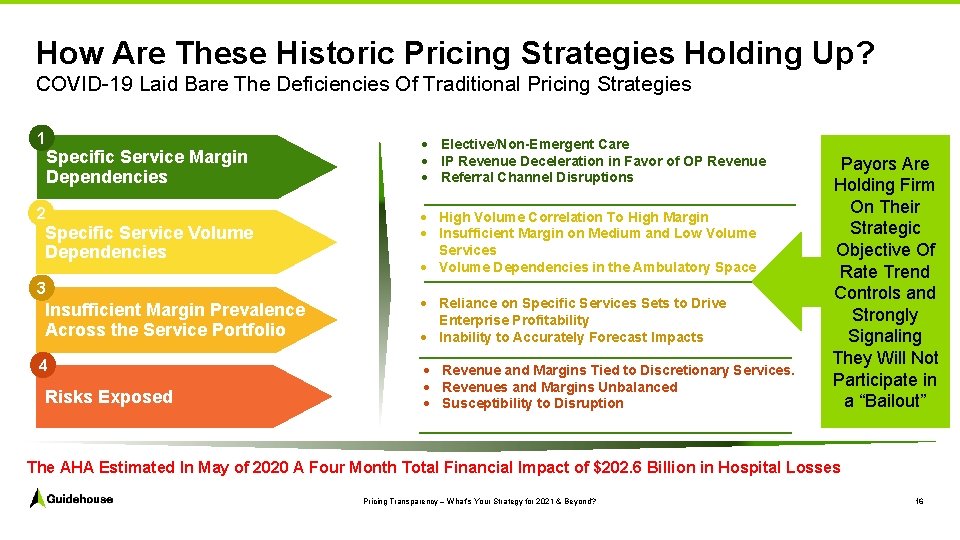
How Are These Historic Pricing Strategies Holding Up? COVID 19 Laid Bare The Deficiencies Of Traditional Pricing Strategies 1 Specific Service Margin Dependencies · Elective/Non-Emergent Care · IP Revenue Deceleration in Favor of OP Revenue · Referral Channel Disruptions Specific Service Volume Dependencies · High Volume Correlation To High Margin · Insufficient Margin on Medium and Low Volume Services · Volume Dependencies in the Ambulatory Space 2 3 Insufficient Margin Prevalence Across the Service Portfolio 4 Risks Exposed · Reliance on Specific Services Sets to Drive Enterprise Profitability · Inability to Accurately Forecast Impacts · Revenue and Margins Tied to Discretionary Services. · Revenues and Margins Unbalanced · Susceptibility to Disruption Payors Are Holding Firm On Their Strategic Objective Of Rate Trend Controls and Strongly Signaling They Will Not Participate in a “Bailout” The AHA Estimated In May of 2020 A Four Month Total Financial Impact of $202. 6 Billion in Hospital Losses Pricing Transparency – What’s Your Strategy for 2021 & Beyond? 16
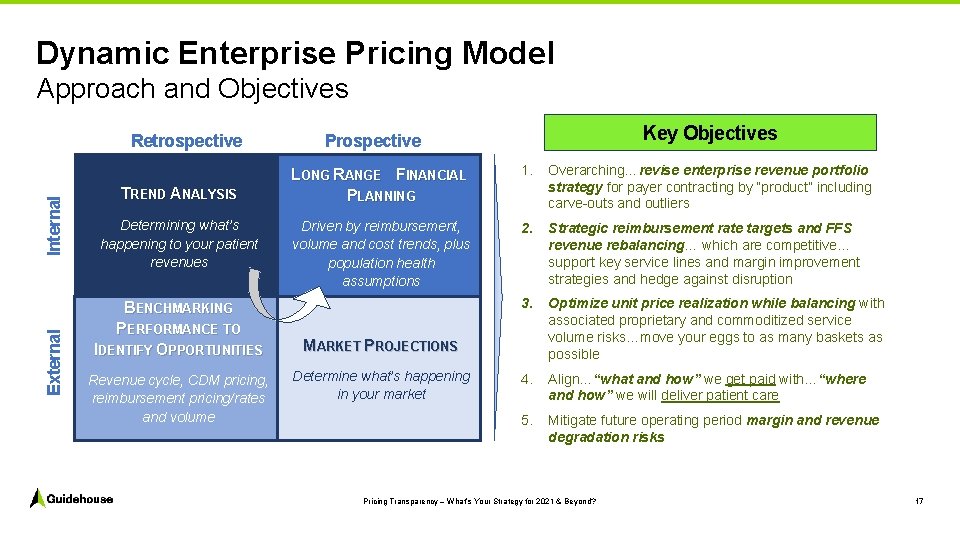
Dynamic Enterprise Pricing Model Approach and Objectives External Internal Retrospective TREND ANALYSIS Determining what’s happening to your patient revenues BENCHMARKING PERFORMANCE TO IDENTIFY OPPORTUNITIES Revenue cycle, CDM pricing, reimbursement pricing/rates and volume Key Objectives Prospective LONG RANGE FINANCIAL PLANNING 1. Overarching…revise enterprise revenue portfolio strategy for payer contracting by “product” including carve outs and outliers Driven by reimbursement, volume and cost trends, plus population health assumptions 2. Strategic reimbursement rate targets and FFS revenue rebalancing… which are competitive… support key service lines and margin improvement strategies and hedge against disruption 3. Optimize unit price realization while balancing with associated proprietary and commoditized service volume risks…move your eggs to as many baskets as possible 4. Align…“what and how” we get paid with…“where and how” we will deliver patient care 5. Mitigate future operating period margin and revenue degradation risks MARKET PROJECTIONS Determine what’s happening in your market Pricing Transparency – What’s Your Strategy for 2021 & Beyond? 17
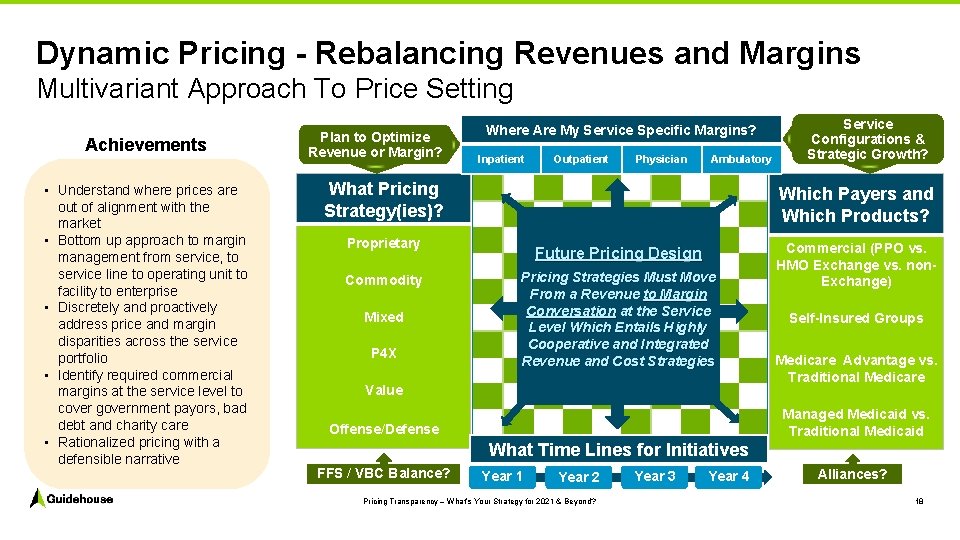
Dynamic Pricing - Rebalancing Revenues and Margins Multivariant Approach To Price Setting Achievements • Understand where prices are out of alignment with the market • Bottom up approach to margin management from service, to service line to operating unit to facility to enterprise • Discretely and proactively address price and margin disparities across the service portfolio • Identify required commercial margins at the service level to cover government payors, bad debt and charity care • Rationalized pricing with a defensible narrative Plan to Optimize Revenue or Margin? Where Are My Service Specific Margins? Inpatient Outpatient Physician Ambulatory What Pricing Strategy(ies)? Which Payers and Which Products? Proprietary Commodity Mixed P 4 X Service Configurations & Strategic Growth? Future Pricing Design Pricing Strategies Must Move From a Revenue to Margin Conversation at the Service Level Which Entails Highly Cooperative and Integrated Revenue and Cost Strategies Value Commercial (PPO vs. HMO Exchange vs. non. Exchange) Self-Insured Groups Medicare Advantage vs. Traditional Medicare Managed Medicaid vs. Traditional Medicaid Offense/Defense What Time Lines for Initiatives FFS / VBC Balance? Year 1 Year 2 Pricing Transparency – What’s Your Strategy for 2021 & Beyond? Year 3 Year 4 Alliances? 18
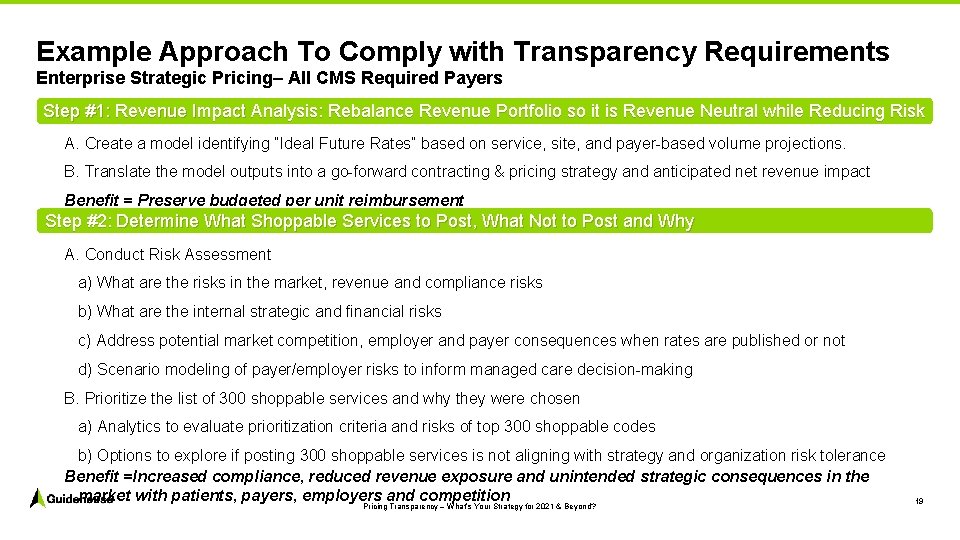
Example Approach To Comply with Transparency Requirements Enterprise Strategic Pricing– All CMS Required Payers Step #1: Revenue Impact Analysis: Rebalance Revenue Portfolio so it is Revenue Neutral while Reducing Risk A. Create a model identifying “Ideal Future Rates” based on service, site, and payer based volume projections. B. Translate the model outputs into a go forward contracting & pricing strategy and anticipated net revenue impact Benefit = Preserve budgeted per unit reimbursement Step #2: Determine What Shoppable Services to Post, What Not to Post and Why A. Conduct Risk Assessment a) What are the risks in the market, revenue and compliance risks b) What are the internal strategic and financial risks c) Address potential market competition, employer and payer consequences when rates are published or not d) Scenario modeling of payer/employer risks to inform managed care decision making B. Prioritize the list of 300 shoppable services and why they were chosen a) Analytics to evaluate prioritization criteria and risks of top 300 shoppable codes b) Options to explore if posting 300 shoppable services is not aligning with strategy and organization risk tolerance Benefit =Increased compliance, reduced revenue exposure and unintended strategic consequences in the market with patients, payers, employers and competition Pricing Transparency – What’s Your Strategy for 2021 & Beyond? 19
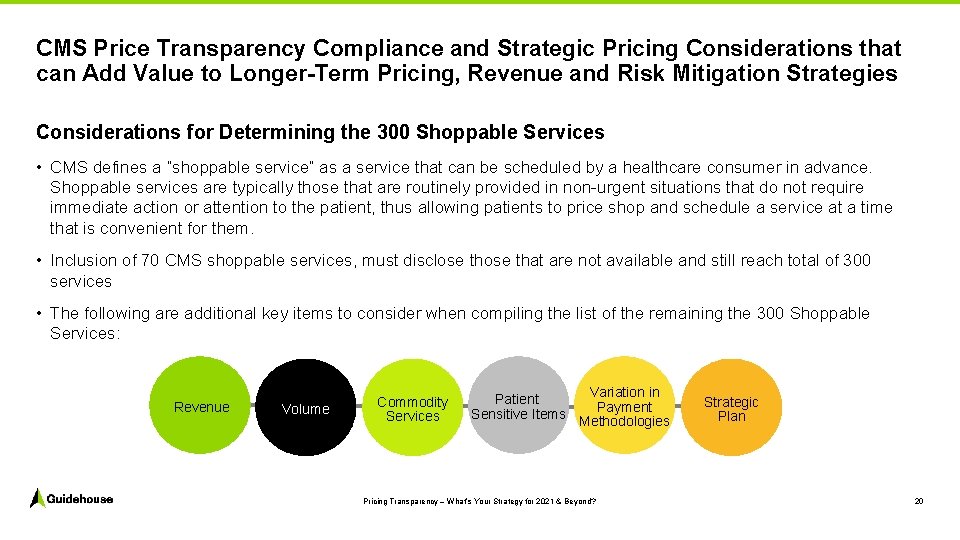
CMS Price Transparency Compliance and Strategic Pricing Considerations that can Add Value to Longer-Term Pricing, Revenue and Risk Mitigation Strategies Considerations for Determining the 300 Shoppable Services • CMS defines a “shoppable service” as a service that can be scheduled by a healthcare consumer in advance. Shoppable services are typically those that are routinely provided in non urgent situations that do not require immediate action or attention to the patient, thus allowing patients to price shop and schedule a service at a time that is convenient for them. • Inclusion of 70 CMS shoppable services, must disclose that are not available and still reach total of 300 services • The following are additional key items to consider when compiling the list of the remaining the 300 Shoppable Services: Revenue Volume Commodity Services Patient Sensitive Items Variation in Payment Methodologies Pricing Transparency – What’s Your Strategy for 2021 & Beyond? Strategic Plan 20
Poll Question #3 Do you feel the traditional approach to Pricing Strategies - “set it and inflate it” - can continue to be a successful in the emerging healthcare landscape? A. Yes, it can continue to be successful…I’m not concerned about my organizations prices or the rates we have with payers. B. No, it can’t be successful…the converging forces in healthcare require an innovative and new approach to traditional managed care strategies. C. I’m not sure…it might be just fine or it might not; it’s too early to tell. Pricing Transparency – What’s Your Strategy for 2021 & Beyond? 21

2 2 3. Other Strategic Considerations
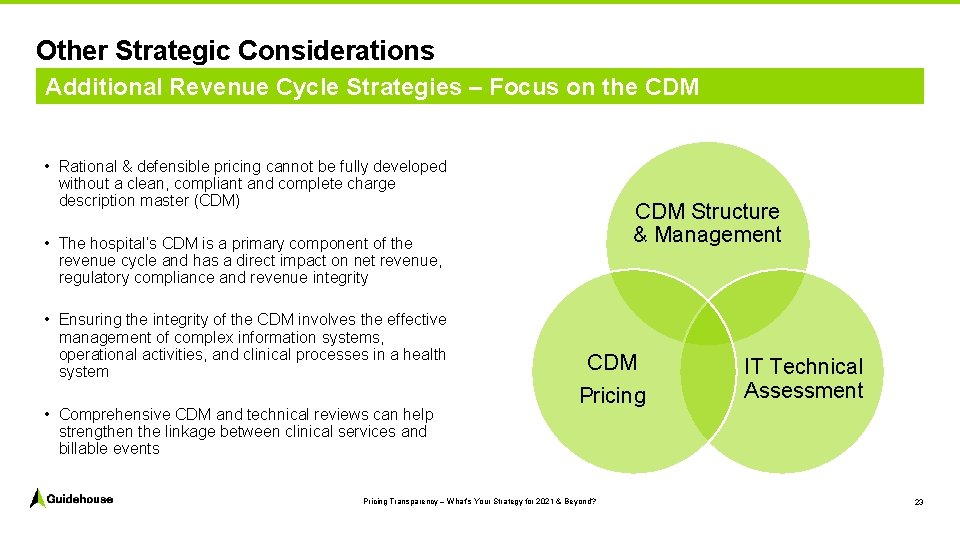
Other Strategic Considerations Additional Revenue Cycle Strategies – Focus on the CDM • Rational & defensible pricing cannot be fully developed without a clean, compliant and complete charge description master (CDM) CDM Structure & Management • The hospital’s CDM is a primary component of the revenue cycle and has a direct impact on net revenue, regulatory compliance and revenue integrity • Ensuring the integrity of the CDM involves the effective management of complex information systems, operational activities, and clinical processes in a health system • Comprehensive CDM and technical reviews can help strengthen the linkage between clinical services and billable events CDM Pricing Transparency – What’s Your Strategy for 2021 & Beyond? IT Technical Assessment 23
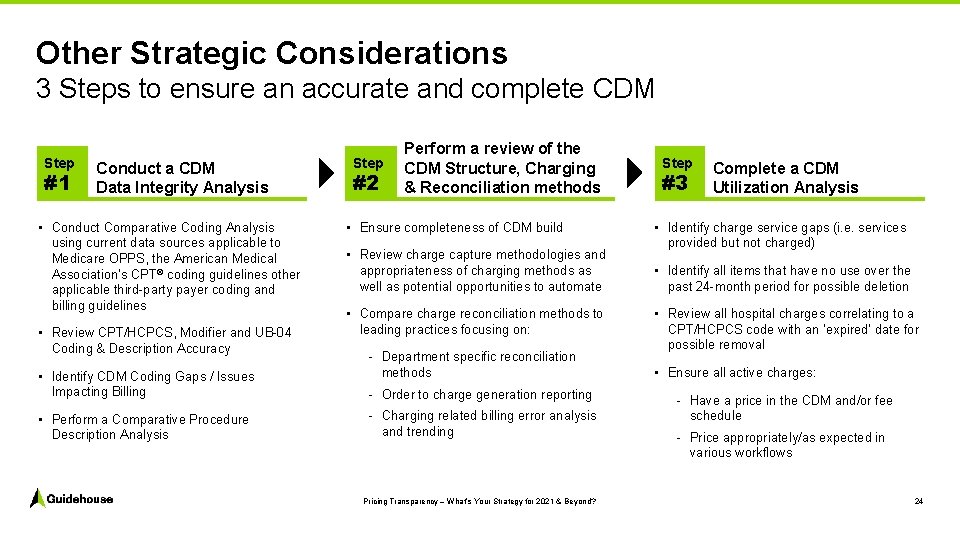
Other Strategic Considerations 3 Steps to ensure an accurate and complete CDM Step #1 Conduct a CDM Data Integrity Analysis • Conduct Comparative Coding Analysis using current data sources applicable to Medicare OPPS, the American Medical Association’s CPT® coding guidelines other applicable third party payer coding and billing guidelines • Review CPT/HCPCS, Modifier and UB 04 Coding & Description Accuracy • Identify CDM Coding Gaps / Issues Impacting Billing • Perform a Comparative Procedure Description Analysis Step #2 Perform a review of the CDM Structure, Charging & Reconciliation methods • Ensure completeness of CDM build • Review charge capture methodologies and appropriateness of charging methods as well as potential opportunities to automate • Compare charge reconciliation methods to leading practices focusing on: Department specific reconciliation methods Order to charge generation reporting Charging related billing error analysis and trending Pricing Transparency – What’s Your Strategy for 2021 & Beyond? Step #3 Complete a CDM Utilization Analysis • Identify charge service gaps (i. e. services provided but not charged) • Identify all items that have no use over the past 24 month period for possible deletion • Review all hospital charges correlating to a CPT/HCPCS code with an ‘expired’ date for possible removal • Ensure all active charges: Have a price in the CDM and/or fee schedule Price appropriately/as expected in various workflows 24
Other Strategic Considerations Digital Patient Engagement ● A recent study found new and expanding healthcare disruptors are outperforming 9 out of 10 health systems when it comes to providing a seamless, integrated digital experience ● The study focuses on the digital best practices that fall in the following categories: 1. Awareness – Search engine optimization, safe browsing and communication, and site performance 2. Consideration – Site usability and accessibility, mobile optimization, navigation usability, and content readability ● Disruptors are not only seizing the consumerization of healthcare in providing access, convenience, choice, and price transparency for lower acuity services, they are also reaching customers with Amazon like capabilities built into their tools ● The lack of digital engagement expertise is putting hospitals and health systems at risk of losing consumers to disruptors offering more routine, lower acuity care. Pricing Transparency – What’s Your Strategy for 2021 & Beyond? 25
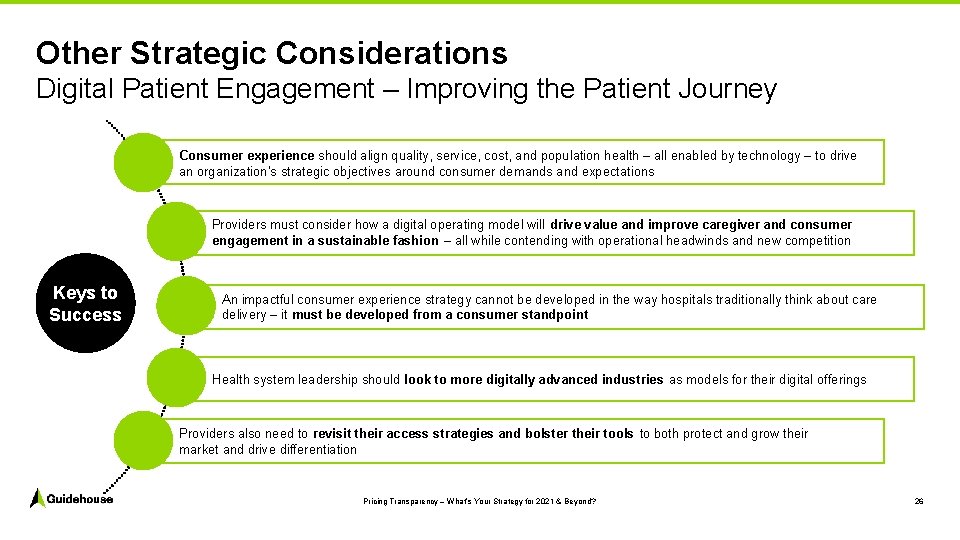
Other Strategic Considerations Digital Patient Engagement – Improving the Patient Journey Consumer experience should align quality, service, cost, and population health – all enabled by technology – to drive an organization’s strategic objectives around consumer demands and expectations Providers must consider how a digital operating model will drive value and improve caregiver and consumer engagement in a sustainable fashion – all while contending with operational headwinds and new competition Keys to Success An impactful consumer experience strategy cannot be developed in the way hospitals traditionally think about care delivery – it must be developed from a consumer standpoint Health system leadership should look to more digitally advanced industries as models for their digital offerings Providers also need to revisit their access strategies and bolster their tools to both protect and grow their market and drive differentiation Pricing Transparency – What’s Your Strategy for 2021 & Beyond? 26

2 7 Q&A 27
Contact Len Mandel Director, Commercial Healthcare len. mandel@guidehouse. com (954) 234 8925 Mark Spehar, CPA, FHFMA, PMP, CGMA Associate Director, Commercial Healthcare mspehar@guidehouse. com (412) 260 7818 Kevin Mc. Carthy Associate Director, Commercial Healthcare kevin. mccarthy@guidehouse. com (312) 583. 5741 © 2020 Guidehouse Inc. All rights reserved. This content is for general information purposes only, and should not be used as a substitute for consultation with professional advisors.
- Slides: 29