
Webinar on the Shark Fin Soup Consumption Reduction
Webinar on the Shark Fin Soup Consumption Reduction Survey 2018 Drivers of demand behavior change in Mainland China, Hong Kong, Taiwan and Singapore July 26 2018
Table of Contents 2 • HOW: Background, objectives and methodologies • WHO: Identify the key consumer groups of shark fin and mobula gill ray consumption (specific section). AND: Describe and analyse the psychosocial and socio-demographic, attitudinal and other aspects of each consumer profile and the consumer segments • WHAT: Identify the prevalence and frequency of consumption, consumption indicators and consumption behavior • WHERE: Consumption occasions • WHY: Identify the major drivers and deterrents of shark fin soup consumption • Q&A

1. HOW: Background, Objectives, Methodologies and Analyses © Caters News Agency
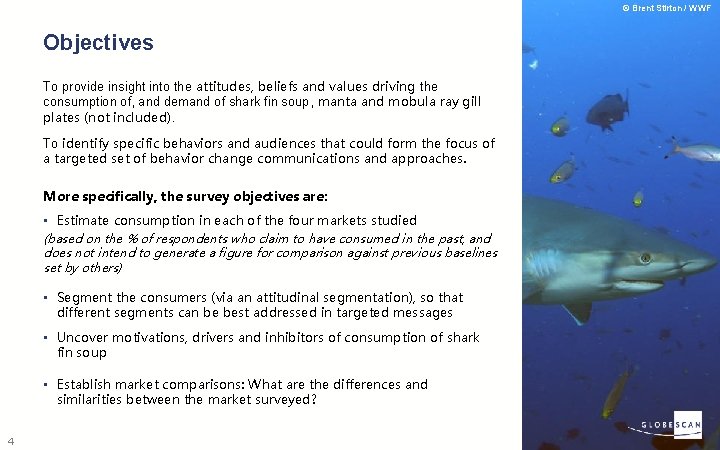
© Brent Stirton / WWF Objectives To provide insight into the attitudes, beliefs and values driving the consumption of, and demand of shark fin soup, manta and mobula ray gill plates (not included). To identify specific behaviors and audiences that could form the focus of a targeted set of behavior change communications and approaches. More specifically, the survey objectives are: • Estimate consumption in each of the four markets studied (based on the % of respondents who claim to have consumed in the past, and does not intend to generate a figure for comparison against previous baselines set by others) • Segment the consumers (via an attitudinal segmentation), so that different segments can be best addressed in targeted messages • Uncover motivations, drivers and inhibitors of consumption of shark fin soup • Establish market comparisons: What are the differences and similarities between the market surveyed? 4
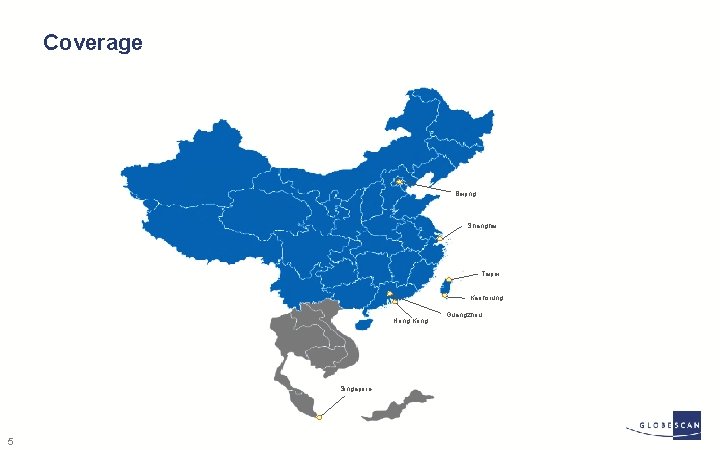
Coverage Beijing Shanghai Taipei Kaohsiung Hong Kong Singapore 5 Guangzhou
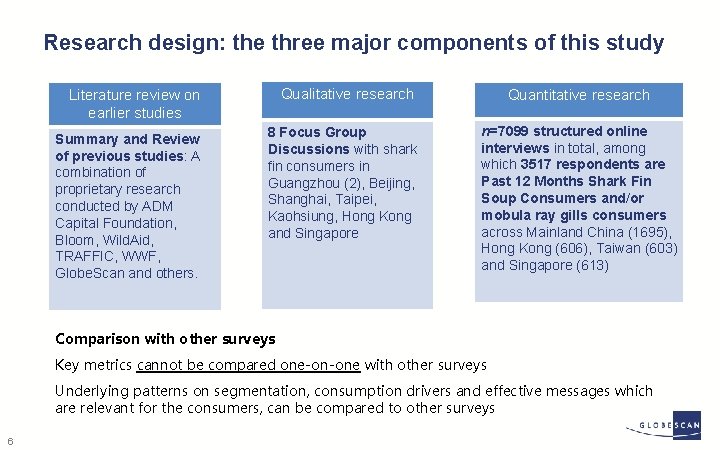
Research design: the three major components of this study Qualitative research Quantitative research 8 Focus Group Discussions with shark fin consumers in Guangzhou (2), Beijing, Shanghai, Taipei, Kaohsiung, Hong Kong and Singapore n=7099 structured online interviews in total, among which 3517 respondents are Past 12 Months Shark Fin Soup Consumers and/or mobula ray gills consumers across Mainland China (1695), Hong Kong (606), Taiwan (603) and Singapore (613) Literature review on earlier studies Summary and Review of previous studies: A combination of proprietary research conducted by ADM Capital Foundation, Bloom, Wild. Aid, TRAFFIC, WWF, Globe. Scan and others. Comparison with other surveys Key metrics cannot be compared one-on-one with other surveys Underlying patterns on segmentation, consumption drivers and effective messages which are relevant for the consumers, can be compared to other surveys 6
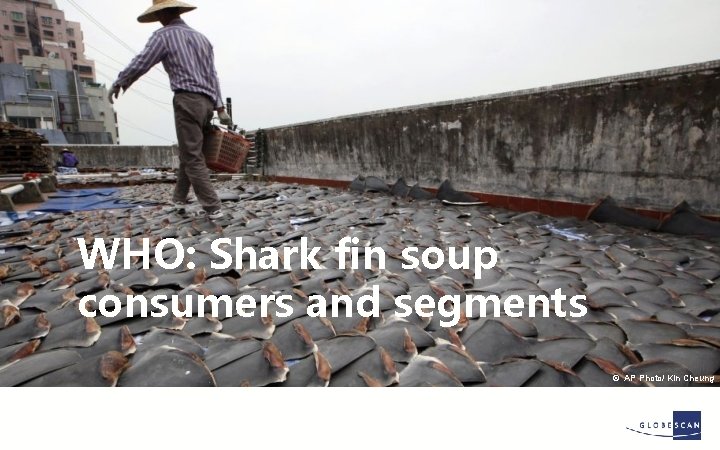
WHO: Shark fin soup consumers and segments © AP Photo/ Kin Cheung
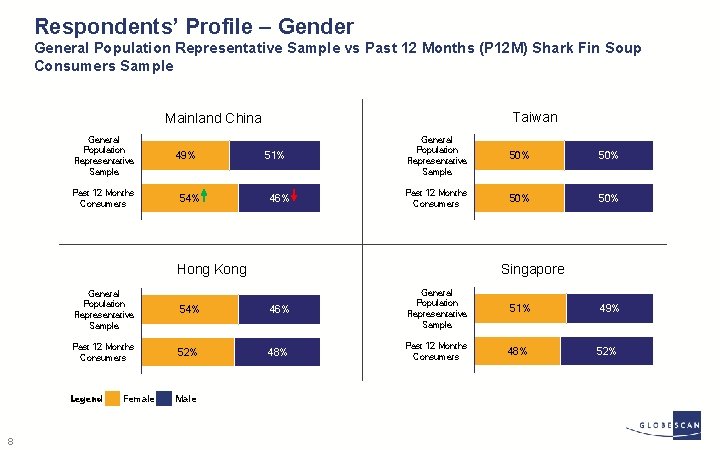
Respondents’ Profile – Gender General Population Representative Sample vs Past 12 Months (P 12 M) Shark Fin Soup Consumers Sample Taiwan Mainland China General Population Representative Sample Past 12 Months Consumers 49% 54% 51% 46% General Population Representative Sample 50% Past 12 Months Consumers 50% Hong Kong General Population Representative Sample 54% Past 12 Months Consumers 52% Legend 8 Female Male Singapore 46% General Population Representative Sample 51% 49% 48% Past 12 Months Consumers 48% 52%
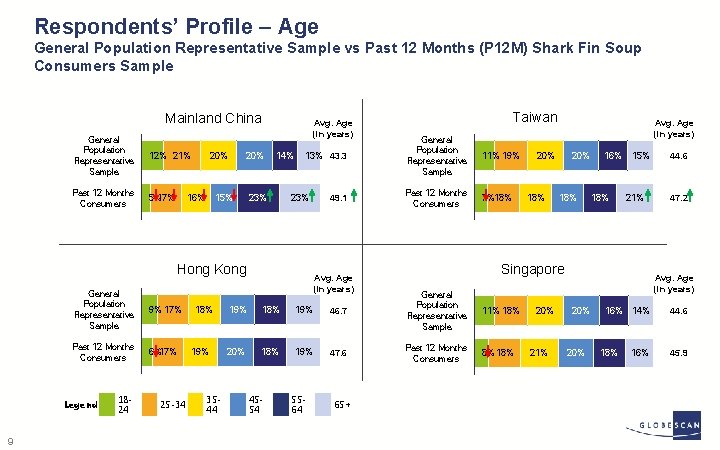
Respondents’ Profile – Age General Population Representative Sample vs Past 12 Months (P 12 M) Shark Fin Soup Consumers Sample Mainland China General Population Representative Sample 12% 21% Past 12 Months Consumers 5% 17% 20% 16% 20% 15% Avg. Age (in years) 14% 23% 13% 43. 3 General Population Representative Sample 11% 19% 49. 1 Past 12 Months Consumers 7%18% 23% Hong Kong General Population Representative Sample 9% 17% Past 12 Months Consumers 6%17% Legend 9 1824 25 -34 18% 19% 3544 Taiwan Avg. Age (in years) 19% 18% 19% 46. 7 20% 18% 19% 47. 6 Past 12 Months Consumers 5564 65+ 20% 18% 16% 18% 15% 21% Singapore General Population Representative Sample 4554 Avg. Age (in years) 11% 18% 8% 18% 20% 21% 44. 6 47. 2 Avg. Age (in years) 20% 16% 18% 14% 44. 6 16% 45. 9
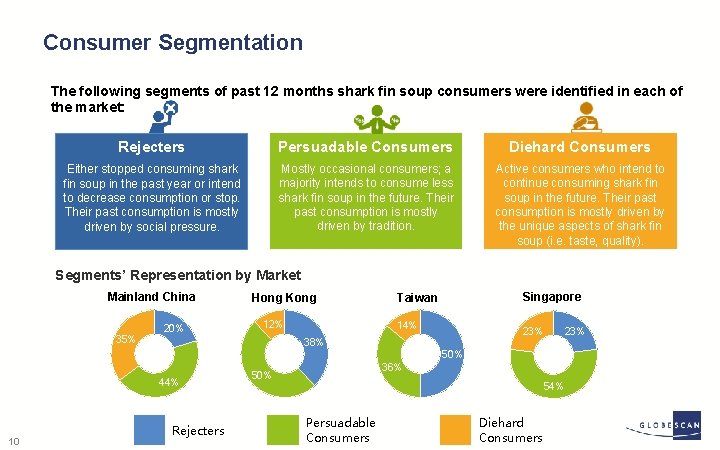
Consumer Segmentation The following segments of past 12 months shark fin soup consumers were identified in each of the market: Rejecters Persuadable Consumers Diehard Consumers Either stopped consuming shark fin soup in the past year or intend to decrease consumption or stop. Their past consumption is mostly driven by social pressure. Mostly occasional consumers; a majority intends to consume less shark fin soup in the future. Their past consumption is mostly driven by tradition. Active consumers who intend to continue consuming shark fin soup in the future. Their past consumption is mostly driven by the unique aspects of shark fin soup (i. e. taste, quality). Segments’ Representation by Market Mainland China 20% Hong Kong 12% 35% Singapore Taiwan 14% 23% 38% 23% 50% 44% 10 Rejecters 36% 50% 54% Persuadable Consumers Diehard Consumers
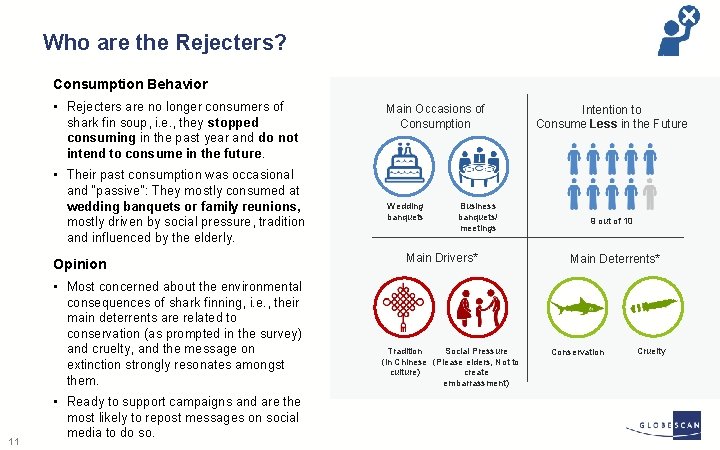
Who are the Rejecters? Consumption Behavior • Rejecters are no longer consumers of shark fin soup, i. e. , they stopped consuming in the past year and do not intend to consume in the future. • Their past consumption was occasional and “passive”: They mostly consumed at wedding banquets or family reunions, mostly driven by social pressure, tradition and influenced by the elderly. Opinion • Most concerned about the environmental consequences of shark finning, i. e. , their main deterrents are related to conservation (as prompted in the survey) and cruelty, and the message on extinction strongly resonates amongst them. 11 • Ready to support campaigns and are the most likely to repost messages on social media to do so. Main Occasions of Consumption Wedding banquets Business banquets/ meetings Main Drivers* Social Pressure Tradition (in Chinese (Please elders, Not to create culture) embarrassment) Intention to Consume Less in the Future 9 out of 10 Main Deterrents* Conservation Cruelty
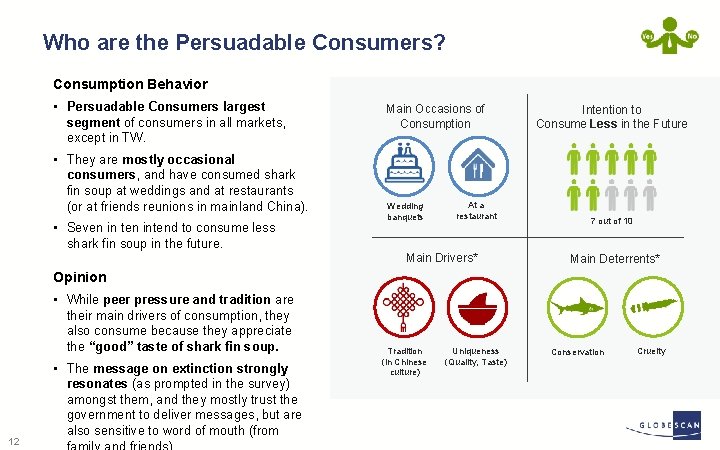
Who are the Persuadable Consumers? Consumption Behavior • Persuadable Consumers largest segment of consumers in all markets, except in TW. • They are mostly occasional consumers, and have consumed shark fin soup at weddings and at restaurants (or at friends reunions in mainland China). • Seven in ten intend to consume less shark fin soup in the future. Main Occasions of Consumption Wedding banquets At a restaurant Main Drivers* Intention to Consume Less in the Future 7 out of 10 Main Deterrents* Opinion • While peer pressure and tradition are their main drivers of consumption, they also consume because they appreciate the “good” taste of shark fin soup. 12 • The message on extinction strongly resonates (as prompted in the survey) amongst them, and they mostly trust the government to deliver messages, but are also sensitive to word of mouth (from Tradition (in Chinese culture) Uniqueness (Quality, Taste) Conservation Cruelty
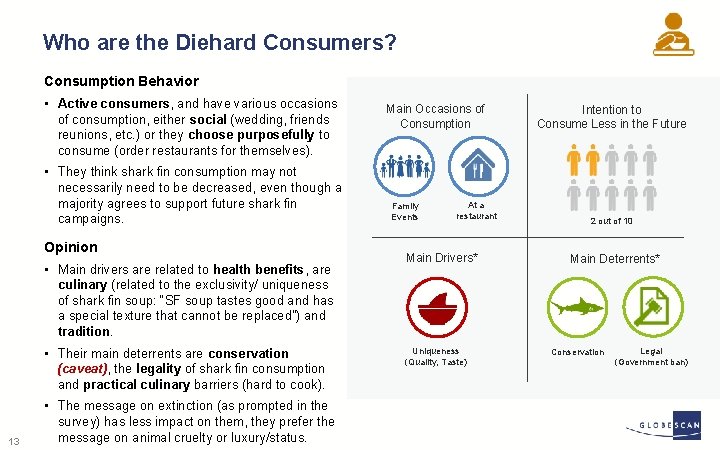
Who are the Diehard Consumers? Consumption Behavior • Active consumers, and have various occasions of consumption, either social (wedding, friends reunions, etc. ) or they choose purposefully to consume (order restaurants for themselves). • They think shark fin consumption may not necessarily need to be decreased, even though a majority agrees to support future shark fin campaigns. Opinion • Main drivers are related to health benefits, are culinary (related to the exclusivity/ uniqueness of shark fin soup: “SF soup tastes good and has a special texture that cannot be replaced”) and tradition. • Their main deterrents are conservation (caveat), the legality of shark fin consumption and practical culinary barriers (hard to cook). 13 • The message on extinction (as prompted in the survey) has less impact on them, they prefer the message on animal cruelty or luxury/status. Main Occasions of Consumption Family Events At a restaurant Main Drivers* Uniqueness (Quality, Taste) Intention to Consume Less in the Future 2 out of 10 Main Deterrents* Conservation Legal (Government ban)
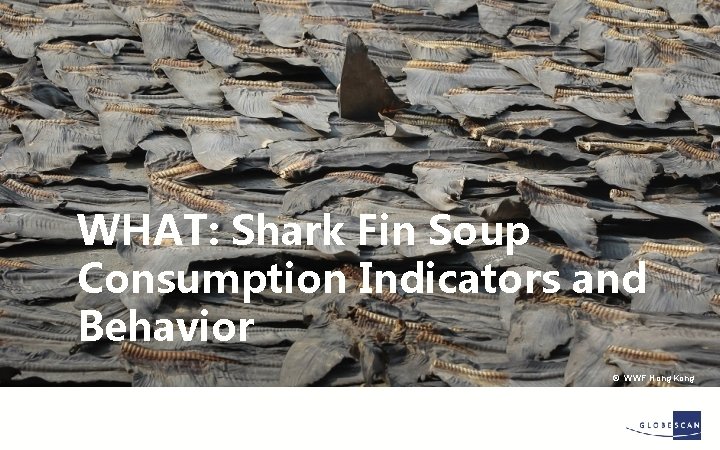
WHAT: Shark Fin Soup Consumption Indicators and Behavior © WWF Hong Kong
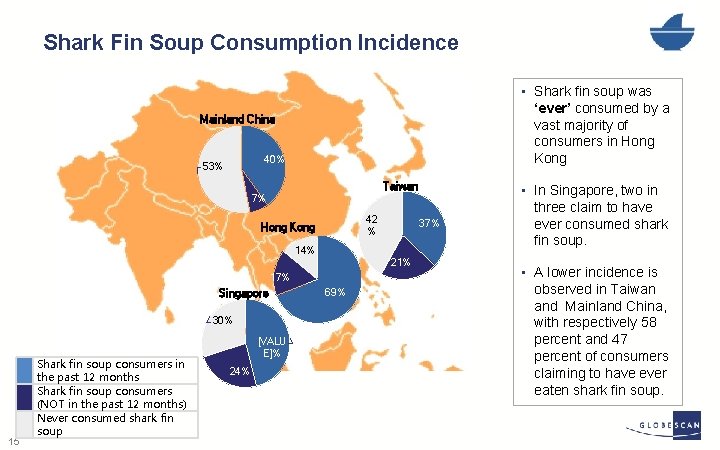
Shark Fin Soup Consumption Incidence • Shark fin soup was ‘ever’ consumed by a vast majority of consumers in Hong Kong Mainland China 40% 53% Taiwan 7% 42 % Hong Kong 37% 14% 21% 17% Singapore 30% 15 Shark fin soup consumers in the past 12 months Shark fin soup consumers (NOT in the past 12 months) Never consumed shark fin soup [VALU E]% 24% 69% • In Singapore, two in three claim to have ever consumed shark fin soup. • A lower incidence is observed in Taiwan and Mainland China, with respectively 58 percent and 47 percent of consumers claiming to have ever eaten shark fin soup.
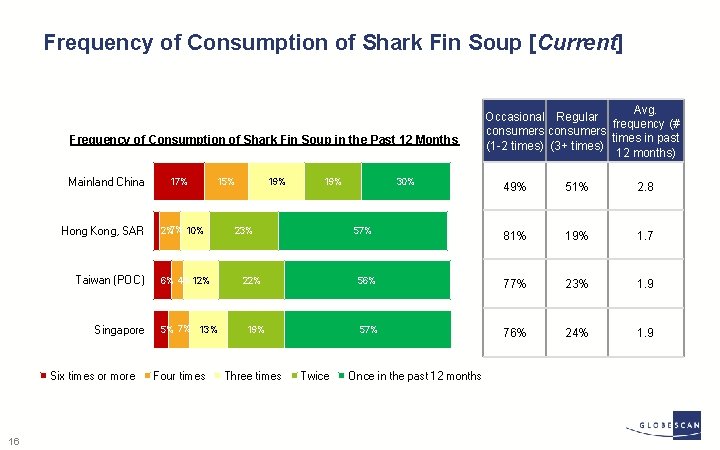
Frequency of Consumption of Shark Fin Soup [Current] Frequency of Consumption of Shark Fin Soup in the Past 12 Months Mainland China Hong Kong, SAR Taiwan (POC) Singapore Six times or more 16 17% 15% 2%7% 10% 6% 4% 12% 5% 7% 13% Four times 19% 23% 49% 51% 2. 8 81% 19% 1. 7 56% 77% 23% 1. 9 57% 76% 24% 1. 9 57% 22% 19% Three times 30% Twice Avg. Occasional Regular frequency (# consumers times in past (1 -2 times) (3+ times) 12 months) Once in the past 12 months
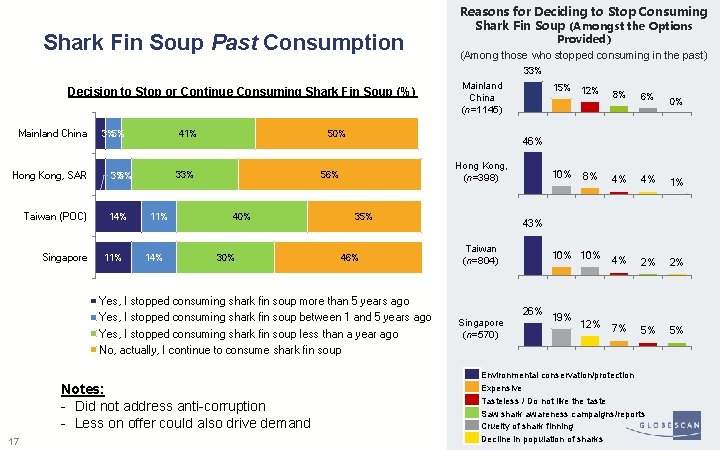
Shark Fin Soup Past Consumption Reasons for Deciding to Stop Consuming Shark Fin Soup (Amongst the Options Provided) (Among those who stopped consuming in the past) 33% Decision to Stop or Continue Consuming Shark Fin Soup (%) Mainland China Hong Kong, SAR Taiwan (POC) Singapore 3%5% 41% 14% 11% 50% 33% 3% 8% 11% 14% Hong Kong, (n=398) 56% 40% 30% Notes: - Did not address anti-corruption - Less on offer could also drive demand 15% 12% 8% 6% 4% 4% 1% 4% 2% 2% 7% 5% 5% 0% 46% 35% 46% Yes, I stopped consuming shark fin soup more than 5 years ago Yes, I stopped consuming shark fin soup between 1 and 5 years ago Yes, I stopped consuming shark fin soup less than a year ago No, actually, I continue to consume shark fin soup 17 Mainland China (n=1145) 10% 8% 43% Taiwan (n=804) 10% 26% Singapore (n=570) 19% 12% Environmental conservation/protection Expensive Tasteless / Do not like the taste Saw shark awareness campaigns/reports Cruelty of shark finning Decline in population of sharks
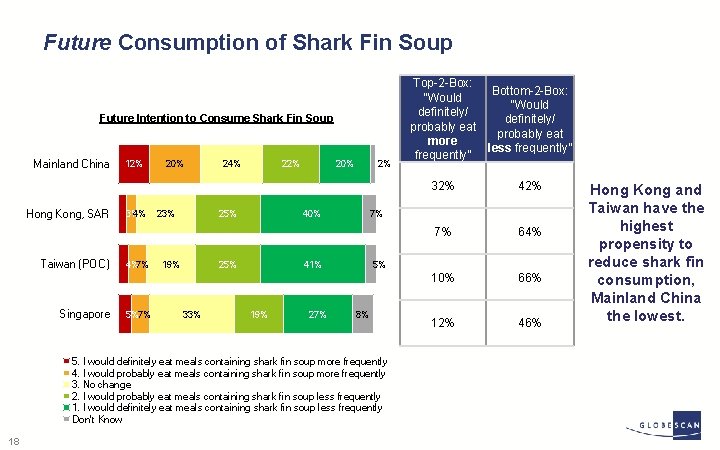
Future Consumption of Shark Fin Soup Future Intention to Consume Shark Fin Soup Mainland China Hong Kong, SAR Taiwan (POC) Singapore 12% 3% 4% 4%7% 5%7% 20% 23% 24% 22% 25% 19% 2% 40% 25% 33% 20% 27% 42% 7% 64% 10% 66% 12% 46% 5% 8% 5. I would definitely eat meals containing shark fin soup more frequently 4. I would probably eat meals containing shark fin soup more frequently 3. No change 2. I would probably eat meals containing shark fin soup less frequently 1. I would definitely eat meals containing shark fin soup less frequently Don't Know 18 32% 7% 41% 19% Top-2 -Box: Bottom-2 -Box: “Would definitely/ probably eat more less frequently” Hong Kong and Taiwan have the highest propensity to reduce shark fin consumption, Mainland China the lowest.
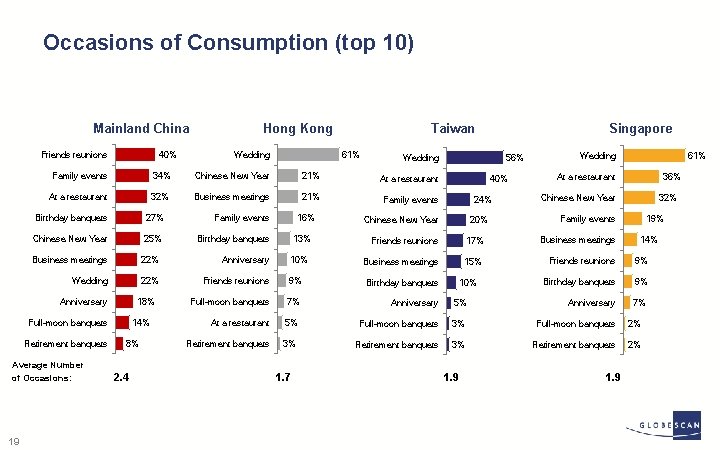
Occasions of Consumption (top 10) Mainland China Friends reunions 40% Wedding Taiwan 61% 34% Chinese New Year 21% At a restaurant 32% Business meetings 21% Family events Birthday banquets 27% Family events Chinese New Year 25% Birthday banquets 16% 13% 56% 40% 24% Chinese New Year 20% Wedding 61% At a restaurant 36% Chinese New Year 32% Family events 19% Friends reunions 17% Business meetings 14% Business meetings 15% Friends reunions 9% Birthday banquets 9% 7% Business meetings 22% Anniversary Wedding 22% Friends reunions 9% Birthday banquets Full-moon banquets 7% Anniversary 5% Anniversary At a restaurant 5% Full-moon banquets 3% Full-moon banquets 2% Retirement banquets 3% Retirement banquets 2% 18% Full-moon banquets Retirement banquets Average Number of Occasions: 14% 8% 2. 4 10% Singapore Wedding Family events Anniversary 19 Hong Kong 1. 7 10% 1. 9
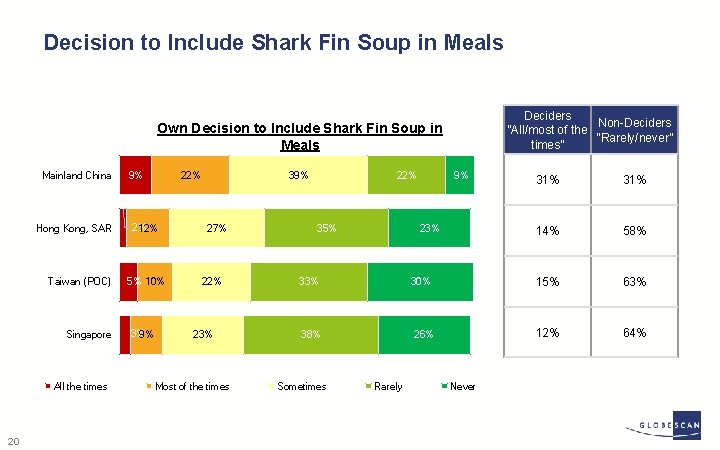
Decision to Include Shark Fin Soup in Meals Deciders Non-Deciders “All/most of the “Rarely/never” times” Own Decision to Include Shark Fin Soup in Meals Mainland China Hong Kong, SAR Taiwan (POC) Singapore All the times 20 9% 22% 2% 12% 5% 10% 3% 9% 39% 27% 22% 23% Most of the times 22% 35% 23% 30% 38% Sometimes 9% 26% Rarely Never 31% 14% 58% 15% 63% 12% 64%
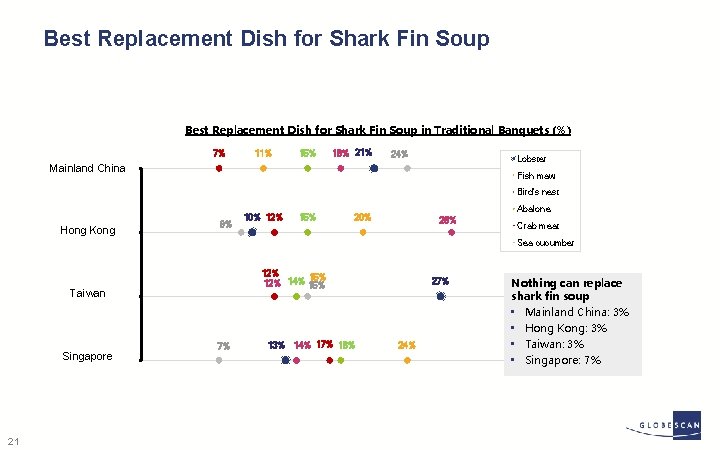
Best Replacement Dish for Shark Fin Soup in Traditional Banquets (%) 7% 11% 15% 18% 21% 24% Lobster Mainland China Fish maw Bird's nest Hong Kong 9% 10% 12% 15% Abalone 20% 28% Crab meat Sea cucumber 12% 15% 12% 14% 15% Taiwan Singapore 21 7% 13% 14% 17% 18% 27% 24% Nothing can replace shark fin soup • Mainland China: 3% • Hong Kong: 3% • Taiwan: 3% • Singapore: 7%
WHY: Drivers and Deterrents of Shark Fin Soup Consumption © qwerty
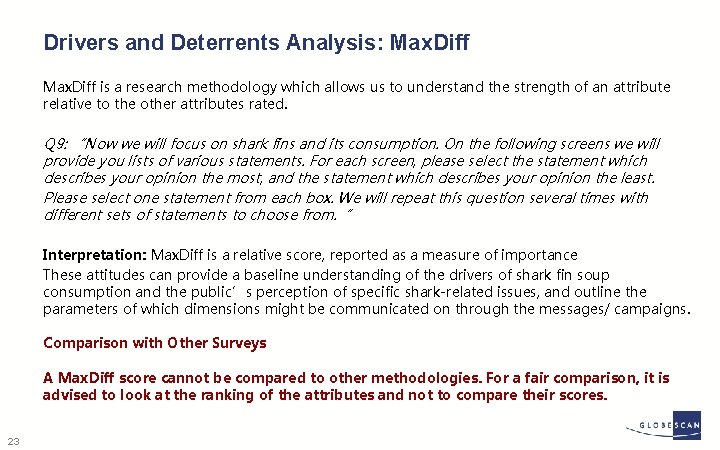
Drivers and Deterrents Analysis: Max. Diff is a research methodology which allows us to understand the strength of an attribute relative to the other attributes rated. Q 9: “Now we will focus on shark fins and its consumption. On the following screens we will provide you lists of various statements. For each screen, please select the statement which describes your opinion the most, and the statement which describes your opinion the least. Please select one statement from each box. We will repeat this question several times with different sets of statements to choose from. “ Interpretation: Max. Diff is a relative score, reported as a measure of importance These attitudes can provide a baseline understanding of the drivers of shark fin soup consumption and the public’s perception of specific shark-related issues, and outline the parameters of which dimensions might be communicated on through the messages/ campaigns. Comparison with Other Surveys A Max. Diff score cannot be compared to other methodologies. For a fair comparison, it is advised to look at the ranking of the attributes and not to compare their scores. 23
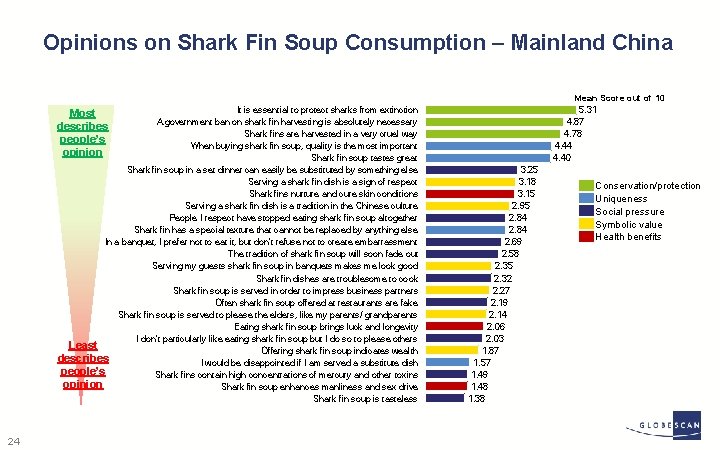
Opinions on Shark Fin Soup Consumption – Mainland China It is essential to protect sharks from extinction Most A government ban on shark fin harvesting is absolutely necessary describes Shark fins are harvested in a very cruel way people’s When buying shark fin soup, quality is the most important opinion Shark fin soup tastes great Shark fin soup in a set dinner can easily be substituted by something else Serving a shark fin dish is a sign of respect Shark fins nurture and cure skin conditions Serving a shark fin dish is a tradition in the Chinese culture People I respect have stopped eating shark fin soup altogether Shark fin has a special texture that cannot be replaced by anything else In a banquet, I prefer not to eat it, but don't refuse not to create embarrassment The tradition of shark fin soup will soon fade out Serving my guests shark fin soup in banquets makes me look good Shark fin dishes are troublesome to cook Shark fin soup is served in order to impress business partners Often shark fin soup offered at restaurants are fake Shark fin soup is served to please the elders, like my parents/ grandparents Eating shark fin soup brings luck and longevity I don't particularly like eating shark fin soup but I do so to please others Least Offering shark fin soup indicates wealth describes I would be disappointed if I am served a substitute dish people’s Shark fins contain high concentrations of mercury and other toxins opinion Shark fin soup enhances manliness and sex drive Shark fin soup is tasteless 24 Mean Score out of 10 5. 31 4. 87 4. 78 4. 44 4. 40 3. 25 3. 18 3. 15 2. 95 2. 84 2. 69 2. 58 2. 35 2. 32 2. 27 2. 19 2. 14 2. 06 2. 03 1. 87 1. 57 1. 49 1. 48 1. 38 Conservation/protection Uniqueness Social pressure Symbolic value Health benefits
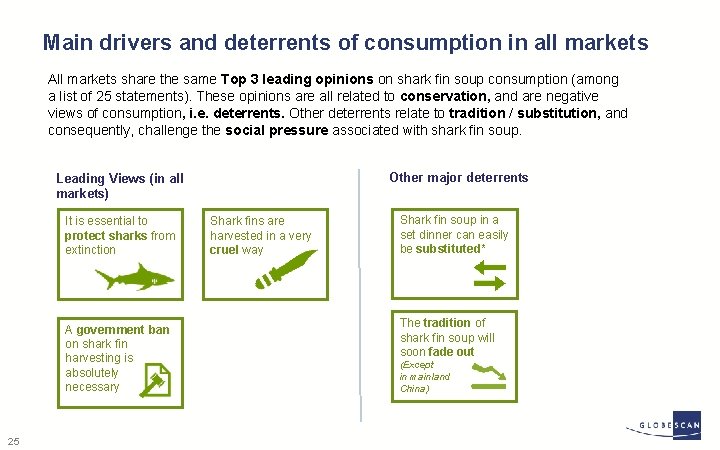
Main drivers and deterrents of consumption in all markets All markets share the same Top 3 leading opinions on shark fin soup consumption (among a list of 25 statements). These opinions are all related to conservation, and are negative views of consumption, i. e. deterrents. Other deterrents relate to tradition / substitution, and consequently, challenge the social pressure associated with shark fin soup. Other major deterrents Leading Views (in all markets) It is essential to protect sharks from extinction A government ban on shark fin harvesting is absolutely necessary 25 Shark fins are harvested in a very cruel way Shark fin soup in a set dinner can easily be substituted* The tradition of shark fin soup will soon fade out (Except in mainland China)
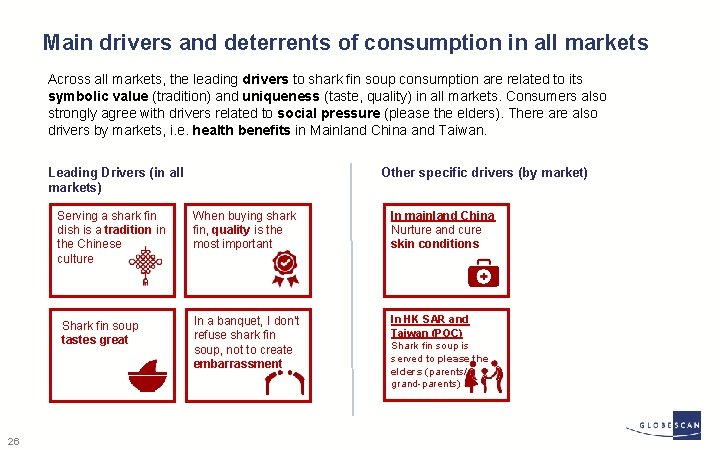
Main drivers and deterrents of consumption in all markets Across all markets, the leading drivers to shark fin soup consumption are related to its symbolic value (tradition) and uniqueness (taste, quality) in all markets. Consumers also strongly agree with drivers related to social pressure (please the elders). There also drivers by markets, i. e. health benefits in Mainland China and Taiwan. Leading Drivers (in all markets) Serving a shark fin dish is a tradition in the Chinese culture Shark fin soup tastes great 26 Other specific drivers (by market) When buying shark fin, quality is the most important In mainland China Nurture and cure skin conditions In a banquet, I don’t refuse shark fin soup, not to create embarrassment In HK SAR and Taiwan (POC) Shark fin soup is served to please the elders (parents/ grand-parents)
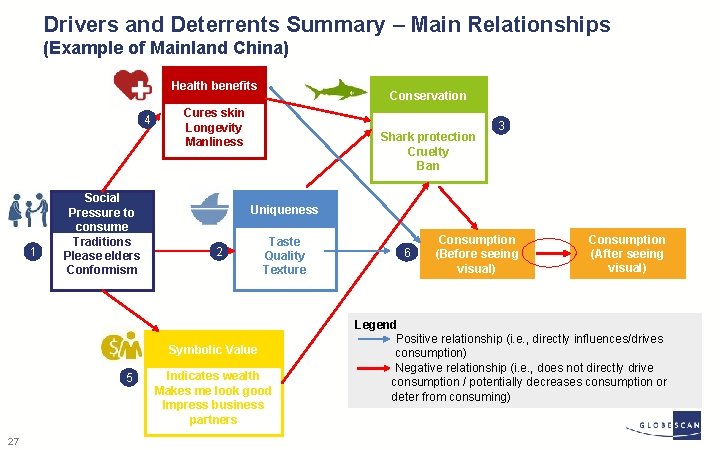
Drivers and Deterrents Summary – Main Relationships (Example of Mainland China) Health benefits 4 1 Social Pressure to consume Traditions Please elders Conformism Conservation Cures skin Longevity Manliness Shark protection Cruelty Ban Uniqueness 2 Taste Quality Texture Symbolic Value 5 27 3 Indicates wealth Makes me look good Impress business partners 6 Consumption (Before seeing visual) Consumption (After seeing visual) Legend Positive relationship (i. e. , directly influences/drives consumption) Negative relationship (i. e. , does not directly drive consumption / potentially decreases consumption or deter from consuming)
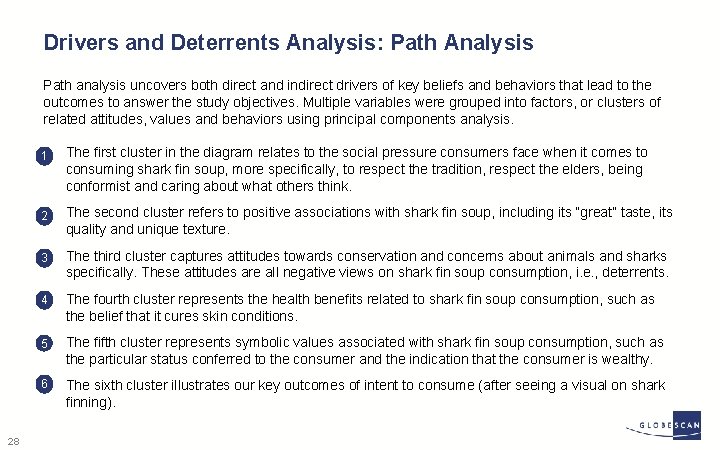
Drivers and Deterrents Analysis: Path Analysis Path analysis uncovers both direct and indirect drivers of key beliefs and behaviors that lead to the outcomes to answer the study objectives. Multiple variables were grouped into factors, or clusters of related attitudes, values and behaviors using principal components analysis. 28 1 • The first cluster in the diagram relates to the social pressure consumers face when it comes to consuming shark fin soup, more specifically, to respect the tradition, respect the elders, being conformist and caring about what others think. 2 • The second cluster refers to positive associations with shark fin soup, including its “great” taste, its quality and unique texture. 3 • The third cluster captures attitudes towards conservation and concerns about animals and sharks specifically. These attitudes are all negative views on shark fin soup consumption, i. e. , deterrents. 4 • The fourth cluster represents the health benefits related to shark fin soup consumption, such as the belief that it cures skin conditions. 5 • The fifth cluster represents symbolic values associated with shark fin soup consumption, such as the particular status conferred to the consumer and the indication that the consumer is wealthy. 6 • The sixth cluster illustrates our key outcomes of intent to consume (after seeing a visual on shark finning).
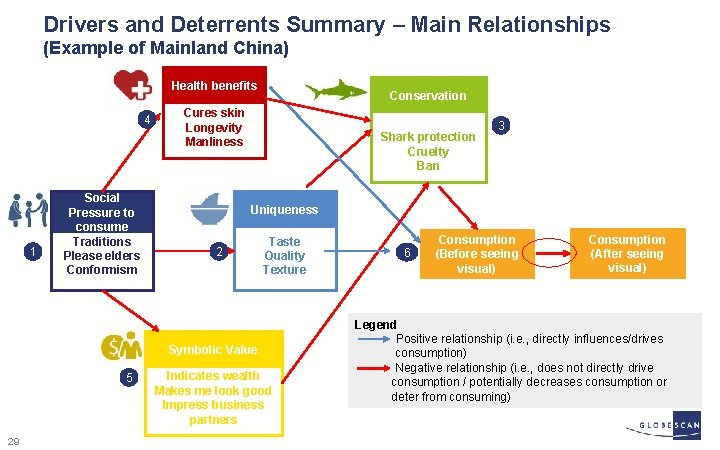
Drivers and Deterrents Summary – Main Relationships (Example of Mainland China) Health benefits 4 1 Social Pressure to consume Traditions Please elders Conformism Conservation Cures skin Longevity Manliness Shark protection Cruelty Ban Uniqueness 2 Taste Quality Texture Symbolic Value 5 29 3 Indicates wealth Makes me look good Impress business partners 6 Consumption (Before seeing visual) Consumption (After seeing visual) Legend Positive relationship (i. e. , directly influences/drives consumption) Negative relationship (i. e. , does not directly drive consumption / potentially decreases consumption or deter from consuming)
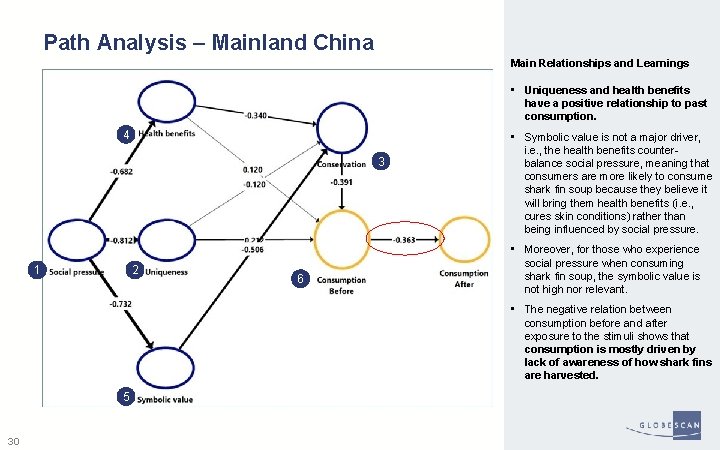
Path Analysis – Mainland China Main Relationships and Learnings • Uniqueness and health benefits have a positive relationship to past consumption. 4 3 1 2 6 • Symbolic value is not a major driver, i. e. , the health benefits counterbalance social pressure, meaning that consumers are more likely to consume shark fin soup because they believe it will bring them health benefits (i. e. , cures skin conditions) rather than being influenced by social pressure. • Moreover, for those who experience social pressure when consuming shark fin soup, the symbolic value is not high nor relevant. • The negative relation between consumption before and after exposure to the stimuli shows that consumption is mostly driven by lack of awareness of how shark fins are harvested. 5 30
Summing Up The leading opinions on shark fin soup consumption are deterrents to consumption. Conservation is found to be the strongest influencer of shark fin soup (non) consumption among P 12 M Consumers, after respondents were shown the stimuli followed by a government ban and the awareness of animal cruelty. Ø These drivers suggest a sense of urgency and highlight the awareness of the consumers that shark fin soup consumption is a direct threat to sharks. Ø It suggests that actions need to be taken to save sharks from extinction, mostly from the government (i. e. , a ban) or by the consumers themselves (i. e. , use a substitute in a set dinner/banquet, stop eating). 31 But some ingrained drivers of consumption remain: the leading drivers are related to social pressure (i. e. , tradition, please the elders, I prefer not to eat but don’t want to be embarrassed) and to the uniqueness of shark fin soup, particularly its taste and quality, and also the role of luxury/ status (with Diehard consumers). Health-related drivers (i. e. , cures skin conditions) also play their part in Mainland China, though less so in the other markets. Ø The belief that serving shark fin soup is part of the Chinese tradition and that it is a sign of respect is a major driver of the

HOW [TO CHANGE]: Test of Concept Messages and Communication © AFP
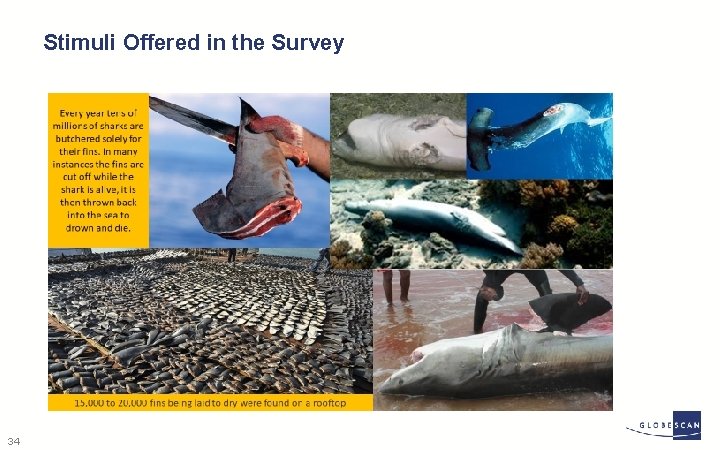
Introduction to the Section: Stimuli Offered in the Survey Ø The stimuli / pictures on the following slide were only shown to the respondents at the last part of the questionnaire. Ø So prior them answering them questions on shark fin soup consumption, on attitude, knowledge and behavior, they had not yet seen the photo’s, the stimuli and the text on the following page. Ø Pictures were shown at the message testing, as we wanted to test the messages as they appear in real life: in adds, in social media. Ø These pictures likely influenced the results, but that would (a) happen in real life and (b) the very purpose is to influence consumers. Ø To what extent it changes behavior is never 1 on 1 to be proofed, but our research suggests that it has a strong impact. 33
Stimuli Offered in the Survey 34
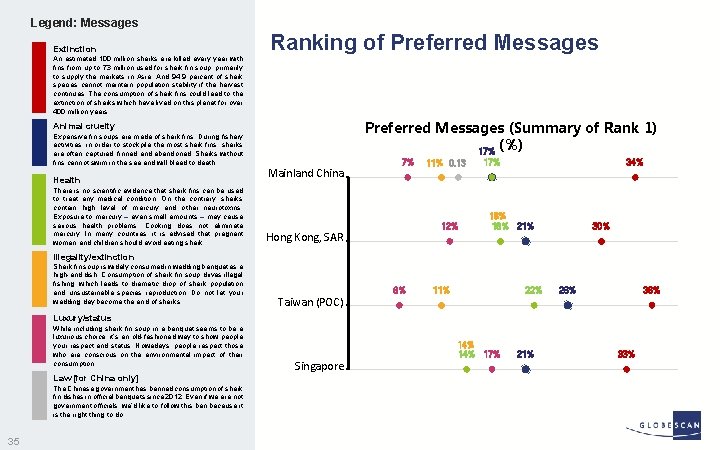
Legend: Messages Extinction Ranking of Preferred Messages An estimated 100 million sharks are killed every year with fins from up to 73 million used for shark fin soup, primarily to supply the markets in Asia. And 94. 9 percent of shark species cannot maintain population stability if the harvest continues. The consumption of shark fins could lead to the extinction of sharks which have lived on this planet for over 400 million years. Preferred Messages (Summary of Rank 1) (%) 17% Animal cruelty Expensive fin soups are made of shark fins. During fishery activities, in order to stockpile the most shark fins, sharks are often captured, finned and abandoned. Sharks without fins cannot swim in the sea and will bleed to death. Health There is no scientific evidence that shark fins can be used to treat any medical condition. On the contrary, sharks contain high level of mercury and other neurotoxins. Exposure to mercury – even small amounts – may cause serious health problems. Cooking does not eliminate mercury. In many countries, it is advised that pregnant women and children should avoid eating shark. Mainland China 7% 11% 0. 13 12% Hong Kong, SAR 17% 34% 18% 21% 30% Illegality/extinction Shark fin soup is widely consumed in wedding banquet as a high-end dish. Consumption of shark fin soup drives illegal fishing, which leads to dramatic drop of shark population and unsustainable species reproduction. Do not let your wedding day become the end of sharks. Taiwan (POC) 6% 11% 22% 26% 36% Luxury/status While including shark fin soup in a banquet seems to be a luxurious choice, it’s an old-fashioned way to show people your respect and status. Nowadays, people respect those who are conscious on the environmental impact of their consumption. Law [for China only] The Chinese government has banned consumption of shark fin dishes in official banquets since 2012. Even if we are not government officials, we’d like to follow this ban because it is the right thing to do. 35 Singapore 14% 17% 21% 33%
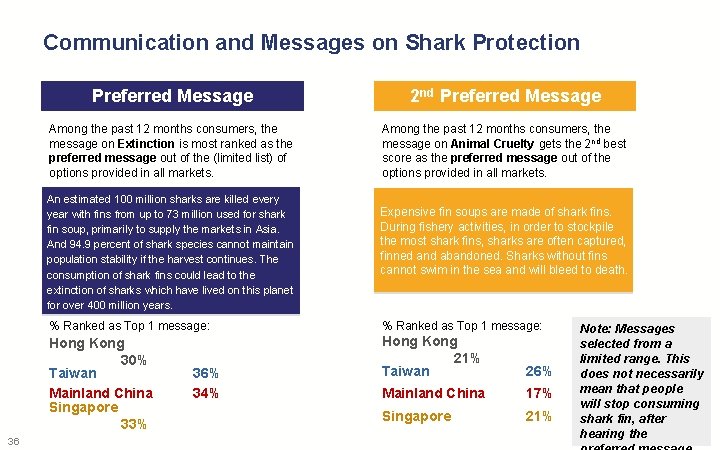
Communication and Messages on Shark Protection Preferred Message 2 nd Preferred Message Among the past 12 months consumers, the message on Extinction is most ranked as the preferred message out of the (limited list) of options provided in all markets. Among the past 12 months consumers, the message on Animal Cruelty gets the 2 nd best score as the preferred message out of the options provided in all markets. An estimated 100 million sharks are killed every year with fins from up to 73 million used for shark fin soup, primarily to supply the markets in Asia. And 94. 9 percent of shark species cannot maintain population stability if the harvest continues. The consumption of shark fins could lead to the extinction of sharks which have lived on this planet for over 400 million years. 36 Expensive fin soups are made of shark fins. During fishery activities, in order to stockpile the most shark fins, sharks are often captured, finned and abandoned. Sharks without fins cannot swim in the sea and will bleed to death. % Ranked as Top 1 message: Hong Kong 30% Taiwan Mainland China Singapore 33% Hong Kong 21% Taiwan 26% Mainland China 17% Singapore 21% 36% 34% Note: Messages selected from a limited range. This does not necessarily mean that people will stop consuming shark fin, after hearing the
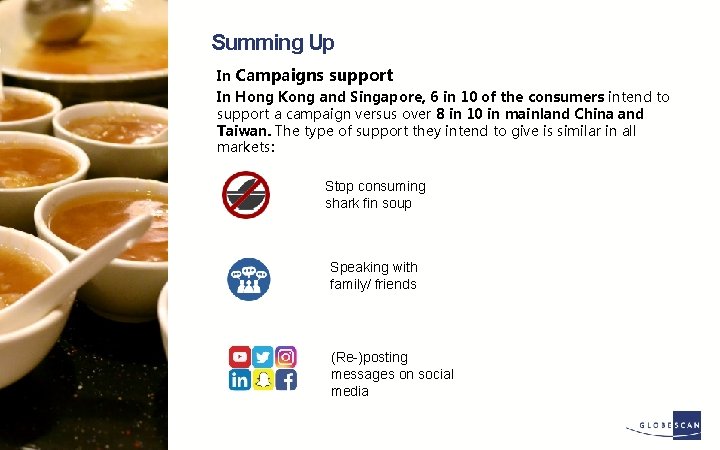
Summing Up In Campaigns support In Hong Kong and Singapore, 6 in 10 of the consumers intend to support a campaign versus over 8 in 10 in mainland China and Taiwan. The type of support they intend to give is similar in all markets: Stop consuming shark fin soup Speaking with family/ friends (Re-)posting messages on social media 37
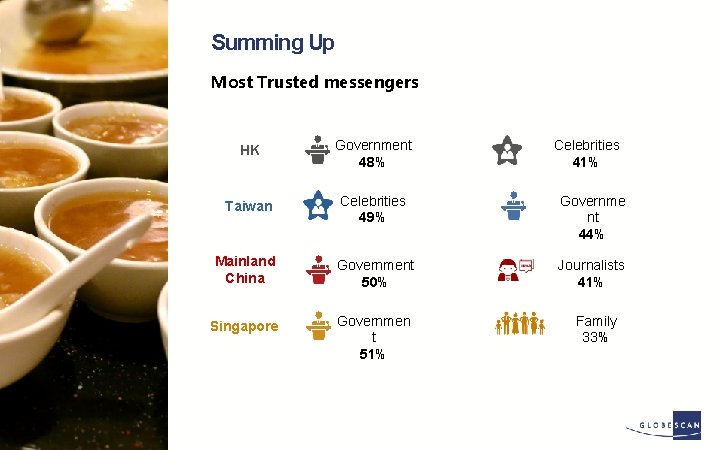
Summing Up Most Trusted messengers 38 HK Government 48% Celebrities 41% Taiwan Celebrities 49% Governme nt 44% Mainland China Government 50% Journalists 41% Singapore Governmen t 51% Family 33%

Any Questions? 39
ADM Capital Foundation is an impact driven foundation focused on making change in Asia. Through research, ADM Capital Foundation identifies environmental challenges then work towards solutions across five key areas: marine ecology, water security, air quality, wildlife trade and forestry conservation finance. WWF is one of the world's largest and most respected independent conservation organizations, with over 5 million supporters and a global network active in over 100 countries. WWF's mission is to stop the degradation of the Earth's natural environment and to build a future in which humans live in harmony with nature, by conserving the world's biological diversity, ensuring that the use of renewable natural resources is sustainable, and promoting the reduction of pollution and wasteful consumption. www. panda. org/news TRAFFIC, the wildlife trade monitoring network, is the leading non-governmental organization working globally on trade in wild animals and plants in the context of both biodiversity conservation and sustainable development. TRAFFIC is a strategic alliance of WWF and IUCN. www. traffic. org Globe. Scan is a strategy and insights consultancy, focused on helping our clients to build longterm trust with their stakeholders. Offering a suite of specialist research and advisory services, Globe. Scan partners with clients to meet strategic objectives across reputation, sustainability and purpose. Our Purpose is to build leadership for a better world and help understand drive Sustainable Living. www. globescan. com 40
- Slides: 40