
Webinar on Modern Surveying Session on Preparing Curves
इड यन रलव इसट टयट इज न यर ग , पण ऑफ स व ल Webinar on Modern Surveying Session on Preparing Curves & Points and Crossing using Auto LISP 1
• In Introduction many instances civil engineer, requires to take decisions related with planning, design and execution of the project in his charge. • Effective decisions cannot be made in absence of adequate spatial information. • To generate such information lot of raw data is required to be made available, which when processed, yields desired information. • Some of such data is Geospatial and is related with measurable features of project site. Such data may be collected through SURVEYING. 2
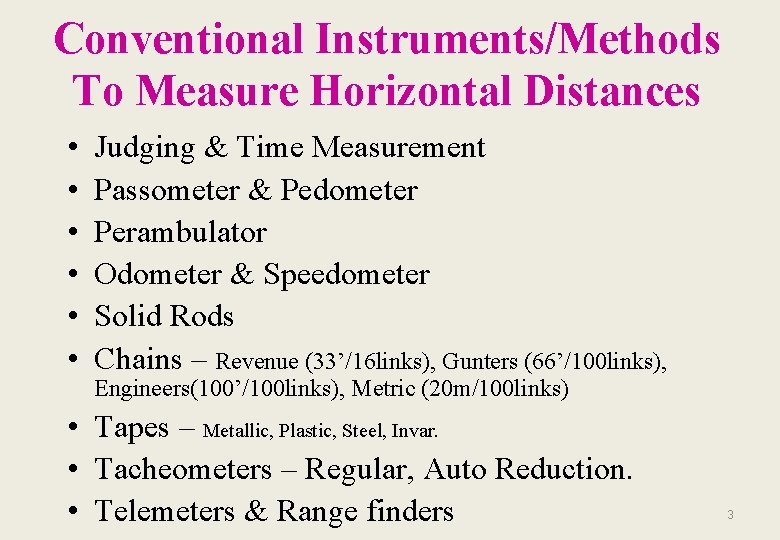
Conventional Instruments/Methods To Measure Horizontal Distances • • • Judging & Time Measurement Passometer & Pedometer Perambulator Odometer & Speedometer Solid Rods Chains – Revenue (33’/16 links), Gunters (66’/100 links), Engineers(100’/100 links), Metric (20 m/100 links) • Tapes – Metallic, Plastic, Steel, Invar. • Tacheometers – Regular, Auto Reduction. • Telemeters & Range finders 3
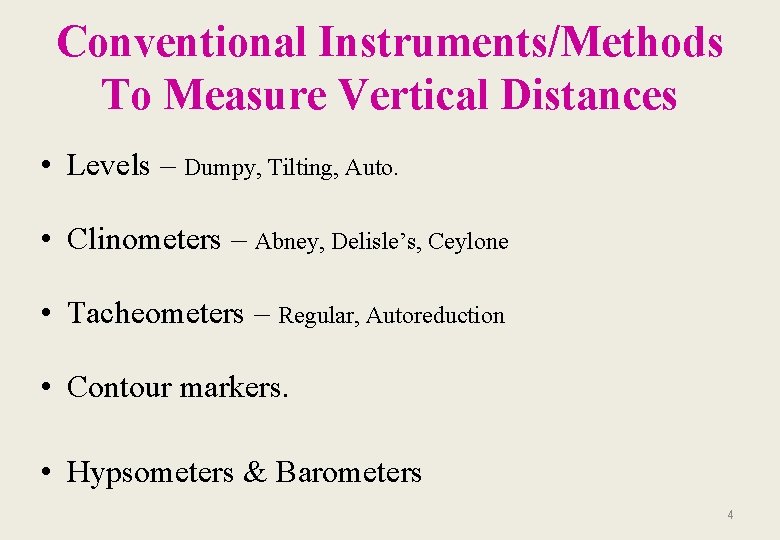
Conventional Instruments/Methods To Measure Vertical Distances • Levels – Dumpy, Tilting, Auto. • Clinometers – Abney, Delisle’s, Ceylone • Tacheometers – Regular, Autoreduction • Contour markers. • Hypsometers & Barometers 4

Conventional Instruments/Methods To Measure Direction Angles • Squares – masons, optical & prism. • Cross staff – Open & French. • Compass – Prismatic & Surveyors. • Sextants - Box & Nautical. • Theodolites - Transit & Nontransit, - Vernier, Micrometer & Microoptic, - Directional & Repeating. 5

Merits of Conventional Instruments/Methods i. iii. iv. v. vi. Simple in construction, Low capital cost, Almost no operating cost, On field repair/adjustment is possible, Local Manufacture & Service, Almost no compute awareness essential to work with them. 6
Demerits of Conventional Instruments/Methods i. Laborious & Fatiguing, ii. Low & Constant/invariable precision, iii. Measurement, especially linear, needs to be done in parts, iv. Different instrument for different process of measurement, v. Number of instruments for same process of measurement, vi. Manual Reading, Recording, Corrections & Reductions, No computer compatibility, vii. Achieving higher accuracies is relatively difficult & costly, 7
Accuracy and Precision • Accuracy: Degree of perfection obtained in any measurement, i. e. closeness to the actual value • Precision: Degree of refinement of measurement, i. e. degree of repeatability or consistency of a group of observations • Both are important in Surveying 8
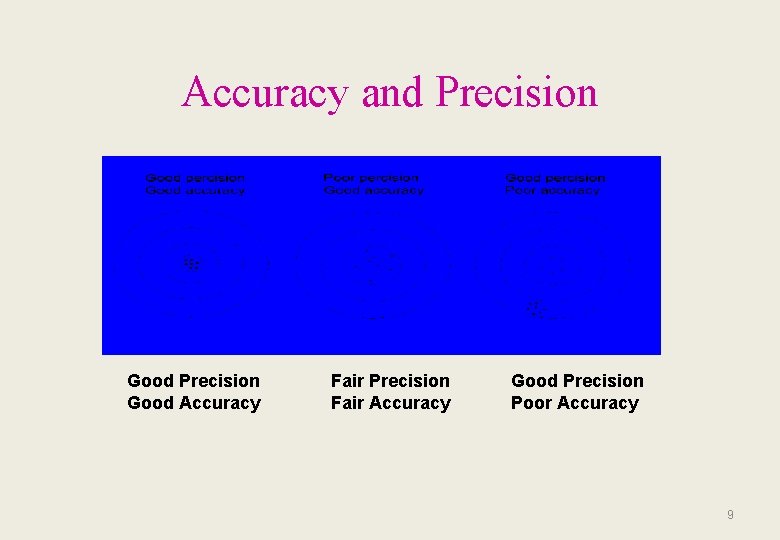
Accuracy and Precision Good Accuracy Fair Precision Fair Accuracy Good Precision Poor Accuracy 9
Modern Instruments In Surveying • The Electronic Distance Meters (EDM) • The Electronic Digital Theodolites (EDT) • The Electronic Digital Levels (EDL) • The Electronic Total Stations (ETS) • The Light Detection and Ranging (Li. DAR) • Global Positioning Systems (GPS) 10
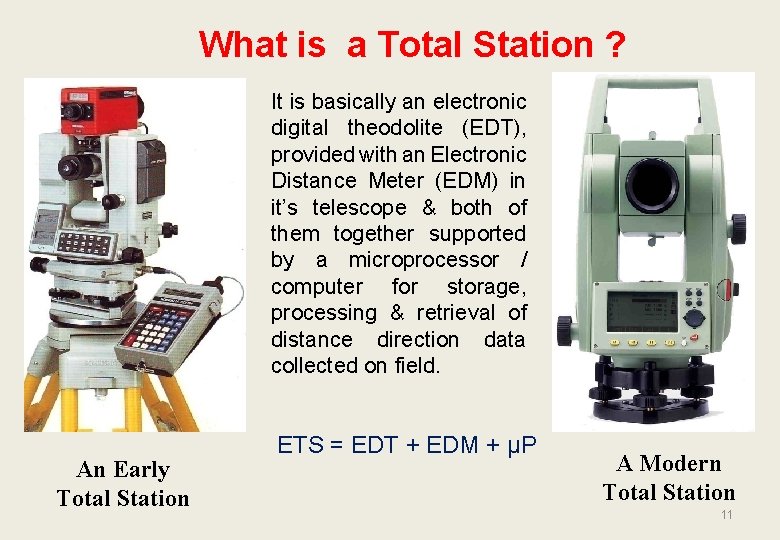
What is a Total Station ? It is basically an electronic digital theodolite (EDT), provided with an Electronic Distance Meter (EDM) in it’s telescope & both of them together supported by a microprocessor / computer for storage, processing & retrieval of distance direction data collected on field. An Early Total Station ETS = EDT + EDM + μP A Modern Total Station 11
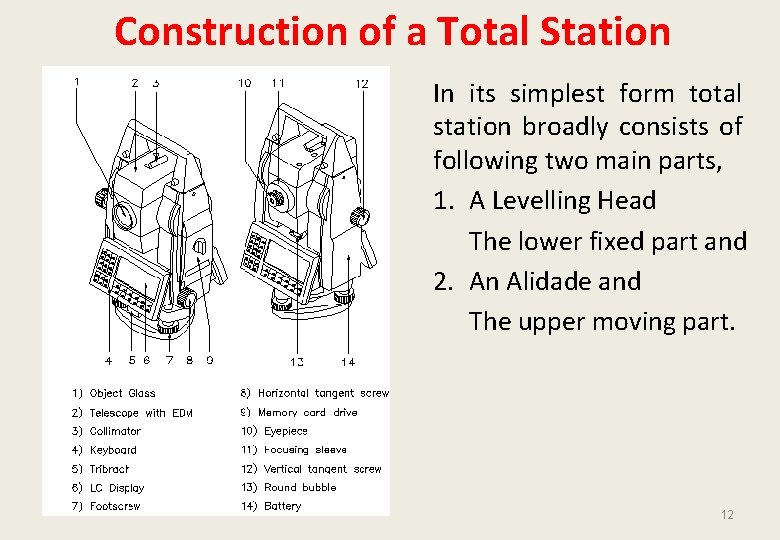
Construction of a Total Station In its simplest form total station broadly consists of following two main parts, 1. A Levelling Head The lower fixed part and 2. An Alidade and The upper moving part. 12
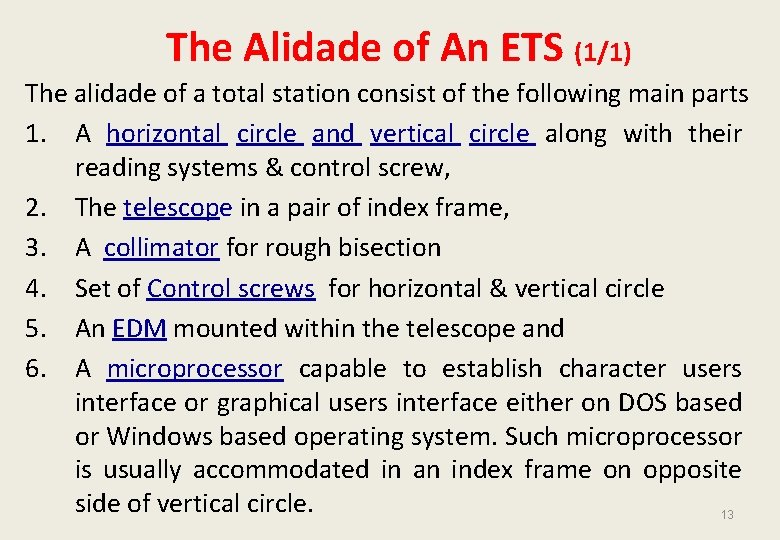
The Alidade of An ETS (1/1) The alidade of a total station consist of the following main parts 1. A horizontal circle and vertical circle along with their reading systems & control screw, 2. The telescope in a pair of index frame, 3. A collimator for rough bisection 4. Set of Control screws for horizontal & vertical circle 5. An EDM mounted within the telescope and 6. A microprocessor capable to establish character users interface or graphical users interface either on DOS based or Windows based operating system. Such microprocessor is usually accommodated in an index frame on opposite side of vertical circle. 13
The Alidade of An ETS (2/2) 7. A Memory device – It is usually a solid state nonvolatile type memory. The memory of a total station is measured in terms points. Storing a point means storing its three coordinates, its description and its identification number. Many of the total stations in market have memory about 10000 points. 8. A Display unit – It is alpha numeric type & may support graphics also. 9. A battery unit – Usually total stations are furnished with Ni. MH standard camcorder type 6 Volt – 1. 8 or 3. 6 Ah rechargeable battery, capable to provide power up to 4 to 6 hours at a stretch. Such batteries can be fully recharged over 1 to 2 hours. 10. A data exchange system – It may be a RS 232 port provided at the bottom of the alidade or a card drive built in alidade at suitable location or a blue tooth system. 14
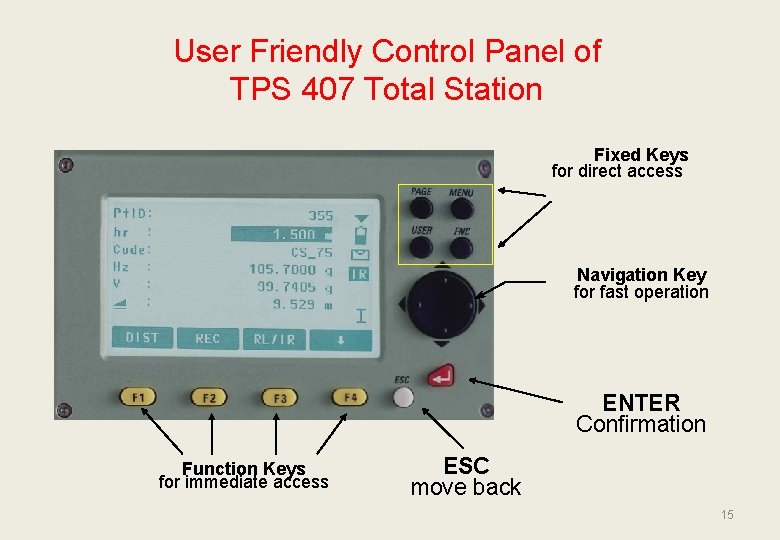
User Friendly Control Panel of TPS 407 Total Station Fixed Keys for direct access Navigation Key for fast operation ENTER Confirmation Function Keys for immediate access ESC move back 15
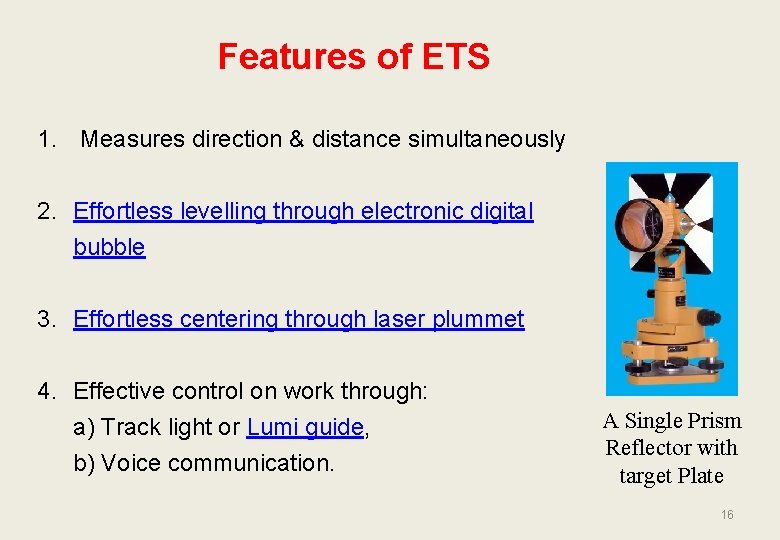
Features of ETS 1. Measures direction & distance simultaneously 2. Effortless levelling through electronic digital bubble 3. Effortless centering through laser plummet 4. Effective control on work through: a) Track light or Lumi guide, b) Voice communication. A Single Prism Reflector with target Plate 16
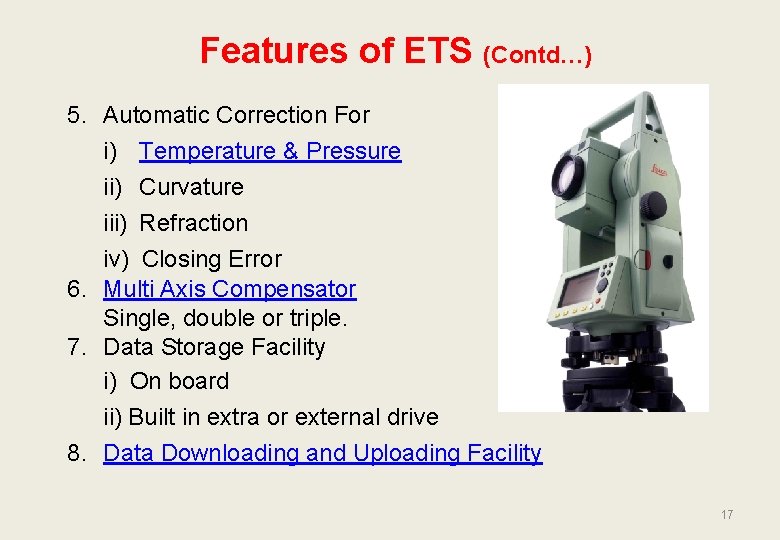
Features of ETS (Contd…) 5. Automatic Correction For i) Temperature & Pressure ii) Curvature iii) Refraction iv) Closing Error 6. Multi Axis Compensator Single, double or triple. 7. Data Storage Facility i) On board ii) Built in extra or external drive 8. Data Downloading and Uploading Facility 17
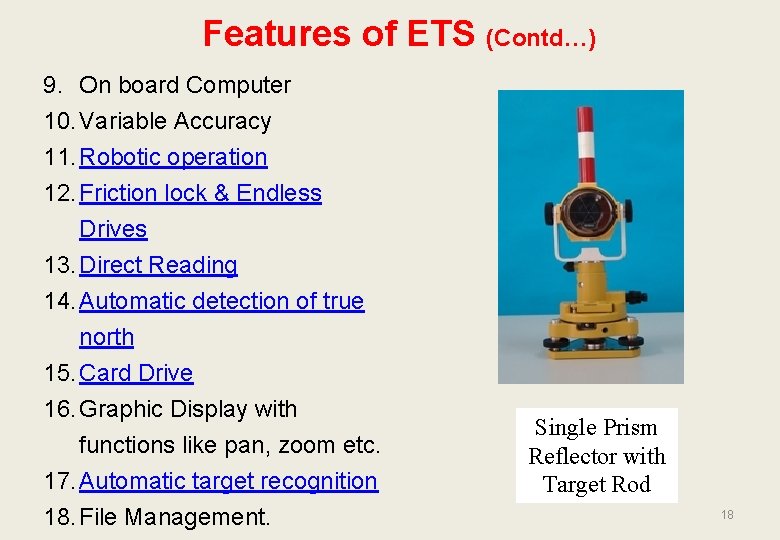
Features of ETS (Contd…) 9. On board Computer 10. Variable Accuracy 11. Robotic operation 12. Friction lock & Endless Drives 13. Direct Reading 14. Automatic detection of true north 15. Card Drive 16. Graphic Display with functions like pan, zoom etc. 17. Automatic target recognition 18. File Management. Single Prism Reflector with Target Rod 18
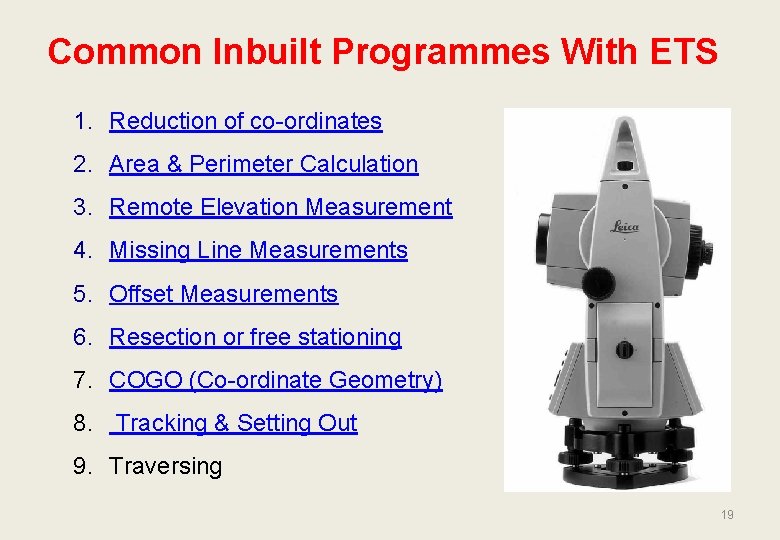
Common Inbuilt Programmes With ETS 1. Reduction of co-ordinates 2. Area & Perimeter Calculation 3. Remote Elevation Measurement 4. Missing Line Measurements 5. Offset Measurements 6. Resection or free stationing 7. COGO (Co-ordinate Geometry) 8. Tracking & Setting Out 9. Traversing 19
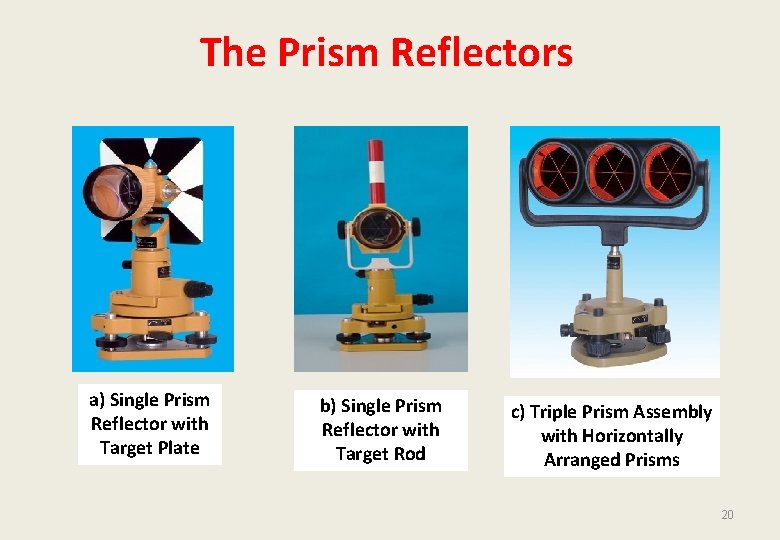
The Prism Reflectors a) Single Prism Reflector with Target Plate b) Single Prism Reflector with Target Rod c) Triple Prism Assembly with Horizontally Arranged Prisms 20
Advantages of a Total Station Ø More Accurate Distance And Angle Measurements. Ø Elimination of Manual Errors. Ø Elimination of Mathematical Reductions. Ø Generation of Data In Digital Format. Ø Effective Control on Work. Ø Reduction of Labour, Time And Cost. Ø Professional Output and Quality Product. 21
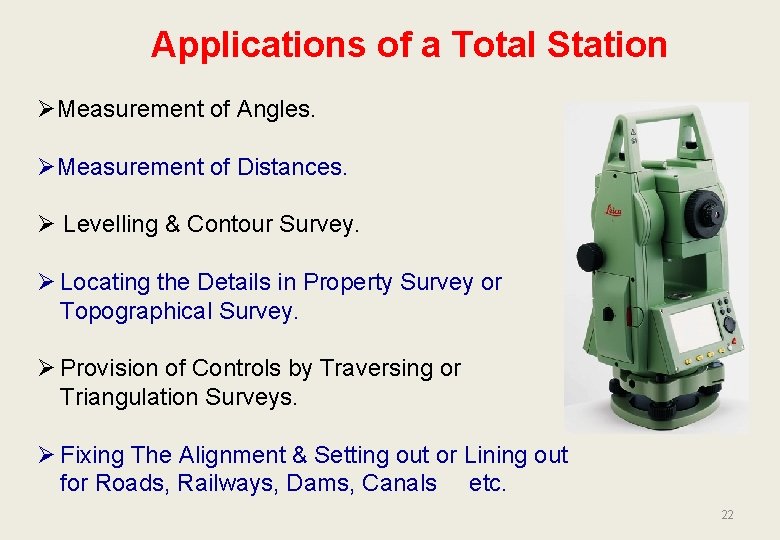
Applications of a Total Station ØMeasurement of Angles. ØMeasurement of Distances. Ø Levelling & Contour Survey. Ø Locating the Details in Property Survey or Topographical Survey. Ø Provision of Controls by Traversing or Triangulation Surveys. Ø Fixing The Alignment & Setting out or Lining out for Roads, Railways, Dams, Canals etc. 22
• • • The Communication/Transfer Software The work environment of the processor on board of the ETS instrument is usually different than your off board computer, the desktop or laptop etc. It is essential to establish interface between them, to have exchange of the data in between them. The software used for the purpose is the Communication/Transfer software. Such softwares are usually supplied along with the ETS instrument as an essential accessory. Leica Geo-Office, Nikon-Transit, Pentax DL 30 are some of such softwares. The format of data downloaded with help of such softwares is such that it can support graphic based softwares like Autocad or spreadsheet type softwares like MS Excel or data base management softwares like Access for further processing of down loaded raw coordinate data to support the Management Information System (MIS). 23
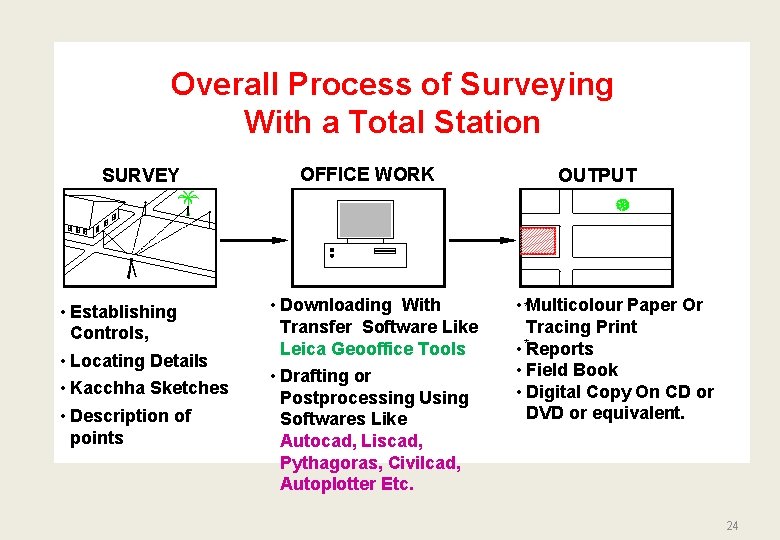
Overall Process of Surveying With a Total Station SURVEY • Establishing Controls, • Locating Details • Kacchha Sketches • Description of points OFFICE WORK • Downloading With Transfer Software Like Leica Geooffice Tools • Drafting or Postprocessing Using Softwares Like Autocad, Liscad, Pythagoras, Civilcad, Autoplotter Etc. OUTPUT • *Multicolour Paper Or Tracing Print • *Reports • Field Book • Digital Copy On CD or DVD or equivalent. 24
Final Output Initial Raw Data 25
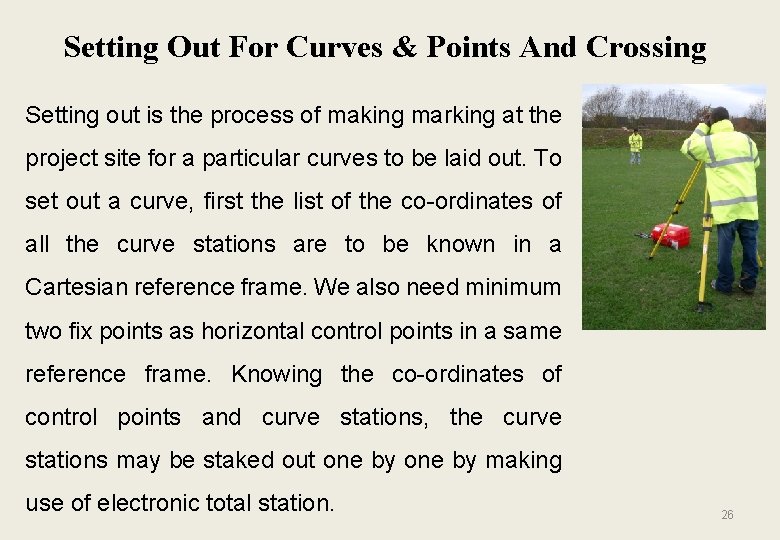
Setting Out For Curves & Points And Crossing Setting out is the process of making marking at the project site for a particular curves to be laid out. To set out a curve, first the list of the co-ordinates of all the curve stations are to be known in a Cartesian reference frame. We also need minimum two fix points as horizontal control points in a same reference frame. Knowing the co-ordinates of control points and curve stations, the curve stations may be staked out one by making use of electronic total station. 26
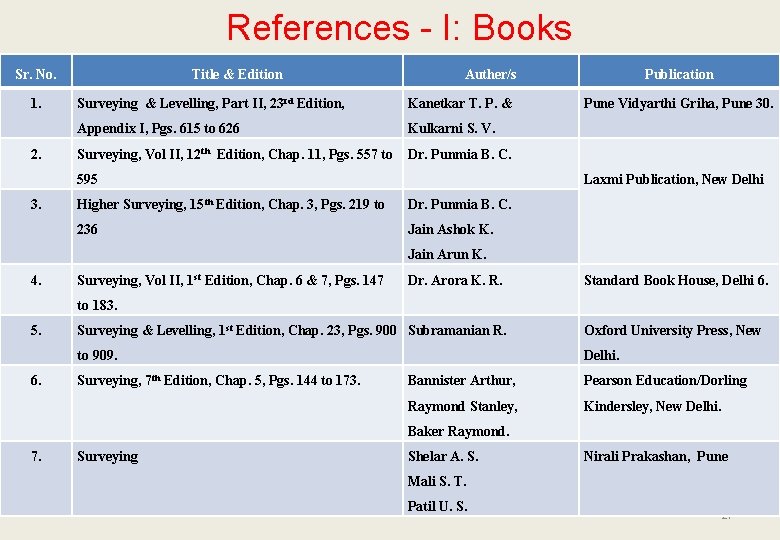
References - I: Books Sr. No. 1. 2. Title & Edition Auther/s Surveying & Levelling, Part II, 23 rd Edition, Kanetkar T. P. & Appendix I, Pgs. 615 to 626 Kulkarni S. V. Surveying, Vol II, 12 th Edition, Chap. 11, Pgs. 557 to Dr. Punmia B. C. 595 3. Publication Pune Vidyarthi Griha, Pune 30. Laxmi Publication, New Delhi Higher Surveying, 15 th Edition, Chap. 3, Pgs. 219 to Dr. Punmia B. C. 236 Jain Ashok K. Jain Arun K. 4. Surveying, Vol II, 1 st Edition, Chap. 6 & 7, Pgs. 147 Dr. Arora K. R. Standard Book House, Delhi 6. to 183. 5. 6. Surveying & Levelling, 1 st Edition, Chap. 23, Pgs. 900 Subramanian R. Oxford University Press, New to 909. Delhi. Surveying, 7 th Edition, Chap. 5, Pgs. 144 to 173. Bannister Arthur, Pearson Education/Dorling Raymond Stanley, Kindersley, New Delhi. Baker Raymond. 7. Surveying Shelar A. S. Nirali Prakashan, Pune Mali S. T. Patil U. S. 27

Thank You!!! Questions? 28
- Slides: 28