
Webinar Middle leadership skills managing difficult conversations Helen
Webinar Middle leadership skills – managing difficult conversations Helen Morgan Download this presentation from oego. co/webinaoego-diffconvers DEVELOPING EXCELLENCE TOGETHER
Managing difficult conversations In this webinar, you will develop your understanding of: ¤ what makes some conversations difficult and why it is essential to have them ¤ the practicalities of having a challenging conversation ¤ strategies and approaches to managing difficult conversations ¤ how to manage your own feelings and those of others. DEVELOPING EXCELLENCE TOGETHER
Reflections Think about any difficult conversations you have had. ¤ What were they about? ¤ What made them difficult? ¤ What did you learn? DEVELOPING EXCELLENCE TOGETHER
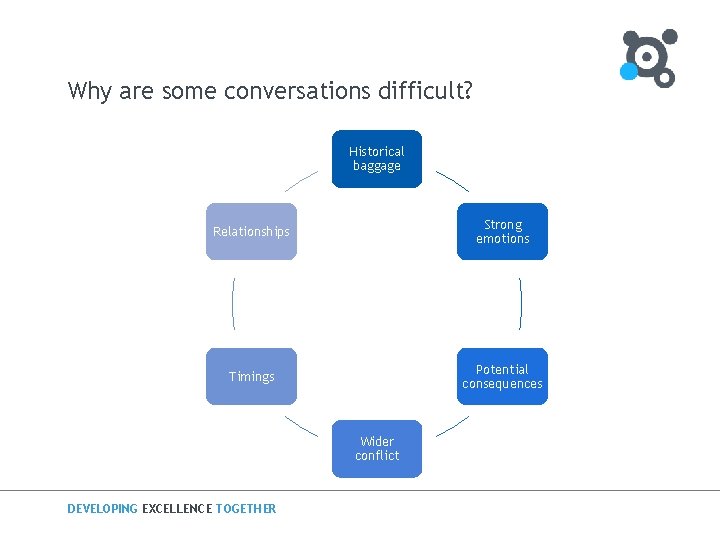
Why are some conversations difficult? Historical baggage Relationships Strong emotions Timings Potential consequences Wider conflict DEVELOPING EXCELLENCE TOGETHER
Framing the conversation What are the reasons for this conversation? Why do I need to have this conversation now? What factors have contributed to this? What do I want to happen? DEVELOPING EXCELLENCE TOGETHER
Practicalities: when and where? ¤ Arrange the meeting sooner rather than later; if there is a problem, it is better to deal with it quickly and efficiently. ¤ Try to arrange the meeting in a place that is private and where you and your colleague won’t be interrupted. Book a meeting room if possible as it is neutral. ¤ Avoid sitting behind a desk and creating an automatic barrier and an immediate sense of hierarchy. ¤ Arrange the meeting at the end of the day or after school so that your colleague can leave the meeting and reflect on the conversation. ¤ Let your colleague know what the meeting is about beforehand so that they don’t arrive ‘cold. ’ DEVELOPING EXCELLENCE TOGETHER
How to open the conversation ¤ Use the KISS technique to open the meeting (Keep It Short and Simple). It is important that your colleague understands the reason for the meeting. ¤ Keep the introduction short (e. g. 2/3 minutes). ¤ Thank your colleague for meeting with you; it is essential to show respect and remain professional at all times. ¤ Briefly explain: – why you are meeting now – what has led to the current situation – the impact of the situation ¤ Use clear and straightforward language so that there is no ambiguity e. g. ‘We are here to discuss the frequency and quality of your marking. ’ DEVELOPING EXCELLENCE TOGETHER
Truman Capote ‘A conversation is a dialogue not a monologue. ’ DEVELOPING EXCELLENCE TOGETHER
How to invite discussion ¤ After you have explained why the meeting is taking place and described the issues, it is important to invite discussion with your colleague. ¤ Avoid ‘why’ questions as they can be confrontational and close the discussion down. It is crucial to focus on the future and moving forward. Potential questions ¤ Tell me how you see the current situation. ¤ Have I got the full picture? ¤ Are there any other reasons for this? ¤ What are the ways forward? ¤ Is there anything that would prevent this? ¤ What do you want to happen? ¤ Is it realistic? ¤ How can I help or support you? DEVELOPING EXCELLENCE TOGETHER
Closing the conversation ¤ Close the conversation by: – thanking your colleague for listening and their contribution – summarising clearly what has been agreed and the way forward. DEVELOPING EXCELLENCE TOGETHER
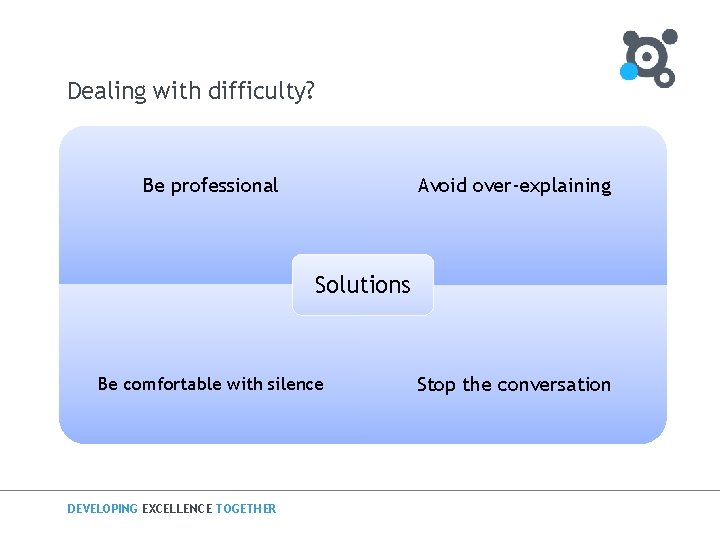
Dealing with difficulty? Be professional Avoid over-explaining Solutions Be comfortable with silence DEVELOPING EXCELLENCE TOGETHER Stop the conversation
Questions & Answers Find more resources at http: //www. my. optimus-education. com/knowledge-centre/leadership-governance Follow us @Optimus. Ed DEVELOPING EXCELLENCE TOGETHER
- Slides: 12