
Webinar DeEscalation Welcome We will begin promptly 8

Webinar – De-Escalation • Welcome! We will begin promptly 8: 00 a. m. • Make sure that your first and last name are visible in the “Participant” list. • Not sure how to do that? • Right click on your name in the video window and select rename if it is not already your first and last name.
Indiana University Human Resources – Organization Development De-Escalation INDIANA UNIVERSITY
Housekeeping • Use the mute function if you are not speaking • Chat function • Breakout rooms are utilized for full participation • Video on as possible
De-Escalation: Section 1 What is De-Escalation
What is De-Escalation? A sample of definitions: 1. De-Escalation of the intensity of a conflict or potentially violent situation. 2. To decrease in intensity, magnitude. 3. To (cause to) become less dangerous or difficult. 4. To diminish in size, scope, or intensity. 5. To reduce the level or intensity, size, scope of. What is the common theme?
Goal of De-escalation Reduce the level of anxiety, anger, frustration, etc. , to encourage the possibility for a discussion, dialogue, and/or resolution. You cannot problem solve or seek a resolution when emotions are still high! Important: De-escalation is not about conflict resolution. It is about regaining control of the situation and the emotions so that problem solving can happen.
De-Escalation: Section 2 Stress and How We Respond
Understanding our Response to Stress 1. Physiological reactions to stress: 2. Our first response is to feel something – fear, anger, frustration, etc. 3. Body shifts into self-protective mode or fight/flight/freeze mode 4. Fight/Flight/Freeze in the body – Perceive the potential for harm • Activate stress function and prepares us for something to happen – Actual harm done • Release adrenaline within seconds • Cortisol within moments Impulsive Behaviors
What Does that Mean? The fight/freeze response is great for protecting us but can fail to support us in de-escalation practices. In fact it can contribute to the escalation of tensions, etc. “The adrenaline-fortified blood gives us the energy to defend ourselves against physical or verbal abuse, but also causes us to approach a person’s anger out of confrontation rather than resolution. It turns our intervention into contest in which we must win and the angry person must lose. ” Keven Fauteux, Ph. D. , MSW, M. Div. In order to be skilled in de-escalation, we must regain control of our stress, emotions and responses. The goal is not about being right, but about problem solving.
The Power of Understanding your Reaction The problem is not that you have a reaction to stress. It is that the reaction to stress can pull you into an escalation of tensions. This will affect your ability to problem solve. Before engaging remember to: 1. Understand your triggers and manage them 2. Calm yourself
De-Escalation: Section 3 Triggers
Understanding Triggers 1. Triggers are activities, events, or behaviors that provoke anxiety and set off the cycle of problem behavior. • Facing big changes • Being under a lot of pressure • Not having much of any control over the situation
Understanding Triggers According to Mayo Clinic: • Identify sources of stress • Write down triggers • Write down what you are currently experiencing • Develop strategies to manage them
Activity: Understanding Stress Response 1. Take a moment to identify your physical responses stress> – Example: Tense jaw, increase in heart rate, tears, quavering voice 2. Does your response change depending on the severity of the stress?
De-Escalation: Section 4 Escalation Cycles

Retaliatory Cycle
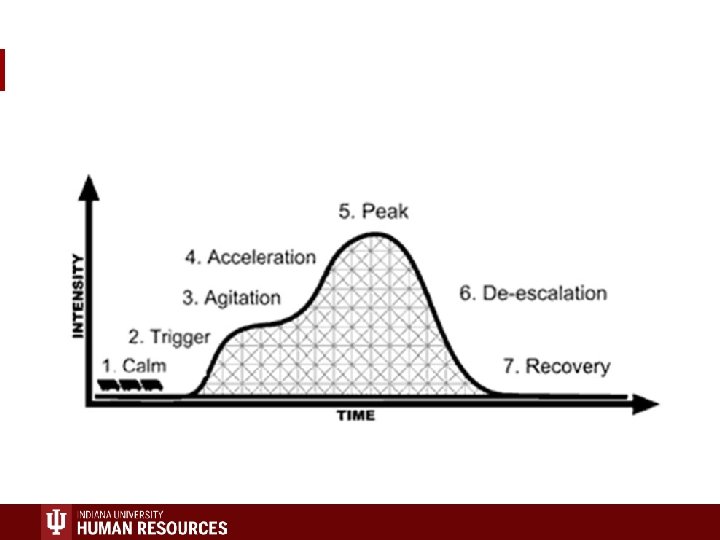
Activity: Identify the Point of Escalation 1. Watch the video. – https: //www. youtube. com/watch? v=u. Kt 4 j. WOpfp. A 2. When did the situation escalate? 3. When could they have engaged in de-escalation practices?
De-Escalation: Section 5 De-Escalation Strategies
1. ) Be Empathetic and Nonjudgmental 1. Empathetic –Showing an ability to understand share the feelings of others – https: //www. youtube. com/watch? v=1 Evwgu 369 Jw 2. Nonjudgmental - not judgmental, avoiding moral judgements According to Crisis Prevention Institute: “When you encounter a person in crisis, be willing to make an earnest effort not to judge or discount their feelings even if you don’t necessarily understand them or feel comfortable with them. Showing somebody else the grace and compassion you would want to be shown can go a long way toward helping them avoid escalating further”
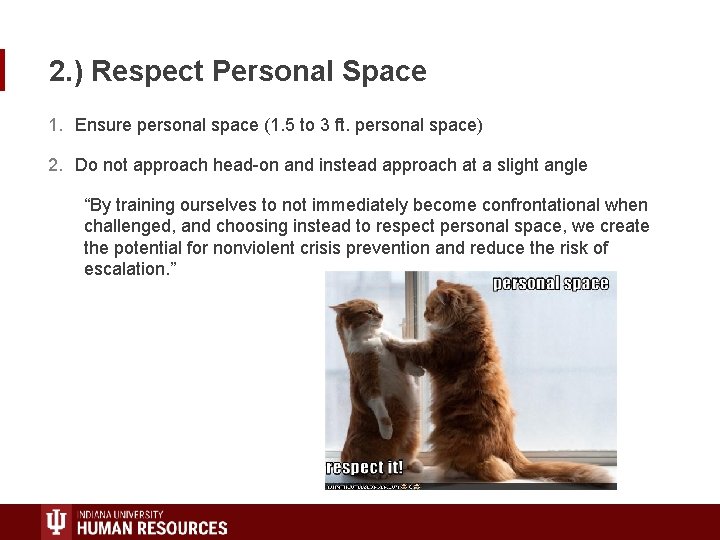
2. ) Respect Personal Space 1. Ensure personal space (1. 5 to 3 ft. personal space) 2. Do not approach head-on and instead approach at a slight angle “By training ourselves to not immediately become confrontational when challenged, and choosing instead to respect personal space, we create the potential for nonviolent crisis prevention and reduce the risk of escalation. ”
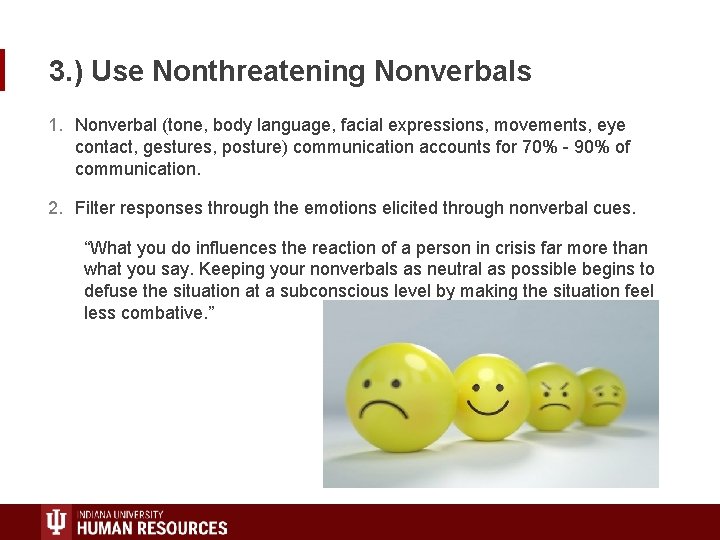
3. ) Use Nonthreatening Nonverbals 1. Nonverbal (tone, body language, facial expressions, movements, eye contact, gestures, posture) communication accounts for 70% - 90% of communication. 2. Filter responses through the emotions elicited through nonverbal cues. “What you do influences the reaction of a person in crisis far more than what you say. Keeping your nonverbals as neutral as possible begins to defuse the situation at a subconscious level by making the situation feel less combative. ”
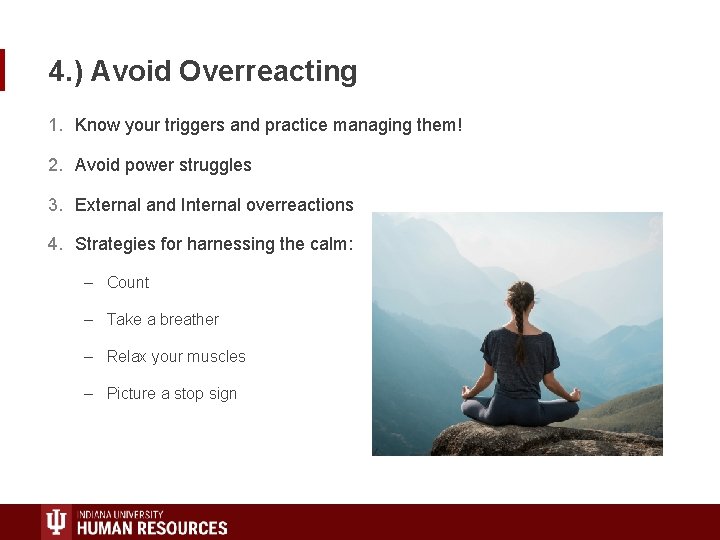
4. ) Avoid Overreacting 1. Know your triggers and practice managing them! 2. Avoid power struggles 3. External and Internal overreactions 4. Strategies for harnessing the calm: – Count – Take a breather – Relax your muscles – Picture a stop sign
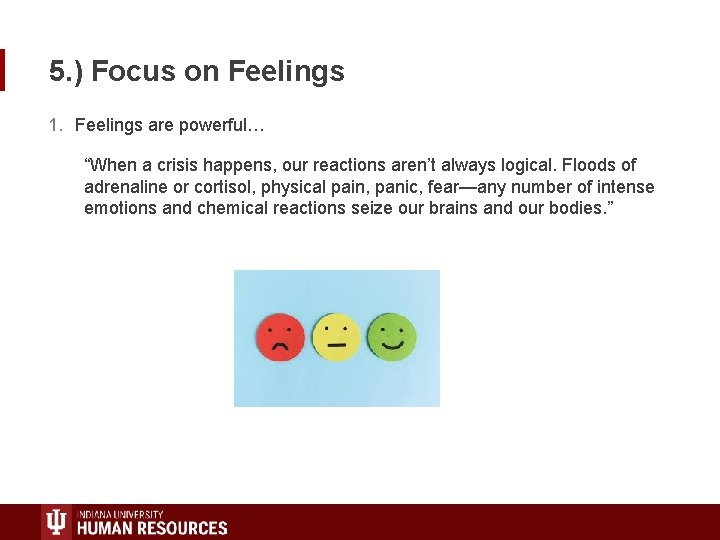
5. ) Focus on Feelings 1. Feelings are powerful… “When a crisis happens, our reactions aren’t always logical. Floods of adrenaline or cortisol, physical pain, panic, fear—any number of intense emotions and chemical reactions seize our brains and our bodies. ”
6. ) Focus on the Thoughts Behind the Feelings It can be difficult to articulate your needs/goals in moments of stress. As a result, your support is often needed. • Help me understand what you need. • Help me understand what you are feeling/experiencing.
Activity: Identify the Emotions 1. Watch the video. – https: //www. youtube. com/watch? v=gls. Ec. SPg. PYM 2. Close your eyes and listen for emotion? 3. What emotions do you hear? 4. Why is this important?
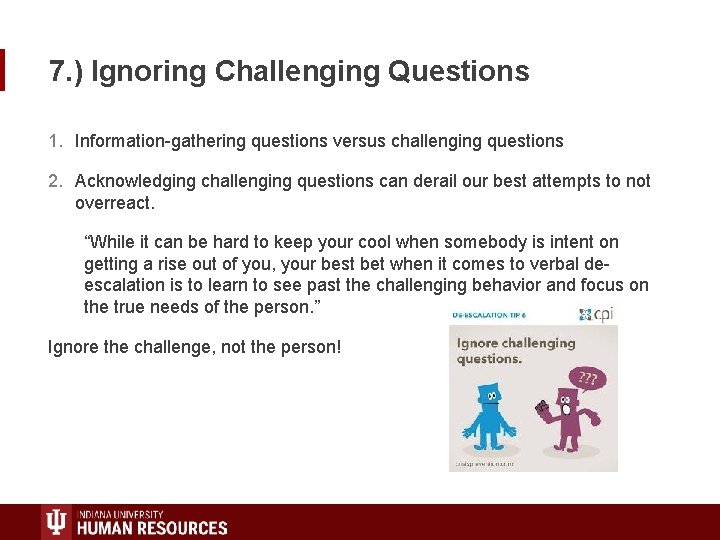
7. ) Ignoring Challenging Questions 1. Information-gathering questions versus challenging questions 2. Acknowledging challenging questions can derail our best attempts to not overreact. “While it can be hard to keep your cool when somebody is intent on getting a rise out of you, your best bet when it comes to verbal deescalation is to learn to see past the challenging behavior and focus on the true needs of the person. ” Ignore the challenge, not the person!
Challenging Questions – Reflection Opportunity WHAT ARE CHALLENGING QUESTIONS FOR YOU? HOW MIGHT YOU RESPOND TO IT?
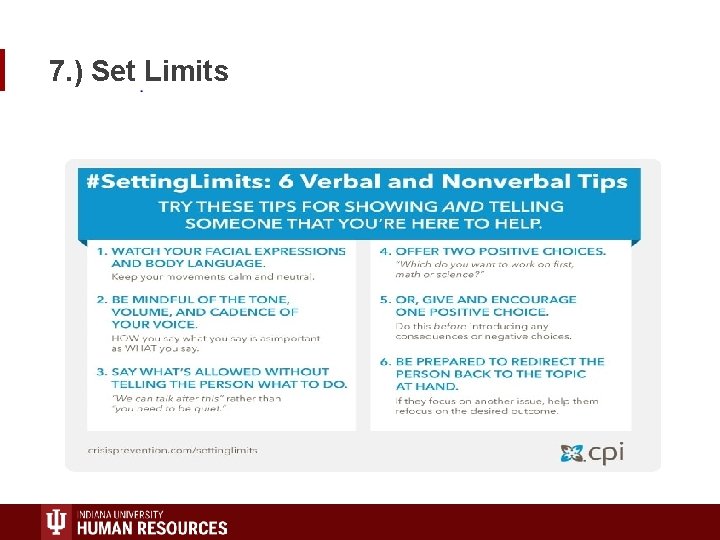
7. ) Set Limits 1. Is – offering choices with consequences 2. Is not – making threats and giving ultimatums 3. Examples: – Time limits – Yelling • Don’t: If you don’t stop yelling, you’ll have to leave. • Do: When you stop yelling, we can find a solution to what’s bothering you.
7. ) Set Limits
8. ) Choose Wisely What You Insist Upon 1. Is it really a rule? 2. Is the rule negotiable or not? 3. Would some flexibility be helpful? Could it head off a confrontation? 4. Keep your eyes on the big picture.
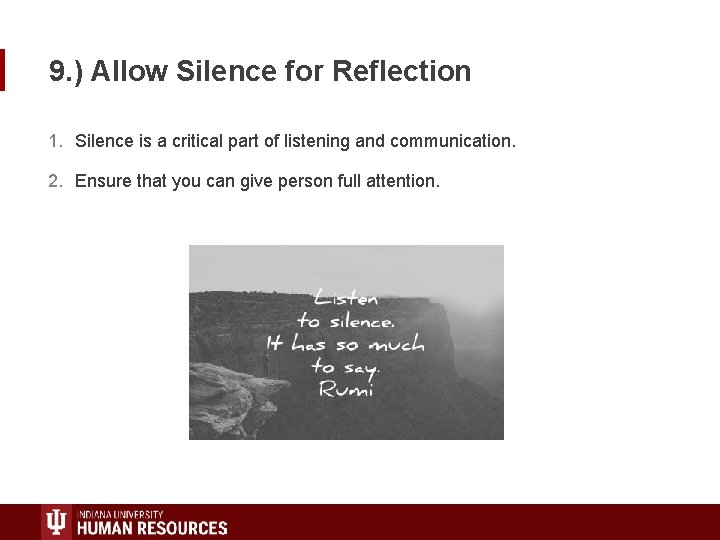
9. ) Allow Silence for Reflection 1. Silence is a critical part of listening and communication. 2. Ensure that you can give person full attention.
10. ) Allow Time for Decisions 1. Resolution/problem solving does not have to occur immediately
Focus on the Future 1. Focus on the future – Avoid backsliding – Keep the conversation future-focused
- Slides: 34