
Webinar 4 Cognitive Impairments that Affect Prison Adjustment
Webinar 4 Cognitive Impairments that Affect Prison Adjustment: Impaired Information Processing, Organization, and Problem-Solving
What are the Main Points of this Webinar? • Brain injury affects our ability to process information and stay organized with our goals. • People with brain injury have trouble doing what they say or intend to do. • People with brain injury have decreased awareness of how they are going about something may not be working. • People with brain injury may have difficulty solving problems.
In this webinar, we will address: How to understand manage: a. Impaired Information Processing b. Impaired Organization and Problem-solving
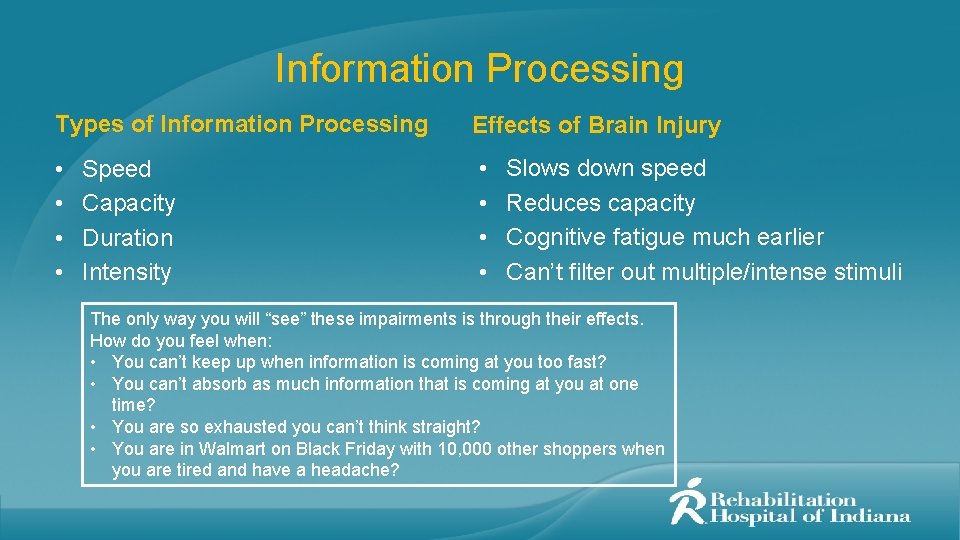
Information Processing Types of Information Processing • • Speed Capacity Duration Intensity Effects of Brain Injury • • Slows down speed Reduces capacity Cognitive fatigue much earlier Can’t filter out multiple/intense stimuli The only way you will “see” these impairments is through their effects. How do you feel when: • You can’t keep up when information is coming at you too fast? • You can’t absorb as much information that is coming at you at one time? • You are so exhausted you can’t think straight? • You are in Walmart on Black Friday with 10, 000 other shoppers when you are tired and have a headache?

Information Processing Impairments • Injury to any part of the brain cause these impairments. • Impaired information processing after brain injury “looks like”: – Problems with keeping up – Difficulties comprehending – The person doesn’t care – Frustration and irritability – Withdrawal – Easily overwhelmed with just normal levels of stimulation
Management of Impaired Information Processing • Avoid complex-intense (lots of noise, lights, movement, and multiple requests to do something) environments or keep it really short and when rested • Take frequent breaks in a very quiet, calm environment • Learn yoga, meditation or other relaxation techniques • Anticipate problems in these situations and have a plan: – Keep checklists of what has to be done – Address when rested, relaxed and pain free
Organization and Problem Solving • We set short term goals (get to work on time) and long term goals (get a college degree). • Accomplishing these goals requires that our behavior stay organized and focused, despite a complex world with constant internal and external changes.
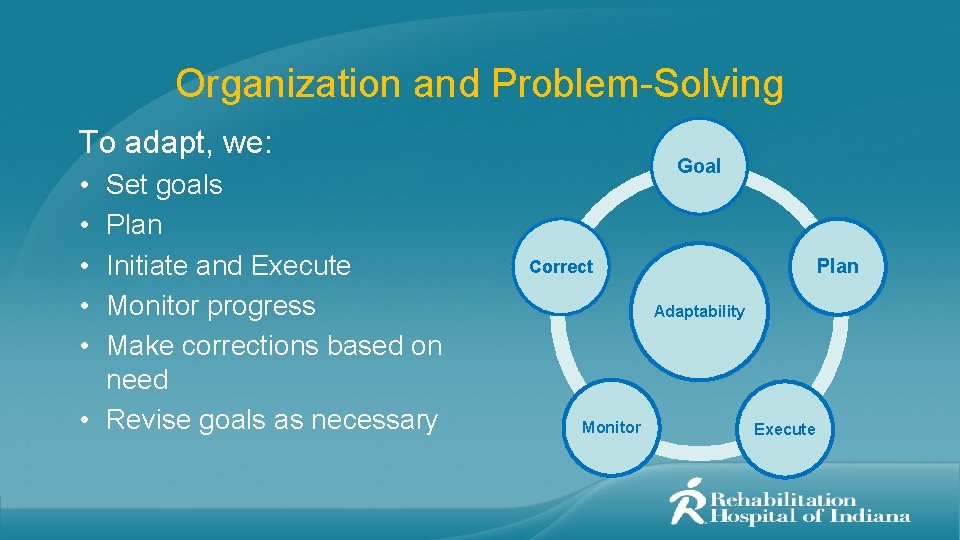
Organization and Problem-Solving To adapt, we: • • • Set goals Plan Initiate and Execute Monitor progress Make corrections based on need • Revise goals as necessary Goal Plan Correct Adaptability Monitor Execute
Impairments of Organization and Problem. Solving • Repetitively making the same mistake • Getting off track in shortterm tasks or long-term goals • Not being aware that a strategy or behavior isn’t working • Having trouble getting started • Impulsively starting something without a plan • Not considering all of the factors that could impact how they should go about doing something • Either setting no goals or setting goals that are unrealistic
Managing Impairments of Organization and Problem-Solving • Write down structured longterm goals and short-term steps to reach them • Anticipate potential problems • Plan possible solutions to these problems, practice them beforehand, and execute them when needed • Set routine reminders to check on progress or “stop and think” • Keep a notebook with: – goals and steps to reach them, – a list of possible problems and what to do when they occur, – a calendar with reminders to get feedback from others regarding progress
What are the Main Points? • Brain injury effects our ability to process information and stay organized with our goals. • People with brain injury have trouble doing what they say or intend to do. • People with brain injury have decreased awareness of how they are going about something may not be working. • People with brain injury may have difficulty solving problems.
In The Next Webinar, We Will Address: • How brain injury affects regulation of mood
This presentation is funded - in part - by US Department of Health & Human Services, Health Resources and Services Administration Maternal and Child Health Bureau Traumatic Brain Injury Implementation Partnership Grant Number H 21 MC 26914 And with funding from the Rehabilitation Hospital of Indiana Foundation 13
- Slides: 13