
Webinar 100 Consistency Check of SEND Datasets Against
Webinar: 100% Consistency Check of SEND Datasets Against Nonclinical Study Reports (NCSR) is Affordable and Quick March 17 th, 2020 at 10 am PST Point. Cross Inc. Get_started@pointcross. com 1
Welcome and Introductions • Thank you for joining this webinar • Laura Kaufman, Ph. D, DABT will be moderating the session and answering any toxicology or SEND related questions • Suresh Madhavan, Ph. D will be presenting the concepts and some of the slides • Raja Ramesh and Karuna Polavarapu will be presenting some of the live demonstrations • Please enter any questions in the chat box or send them to get_started@pointcross. com – we will respond privately if you request and anonymize the source of the question if you would like to share your questions in a FAQ format Point. Cross Inc. Get_started@pointcross. com 2

This Webinar is … • Not about SEND preparations, or standards • Not about analysis, review or visualization of SEND datasets • Not about validating conformance of SEND datasets to published Rules • Not about typical issues found in SEND data – FDA has presented it in Sept. 2019; • A demonstration that 100% Reconciliation of SEND dataset against the Study Report is an affordable and quick process • Sharing ideas, tools, techniques and dataflows across the SEND lifecycle to help ensure absolute quality and consistency of SEND • Meant for Sponsors and SEND preparers at CROs, CRO-IT organizations, who want to submit quality data • Meant for Reviewers who must have confidence in submitted SEND datasets quickly and inexpensively • A practical "How To" session with live demos, processes and tools. Point. Cross Inc. Get_started@pointcross. com 3

Our Strategic Steps since 2015 to become SEND Ready • Since Jan 2015 we issued alerts and webinars that SEND data will drift away from Study Reports and be inconsistent • Automate Semantic Enrichment to selected SEND CT • Automate Generation of Trial Design domains • Create a SEND-ASSURE process that ensures: • 100% checking of consistency between SEND datasets and Study Reports – whether we do the standardization or a 3 rd Party does it • Conformance checking to rules – built e. Data Validator • Checking of how well SEND Best Practices were followed • Measure and categorize the number of issues seen in every SEND -ASSURE service for continuous improvement • SEND was meant for deeper reviews – let us make it trustworthy • ALL these goals were met by end of 2017 Point. Cross Inc. Get_started@pointcross. com 4

Need for New Strategic Goals for SEND after Sept 2019 – Jan 2020 • FDA Webinar on SEND data quality Sept 2019 & Nov F 2 F: • Appears only 10% - 11% of SEND datasets get a “fitness for review” assessment through Kick-start. • Most of the assessed studies have issues that prevent them from re-generating the summaries in the Study Report • SEND-ASSURE data on 88 Studies standardized by reputable CROs and SEND preparers from 2017 to Jan 2020 confirm FDA’s findings • All 88 studies needed remedial corrections – they were NOT fit for review • Proof that any study that is not 100% consistency checked will NOT be consistent – Point. Cross standardized 91 studies that would NOT be fit for review if consistency was not enforced at 100% • The fault is NOT with the SEND preparer but the lack of 100% consistency checks that ties SEND to Study Report • Preliminary raw responses from Ph. USE survey – suggests that no SEND preparer is checking or can check for 100% consistency. • The barrier to not checking appears to be cost and time! Point. Cross Inc. Get_started@pointcross. com 5
2020 – New Strategic Design Goals for SEND Lifecycle • 100% Reconciliation of SEND against Study Report should take < 10 hours per study for SEND preparers • Requires a digitized representation of Study Report summary tables • Automatic Reconciler tool should generate machine readable instructions to correct errors in SEND datasets and fill n. SDRG if needed • Allowing preparers to fix problems manually = source of new errors • FDA, Sponsors can verify consistency of a SEND dataset in less than 1 hour using a “digital proof of reconciliation” to begin review • If it takes days or weeks to establish fit-for-review it cuts into time allowed for review (e. g. IND 30 days) • Eliminate all doubt about SEND data’s usability for review • If SEND is not used for regulatory decisions – who is it helping? Point. Cross Inc. Get_started@pointcross. com 6

SEND preparation today Toxicologist /Investigator • Assumptions/Decisions • Select Cohorts • Select Timing • Analyze • Tabulate, Figures • Conclusions PDF Study Report + LIMS As-collected Subject Data • SEND – Separate from Study Report • --NOMDY – Grouping VISITDY and timing transferred manually pulled from Study Report (Expected variable) • --NOMLBL – Transfer Label in Study to SEND (Permissible) • EXPECTATION: SEND MUST BE CONSISTENT WITH STUDY REPORT • BUT: NO MECHANISM TO ENSURE CONSISTENCY • RESULT: SEND is inconsistent unless checked at 100% Validator SEND CDISC Get_started@pointcross. com Point. Cross Inc. FDA Validation Rules PMDA 7

SEND will DRIFT AWAY from STUDY REPORT WITHOUT RECONCILIATION Toxicologist /Investigator • Assumptions/Decisions • Select Cohorts • Select Timing • Analyze • Tabulate, Figures • Conclusions PDF Study Report + LIMS As-collected Subject Data SEND Conformance and Validation Rules do NOT address consistency with Report Validation is necessary but NOT Sufficient Get_started@pointcross. com Point. Cross Inc. Validator CDISC FDA PMDA Validation Rules 8

Reconciliation forces SEND to be Consistent with Study Report SRR – Study Report Reference Files: Toxicologist /Investigator Digital Representation of PDF Summaries • Assumptions/Decisions • Select Cohorts • Select Timing • Analyze • Tabulate, Figures • Conclusions Reconciler: Tool to compare and Reconcile SRR and SEND + LIMS Group Summaries Re. Calculated from SEND As-collected Subject Data Validator CDISC Get_started@pointcross. com Point. Cross Inc. FDA Validation Rules PMDA 9
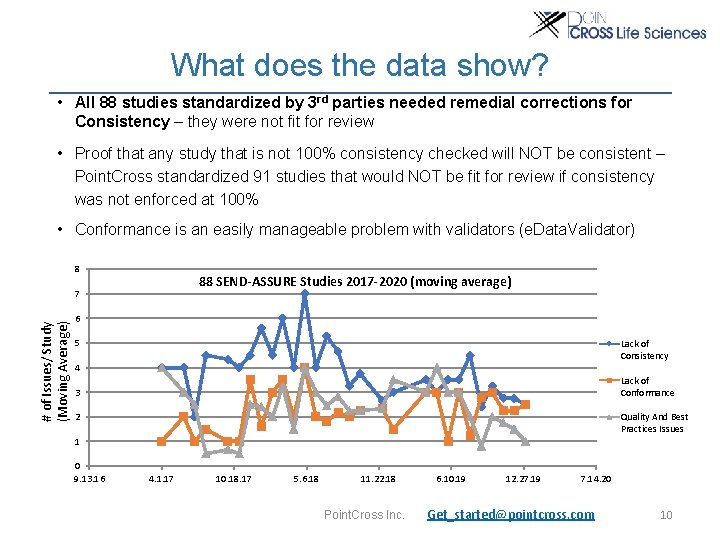
What does the data show? • All 88 studies standardized by 3 rd parties needed remedial corrections for Consistency – they were not fit for review • Proof that any study that is not 100% consistency checked will NOT be consistent – Point. Cross standardized 91 studies that would NOT be fit for review if consistency was not enforced at 100% • Conformance is an easily manageable problem with validators (e. Data. Validator) 8 88 SEND-ASSURE Studies 2017 -2020 (moving average) # of Issues/ Study (Moving Average) 7 6 5 Lack of Consistency 4 Lack of Conformance 3 2 Quality And Best Practices Issues 1 0 9. 13. 16 4. 1. 17 10. 18. 17 5. 6. 18 11. 22. 18 Point. Cross Inc. 6. 10. 19 12. 27. 19 7. 14. 20 Get_started@pointcross. com 10
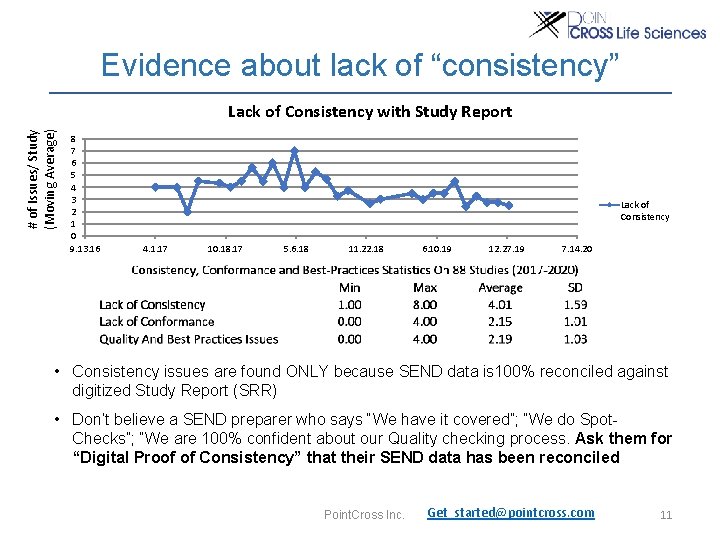
Evidence about lack of “consistency” # of Issues/ Study (Moving Average) Lack of Consistency with Study Report 8 7 6 5 4 3 2 1 0 9. 13. 16 Lack of Consistency 4. 1. 17 10. 18. 17 5. 6. 18 11. 22. 18 6. 10. 19 12. 27. 19 7. 14. 20 • Consistency issues are found ONLY because SEND data is 100% reconciled against digitized Study Report (SRR) • Don’t believe a SEND preparer who says “We have it covered”; “We do Spot. Checks”; “We are 100% confident about our Quality checking process. Ask them for “Digital Proof of Consistency” that their SEND data has been reconciled Point. Cross Inc. Get_started@pointcross. com 11
Some important definitions related to SRR • SRR: Study Report Reference - a set of digital, machine readable, columnar tabulation files, that faithfully represents data in the Study Report needed for 100% reconciliation with the SEND dataset. A free copy of the SRR specification is published by Point. Cross. SRR includes the following: • TS-SR: A Trial Summary file in SEND IG format generated independently using only the Study Report • TD-SR: Trial Design (TE, TA, TX, DM, EX) domains in SEND IG format generated independently using only the Study Report • SRS-Quant: Study Report Summary, a digital, machine readable, columnar tabulation file that is extracted and un-pivoted from the Study Report’s quantitative summary tables (mean, standard deviations, counts) • SRS-Qual: Study Report Summary, a digital, machine readable, columnar tabulation file that is extracted and un-pivoted from the Study Report’s qualitative summary tables (Observation, Severity, Specimen, Incidence Counts) Point. Cross Inc. Get_started@pointcross. com 12
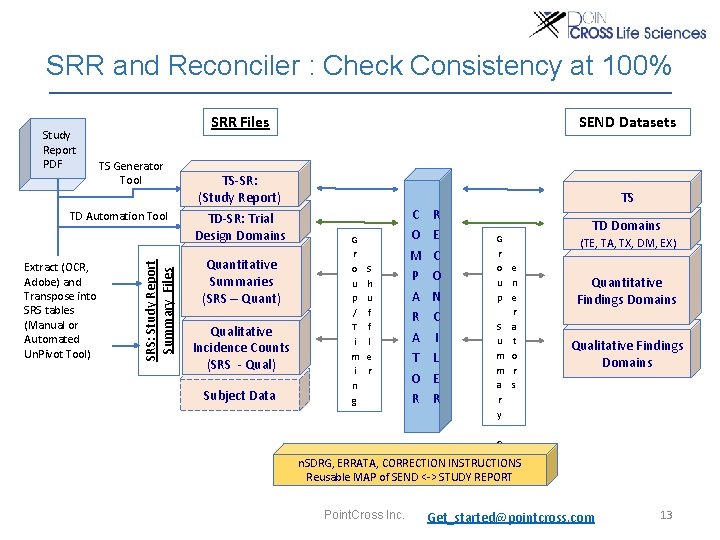
SRR and Reconciler : Check Consistency at 100% Study Report PDF SRR Files TS Generator Tool Extract (OCR, Adobe) and Transpose into SRS tables (Manual or Automated Un. Pivot Tool) SRS: Study Report Summary Files TD Automation Tool TS-SR: (Study Report) TD-SR: Trial Design Domains Quantitative Summaries (SRS – Quant) Qualitative Incidence Counts (SRS - Qual) Subject Data SEND Datasets G r o u p / T i m i n g S h u f f l e r C O M P A R A T O R R E C O N C I L E R TS G r o e u n p e r S a u t m o m r a s r y TD Domains (TE, TA, TX, DM, EX) Quantitative Findings Domains Qualitative Findings Domains G n. SDRG, ERRATA, CORRECTION INSTRUCTIONS Reusable MAP of SEND <-> STUDY REPORT Point. Cross Inc. Get_started@pointcross. com 13
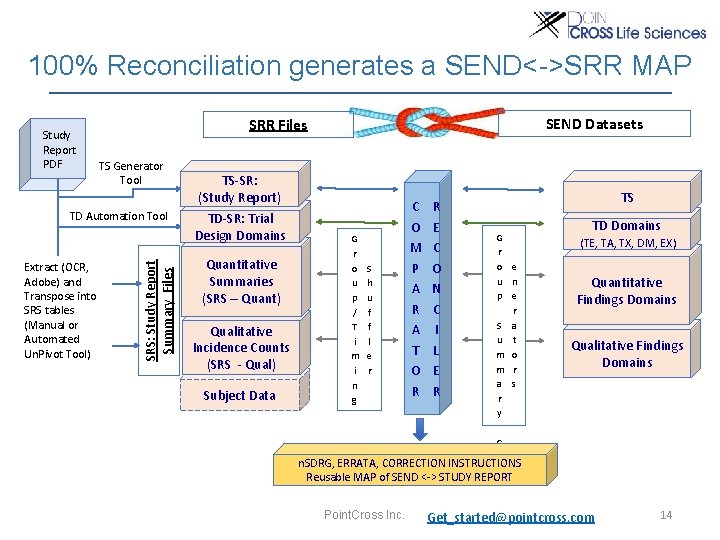
100% Reconciliation generates a SEND<->SRR MAP Study Report PDF TS Generator Tool SRS: Study Report Summary Files TD Automation Tool Extract (OCR, Adobe) and Transpose into SRS tables (Manual or Automated Un. Pivot Tool) SEND Datasets SRR Files TS-SR: (Study Report) TD-SR: Trial Design Domains Quantitative Summaries (SRS – Quant) Qualitative Incidence Counts (SRS - Qual) Subject Data G r o u p / T i m i n g S h u f f l e r C O M P A R A T O R R E C O N C I L E R TS G r o e u n p e r S a u t m o m r a s r y TD Domains (TE, TA, TX, DM, EX) Quantitative Findings Domains Qualitative Findings Domains G n. SDRG, ERRATA, CORRECTION INSTRUCTIONS Reusable MAP of SEND <-> STUDY REPORT Point. Cross Inc. Get_started@pointcross. com 14
DEMO of SRR and SRS Generation Generating SRR & SRS is quick, inexpensive $3, 000 / study for SRR as a Service Over 1, 500 SRS on Study Reports done since 2012 Point. Cross Inc. Get_started@pointcross. com 15
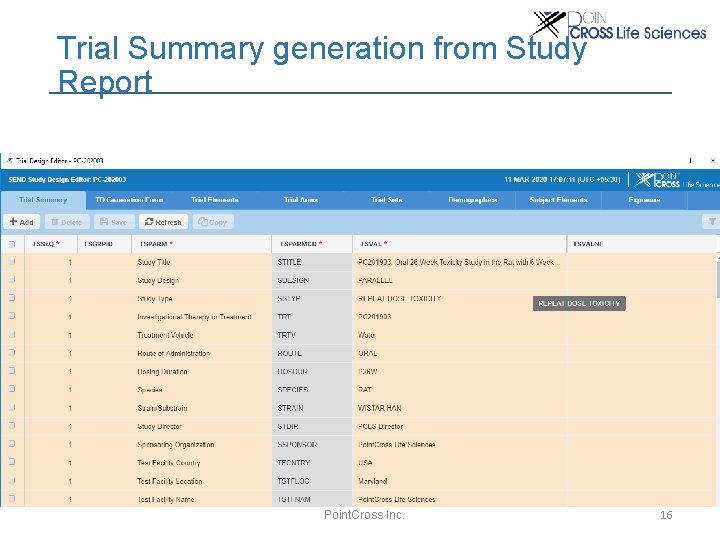
Trial Summary generation from Study Report Point. Cross Inc. 16
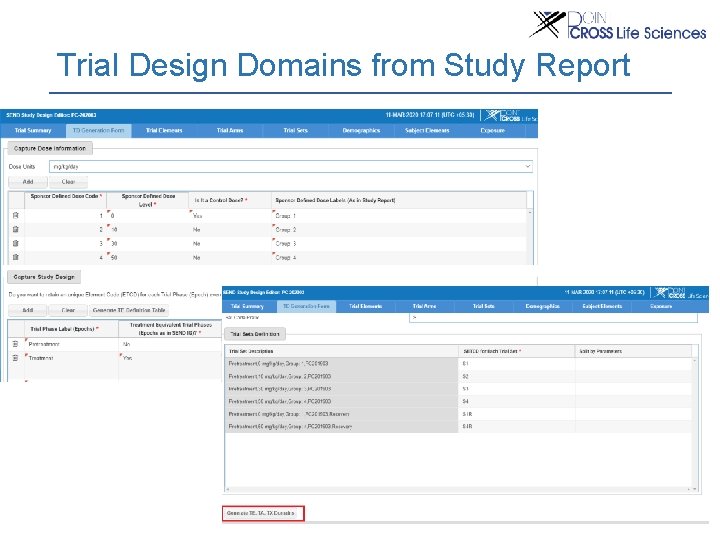
Trial Design Domains from Study Report Point. Cross Inc. 17
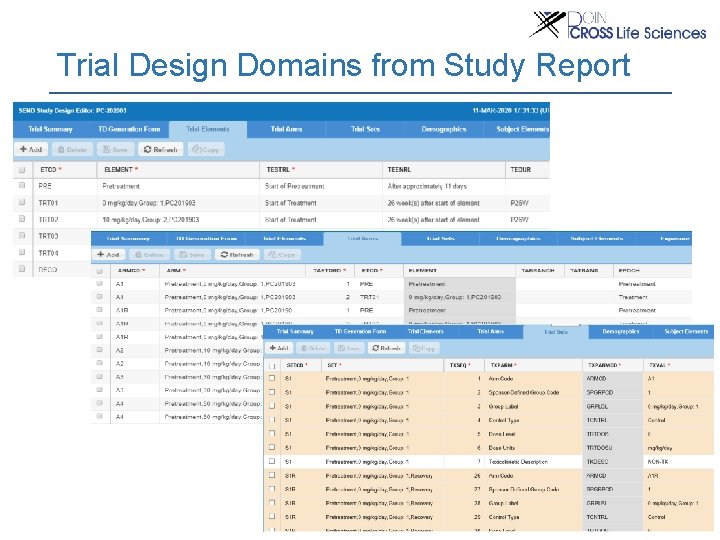
Trial Design Domains from Study Report Point. Cross Inc. 18
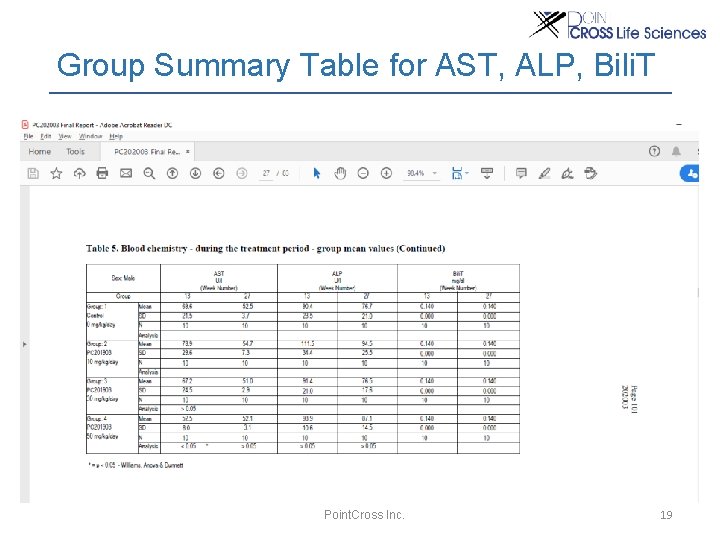
Group Summary Table for AST, ALP, Bili. T Point. Cross Inc. 19
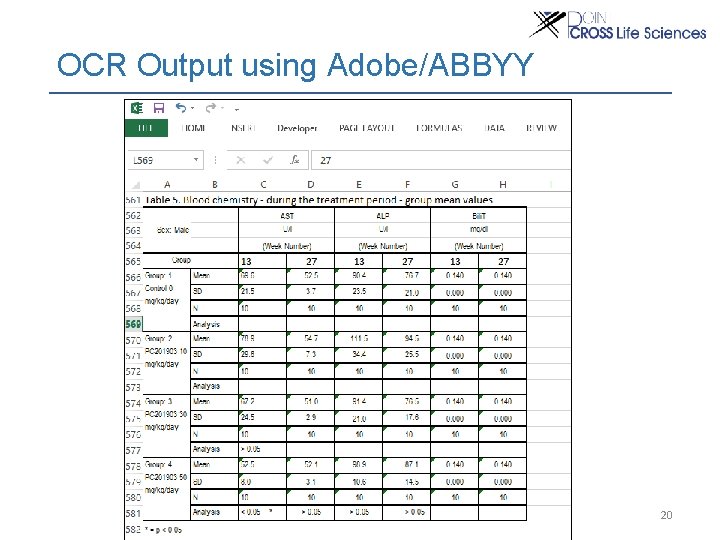
OCR Output using Adobe/ABBYY Point. Cross Inc. 20
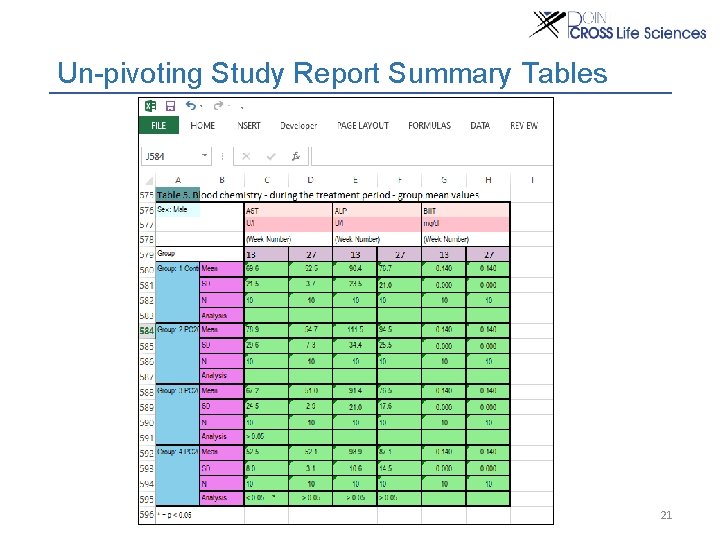
Un-pivoting Study Report Summary Tables Point. Cross Inc. 21
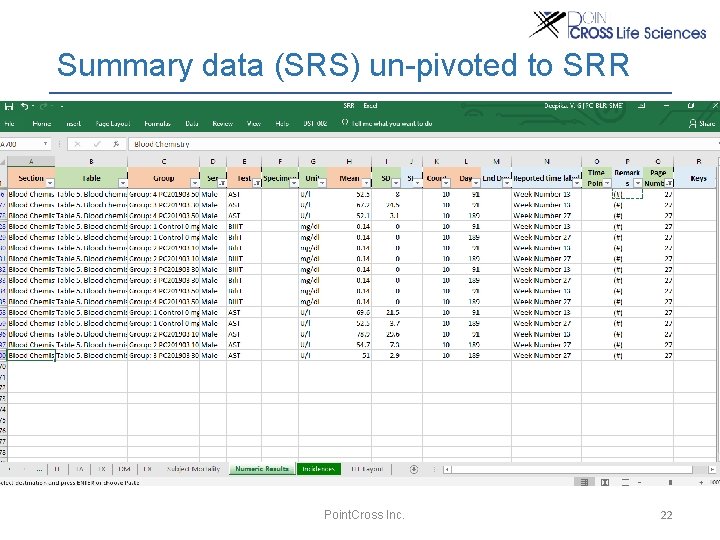
Summary data (SRS) un-pivoted to SRR Point. Cross Inc. 22
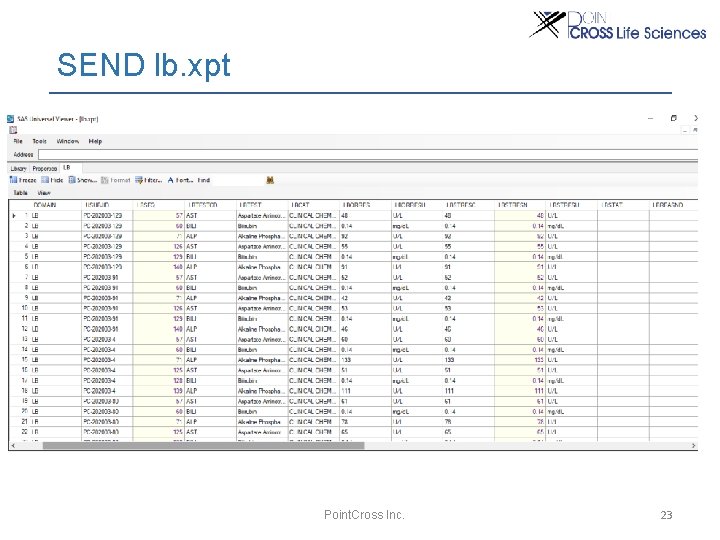
SEND lb. xpt Point. Cross Inc. 23
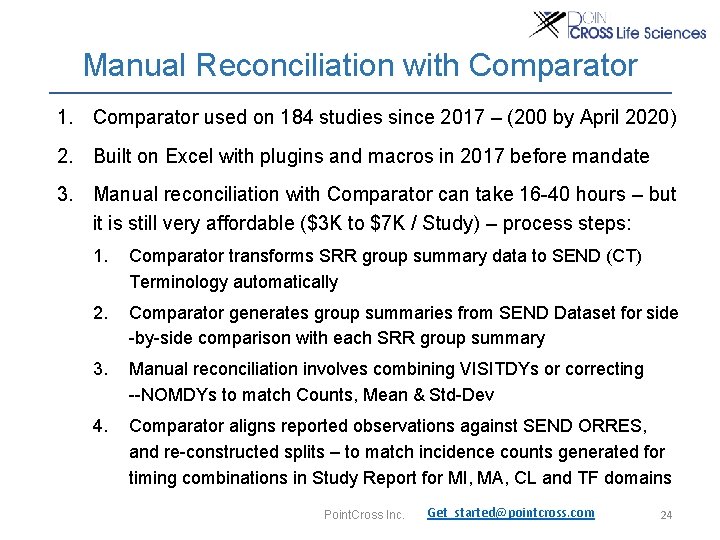
Manual Reconciliation with Comparator 1. Comparator used on 184 studies since 2017 – (200 by April 2020) 2. Built on Excel with plugins and macros in 2017 before mandate 3. Manual reconciliation with Comparator can take 16 -40 hours – but it is still very affordable ($3 K to $7 K / Study) – process steps: 1. Comparator transforms SRR group summary data to SEND (CT) Terminology automatically 2. Comparator generates group summaries from SEND Dataset for side -by-side comparison with each SRR group summary 3. Manual reconciliation involves combining VISITDYs or correcting --NOMDYs to match Counts, Mean & Std-Dev 4. Comparator aligns reported observations against SEND ORRES, and re-constructed splits – to match incidence counts generated for timing combinations in Study Report for MI, MA, CL and TF domains Point. Cross Inc. Get_started@pointcross. com 24
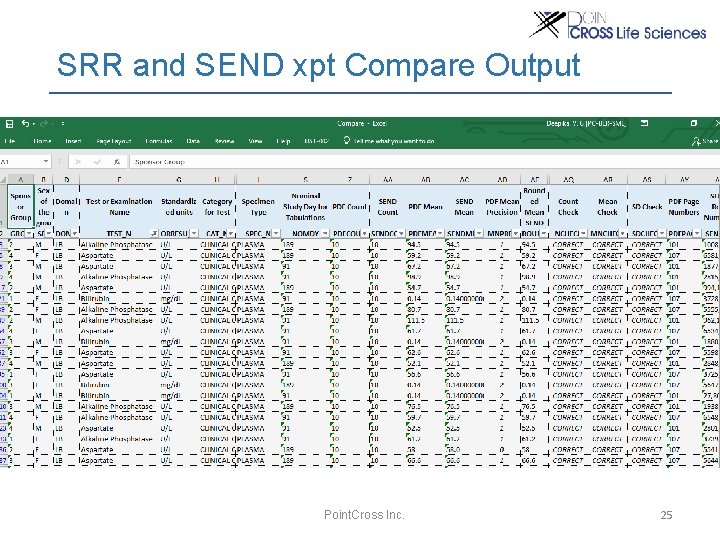
SRR and SEND xpt Compare Output Point. Cross Inc. 25
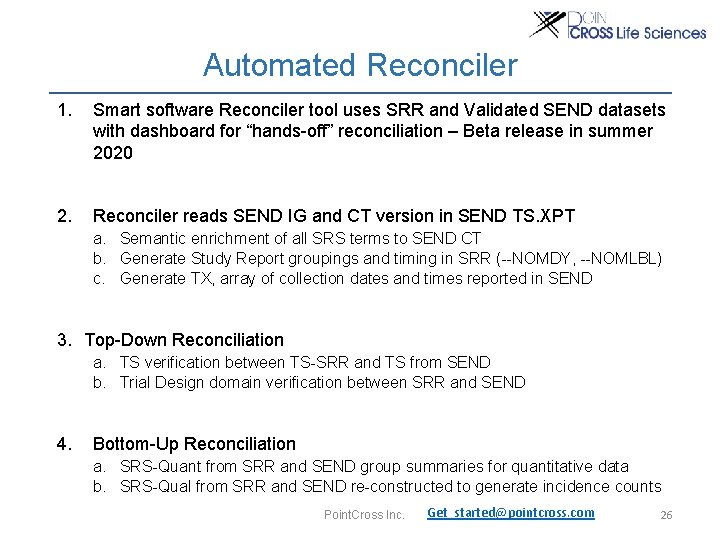
Automated Reconciler 1. Smart software Reconciler tool uses SRR and Validated SEND datasets with dashboard for “hands-off” reconciliation – Beta release in summer 2020 2. Reconciler reads SEND IG and CT version in SEND TS. XPT a. Semantic enrichment of all SRS terms to SEND CT b. Generate Study Report groupings and timing in SRR (--NOMDY, --NOMLBL) c. Generate TX, array of collection dates and times reported in SEND 3. Top-Down Reconciliation a. TS verification between TS-SRR and TS from SEND b. Trial Design domain verification between SRR and SEND 4. Bottom-Up Reconciliation a. SRS-Quant from SRR and SEND group summaries for quantitative data b. SRS-Qual from SRR and SEND re-constructed to generate incidence counts Point. Cross Inc. Get_started@pointcross. com 26
DEMO – Automated Reconciler Point. Cross Inc. Get_started@pointcross. com 27
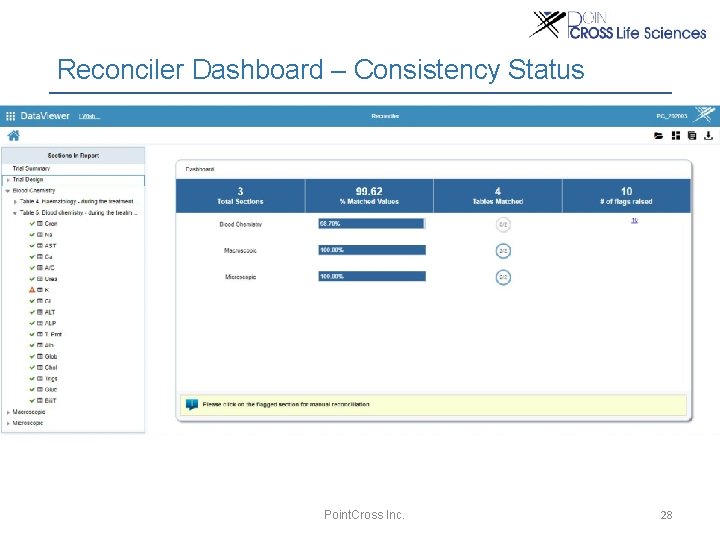
Reconciler Dashboard – Consistency Status Point. Cross Inc. 28
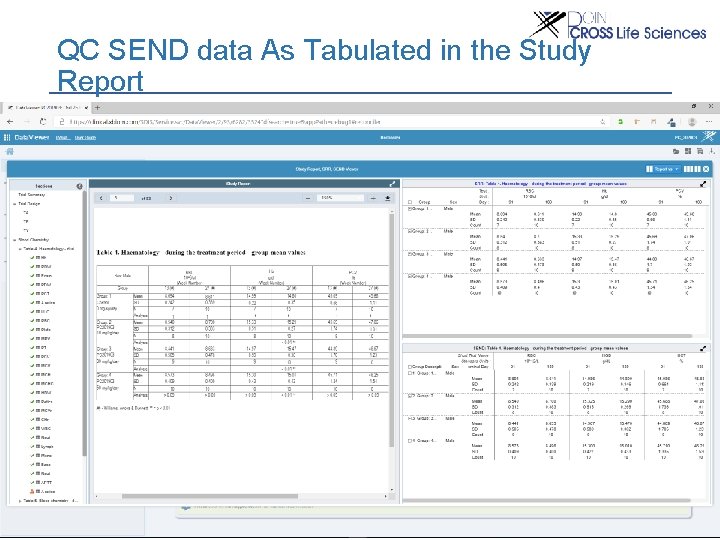
QC SEND data As Tabulated in the Study Report Point. Cross Inc. 29

Industry can make SEND 100% Consistent and Reviewable 1. Generate SRR • Study Report – Extract Digital Tables. Point. Cross is offering an SRR specification and templates for free to the industry • CROs can generate SRR by entering un-pivoted tables of final Study Report to columnar format of SRR – OR • Cut and paste tables from Report PDFA to SRR Templates (about 20 -50 hours) - OR • Point. Cross has a SRR generation service for $3, 000 per study fixed price • Over 1, 500 SRRs generated since 2012 (IMI-SD and SEND) 2. Reconcile using a Comparator with Manual Reconciliation OR with Automated Reconciler • Reconcilers or Comparators can be independently built by companies or FDA • Use the SRR and SENDIG specifications • Point. Cross is releasing an automated Reconciler in summer 2020 • Meanwhile – Point. Cross SEND-ASSURE service will offer SRR and comparator file as part of deliverables to clients Get_started@pointcross. com Point. Cross Inc. 30
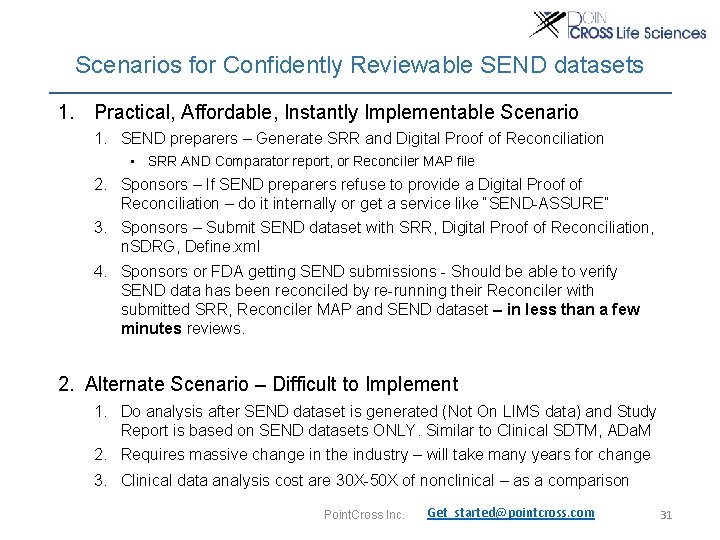
Scenarios for Confidently Reviewable SEND datasets 1. Practical, Affordable, Instantly Implementable Scenario 1. SEND preparers – Generate SRR and Digital Proof of Reconciliation • SRR AND Comparator report, or Reconciler MAP file 2. Sponsors – If SEND preparers refuse to provide a Digital Proof of Reconciliation – do it internally or get a service like “SEND-ASSURE” 3. Sponsors – Submit SEND dataset with SRR, Digital Proof of Reconciliation, n. SDRG, Define. xml 4. Sponsors or FDA getting SEND submissions - Should be able to verify SEND data has been reconciled by re-running their Reconciler with submitted SRR, Reconciler MAP and SEND dataset – in less than a few minutes reviews. 2. Alternate Scenario – Difficult to Implement 1. Do analysis after SEND dataset is generated (Not On LIMS data) and Study Report is based on SEND datasets ONLY. Similar to Clinical SDTM, ADa. M 2. Requires massive change in the industry – will take many years for change 3. Clinical data analysis cost are 30 X-50 X of nonclinical – as a comparison Point. Cross Inc. Get_started@pointcross. com 31

Scenario 3: “Insanity is doing the same thing over and over again and expecting a different result” … anonymous but often misattributed to Albert Einstein Alternate Scenario: Maintain Status Quo and change nothing • All SEND datasets without a verifiable Digital Reconciliation will continue to be inconsistent with Study Report • Self-certification by SEND preparers is not verifiable • Cost to check a study manually & thoroughly – can take weeks and $20, 000 to $30, 000. Cost for 1, 000 studies can be $20 -30 Million/year • Checking a percentage of studies only means that remaining unchecked SEND studies will continue to be inconsistent with Study Report • FDA is only offering Kick-Start to about 11% of submitted studies • Reviewers may lose 2 weeks before their review can begin – so they will revert to Study Report because they have to respond to IND in 30 days • Will SEND be used for regulatory decision making if it is not a trusted data source? Point. Cross Inc. Get_started@pointcross. com 32

Digital Proofs for: Validation, Reconciliation – to Ensure Quality Digital Proof of Reconciliation SRRProof and Reconciler Map Digital of Reconciliation (orand Comparator Report) SRR Reconciler Map Run by Sponsor or FDA on their Reconciler Digital Proof of Validation Validator Check (for Conformance) Validator CDISC FDA PMDA Validation Rules Get_started@pointcross. com Point. Cross Inc. 33
SRR is also valuable because • SRR speeds SEND dataset generation with consistency (we do it) • Reconciler “MAP” of SEND to SRR allows data to be visualized by project toxicologists and reviewers in the same format and terminology in Study Report – no need to train toxicologists on SEND variables • Reviewers may use SRR with their review tools to immediately compare their own cohort analysis against Study Report digitally (on Janus) • SRR is a way to Exchange Analysis Results – leaving SEND to exchange As. Collected data from subjects – as originally intended • Organizations such as Sponsors and FDA can map all SEND data to their standardized Trial Design notation using SRR to support time, IG and CT invariant data for Cross-Study Analysis Point. Cross Inc. Get_started@pointcross. com 34
Q&A and Thank You for Attending ! • 100% Reconciliation of SEND dataset against the Study Report is quick and affordable – it will cost less than cost of current quality practices • Isn’t it our obligation to submit trustworthy reviewable SEND data? • If you think of other ways to make your SEND data absolutely verifiably consistent – let us know. • Please let us know what you thought about this webinar. Contact us at: Get_started@pointcross. com Chat on line at our website, or Tel: +1 -844 -382 -7257 Email our experts: kurien@pointcross. com karuna@pointcross. com karen@pointcross. com Point. Cross Inc. 35
- Slides: 35