
WEBERS THEORY OF LOCATION WHO WAS ALFRED WEBER

WEBER’S THEORY OF LOCATION
WHO WAS ALFRED WEBER? � Alfred Weber (30 July 1868 – 2 May 1958) was a German economist, sociologist and theoretician of culture whose work was influential in the development of modern economic geography
ASSUMPTIONS OF WEBER’s THEORY OF LOCATION The centres of consumption are fixed. -PRODUCTION MANUFACTURE OF PARTS ASSEMBLY -OF PARTS FOR FINISHED GOODS PACKAGING OF -FINISHED GOODS. � � The cost of raw material is the same at all places even though the distribution of deposits of raw materials is uneven. � There are fixed centres of labour supply and they have unlimited supplies of labour at cost. � Transport cost depends upon weight of material and distance.
FACTORS INFLUENCING LOCATION OF PLANTS Primary or regional factors Secondary or agglomerative and deglomerative

PRIMARY FACTORS: These factors influence the location of plants over different regions. Weber developed his theory on the basis of two regional factors: 1) Transportation cost 2) Labour cost
TRANSPORTATION COST TRANSPORTATION A plant tends to be located at a site where the total cost of transportation of materials and products is minimum. � Transport cost is dependent on 2 basis -The weight to be transported -Distance to be covered
The Weight Losing Case The final product is lighter than the raw material that require transport. • Usually this is a case of some ubiquitous (everywhere available) raw material such as water •
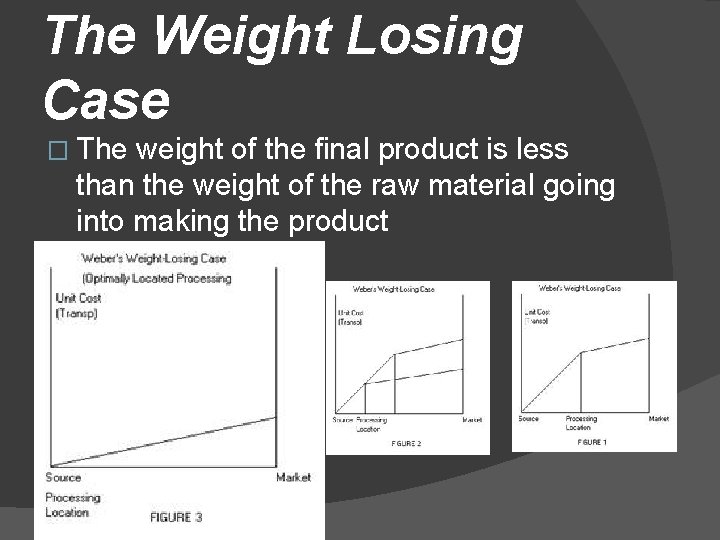
The Weight Losing Case � The weight of the final product is less than the weight of the raw material going into making the product
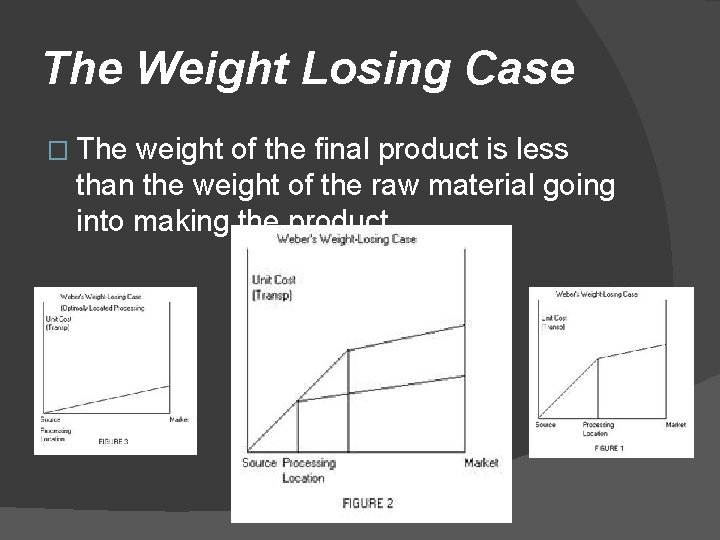
The Weight Losing Case � The weight of the final product is less than the weight of the raw material going into making the product
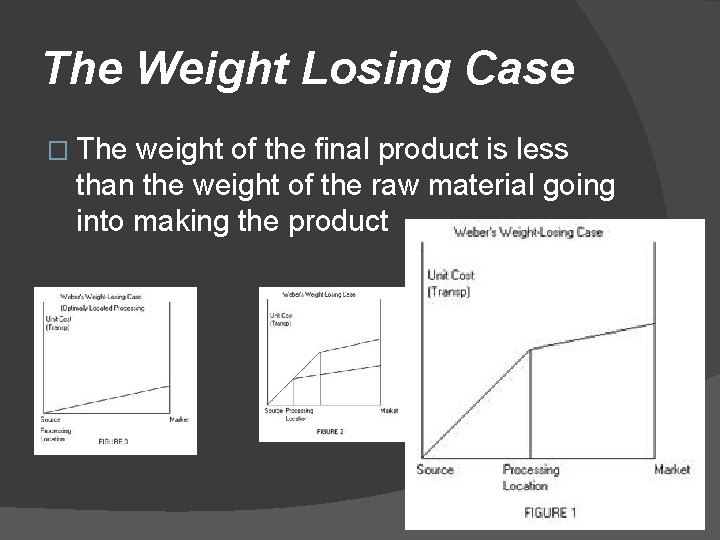
The Weight Losing Case � The weight of the final product is less than the weight of the raw material going into making the product
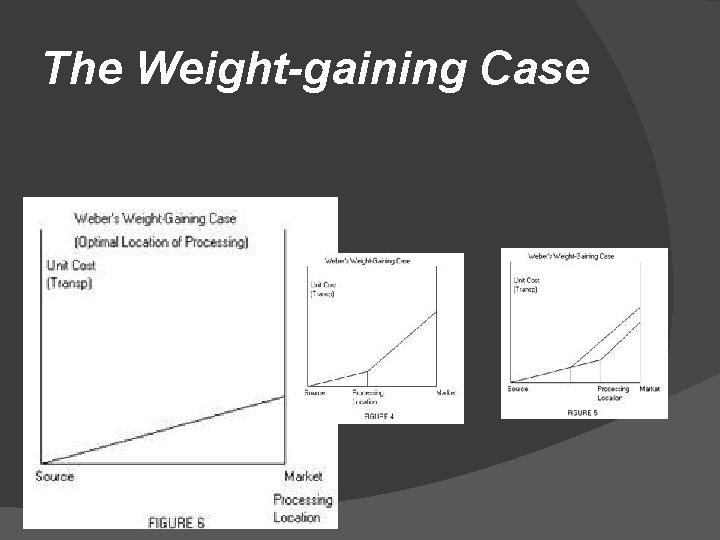
The Weight-gaining Case
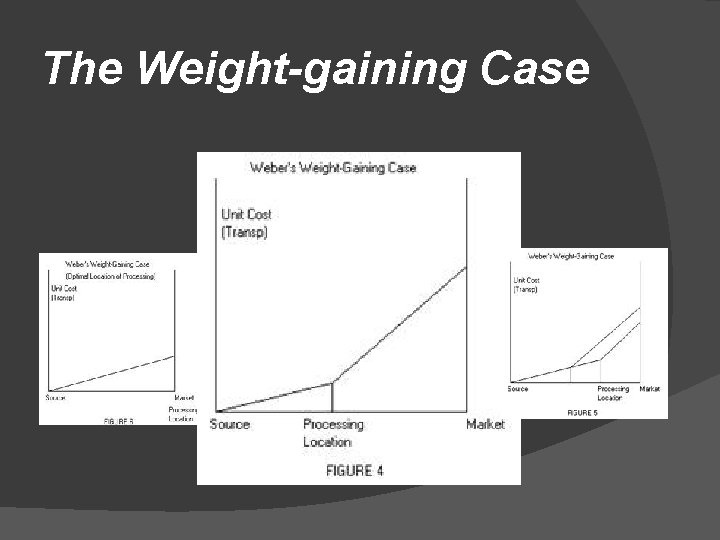
The Weight-gaining Case
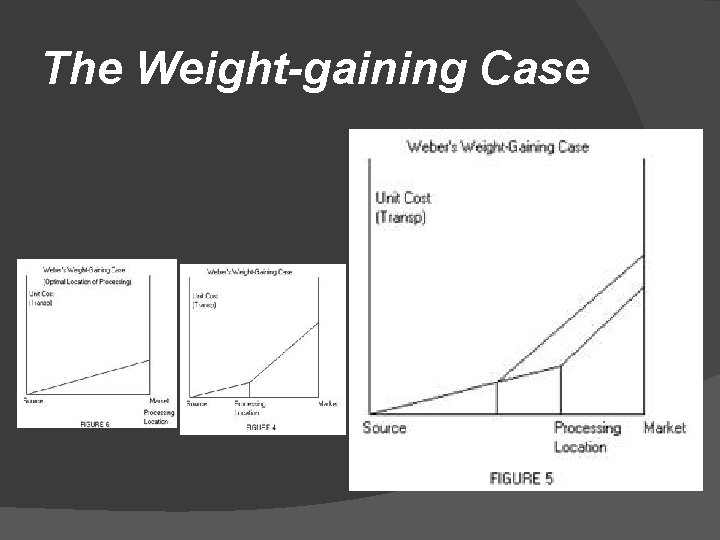
The Weight-gaining Case
Weber classified materials in 2 forms: � Ubiquitous materials and Localized materials � Ubiquitous materials – are materials that are present everywhere. Example: - water, air etc
Localized materials- are materials that are confined to a particular region. Example: - iron, gold, cotton etc � Localized materials can be further divided into: - Pure materials and Gross materials
Pure materials and Gross materials Pure materials - Pure or non-weight loosing materials do not loose their weight in the process of production. Such materials do not pull plants to their place of deposits. Example: - cotton, wool etc � Gross materials - Gross or weight-losing materials impart a small part or none of their weight to the finished product. Such materials attract production towards places of deposits. Example: -sugarcane farms, coal etc �

� Material index On the basis of the above reasoning, Weber developed a mathematical formula to measure the relative pull of materials while those with low materials and the market on industrial location. � Material index = weight of localized material /weight of the finished goods. � If material index > 1 then plant will be located near the resources. � If material index < 1 then plant will be located near to the market.
� Labour cost - Cost incurred to employee workers. These costs directly affects the production of the firm. �A plant may deviate from the point of least transportation cost when the savings in labour cost are greater than the additional cost of transportation at the new centre. Least transportation cost Resources Factory
Isodapanes represent points of equal transportation cost, including assembling cost of materials and distribution cost of finished product. Critical Isodapane Is a point where Transportation cost = Labour cost i. e. where both labour cost and transportation cost are minimum as compared to their total cost any where else. A point where both the costs are minimum is the Optimum place for a factory resource labour.
Weber built on his idea to use Isotims (concentric rings that connect equal-cost points) And Isodapanes (Variations in total transport costs)
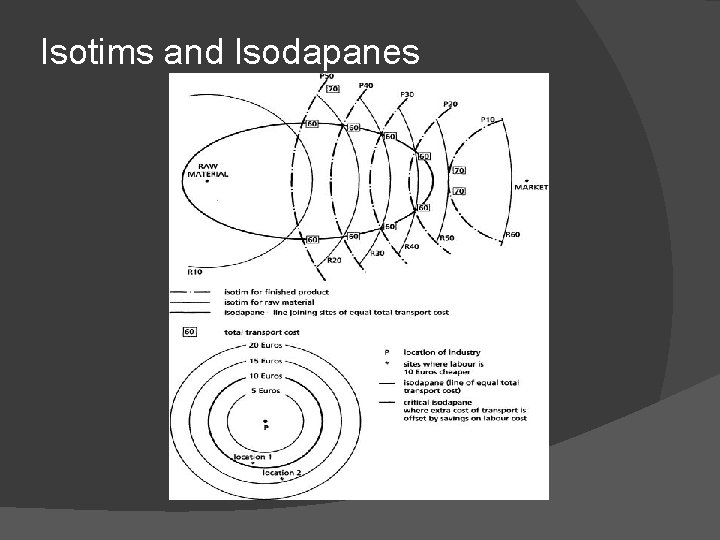
Isotims and Isodapanes
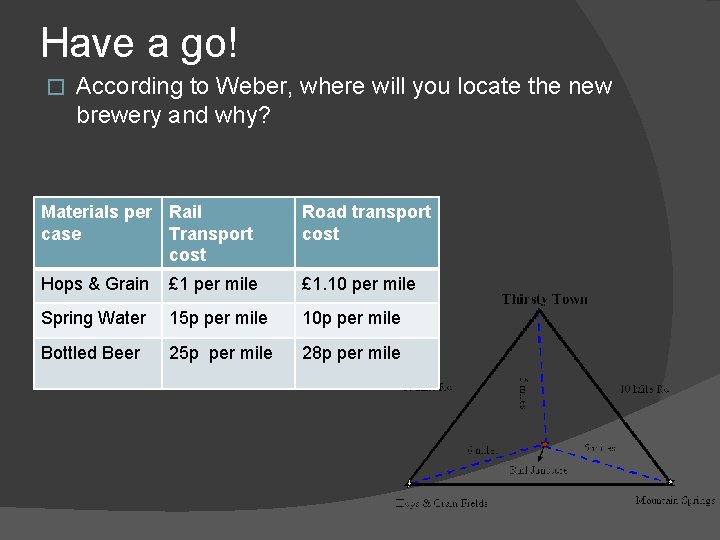
Have a go! � According to Weber, where will you locate the new brewery and why? Materials per Rail case Transport cost Road transport cost Hops & Grain £ 1 per mile £ 1. 10 per mile Spring Water 15 p per mile 10 p per mile Bottled Beer 25 p per mile 28 p per mile
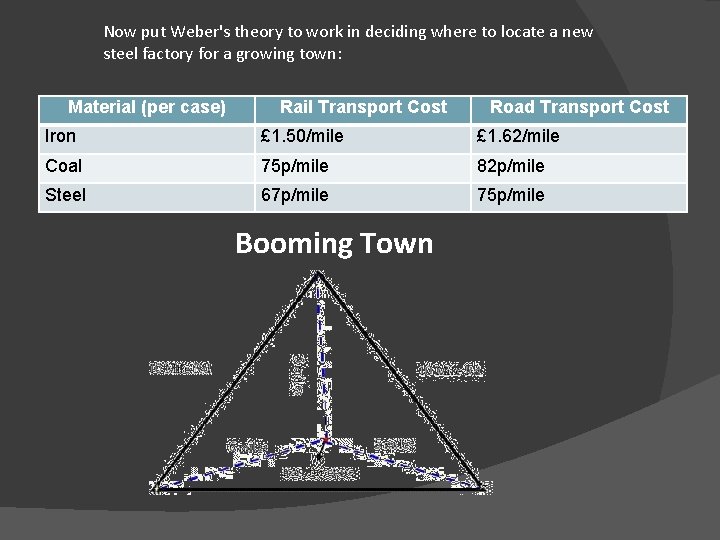
Now put Weber's theory to work in deciding where to locate a new steel factory for a growing town: Material (per case) Rail Transport Cost Road Transport Cost Iron £ 1. 50/mile £ 1. 62/mile Coal 75 p/mile 82 p/mile Steel 67 p/mile 75 p/mile Booming Town
Labour costs depends upon: � Labour cost per unit. (It is measured by labour cost index - i. e. proportion of labour cost to the weight of the finished product. ) � Locational weight. (It is the weight to be transported during the process of production. )
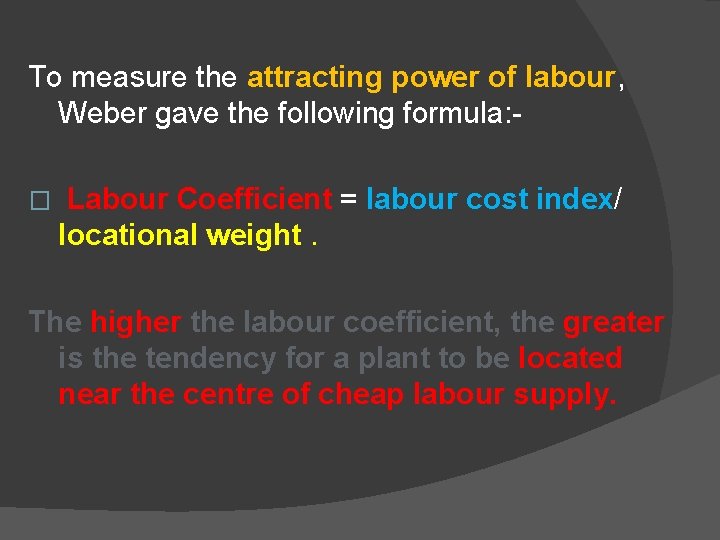
To measure the attracting power of labour, Weber gave the following formula: � Labour Coefficient = labour cost index/ locational weight. The higher the labour coefficient, the greater is the tendency for a plant to be located near the centre of cheap labour supply.
Secondary Factors � Secondary factors lead to concentration or dispersal of industries. They are; Agglomerative and Deglomerative Agglomerative factors are the external economies which result from concentration of industries at a particular place. Deglomerative These are external diseconomies that causes geographical dispersal of industry.
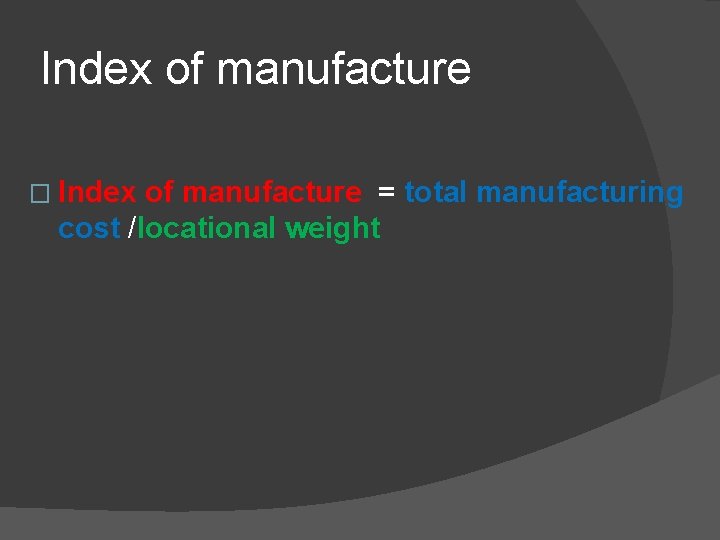
Index of manufacture � Index of manufacture = total manufacturing cost /locational weight
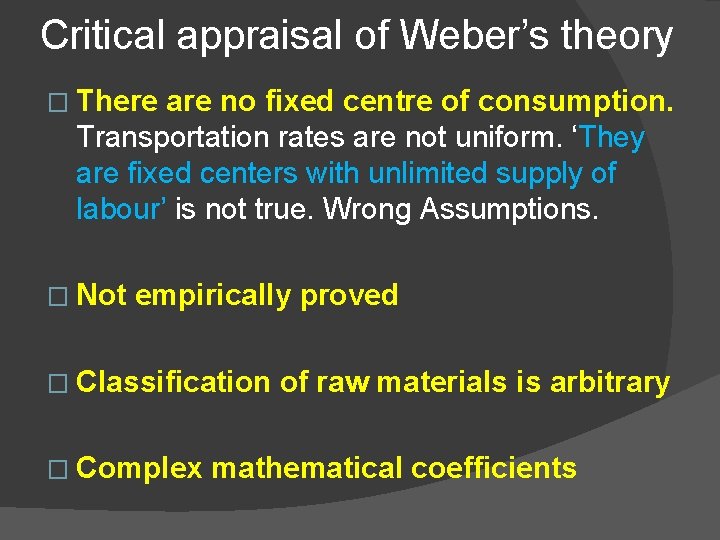
Critical appraisal of Weber’s theory � There are no fixed centre of consumption. Transportation rates are not uniform. ‘They are fixed centers with unlimited supply of labour’ is not true. Wrong Assumptions. � Not empirically proved � Classification � Complex of raw materials is arbitrary mathematical coefficients
� Within your tables write down the good and bad points that you foresee with this model. Both groups discuss the evolution of industrial location theory. � Find out and write a summary of the main points of Smith and Pred’s theory.
- Slides: 29