
Webcast 2 hours Miscellaneous Commercial Coverages Part 1
Webcast (2 hours) ““Miscellaneous Commercial Coverages: Part 1” Tom Ashley, AAI, AIAM, AIP © Florida Association of Insurance Agents – 2010 1 11/09
You Can Ask Questions! Feel free to ask questions throughout today’s webcast by using the Question Tab. 2
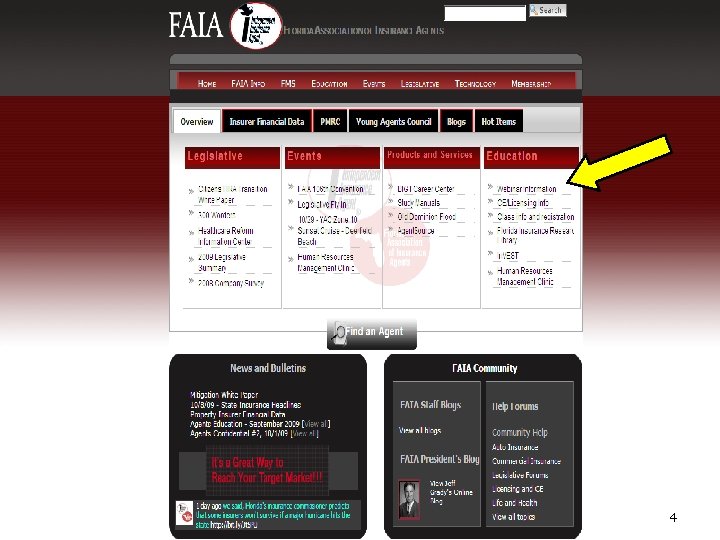
FLORIDA Agents -Important !!! Per DFS requirements, you need to sign an Acknowledgement Form in order to receive CE credit. 1) Go to www. faia. com – Under “Education”, click “Webinar Information”. Click “Webinar Acknowledgement Form” 2) Complete all the required information and transmit the form to FAIA. 3) You have three (3) business days to submit the 3 form.
4
--- The importance of miscellaneous commercial coverages to your clients. --- Commercial insurance clients need to be aware of the coverages available to them. 5
Today’s Topics 1) 2) 3) 4) Employee Theft Directors and Officers Liability Pollution Liability Disability Income 6
Part II – separate class 1) 2) 3) 4) Aviation Insurance Electronic Data Liability Ins. Ocean Marine Key Person Life 7
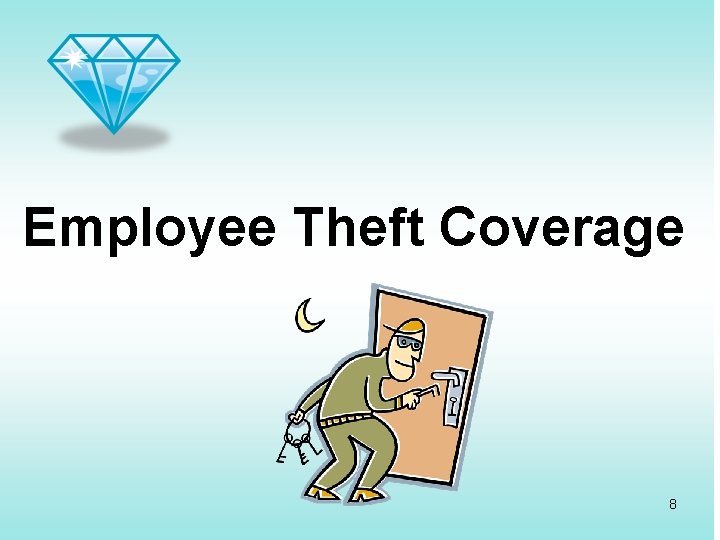
Employee Theft Coverage 8
Definition Old term (pre-ISO 2000) “Employee dishonesty” Means only dishonest acts committed by an “employee”, whether identified or not, acting alone or in collusion with other persons, except you or a partner, with the manifest intent to: 1) Cause you to sustain loss; and also 2) Obtain financial benefit (other than employee benefits earned. . , incl. salaries, fees, etc. ) for: 9
Definition Old term (pre ISO 2000) “Employee dishonesty” a. The “employee”; or b. Any person or organization intended by the “employee” to receive that benefit. 10
Definition New term (ISO 2000) “Employee theft” Means “the unlawful taking of money, securities, or other property to the deprivation of the insured. ” (so theft is defined!) (“Manifest intent” and “received financial benefit” omitted. ) 11
Definition “Employee” means: 1. Any natural person: 2. a. While in your service or for 30 days after termination of service; and 3. b. Who you compensate directly by salary, wages or commissions; and 4. c. Who you have a right to direct and control while performing services for you; or 12
Definition “Employee” means: 2. Any natural person who is furnished temporarily to you: a. To substitute for a permanent employee as defined in paragraph (1) above who is on leave; or b. To meet seasonal or short-term work load 13 conditions;
Definition “Employee” means: while that person is subject to your direction and control and performing services for you, excluding, however, any such person while having care and custody of property outside the “premises”. (“Premises” is defined as the interior part of the 14 building occupied by the insured. )
Definition “Employee” means: But “employee” does not mean any: 1. Agent, broker, factor, commission merchant, consignee, independent contractor or representative of the same general character; or 2. Director or trustee except while performing acts coming within the scope of the usual duties 15 of an employee.
Definition Employees Not Covered -- Excluded: 1) Insured’s employees for whom similar prior insurance has been canceled and not reinstated. 2) Discovery by the insured of “theft” or any other dishonest acts by an employee immediately cancels coverage for that employee – whether the discovery was before or after becoming 16 employed by the insured.
Employee theft: --- Excluded from Causes of Loss – Special Form (CP 10 30 04 02) --- May be written as part of a CPP or as standalone. --- Written with a basic Commercial Crime Coverage Form, which includes seven primary 17 insuring agreements.
Exclusions to the Insuring Agreements (Crime Form) 1) Acts committed by you, your partners, or your members (LLC) 2) Acts of employees, managers, directors, trustees, or representatives (does not apply to Employee Theft, obviously) 3) Government action 4) Indirect loss 18
Exclusions to the Insuring Agreements (Crime Form) 5) Legal expenses 6) Nuclear hazards 7) War and similar actions 19
Two ISO Coverage Forms 1) Loss Sustained Form (most common) 2) (ISO CR 00 29) 3) 2) Discovery Form (kind of like “claims made (ISO CR 00 28) 20
Two ISO Coverage Forms (Loss triggers) 1) Loss Sustained Form (most common) 2) Covers losses that occur during the policy period and are discovered either during the policy period or within one year after the policy period ends. 3) Losses discovered after one year are not covered. * 21
Two ISO Coverage Forms (Loss triggers) * Loss Sustained During Prior Insurance Losses discovered after the discovery period of prior insurance has expired are covered, but only if the insured has replaced the prior coverage with the existing insurance. (Must have become effective at the same time the prior coverage ended. Coverage amount is the smaller 22 of the two policies. )
Two ISO Coverage Forms (Loss triggers) 2) Discovery Form (kind of like “claims made”) Losses are covered no matter when they occurred if they are first discovered during the policy period. (The insured has 60 days after the termination or cancellation of the policy to discover a loss sustained during the policy period. ) 23
Employee Theft May be written in three ways: 1) Scheduled Persons (by endorsement) 2) Scheduled Position (by endorsement) 3) Blanket (any employee) (included in the basic insuring agreement) 24
Employee Theft Coverage for any employee is canceled immediately upon discovery by the named insured (or a partner, officer or director not in collusion with the employee) of any dishonest act committed by the employee, whether before or after employment by the insured. (The company may cancel as to any employee with 30 days written notice to the insured. ) 25
Employee Theft Coverage excludes loss caused by any employee for whom similar prior insurance has been canceled and not later reinstated. (Could be current carrier or previous carrier. ) There is also no coverage for a loss if the proof is dependent upon inventory shortage or a profit and loss computation. However, such records may be used to document the amount of a loss. 26
Employee Theft With an optional endorsement, (ISO CR 25 35), one limit may apply as a general blanket or scheduled limit, and excess amounts over such limits may be applied to all persons occupying particular positions. 27
Employee Theft “Occurrence” means: “all losses caused by, or involving, one or more “employees, ” whether the result of a single act or series of acts. ” --- Employee theft occurs over a long period of time. Frequently, the employee steals small amounts on numerous occasions. Each theft is not a separate occurrence; the occurrence limit applies to all thefts. 28
Employee Theft Rating Employee Theft Coverage is rated by the number of ratable employees – not the same as the number of total employees. Defined as follows: 1) All officers; 2) All employees who handle, have custody, or maintain records of money, securities, or other property, including persons or entities construed to be employees by endorsement. 29 3) (more)
Employee Theft Rating 3) Directors, trustees, officers, employees, administrators, and managers not included in paragraphs 1 or 2, who handle funds or other property of employee benefit plans subject to ERISA. 4) One percent of all other employees. 30
Reducing Employee Theft 3 key indicators employees will steal from employer 1) Perceived pressure 2) --- The pressure to steal is generated by the need for funds. 3) --- 95% of all fraud cases involve either financial or vice-related problems. 4) --- Few employees who steal from their 31 employer save or hoard the stolen property.
Reducing Employee Theft 3 key indicators employees will steal from employer 2) Perceived opportunity --- This means the employee’s ability to perpetrate and conceal a theft. --- A lack of controls or an environment of nonenforcement provides the opportunity, including: 32
Reducing Employee Theft 3 key indicators employees will steal from employer ● Failure to segregate duties ● Lack of an audit trail ● Lack of appropriate oversight ● Poor accounting records ● Poor physical safeguards ● Failure to discipline perps for minor infractions ● Inappropriate computer access 33
Reducing Employee Theft 3 key indicators employees will steal from employer 3) The employee’s rationalization or attitudes --- Employees justify in their minds their illicit actions as being consistent with their own personal code of ethics by: ● Feeling that they are underpaid ● Believing that they are overworked 34 ● Feeling that “everybody else is doing it” (more)
Reducing Employee Theft 3 key indicators employees will steal from employer ● Believing that rank has its privileges ● Having low self-esteem or morale ● Desiring revenge ● Rationalizing that it is a loan they will repay ● Believing that it is a victimless crime ● Feeling they are using the stolen property for a good purpose 35
Directors and Officers Liability Coverage 36
Directors and officers of corporations and other organizations face personal liability exposures that the usual liability policies do not address. D&Os are responsible for managing the financial affairs of and establishing policies for the organization -- could result in claims by others that decisions made by the D&Os , either individually or collectively, resulted in some harm to the organization or to the individual making the claim. 37
Standard commercial polices, such as CGL and business auto, cover directors and officers, but only for claims arising out of bodily injury, personal injury, and property damage. 38
Organizations, both profit and non-profit, would have a hard time finding leaders willing to serve without D&O insurance in place. Covers personal assets from claims arising out of decisions made in good faith. 39
D&O Policies D&O policies are similar to E&O policies because there is no single standard policy form and are written on a claims-made basis. Despite being non-standard, all D&O policies have similarities. They each have 1) a declarations page, 2) an insuring agreement, 3) definitions, 4) exclusions, 5) and deductibles or retentions. 40
D&O Policies 1) Dec Page: Contains the usual stuff: named insured, address, policy period, limit of liability, etc. The limit of liability is usually expressed as an aggregate for all claims during the policy period, including defense costs. 41
D&O Policies 2) Insuring Agreement: a) Direct liability coverage for the D&Os wrongful acts, covering claims for which the organization does not indemnify the individual in accordance with its charter or bylaws. b) Reimbursement coverage for the organization itself for payments it is obligated to make to 42 indemnify its D&Os.
D&O Policies 2) Insuring Agreement: So, the D&O policy does not cover the organization itself. It only responds to claims brought against the organization’s directors and officers – either individually or collectively. 43
D&O Policies 3) Definitions: a) “Wrongful act” – any actual or alleged error, misstatement, misleading statement, act or omission, or neglect or breach of duty by the directors or officers in the discharge of their duties solely by reason of their being directors and officers of the organizations shown in the declarations. 44
D&O Policies 3) Definitions: b) “Covered persons” – persons who were, are, or may be duly elected or appointed directors and officers of the organization, and also the estates, heirs, or legal representatives of deceased directors and officers. c) Heirs are covered! How important is that to 45 someone considering whether or not to serve?
D&O Policies 4) Exclusions: The exclusions may differ by insurer, so be sure to read the language in the D&O products you sell. Typical D&O policy exclusions are: 46
D&O Policies 4) Exclusions: ● Acts involving any personal profit or advantage to the director or officer ● Criminal, dishonest, or fraudulent acts ● Failure to maintain insurance ● Acts committed before the policy period (unless the retroactive date is before the policy effective date) 47 ● Pollution incidents (more)
D&O Policies 4) Exclusions: ● Responsibilities under ERISA (employee benefits) ● Bodily injury, sickness, disease, death, emotional distress, personal injury, or property damage ● Actions of one director or officer against another, or of the organization itself against a director or 48 an officer.
D&O Policies 5) Deductibles or Retentions: Most D&O policies show two deductibles on the Dec page: 1) Applies to each director and officer 2) Applies as an aggregate deductible 49
D&O Policies D&O insurance is usually provided by surplus lines carriers, but some admitted companies have recently entered the market with programs targeted to specific industries or types of organizations. Underwriters want organizations with long and strong histories of successful operations. The organization’s financial info is vital and submission of financial statements for the three most recent years along with a detailed app is required. Previous claims or suits 50 against the organization or D&Os must be disclosed.
D&O Policies Because the policy excludes any claim arising out of circumstances of which a covered person is aware at the time of the application for coverage, producers should be certain that each covered person is polled before indicating there are no such circumstances. 51
D&O Policies For-profit corporations of all sizes should carry D&O insurance. Non-profit organizations in your community should carry it as well. Churches, social clubs, charitable organizations, condominium and neighborhood associations, trade associations, to name a few. 52
Environmental Liability Insurance 53
Background Almost all liability coverage for pollution is excluded in standard insurance policies. Reasons: 1) Emerging environmental awareness 2) Passage of federal and state laws imposing strict liability Opens the door for specialized pollution coverages. 54
Laws Governing Pollution Liability In addition to the exposures for liability claims that every insured faces (ex. , negligence, intentional torts, strict liability, and contractual liability), environmental liability exposure is compounded by statutorily imposed responsibilities. They include: 55
Laws Governing Pollution Liability Clean Water Act Prohibits or regulates the discharge of pollutants into navigable waters. The goal is to restore the waters to “fishable” and “swimmable” quality. “Pollutant” is broadly defined to include all solid waste; chemical waste; heat; and industrial, municipal, and agricultural waste. ---Spills of petroleum or hazardous materials in U. S. waters are governed by the Oil Pollution Act (OPA) of 1990. 56
Laws Governing Pollution Liability Clean Air Act Regulates emissions from both mobile and stationary sources of air pollution. Establishes National Ambient Air Quality Standards for specific common air pollutants. (In areas of poor air quality major sources of air pollution must install pollution control equipment. ) 57
Laws Governing Pollution Liability Resource Conservation and Recovery Act (RCRA) Imposes strict waste management requirements on generators and transporters of hazardous wastes, and on hazardous waste treatment, storage, and disposal (TSD) facilities. Also regulates underground storage tanks, medical waste, and nonhazardous solid waste. Owners of TSD facilities and storage tanks are required to show ability to pay third-party claims and cleanup costs associated with a pollution spill. 58
Laws Governing Pollution Liability Comprehensive Environmental Response, Compensation, and Liability Act (“Superfund”) Passed in 1980 to cover abandoned waste disposal sites not covered by RCRA. Imposes strict liability (liability without regard to fault). Liability is retroactive and includes a broad classification of parties known as potential responsible parties (PRPs), which include current and prior owners and operators of contaminated property, generators, ……. 59
Laws Governing Pollution Liability Comprehensive Environmental Response, Compensation, and Liability Act (“Superfund”) … transporters, and anyone who arranged for disposal of hazardous substance at the site. Lessees as well as corporate officers may be held liable as “operators”. --- Superfund imposes strict and expensive cleanup standards. The average cost to clean up a Superfund priority site is $30 million. There are 1, 300 sites. (Ex. – Love Canal, NY) 60
Laws Governing Pollution Liability Motor Carrier Act of 1980 Applies to both private and for-hire carriers (trucks). Establishes minimum levels of financial responsibility to cover third-party liability claims for property damage and environmental restoration. 61
Environmental Liability Insurance Coverage The two general classes of environmental insurance are: 1) Site-Specific Environmental Liability Insurance 2) Contractors Environmental Impairment Liability Insurance 62
Environmental Liability Insurance Coverage Site-Specific Environmental Liability Insurance a) Environmental Impairment Liability Insurance b) Covers both sudden and gradual releases of pollutants. Covers bodily injury, property damage, and cleanup costs resulting from pollutants emanating from an insured site. Defense costs are covered as part of the limit of liability. Claims-made, no retroactive date. 63
Environmental Liability Insurance Coverage Site-Specific Environmental Liability Insurance b) Underground Storage Tank Insurance (UST) RCRA regulations require owners or operators of USTs to demonstrate their ability to pay claims resulting from the release of materials from the tank. They must provide proof of financial responsibility (could be insurance UST insurance) of $1 64 million per claim. (more)
Environmental Liability Insurance Coverage Site-Specific Environmental Liability Insurance b) Underground Storage Tank Insurance UST insurance covers third-party liability claims for BI, PD, and off-site clean-up costs. Firstparty costs for cleanup of the insured site can also be covered. Even though current regulations do not apply to above-ground tanks, many companies simply 65 use the same policies to cover them.
Environmental Liability Insurance Coverage Site-Specific Environmental Liability Insurance b) Underground Storage Tank Insurance UST policies do not cover the release of all contaminants from the insured site. They respond only to claims under RCRA, not other environmental liability claims. 66
Environmental Liability Insurance Coverage Contractors Environmental Impairment Liability Ins. Covers the environmental liability insurance needs of contractors performing cleanup services on contaminated sites. Provides coverage for BI, PD, cleanup, and defense costs. Claims-made, and defense costs are within the limit of insurance. (Applies to losses arising from the described operations of the named insured rather than a specific site. ) 67
Environmental Liability Insurance Coverage Contractors Environmental Impairment Liability Ins. A special type of policy is available for asbestos and lead abatement contractors because they’re typically written on occurrence forms. Also, these policies generally combine the insured’s general liability and environmental insurance into one policy. 68
Environmental Liability Insurance Coverage Combined Environmental Insurance Policies New products have been developed combining policies which allow insureds to select coverages. They include: ● Discovery of new on-site pollution conditions ● Discovery of pre-existing on-site pollution conditions (more) 69
Environmental Liability Insurance Coverage ● Third-party claims for BI, PD, or cleanup costs for new on-site pollution conditions ● Third-party claims for BI, PD, or cleanup costs for pre-existing on-site pollution conditions ● Third-party claims for BI, PD, or cleanup costs for new off-site pollution conditions ● Third-party claims for BI, PD, or cleanup costs for preexisting off-site pollution conditions 70
Environmental Liability Insurance Coverage ● Third-party claims for BI, PD, or cleanup costs at nonowned locations ● Pollution releases from transported cargo carried by covered autos ● Third-party claims arising from transportation of the insured’s product or waste by vendors Each coverage is separately underwritten and rated. 71 Subject to a single policy aggregate limit.
Environmental Liability Insurance Coverage Environmental Liability Ins. in Other Policies a) Limited Pollution Liability Extension Endorsement b) Independently Developed Time-Related Pollution Coverage 72
Environmental Liability Insurance Coverage Environmental Liability Ins. in Other Policies a) Limited Pollution Liab. Extension Endorsement b) ISO endorsement for use with the CGL policy. Provides some pollution liability coverage. It modifies the pollution exclusion to apply to only the following: 73
Environmental Liability Insurance Coverage Environmental Liability Ins. in Other Policies ● Waste handling, storage, disposal, processing, treatment, or transportation ● Pollution monitoring, cleanup removal, containment, treatment, detoxification, or neutralization ● Underground or underwater storage tanks, containers, ducts, or piping (more) 74
Environmental Liability Insurance Coverage Environmental Liability Ins. in Other Policies ● Orders, demands, claims, or suits under any statute or regulation or by or on behalf of any government agency to respond in any way to the effects of pollutants A separate aggregate limit of liability is provided, typically $100, 000. Endorsement is not widely used – usually offered to insureds who have a low possibility of pollution claims. 75
Environmental Liability Insurance Coverage Environmental Liability Ins. in Other Policies b) Indep. Developed Time-Related Pollution Cov. Some insurers have their own pollution coverage provisions for use with CGL policies written with a low loss exposure. Written on a time-related basis – the incident must begin and end within a fixed time period, 76 frequently 72 hours.
Disability Insurance 77
Disability Insurance Let’s compare: 1) Disability coverage under workers comp, and 2) Private disability income insurance 78
Disability Insurance 1) Coverage under workers comp 2) “Disability” means incapacity, because of the injury to earn in the same or any other employment the wages that the employee was receiving at the time at time of the injury. 3) Disability benefit is the “average weekly wage” of the employee at the time of the injury (avg. prior 13 weeks pay). 79 4)
Disability Insurance 1) Coverage under workers comp 2) “Waiting Period” is when no benefits are payable for the first seven days of a disability. If the disability lasts more than 21 days, benefits are payable from the first day of the injury. 80
Disability Insurance 1) Coverage under workers comp 2) “Amounts Paid” -- a minimum of $20 per week to a maximum of the “statewide average weekly wage” which is currently $765 (revised annually). 81
Disability Insurance 1) Coverage under workers comp 2) Classes of Disability – benefits depend upon which of four classes of disability is incurred. 3) a) Permanent Total 4) b) Temporary Total 5) c) Permanent Impairment 6) d) Temporary Partial 82
Disability Insurance Coverage under workers comp a) Permanent Total Compensated at 66 2/3% of the employee’s average weekly wage, with no time limit. Only those with catastrophic injuries are eligible: spinal cord injury involving severe paralysis, amputation of arm or hand or foot or leg, severe brain or closed-head injury, 2 nd or 3 rd degree burns of 25% or more of the body or 3 rd degree burns of 5% or more to the face and hands, 83 total or industrial blindness.
Disability Insurance Coverage under workers comp b) Temporary Total Compensated at 66 2/3% of the employee’s average weekly wage not to exceed 104 weeks (except up to 80% of weekly wages up to $700 per week for up to 6 months during retraining and rehab). 84
Disability Insurance Coverage under workers comp c) Permanent Impairment “Impairment benefits” are based upon a medical impairment rating schedule approved by the Div. of Workers Comp. Once the rating (based on the degree of injury) is assigned, the benefits are paid weekly at the rate of 75% of the employee’s avg. weekly Temporary Total Disability benefit. 85
Disability Insurance Coverage under workers comp d) Temporary Partial Compensation is under the “wage loss” formula, for a period of up to 104 weeks of impaired earnings. 86
Disability Insurance Coverage under workers comp --- Death Benefit Payable if the death results within one year of an accident or, if it follows continuous disability, within five years after the accident. Actual funeral expenses, up to $7, 500, are payable. Then, benefits to dependent relatives are payable up to a maximum of 66 2/3% of the avg. weekly wage, up to a maximum of $150, 000 for all dependent claims combined. Includes spouse, 87 children, parents, and other relatives.
Disability Insurance 2) Private Disability Income Insurance Designed to provide an individual with a stated amount of periodic income in the event he or she cannot work due to a disabling illness or accident (does not have to be work related). More important than life insurance – more likely to become disabled. Available individually or group. 88
Disability Insurance 2) Private Disability Income Insurance --- Benefits are paid monthly. --- Typically, limit is up to 60% of gross income. --- Must be totally disabled in order to collect benefit (there are benefits for partial disability) 89
Disability Insurance 2) Private Disability Income Insurance “ Total Disability” must be defined – two definitions (varies from policy to policy): a) “Any occupation” – unable to perform the duties of any occupation for which he or she is reasonably suited by reason of education, training, or experience. 90
Disability Insurance 2) Private Disability Income Insurance “ Total Disability” must be defined – two definitions (varies from policy to policy): b) “Own occupation” – unable to perform the duties of his or her own occupation as a result of accident or sickness. (This one is more advantageous, but also more expensive. ) 91
Disability Insurance 2) Private Disability Income Insurance Partial Disability --- included in the basic policy or as an optional rider for an additional premium. Defined as the inability to perform one or more important duties of his or her job or the inability to work at that job on a full-time basis, either of which results in a decrease in income. 92
Disability Insurance 2) Private Disability Income Insurance Cause of Disability must also be defined. a) Accidental means – the cause of the injury must have been unexpected and accidental. b) Accidental result – the injury itself has to be unexpected and accidental. 93
Disability Insurance 2) Private Disability Income Insurance Disability Income Policy Provisions a) Probationary Period – the period of time that must elapse following the effective date of the policy before benefits are payable. Applies to sickness, not accidents. One time only. Usually 15 or 30 days. Purpose is to exclude preexisting sickness. Also helps protect the insurance company from adverse selection. 94
Disability Insurance 2) Private Disability Income Insurance Disability Income Policy Provisions b) Elimination Period – the time immediately following the start of a disability when benefits are not payable. 30, 60, 90, 180 days, 1 year. The longer the elimination period the lower the premiums – it’s like a deductible. 95
Disability Insurance 2) Private Disability Income Insurance Disability Income Policy Provisions c) Benefit Period – the maximum length of time that disability income benefits will be paid to the disabled insured. For short-term disability, usually 6 months to 2 year. For long-term disability, 5, 10, 20 years, or to age 65, etc. The longer the benefit period the more expensive the premiums. 96
Disability Insurance 2) Private Disability Income Insurance Disability Income Policy Riders a) Waiver of Premium – exempts the policyowner from paying the policy’s premiums during the periods of total disability. To qualify for the exemption, the insured must experience total disability for more than a specified period – usually three or six months. 97
Disability Insurance 2) Private Disability Income Insurance Disability Income Policy Riders b) Social Security Rider – provides for payment of additional income when the insured is eligible for social insurance benefits (such as S. S. Disability) but those benefits have not yet begun, or have been denied, or have begun in an amount less than the benefit amount of the rider. 98
Disability Insurance 2) Private Disability Income Insurance Disability Income Policy Riders c) Cost of Living Adjustment (COLA) Rider – provides for indexing the monthly or weekly benefit payable under a DI policy to changes in the Consumer Price Index (CPI). Typically adjusted on anniversary date of the policy. (If benefits are adjusted upward, premiums go up accordingly. ) 99
Disability Insurance 2) Private Disability Income Insurance Disability Income Policy Riders d) Guaranteed Insurability Rider – guarantees the insured the right to purchase additional amounts of DI coverage a pre-determined times in the future without evidence of insurability. Usually at 6 different birthdates up to age 40. 100
Disability Insurance 2) Private Disability Income Insurance This is pretty good stuff to own !! 101
Representing Unauthorized Entities 102
Florida Statement The state of Florida has taken a very strong position on the issue of unauthorized entities. An unauthorized entity is an insurance company that is not licensed by the Florida department of financial services. Agents and brokers have responsibility for conducting reasonable research to ensure that they are not writing policies or placing business with unauthorized entities. Lack of careful screening can result in significant financial loss to Florida residents due to unpaid claims and/or theft of premiums. 103
Agents may be held liable when representing these unauthorized entities. It is the agents and brokers responsibility to give fair and accurate information regarding the companies they represent. Any question about the authorized status of a company can be checked by calling the Florida department of financial services at 877693 -5236 or for out of state agents, 800 -413 -3089. We urge all agents and brokers to adhere to this admonition. 104

For more information on unauthorized entities go to FAIA’s website at www. faia. com and under the Education section you will find a handout that you can download. 105

For more information on unauthorized entities go to FAIA’s website at www. faia. com and under the Education section you will find a handout that you can download. 106
FLORIDA Agents -Important !!! Per DFS requirements, you need to sign an Acknowledgement Form in order to receive CE credit. 1) Go to www. faia. com – Under “Education”, click “Webinar Information”. Click “Webinar Acknowledgement Form” 2) Complete all the required information and transmit the form to FAIA. 3) You have three (3) business days to submit the 107 form.
Webcast (2 hours) ““Miscellaneous Commercial Coverages: Part 1” Tom Ashley, AAI, AIAM, AIP © Florida Association of Insurance Agents – 2010 108 11/09
- Slides: 108