
Webbased Learning Learning from the Internet Information to
Web-based Learning 網上學習 Learning from the Internet: Information to knowledge through inquiry
Why Web-based Learning? o Internet is a great source of information n o Authentic Information/Situation n o arouse motivation Easy communication/collaboration n o Information finding skill flexibility Not traditional n Learning shifted as a result of technology towards how to develop knowledge from information. How?

Aims of Web-based Learning o o Abilities like searching, evaluating, integrating, summarizing, Communicating and collaborative learning Problem-solving abilities Life-long learning n o The development of study skills throughout life Paradigm-shift n From teacher-directed to student-led, inquirybased learning
Web-based Learning How? o o o Web resources = web-based learning? Information = knowledge? So what? What should teachers do with the Internet and the Web? Theory and Practice on Integrating the Web for Learning Working http: //www. ozline. com/learning/theory. html
Interactive Web sites o o Achieve the aims of web-based learning? How? Or just deliver of information plus supplements with interactive games/quizzes, or Web-based CAI For example, http: //www. urbanext. uiuc. edu/gpe/case 1/c 1 facts 2 a. html
The Web. Quest(ions) o An inquiry-oriented activity n n Teachers choose Web resources for students to use Built around pre-selected resources Can involve group work Support analysis, evaluation and synthesis of information Adapted from the articles by Bernie Dodge, San Diego State University “Some Thoughts about Web. Quests” (http: //webquest. sdsu. edu/about_webquests. html ) and “Building Blocks of a Web. Quest” (http: //projects. edtech. sandi. net/staffdev/buildingblocks/p-index. htm )
The Web. Quest Model o Introduction n n o sets the stage and provides some background information. An instructional set that stimulates prior knowledge and prepares students for new learning. Task or Problems n The challenge or conflict to be addressed in the Web. Quest activities
The Web. Quest Model … o Process (including Information sources) n n students go through in accomplishing the task Collaborative teams are formed Specific guided activities information needed to complete the task o o Web-based Print or video resources (in libraries) Web. Quest allows students focusing on using information instead of finding information
The Web. Quest Model … o Evaluation n o Conclusion n n o Open-ended for products created by students as a result of their problem solving. The closure to the quest Reminds the learners about what they've learned Teacher’s page n n information to help other teachers to implement the Webquest, including: target learners, curriculum contents, notes for teaching the unit, and, in some cases, examples of student work References and citations
Types of Web. Quests o Short term n n o Instructional goal is knowledge acquisition Designed to be completed in one to three periods Long term n n Instructional goal is extending and refining knowledge Designed to take over one week
FOCUS: Five Rules for Writing a Great Web. Quest o o Find great sites Orchestrate learners and resources n o Ensure trouble-free group work by creating a cooperative learning environment Challenge learners to think Dodge, B. (2001). FOCUS: Five Rules for Writing a Great Web. Quest. Learning & Leading with Technology, 28(8).
FOCUS: Five Rules for Writing a Great Web. Quest o Use the Medium n n o Access to multimedia resources such as video or audio Take advantage of the unique features the Internet contains Scaffold high expectations n Make it easy for students to succeed by providing guides that help them acquire, transform, and present knowledge.
Student-created Web. Quest o o o Web. Quest becomes a learning tool It demonstrates students’ knowledge gained It focuses students on their information needs and their own products they are to achieve (ownership)
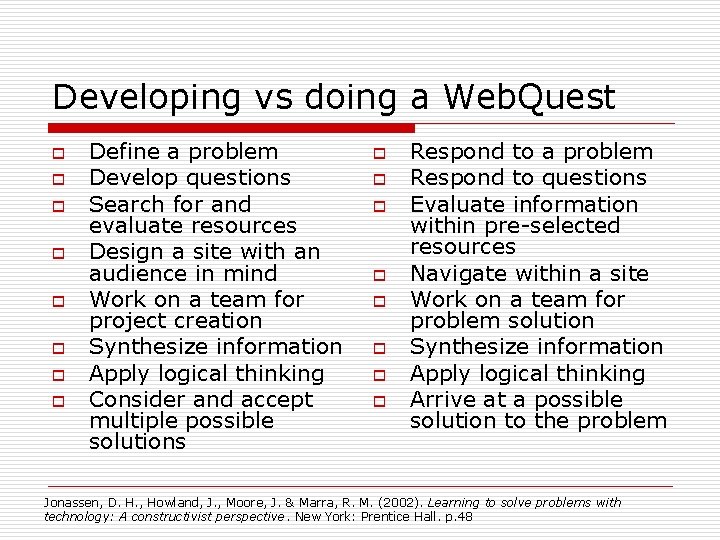
Developing vs doing a Web. Quest o o o o Define a problem Develop questions Search for and evaluate resources Design a site with an audience in mind Work on a team for project creation Synthesize information Apply logical thinking Consider and accept multiple possible solutions o o o o Respond to a problem Respond to questions Evaluate information within pre-selected resources Navigate within a site Work on a team for problem solution Synthesize information Apply logical thinking Arrive at a possible solution to the problem Jonassen, D. H. , Howland, J. , Moore, J. & Marra, R. M. (2002). Learning to solve problems with technology: A constructivist perspective. New York: Prentice Hall. p. 48
Learning resources o o o Web. Quest Workshop Web. Quest Collections Web. Quest Templates Web. Quest Taskonomy CUHK learning community
- Slides: 15