
WebBased Activity Guided Notes on Enzymes Go to

Web-Based Activity: Guided Notes on Enzymes Go to “Lew. Port enzymes” (first link on google) http: //www. lew-port. com/10712041113402793/lib/10712041113402793/Animations/Enzyme_activity. html Read aloud the blue text on each slide Use this info to fill in the Notes column on the back of your worksheet Then use the animations on the Enzyme Menu to fill in drawings or descriptions in the Evidence column We will do the first one together… You will work quietly w/ your assigned partner to Objectives for Class: complete the rest. � Describe what an enzyme does and how it works � Explain why an enzyme’s shape is so important
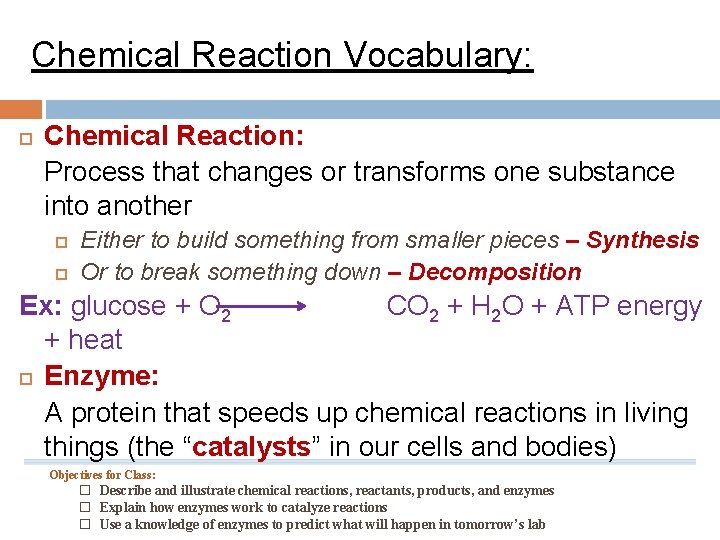
Chemical Reaction Vocabulary: Chemical Reaction: Process that changes or transforms one substance into another Either to build something from smaller pieces – Synthesis Or to break something down – Decomposition Ex: glucose + O 2 CO 2 + H 2 O + ATP energy + heat Enzyme: A protein that speeds up chemical reactions in living things (the “catalysts” in our cells and bodies) Objectives for Class: � Describe and illustrate chemical reactions, reactants, products, and enzymes � Explain how enzymes work to catalyze reactions � Use a knowledge of enzymes to predict what will happen in tomorrow’s lab
Chemical Reaction Vocabulary continued: Reactants: the starting materials in a chemical reaction (also known as substrates) Products: substances that are produced in the chemical reaction (the end result) Objectives for Class: � Describe and illustrate chemical reactions, reactants, products, and enzymes � Explain how enzymes work to catalyze reactions � Use a knowledge of enzymes to predict what will happen in tomorrow’s lab
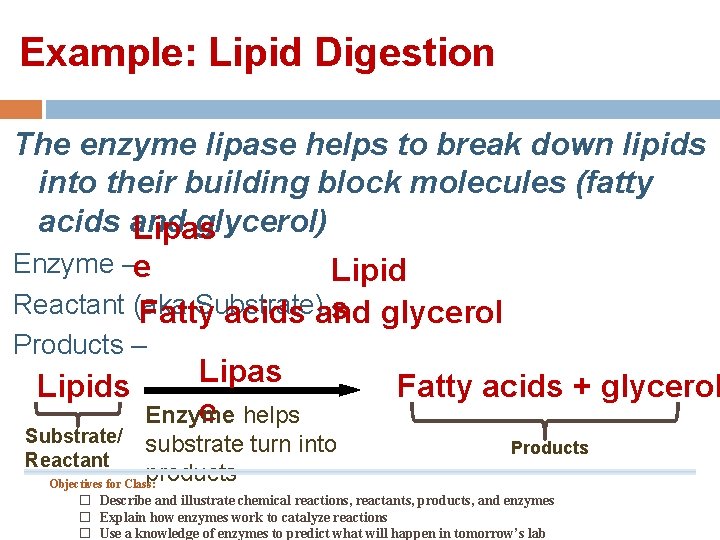
Example: Lipid Digestion The enzyme lipase helps to break down lipids into their building block molecules (fatty acids and glycerol) Lipas Enzyme –e Lipid Reactant (aka Substrate) – glycerol s Fatty acids and Products – Lipas Lipids e helps Enzyme Substrate/ Reactant substrate turn into products Objectives for Class: Fatty acids + glycerol Products � Describe and illustrate chemical reactions, reactants, products, and enzymes � Explain how enzymes work to catalyze reactions � Use a knowledge of enzymes to predict what will happen in tomorrow’s lab
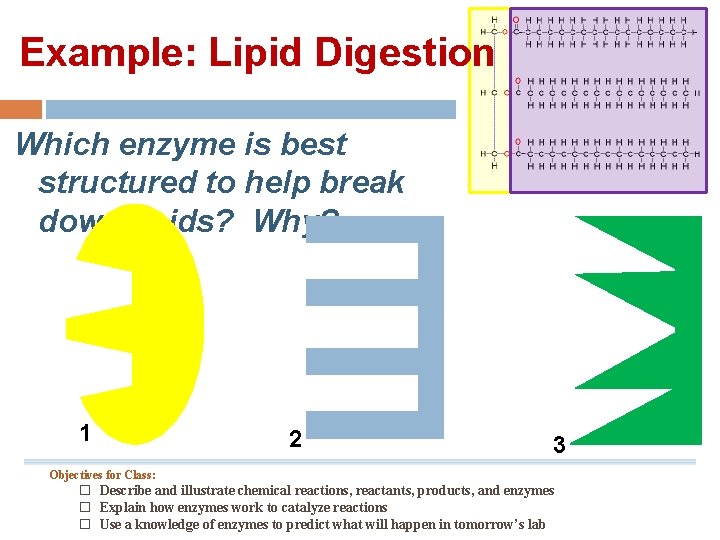
Example: Lipid Digestion Which enzyme is best structured to help break down lipids? Why? 1 2 3 Objectives for Class: � Describe and illustrate chemical reactions, reactants, products, and enzymes � Explain how enzymes work to catalyze reactions � Use a knowledge of enzymes to predict what will happen in tomorrow’s lab
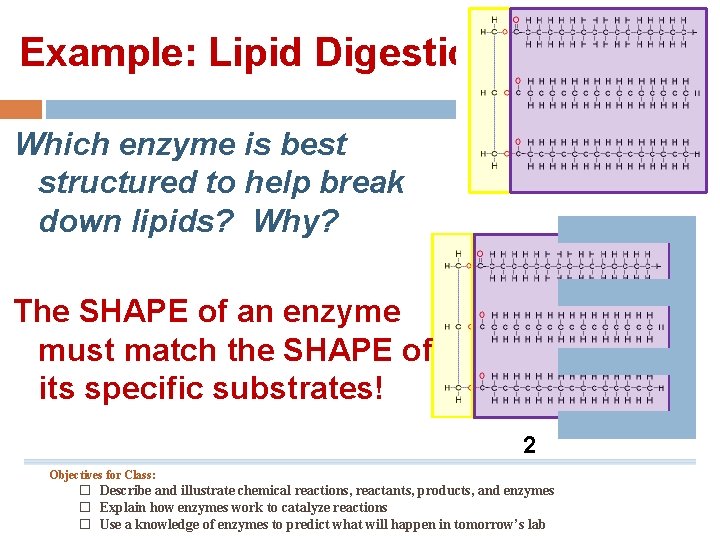
Example: Lipid Digestion Which enzyme is best structured to help break down lipids? Why? The SHAPE of an enzyme must match the SHAPE of its specific substrates! 2 Objectives for Class: � Describe and illustrate chemical reactions, reactants, products, and enzymes � Explain how enzymes work to catalyze reactions � Use a knowledge of enzymes to predict what will happen in tomorrow’s lab
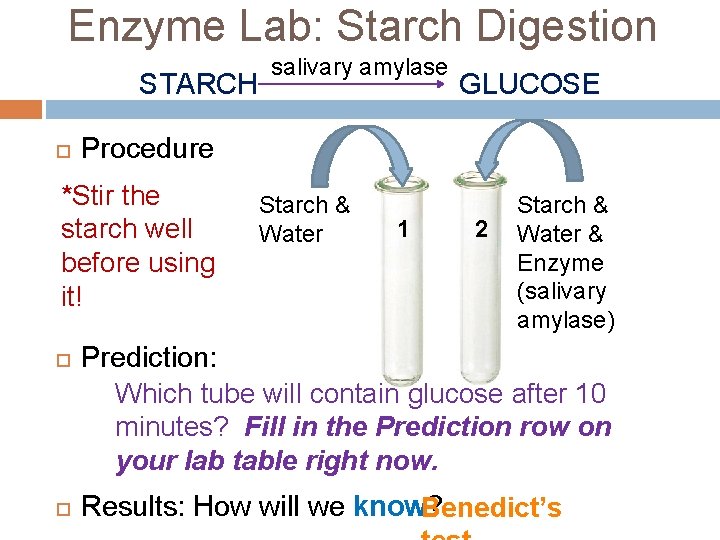
Enzyme Lab: Starch Digestion STARCH GLUCOSE Procedure *Stir the starch well before using it! salivary amylase Starch & Water 1 2 Starch & Water & Enzyme (salivary amylase) Prediction: Which tube will contain glucose after 10 minutes? Fill in the Prediction row on your lab table right now. Results: How will we know? Benedict’s
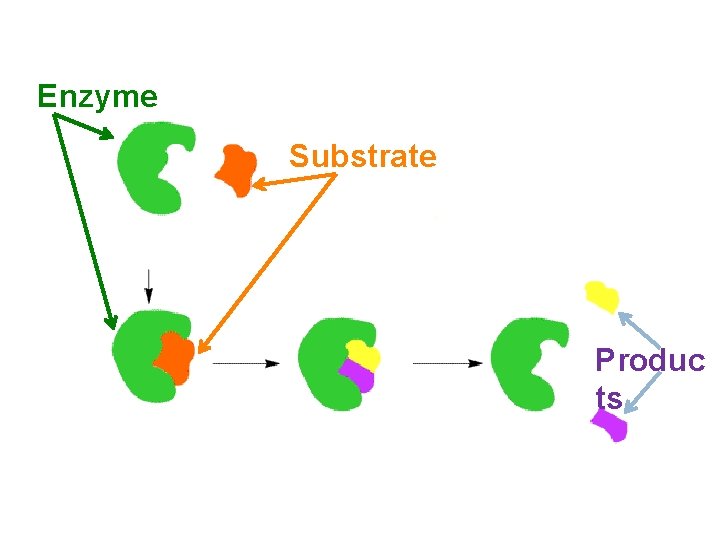
Enzyme Substrate Produc ts
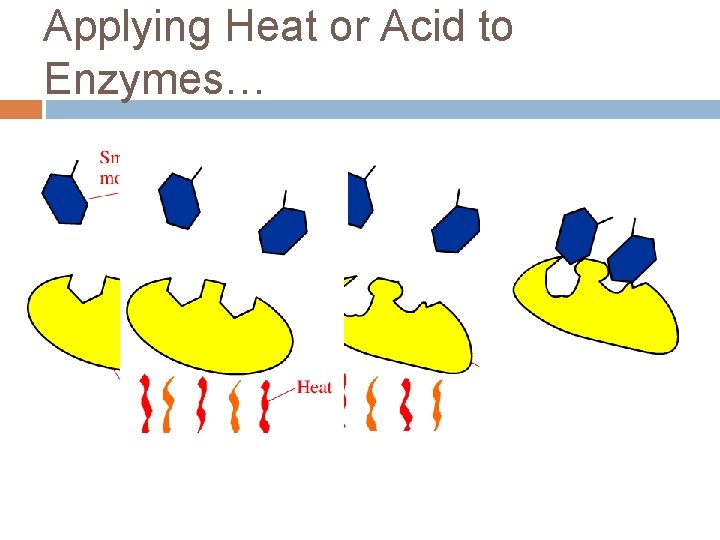
Applying Heat or Acid to Enzymes…
Denaturing Enzymes When an enzyme is denatured, it… Becomes misshapen and deformed Loses its original shape Becomes unable to speed up the reaction it is designed for, because its shape no longer matches its substrate
- Slides: 10