
Web Systems Technologies Chapter 5 PHP Functions and
Web Systems & Technologies Chapter 5 - PHP Functions and Objects 1
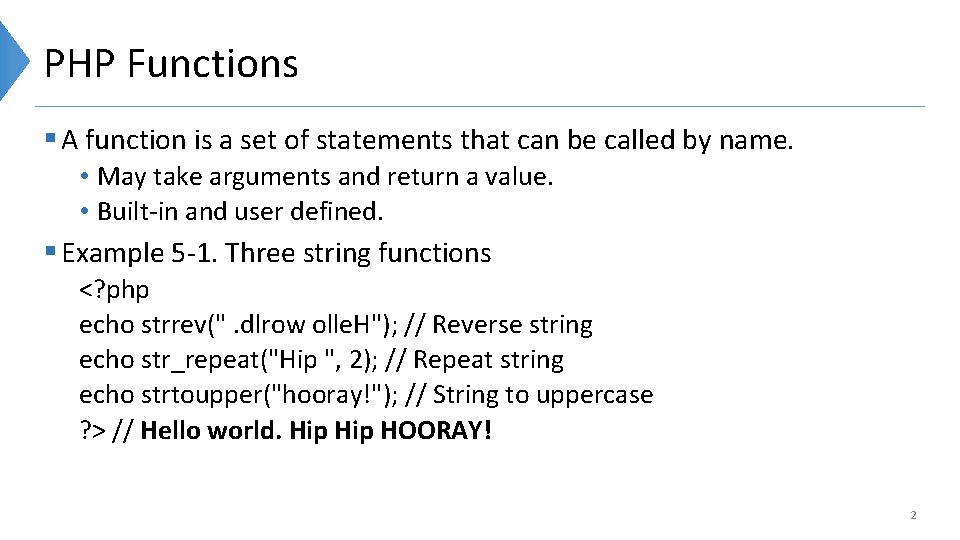
PHP Functions § A function is a set of statements that can be called by name. • May take arguments and return a value. • Built-in and user defined. § Example 5 -1. Three string functions <? php echo strrev(". dlrow olle. H"); // Reverse string echo str_repeat("Hip ", 2); // Repeat string echo strtoupper("hooray!"); // String to uppercase ? > // Hello world. Hip HOORAY! 2
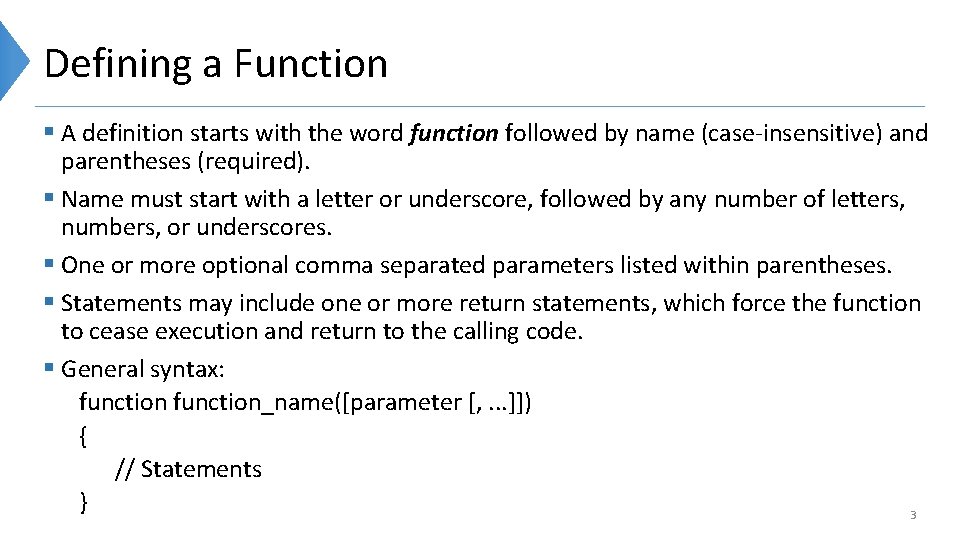
Defining a Function § A definition starts with the word function followed by name (case-insensitive) and parentheses (required). § Name must start with a letter or underscore, followed by any number of letters, numbers, or underscores. § One or more optional comma separated parameters listed within parentheses. § Statements may include one or more return statements, which force the function to cease execution and return to the calling code. § General syntax: function_name([parameter [, . . . ]]) { // Statements } 3
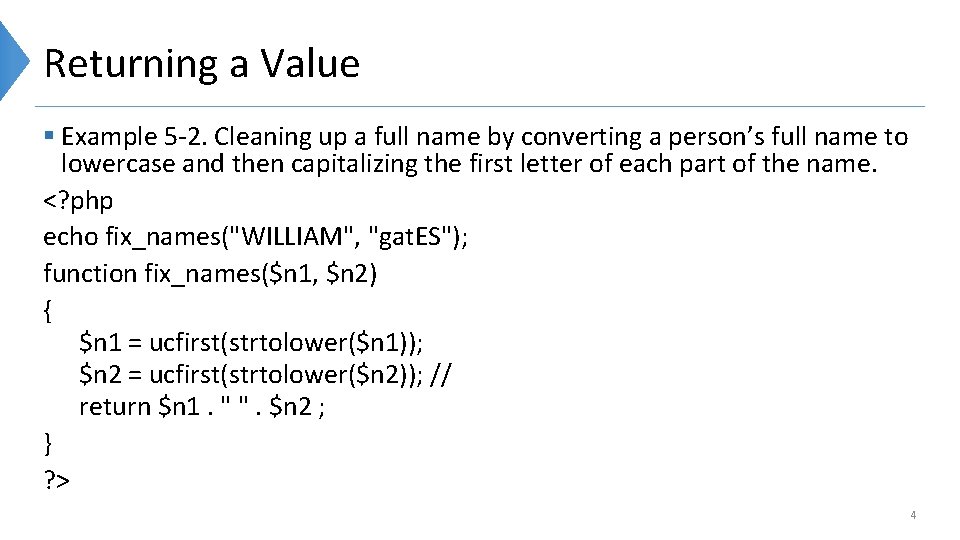
Returning a Value § Example 5 -2. Cleaning up a full name by converting a person’s full name to lowercase and then capitalizing the first letter of each part of the name. <? php echo fix_names("WILLIAM", "gat. ES"); function fix_names($n 1, $n 2) { $n 1 = ucfirst(strtolower($n 1)); $n 2 = ucfirst(strtolower($n 2)); // return $n 1. " ". $n 2 ; } ? > 4
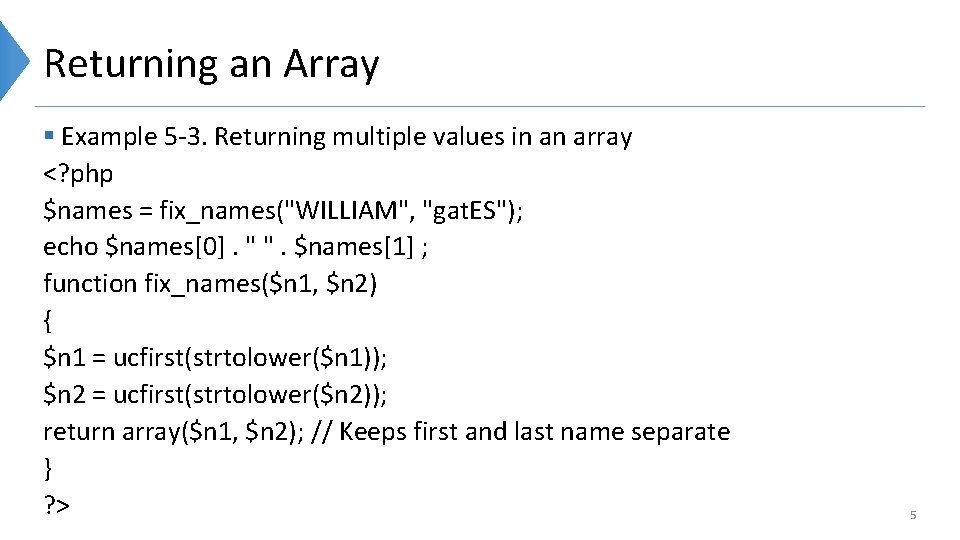
Returning an Array § Example 5 -3. Returning multiple values in an array <? php $names = fix_names("WILLIAM", "gat. ES"); echo $names[0]. " ". $names[1] ; function fix_names($n 1, $n 2) { $n 1 = ucfirst(strtolower($n 1)); $n 2 = ucfirst(strtolower($n 2)); return array($n 1, $n 2); // Keeps first and last name separate } ? > 5
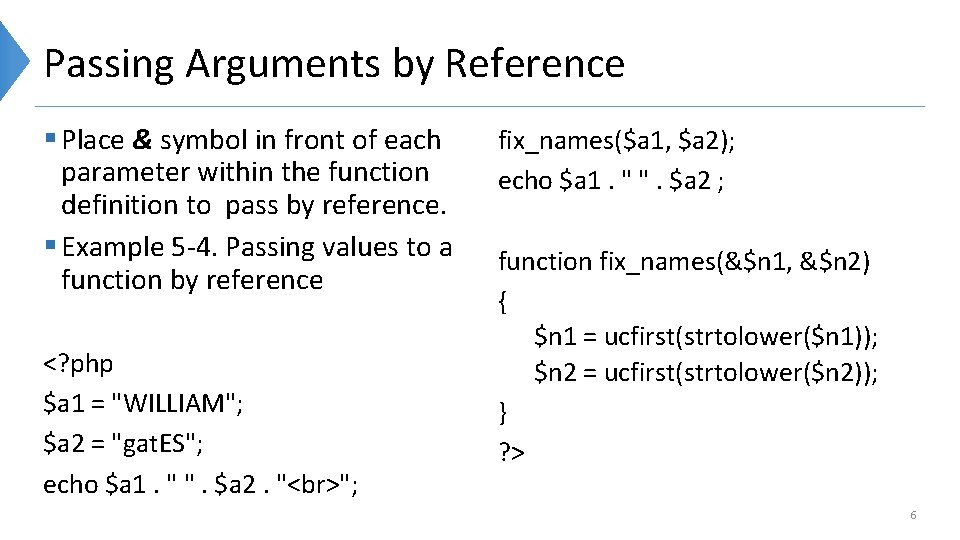
Passing Arguments by Reference § Place & symbol in front of each parameter within the function definition to pass by reference. § Example 5 -4. Passing values to a function by reference <? php $a 1 = "WILLIAM"; $a 2 = "gat. ES"; echo $a 1. " ". $a 2. " "; fix_names($a 1, $a 2); echo $a 1. " ". $a 2 ; function fix_names(&$n 1, &$n 2) { $n 1 = ucfirst(strtolower($n 1)); $n 2 = ucfirst(strtolower($n 2)); } ? > 6

Returning Global Variables § Example 5 -5. Returning values in global variables <? php $a 1 = "WILLIAM"; $a 2 = "gat. ES"; echo $a 1. " ". $a 2. " "; fix_names(); echo $a 1. " ". $a 2 ; function fix_names() { global $a 1; $a 1 = ucfirst(strtolower($a 1)); global $a 2; $a 2 = ucfirst(strtolower($a 2)); // Once declared global, these variables retain global access and are available to the rest of the program } ? > 7
Recap of Variable Scope § Local variables are accessible just from the part of your code where you define them. § Global variables are accessible from all parts of your code. § Static variables are accessible only within the function that declared them but retain their value over multiple calls. 8
Including and Requiring Files § The include Statement • Tells PHP to fetch a particular file and load all its contents. • Example 5 -6. Including a PHP file <? php include "library. php"; // Your code goes here ? > 9
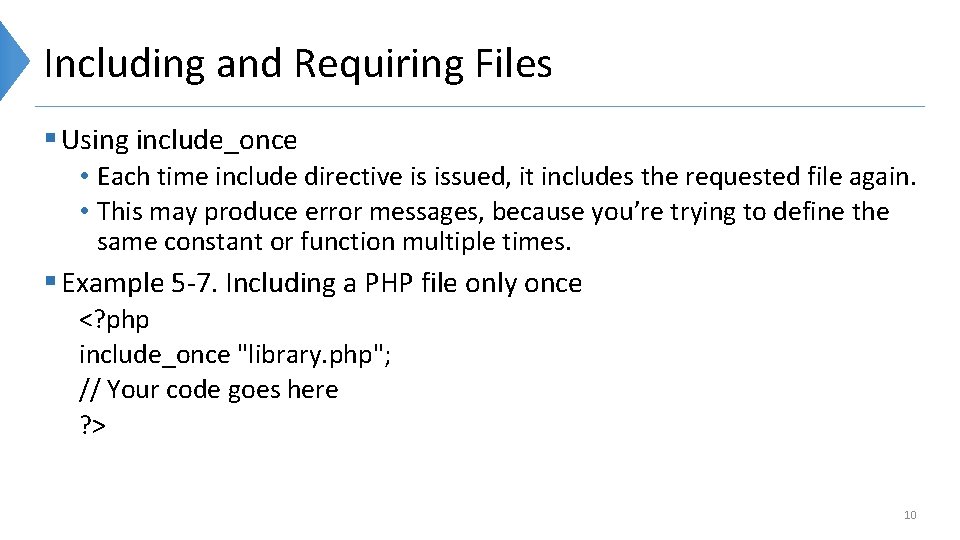
Including and Requiring Files § Using include_once • Each time include directive is issued, it includes the requested file again. • This may produce error messages, because you’re trying to define the same constant or function multiple times. § Example 5 -7. Including a PHP file only once <? php include_once "library. php"; // Your code goes here ? > 10
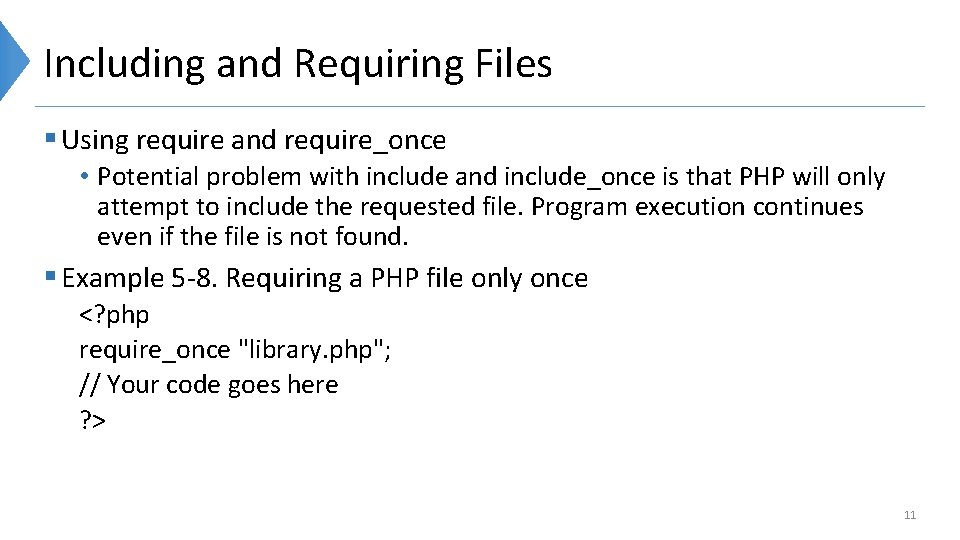
Including and Requiring Files § Using require and require_once • Potential problem with include and include_once is that PHP will only attempt to include the requested file. Program execution continues even if the file is not found. § Example 5 -8. Requiring a PHP file only once <? php require_once "library. php"; // Your code goes here ? > 11
PHP Objects § When creating a program to use objects, you need to design a composite of data and code called a class. § Objects based on class are called an instance(s) of that class. § The data associated with an object is called its properties and functions it uses are called methods. 12
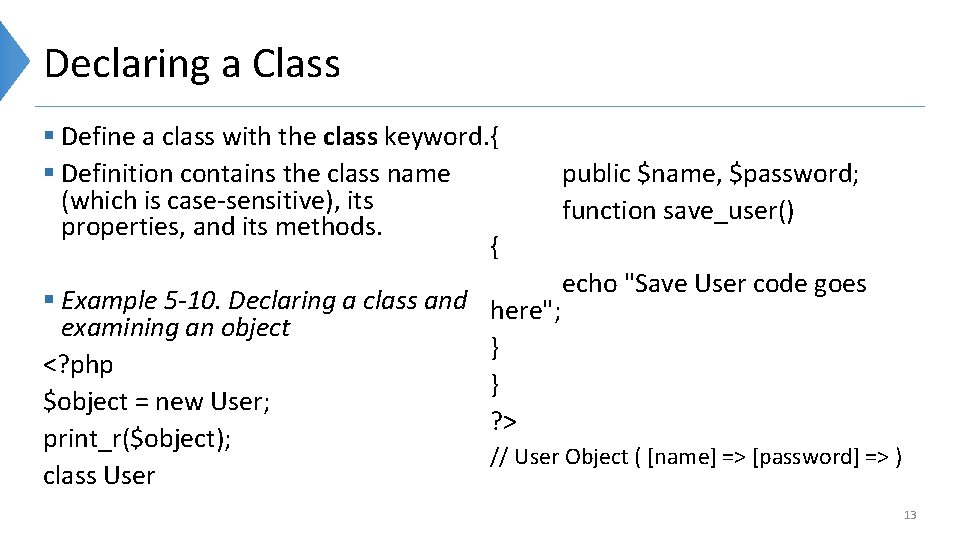
Declaring a Class § Define a class with the class keyword. { § Definition contains the class name (which is case-sensitive), its properties, and its methods. { § Example 5 -10. Declaring a class and examining an object <? php $object = new User; print_r($object); class User here"; } } ? > public $name, $password; function save_user() echo "Save User code goes // User Object ( [name] => [password] => ) 13
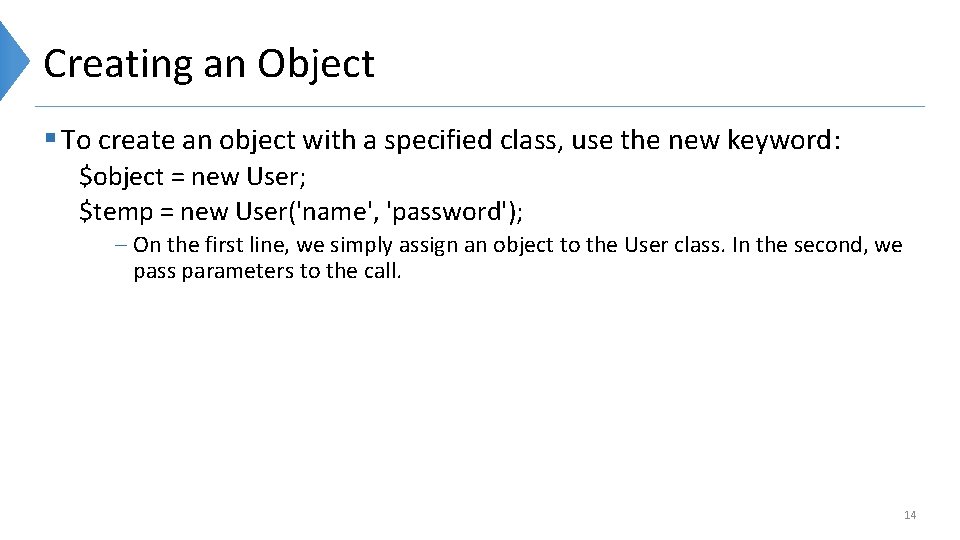
Creating an Object § To create an object with a specified class, use the new keyword: $object = new User; $temp = new User('name', 'password'); – On the first line, we simply assign an object to the User class. In the second, we pass parameters to the call. 14
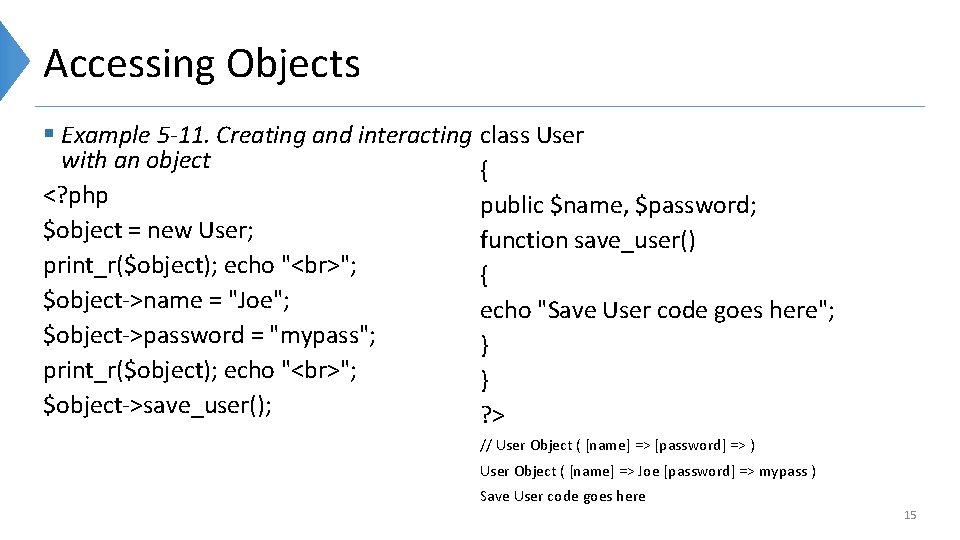
Accessing Objects § Example 5 -11. Creating and interacting class User with an object { <? php public $name, $password; $object = new User; function save_user() print_r($object); echo " "; { $object->name = "Joe"; echo "Save User code goes here"; $object->password = "mypass"; } print_r($object); echo " "; } $object->save_user(); ? > // User Object ( [name] => [password] => ) User Object ( [name] => Joe [password] => mypass ) Save User code goes here 15
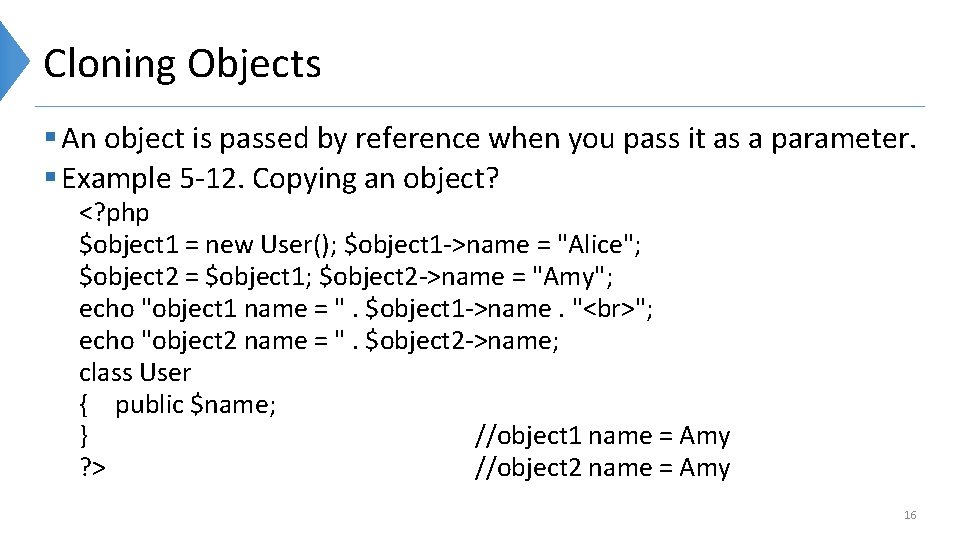
Cloning Objects § An object is passed by reference when you pass it as a parameter. § Example 5 -12. Copying an object? <? php $object 1 = new User(); $object 1 ->name = "Alice"; $object 2 = $object 1; $object 2 ->name = "Amy"; echo "object 1 name = ". $object 1 ->name. " "; echo "object 2 name = ". $object 2 ->name; class User { public $name; } //object 1 name = Amy ? > //object 2 name = Amy 16
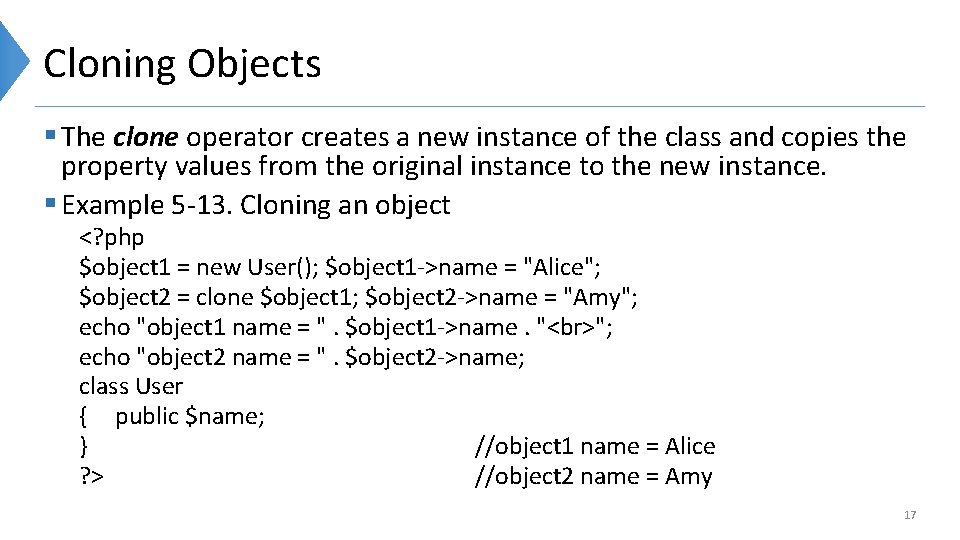
Cloning Objects § The clone operator creates a new instance of the class and copies the property values from the original instance to the new instance. § Example 5 -13. Cloning an object <? php $object 1 = new User(); $object 1 ->name = "Alice"; $object 2 = clone $object 1; $object 2 ->name = "Amy"; echo "object 1 name = ". $object 1 ->name. " "; echo "object 2 name = ". $object 2 ->name; class User { public $name; } //object 1 name = Alice ? > //object 2 name = Amy 17
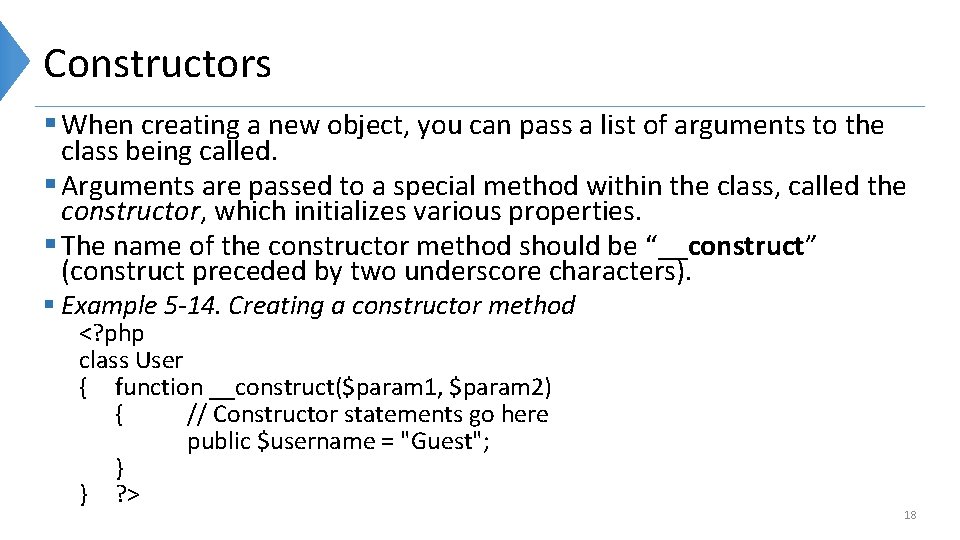
Constructors § When creating a new object, you can pass a list of arguments to the class being called. § Arguments are passed to a special method within the class, called the constructor, which initializes various properties. § The name of the constructor method should be “__construct” (construct preceded by two underscore characters). § Example 5 -14. Creating a constructor method <? php class User { function __construct($param 1, $param 2) { // Constructor statements go here public $username = "Guest"; } } ? > 18
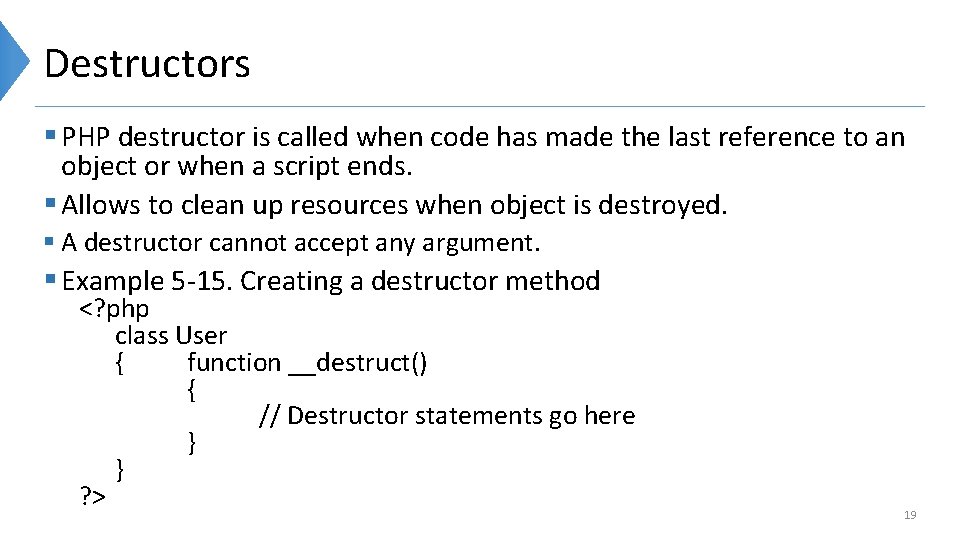
Destructors § PHP destructor is called when code has made the last reference to an object or when a script ends. § Allows to clean up resources when object is destroyed. § A destructor cannot accept any argument. § Example 5 -15. Creating a destructor method <? php class User { function __destruct() { // Destructor statements go here } } ? > 19
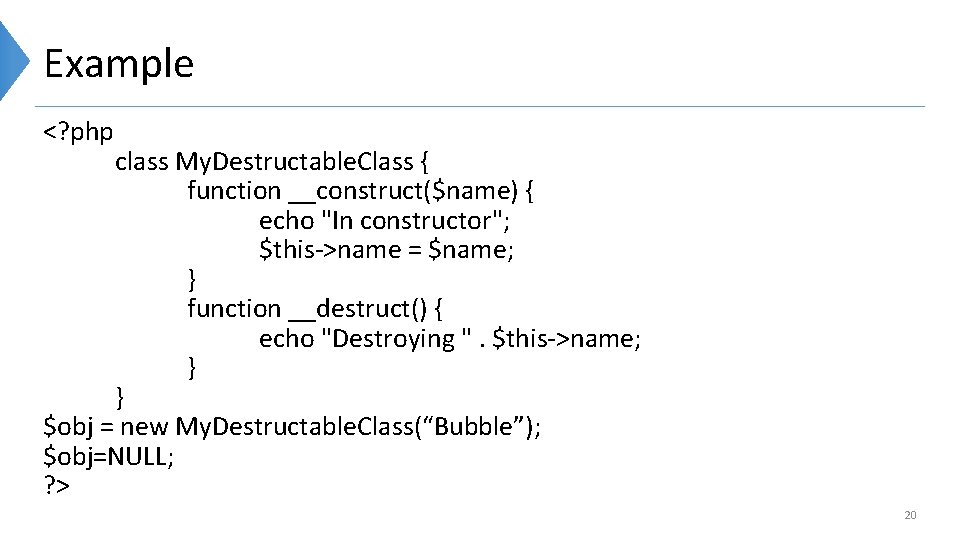
Example <? php class My. Destructable. Class { function __construct($name) { echo "In constructor"; $this->name = $name; } function __destruct() { echo "Destroying ". $this->name; } } $obj = new My. Destructable. Class(“Bubble”); $obj=NULL; ? > 20
Writing Methods § Declaring a method is similar to declaring a function. § Method names beginning with a double underscore (__) are reserved. § A special variable called $this is used to access the current object’s properties. 21
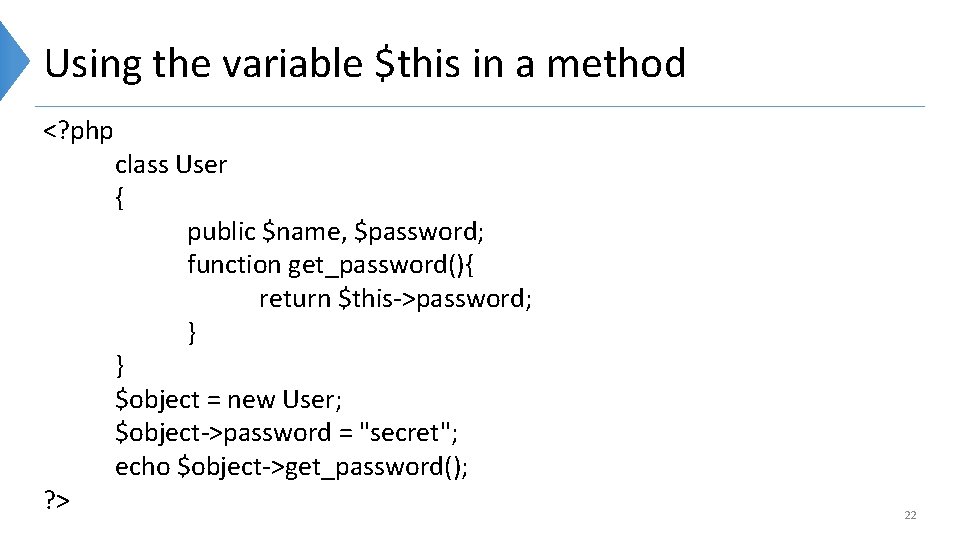
Using the variable $this in a method <? php ? > class User { public $name, $password; function get_password(){ return $this->password; } } $object = new User; $object->password = "secret"; echo $object->get_password(); 22
Static Methods § A static method is called on a class itself, not on an object. § A static method has no access to any object properties. § Call the class, along with the static method, using a double colon (: : scope resolution operator), not ->. § Static functions are useful for performing actions relating to the class itself, but not to specific instances of the class. 23
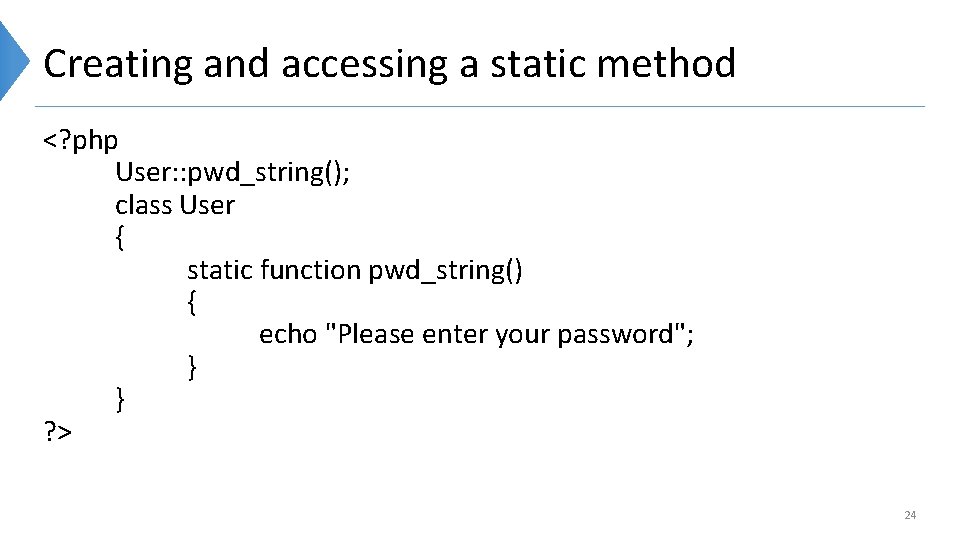
Creating and accessing a static method <? php User: : pwd_string(); class User { static function pwd_string() { echo "Please enter your password"; } } ? > 24
Declaring Properties § Properties within classes can be implicitly defined when first used. • PHP implicitly declares the variables for you. § Implicit declarations can lead to bugs that are difficult to discover, because name was declared from outside the class. § Always declare properties explicitly within classes. § A property within a class can be assigned a default value to it. § The value must be a constant and not the result of a function or expression. 25
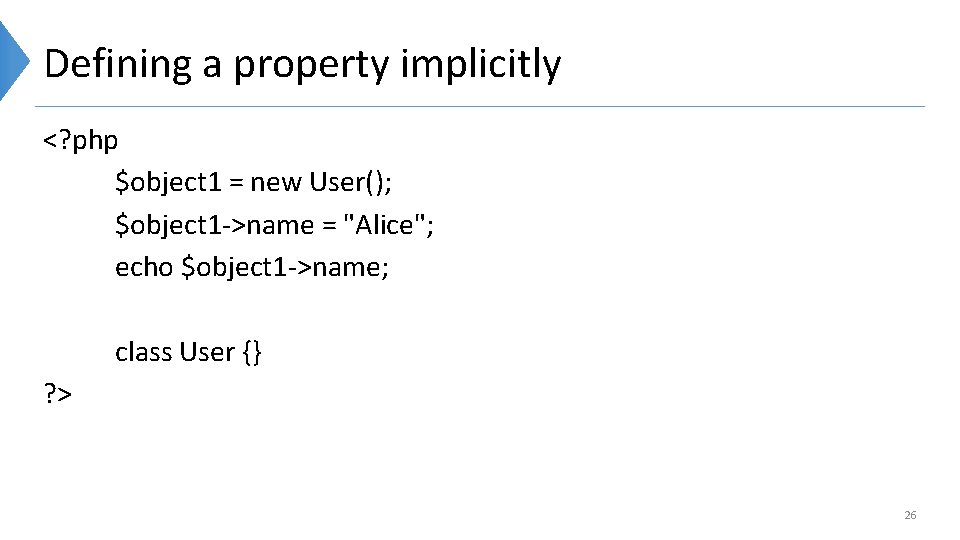
Defining a property implicitly <? php $object 1 = new User(); $object 1 ->name = "Alice"; echo $object 1 ->name; class User {} ? > 26
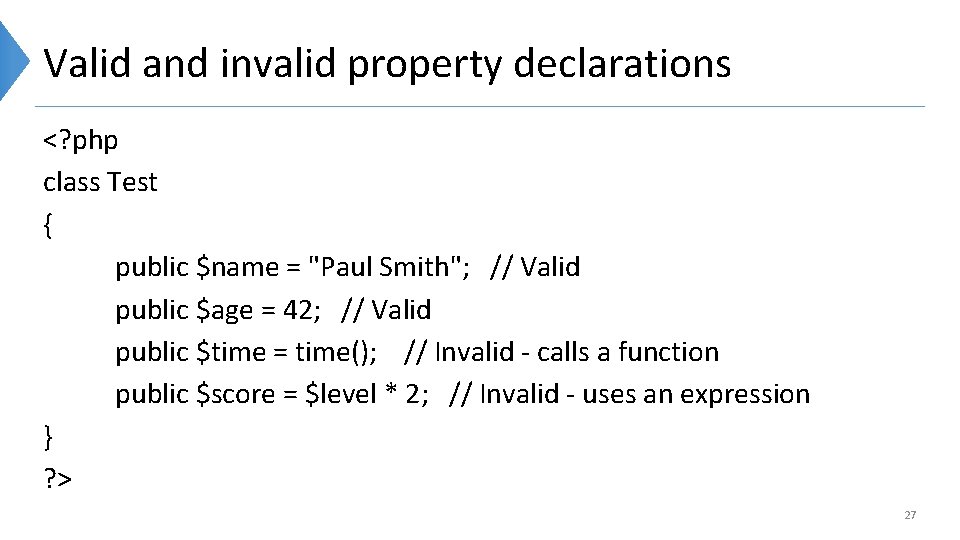
Valid and invalid property declarations <? php class Test { public $name = "Paul Smith"; // Valid public $age = 42; // Valid public $time = time(); // Invalid - calls a function public $score = $level * 2; // Invalid - uses an expression } ? > 27
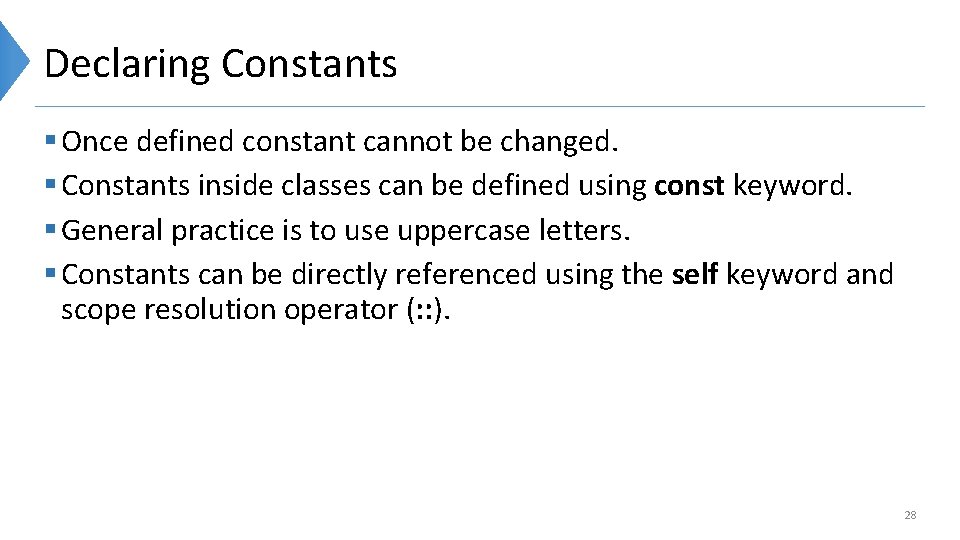
Declaring Constants § Once defined constant cannot be changed. § Constants inside classes can be defined using const keyword. § General practice is to use uppercase letters. § Constants can be directly referenced using the self keyword and scope resolution operator (: : ). 28
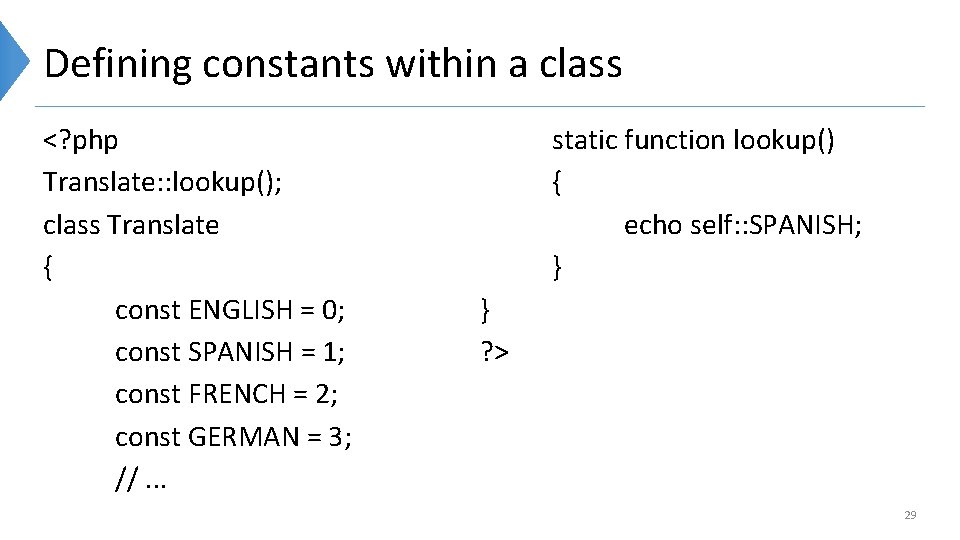
Defining constants within a class <? php Translate: : lookup(); class Translate { const ENGLISH = 0; const SPANISH = 1; const FRENCH = 2; const GERMAN = 3; //. . . static function lookup() { echo self: : SPANISH; } } ? > 29
Property and Method Scope § public • These properties are the default when you are declaring a variable or when a variable is implicitly declared the first time it is used. • Methods are assumed to be public by default. § protected • These properties and methods (members) can be referenced only by the object’s class methods and those of any subclasses. § private • These members can be referenced only by methods within the same class—not by subclasses. 30
Property and Method Scope § How to decide which to use: • Use public when outside code should access this member and extending classes should also inherit it. • Use protected when outside code should not access this member but extending classes should inherit it. • Use private when outside code should not access this member and extending classes also should not inherit it. 31
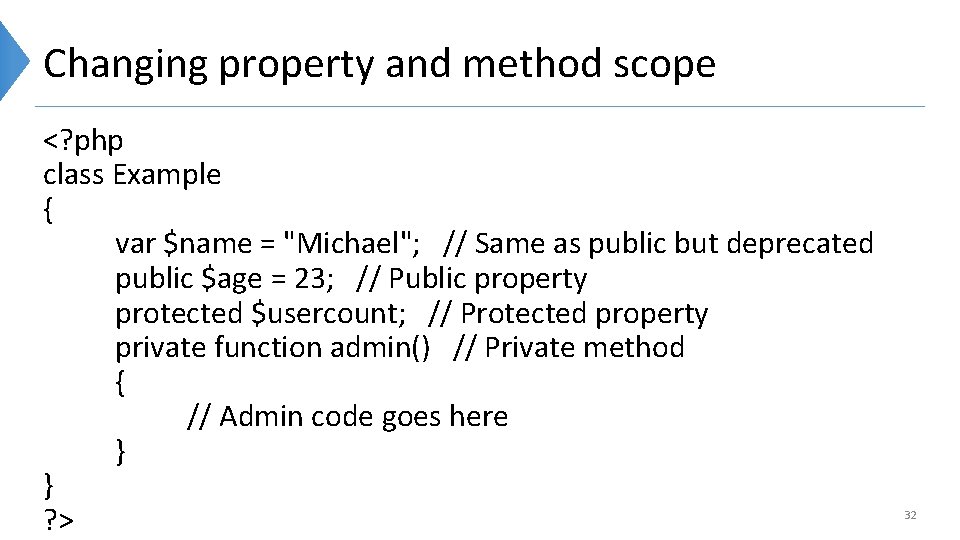
Changing property and method scope <? php class Example { var $name = "Michael"; // Same as public but deprecated public $age = 23; // Public property protected $usercount; // Protected property private function admin() // Private method { // Admin code goes here } } ? > 32
Static Properties and Methods § Most data and methods apply to instances of a class. § But occasionally you’ll want to maintain data about a whole class. • For instance, to report how many users are registered, you will store a variable that applies to the whole User class. § Declaring members of a class static makes them accessible without an instantiation of the class. § A property declared static cannot be directly accessed within an instance of a class, but a static method can. 33
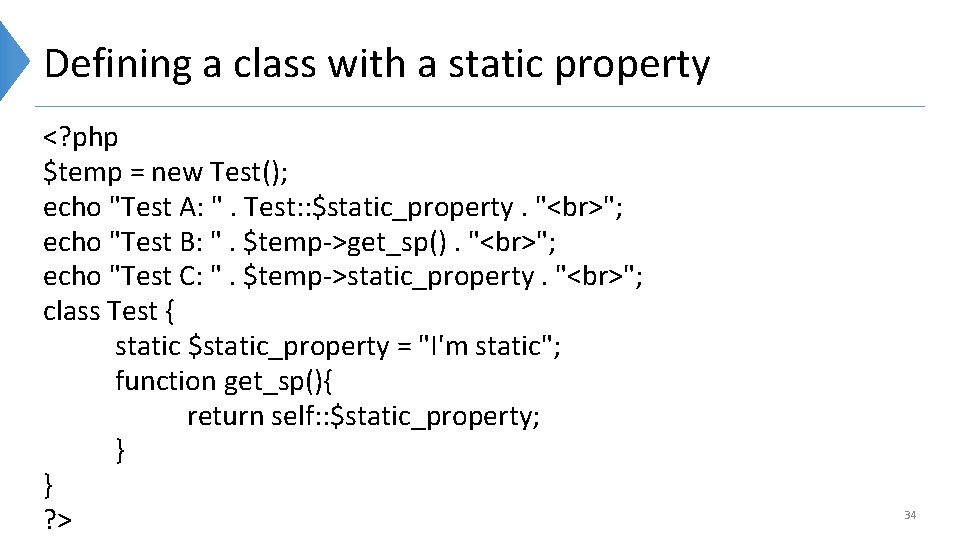
Defining a class with a static property <? php $temp = new Test(); echo "Test A: ". Test: : $static_property. " "; echo "Test B: ". $temp->get_sp(). " "; echo "Test C: ". $temp->static_property. " "; class Test { static $static_property = "I'm static"; function get_sp(){ return self: : $static_property; } } ? > 34
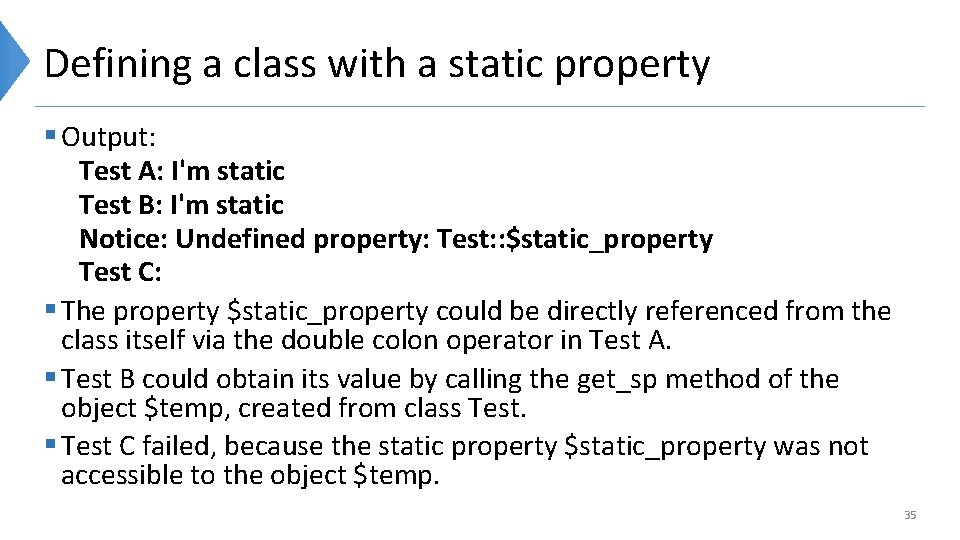
Defining a class with a static property § Output: Test A: I'm static Test B: I'm static Notice: Undefined property: Test: : $static_property Test C: § The property $static_property could be directly referenced from the class itself via the double colon operator in Test A. § Test B could obtain its value by calling the get_sp method of the object $temp, created from class Test. § Test C failed, because the static property $static_property was not accessible to the object $temp. 35
Inheritance § Once you have written a class, you can derive subclasses from it. § You can take a class similar to the one you need to write, extend it to a subclass, and just modify the parts that are different. You achieve this using the extends operator. § The final keyword can be used to prevent class inheritance. 36
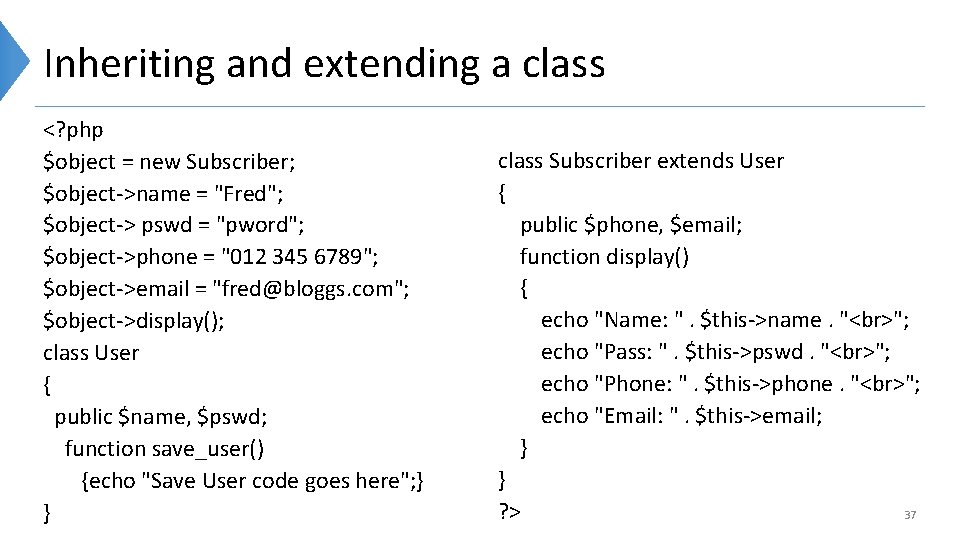
Inheriting and extending a class <? php $object = new Subscriber; $object->name = "Fred"; $object-> pswd = "pword"; $object->phone = "012 345 6789"; $object->email = "fred@bloggs. com"; $object->display(); class User { public $name, $pswd; function save_user() {echo "Save User code goes here"; } } class Subscriber extends User { public $phone, $email; function display() { echo "Name: ". $this->name. " "; echo "Pass: ". $this->pswd. " "; echo "Phone: ". $this->phone. " "; echo "Email: ". $this->email; } } ? > 37
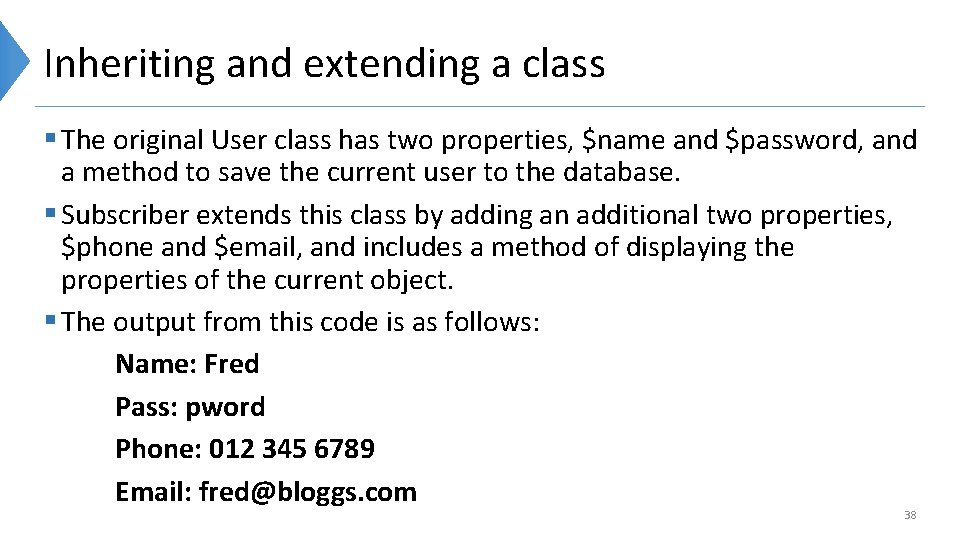
Inheriting and extending a class § The original User class has two properties, $name and $password, and a method to save the current user to the database. § Subscriber extends this class by adding an additional two properties, $phone and $email, and includes a method of displaying the properties of the current object. § The output from this code is as follows: Name: Fred Pass: pword Phone: 012 345 6789 Email: fred@bloggs. com 38
The parent operator § If you write a method in a subclass with the same name as one in its parent class, its statements will override those of the parent class. § Use the parent operator when you need to access the parent class method. 39
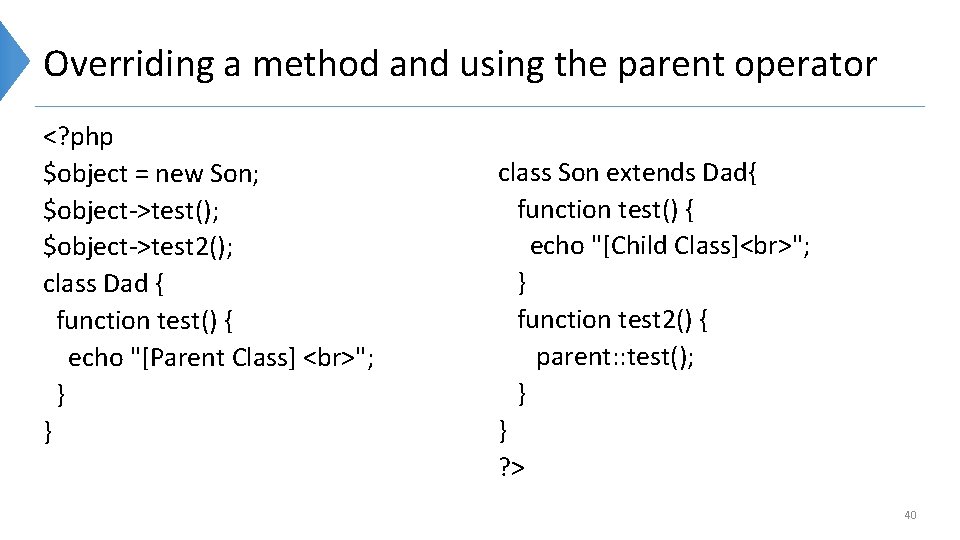
Overriding a method and using the parent operator <? php $object = new Son; $object->test(); $object->test 2(); class Dad { function test() { echo "[Parent Class] "; } } class Son extends Dad{ function test() { echo "[Child Class] "; } function test 2() { parent: : test(); } } ? > 40
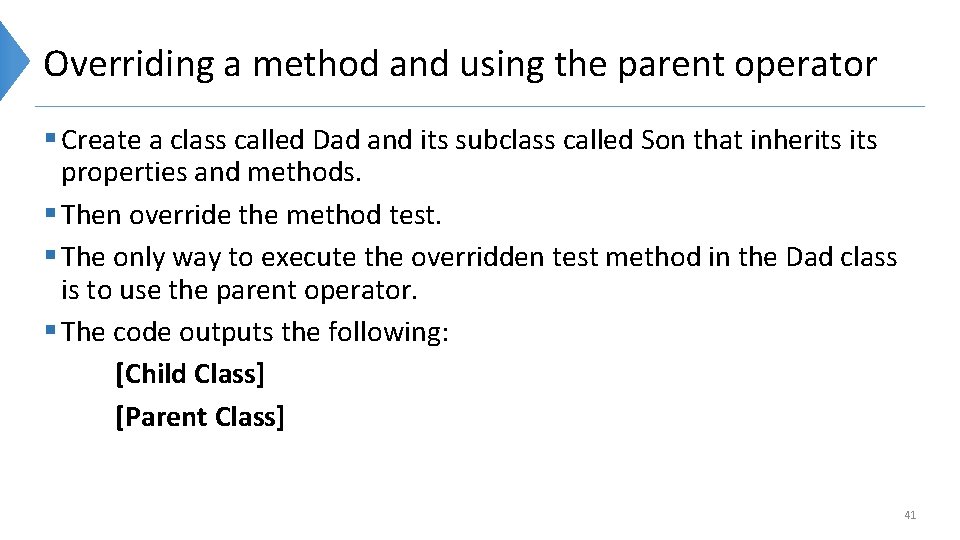
Overriding a method and using the parent operator § Create a class called Dad and its subclass called Son that inherits properties and methods. § Then override the method test. § The only way to execute the overridden test method in the Dad class is to use the parent operator. § The code outputs the following: [Child Class] [Parent Class] 41
Subclass constructors § PHP will not automatically call the constructor method of the parent class. § Subclasses should always call the parent constructors to execute all the initialization code. 42
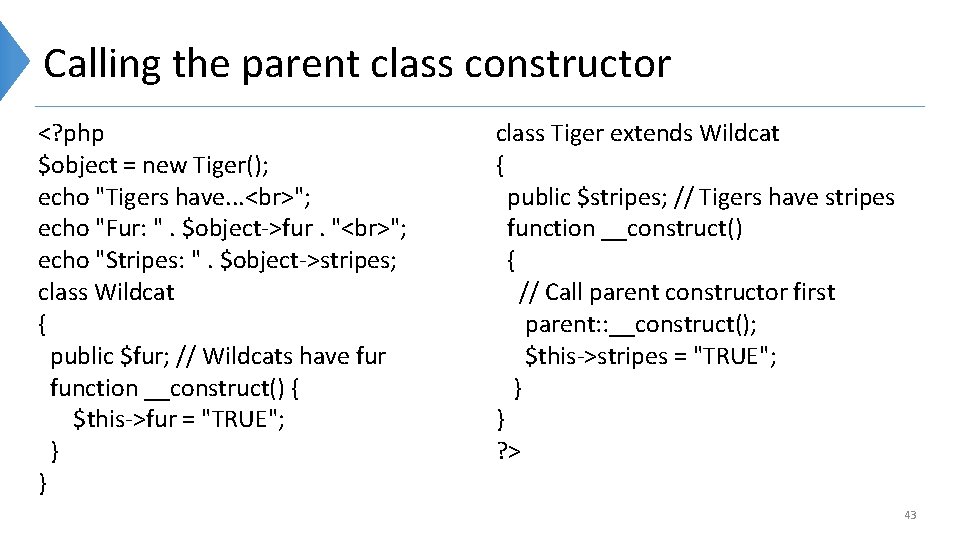
Calling the parent class constructor <? php $object = new Tiger(); echo "Tigers have. . . "; echo "Fur: ". $object->fur. " "; echo "Stripes: ". $object->stripes; class Wildcat { public $fur; // Wildcats have fur function __construct() { $this->fur = "TRUE"; } } class Tiger extends Wildcat { public $stripes; // Tigers have stripes function __construct() { // Call parent constructor first parent: : __construct(); $this->stripes = "TRUE"; } } ? > 43
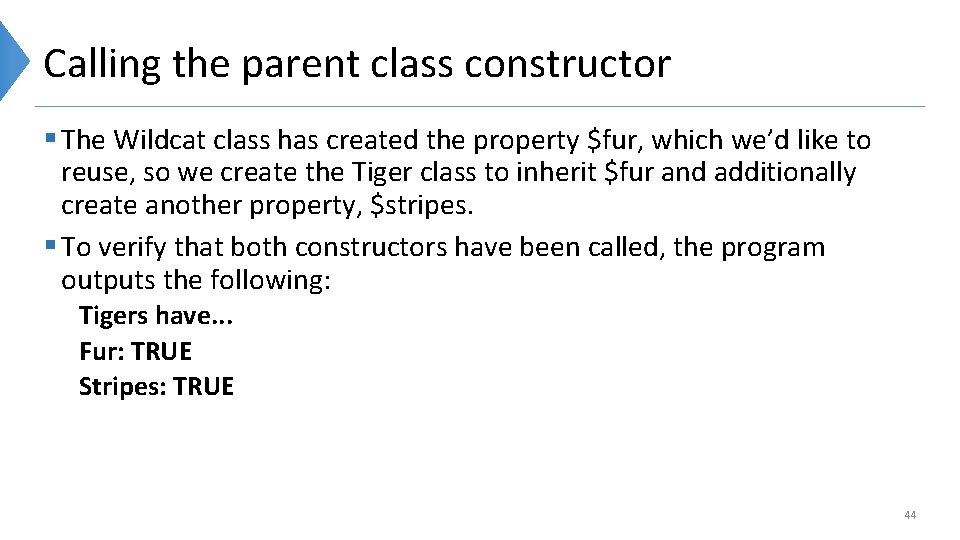
Calling the parent class constructor § The Wildcat class has created the property $fur, which we’d like to reuse, so we create the Tiger class to inherit $fur and additionally create another property, $stripes. § To verify that both constructors have been called, the program outputs the following: Tigers have. . . Fur: TRUE Stripes: TRUE 44
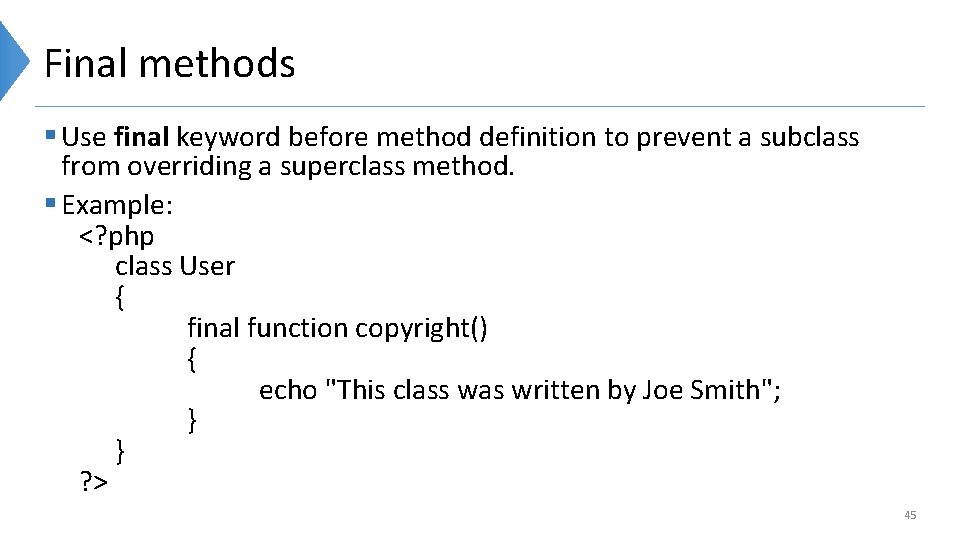
Final methods § Use final keyword before method definition to prevent a subclass from overriding a superclass method. § Example: <? php class User { final function copyright() { echo "This class was written by Joe Smith"; } } ? > 45
- Slides: 45