
Web Services Based partially on Sun Java Tutorial
Web Services Based partially on Sun Java Tutorial at http: //java. sun. com/webservices/ Also, XML, Java and the Future of The Web, Jon Bosak. And WSDL Tutorial at: http: //www. w 3 schools. com/wsdl/ Netprog 2002 - HTTP
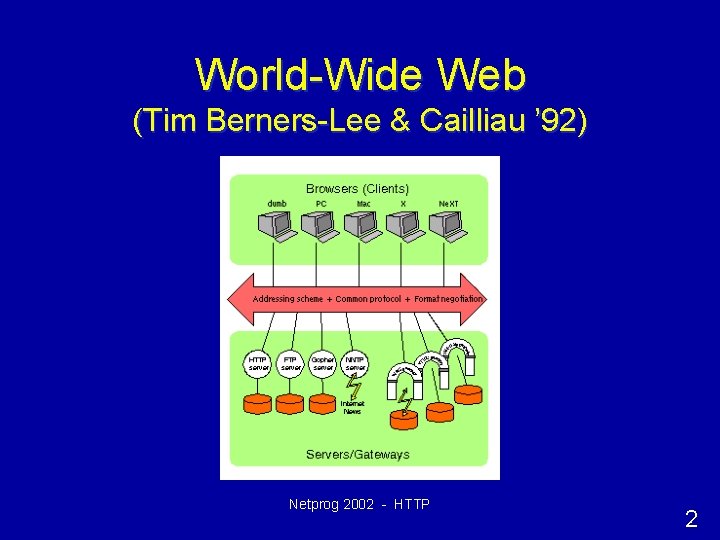
World-Wide Web (Tim Berners-Lee & Cailliau ’ 92) Netprog 2002 - HTTP 2
Topics • • What are Web Services? XML – Extensible Markup Language WSDL – Web Service Definition Language Java APIs for Web Services – – XML Processing XML Messaging (SOAP) XML Registries XML-based RPC (SOAP) Netprog 2002 - HTTP 3
What are Web Services? • Services available via the Web. • Meant mainly for application to application communication (as opposed to users directly) – Enables Business-to-Business transactions. – Toward a “Semantic Web”. • E. g. , a web service is contacted on a URL using the SOAP protocol over HTTP. Netprog 2002 - HTTP 4
Web Service Examples • A stock quote service. – An application requires the current value of a stock, the web service returns it. • A route finder for delivery of goods. – Given an initial and a final location, find the most cost-effective delivery route. • A weather service, a map service, a web search service… – any composition of Web services. Netprog 2002 - HTTP 5

HTML Limitations Lack of Extensibility No new tags/attributes allowed. Fixed Tag Structure Emphasis on presentation in markup. No Validation No data-checking or types. In contrast to SGML (Standard Generalized Markup Language). But SGML is too complex to be appealing. So, XML comes to the rescue. Netprog 2002 - HTTP 6
What is XML? • Extensible Markup Language. • HTML++, SGML--. • Document Type Definitions (DTD) precisely define valid tags and their grammar. • Not backward compatible with HTML. • System-independent and vendor-independent. • Product of the World Wide Web Consortium (W 3 C), trademarked by MIT. Netprog 2002 - HTTP 7
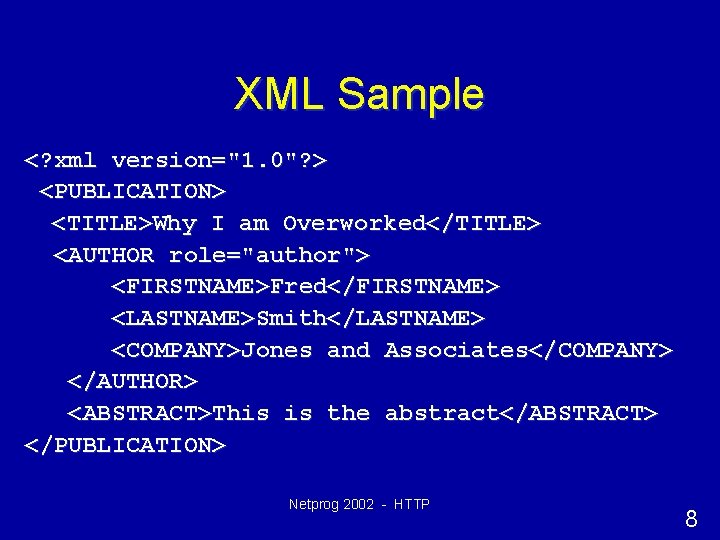
XML Sample <? xml version="1. 0"? > <PUBLICATION> <TITLE>Why I am Overworked</TITLE> <AUTHOR role="author"> <FIRSTNAME>Fred</FIRSTNAME> <LASTNAME>Smith</LASTNAME> <COMPANY>Jones and Associates</COMPANY> </AUTHOR> <ABSTRACT>This is the abstract</ABSTRACT> </PUBLICATION> Netprog 2002 - HTTP 8
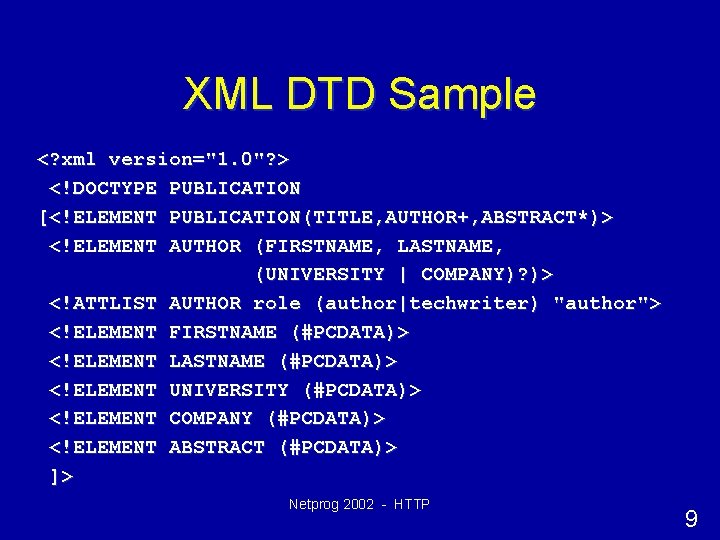
XML DTD Sample <? xml version="1. 0"? > <!DOCTYPE PUBLICATION [<!ELEMENT PUBLICATION(TITLE, AUTHOR+, ABSTRACT*)> <!ELEMENT AUTHOR (FIRSTNAME, LASTNAME, (UNIVERSITY | COMPANY)? )> <!ATTLIST AUTHOR role (author|techwriter) "author"> <!ELEMENT FIRSTNAME (#PCDATA)> <!ELEMENT LASTNAME (#PCDATA)> <!ELEMENT UNIVERSITY (#PCDATA)> <!ELEMENT COMPANY (#PCDATA)> <!ELEMENT ABSTRACT (#PCDATA)> ]> Netprog 2002 - HTTP 9
What Makes XML Portable? • The schema (DTD) is associated with a document which allows to perform validation on the document. • Human-readable/writable. • Independent of presentation (formatting). Netprog 2002 - HTTP 10
Syntactic vs Semantic Interoperability • While XML is portable, communicating parties still need to agree on: – Document type definitions – Meaning of tags – “Operations” on data (interfaces). – Meaning of those operations. • Semantic interoperability is still a problem! Netprog 2002 - HTTP 11
What is WSDL? • • Web Services Description Language WSDL is written in XML WSDL is an XML document WSDL is used to describe Web services – What operations does the service expose? • WSDL is also used to locate Web services – Where is the web service located? Netprog 2002 - HTTP 12
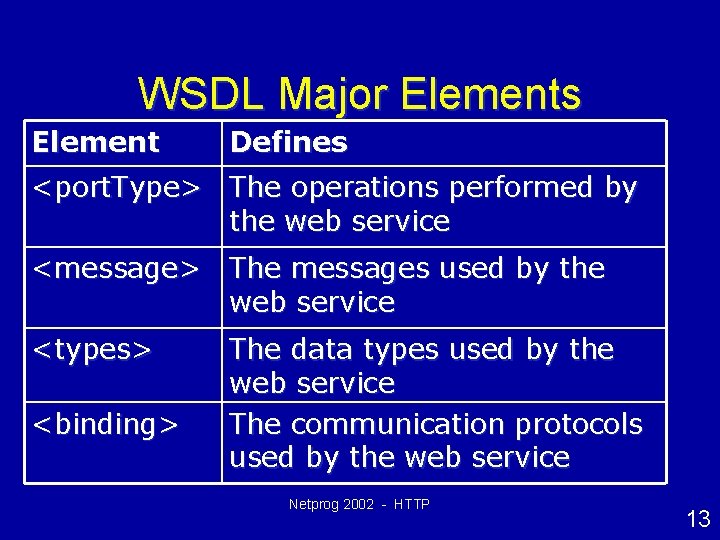
WSDL Major Elements Element Defines <port. Type> The operations performed by the web service <message> The messages used by the web service <types> <binding> The data types used by the web service The communication protocols used by the web service Netprog 2002 - HTTP 13
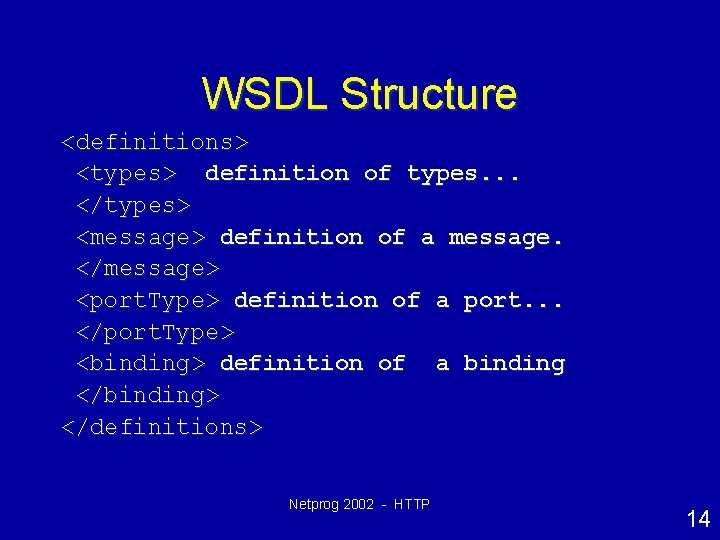
WSDL Structure <definitions> <types> definition of types. . . </types> <message> definition of a message. </message> <port. Type> definition of a port. . . </port. Type> <binding> definition of a binding </binding> </definitions> Netprog 2002 - HTTP 14
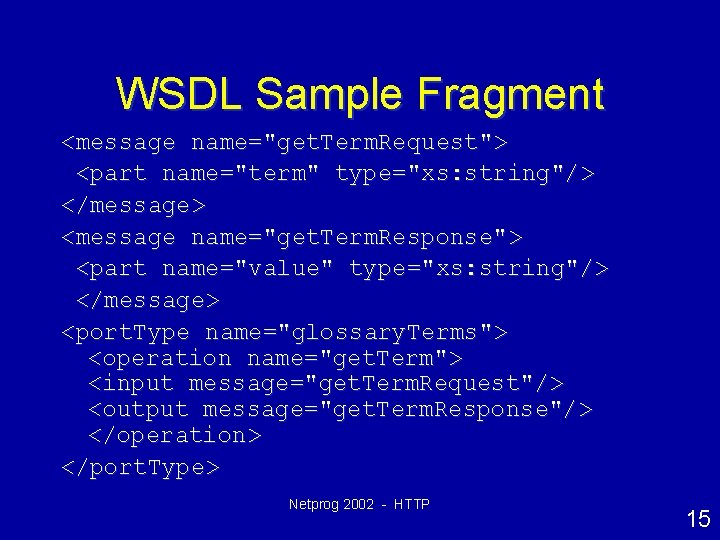
WSDL Sample Fragment <message name="get. Term. Request"> <part name="term" type="xs: string"/> </message> <message name="get. Term. Response"> <part name="value" type="xs: string"/> </message> <port. Type name="glossary. Terms"> <operation name="get. Term"> <input message="get. Term. Request"/> <output message="get. Term. Response"/> </operation> </port. Type> Netprog 2002 - HTTP 15
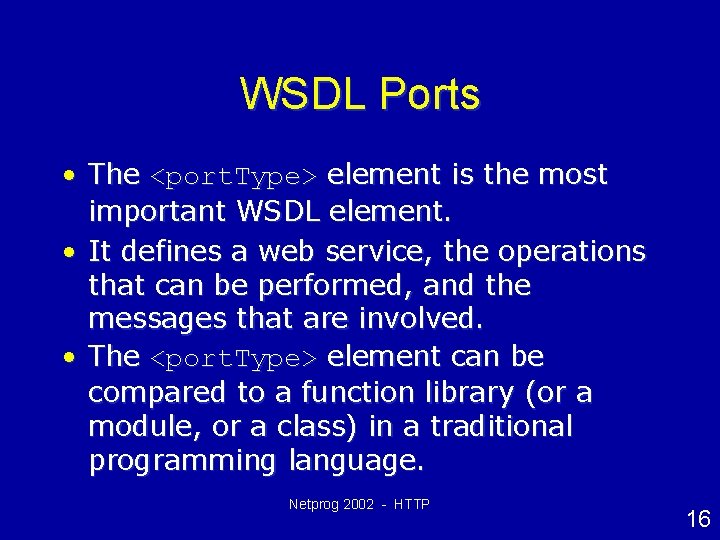
WSDL Ports • The <port. Type> element is the most important WSDL element. • It defines a web service, the operations that can be performed, and the messages that are involved. • The <port. Type> element can be compared to a function library (or a module, or a class) in a traditional programming language. Netprog 2002 - HTTP 16
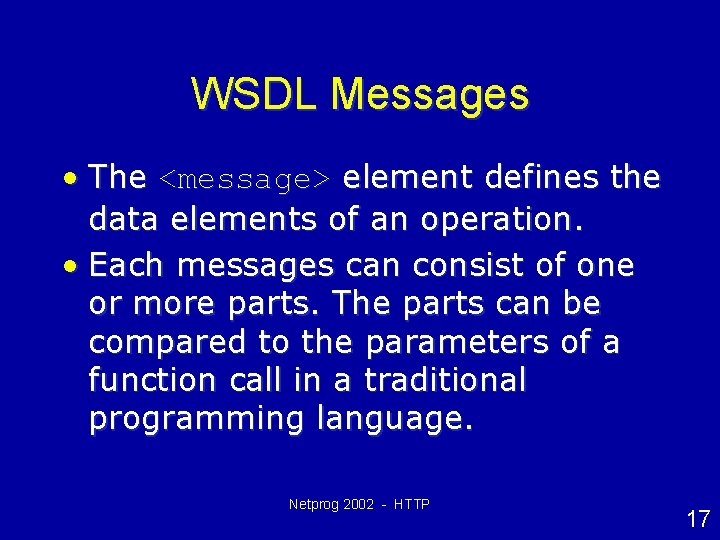
WSDL Messages • The <message> element defines the data elements of an operation. • Each messages can consist of one or more parts. The parts can be compared to the parameters of a function call in a traditional programming language. Netprog 2002 - HTTP 17
WSDL Types • The <types> element defines the data type that are used by the web service. • For maximum platform neutrality, WSDL uses XML Schema syntax to define data types. Netprog 2002 - HTTP 18
WSDL Bindings • The <binding> element defines the message format and protocol details for each port. Netprog 2002 - HTTP 19
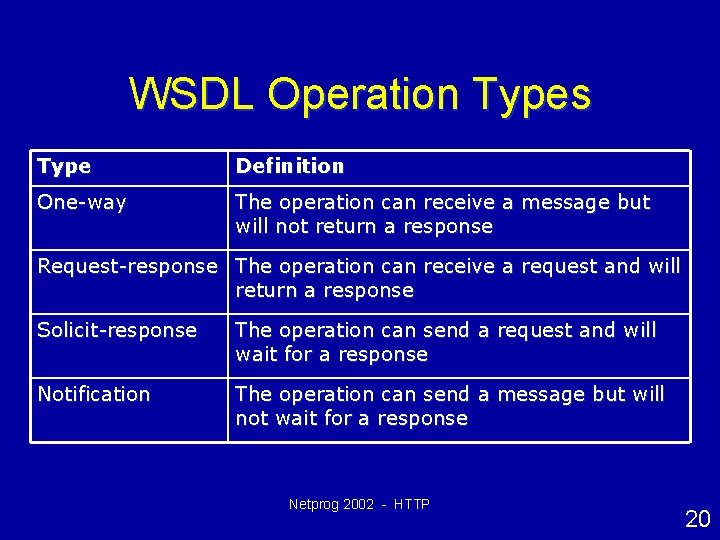
WSDL Operation Types Type Definition One-way The operation can receive a message but will not return a response Request-response The operation can receive a request and will return a response Solicit-response The operation can send a request and will wait for a response Notification The operation can send a message but will not wait for a response Netprog 2002 - HTTP 20
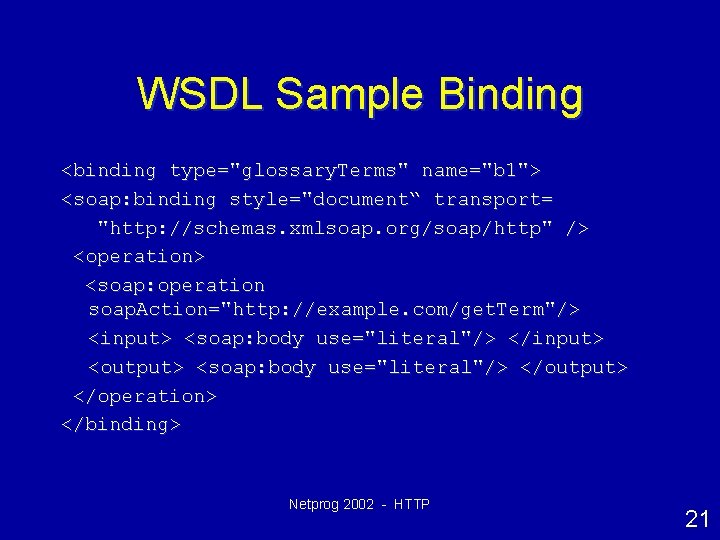
WSDL Sample Binding <binding type="glossary. Terms" name="b 1"> <soap: binding style="document“ transport= "http: //schemas. xmlsoap. org/soap/http" /> <operation> <soap: operation soap. Action="http: //example. com/get. Term"/> <input> <soap: body use="literal"/> </input> <output> <soap: body use="literal"/> </output> </operation> </binding> Netprog 2002 - HTTP 21
Java APIs for XML • JAXP -- Java API for XML Processing – processes XML documents using various parsers • JAX-RPC -- Java API for XML-based RPC – sends SOAP method calls to remote parties over the Internet and receives the results • JAXM -- Java API for XML Messaging – sends SOAP messages over the Internet • JAXR -- Java API for XML Registries – provides a standard way to access business registries and share information Netprog 2002 - HTTP 22
JAX-RPC and SOAP • • • JAX-RPC -- Java API for XML-based RPC. SOAP – Simple Object Access Protocol In JAX-RPC, a remote procedure call is represented by an XML-based protocol such as SOAP. The SOAP specification defines envelope structure, encoding rules, and a convention for representing remote procedure calls and responses. These calls and responses are transmitted as SOAP messages over HTTP. Netprog 2002 - HTTP 23
JAX-RPC -- SOAP • JAX-RPC hides this complexity from the application developer. • On the server side, the developer specifies the remote procedures by defining methods in an interface. • The developer also codes one or more classes that implement those methods. • Client programs create a proxy, a local object representing the service, and then simply invokes methods on the proxy. Netprog 2002 - HTTP 24
JAX-RPC -- Java API for XML -based RPC • A JAX-RPC client can access a Web service that is not running on the Java platform and vice versa. • This flexibility is possible because JAXRPC uses technologies defined by the World Wide Web Consortium (W 3 C): HTTP, SOAP, and WSDL. Netprog 2002 - HTTP 25
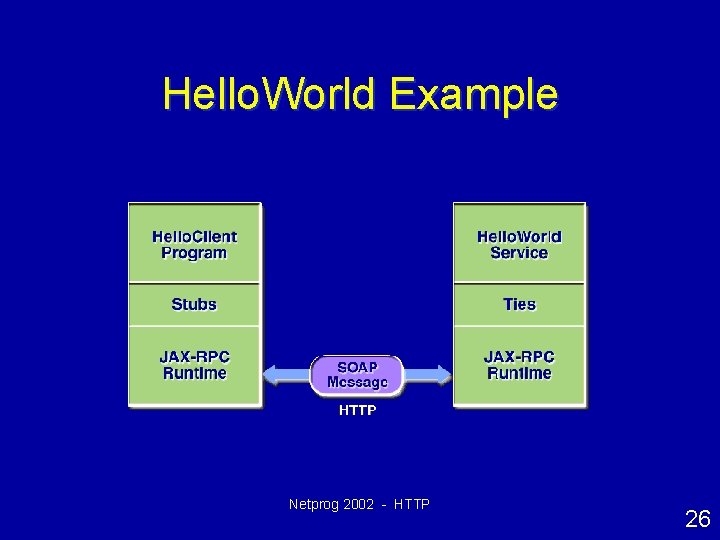
Hello. World Example Netprog 2002 - HTTP 26
Downloading and Running the Hello. World Example • Detailed instructions for running the Hello. World example can be found at: http: //java. sun. com/webservices/docs/1. 0/ tutorial/doc/JAXRPC 3. html Netprog 2002 - HTTP 27
- Slides: 27