
Web Services and Application Programming Interfaces SI 539
Web Services and Application Programming Interfaces SI 539 - Charles Severance
Service Oriented Approach http: //en. wikipedia. org/wiki/Service-oriented_architecture
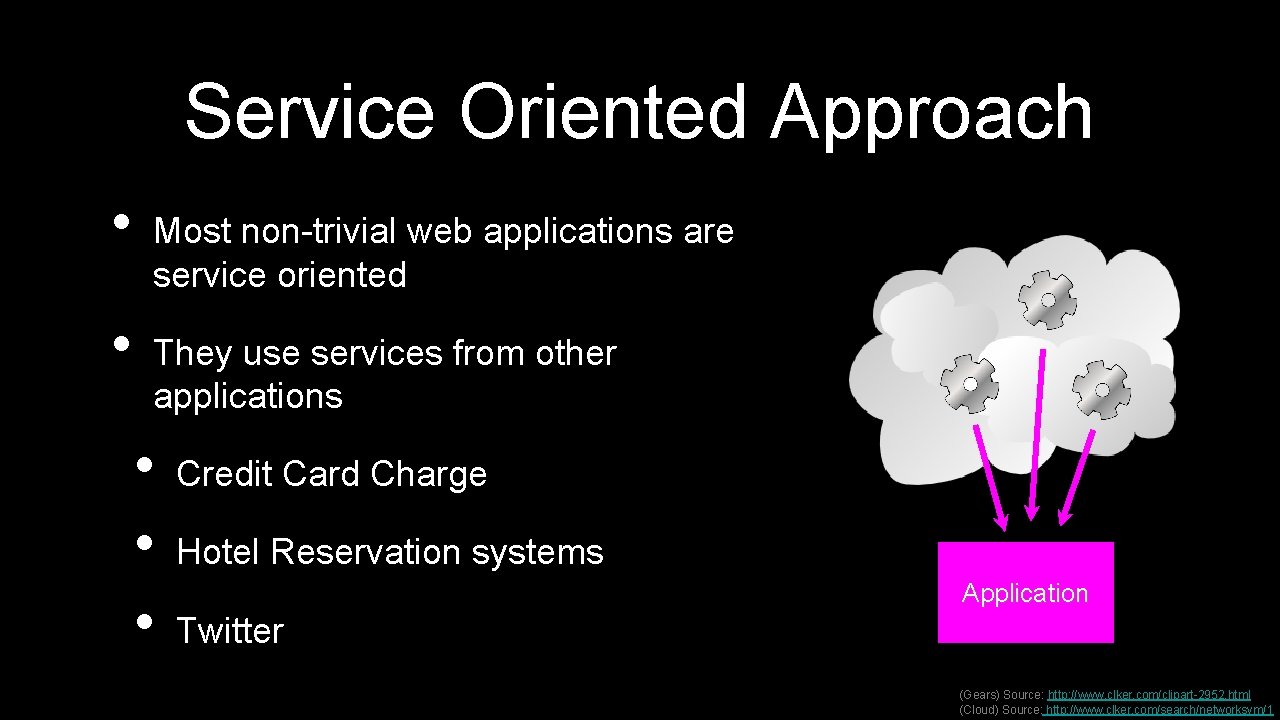
Service Oriented Approach • • Most non-trivial web applications are service oriented They use services from other applications • • • Credit Card Charge Hotel Reservation systems Application Twitter (Gears) Source: http: //www. clker. com/clipart-2952. html (Cloud) Source: http: //www. clker. com/search/networksym/1
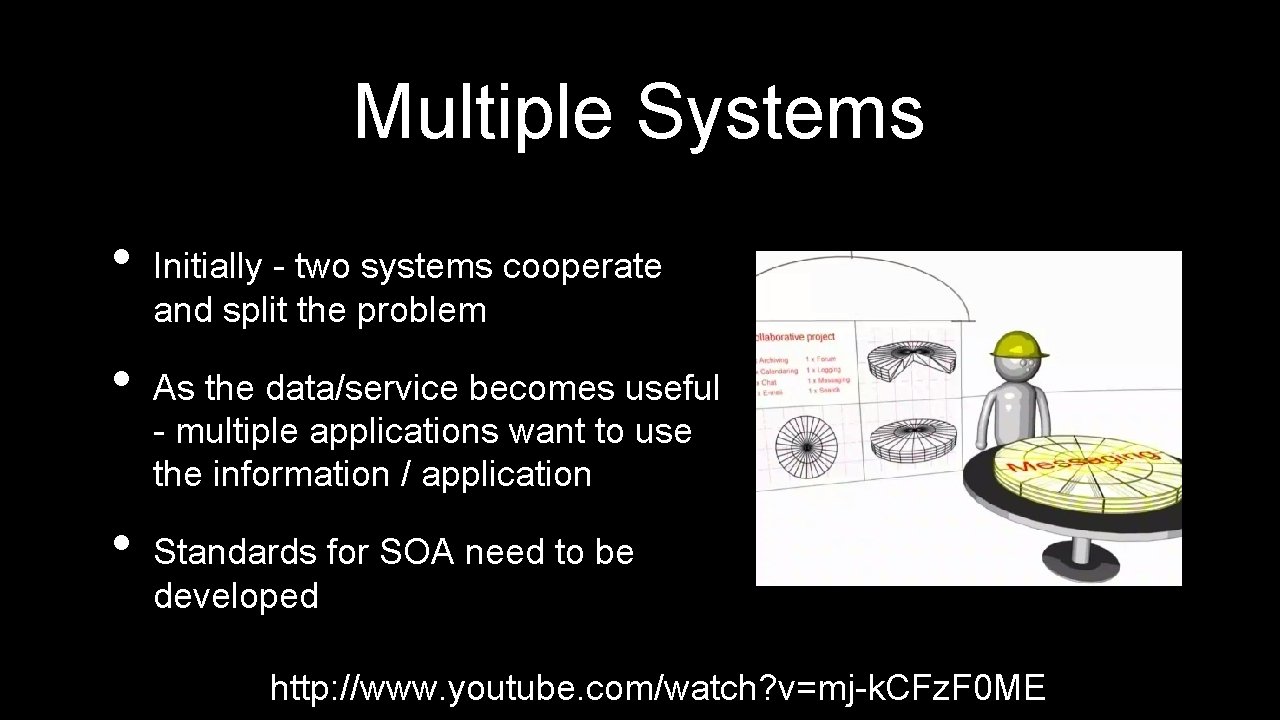
Multiple Systems • • • Initially - two systems cooperate and split the problem As the data/service becomes useful - multiple applications want to use the information / application Standards for SOA need to be developed http: //www. youtube. com/watch? v=mj-k. CFz. F 0 ME
Application Progam Interface The API itself is largely abstract in that it specifies an interface and controls the behavior of the objects specified in that interface. The software that provides the functionality described by an API is said to be an “implementation” of the API. An API is typically defined in terms of the programming language used to build an application. http: //en. wikipedia. org/wiki/API
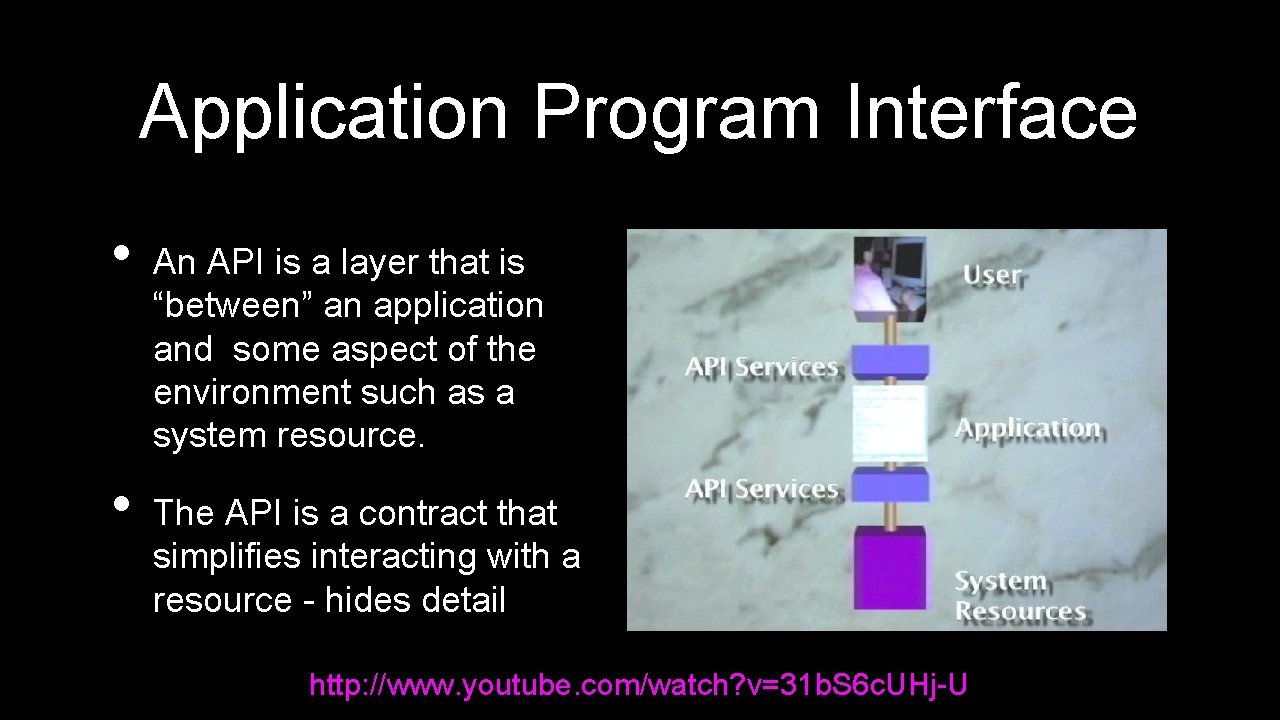
Application Program Interface • • An API is a layer that is “between” an application and some aspect of the environment such as a system resource. The API is a contract that simplifies interacting with a resource - hides detail http: //www. youtube. com/watch? v=31 b. S 6 c. UHj-U
The Twitter API Biz Stone (Founder of Twitter): Yeah. The API has been arguably the most important, or maybe even inarguably, the most important thing we’ve done with Twitter. It has allowed us, first of all, to keep the service very simple and create a simple API so that developers can build on top of our infrastructure and come up with ideas that are way better than our ideas, and build things like Twitterrific, which is just a beautiful elegant way to use Twitter that we wouldn’t have been able to get to, being a very small team. So, the API which has easily 10 times more traffic than the website, has been really very important to us. http: //readwritetalk. com/2007/09/05/biz-stone-co-founder-twitter/
Web Services http: //en. wikipedia. org/wiki/Web_services
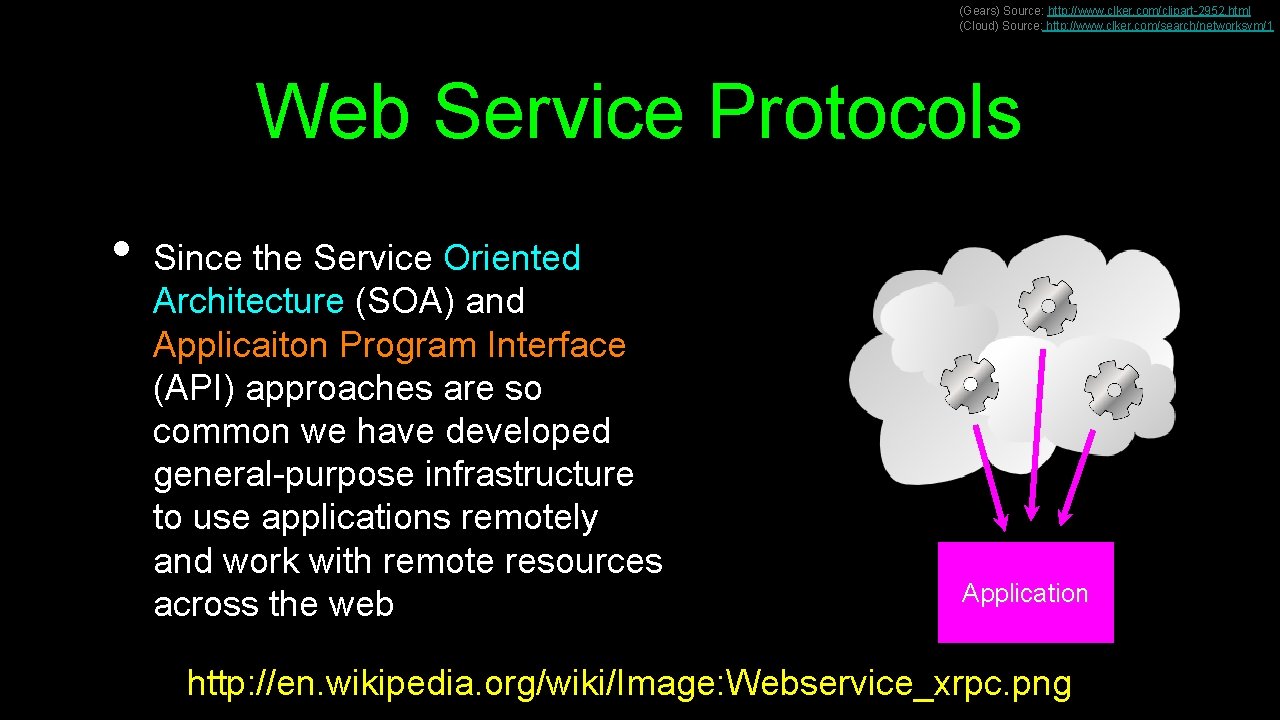
(Gears) Source: http: //www. clker. com/clipart-2952. html (Cloud) Source: http: //www. clker. com/search/networksym/1 Web Service Protocols • Since the Service Oriented Architecture (SOA) and Applicaiton Program Interface (API) approaches are so common we have developed general-purpose infrastructure to use applications remotely and work with remote resources across the web Application http: //en. wikipedia. org/wiki/Image: Webservice_xrpc. png
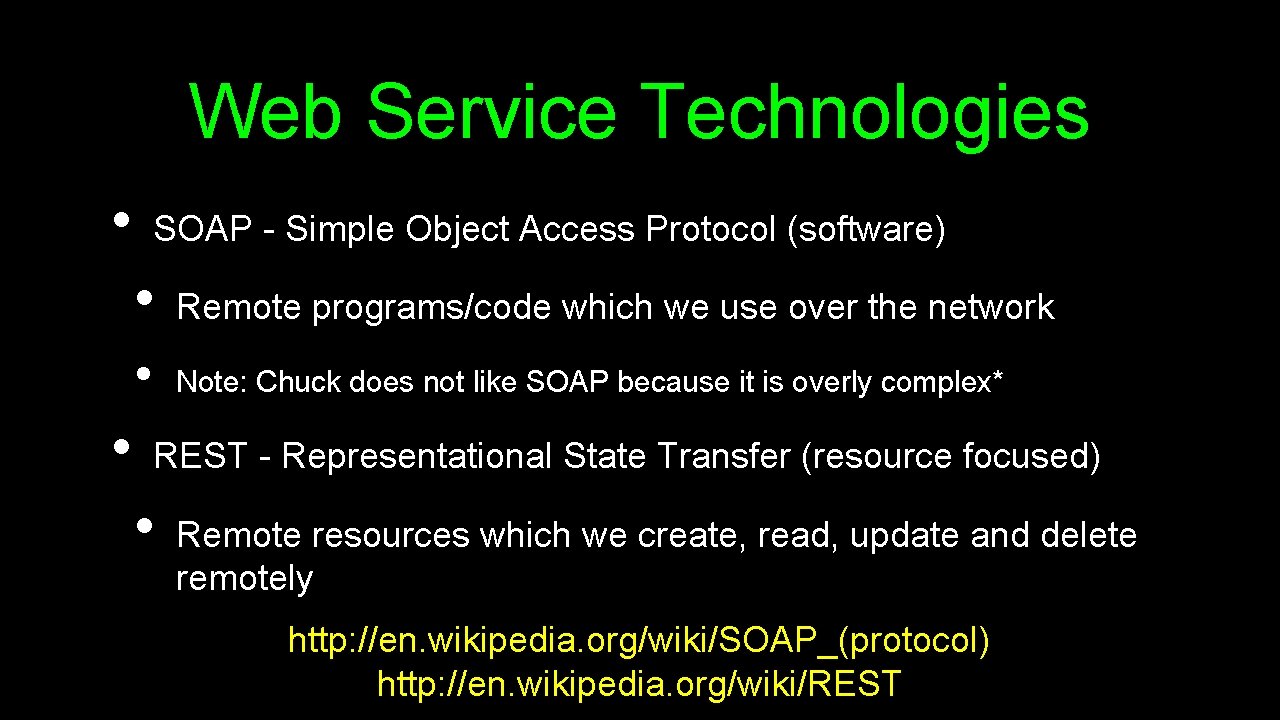
Web Service Technologies • • SOAP - Simple Object Access Protocol (software) • Remote programs/code which we use over the network • Note: Chuck does not like SOAP because it is overly complex* REST - Representational State Transfer (resource focused) • Remote resources which we create, read, update and delete remotely http: //en. wikipedia. org/wiki/SOAP_(protocol) http: //en. wikipedia. org/wiki/REST
REST Representational State Transfer http: //www. ics. uci. edu/~fielding/pubs/dissertation/rest_arch_style. htm http: //en. wikipedia. org/wiki/REST http: //www. infoq. com/articles/rest-introduction http: //wiki. developer. mindtouch. com/REST_for_the_Rest_of_Us
REpresentational State Transfer • Rest goes back to the basic concepts of the Internet • • • URLs = Documents We have HTTP Operations on URLs: GET, PUT, POST, and DELETE Actually there are called URIs - Uniform Resource Identifiers
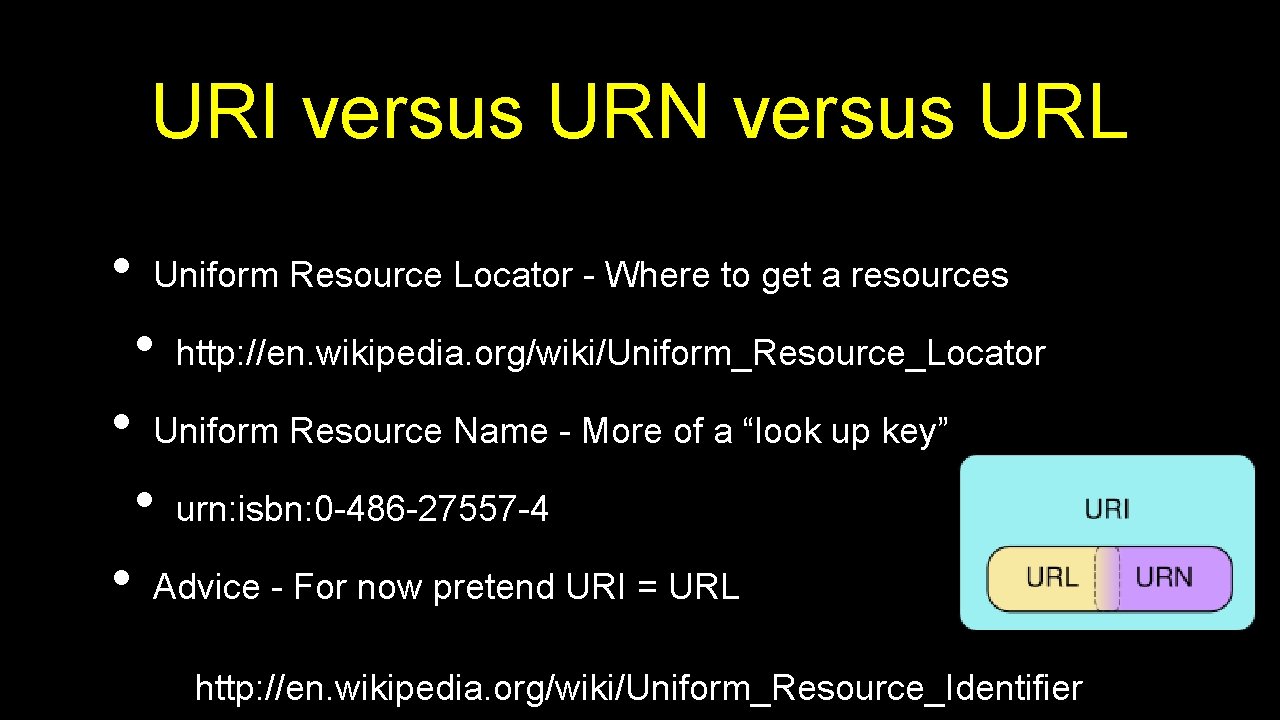
URI versus URN versus URL • Uniform Resource Locator - Where to get a resources • • Uniform Resource Name - More of a “look up key” • • http: //en. wikipedia. org/wiki/Uniform_Resource_Locator urn: isbn: 0 -486 -27557 -4 Advice - For now pretend URI = URL http: //en. wikipedia. org/wiki/Uniform_Resource_Identifier
HTTP Methods • HTTP Methods Operate on a URI • • GET - Retrieve a resource at a URI POST - Create/Modify a resource at a URL (remember <form>) PUT - Create/Replace/Overwrite a resource at a URI DELETE - Delete a resource at a URI
What does a REST Resource look like? • It depends - the idea is that when you GET the “resource” is returned to you in the most convenient format • • If it is an image - it is the bytes which make up the image If it is an “Object” such as a person - it may be an XML representation of that person
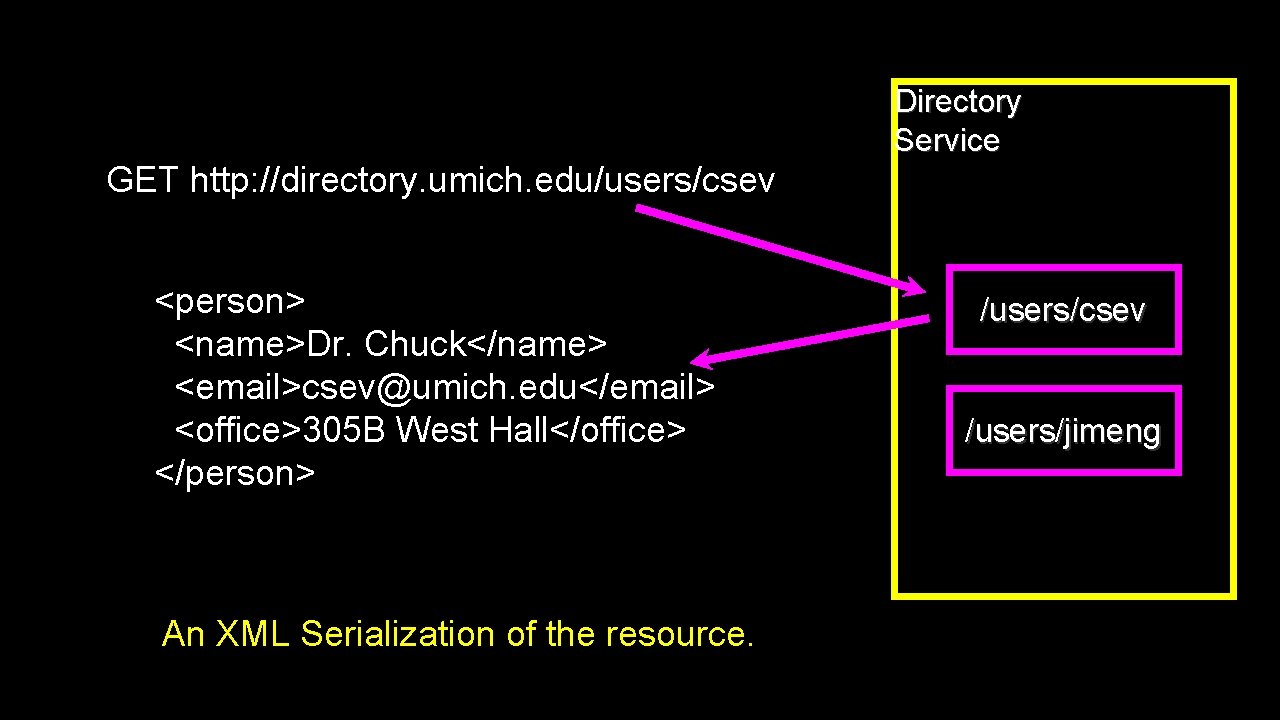
Directory Service GET http: //directory. umich. edu/users/csev <person> <name>Dr. Chuck</name> <email>csev@umich. edu</email> <office>305 B West Hall</office> </person> An XML Serialization of the resource. /users/csev /users/jimeng
Twitter - a REST Example
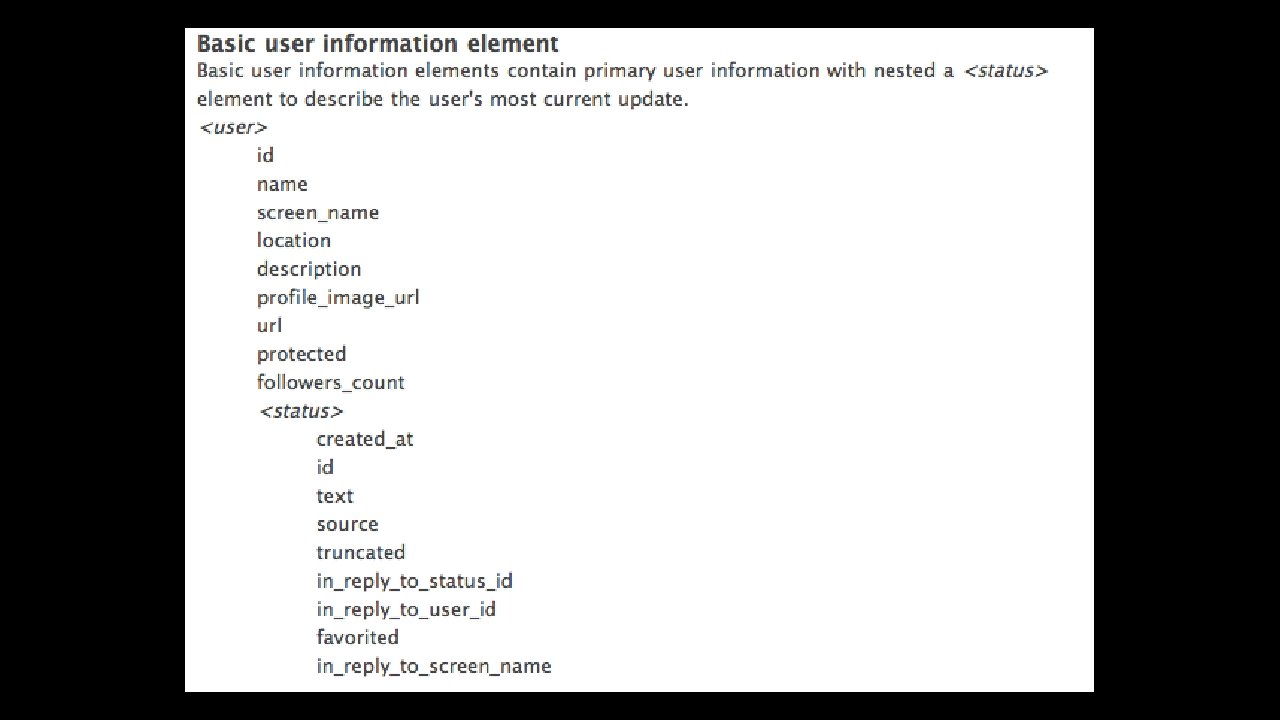
Twitter REST API • • • A series of URLs which you retrieve which return data Much like the information on twitter. com Returns XML data in the HTTP Document http: //apiwiki. twitter. com/REST+API+Documentation
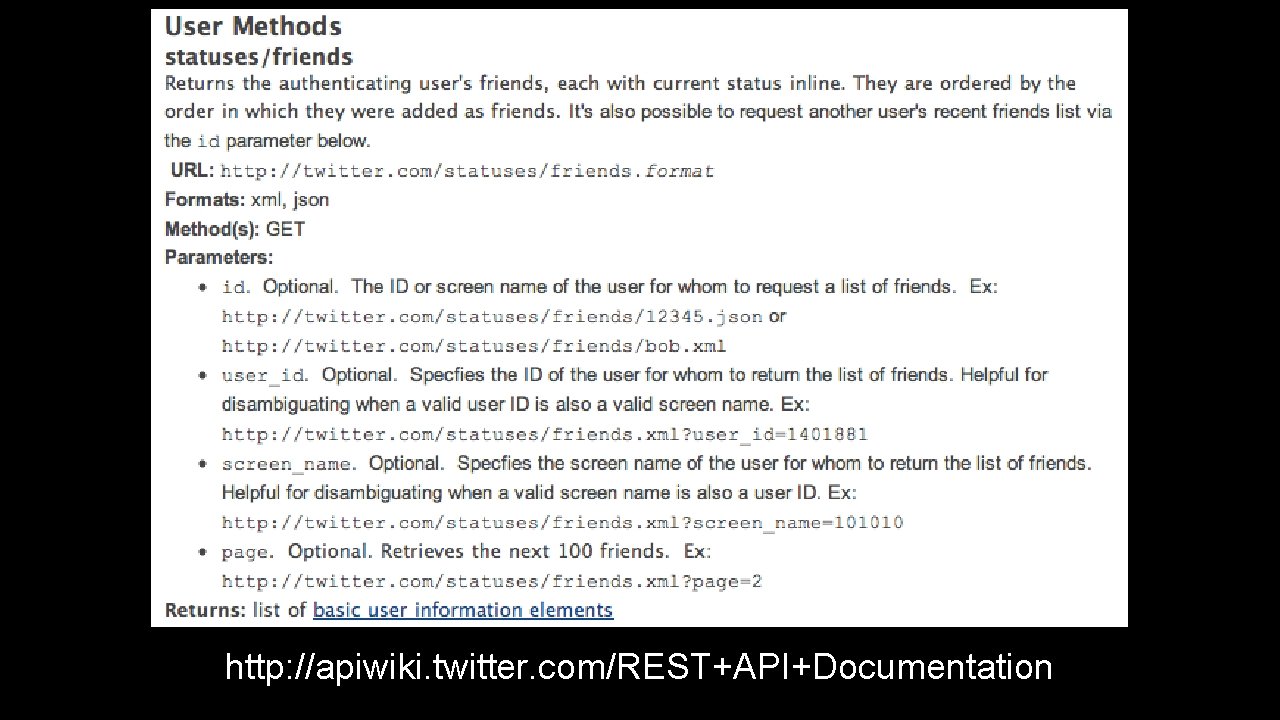
http: //apiwiki. twitter. com/REST+API+Documentation
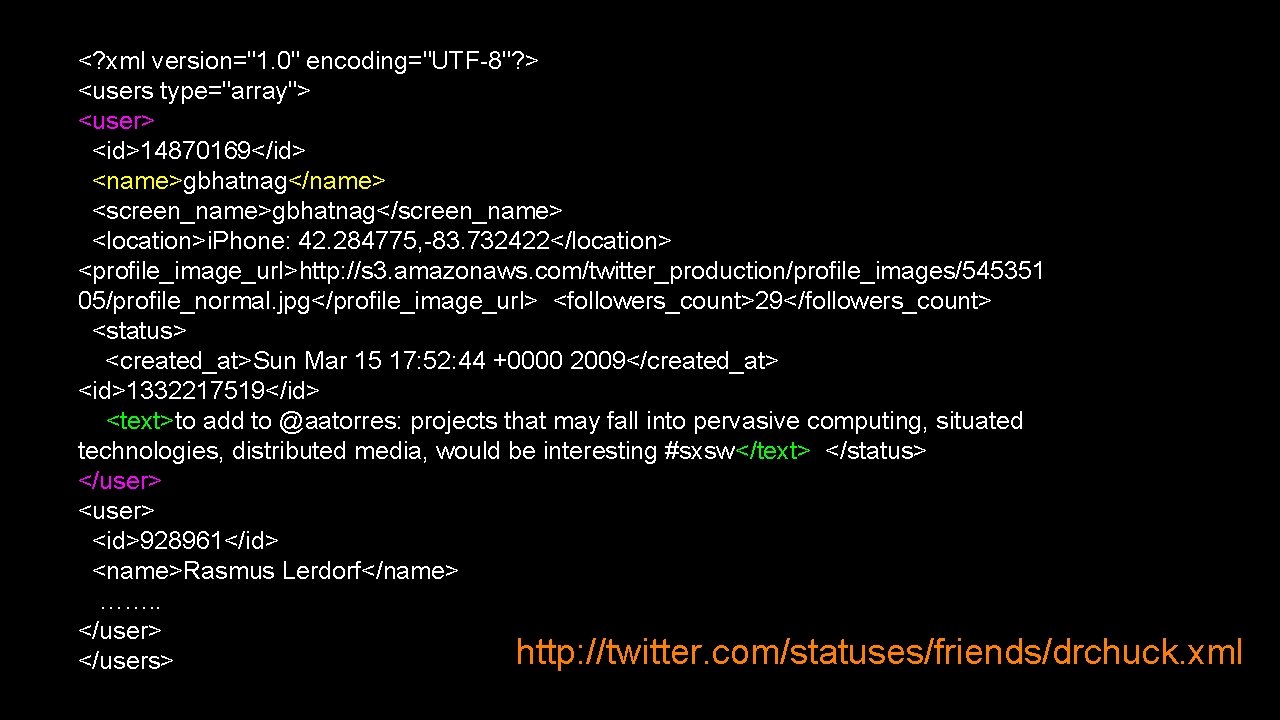
<? xml version="1. 0" encoding="UTF-8"? > <users type="array"> <user> <id>14870169</id> <name>gbhatnag</name> <screen_name>gbhatnag</screen_name> <location>i. Phone: 42. 284775, -83. 732422</location> <profile_image_url>http: //s 3. amazonaws. com/twitter_production/profile_images/545351 05/profile_normal. jpg</profile_image_url> <followers_count>29</followers_count> <status> <created_at>Sun Mar 15 17: 52: 44 +0000 2009</created_at> <id>1332217519</id> <text>to add to @aatorres: projects that may fall into pervasive computing, situated technologies, distributed media, would be interesting #sxsw</text> </status> </user> <id>928961</id> <name>Rasmus Lerdorf</name> ……. . </user> http: //twitter. com/statuses/friends/drchuck. xml </users>
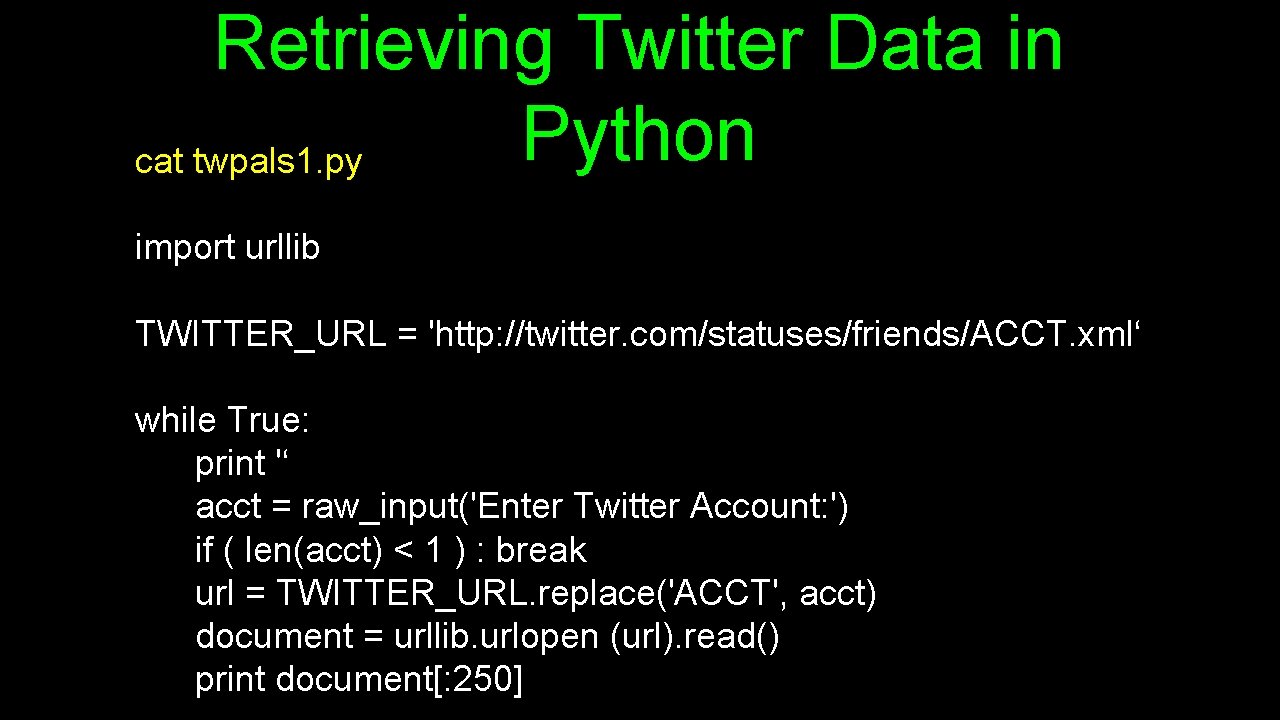
Retrieving Twitter Data in Python cat twpals 1. py import urllib TWITTER_URL = 'http: //twitter. com/statuses/friends/ACCT. xml‘ while True: print '‘ acct = raw_input('Enter Twitter Account: ') if ( len(acct) < 1 ) : break url = TWITTER_URL. replace('ACCT', acct) document = urllib. urlopen (url). read() print document[: 250]
Parsing XML in Python • XML Becomes a Document Object Model - DOM The Document Object Model (DOM) is a platform- and language-independent standard object model for representing HTML or XML documents as well as an Application Programming Interface (API) for querying, traversing and manipulating such documents. http: //en. wikipedia. org/wiki/Document_Object_Model
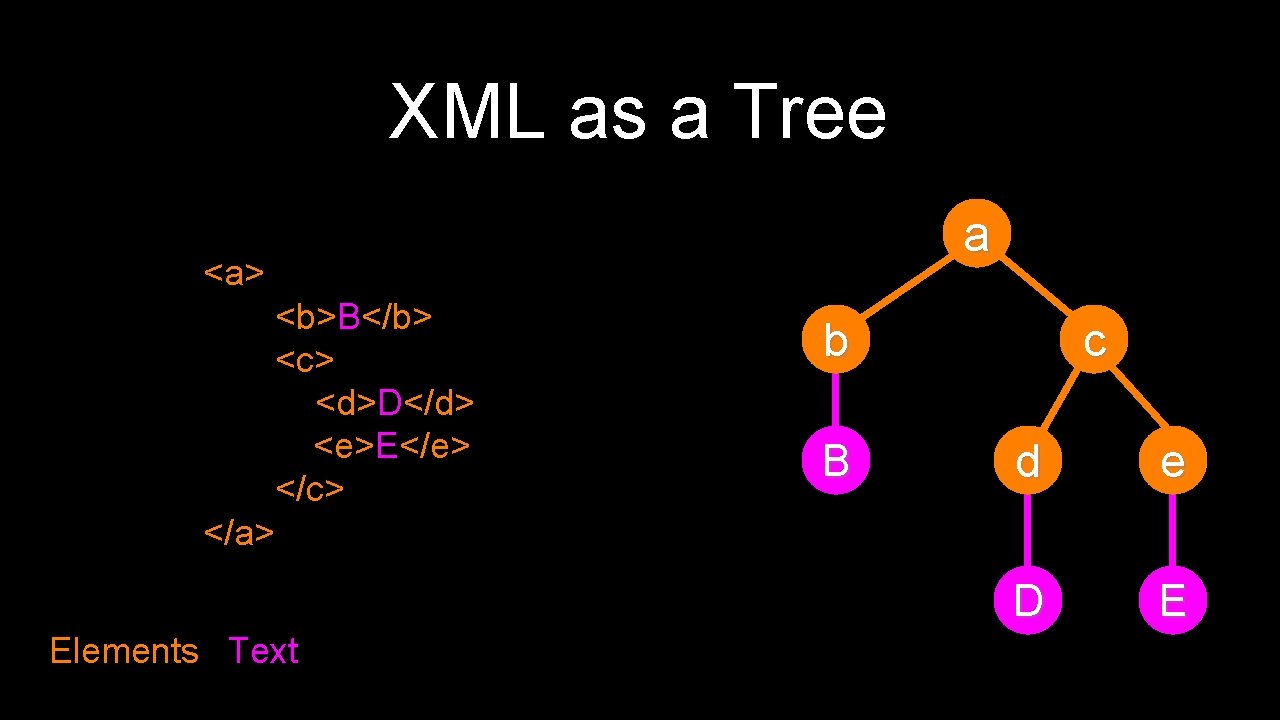
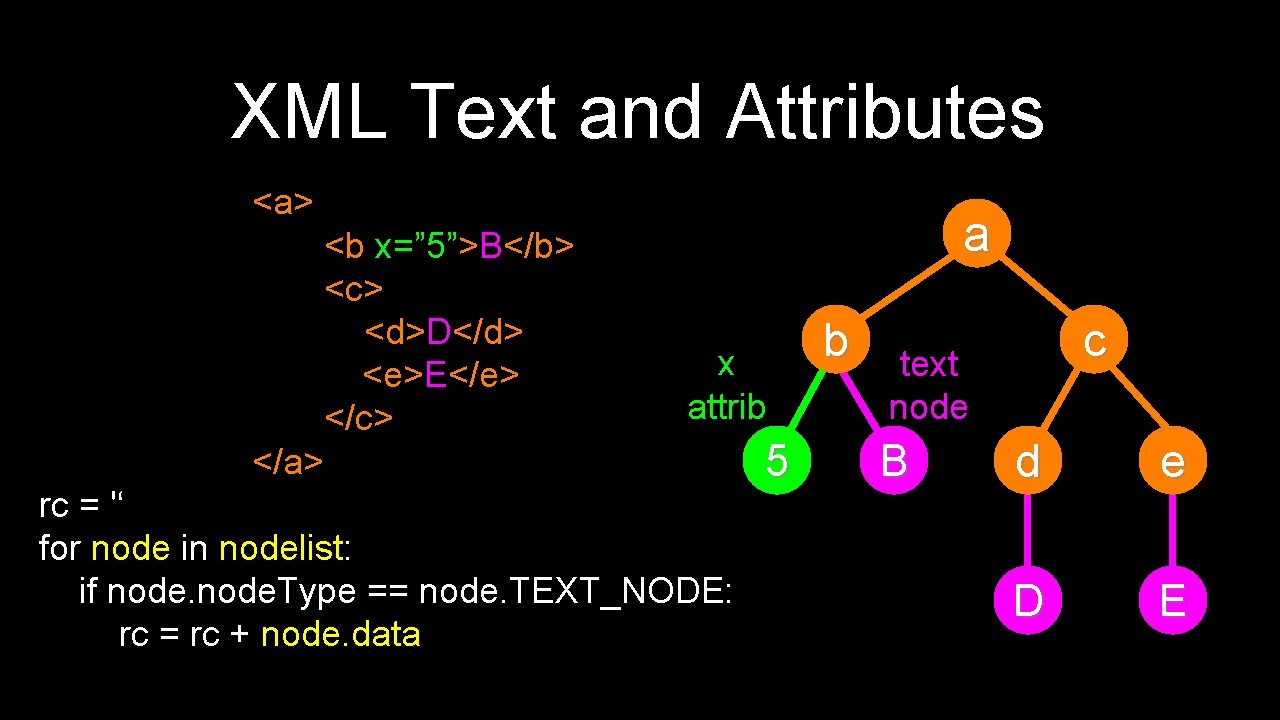
XML as a Tree a <a> <b>B</b> <c> <d>D</d> <e>E</e> </c> b B c d e D E </a> Elements Text
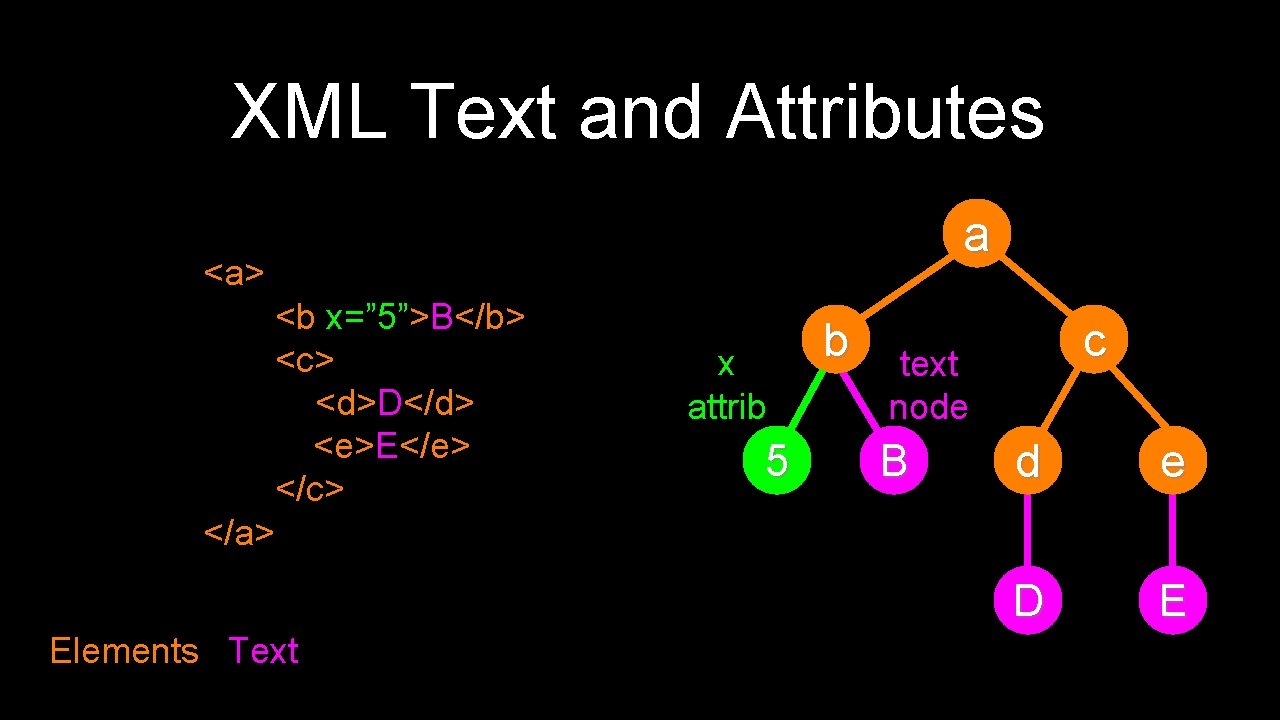
XML Text and Attributes a <a> <b x=” 5”>B</b> <c> <d>D</d> <e>E</e> </c> x attrib 5 b c text node B d e D E </a> Elements Text
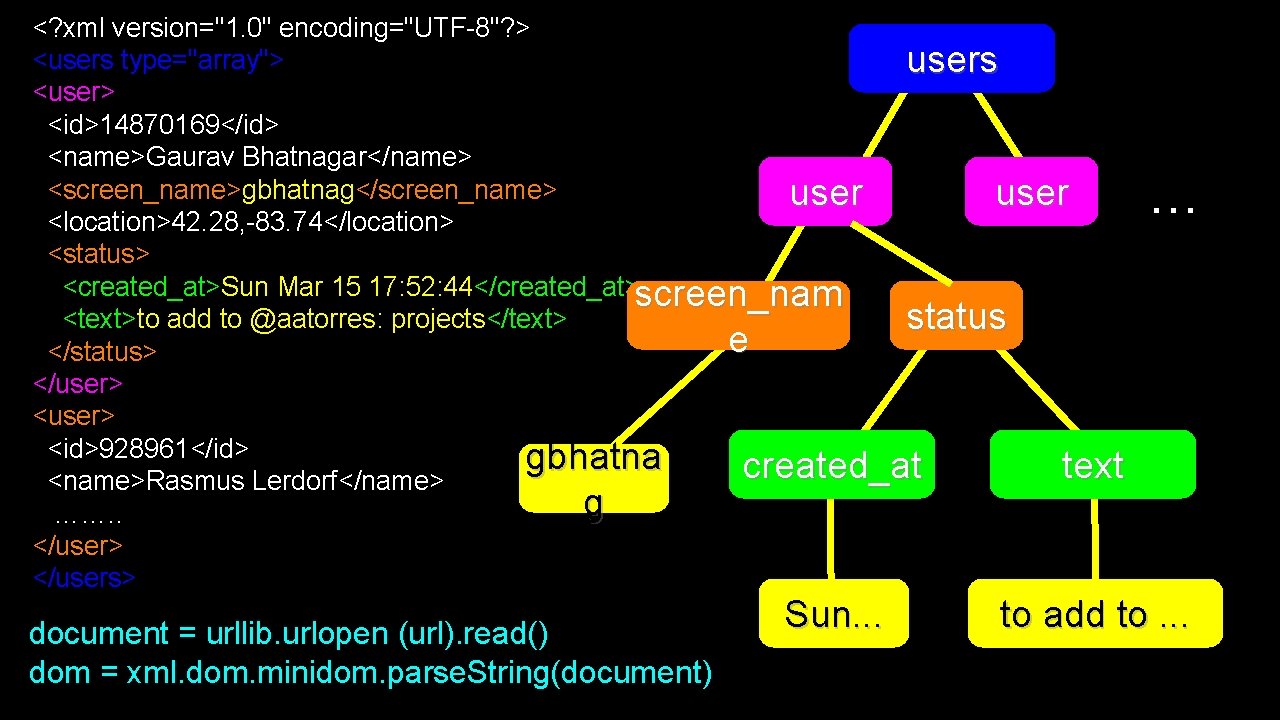
<? xml version="1. 0" encoding="UTF-8"? > <users type="array"> users <user> <id>14870169</id> <name>Gaurav Bhatnagar</name> <screen_name>gbhatnag</screen_name> user <location>42. 28, -83. 74</location> <status> <created_at>Sun Mar 15 17: 52: 44</created_at>screen_nam <text>to add to @aatorres: projects</text> status e </status> </user> <id>928961</id> gbhatna created_at text <name>Rasmus Lerdorf</name> g ……. . </user> </users> document = urllib. urlopen (url). read() dom = xml. dom. minidom. parse. String(document) Sun. . . to add to. . .
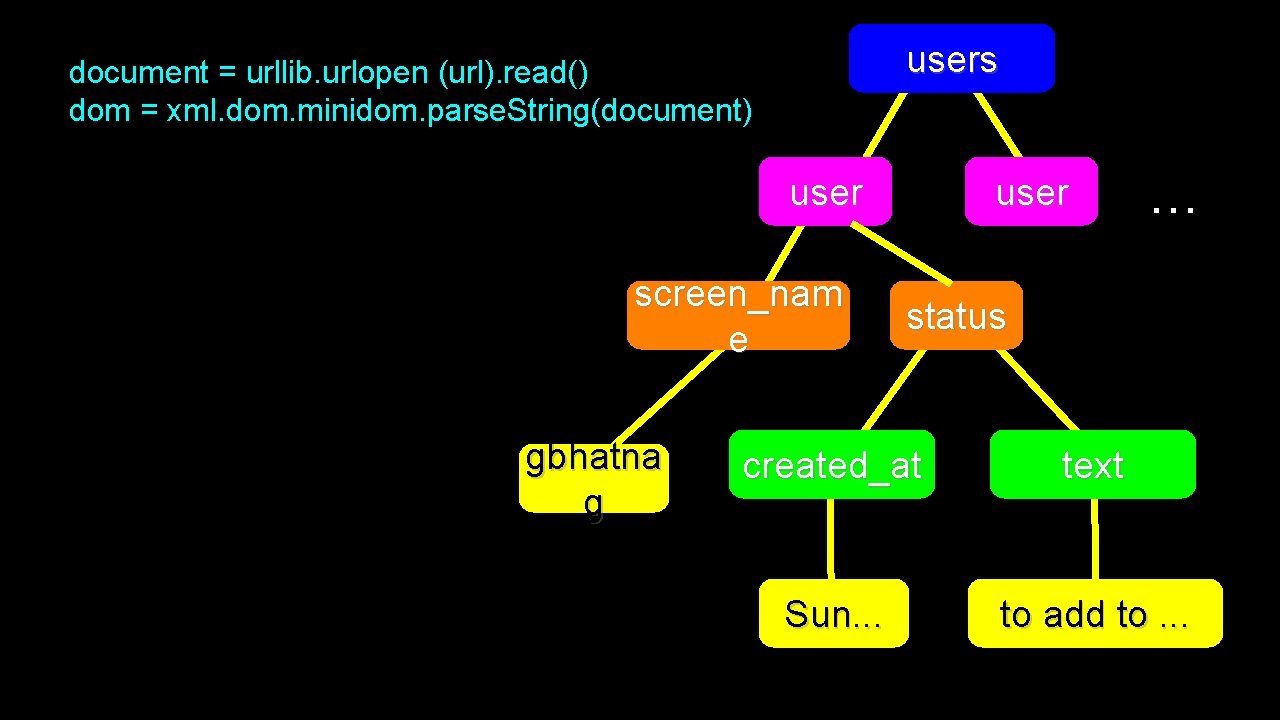
users document = urllib. urlopen (url). read() dom = xml. dom. minidom. parse. String(document) user screen_nam e gbhatna g user . . . status created_at text Sun. . . to add to. . .
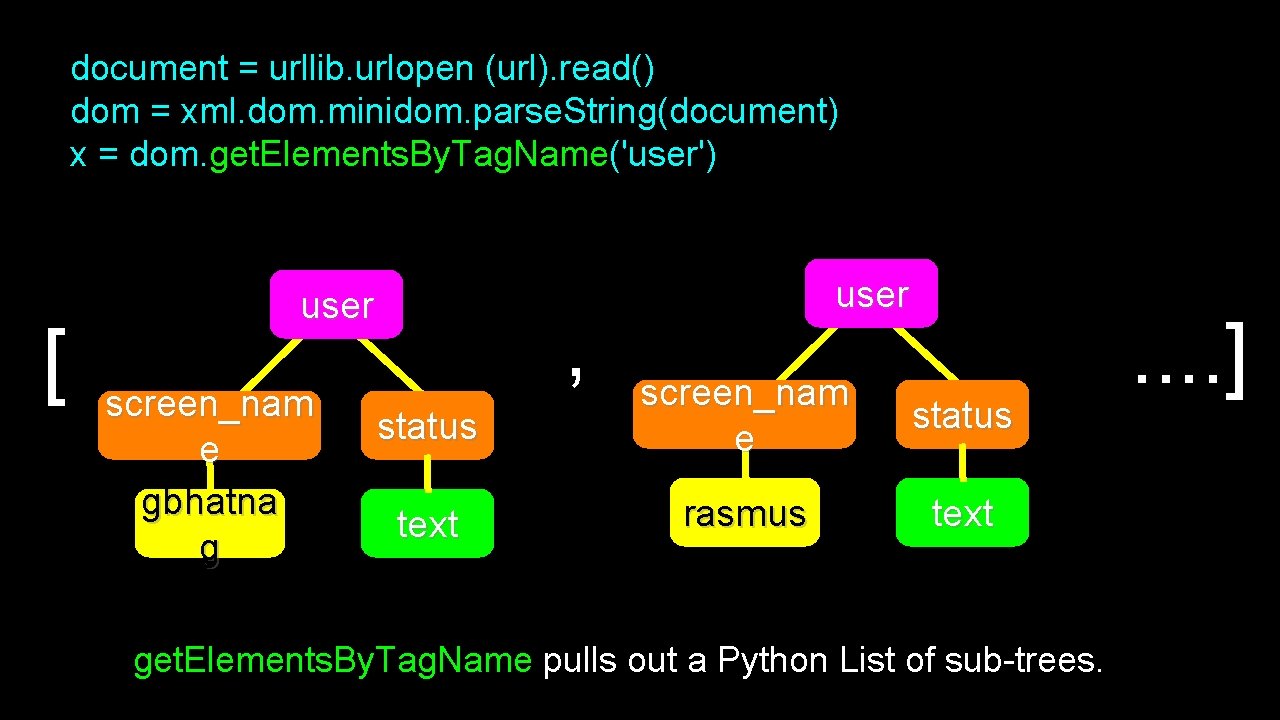
document = urllib. urlopen (url). read() dom = xml. dom. minidom. parse. String(document) x = dom. get. Elements. By. Tag. Name('user') [ user screen_nam e gbhatna g , user status screen_nam e status text rasmus text get. Elements. By. Tag. Name pulls out a Python List of sub-trees. . . ]
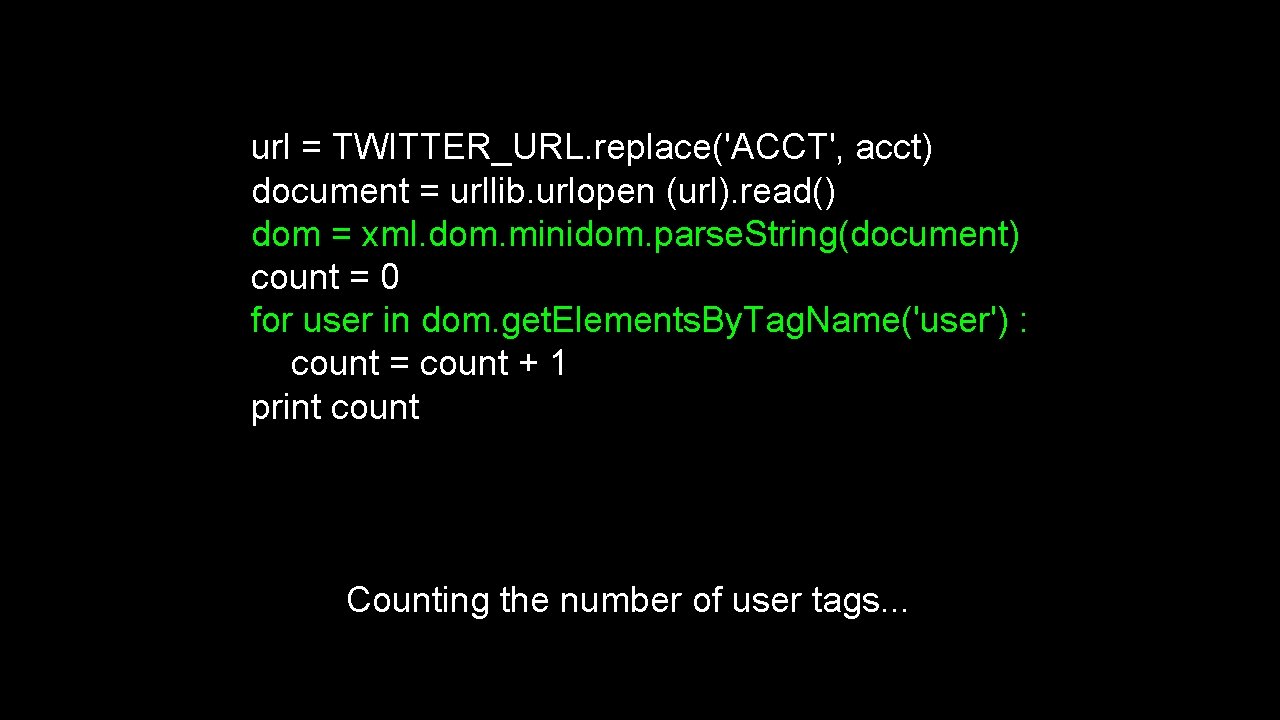
url = TWITTER_URL. replace('ACCT', acct) document = urllib. urlopen (url). read() dom = xml. dom. minidom. parse. String(document) count = 0 for user in dom. get. Elements. By. Tag. Name('user') : count = count + 1 print count Counting the number of user tags. . .
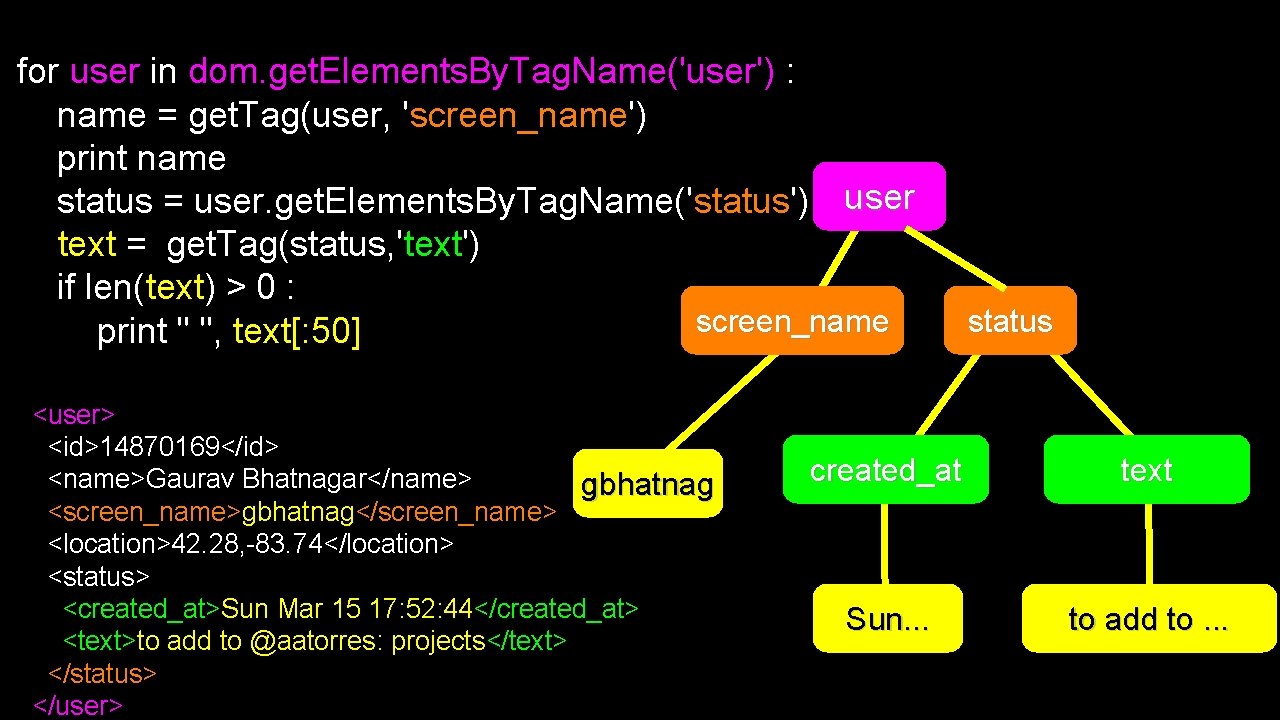
for user in dom. get. Elements. By. Tag. Name('user') : name = get. Tag(user, 'screen_name') print name status = user. get. Elements. By. Tag. Name('status') user text = get. Tag(status, 'text') if len(text) > 0 : screen_name print " ", text[: 50] <user> <id>14870169</id> <name>Gaurav Bhatnagar</name> gbhatnag <screen_name>gbhatnag</screen_name> <location>42. 28, -83. 74</location> <status> <created_at>Sun Mar 15 17: 52: 44</created_at> <text>to add to @aatorres: projects</text> </status> </user> status created_at text Sun. . . to add to. . .
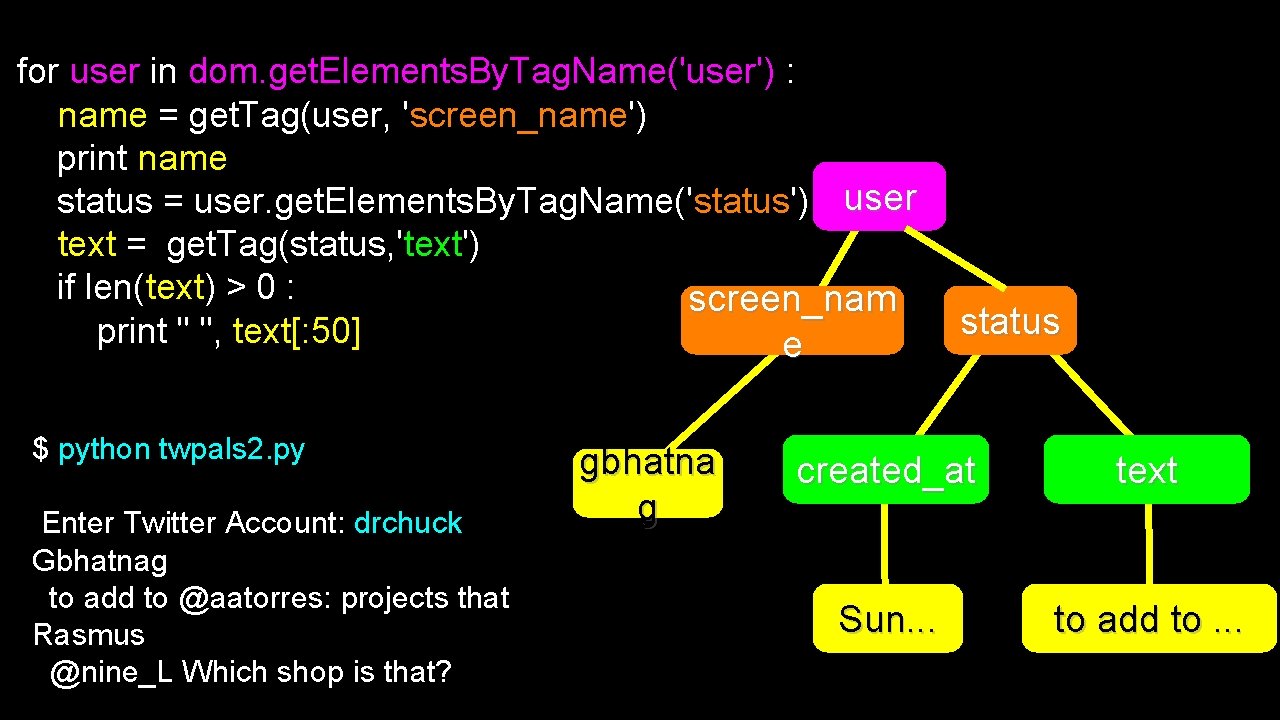
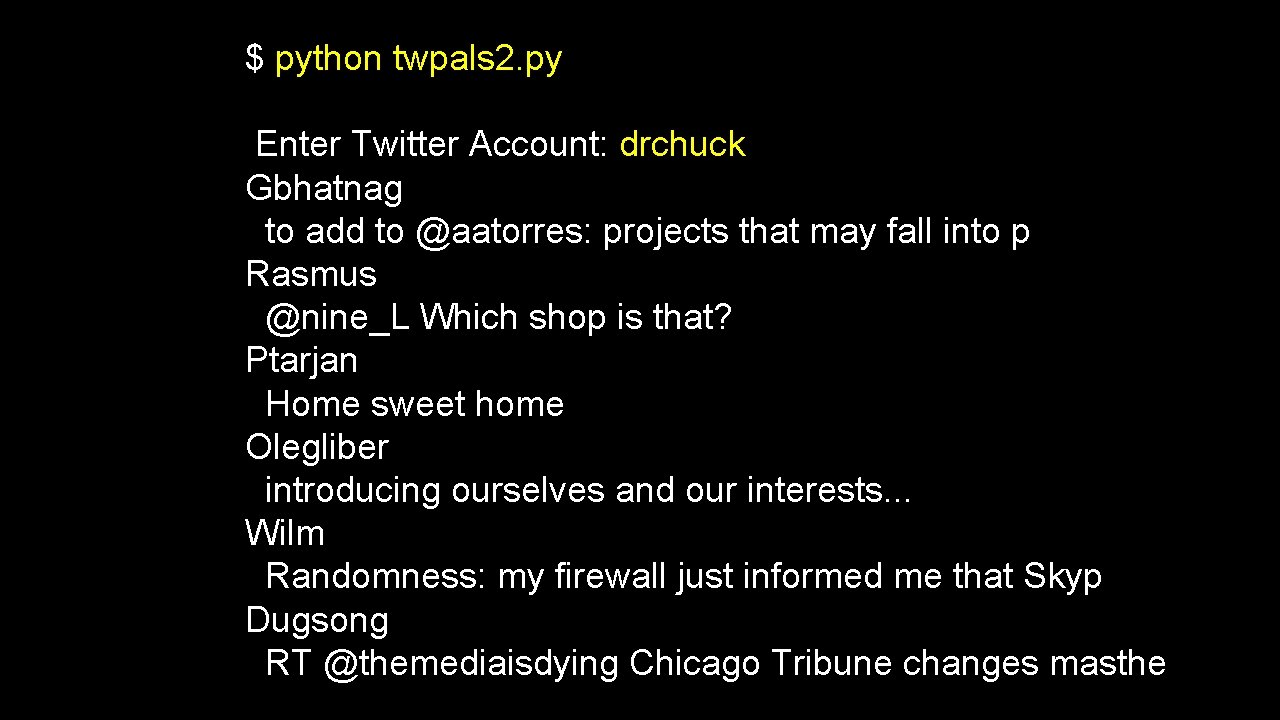
for user in dom. get. Elements. By. Tag. Name('user') : name = get. Tag(user, 'screen_name') print name status = user. get. Elements. By. Tag. Name('status') user text = get. Tag(status, 'text') if len(text) > 0 : screen_nam print " ", text[: 50] e $ python twpals 2. py Enter Twitter Account: drchuck Gbhatnag to add to @aatorres: projects that Rasmus @nine_L Which shop is that? gbhatna g status created_at text Sun. . . to add to. . .
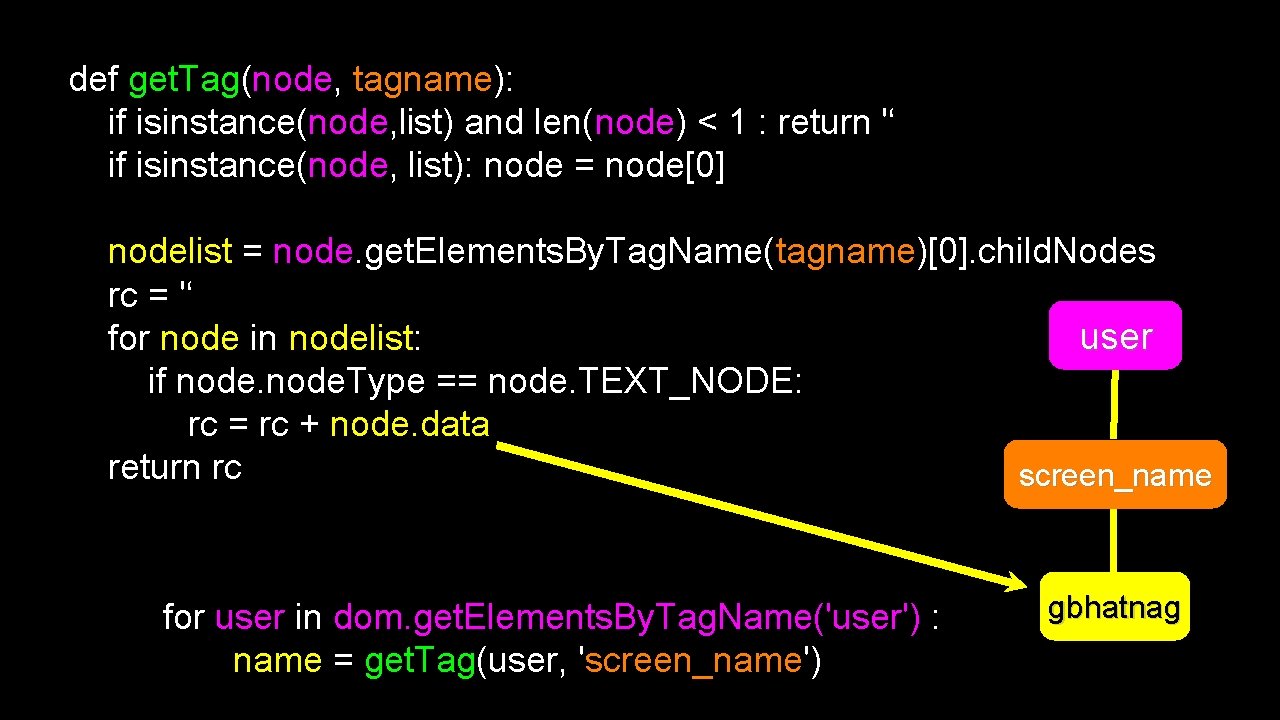
def get. Tag(node, tagname): if isinstance(node, list) and len(node) < 1 : return '‘ if isinstance(node, list): node = node[0] nodelist = node. get. Elements. By. Tag. Name(tagname)[0]. child. Nodes rc = '‘ user for node in nodelist: if node. Type == node. TEXT_NODE: rc = rc + node. data return rc screen_name for user in dom. get. Elements. By. Tag. Name('user') : name = get. Tag(user, 'screen_name') gbhatnag
XML Text and Attributes <a> <b x=” 5”>B</b> <c> <d>D</d> <e>E</e> </c> a x attrib </a> rc = '‘ for node in nodelist: if node. Type == node. TEXT_NODE: rc = rc + node. data 5 b c text node B d e D E
$ python twpals 2. py Enter Twitter Account: drchuck Gbhatnag to add to @aatorres: projects that may fall into p Rasmus @nine_L Which shop is that? Ptarjan Home sweet home Olegliber introducing ourselves and our interests. . . Wilm Randomness: my firewall just informed me that Skyp Dugsong RT @themediaisdying Chicago Tribune changes masthe
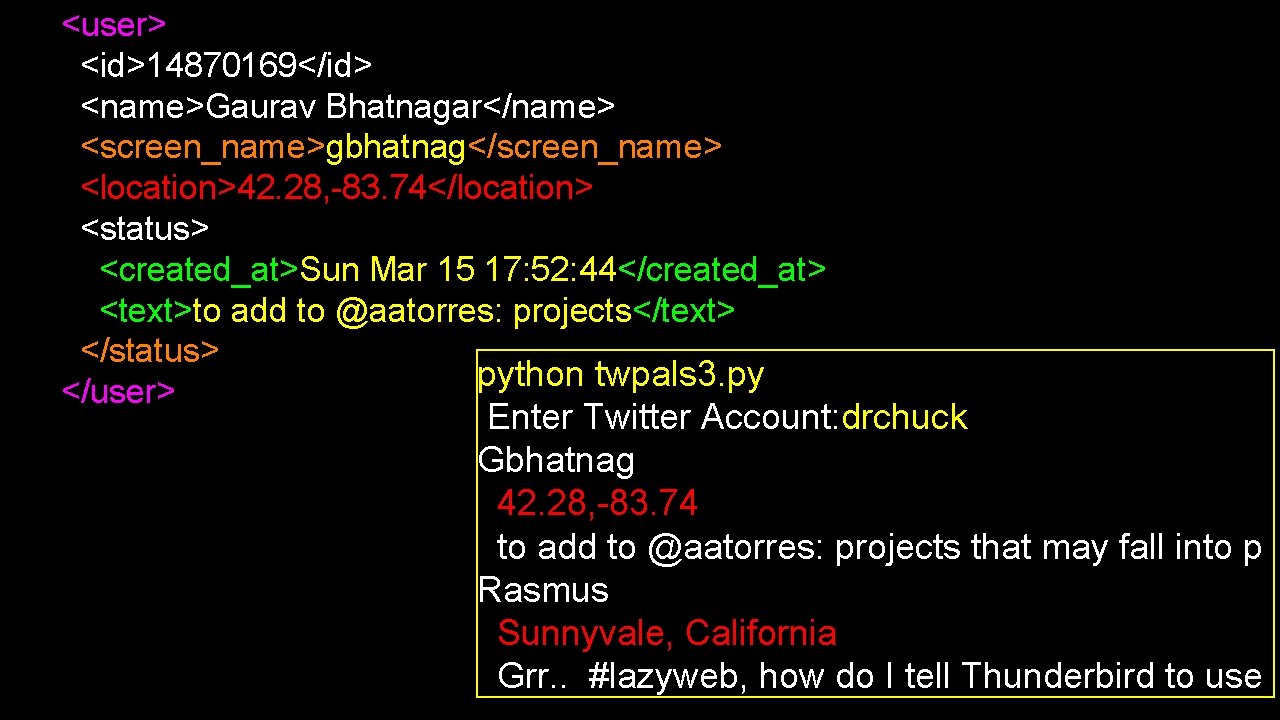
<user> <id>14870169</id> <name>Gaurav Bhatnagar</name> <screen_name>gbhatnag</screen_name> <location>42. 28, -83. 74</location> <status> <created_at>Sun Mar 15 17: 52: 44</created_at> <text>to add to @aatorres: projects</text> </status> python twpals 3. py </user> Enter Twitter Account: drchuck Gbhatnag 42. 28, -83. 74 to add to @aatorres: projects that may fall into p Rasmus Sunnyvale, California Grr. . #lazyweb, how do I tell Thunderbird to use
Summary • • • Service Oriented Architecture - allows an application to be broken into parts and distributed across a network - and for standards to be developed for service reuse An Application Program Interface (API) is a contract for interaction Web Services provide infrastructure for applications cooperating (an API) over a network - SOAP and REST are two styles of web services
- Slides: 37