
Web Security Threats Table provides a summary of

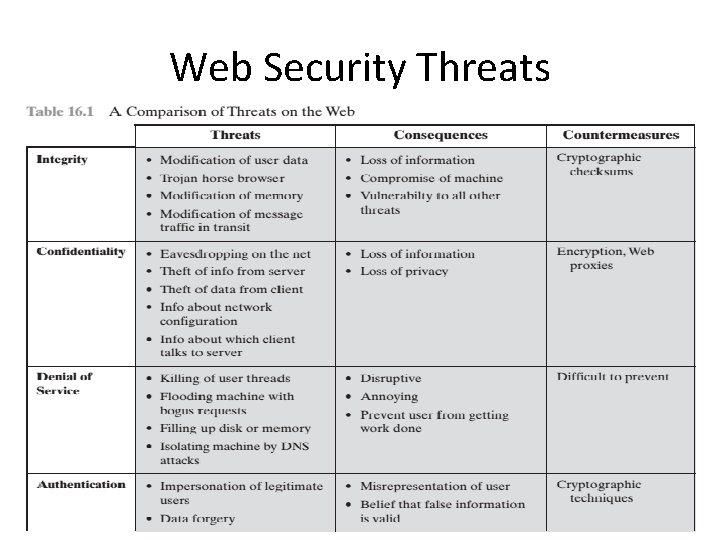
Web Security Threats • Table provides a summary of the types of security threats faced when using the Web. • One way to group these threats is in terms of passive and active attacks. • Passive attacks include eavesdropping on network traffic between browser and server and gaining access to information on a Web site that is supposed to be restricted. • Active attacks include impersonating another user, altering messages in transit between client and server, and altering information on a Web site.
Web Security Threats
Web Traffic Security Approaches • A number of approaches to providing Web security are possible. The various approaches that have been considered are similar in the services they provide and, to some extent, in the mechanisms that they use, but they differ with respect to their scope of applicability and their relative location within the TCP/IP protocol stack.
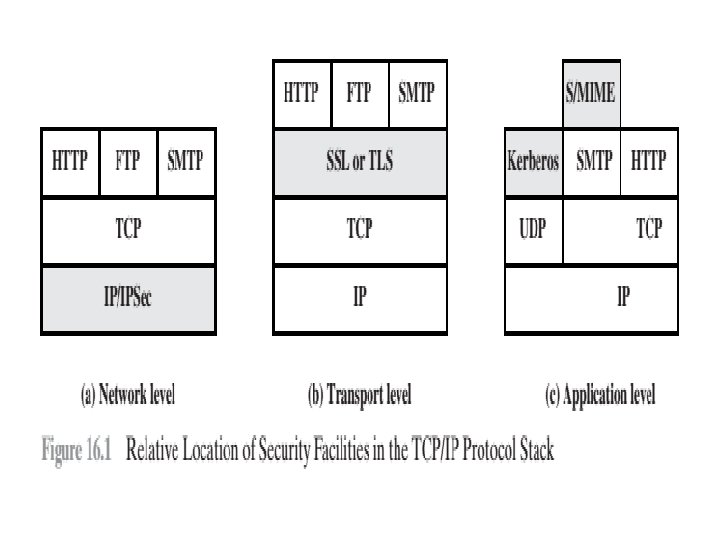
Web Traffic Security Approaches • One way to provide Web security is to use IP security (IPsec) (Figure 16. 1 a). • The advantage of using IPsec is that it is transparent to end users and applications and provides a general-purpose solution. • Furthermore, IPsec includes a filtering capability so that only selected traffic need incur the overhead of IPsec processing.
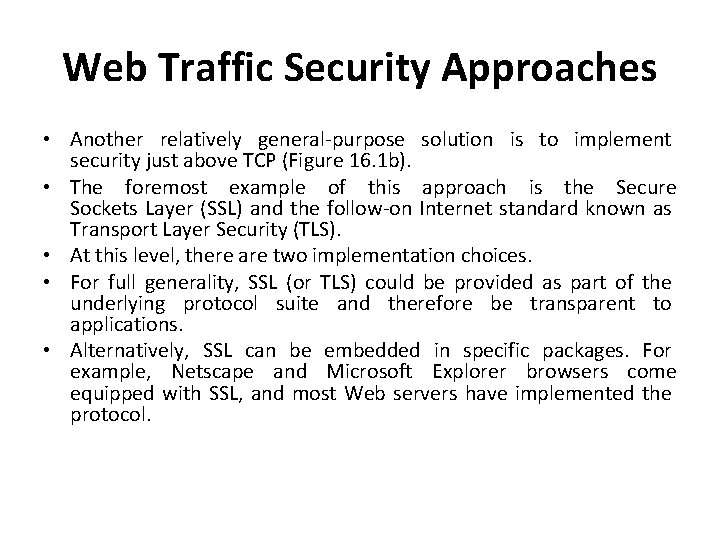
Web Traffic Security Approaches • Another relatively general-purpose solution is to implement security just above TCP (Figure 16. 1 b). • The foremost example of this approach is the Secure Sockets Layer (SSL) and the follow-on Internet standard known as Transport Layer Security (TLS). • At this level, there are two implementation choices. • For full generality, SSL (or TLS) could be provided as part of the underlying protocol suite and therefore be transparent to applications. • Alternatively, SSL can be embedded in specific packages. For example, Netscape and Microsoft Explorer browsers come equipped with SSL, and most Web servers have implemented the protocol.
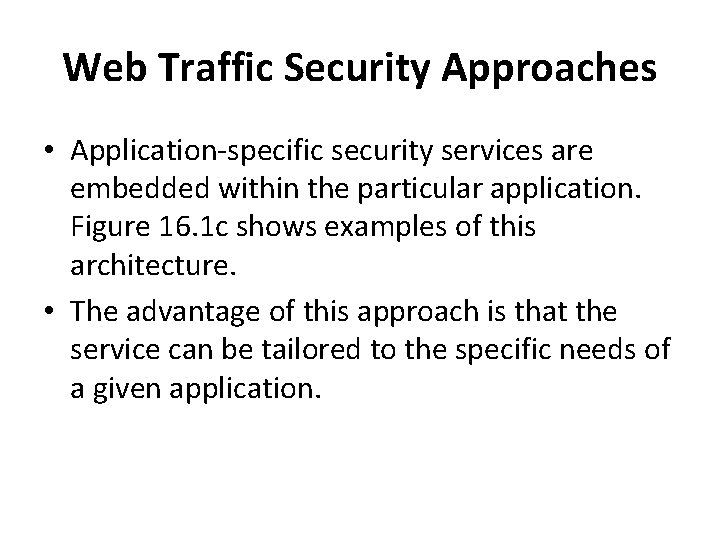
Web Traffic Security Approaches • Application-specific security services are embedded within the particular application. Figure 16. 1 c shows examples of this architecture. • The advantage of this approach is that the service can be tailored to the specific needs of a given application.
- Slides: 8