
Web Security Session Management websec 1 Recall from
Web Security Session Management websec 1
Recall from last week: the web • On the web, servers and clients communicate by HTTP requests and responses • HTTP request are usually GET or POST requests – GET: parameters in URL – POST: parameters in HTTP body • Data sent in HTTP traffic, in the URL or in the body, may be encoded in various ways – URL encoding for (data used in) URLs – HTML encoding for (data used in ) HTML – base 64 encoding for raw binary data sent as text websec 2
Web Security Session Management websec 3
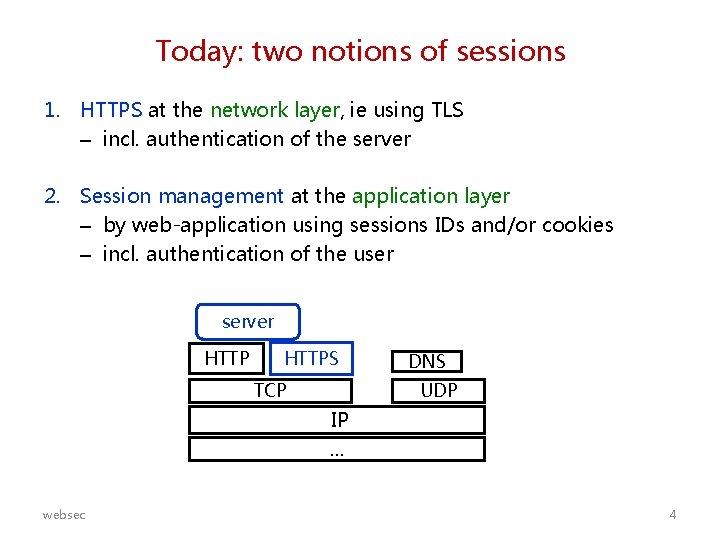
Today: two notions of sessions 1. HTTPS at the network layer, ie using TLS – incl. authentication of the server 2. Session management at the application layer – by web-application using sessions IDs and/or cookies – incl. authentication of the user server HTTPS TCP DNS UDP IP. . . websec 4
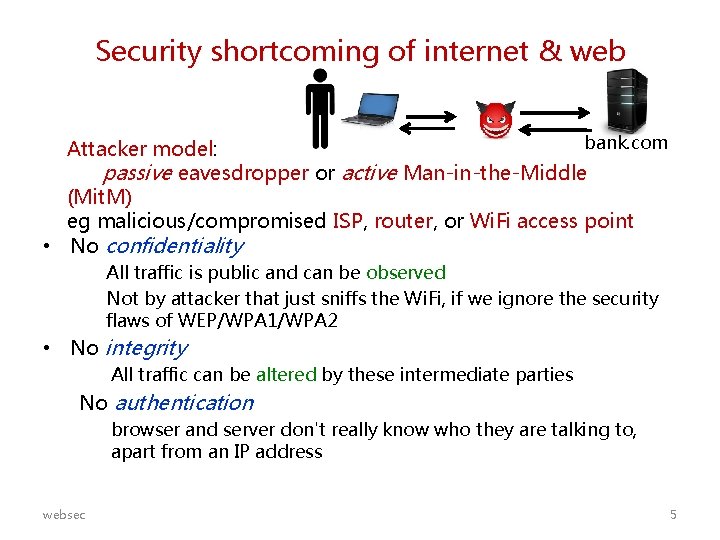
Security shortcoming of internet & web bank. com Attacker model: passive eavesdropper or active Man-in-the-Middle (Mit. M) eg malicious/compromised ISP, router, or Wi. Fi access point • No confidentiality All traffic is public and can be observed Not by attacker that just sniffs the Wi. Fi, if we ignore the security flaws of WEP/WPA 1/WPA 2 • No integrity All traffic can be altered by these intermediate parties No authentication browser and server don't really know who they are talking to, apart from an IP address websec 5
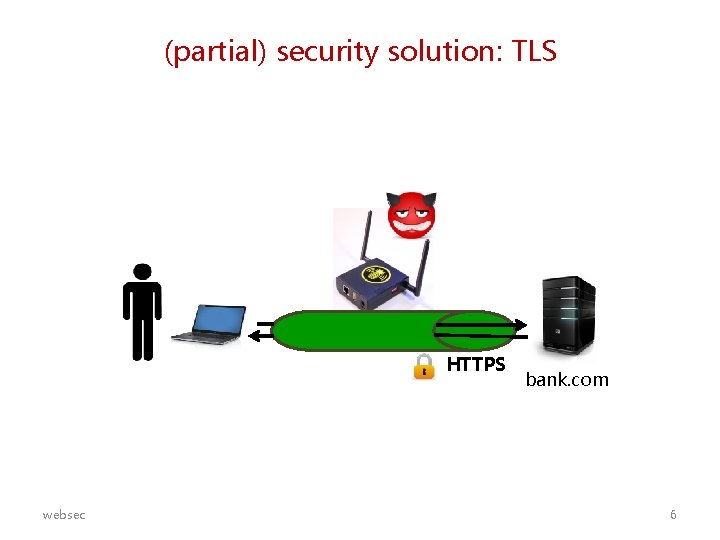
(partial) security solution: TLS HTTPS websec bank. com 6
(Aside: name confusion TLS vs SSL) • TLS (Transport Layer Security) used to be called SSL (Secure Sockets Layer) • • TLS version 1. 0 is SSL version 3. 1 TLS version 1. 2 is current, TLS version 1. 3 is being rolled out • In practical use, SSL and TLS are synonyms. Eg. X 509 certificates are often called SSL certificates and a leading TLS implementation is called Open. SSL websec 7
HTTPS: HTTP over TLS HTTP TLS is configurable, and security guarantees TLS depend on configuration: • Confidentiality & integrity of the session – Attacker on the network can still see that two IP addresses communicate (i. e. meta-data), but not what • All HTTP content, incl. headers & URL parameters are protected inside TLS tunnel – Attacker cannot change any traffic or replay without this being detected • Nearly always: server authentication, using certificates • Possibly, but uncommon: client authentication with a client certificate – Usually servers use some other means to authenticate clients: often passwords websec 8
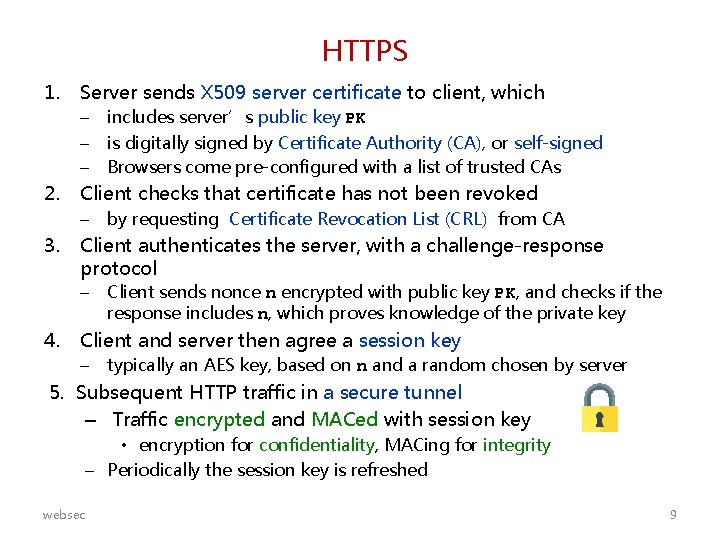
HTTPS 1. Server sends X 509 server certificate to client, which – includes server’s public key PK – is digitally signed by Certificate Authority (CA), or self-signed – Browsers come pre-configured with a list of trusted CAs 2. Client checks that certificate has not been revoked – by requesting Certificate Revocation List (CRL) from CA 3. Client authenticates the server, with a challenge-response protocol – Client sends nonce n encrypted with public key PK, and checks if the response includes n, which proves knowledge of the private key 4. Client and server then agree a session key – typically an AES key, based on n and a random chosen by server 5. Subsequent HTTP traffic in a secure tunnel – Traffic encrypted and MACed with session key • encryption for confidentiality, MACing for integrity – Periodically the session key is refreshed websec 9
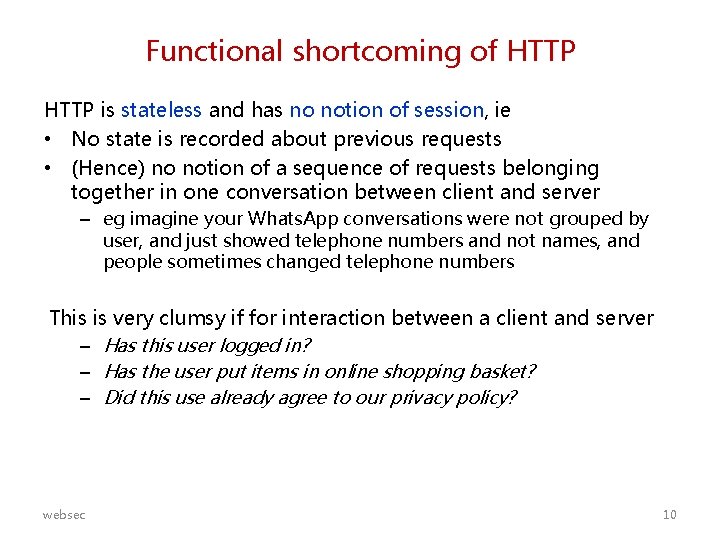
Functional shortcoming of HTTP is stateless and has no notion of session, ie • No state is recorded about previous requests • (Hence) no notion of a sequence of requests belonging together in one conversation between client and server – eg imagine your Whats. App conversations were not grouped by user, and just showed telephone numbers and not names, and people sometimes changed telephone numbers This is very clumsy if for interaction between a client and server – Has this user logged in? – Has the user put items in online shopping basket? – Did this use already agree to our privacy policy? websec 10
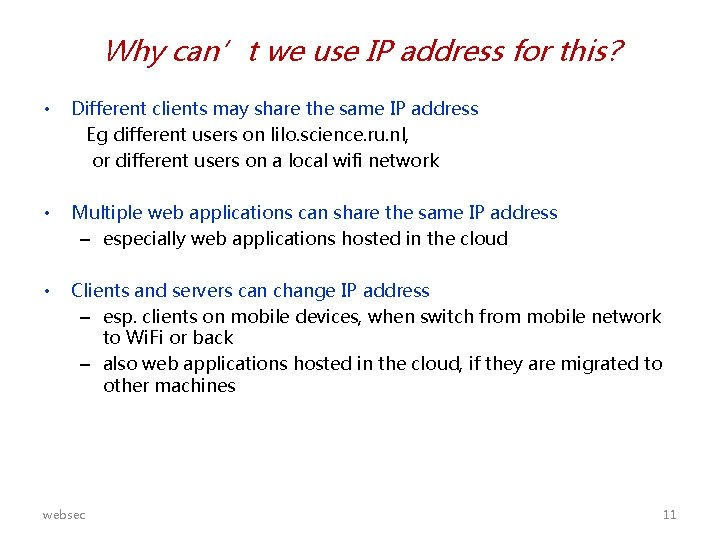
Why can’t we use IP address for this? • Different clients may share the same IP address Eg different users on lilo. science. ru. nl, or different users on a local wifi network • Multiple web applications can share the same IP address – especially web applications hosted in the cloud • Clients and servers can change IP address – esp. clients on mobile devices, when switch from mobile network to Wi. Fi or back – also web applications hosted in the cloud, if they are migrated to other machines websec 11
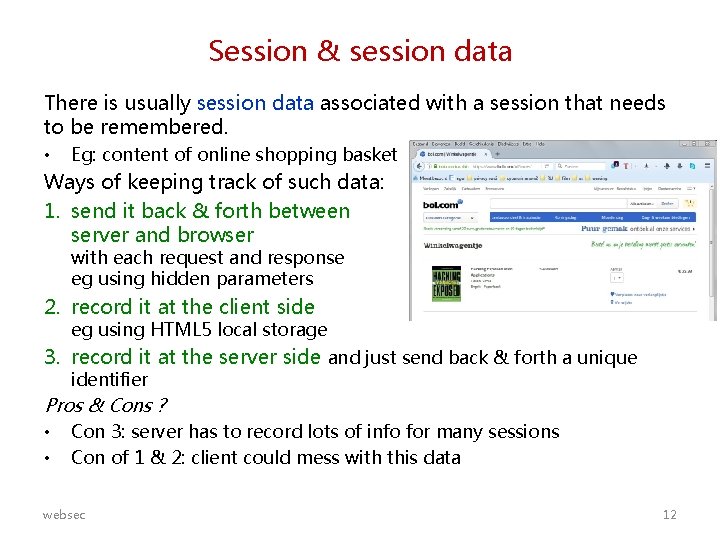
Session & session data There is usually session data associated with a session that needs to be remembered. • Eg: content of online shopping basket Ways of keeping track of such data: 1. send it back & forth between server and browser with each request and response eg using hidden parameters 2. record it at the client side eg using HTML 5 local storage eg 3. record it at the server side and just send back & forth a unique identifier Pros & Cons ? • Con 3: server has to record lots of info for many sessions • Con of 1 & 2: client could mess with this data websec 12
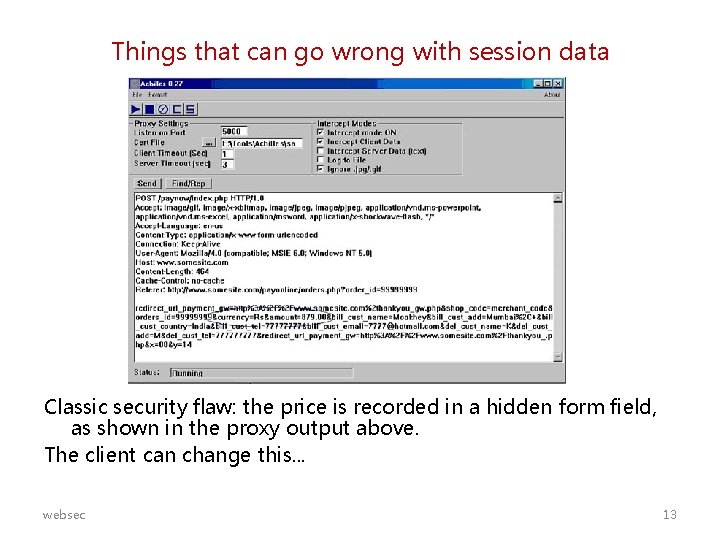
Things that can go wrong with session data Classic security flaw: the price is recorded in a hidden form field, as shown in the proxy output above. The client can change this. . . websec 13
Misplaced trust in the client For data for which integrity is important (eg prices) the server should never trust the client to provide this data or to return this data unaltered Instead, the server should • store such data server-side, or • add a cryptographic integrity check – eg using a MAC (Message Authentication Code) or Digital Signature – Such a check should also include a time stamp or some session id that frequently changes, to avoid replay or roll-back attacks. websec 14
Sessions managed by the web application Typical steps 1. Web application creates & manages sessions – Session data is stored at server and associated with a unique session ID 2. Client is informed of session ID – and client attaches session ID to subsequent requests so server knows about previous requests Web application frameworks usually provide built-in support for session management, but web application developers can implement their own • NB it is better to use existing solutions than inventing your own • Still, don’t underestimate the complexity of using these correctly websec 15
Sessions & authentication The notion of session close tied with authentication • Eg after logging in with a username & password, you will often have certain access rights for the rest of the session While the session lasts, any information that can be used by an attacker to spoof the session (eg a session ID) is just as valuable as the username/password! So such info should not be sent via HTTP but via HTTPS. How can a website mitigate this risk? • by having a time-out to terminate inactive sessions • by having a prominent Log. Out button on every webpage websec 16
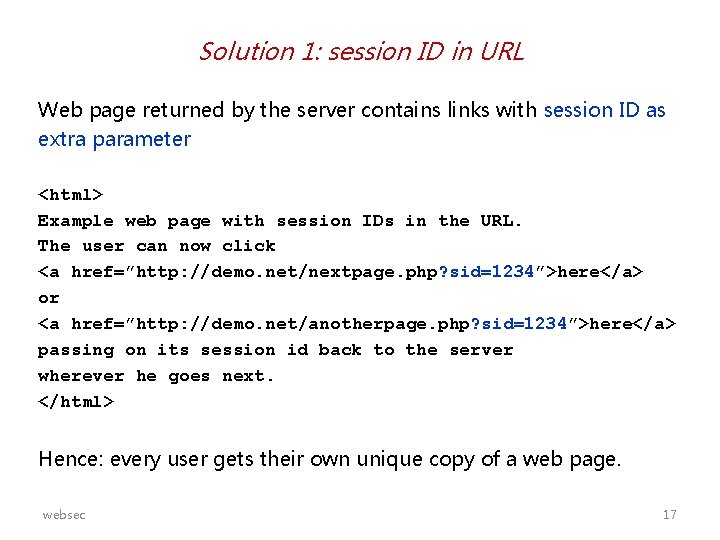
Solution 1: session ID in URL Web page returned by the server contains links with session ID as extra parameter <html> Example web page with session IDs in the URL. The user can now click <a href=”http: //demo. net/nextpage. php? sid=1234”>here</a> or <a href=”http: //demo. net/anotherpage. php? sid=1234”>here</a> passing on its session id back to the server wherever he goes next. </html> Hence: every user gets their own unique copy of a web page. websec 17
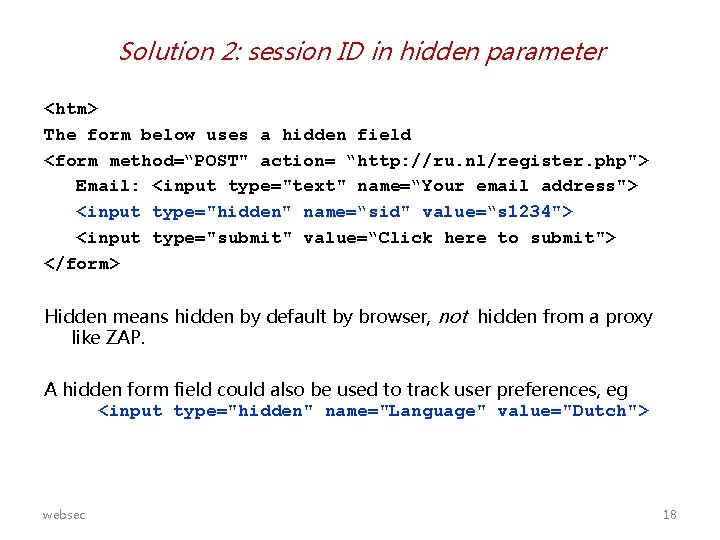
Solution 2: session ID in hidden parameter <htm> The form below uses a hidden field <form method=“POST" action= “http: //ru. nl/register. php"> Email: <input type="text" name=“Your email address"> <input type="hidden" name=“sid" value=“s 1234"> <input type="submit" value=“Click here to submit"> </form> Hidden means hidden by default by browser, not hidden from a proxy like ZAP. A hidden form field could also be used to track user preferences, eg <input type="hidden" name="Language" value="Dutch"> websec 18
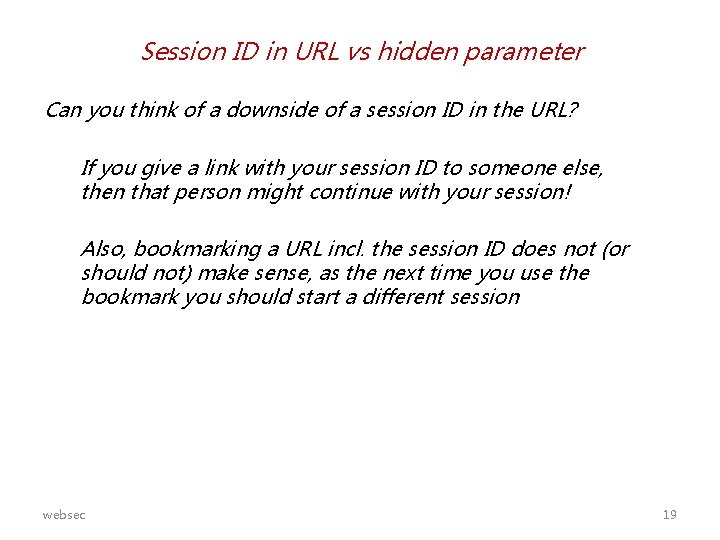
Session ID in URL vs hidden parameter Can you think of a downside of a session ID in the URL? If you give a link with your session ID to someone else, then that person might continue with your session! Also, bookmarking a URL incl. the session ID does not (or should not) make sense, as the next time you use the bookmark you should start a different session websec 19
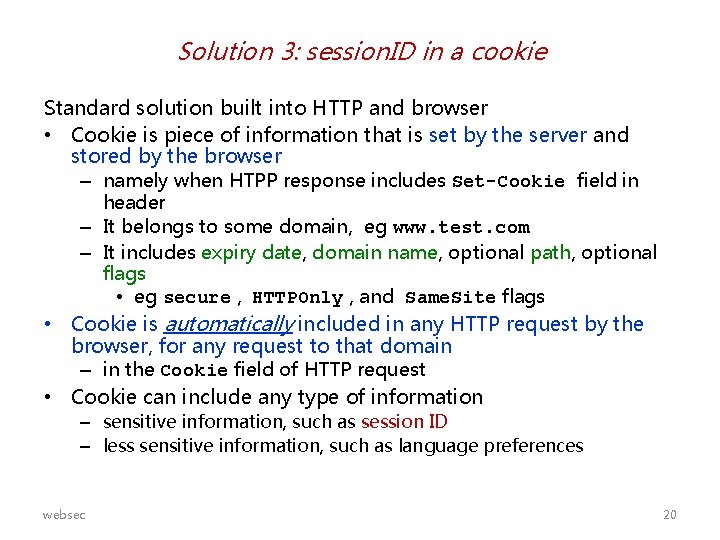
Solution 3: session. ID in a cookie Standard solution built into HTTP and browser • Cookie is piece of information that is set by the server and stored by the browser – namely when HTPP response includes Set-Cookie field in header – It belongs to some domain, eg www. test. com – It includes expiry date, domain name, optional path, optional flags • eg secure , HTTPOnly , and Same. Site flags • Cookie is automatically included in any HTTP request by the browser, for any request to that domain – in the Cookie field of HTTP request • Cookie can include any type of information – sensitive information, such as session ID – less sensitive information, such as language preferences websec 20
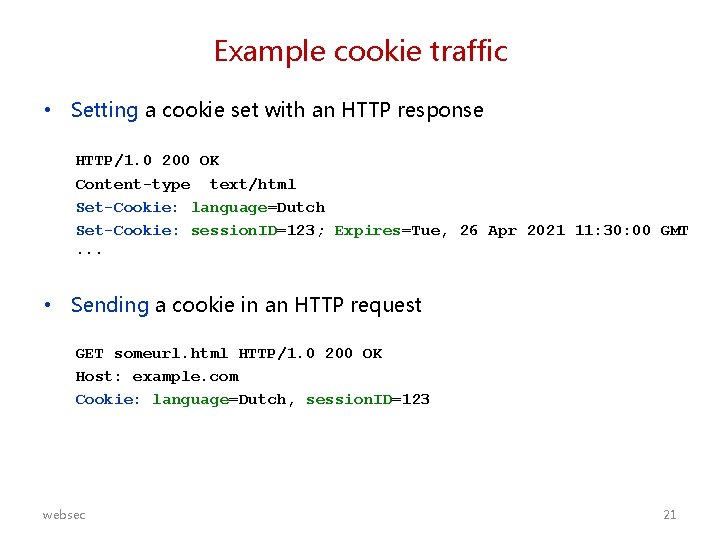
Example cookie traffic • Setting a cookie set with an HTTP response HTTP/1. 0 200 OK Content-type text/html Set-Cookie: language=Dutch Set-Cookie: session. ID=123; Expires=Tue, 26 Apr 2021 11: 30: 00 GMT. . . • Sending a cookie in an HTTP request GET someurl. html HTTP/1. 0 200 OK Host: example. com Cookie: language=Dutch, session. ID=123 websec 21
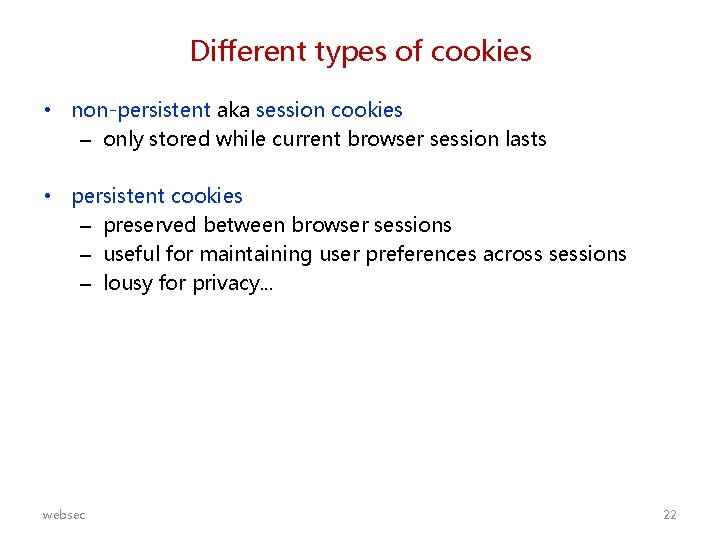
Different types of cookies • non-persistent aka session cookies – only stored while current browser session lasts • persistent cookies – preserved between browser sessions – useful for maintaining user preferences across sessions – lousy for privacy. . . websec 22
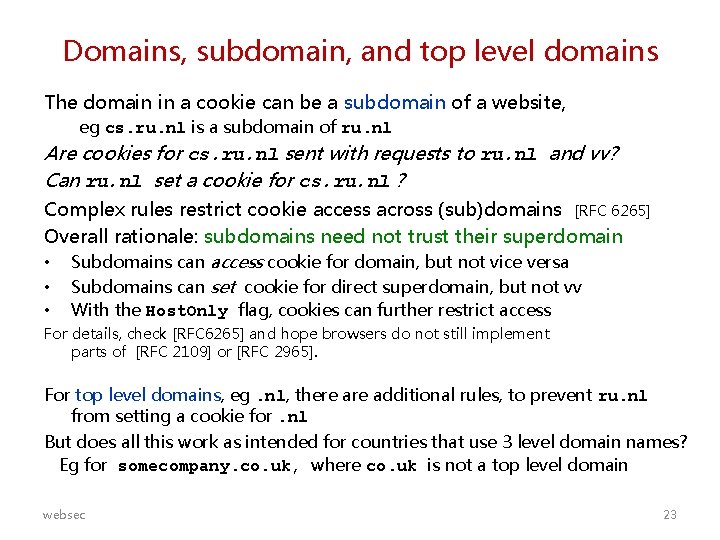
Domains, subdomain, and top level domains The domain in a cookie can be a subdomain of a website, eg cs. ru. nl is a subdomain of ru. nl Are cookies for cs. ru. nl sent with requests to ru. nl and vv? Can ru. nl set a cookie for cs. ru. nl ? Complex rules restrict cookie access across (sub)domains [RFC 6265] Overall rationale: subdomains need not trust their superdomain • • • Subdomains can access cookie for domain, but not vice versa Subdomains can set cookie for direct superdomain, but not vv With the Host. Only flag, cookies can further restrict access For details, check [RFC 6265] and hope browsers do not still implement parts of [RFC 2109] or [RFC 2965]. For top level domains, eg. nl, there additional rules, to prevent ru. nl from setting a cookie for. nl But does all this work as intended for countries that use 3 level domain names? Eg for somecompany. co. uk, where co. uk is not a top level domain websec 23
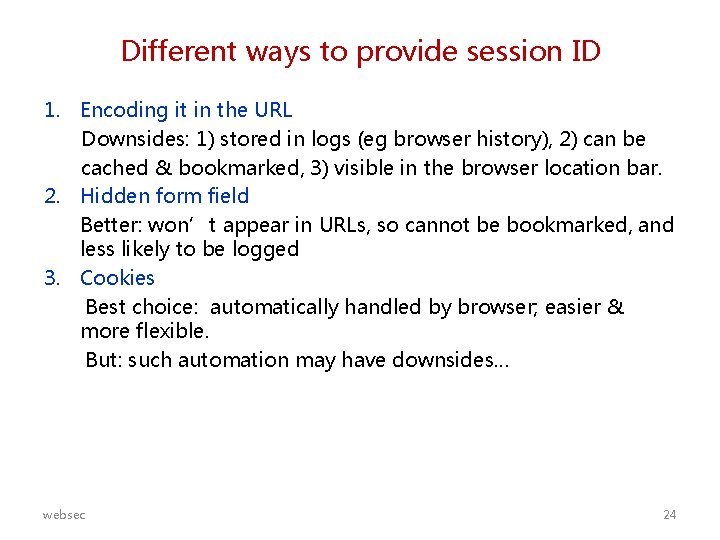
Different ways to provide session ID 1. Encoding it in the URL Downsides: 1) stored in logs (eg browser history), 2) can be cached & bookmarked, 3) visible in the browser location bar. 2. Hidden form field Better: won’t appear in URLs, so cannot be bookmarked, and less likely to be logged 3. Cookies Best choice: automatically handled by browser; easier & more flexible. But: such automation may have downsides… websec 24
Some session attacks Aim of attacker: get the session ID – This can be session cookie, or other form of session ID – If the victim is logged in, this is just as good as stealing his username and password! • Stealing the session ID – eg sniffing network traffic (or XSS attacks discussed later) • Session Prediction – try to guess a session ID • Brute Force – try many guesses for the session ID, until you get lucky • Session Fixation – make the victim use a known session ID websec 25
Session ID prediction attack Suppose you can check your grades in blackboard on page brightspace. ru. nl/grades. php? s=s 776823 Is this a security problem? If s 776823 is your student number and also the session id (in the URL in this case) then it is! Attacker could try other student IDs or – better still – the university employee number of a teacher. websec 26
Session fixation attack If the session. ID is in the URL, an attacker can 1. start a session with say bank. com and obtain a session ID; 2. craft a link with that session ID and gets victims to click it, by a) emailing victims with that link in the email; or b) luring victims to a webpage with that link 3. The victim now goes to the website using a known session ID; 4. If victim logs in, and session ID is not changed, then attacker can join the session & abuse the user’s rights! Therefore: web server should change session ID on login actions If the session-ID is a hidden form field, it does not end up in URL, attacker cannot email a link, but option 2 b) is still possible, with a POST request. Variant: attacker has already logged in, so victim joins the attacker’s session and may enter confidential data (eg credit card number) for attacker’s account. [aka Login CSRF, see Surviving the Web § 3. 3. 4] websec 27
Making attacks on sessions harder • Use long enough, random session IDs – ie with enough entropy – prevents session prediction and brute forcing • Change session ID after any change in privilege level eg after logging in – prevents session fixations • Expire sessions eg by setting expiration on cookies – reduces the attack surface in time • Use HTTPS for all requests & responses that include session ID, not just the login – prevents networking sniffing of session ID • Let clients re-authenticate before important actions – reduces the value of any stolen session ID websec 28
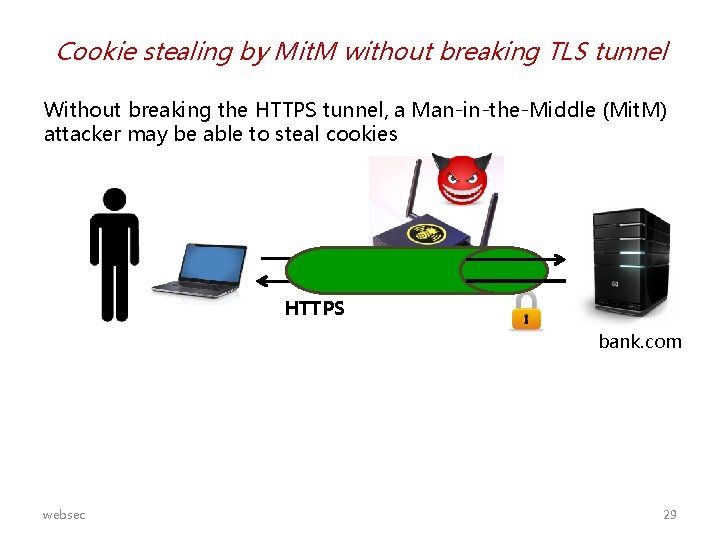
Cookie stealing by Mit. M without breaking TLS tunnel Without breaking the HTTPS tunnel, a Man-in-the-Middle (Mit. M) attacker may be able to steal cookies HTTPS bank. com websec 29
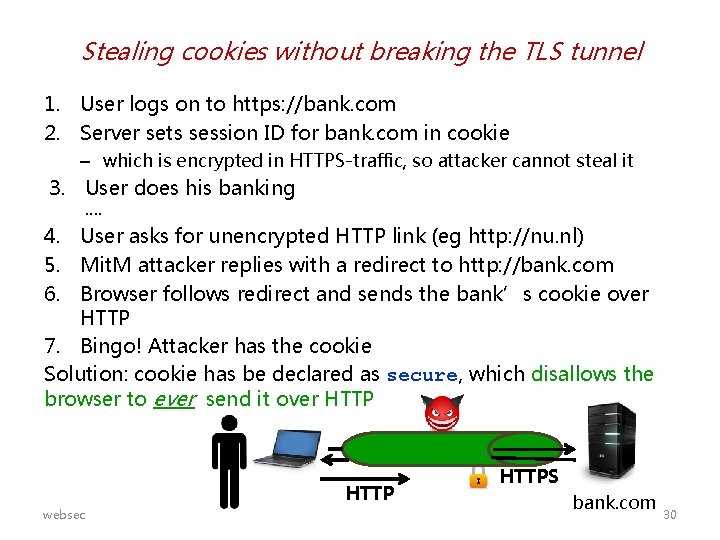
Stealing cookies without breaking the TLS tunnel 1. User logs on to https: //bank. com 2. Server sets session ID for bank. com in cookie – which is encrypted in HTTPS-traffic, so attacker cannot steal it 3. User does his banking …. 4. User asks for unencrypted HTTP link (eg http: //nu. nl) 5. Mit. M attacker replies with a redirect to http: //bank. com 6. Browser follows redirect and sends the bank’s cookie over HTTP 7. Bingo! Attacker has the cookie Solution: cookie has be declared as secure, which disallows the browser to ever send it over HTTP websec HTTPS bank. com 30
Stealing cookies with scripts (XSS) • If the attacker can sneak a script into the bank’s website, the script can inspect the cookies and send them anywhere on the internet, including to https: //mafia. com • Such an attack, called Cross Site Scripting (XSS) attacks will be discussed in 2 weeks • Solution: cookie has be declared as Http. Only – This means the cookie is only used for sending along with HTTP requests & never allowed to be accessed by scripts running in the webpage websec 31
Abusing cookies without stealing them (CSRF) Suppose webpage bank. com contains <a href=”transfer. Money? amount=1000 &to. Account=52. 12. 57. 762”> Suppose attacker sets up a malicious website mafia. com with <a href=”https: //bank. com/transfer. Money? amount=1000 &to. Account=52. 12. 57. 762”> Will there be a difference in HTTP requests? In other words, can bank. com tell the difference? • No! • The browser automatically attaches the bank’s cookies to both • requests! So if the victim is logged in to the bank, money will be transferred This is called a Cross-Site Request Forgery (CSRF) websec 32
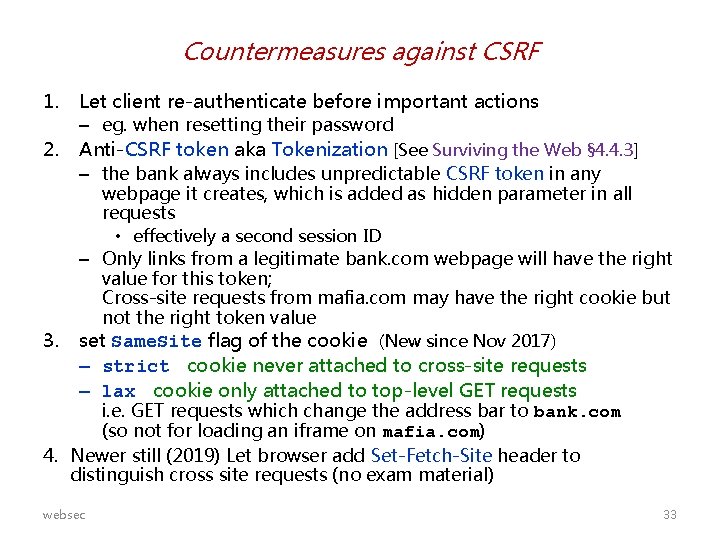
Countermeasures against CSRF 1. 2. 3. Let client re-authenticate before important actions – eg. when resetting their password Anti-CSRF token aka Tokenization [See Surviving the Web § 4. 4. 3] – the bank always includes unpredictable CSRF token in any webpage it creates, which is added as hidden parameter in all requests • effectively a second session ID – Only links from a legitimate bank. com webpage will have the right value for this token; Cross-site requests from mafia. com may have the right cookie but not the right token value set Same. Site flag of the cookie (New since Nov 2017) – strict cookie never attached to cross-site requests – lax cookie only attached to top-level GET requests i. e. GET requests which change the address bar to bank. com (so not for loading an iframe on mafia. com) 4. Newer still (2019) Let browser add Set-Fetch-Site header to distinguish cross site requests (no exam material) websec 33
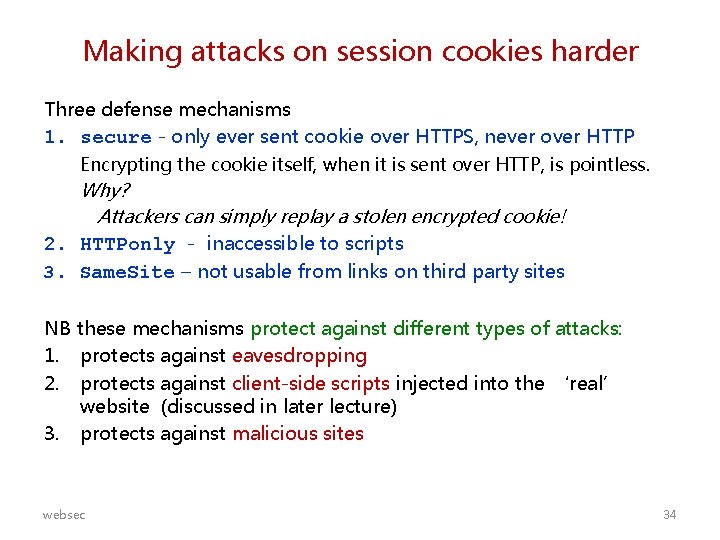
Making attacks on session cookies harder Three defense mechanisms 1. secure - only ever sent cookie over HTTPS, never over HTTP Encrypting the cookie itself, when it is sent over HTTP, is pointless. Why? Attackers can simply replay a stolen encrypted cookie! 2. HTTPonly - inaccessible to scripts 3. Same. Site – not usable from links on third party sites NB these mechanisms protect against different types of attacks: 1. protects against eavesdropping 2. protects against client-side scripts injected into the ‘real’ website (discussed in later lecture) 3. protects against malicious sites websec 34
Attacking HTTPS websec 35
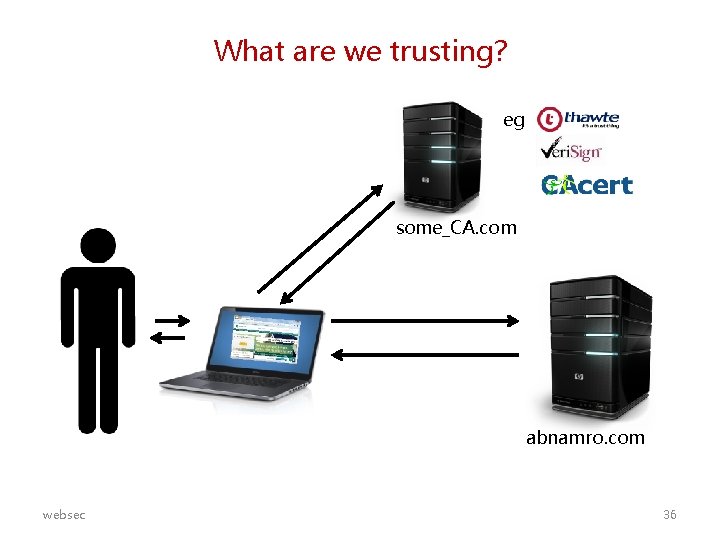
What are we trusting? eg some_CA. com abnamro. com websec 36
EV certificates recognisable in browser websec 37
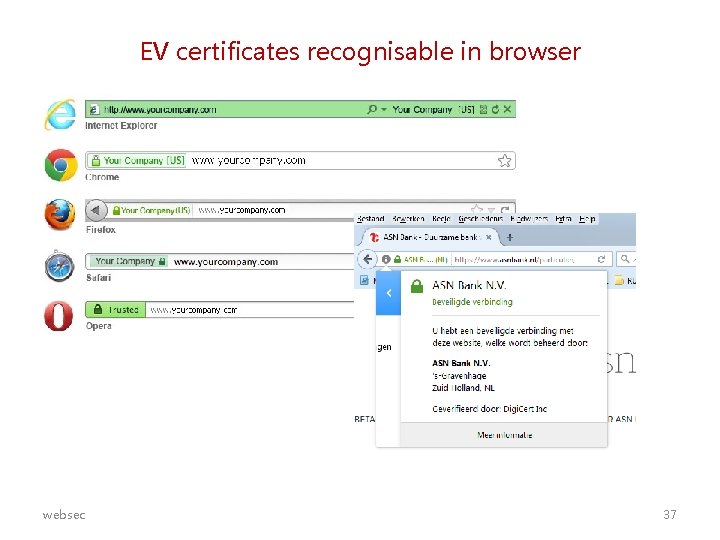
DV, OV and EV SSL certificates CAs validates who is requesting a certificate for a domain in different ways: • DV (Domain Validation) certificates – Email check to validate that this is the owner of that domain, using whois information (eg via https: //www. sidn. nl/whois) – Free via Let's. Encypt since April 2016 • OV (Organisation Validation) certificates – Additional check on identity & existence of the organisation eg against Chamber of Commerce records • EV (Extended Validation) certificates – More rigorous check on identity of the organisation – How much extra security EV gives over OV brings is debatable. . . Certificates can be wild-card certificates, eg for *. ru. nl instead of www. ru. nl websec 38
Trusted Computing Base (TCB) The Trusted Computing Base (TCB) is the smallest amount of software (and hardware, people, organisations, . . . ) that you MUST trust for some security property. The TCB for HTTPS is huge: we trust that • the TLS software is correct (but: Heart. Bleed) • the web-server protects its private key • the browser checks the certificate correctly, including the CRL • the Certificate Authorities (CAs) For Firefox, https: //ccadb-public. secure. force. com/mozilla/Included. CACertificate. Report • the user checks for lock icon (and maybe the content of the certificate? ) • there is no malware in our browser or on our machine that is faking the display • . . websec 39
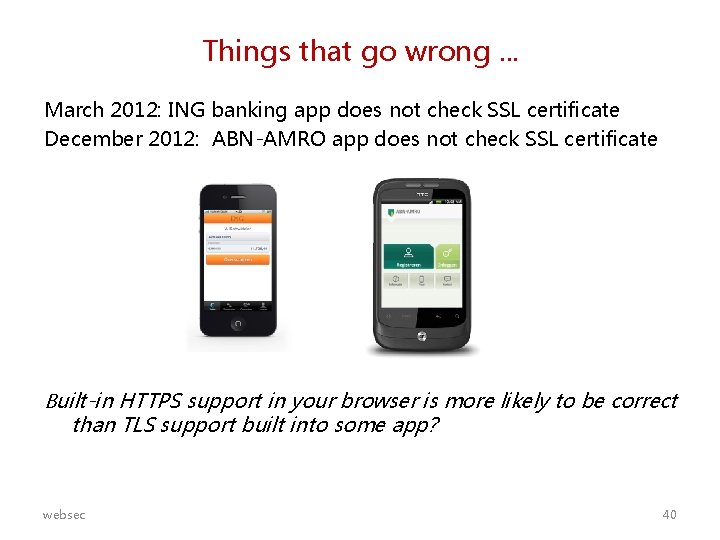
Things that go wrong. . . March 2012: ING banking app does not check SSL certificate December 2012: ABN-AMRO app does not check SSL certificate Built-in HTTPS support in your browser is more likely to be correct than TLS support built into some app? websec 40
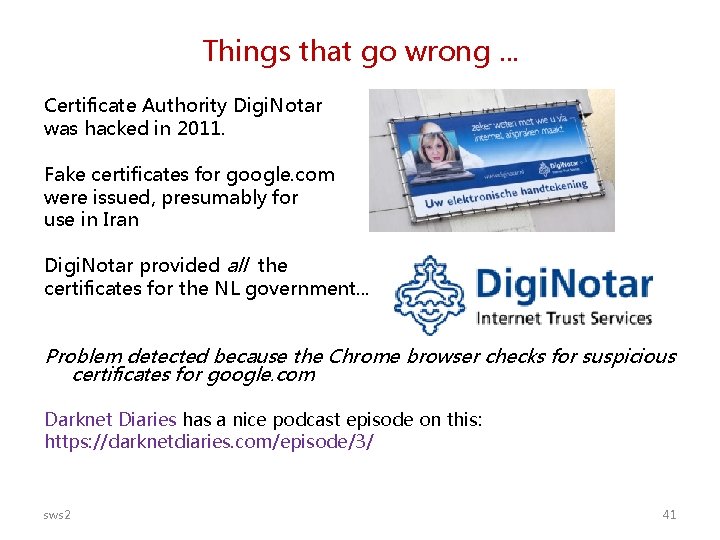
Things that go wrong. . . Certificate Authority Digi. Notar was hacked in 2011. Fake certificates for google. com were issued, presumably for use in Iran Digi. Notar provided all the certificates for the NL government. . . Problem detected because the Chrome browser checks for suspicious certificates for google. com Darknet Diaries has a nice podcast episode on this: https: //darknetdiaries. com/episode/3/ sws 2 41
Countermeasures • HPKP (HTTP Public Key Certificate Pinning) – browser remembers the public key of domains, and refuses new certificates for that domain with a new key – Not a big success: abandoned in 2017, because of the risks it introduces • eg if a wrong public key ends up in the browser, there is NO way to recover from this • Certificate Transparency (CT) – Initiative to publicly share info on all issued certificates • See eg https: //crt. sh – Organisations can spot if a rogue certificate is issued in their name: i. e. someone at Radboud should periodically (daily? ) check there are no rogue certificates issued for ru. nl websec 42
Attacking HTTPS with Man-in-the-Middle attack • Capabilities of the attacker – eavesdrop on traffic & modify traffic (i. e. imagine of a proxy) • Goals of the attacker – seeing plaintext data – modifying traffic without user noticing – or just: seeing the cookie Different attack vectors/attack scenarios for a Mit. M attack: • malicious wireless access point • fake website, which redirects the traffic to the real website • by the ISP, e. g. nation state intercepting all internet traffic websec 43
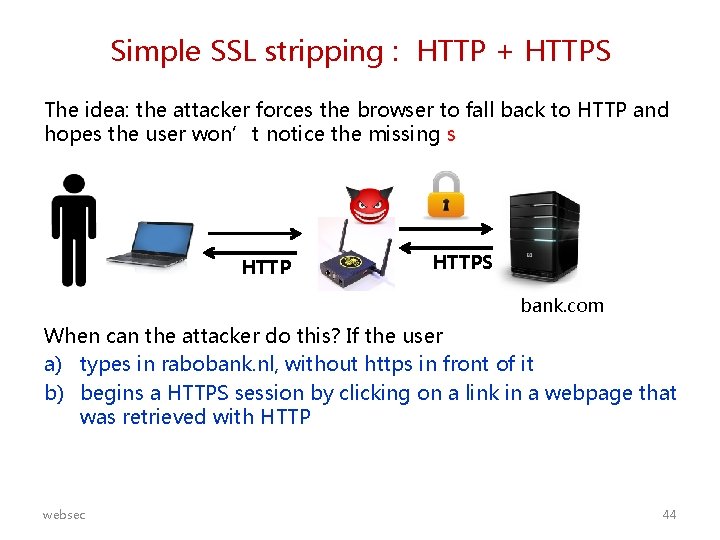
Simple SSL stripping : HTTP + HTTPS The idea: the attacker forces the browser to fall back to HTTP and hopes the user won’t notice the missing s HTTPS bank. com When can the attacker do this? If the user a) types in rabobank. nl, without https in front of it b) begins a HTTPS session by clicking on a link in a webpage that was retrieved with HTTP websec 44
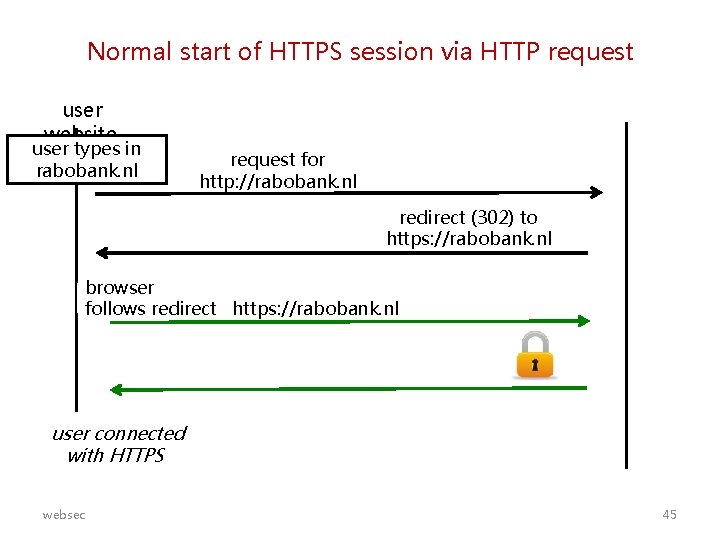
Normal start of HTTPS session via HTTP request user website user types in rabobank. nl request for http: //rabobank. nl redirect (302) to https: //rabobank. nl browser follows redirect https: //rabobank. nl user connected with HTTPS websec 45
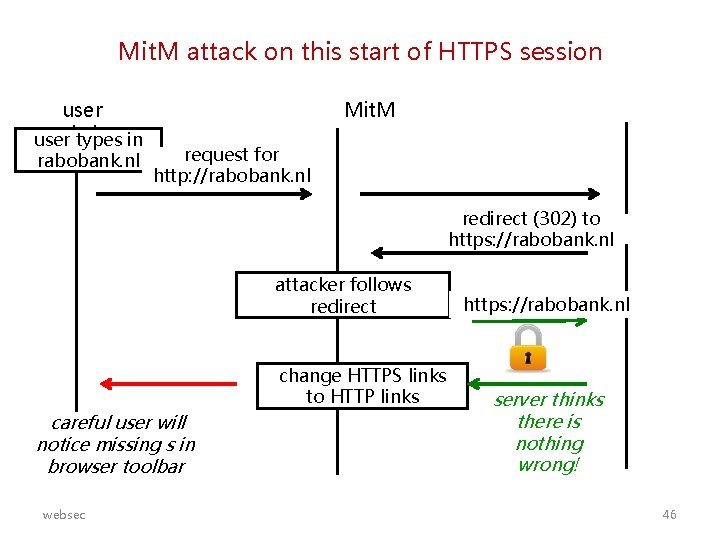
Mit. M attack on this start of HTTPS session user website user types in rabobank. nl Mit. M request for http: //rabobank. nl redirect (302) to https: //rabobank. nl attacker follows redirect change HTTPS links to HTTP links careful user will notice missing s in browser toolbar websec https: //rabobank. nl server thinks there is nothing wrong! 46
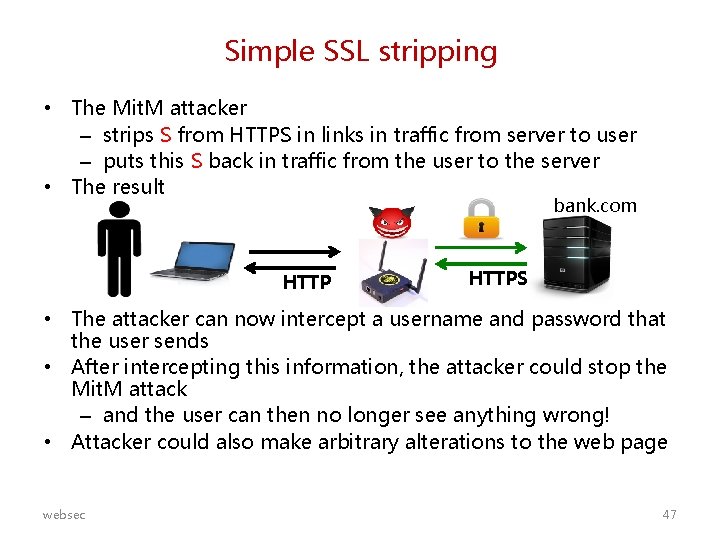
Simple SSL stripping • The Mit. M attacker – strips S from HTTPS in links in traffic from server to user – puts this S back in traffic from the user to the server • The result bank. com HTTPS • The attacker can now intercept a username and password that the user sends • After intercepting this information, the attacker could stop the Mit. M attack – and the user can then no longer see anything wrong! • Attacker could also make arbitrary alterations to the web page websec 47
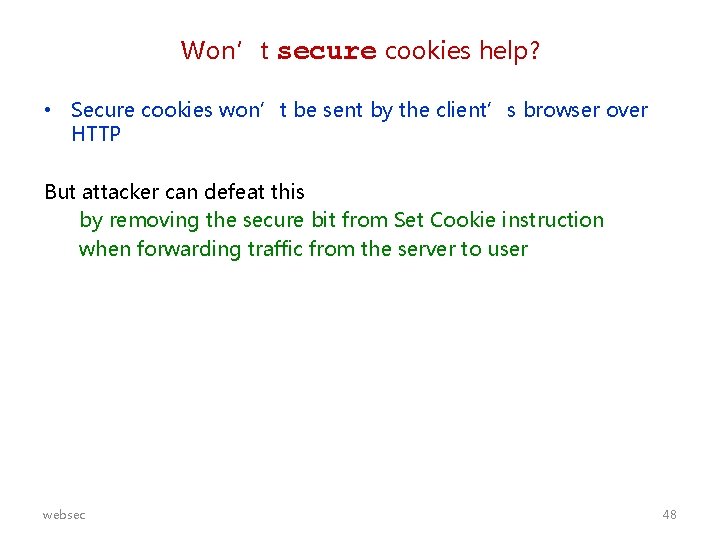
Won’t secure cookies help? • Secure cookies won’t be sent by the client’s browser over HTTP But attacker can defeat this by removing the secure bit from Set Cookie instruction when forwarding traffic from the server to user websec 48
Spotting this attack? A careful user can spot this attack • the URL misses the s in https • the little lock is missing in the browser corner Nice improvement: the attacker can add websec as flavicon 49
![The original secure site websec [source: Moxie Marlinspike, Blackhat 2009] 50](http://slidetodoc.com/presentation_image_h2/acc0d153213e1764fb3ae6b394f94b5d/image-50.jpg "The original secure site websec [source: Moxie Marlinspike, Blackhat 2009] 50")
The original secure site websec [source: Moxie Marlinspike, Blackhat 2009] 50
![SSL stripped version lock as flavicon websec [source: Moxie Marlinspike, Blackhat 2009] 51](http://slidetodoc.com/presentation_image_h2/acc0d153213e1764fb3ae6b394f94b5d/image-51.jpg "SSL stripped version lock as flavicon websec [source: Moxie Marlinspike, Blackhat 2009] 51")
SSL stripped version lock as flavicon websec [source: Moxie Marlinspike, Blackhat 2009] 51
![The original secure site websec [source: Moxie Marlinspike, Blackhat 2009] 52](http://slidetodoc.com/presentation_image_h2/acc0d153213e1764fb3ae6b394f94b5d/image-52.jpg "The original secure site websec [source: Moxie Marlinspike, Blackhat 2009] 52")
The original secure site websec [source: Moxie Marlinspike, Blackhat 2009] 52
![The SSL stripped version websec [source: Moxie Marlinspike, Blackhat 2009] 53](http://slidetodoc.com/presentation_image_h2/acc0d153213e1764fb3ae6b394f94b5d/image-53.jpg "The SSL stripped version websec [source: Moxie Marlinspike, Blackhat 2009] 53")
The SSL stripped version websec [source: Moxie Marlinspike, Blackhat 2009] 53
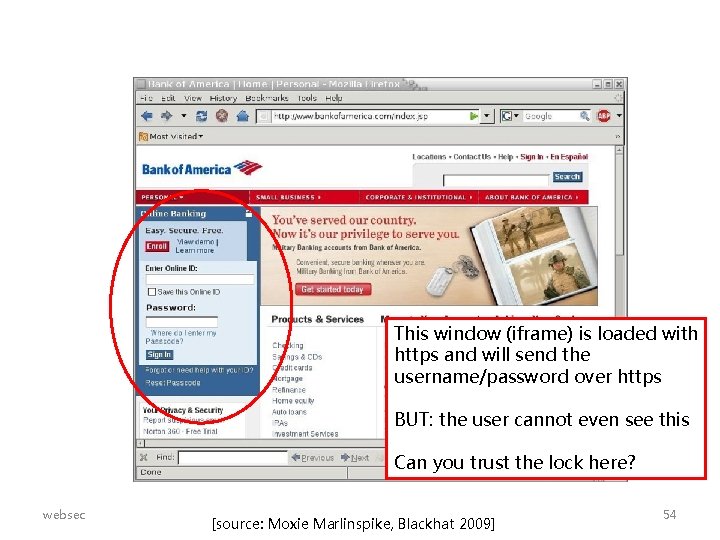
This window (iframe) is loaded with https and will send the username/password over https BUT: the user cannot even see this Can you trust the lock here? websec [source: Moxie Marlinspike, Blackhat 2009] 54
Mixing http & https Moral of the last example: • Never use https for a frame inside a http page • Never issue https requests from an http page Web browsers nowadays warn about (or even block) mixed http/https content. Demo: check out how this works in your browser http: //www. cs. ru. nl/~erikpoll/websec/demo/mixed_content. html https: //www. cs. ru. nl/~erikpoll/websec/demo/mixed_content. html websec 55
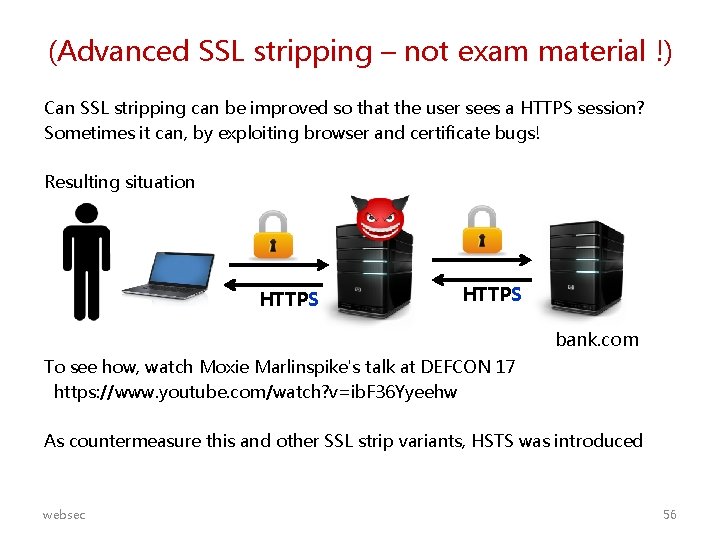
(Advanced SSL stripping – not exam material !) Can SSL stripping can be improved so that the user sees a HTTPS session? Sometimes it can, by exploiting browser and certificate bugs! Resulting situation HTTPS bank. com To see how, watch Moxie Marlinspike's talk at DEFCON 17 https: //www. youtube. com/watch? v=ib. F 36 Yyeehw As countermeasure this and other SSL strip variants, HSTS was introduced websec 56
Other countermeasures to SSL stripping • HTTPS Everywhere browser plugin – ie. simply never use HTTP • HSTS (HTTP Strict Transport Security) websec 57
![HTTP Strict Transport Security (HSTS) [RFC 6797] Protection against SSL stripping 1. website (e.](http://slidetodoc.com/presentation_image_h2/acc0d153213e1764fb3ae6b394f94b5d/image-58.jpg "HTTP Strict Transport Security (HSTS) [RFC 6797] Protection against SSL stripping 1. website (e.")
HTTP Strict Transport Security (HSTS) [RFC 6797] Protection against SSL stripping 1. website (e. g. bank. nl) tells the browser that it only ever wants to use HTTPS, in HTTP response header Strict-Transport-Security: max-age=15768000; include. Sub. Domain 2. the browser remembers this, and will in future turn http requests for that domain into https requests Eg browser will turn http: //bank. nl/rekening/. . . into https: //bank. nl/rekening/. . . HSTS is now supported by all mainstream browsers. websec 58
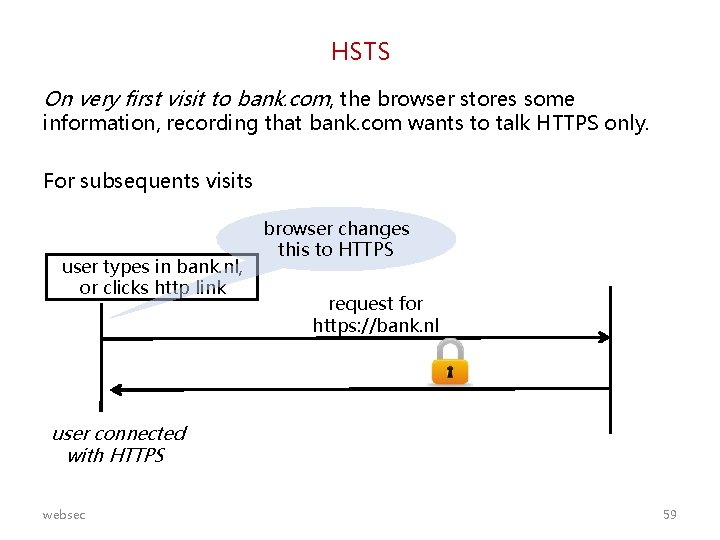
HSTS On very first visit to bank. com, the browser stores some information, recording that bank. com wants to talk HTTPS only. For subsequents visits user types in bank. nl, or clicks http link bank. nl browser changes this to HTTPS request for https: //bank. nl user connected with HTTPS websec 59
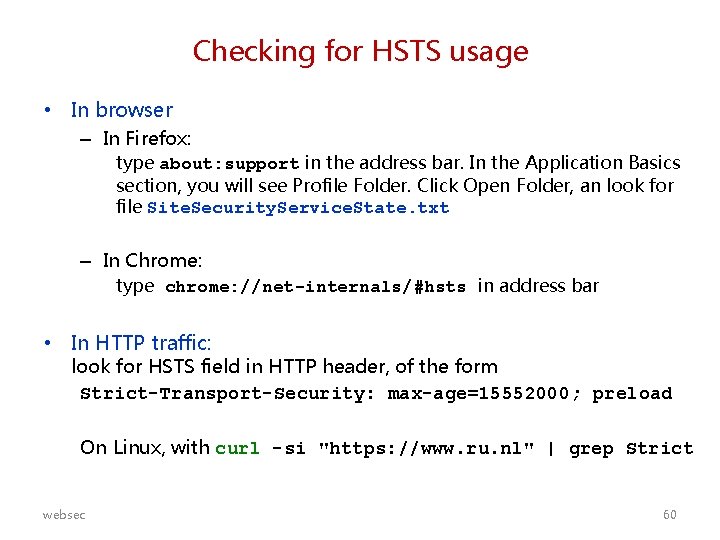
Checking for HSTS usage • In browser – In Firefox: type about: support in the address bar. In the Application Basics section, you will see Profile Folder. Click Open Folder, an look for file Site. Security. Service. State. txt – In Chrome: type chrome: //net-internals/#hsts in address bar • In HTTP traffic: look for HSTS field in HTTP header, of the form Strict-Transport-Security: max-age=15552000; preload On Linux, with curl -si "https: //www. ru. nl" | grep Strict websec 60
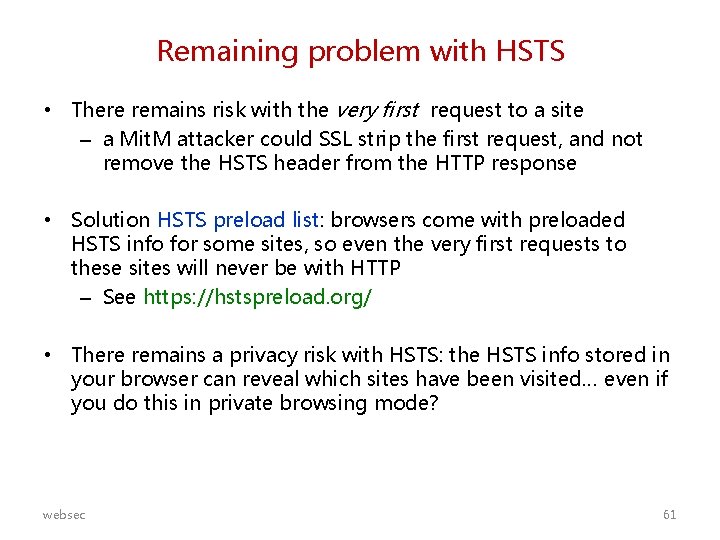
Remaining problem with HSTS • There remains risk with the very first request to a site – a Mit. M attacker could SSL strip the first request, and not remove the HSTS header from the HTTP response • Solution HSTS preload list: browsers come with preloaded HSTS info for some sites, so even the very first requests to these sites will never be with HTTP – See https: //hstspreload. org/ • There remains a privacy risk with HSTS: the HSTS info stored in your browser can reveal which sites have been visited… even if you do this in private browsing mode? websec 61
Exercises for this week A. Checking input sanitisation in Brightspace How is input encoded & sanitised in Discussion Forums, at the client side and/or at the server side? B. Checking secruity settings (cookie setting & HSTS, Certificate Transparency, . . ) for some sites where you have a login C. One more Web. Goat lesson Authentication Flaws - Authentication Bypasses NB A & B to be handed in (in pairs) via Brightspace Deadline Friday 11 Sept, 23: 59 websec 62
- Slides: 62