
Web search engines Paolo Ferragina Dipartimento di Informatica

Web search engines Paolo Ferragina Dipartimento di Informatica Università di Pisa
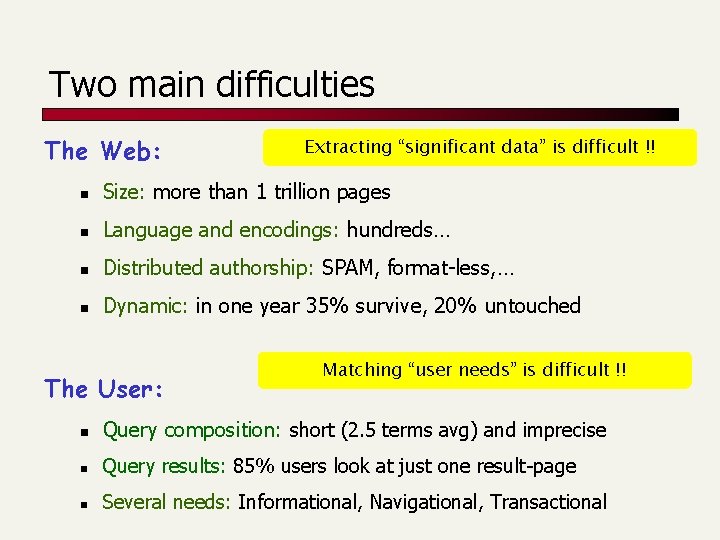
Two main difficulties The Web: Extracting “significant data” is difficult !! n Size: more than 1 trillion pages n Language and encodings: hundreds… n Distributed authorship: SPAM, format-less, … n Dynamic: in one year 35% survive, 20% untouched The User: Matching “user needs” is difficult !! n Query composition: short (2. 5 terms avg) and imprecise n Query results: 85% users look at just one result-page n Several needs: Informational, Navigational, Transactional
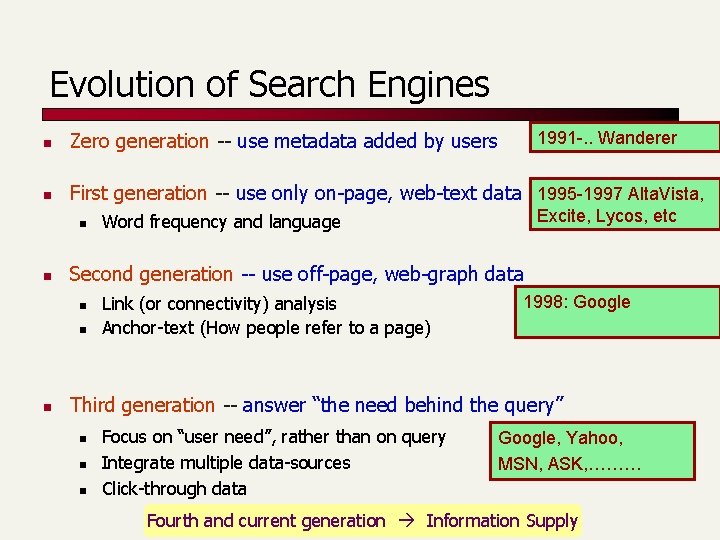
Evolution of Search Engines 1991 -. . Wanderer n Zero generation -- use metadata added by users n First generation -- use only on-page, web-text data 1995 -1997 Alta. Vista, n n Second generation -- use off-page, web-graph data n n n Excite, Lycos, etc Word frequency and language Link (or connectivity) analysis Anchor-text (How people refer to a page) 1998: Google Third generation -- answer “the need behind the query” n n n Focus on “user need”, rather than on query Integrate multiple data-sources Click-through data Google, Yahoo, MSN, ASK, ……… Fourth and current generation Information Supply
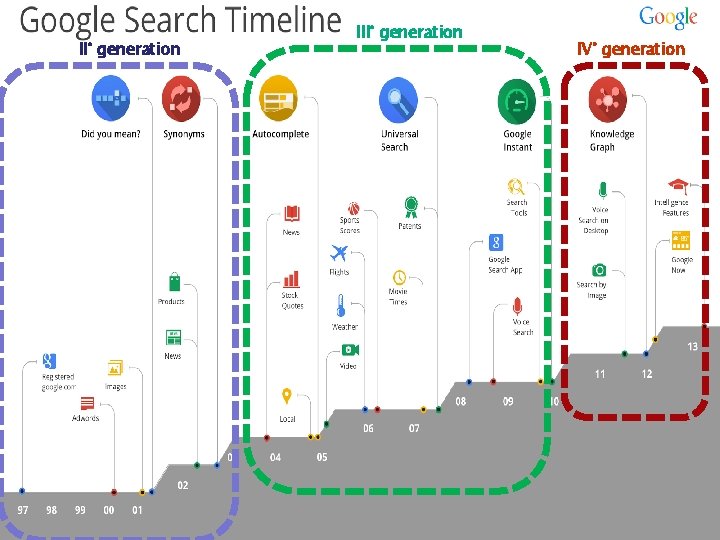
II° generation IV° generation
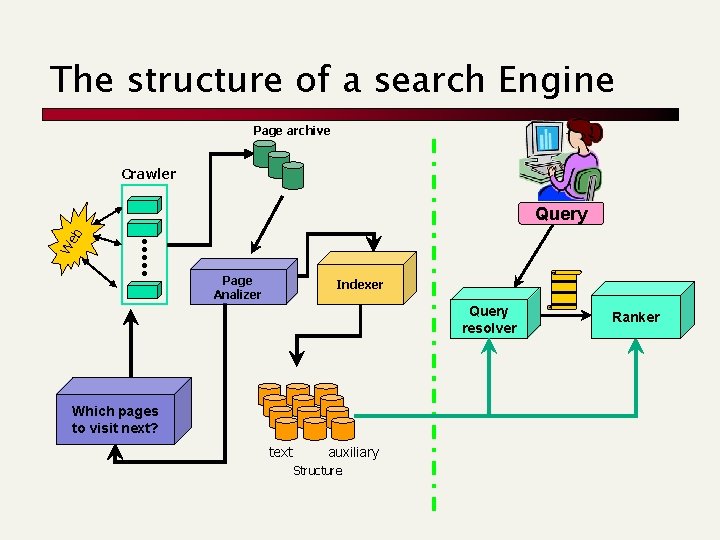
The structure of a search Engine Page archive Crawler We b Query Page Analizer Indexer Query resolver Which pages to visit next? text auxiliary Structure Ranker

The web graph: properties Paolo Ferragina Dipartimento di Informatica Università di Pisa
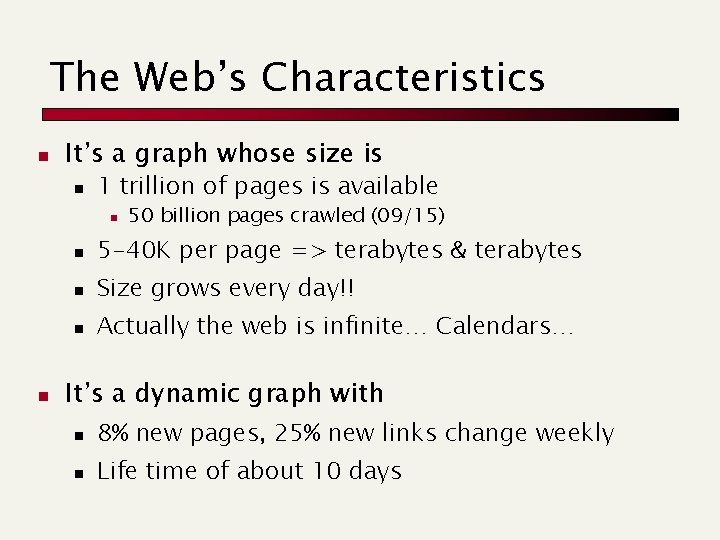
The Web’s Characteristics n It’s a graph whose size is n 1 trillion of pages is available n n 50 billion pages crawled (09/15) n 5 -40 K per page => terabytes & terabytes n Size grows every day!! n Actually the web is infinite… Calendars… It’s a dynamic graph with n 8% new pages, 25% new links change weekly n Life time of about 10 days
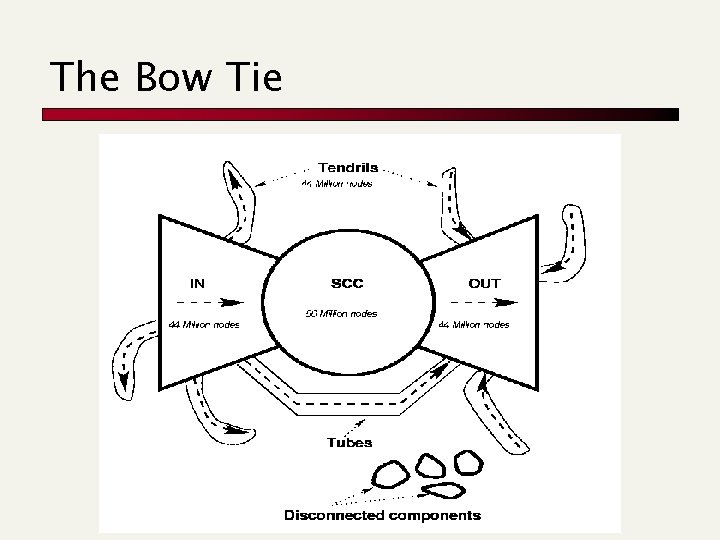
The Bow Tie

Crawling Paolo Ferragina Dipartimento di Informatica Università di Pisa
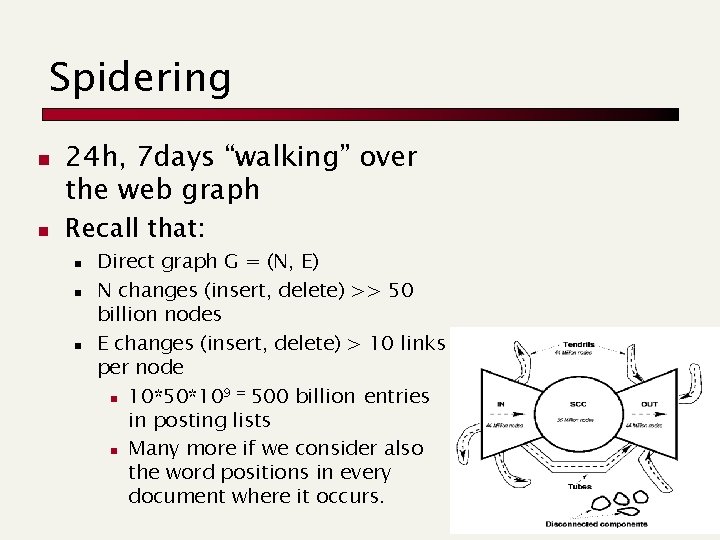
Spidering n n 24 h, 7 days “walking” over the web graph Recall that: n n n Direct graph G = (N, E) N changes (insert, delete) >> 50 billion nodes E changes (insert, delete) > 10 links per node 9 = 500 billion entries n 10*50*10 in posting lists n Many more if we consider also the word positions in every document where it occurs.
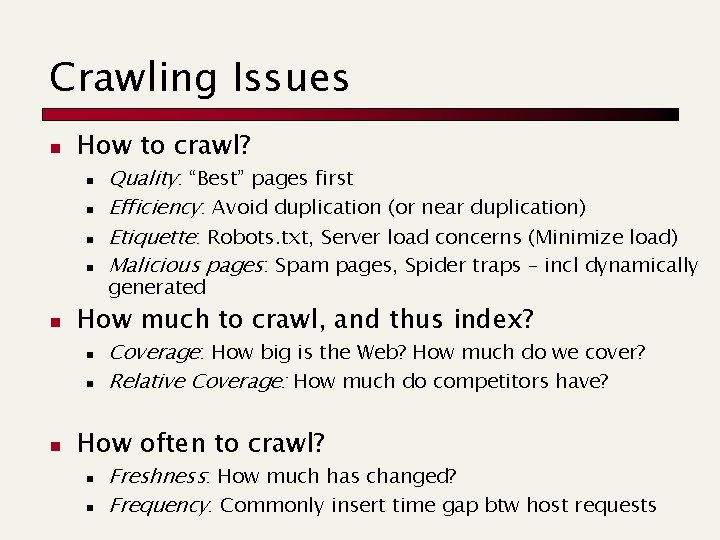
Crawling Issues n How to crawl? n n n generated How much to crawl, and thus index? n n n Quality: “Best” pages first Efficiency: Avoid duplication (or near duplication) Etiquette: Robots. txt, Server load concerns (Minimize load) Malicious pages: Spam pages, Spider traps – incl dynamically Coverage: How big is the Web? How much do we cover? Relative Coverage: How much do competitors have? How often to crawl? n n Freshness: How much has changed? Frequency: Commonly insert time gap btw host requests
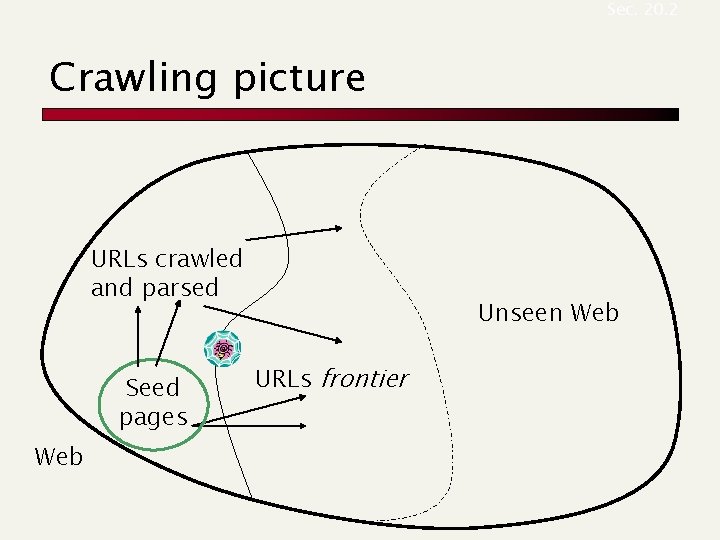
Sec. 20. 2 Crawling picture URLs crawled and parsed Seed pages Web Unseen Web URLs frontier
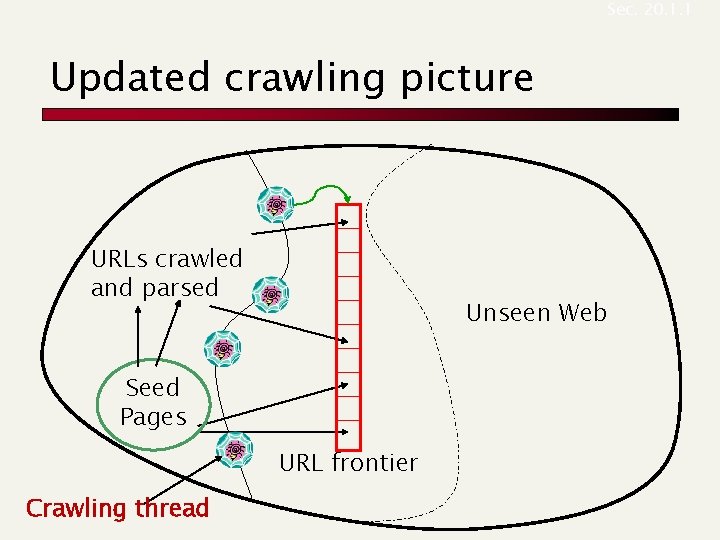
Sec. 20. 1. 1 Updated crawling picture URLs crawled and parsed Unseen Web Seed Pages URL frontier Crawling thread
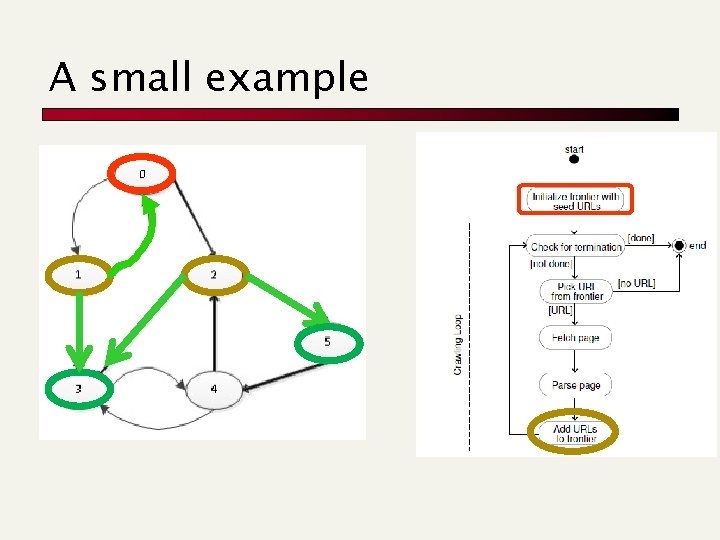
A small example
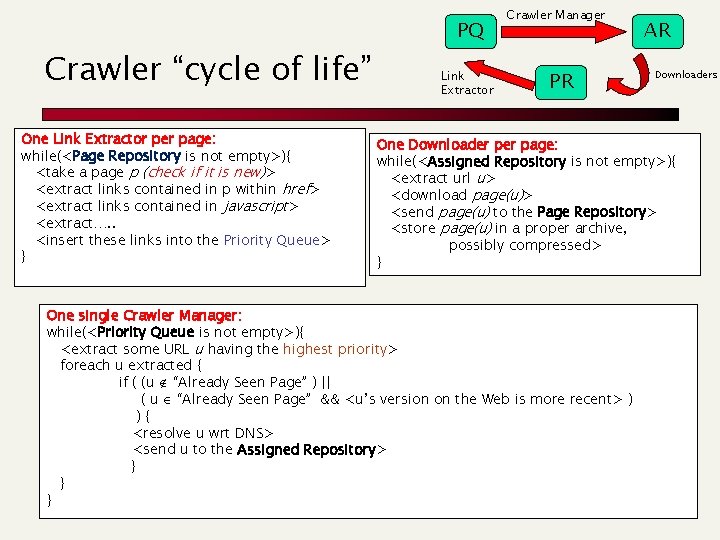
Crawler “cycle of life” One Link Extractor per page: while(<Page Repository is not empty>){ <take a page p (check if it is new)> <extract links contained in p within href> <extract links contained in javascript> <extract…. . <insert these links into the Priority Queue> } PQ Link Extractor Crawler Manager PR AR Downloaders One Downloader page: while(<Assigned Repository is not empty>){ <extract url u> <download page(u)> <send page(u) to the Page Repository> <store page(u) in a proper archive, possibly compressed> } One single Crawler Manager: while(<Priority Queue is not empty>){ <extract some URL u having the highest priority> foreach u extracted { if ( (u “Already Seen Page” ) || ( u “Already Seen Page” && <u’s version on the Web is more recent> ) ){ <resolve u wrt DNS> <send u to the Assigned Repository> } } }
URL frontier visiting n Given a page P, define how “good” P is. n Several metrics (via priority assignment): n n n BFS, DFS, Random Popularity driven (Page. Rank, full vs partial) Topic driven or focused crawling Combined How to fast check whether the URL is new ?
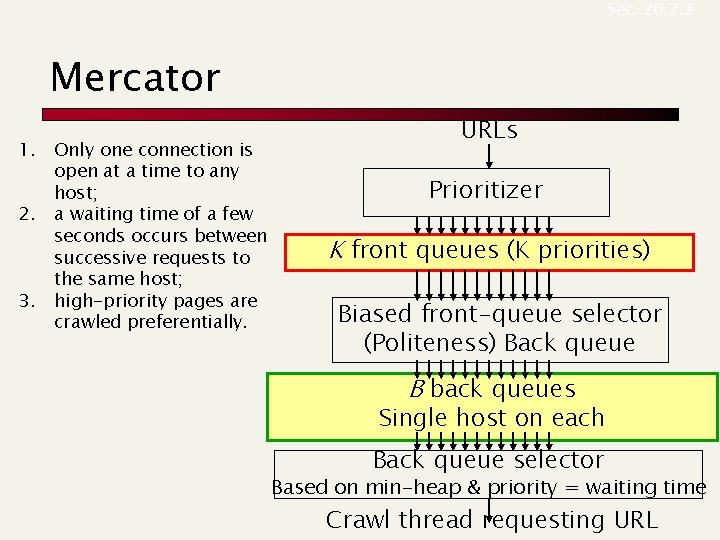
Sec. 20. 2. 3 Mercator 1. Only one connection is open at a time to any host; 2. a waiting time of a few seconds occurs between successive requests to the same host; 3. high-priority pages are crawled preferentially. URLs Prioritizer K front queues (K priorities) Biased front-queue selector (Politeness) Back queue B back queues Single host on each Back queue selector Based on min-heap & priority = waiting time Crawl thread requesting URL
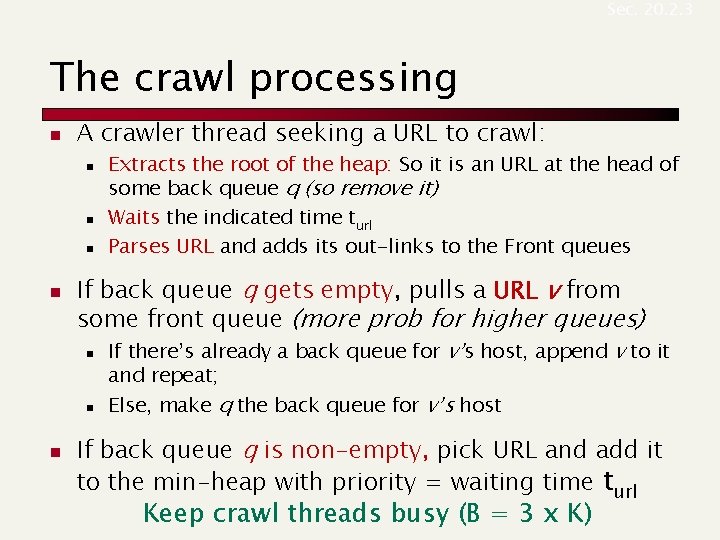
Sec. 20. 2. 3 The crawl processing n A crawler thread seeking a URL to crawl: n n If back queue q gets empty, pulls a URL v from some front queue (more prob for higher queues) n n n Extracts the root of the heap: So it is an URL at the head of some back queue q (so remove it) Waits the indicated time turl Parses URL and adds its out-links to the Front queues If there’s already a back queue for v’s host, append v to it and repeat; Else, make q the back queue for v’s host If back queue q is non-empty, pick URL and add it to the min-heap with priority = waiting time turl Keep crawl threads busy (B = 3 x K)
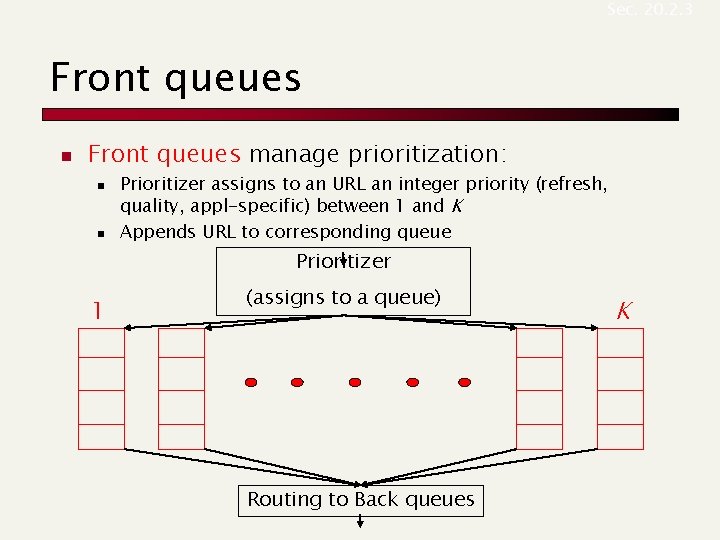
Sec. 20. 2. 3 Front queues n Front queues manage prioritization: n n Prioritizer assigns to an URL an integer priority (refresh, quality, appl-specific) between 1 and K Appends URL to corresponding queue Prioritizer 1 (assigns to a queue) Routing to Back queues K
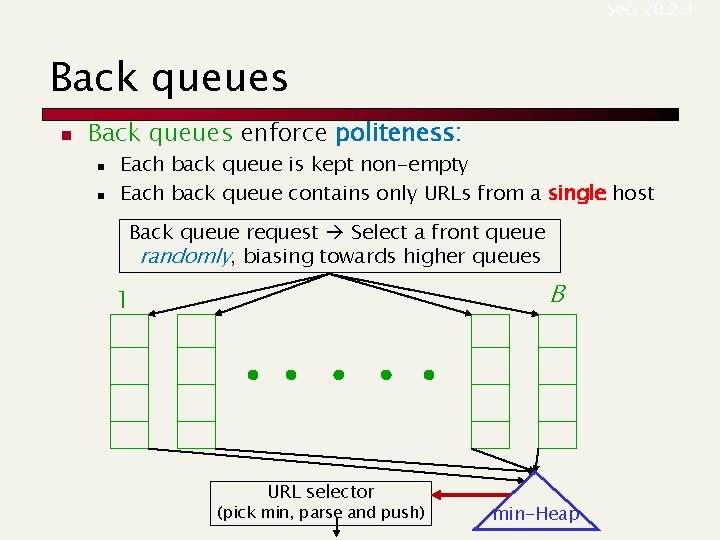
Sec. 20. 2. 3 Back queues n Back queues enforce politeness: n n Each back queue is kept non-empty Each back queue contains only URLs from a single host Back queue request Select a front queue randomly, biasing towards higher queues B 1 URL selector (pick min, parse and push) min-Heap
Sec. 20. 2. 3 The min-heap n n n It contains one entry per back queue The entry is the earliest time te at which the host corresponding to the back queue can be “hit again” This earliest time is determined from n n Last access to that host Any time buffer heuristic we choose
- Slides: 21