
Web Engineering Web Application Architectures Lecture V 4
Web Engineering Web Application Architectures Lecture V – 4 th November 2008 Federico M. Facca © Copyright 2008 STI - INNSBRUCK www. sti-innsbruck. at
Overview • Introduction • Web Application Architectures • Wrap-up Web Engineering (703512) 2
What is an architecture? INTRODUCTION Web Engineering (703512) 3
Software Architectures • “Architecture is defined as the fundamental organization of a system, embodied in its components, their relationships to each other and the environment, and the principles governing its design and evolution. • ”(IEEE Architecture Working Group, P 1471, 1999) • Architectures describe structure – Components of software systems, their interfaces and relationships – static as well as dynamic aspects – blueprint of software system • Architectures connect software development phases – requirements are mapped to components and their relationships Web Engineering (703512) 4
![Software Architectures • “Architecture is the set of design decisions [. . . ]](http://slidetodoc.com/presentation_image_h2/86652cea968aa31544d55c77cd2c0d92/image-5.jpg "Software Architectures • “Architecture is the set of design decisions [. . . ]")
Software Architectures • “Architecture is the set of design decisions [. . . ] that keeps its implementers and maintainers from exercising needless creativity. ”(Desmond F. D’Souza and Alan C. Wills, 1999) • Architectures describe different viewpoints – conceptual view: entities of application domain and their relationships – process view: system runs and synchronization – implementation view: software arte facts (subsystems, components, source code) – runtime view: components at runtime and their communication • Architectures make systems comprehensible and controllable – structuring according to different viewpoints – enables communication between different stakeholders Web Engineering (703512) 5
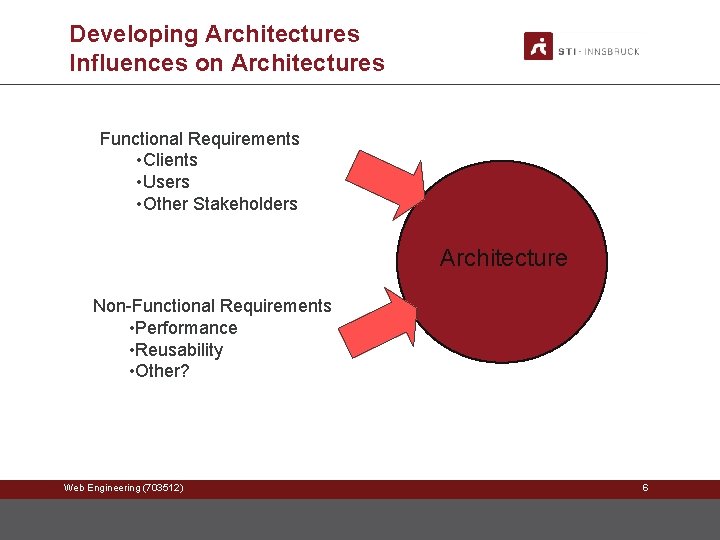
Developing Architectures Influences on Architectures Functional Requirements • Clients • Users • Other Stakeholders Architecture Non-Functional Requirements • Performance • Reusability • Other? Web Engineering (703512) 6
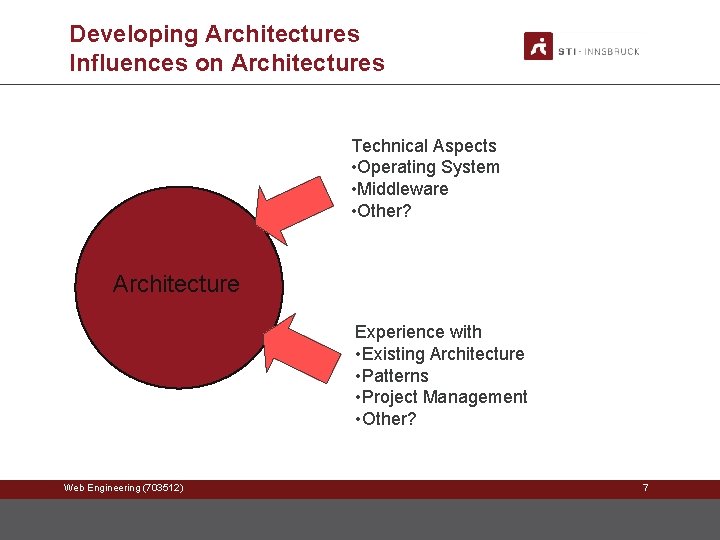
Developing Architectures Influences on Architectures Technical Aspects • Operating System • Middleware • Other? Architecture Experience with • Existing Architecture • Patterns • Project Management • Other? Web Engineering (703512) 7
Developing Architectures • Remember, requirements are always subject to change. – Organizational & Environment changes – Ambiguous requirements initially • Thus, iterative approaches are the suggested means of development – Pro: Helps to mitigate design risks – Caution: Doesn’t guarantee a good architecture (ex. , What about legacy systems? ) Web Engineering (703512) 8
Patterns & Frameworks • Patterns describe recurring design problems • Types of patterns – Architecture patterns – Design patterns (e. g. Publisher-Subscriber) • They are a guideline, implementation must be grounded to the specific problem • Patterns need to be “integrated” among them! Web Engineering (703512) 9
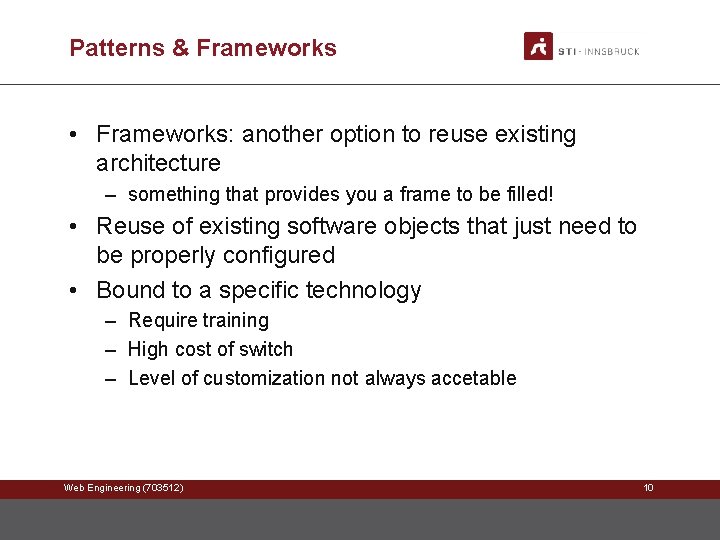
Patterns & Frameworks • Frameworks: another option to reuse existing architecture – something that provides you a frame to be filled! • Reuse of existing software objects that just need to be properly configured • Bound to a specific technology – Require training – High cost of switch – Level of customization not always accetable Web Engineering (703512) 10
WEB APPLICATION ARCHITECTURES Web Engineering (703512) 11
Architecture Types • Layering Aspect – “Separation of concerns” – How many concurrent users are you serving? – Shared needs among multiple applications? (e. g. , security) • Data Aspect – What kind(s) of data are you delivering? • Structured vs. non-structured • On-demand vs. real-time – What are the bandwidth requirements? • Size & nature of data • Again, audience concerns Web Engineering (703512) 12

Architecture Types • Web Platform Architecture (WPA) – Platform = Infrastructure • Hardware • Software modules & configurations • Choice of software platform (e. g. , J 2 EE, . NET) • Web Application Architecture (WAA) – Conceptual view of how key business processes and needs are separated & implemented – Often domain-specific – Greater complexity requires greater modularity Web Engineering (703512) 13
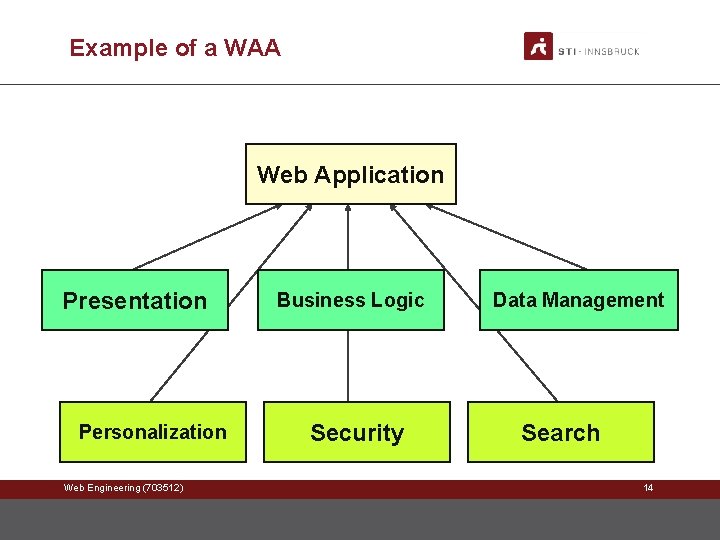
Example of a WAA Web Application Presentation Personalization Web Engineering (703512) Business Logic Security Data Management Search 14
Generic Web (Platform) Architecture • The Web “platform” is based on – TCP/IP – HTTP – HTML • It’s essentially a Client/Server architecture! – In term of patterns one of the simplest one • But still thing can get complex… – Components on the network (firewall, proxy, load balancer) – Components in the intranet (Web server, application server, data base, legacy systems, web services) Web Engineering (703512) 15
Web Architectures: Specifics • Technological constraints – HTTP • Broad variety of technical solutions – application servers, proxies, firewalls. – checking of quality difficult • e. g. , performance depends on various components, like database, network bandwidth, processor, memory, code, … – improvement of quality difficult • e. g. , code performance may not change overall performance substantially • Technical solutions. – short product life cycles – missing standards impede component integration from different manufactures • Global access to Web applications – internationalization, cultural differences Web Engineering (703512) 16
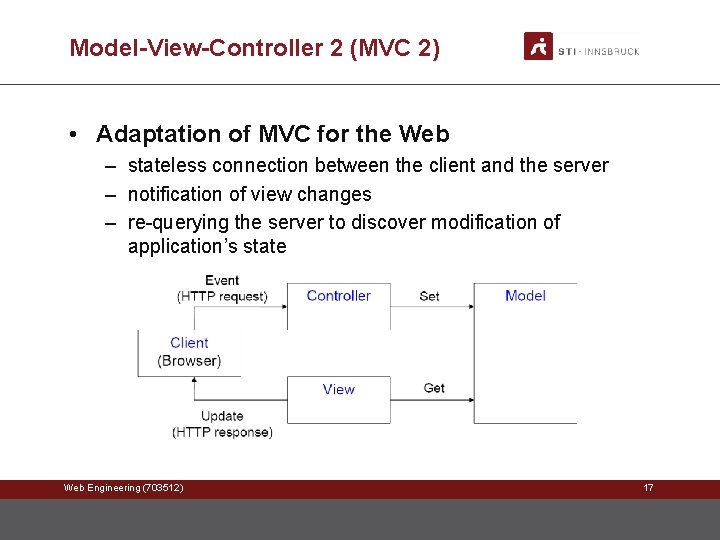
Model-View-Controller 2 (MVC 2) • Adaptation of MVC for the Web – stateless connection between the client and the server – notification of view changes – re-querying the server to discover modification of application’s state Web Engineering (703512) 17
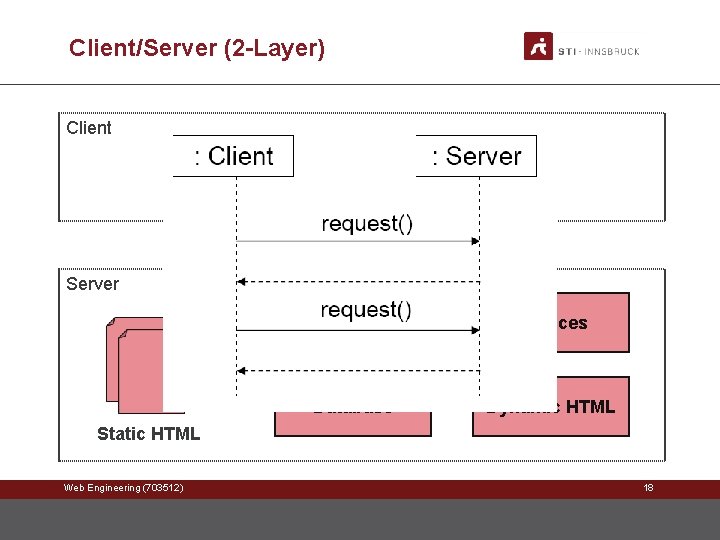
Client/Server (2 -Layer) Client Server Web/App Server Services Database Dynamic HTML Static HTML Web Engineering (703512) 18
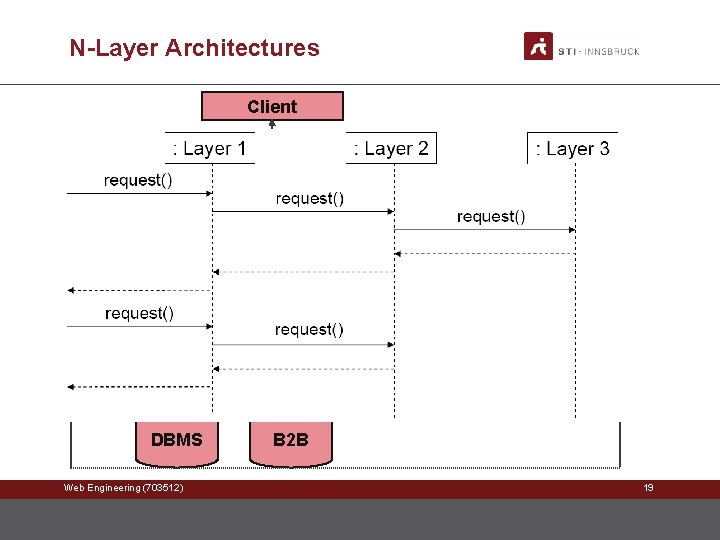
N-Layer Architectures Client Firewall Proxy Web Server Presentation Layer Business Layer Application Server (Business Logic, Connectors, Personalization, Data Access) Backend (Legacy Application, Enterprise Info System) Data Layer DBMS Web Engineering (703512) B 2 B 19
Why an N-Layer Architecture? • Separating services in business layer promotes reuse among applications – Loose-coupling – changes reduce impact on overall system. – More maintainable (in terms of code) – More extensible (modular) • Trade-offs – Needless complexity – More points of failure Web Engineering (703512) 20
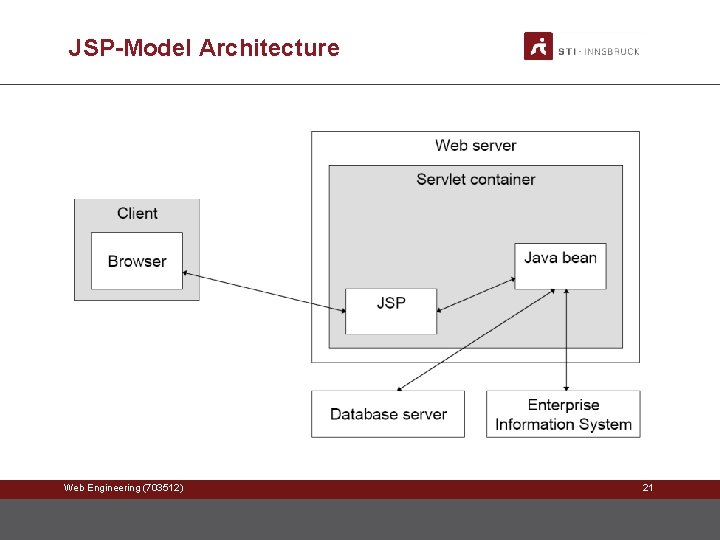
JSP-Model Architecture Web Engineering (703512) 21
- Slides: 21