
Web Conference 4 NRSG 785 Professional Writing More
Web Conference #4 NRSG 785 Professional Writing More Synthesis
Objectives • Explain components of literature synthesis • Apply elements of reflective model to writing process
Before we begin… any burning questions?
Now that you have collected and judged the evidence… • Let’s take it to the next steps: – Summarize – Analyze and critique – Synthesize!

Summary vs. Critique • Summaries describe the key points of an article for the reader • Critiques begin with a summary, then analyze and evaluate the author’s research – – – Comparisons Contrasts Strengths Limitations Implications Future directions
• • Important things to consider in a Critique Do data and conclusions match? Are the conclusions supported? What questions remain unanswered? How could future studies be improved?
Critique vs. Synthesis “…a synthesis is more than combining a spectrum of source material into a single document. Why? Because you also have to use your own mind and words to draw connections between the sources, and using these connections to relate the different texts in a way that illuminates and transforms the material. ” C. Schmidt, (2015) Word. Pressblog
Synthesis • Should not contain a series of disjointed summaries of research articles. • The final product will be a synthesis — a smooth blending — of selected articles built around your topic
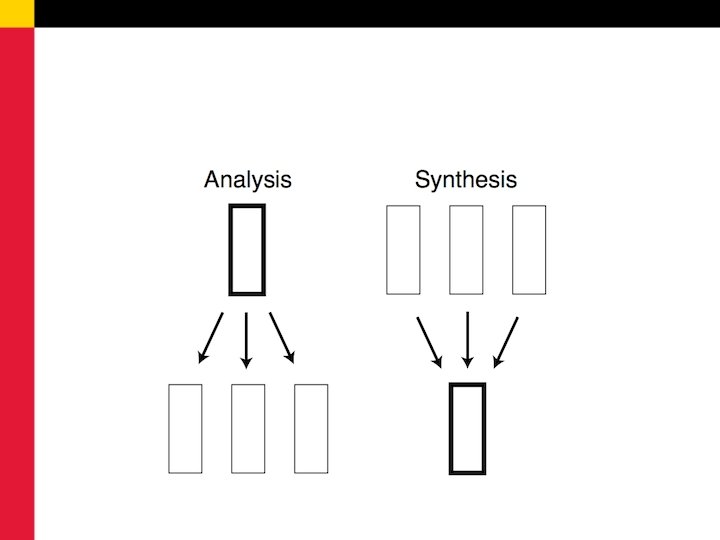
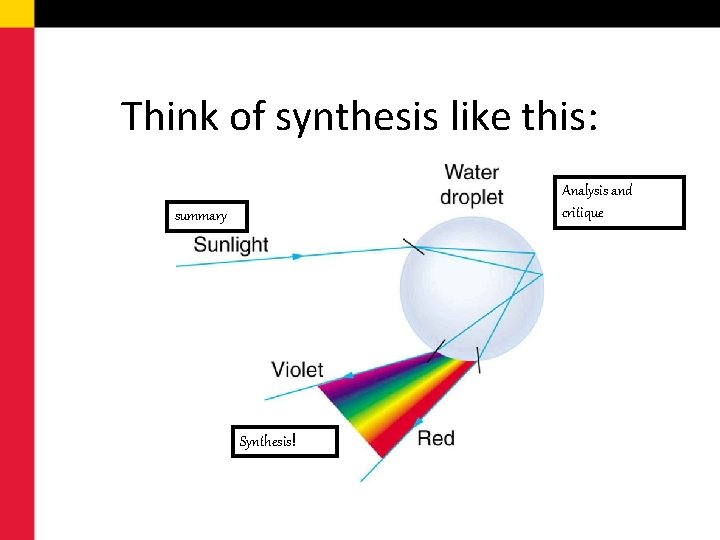
Think of synthesis like this: Analysis and critique summary Synthesis!

Or better yet… • Let’s go shoe shopping!
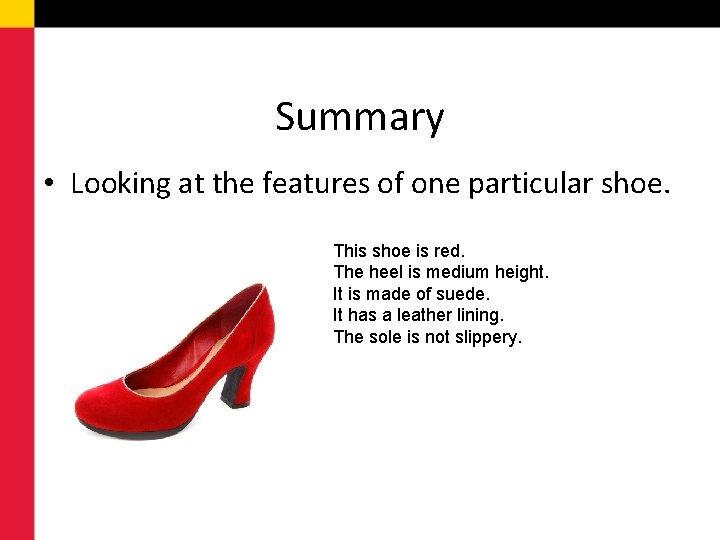
Summary • Looking at the features of one particular shoe. This shoe is red. The heel is medium height. It is made of suede. It has a leather lining. The sole is not slippery.
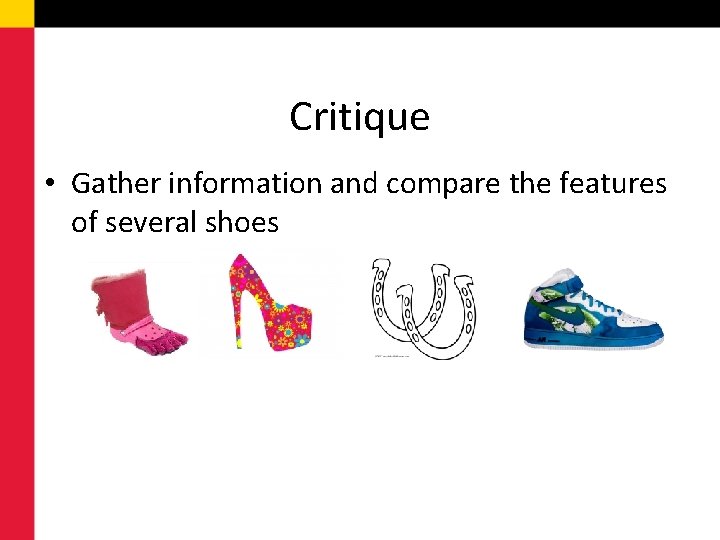
Critique • Gather information and compare the features of several shoes
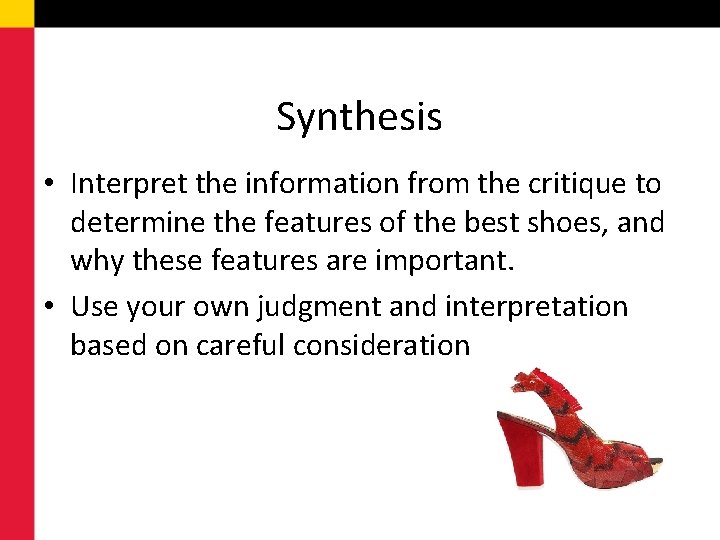
Synthesis • Interpret the information from the critique to determine the features of the best shoes, and why these features are important. • Use your own judgment and interpretation based on careful consideration
What is synthesis? • Synthesizing sources is a matter of pulling them together into some kind of harmony. • Consider whether what seem like unrelated elements or opposite observations might be reconciled. • Create an umbrella idea, some larger argument under which several observations and perspectives might stand.
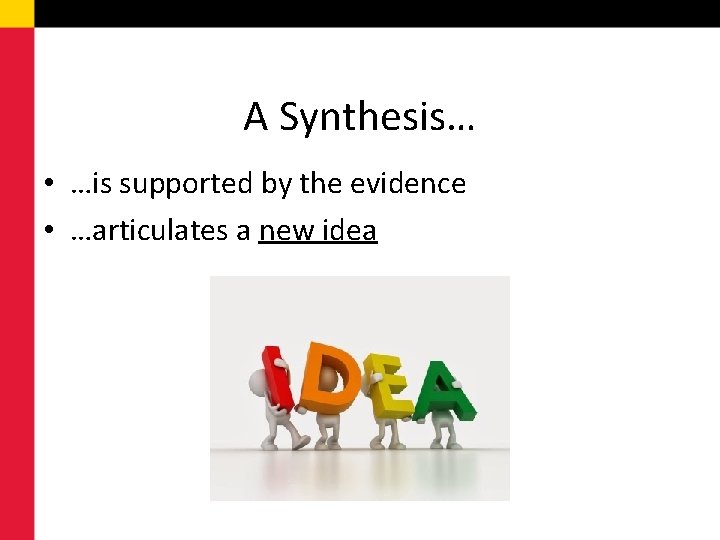
A Synthesis… • …is supported by the evidence • …articulates a new idea
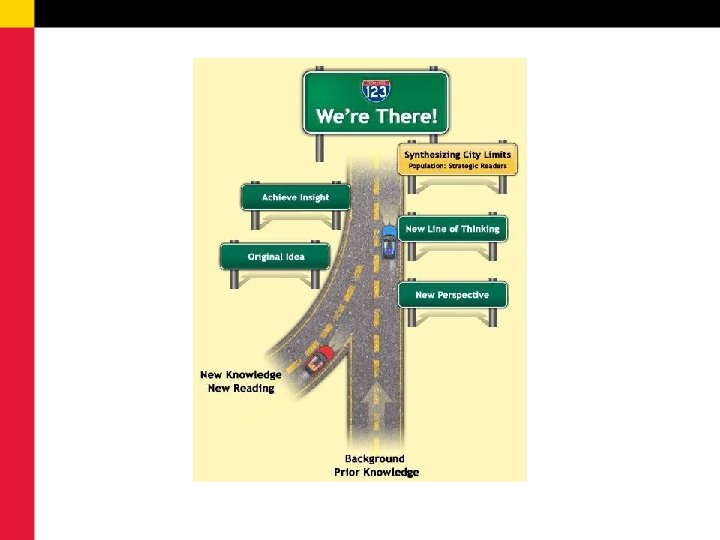
Kinds of Synthesis • • Concept or explanatory Event History or chronology Argument
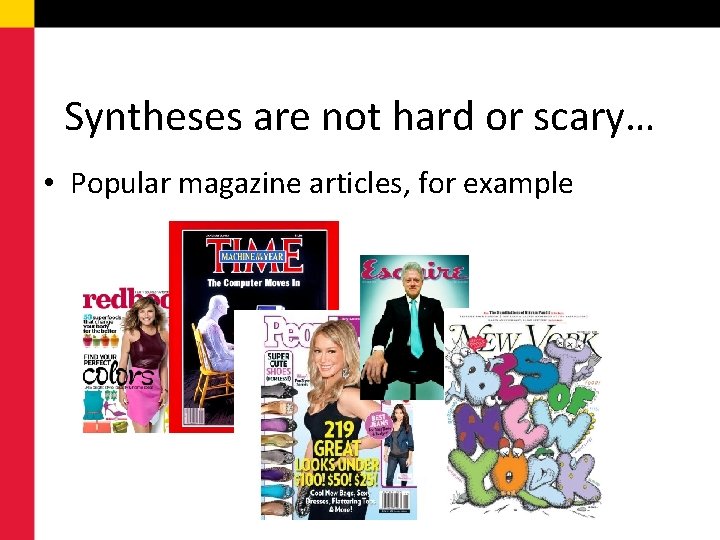
Syntheses are not hard or scary… • Popular magazine articles, for example
• reading source materials and then in drawing upon them to write your own material • create a "dialogue" between the essay author's ideas and her sources, and also among the sources themselves https: //www. youtube. com/watch? v=Gm 8 m. ZCl. Nuw
Getting Started • What is the intent? Why are your writing this? • Remember your reader. • Make sure you fully understand the articles that you have read. – Look up terms and related articles. – Key question: were these good studies?
Keep the purpose of your synthesis in mind… Your purpose determines: • which sources you use • which parts of them you use • at which points in your essay you use them • how you relate them to one another • how much weight or space to give them in your story
Start reading differently… • Never read passively. Annotate, model, think, and synthesize while you read, even when you’re reading introductory stuff. That way, you will always aim towards understanding things at a resolution fine enough for you to be creative. Boyden, E. (2007)How to think. MIT Technology Review.
Read actively • recognize the connections between ideas that form the basis for synthesizing • combine information and ideas • you must have reason for attempting to combine them – What are the relationships among your sources that make them worth synthesizing? Answering this question can help provide a framework for the synthesis.
Formulating a synthesis • Try to describe the article in your own words first • Distill it down to its “scientific essence” • Be accurate about the key points • A reader who has not read the original article should still be able to understand your summary
More tips… • Write your draft without looking at the articles: put in your own words • Ask: – What is the purpose of this study? What questions were asked? – How did the study address the questions? – What assumptions did the author make? – What were the findings? – What surprised you or struck you as interesting? – What questions are left unanswered?
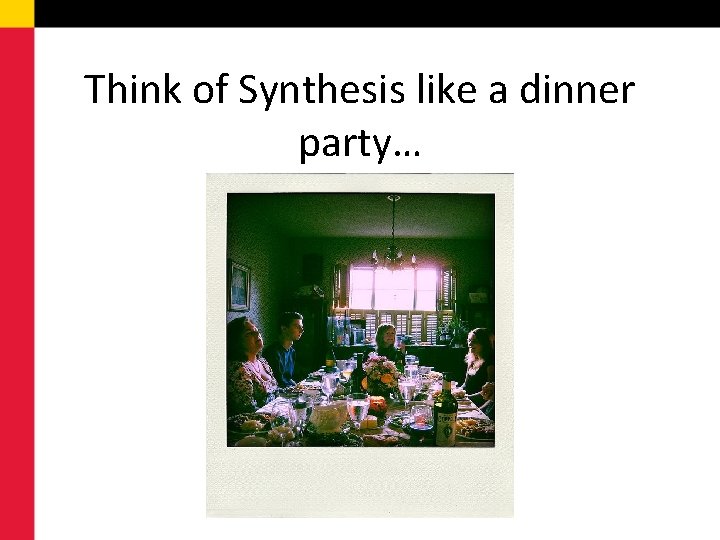
Think of Synthesis like a dinner party…
• Your four articles are the guests • They each have something different to add to the conversation about your topic – Some agree, some disagree, some emphasize certain points, some reason well, some not, etc. • You are the fifth guest • You join the conversation!
Formulating a synthesis • Try to describe the article in your own words first (No cutting and pasting!) • Distill it down to its “scientific essence” • Be accurate about the key points • A reader who has not read the original articles should still be able to understand your thinking
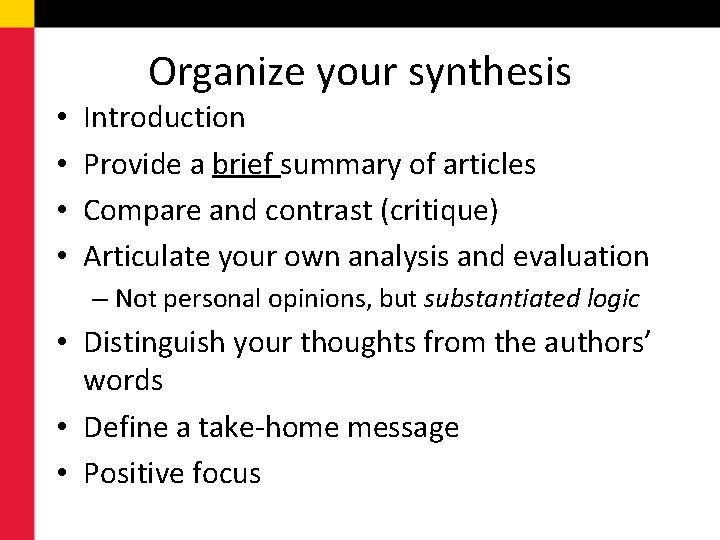
Organize your synthesis • • Introduction Provide a brief summary of articles Compare and contrast (critique) Articulate your own analysis and evaluation – Not personal opinions, but substantiated logic • Distinguish your thoughts from the authors’ words • Define a take-home message • Positive focus
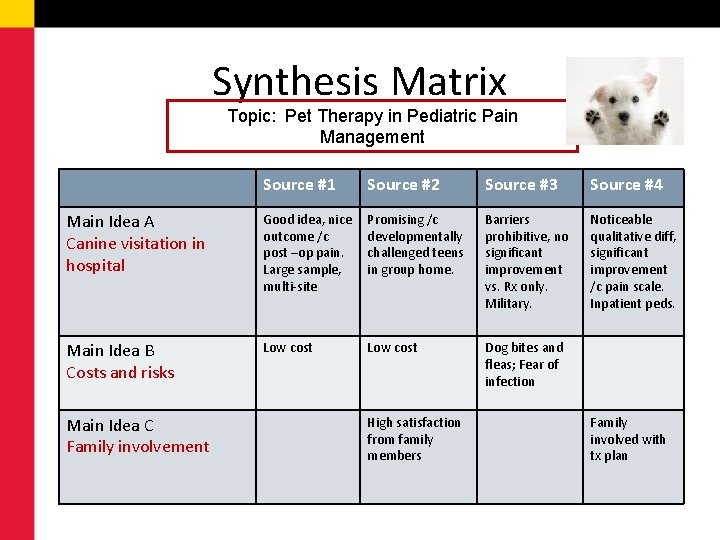
Synthesis Matrix Topic: Pet Therapy in Pediatric Pain Management Source #1 Source #2 Source #3 Source #4 Main Idea A Canine visitation in hospital Good idea, nice outcome /c post –op pain. Large sample, multi-site Promising /c developmentally challenged teens in group home. Barriers prohibitive, no significant improvement vs. Rx only. Military. Noticeable qualitative diff, significant improvement /c pain scale. Inpatient peds. Main Idea B Costs and risks Low cost Dog bites and fleas; Fear of infection Main Idea C Family involvement High satisfaction from family members Family involved with tx plan
Hunting, gathering, sorting… https: //www. youtube. com/watch? v=x 3 xbj. Qjpd. Y Synthesis video https: //www. youtube. com/watch? v=x 3 xbj-Qjpd. Y
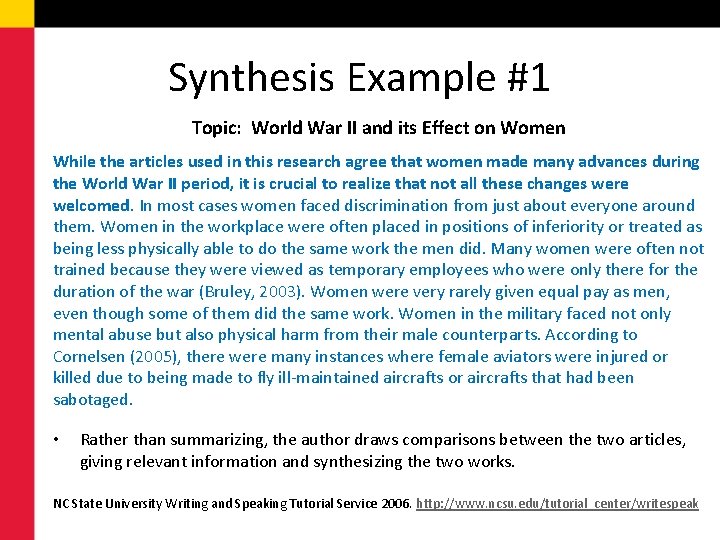
Synthesis Example #1 Topic: World War II and its Effect on Women While the articles used in this research agree that women made many advances during the World War II period, it is crucial to realize that not all these changes were welcomed. In most cases women faced discrimination from just about everyone around them. Women in the workplace were often placed in positions of inferiority or treated as being less physically able to do the same work the men did. Many women were often not trained because they were viewed as temporary employees who were only there for the duration of the war (Bruley, 2003). Women were very rarely given equal pay as men, even though some of them did the same work. Women in the military faced not only mental abuse but also physical harm from their male counterparts. According to Cornelsen (2005), there were many instances where female aviators were injured or killed due to being made to fly ill-maintained aircrafts or aircrafts that had been sabotaged. • Rather than summarizing, the author draws comparisons between the two articles, giving relevant information and synthesizing the two works. NC State University Writing and Speaking Tutorial Service 2006. http: //www. ncsu. edu/tutorial_center/writespeak
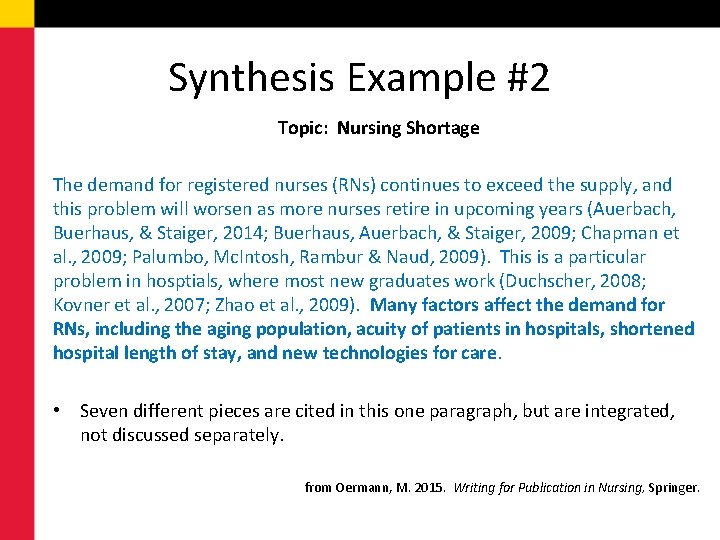
Synthesis Example #2 Topic: Nursing Shortage The demand for registered nurses (RNs) continues to exceed the supply, and this problem will worsen as more nurses retire in upcoming years (Auerbach, Buerhaus, & Staiger, 2014; Buerhaus, Auerbach, & Staiger, 2009; Chapman et al. , 2009; Palumbo, Mc. Intosh, Rambur & Naud, 2009). This is a particular problem in hosptials, where most new graduates work (Duchscher, 2008; Kovner et al. , 2007; Zhao et al. , 2009). Many factors affect the demand for RNs, including the aging population, acuity of patients in hospitals, shortened hospital length of stay, and new technologies for care. • Seven different pieces are cited in this one paragraph, but are integrated, not discussed separately. from Oermann, M. 2015. Writing for Publication in Nursing, Springer.
Style Matters Literature reviews and syntheses for different purposes: • • Academic-for papers and courses Research-for theses, dissertations Manuscript-for journals or book chapters Other-for grants, projects, applications, other
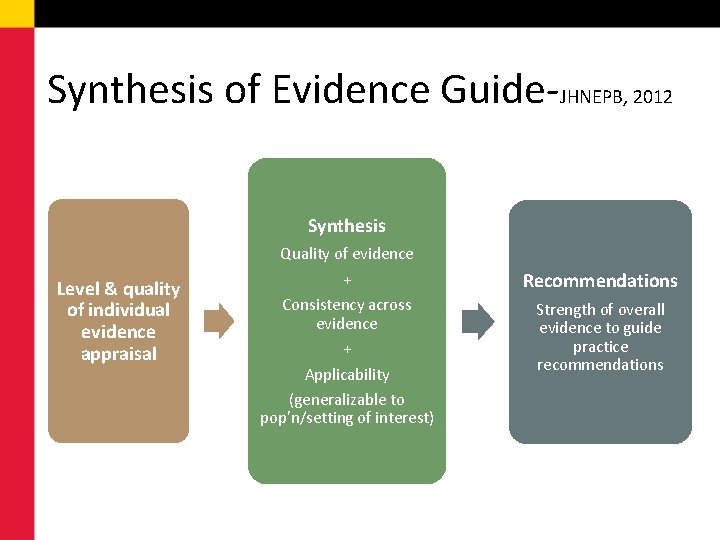
Synthesis of Evidence Guide-JHNEPB, 2012 Synthesis Level & quality of individual evidence appraisal Quality of evidence + Consistency across evidence + Applicability (generalizable to pop’n/setting of interest) Recommendations Strength of overall evidence to guide practice recommendations
Let’s have some examples… • …Direction • …Clarity
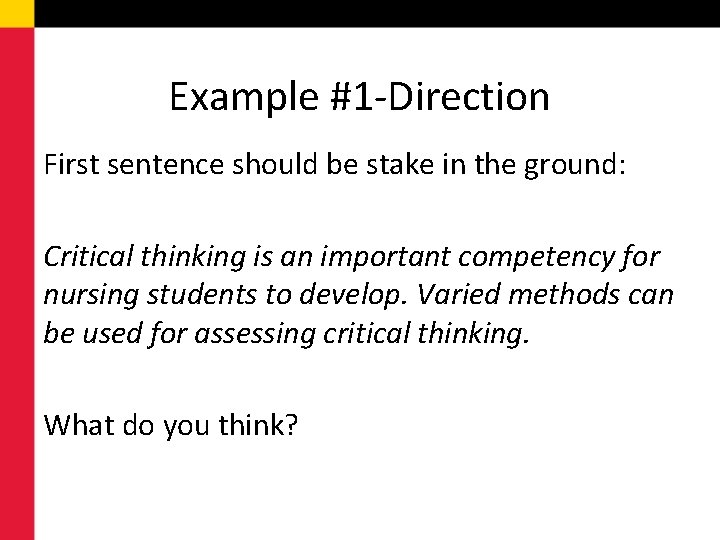
Example #1 -Direction First sentence should be stake in the ground: Critical thinking is an important competency for nursing students to develop. Varied methods can be used for assessing critical thinking. What do you think?
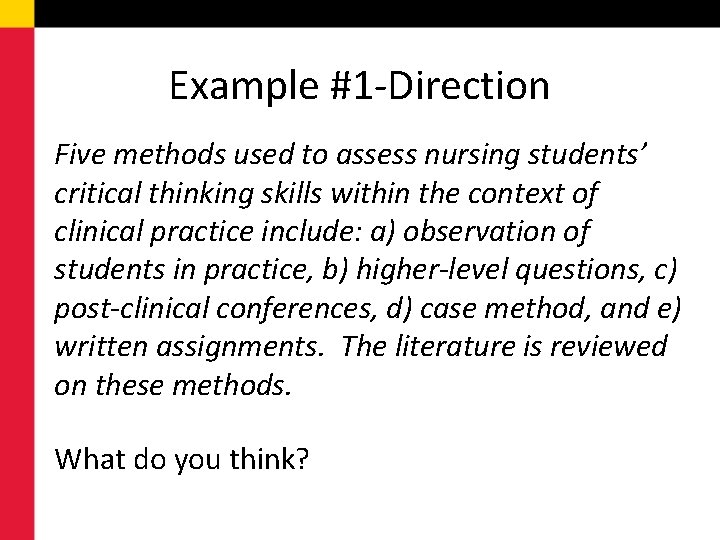
Example #1 -Direction Five methods used to assess nursing students’ critical thinking skills within the context of clinical practice include: a) observation of students in practice, b) higher-level questions, c) post-clinical conferences, d) case method, and e) written assignments. The literature is reviewed on these methods. What do you think?
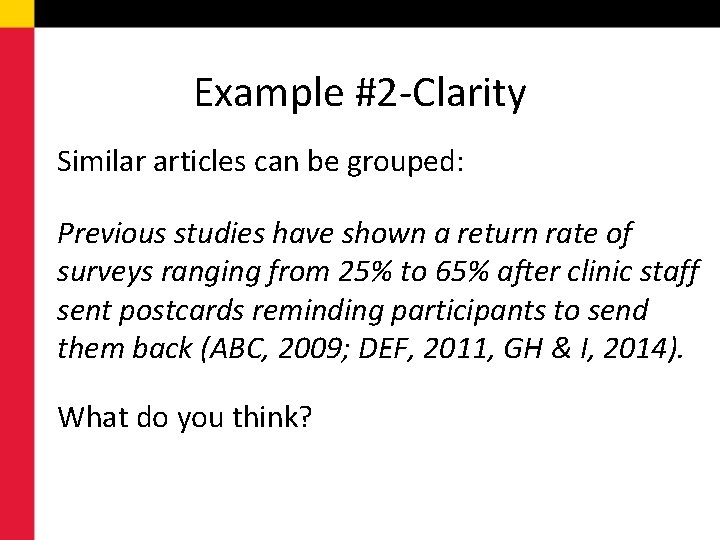
Example #2 -Clarity Similar articles can be grouped: Previous studies have shown a return rate of surveys ranging from 25% to 65% after clinic staff sent postcards reminding participants to send them back (ABC, 2009; DEF, 2011, GH & I, 2014). What do you think?
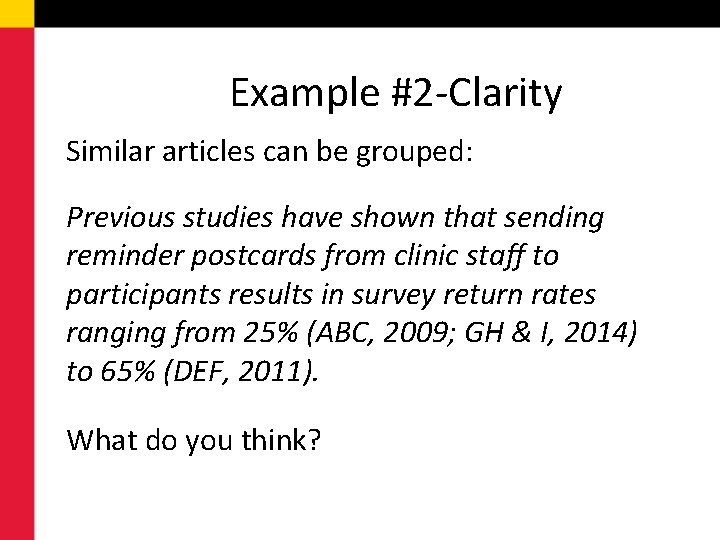
Example #2 -Clarity Similar articles can be grouped: Previous studies have shown that sending reminder postcards from clinic staff to participants results in survey return rates ranging from 25% (ABC, 2009; GH & I, 2014) to 65% (DEF, 2011). What do you think?
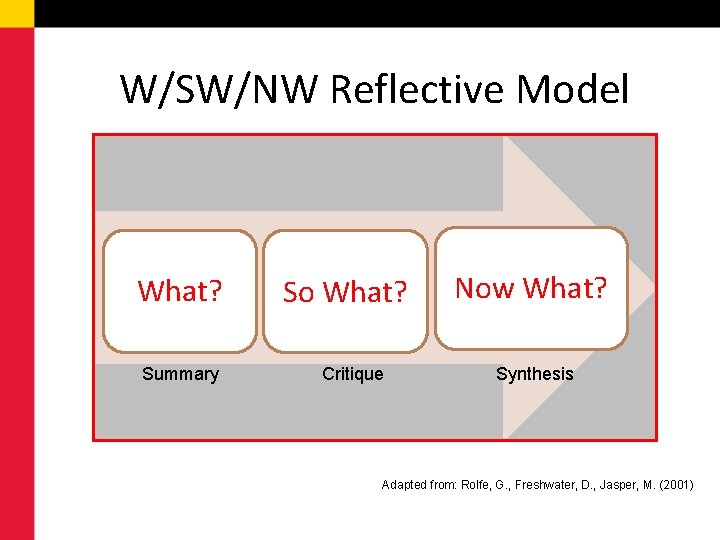
W/SW/NW Reflective Model What? Summary So What? Critique Now What? Synthesis Adapted from: Rolfe, G. , Freshwater, D. , Jasper, M. (2001)
Connecting the dots…. • Synthesis is the forming of new ideas based on your thoughts, experiences, and evidence • Discussion is a way to share all of the above in a way that helps readers get the What, So What, Now What from your perspective!
Applicability to DNP Role Scholarly Project is an opportunity to learn and practice the DNP role: WHAT is the problem/change/contribution you want to address? SO WHAT does the literature/evidence/science have to say about it? NOW WHAT shall I do with what I learned and the tools I have in my toolbox?
Your Turn • How has what you’ve learned about writing helped you read differently? • How has what you’ve learned about reading helped you organize differently? • How has what you’ve learned about organizing your topic helped you think differently? • How will what you’ve learned about your thinking help you going forward?

Questions, comments, other?
- Slides: 48